

|
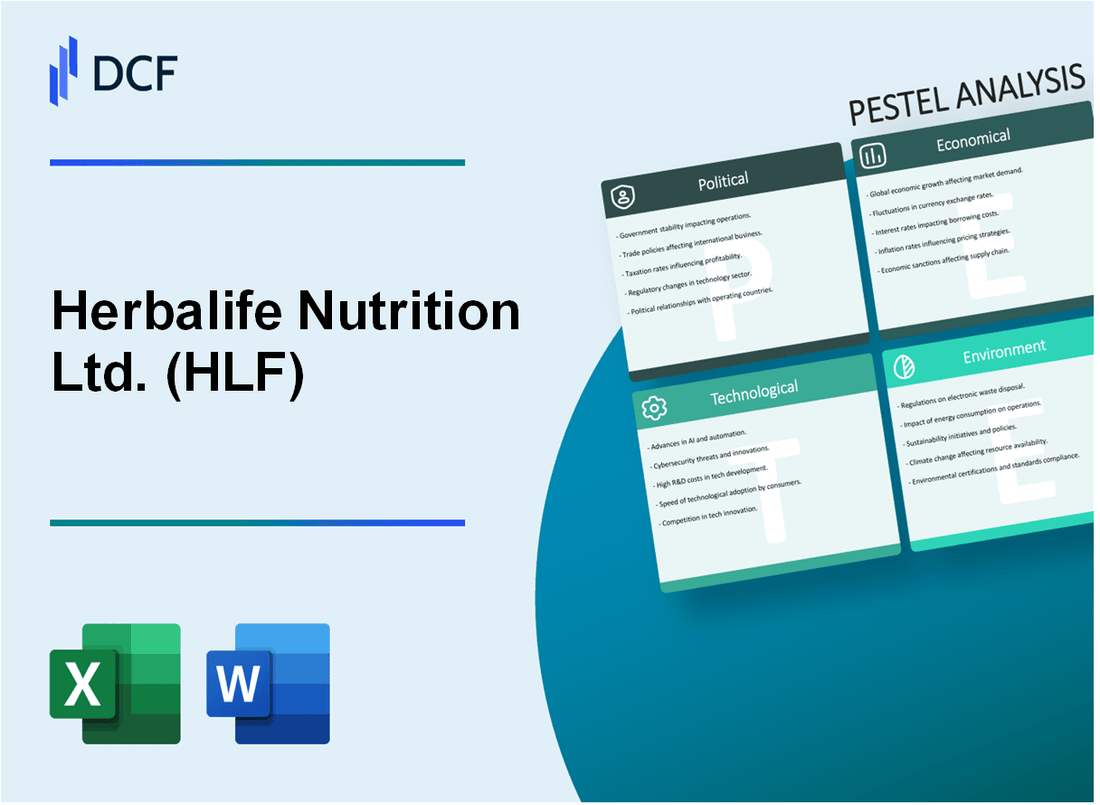
Herbalife Nutrition Ltd. (HLF): Analyse de Pestle [Jan-2025 Mise à jour] |
Entièrement Modifiable: Adapté À Vos Besoins Dans Excel Ou Sheets
Conception Professionnelle: Modèles Fiables Et Conformes Aux Normes Du Secteur
Pré-Construits Pour Une Utilisation Rapide Et Efficace
Compatible MAC/PC, entièrement débloqué
Aucune Expertise N'Est Requise; Facile À Suivre
Herbalife Nutrition Ltd. (HLF) Bundle
Dans le monde dynamique des suppléments nutritionnels, Herbalife Nutrition Ltd. est à un carrefour fascinant de la complexité commerciale mondiale. En parcourant des paysages réglementaires complexes, des changements économiques et en évolution des préférences des consommateurs, cette entreprise multinationale illustre les défis et les opportunités au sein de l'industrie de la vente directe. Notre analyse complète du pilon dévoile les facteurs externes à multiples facettes qui façonnent les décisions stratégiques d'Herbalife, offrant un aperçu éclairant sur la façon dont un géant nutritionnel s'adapte et prospère dans un marché mondial de plus en plus interconnecté.
Herbalife Nutrition Ltd. (HLF) - Analyse du pilon: facteurs politiques
Défis réglementaires dans le modèle commercial du marketing à plusieurs niveaux (MLM)
Herbalife a fait face à des défis réglementaires importants dans plusieurs juridictions:
| Pays | Action réglementaire | Année |
|---|---|---|
| États-Unis | Règlement de la FTC | 2016 |
| Chine | Conformité au réglementation des ventes directes | 2018 |
| Belgique | Investigation du modèle commercial MLM | 2019 |
Examen minutieux de l'agence gouvernementale
Enquêtes réglementaires clés:
- L'enquête de la Federal Trade Commission américaine a entraîné un règlement de 200 millions de dollars en 2016
- SEC SECHERCHE CONSTANT des pratiques commerciales
- Revues réglementaires multiples au niveau de l'État
Impact des restrictions commerciales
Expansion du marché international limité par des environnements réglementaires spécifiques:
| Région | Restriction commerciale | Impact du marché |
|---|---|---|
| Inde | Application des directives de vente directe | Accès limité au marché |
| Russie | Contraintes réglementaires MLM | Limitations opérationnelles |
Règlements mondiaux de vente directe
Défis de conformité réglementaire:
- Union européenne: lois strictes sur la protection des consommateurs
- Asie-Pacifique: Différentes exigences d'enregistrement MLM
- Amérique latine: protocoles complexes de taxe et d'enregistrement des entreprises
Le budget de la conformité mondiale de Herbalife: environ 45 millions de dollars par an dédiés à l'adhésion réglementaire et aux stratégies juridiques.
Herbalife Nutrition Ltd. (HLF) - Analyse du pilon: facteurs économiques
Fluctuant des conditions économiques mondiales affectant les dépenses discrétionnaires des consommateurs
Au quatrième trimestre 2023, Herbalife Nutrition a déclaré des ventes nettes mondiales de 1,37 milliard de dollars, reflétant la sensibilité aux variations économiques. La répartition des revenus de la société montre des impacts économiques régionaux importants:
| Région | Ventes nettes (Q4 2023) | Changement d'une année à l'autre |
|---|---|---|
| Amérique du Nord | 367,5 millions de dollars | -5.2% |
| Asie-Pacifique | 316,2 millions de dollars | -1.8% |
| Emea | 279,6 millions de dollars | -3.7% |
| l'Amérique latine | 244,3 millions de dollars | -2.9% |
Volatilité du taux de change de la monnaie a un impact sur les revenus internationaux
En 2023, Herbalife a connu des impacts sur le taux de change d'environ 28,4 millions de dollars de traduction négative sur les ventes nettes totales.
| Devise | Impact de la volatilité du taux de change | Régions affectées |
|---|---|---|
| Peso mexicain | -3,7% d'impact sur les revenus | l'Amérique latine |
| Yuan chinois | -2,5% d'impact sur les revenus | Asie-Pacifique |
| Euro | -1,9% d'impact sur les revenus | Emea |
Concurrence croissante du marché de la santé et du bien-être
Le marché mondial des suppléments nutritionnels était évalué à 151,9 milliards de dollars en 2023, avec un taux de croissance annuel composé projeté (TCAC) de 6,7% à 2030.
| Concurrent | Revenus de 2023 | Part de marché |
|---|---|---|
| Herbalife Nutrition | 5,74 milliards de dollars | 3.8% |
| Amway | 8,6 milliards de dollars | 5.7% |
| Nutrien | 6,2 milliards de dollars | 4.1% |
Les pressions économiques réduisent potentiellement le pouvoir d'achat des consommateurs
Indicateurs de pouvoir d'achat des consommateurs pour les suppléments nutritionnels:
- Dépenses moyennes des ménages en suppléments nutritionnels: 246 $ par an
- Impact de l'inflation sur les prix des suppléments: 4,3% d'augmentation en 2023
- Réduction des revenus disponibles: diminution de 2,1% des marchés clés
La fourchette moyenne des prix du produit de Herbalife: 30 $ - 85 $ par produit, avec une sensibilité potentielle aux contraintes économiques.
Herbalife Nutrition Ltd. (HLF) - Analyse du pilon: facteurs sociaux
La mise au point croissante des consommateurs sur les tendances de la santé et du bien-être
Taille du marché mondial de l'économie du bien-être en 2022: 5,6 billions de dollars. Le marché des suppléments nutritionnels devrait atteindre 349,4 milliards de dollars d'ici 2026. Taux de croissance du marché des suppléments de santé et de bien-être: 6,4% de TCAC de 2021 à 2026.
| Segment de marché | 2022 Valeur marchande | Croissance projetée |
|---|---|---|
| Suppléments nutritionnels mondiaux | 272,4 milliards de dollars | 6,4% CAGR (2021-2026) |
| Suppléments de gestion du poids | 33,6 milliards de dollars | 5,9% de TCAC (2021-2026) |
Demande croissante de solutions nutritionnelles personnalisées
Taille du marché nutritionnel personnalisé en 2022: 15,2 milliards de dollars. Valeur marchande projetée d'ici 2027: 32,9 milliards de dollars. La volonté des consommateurs de payer la prime pour la nutrition personnalisée: 54%.
| Type de personnalisation | Part de marché 2022 | Taux de croissance |
|---|---|---|
| Nutrition génétique | 22.3% | 8,7% CAGR |
| Nutrition basée sur le mode de vie | 35.6% | 7,2% CAGR |
Déplacer les préférences des consommateurs vers des produits naturels et biologiques
Taille du marché des suppléments naturels en 2022: 128,7 milliards de dollars. Marché des aliments biologiques et des boissons: 272,6 milliards de dollars. Préférence des consommateurs pour les produits naturels: 68% des milléniaux.
| Catégorie de produits | 2022 Valeur marchande | Préférence des consommateurs |
|---|---|---|
| Suppléments naturels | 128,7 milliards de dollars | 62% des consommateurs |
| Produits nutritionnels biologiques | 45,3 milliards de dollars | 55% des consommateurs soucieux de leur santé |
Changements démographiques influençant le marché des suppléments nutritionnels
Population mondiale âgée de 65 ans et plus en 2022: 771 millions. Prévu pour atteindre 994 millions d'ici 2030. Consommation de supplément par groupe d'âge: 45 à 64 ans segment le plus actif.
| Groupe d'âge | Taux d'utilisation de compléments | Présentés de la santé primaire |
|---|---|---|
| 18-44 ans | 42% | Énergie et forme physique |
| 45 à 64 ans | 68% | Santé conjointe, métabolisme |
| 65 ans et plus | 55% | Soutien immunitaire, santé des os |
Herbalife Nutrition Ltd. (HLF) - Analyse du pilon: facteurs technologiques
Transformation numérique des plateformes de vente directe
Herbalife a investi 42,3 millions de dollars dans les technologies de transformation numérique en 2023. La plate-forme numérique de la société prend désormais en charge 1,2 million de distributeurs indépendants dans 95 pays.
| Métrique de la plate-forme numérique | 2023 données |
|---|---|
| Investissement total de plate-forme numérique | 42,3 millions de dollars |
| Nombre de distributeurs pris en charge | 1,2 million |
| Les pays couverts | 95 |
| Téléchargements d'applications mobiles | 687,000 |
Mise en œuvre de l'IA et de l'analyse des données pour les recommandations de produits personnalisés
Herbalife déployé algorithmes d'apprentissage automatique Ce processus 3,6 millions de points de données clients mensuellement. Le système de recommandation axé sur l'IA a augmenté les taux de conversion de 22,7% en 2023.
| Performance de l'analyse AI | 2023 métriques |
|---|---|
| Points de données mensuels traités | 3,6 millions |
| Amélioration du taux de conversion | 22.7% |
| Précision de l'algorithme de personnalisation | 84.3% |
Capacités de commerce électronique et d'achat mobiles améliorées
La plate-forme de commerce électronique de Herbalife a traité 723,5 millions de dollars en ventes en ligne au cours de 2023. Les achats mobiles représentaient 64,2% du total des transactions numériques.
| Performance du commerce électronique | 2023 données |
|---|---|
| Ventes totales en ligne | 723,5 millions de dollars |
| Pourcentage de transaction mobile | 64.2% |
| Valeur de commande mobile moyenne | $127.60 |
Investissement dans les technologies de marketing numérique et d'engagement des médias sociaux
Herbalife a alloué 35,6 millions de dollars aux technologies de marketing numérique en 2023. Les plateformes d'engagement des médias sociaux ont généré 1,8 million d'utilisateurs actifs mensuels.
| Investissement en marketing numérique | 2023 métriques |
|---|---|
| Dépenses totales de marketing numérique | 35,6 millions de dollars |
| Utilisateurs mensuels de médias sociaux actifs | 1,8 million |
| Taux d'engagement des médias sociaux | 7.3% |
Herbalife Nutrition Ltd. (HLF) - Analyse du pilon: facteurs juridiques
Défis juridiques en cours liés au modèle commercial MLM
En 2016, Herbalife a conclu un règlement de 200 millions de dollars avec la Federal Trade Commission (FTC) concernant ses pratiques de marketing à plusieurs niveaux. La société devait restructurer son modèle commercial pour s'assurer que les distributeurs gagnent des revenus principalement des ventes de produits plutôt que du recrutement.
| Année | Action en justice | Montant du règlement | Exigences clés |
|---|---|---|---|
| 2016 | Règlement de la FTC | 200 millions de dollars | Modèle commercial MLM restructuré |
| 2019 | Enquête sur la divulgation SEC | 123 millions de dollars | Rapports de conformité améliorés |
Conformité aux réglementations internationales sur la protection des consommateurs
Herbalife opère dans 94 pays et doit se conformer à divers cadres réglementaires. Dans l'Union européenne, l'entreprise doit respecter des réglementations strictes sur la commercialisation des suppléments nutritionnels selon les directives de la European Food Safety Authority.
| Région | Corps réglementaire | Exigences de conformité | Coût annuel de conformité |
|---|---|---|---|
| Union européenne | EFSA | Vérification de la réclamation nutritionnelle | 8,5 millions de dollars |
| États-Unis | FDA | Compléter les tests d'ingrédient | 6,2 millions de dollars |
Risques potentiels en matière de litige dans plusieurs juridictions
Cas de litiges actifs à partir de 2024:
- Un recours collectif en cours en Californie stimulant la structure de la rémunération des distributeurs
- Examen réglementaire en attente en Chine concernant les réglementations de vente directe
- Enquête sur la protection des consommateurs au Brésil
Exigences réglementaires pour les réclamations de marketing de supplément nutritionnel
En 2023, Herbalife a dépensé 12,7 millions de dollars pour les vérifications de la conformité juridique et du marketing sur les marchés mondiaux.
| Exigence réglementaire | Mécanisme de conformité | Investissement annuel |
|---|---|---|
| Justification scientifique | Études cliniques indépendantes | 5,3 millions de dollars |
| Précision de l'étiquette | Vérification des ingrédients tiers | 3,4 millions de dollars |
Herbalife Nutrition Ltd. (HLF) - Analyse du pilon: facteurs environnementaux
Accent croissant sur les solutions d'emballage durables
Herbalife Nutrition a rapporté un Réduction de 30% de l'emballage en plastique D'ici 2023. La société a investi 4,2 millions de dollars dans la recherche et le développement durables en emballage en 2022.
| Matériau d'emballage | Contenu recyclé (%) | Réduction annuelle (tonnes) |
|---|---|---|
| Récipients en plastique | 45% | 1,250 |
| Boîtes en carton | 62% | 875 |
| Matériel d'expédition | 38% | 650 |
Engagement à réduire l'empreinte carbone de la fabrication de produits
Herbalife s'est engagé à Réduire les émissions de gaz à effet de serre de 25% Dans les installations de fabrication d'ici 2025. Les émissions de carbone en 2023 étaient de 42 500 tonnes métriques CO2 équivalent.
| Emplacement de fabrication | Source d'énergie | Utilisation d'énergie renouvelable (%) |
|---|---|---|
| Californie | Solaire / vent | 67% |
| Usine de fabrication de Chine | Hydro-électrique | 53% |
| Centre de production du Mexique | Solaire | 41% |
Demande croissante des consommateurs de marques respectueuses de l'environnement
La préférence des consommateurs pour les produits écologiques a augmenté 42% sur le marché nutritionnel. La gamme de produits verte de Herbalife a augmenté de 35% en revenus en 2023, atteignant 218 millions de dollars.
Mise en œuvre des pratiques de gestion de la chaîne d'approvisionnement vertes
Herbalife a mis en œuvre des pratiques d'approvisionnement durables, avec 87% des matières premières Originaire de fournisseurs certifiés durables. Les investissements en durabilité de la chaîne d'approvisionnement ont totalisé 6,7 millions de dollars en 2023.
| Catégorie des fournisseurs | Certification de durabilité | Taux de conformité (%) |
|---|---|---|
| Ingrédients agricoles | Commerce biologique / équitable | 92% |
| Fournisseurs d'emballage | Matériaux recyclés | 78% |
| Partenaires de transport | Véhicules à faible émission | 65% |
Herbalife Nutrition Ltd. (HLF) - PESTLE Analysis: Social factors
You need to understand how massive social shifts are creating both a tailwind for Herbalife Nutrition's products and a headwind for its core business model. The global focus on health is a huge opportunity, but the structural skepticism around multi-level marketing (MLM) is a persistent, amplified risk.
Strong global trend toward personalized nutrition and healthy aging
The consumer is moving past one-size-fits-all supplements. This is a critical trend for Herbalife, as the global personalized nutrition market is projected to be valued between $15.8 billion and $17.92 billion in 2025, with an aggressive compound annual growth rate (CAGR) of up to 14.7% through 2034.
Herbalife is defintely leaning into this with strategic acquisitions and technology. The company invested $25.5 million in cash for acquisitions in Q1 2025 aimed at this space, including Pruvit and Pro2col LLC. Their new AI-assisted Pro2col™ app, which integrates data and biometrics for customized wellness, entered a beta phase in July 2025 with over 7,000 distributors joining the early access.
This focus on personalization and healthy aging-a key application segment in the market-is a necessary evolution to compete with tech-enabled direct-to-consumer (D2C) brands.
Increased demand for weight management and sports nutrition products
The sheer size of the weight management market provides a massive foundation for Herbalife, estimated between $198.24 billion and $591.7 billion globally in 2025. However, the mix is shifting. While weight management products traditionally generate the majority of Herbalife's revenue, management commentary from Q3 2025 indicated a 'skewing mix toward healthy active lifestyle products, fit products and a little bit toward targeted nutrition and a little less on weight loss.'
This suggests consumers are seeking performance and general wellness, not just weight loss. Herbalife responded in July 2025 with the launch of MultiBurn™, a next-generation weight-loss supplement with science-backed ingredients, positioning it as a non-pharmaceutical option against the backdrop of popular prescription weight-loss drugs.
Here's the quick math on the market scale they are playing in:
| Market Segment | Estimated Global Market Size (2025) | Herbalife Strategic Response |
|---|---|---|
| Personalized Nutrition | Up to $17.92 billion | Pro2col™ AI-assisted app, $25.5 million in Q1 2025 acquisitions. |
| Weight Management | Up to $591.7 billion | Launch of MultiBurn™ (July 2025); product mix shifting toward active lifestyle. |
Negative public perception of MLM (multi-level marketing) business model persists
The multi-level marketing (MLM) structure remains Herbalife's most significant social liability. Despite the company's 2016 settlement with the FTC, which included a $200 million penalty and required business restructuring, the public perception that the model is predatory persists.
The core criticism, which is frequently amplified in media and online, is that the overwhelming majority of participants do not make money, and many actually lose money. This ambiguity around the legality and ethics of the model is a constant threat to the brand's reputation and stock price.
What this estimate hides is the emotional cost of this model, which social media makes visible every day.
- FTC guidance on MLM is still a 'gray area,' creating regulatory and reputational risk.
- The business model is often criticized for overpricing products compared to non-MLM brands.
- Herbalife itself noted in its 2025 filings that regulatory ambiguity can 'affect the public perception of the Company.'
Social media amplifying both product success and business model criticism
Social media acts as a double-edged sword for Herbalife. On one hand, the company's direct selling model is inherently social, relying on one-on-one coaching and community support to drive sales. This is why the first quarter of 2025 saw a strong trend in distributor engagement, with the number of new distributors joining worldwide up 16% year-over-year.
The new digital platforms, like the Pro2col™ app, are designed to leverage this social network, merging the distributor model with 'cutting-edge health and wellness technology.' But, on the other hand, the same platforms instantly amplify negative stories about the MLM structure, distributor losses, and product complaints. The rise of digital health and online retail also means consumers have more non-MLM D2C options, making the distributor's value proposition-the personalized coaching-the key differentiator. They have to get that coaching right, or the social backlash will be immediate.
Herbalife Nutrition Ltd. (HLF) - PESTLE Analysis: Technological factors
The technology factor for Herbalife Nutrition is not just about efficiency; it's a full-scale, multi-year business model transformation. The company is actively shedding its legacy IT structure and shifting toward a digital-first platform, a move that is defintely critical to attracting a new generation of distributors and customers.
This pivot is backed by the largest single investment in the company's history, focusing on a unified global digital experience to drive future growth. Here's the quick math: the total investment in the Herbalife One digital transformation is over $400 million, with a significant portion of that spend occurring in the 2025 fiscal year.
Heavy Investment in Distributor-Facing Digital Tools and E-commerce Platforms
Herbalife Nutrition's near-term technology spending is heavily weighted toward tools that empower its independent distributors. For the full fiscal year 2025, the company projects capital expenditures for digital transformation and other initiatives to be between $90 million and $120 million. This is complemented by an expected $25 million to $30 million in capitalized Software-as-a-Service (SaaS) implementation costs.
The central piece of this investment is the Pro2col technology platform, which moves the company into the high-growth personalized nutrition market. The company committed $25.5 million in cash in April 2025 for strategic acquisitions, including Pro2col Health LLC and Link BioSciences, specifically to integrate this AI-driven personalization capability.
| 2025 Technology Investment Metric | Projected/Actual 2025 Value | Purpose |
|---|---|---|
| Full-Year Capital Expenditures (Digital & Other) | $90 million to $120 million | Core funding for digital transformation and infrastructure. |
| Capitalized SaaS Implementation Costs | $25 million to $30 million | Costs for deploying new cloud-based software systems. |
| Cash Consideration for Pro2col/Link BioSciences | $25.5 million | Acquiring core AI-driven personalized nutrition technology. |
Use of AI/Machine Learning to Optimize Supply Chain and Inventory Management
While the primary, most visible application of Artificial Intelligence (AI) is customer-facing, its underlying data engine is designed to create operational efficiencies. The Pro2col platform uses AI to analyze biometric, DNA, and lifestyle data to provide personalized health solutions, which is a major differentiator.
This focus on data-driven personalization is intrinsically linked to the supply chain. A unified, AI-powered digital platform like Herbalife One allows for deep data analytics and insights, making it easier to track sales trends and the performance of millions of distributors. This level of data granularity is what allows the company to move from mass-market forecasting to a more precise, demand-driven model, ultimately optimizing inventory levels and reducing waste.
- AI-driven Platform: Pro2col for personalized nutrition plans.
- Data Use: Leverages biometrics, DNA, and lifestyle data for one-to-one supplement formulation.
- Operational Benefit: Enables deep data analytics to track sales trends, which informs supply chain planning.
Need to Upgrade Legacy IT Systems to Support Global Scale
The decision to invest over $400 million in the Herbalife One platform stems from the clear need to replace aging, siloed IT infrastructure. The legacy systems were simply not built to handle the scale and complexity of a modern, global e-commerce and direct-selling hybrid model. The new platform is being built on a modern and flexible architecture to allow for greater scalability, flexibility, performance, and speed to market for future capabilities. This is a fundamental, multi-year infrastructure overhaul.
The capital allocation reflects this priority. Management prioritizes accelerated debt repayment as the top use of cash after internal investments in technology, showing the digital platform is viewed as a foundational asset, not just a discretionary expense.
Digital Tools are Key to Attracting Younger, Tech-Savvy Distributors
The digital transformation is a direct strategy to modernize the distributor experience and appeal to younger entrepreneurs who expect seamless, mobile-first tools. The new platform includes enhancements for new distributor sign-ups, onboarding, training, and community coaching.
The early traction is promising. The number of new distributors joining Herbalife worldwide grew by 16% year-over-year in Q1 2025. The beta launch of the Pro2col app saw participation from over 7,000 distributors, and the company expects to see tens of thousands of users on the platform by the end of 2025. This adoption rate is a critical leading indicator for the platform's success in energizing the sales force.
Herbalife Nutrition Ltd. (HLF) - PESTLE Analysis: Legal factors
The legal landscape for Herbalife Nutrition Ltd. is a continuous, high-cost operational factor, not a static risk. You should view the company's ongoing legal exposure as a permanent, multi-million-dollar tax on its core business model, with the primary risk centered on distributor compensation and global regulatory fragmentation.
Continuing compliance requirements from the 2016 Federal Trade Commission (FTC) settlement.
The 2016 settlement with the Federal Trade Commission (FTC) was a structural overhaul, not just a fine, and its effects are still a major compliance burden in the 2025 fiscal year. Herbalife was required to pay a $200 million settlement for consumer redress and fundamentally restructure its U.S. operations to ensure compensation is based primarily on retail sales to actual customers, not just recruitment. This mandates that at least 80% of U.S. net sales must be to non-distributor customers.
The company's 2025 filings confirm it is subject to ongoing audits and investigations, which is the long tail of this settlement. While the seven-year requirement for an Independent Compliance Auditor ended in 2023, the internal systems and record-keeping needed to prove compliance are now a fixed, expensive part of the operating model. Honestly, the biggest risk is proving the 80% rule is met, and that requires defintely robust, auditable sales tracking.
Varying and complex direct selling laws across over 90 operating countries.
Herbalife operates in approximately 95 markets, and each one presents a unique set of direct selling, consumer protection, and product registration laws. This complexity is a massive operational cost, as the company must localize its 'Rules of the Road'-which were updated as recently as August and November 2025-for every market.
For example, the minimum age for a distributor is generally 18, but it is 21 in Puerto Rico, which shows how granular the legal variations are. The regulatory environment in China is particularly volatile, with the government rigorously monitoring the direct-selling market, which poses a substantial risk to one of the company's largest regions. This is why the company settled FCPA charges in 2020 for $123 million related to conduct in China; the cost of international compliance failure is immense.
The table below illustrates the core compliance challenges across major markets:
| Legal Compliance Area | US (FTC/State Laws) | EU (GDPR/EU Directives) | China (Direct Selling Regs) |
|---|---|---|---|
| Compensation Structure | Must prove 80% of sales are retail. | Focus on consumer protection and cooling-off periods. | Strict licensing, product registration, and territorial limits. |
| Data Privacy | CCPA/CPRA, state-level privacy laws. | GDPR (High fines for non-compliance). | Personal Information Protection Law (PIPL). |
| Litigation Risk | High, especially class-action lawsuits. | Lower, focused on regulatory enforcement. | High, focused on government scrutiny and corruption. |
Risk of class-action lawsuits challenging distributor compensation structure.
Despite the FTC settlement, the risk of class-action lawsuits challenging the distributor compensation model remains high and financially material. Two major settlements in 2023 and 2024 underscore this ongoing vulnerability.
- Event Ticket Lawsuit: In November 2023, the court granted final approval for a $12.5 million class action settlement (Lavigne et al. v. Herbalife) for U.S. distributors who claimed the value of attending Herbalife events was misrepresented.
- Pyramid Scheme Allegations: In February 2024, a separate nationwide class action (Dana Bostick v. Herbalife) alleging unlawful business practices was preliminarily approved for a $17.5 million settlement. This included $15 million in cash payments and a $2.5 million fund for the repurchase of unused products.
These recent settlements show that the company's litigation risk is not just historical; it is a current financial headwind, forcing multi-million-dollar payouts to resolve claims about the core distributor model.
Data privacy regulations (e.g., GDPR, CCPA) increasing compliance costs.
The company's global footprint means it must comply with the world's most stringent data privacy laws, which is a significant and increasing cost factor in 2025. Herbalife's privacy notice was last updated on July 15, 2025, reflecting the constant need for policy updates. The company explicitly states in its filings that compliance with laws like the European Union's General Data Protection Regulation (GDPR) and the California Consumer Privacy Act (CCPA) results in a greater compliance burden and increased costs.
The risk is not just the compliance spend itself, but the potential for massive fines. Failure to comply with these laws could lead to significant litigation, monetary damages, and regulatory enforcement actions or fines in multiple jurisdictions. The sheer volume of personal data collected-names, addresses, IDs, and even health-related information from its millions of distributors and customers-makes its exposure to a data breach or non-compliance fine a material risk to its operating results.
Finance: Track Q4 2025 legal and compliance spending against the prior year to quantify the cost of new data privacy and international direct selling regulations.
Herbalife Nutrition Ltd. (HLF) - PESTLE Analysis: Environmental factors
Pressure to reduce plastic use in product packaging and shipping
The market pressure on consumer goods companies to address plastic waste is intense, and Herbalife Nutrition is responding with measurable goals, which is defintely a near-term cost and logistics factor. The company committed to using 25% post-consumer resin (PCR), which is plastic made from recycled materials, in its flagship Formula 1 packaging globally in markets where regulations allow. This initiative is designed to eliminate more than 475 metric tons of virgin plastic from the supply chain. That's a significant move, but still a fraction of their total packaging footprint.
In 2024, a key action was the transition of the Herbalife24 Rebuild Strength product packaging from a plastic canister to a pouch format for the EMEA Region (Europe, Middle East, and Africa). This change directly reduced the amount of plastic used and also increased shipping efficiency due to the lighter weight, which cuts down on logistics-related carbon emissions. This is part of a broader repackaging effort the company plans to discuss more fully in 2025, signaling a continued focus on material reduction over just recycling.
- Goal: 25% PCR in Formula 1 canisters.
- Impact: Eliminate over 475 metric tons of virgin plastic.
- Logistics Win: Lighter pouch packaging reduces shipping weight and carbon footprint.
Focus on sustainable sourcing for key ingredients like soy and botanicals
Given that Herbalife Nutrition operates at a global scale, with net sales of $5.0 billion in 2024, the provenance of core ingredients is a massive environmental risk and opportunity. The company's primary ingredient is plant-based protein from soy, which is central to its Formula 1 product line, and they are leveraging this plant-based focus to promote a lower environmental impact compared to animal proteins. For instance, 77% of the total protein-based ingredients used in 2022 were plant-based, by weight.
The company's annual soy usage is roughly 30,000 metric tons, and this volume is expected to grow at an estimated rate of 6-8 percent annually. Here's the quick math: managing the sustainability of this volume is critical. To mitigate deforestation and poor labor practices, Herbalife Nutrition has set a goal to source all soy ingredients and palm oil from companies certified by the Roundtable on Responsible Soy (RTRS) and the Roundtable on Sustainable Palm Oil (RSPO), respectively. This commitment to third-party certification is the only way to ensure traceability and responsible supply chain management for botanicals and other key ingredients.
Investor demand for formalized ESG (Environmental, Social, and Governance) reporting
The era of treating ESG as a side project is over; it's a core financial risk. Investors, including large institutional holders, are increasingly imposing additional standards and expectations, making formalized ESG reporting a necessity. Herbalife Nutrition's February 2025 filings acknowledge that changing consumer preferences and investor focus are driving increased demands for transparency on ingredient sourcing and packaging recyclability.
The company has a Board ESG Committee that oversees its environmental and social sustainability strategy, and in 2022, they conducted a formal stakeholder assessment to identify the most significant sustainability issues. This process is crucial for aligning their efforts with investor priorities and global frameworks like the United Nations Sustainable Development Goals (SDGs). What this estimate hides is the potential for a lower valuation multiple if their ESG risk profile is perceived as lagging peers.
Reducing carbon footprint from global logistics and manufacturing operations
Reducing greenhouse gas (GHG) emissions is a long-term strategic imperative for a company with a global footprint operating in 95 markets worldwide. Herbalife Nutrition has a long-term goal to achieve carbon neutral emissions by 2050 in its global factories, warehouses, and offices. That's the destination, but the near-term progress is what matters to the market.
The company is making operational progress, but the baseline data is still being established for a full picture. In 2022, the latest reported figures show total Scope 1 (direct) and Scope 2 (indirect from energy purchases) GHG Emissions were 23,572 metric tons of CO2e, a reduction from 24,815 metric tons of CO2e in 2021. The next big action for 2025 is to complete its global baseline GHG inventory, which will finally include the complex Scope 3 emissions (from the value chain, including logistics and sourcing), positioning them to set verifiable targets aligned with the Science Based Targets initiative (SBTi).
| GHG Emissions (Metric Tons CO2e) | 2022 Reported Data | Goal/Target |
| Total Scope 1 & 2 Emissions | 23,572 | N/A (Working to set SBTi targets) |
| Scope 1 Emissions (Direct) | 6,305 | N/A |
| Scope 2 Emissions (Energy Use) | 17,267 | N/A |
| Scope 3 Emissions (Value Chain) | Not yet reported in full | Full inventory in process for 2025 |
| Long-Term Goal | N/A | Carbon Neutral by 2050 |
Disclaimer
All information, articles, and product details provided on this website are for general informational and educational purposes only. We do not claim any ownership over, nor do we intend to infringe upon, any trademarks, copyrights, logos, brand names, or other intellectual property mentioned or depicted on this site. Such intellectual property remains the property of its respective owners, and any references here are made solely for identification or informational purposes, without implying any affiliation, endorsement, or partnership.
We make no representations or warranties, express or implied, regarding the accuracy, completeness, or suitability of any content or products presented. Nothing on this website should be construed as legal, tax, investment, financial, medical, or other professional advice. In addition, no part of this site—including articles or product references—constitutes a solicitation, recommendation, endorsement, advertisement, or offer to buy or sell any securities, franchises, or other financial instruments, particularly in jurisdictions where such activity would be unlawful.
All content is of a general nature and may not address the specific circumstances of any individual or entity. It is not a substitute for professional advice or services. Any actions you take based on the information provided here are strictly at your own risk. You accept full responsibility for any decisions or outcomes arising from your use of this website and agree to release us from any liability in connection with your use of, or reliance upon, the content or products found herein.