

|
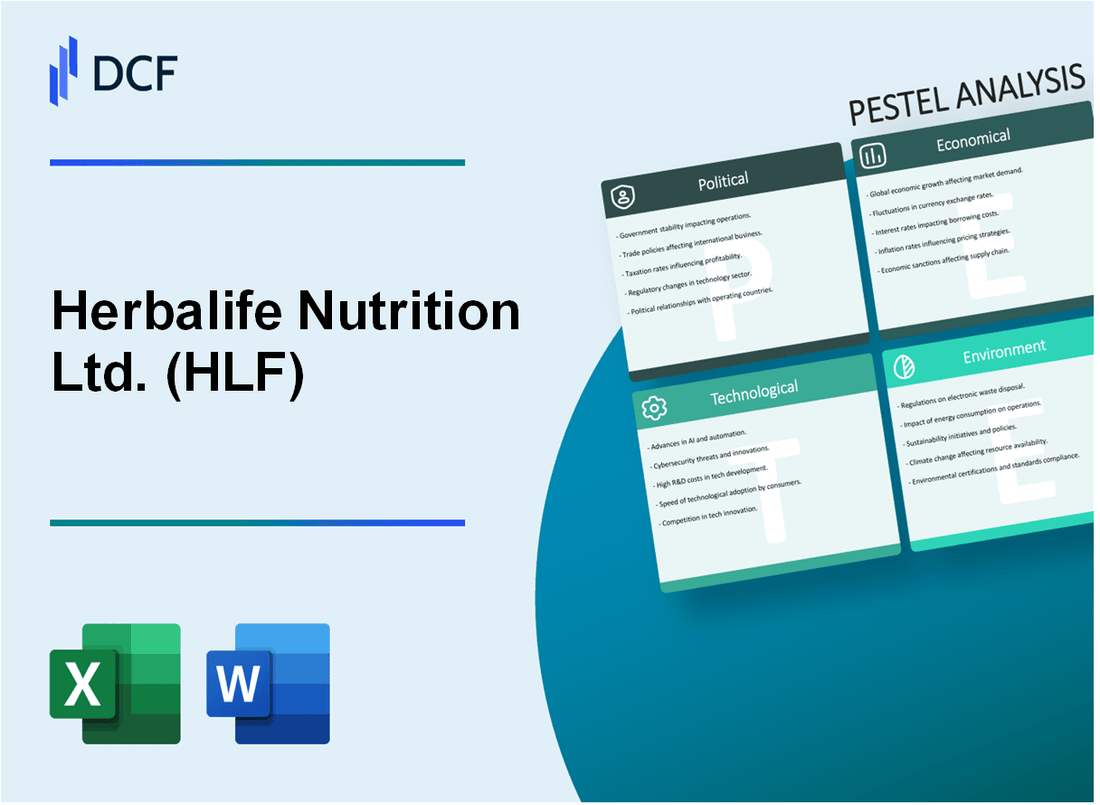
Herbalife Nutrition Ltd. (HLF): PESTLE Analysis [Nov-2025 Updated] |
Fully Editable: Tailor To Your Needs In Excel Or Sheets
Professional Design: Trusted, Industry-Standard Templates
Investor-Approved Valuation Models
MAC/PC Compatible, Fully Unlocked
No Expertise Is Needed; Easy To Follow
Herbalife Nutrition Ltd. (HLF) Bundle
You need to know if Herbalife Nutrition Ltd. (HLF) can shake its regulatory baggage and capitalize on the massive global health trend. Honestly, the company is walking a tightrope: on one side, you have the political and legal pressure on their multi-level marketing (MLM) structure, but on the other, their strategic digital investments are defintely helping to stabilize the business. For 2025, the game plan is clear-manage costs to hit an operating margin targeted around 8.5% while aiming for a projected net sales guidance near $5.1 billion. Let's map out the risks and the real opportunities.
Herbalife Nutrition Ltd. (HLF) - PESTLE Analysis: Political factors
The political landscape for Herbalife Nutrition is a high-wire act, fundamentally tied to the regulatory stability of its direct selling (multi-level marketing) model in its largest markets. You need to focus on two things: the constant, granular scrutiny of distributor behavior and the macro-level friction of global trade, which is directly hitting their cost of goods.
Ongoing regulatory risk in key markets like China and the U.S.
The core political risk for Herbalife Nutrition is the continuous, intense oversight of its business model, especially in the U.S. and China. In the U.S., the 2016 Federal Trade Commission (FTC) settlement remains the foundational constraint, requiring the company to prove that at least 80% of its sales are made to individuals outside its distributor network. This isn't a one-time fine; it's a permanent operational shift that requires constant monitoring for compliance. If they slip, the financial penalty and reputational damage would be huge.
China presents a different, more complex political hurdle. The process for obtaining and maintaining direct-selling licenses is protracted and cumbersome, involving multiple layers of governmental authorities. Honestly, that's just a fancy way of saying it's a bureaucratic maze. This regulatory environment is a major headwind, which is why the China region's net sales declined by 5% year-over-year in Q3 2025. The company has to operate a modified business model there to comply with local laws that prohibit pyramid promotional schemes.
Government focus on consumer protection and direct selling model oversight.
The global trend is clear: governments are prioritizing consumer protection over distributor incentives, and Herbalife's internal rules reflect this political pressure. The U.S. FTC settlement forced a structural change, and the company's internal 'Rules of the Road'-updated as recently as November 2025-are a direct response to global regulatory demands for transparency and ethics.
This focus on consumer protection dictates strict rules for their independent contractors:
- Prohibit high-pressure selling to customers and members.
- Mandate a 30-day money-back guarantee for customers.
- Forbid sales on third-party online marketplaces like Amazon or eBay.
- Require new distributors to complete mandatory training before selling or recruiting.
The political environment forces them to be hyper-vigilant about distributor conduct. One clean one-liner: Every distributor is a walking compliance risk.
Trade tensions impacting global supply chain and raw material costs.
Trade tensions, particularly between the U.S. and China, are a direct cost driver. While the company stated in May 2025 that it expects little material impact from increased tariffs on imports from China, the financial results tell a more nuanced story. In Q3 2025, the gross profit margin decreased to 77.7% from 78.3% in the prior-year period. This decline was partially driven by 30 basis points of input cost inflation, which the company explicitly attributes mainly to higher raw material costs. Here's the quick math: tariffs and geopolitical uncertainty feed inflation, and inflation hits the gross margin. The company's Q4 2025 guidance also includes preliminary estimates for incremental tariffs enacted as of November 4, 2025, confirming this is an active political risk factor.
Shifting foreign policy affecting market access and operational stability.
The volatility in foreign policy and global economics translates directly into foreign currency (FX) headwinds, which are a major drag on reported earnings. In Q3 2025, FX headwinds negatively impacted net sales by 50 basis points and diluted EPS by a significant $0.08 year-over-year. This is a political risk because it stems from central bank actions and geopolitical instability in the 95 markets where Herbalife operates.
To be fair, some regions are thriving despite this: Latin America net sales grew by 11% and EMEA by 4% in Q3 2025, showing that regional political stability or favorable currency movements can create opportunities. But still, the overall picture is one of operational instability caused by macro-political shifts. The company's ability to navigate these diverse political climates is what separates a $1.3 billion net sales quarter (Q3 2025) from a much lower number.
| Political Factor | Impact on HLF Business (2025 Fiscal Year Data) | Actionable Risk/Opportunity |
|---|---|---|
| China Regulatory Complexity (Direct Selling Licenses) | China net sales declined 5% year-over-year in Q3 2025. Protracted and cumbersome license process. | Risk: Continued market contraction and operational freeze in key provinces. |
| U.S. FTC Settlement (Consumer Protection) | Requires proof of 80% of sales to non-distributors. Compliance is a non-negotiable operational cost. | Risk: Non-compliance could lead to severe penalties and a forced business model overhaul. |
| Trade Tensions / Tariffs | Contributed to 30 basis points of Q3 2025 gross profit margin decline due to higher raw material costs. | Risk: Increased cost of goods sold (COGS) and pressure on the 77.7% gross margin. |
| Foreign Currency (FX) Volatility | FX headwinds negatively impacted Q3 2025 net sales by 50 basis points and diluted EPS by $0.08. | Action: Implement more aggressive hedging strategies to protect the $1.3 billion quarterly net sales. |
Finance: Track and report the political risk reserve against the full-year 2025 adjusted EBITDA guidance of $645-655 million.
Herbalife Nutrition Ltd. (HLF) - PESTLE Analysis: Economic factors
Projected 2025 full-year net sales guidance near $5.1 billion, reflecting a stabilization.
You need to see where the top-line revenue is actually landing, and for Herbalife Nutrition, the full-year 2025 outlook points to a stabilization after a period of volatility. The latest revised full-year net sales guidance is for a range between a slight decline of 0.3% and growth of 0.7% year-over-year (YoY). Here's the quick math: based on the 2024 actual net sales of $4,993.1 million, this translates to a 2025 reported net sales range of approximately $4.98 billion to $5.03 billion. This is defintely a tight range, signaling a more predictable environment.
The stabilization is clearer when you look past currency effects. The company projects constant currency net sales growth between 1.2% and 2.2% for the full year 2025, which shows underlying demand is improving. That constant currency number is the one to watch for real momentum.
| Metric | Full-Year 2025 Guidance (Reported) | FY 2024 Actual |
|---|---|---|
| Net Sales Growth (YoY) | (0.3)% to +0.7% | N/A |
| Net Sales (Calculated Range) | ~$4.98 billion to $5.03 billion | $4,993.1 million |
| Adjusted EBITDA | $645 million to $655 million | $634.8 million |
| Adjusted EBITDA Margin | ~12.8% to 13.2% | 12.7% |
Inflationary pressures increasing costs for raw materials and logistics.
Inflation is still a headwind, hitting the cost of goods sold (COGS) and logistics. While the company has implemented pricing actions to offset some of this, the impact on gross margin is clear. In the third quarter of 2025, gross profit margin faced a headwind of 30 basis points specifically due to input cost inflation, driven mainly by higher raw material costs. This shows that even with a strong gross margin, the pressure from commodity prices and global supply chain costs is persistent.
Currency volatility impacting translation of international earnings.
Given Herbalife Nutrition operates in over 90 markets, currency volatility remains a major economic risk. A stronger U.S. dollar translates foreign earnings into fewer dollars, directly hitting reported results. This isn't a core business problem, but it's a big reporting problem.
The impact in 2025 has been substantial and volatile:
- Q1 2025 reported net sales saw a 480 basis points negative impact from foreign exchange headwinds.
- Q3 2025 net sales included a 50 basis points foreign currency headwind.
- Q3 2025 Adjusted EBITDA was reduced by approximately $12 million year-over-year due to foreign currency headwinds.
- Q3 2025 Adjusted Diluted EPS included a $0.08 year-over-year foreign currency headwind.
High interest rates potentially slowing distributor recruitment and consumer spending.
The macro environment of high interest rates, driven by the Federal Reserve's actions to combat inflation, creates a dual challenge. For the consumer, higher rates can reduce discretionary spending, which can slow purchases of non-essential nutrition products. For the distributor, tighter credit and higher personal borrowing costs can make the initial investment in a direct-selling business model less appealing.
However, the company's internal performance suggests they are managing this macro risk effectively. New distributor growth in North America was up 17% in Q3 2025, showing that the company's strategic initiatives are currently overpowering the general economic headwind on recruitment. Plus, the company has significantly de-risked its own balance sheet by fully repaying its 2025 notes in September, reducing its total leverage ratio to 2.8x, which is a huge positive for financial stability.
Operating margin targeted around 8.5% for 2025, showing cost control.
The company's focus on cost control and operational efficiency is evident in its profitability guidance. While the outline mentions 8.5%, the company primarily guides on Adjusted EBITDA. The full-year 2025 Adjusted EBITDA guidance is between $645 million and $655 million. This translates to an Adjusted EBITDA margin of approximately 12.8% to 13.2%, which is slightly above the 2024 actual margin of 12.7%. This margin expansion, despite the currency and inflation headwinds, confirms disciplined execution on costs and pricing power.
Herbalife Nutrition Ltd. (HLF) - PESTLE Analysis: Social factors
You need to understand how massive social shifts are creating both a tailwind for Herbalife Nutrition's products and a headwind for its core business model. The global focus on health is a huge opportunity, but the structural skepticism around multi-level marketing (MLM) is a persistent, amplified risk.
Strong global trend toward personalized nutrition and healthy aging
The consumer is moving past one-size-fits-all supplements. This is a critical trend for Herbalife, as the global personalized nutrition market is projected to be valued between $15.8 billion and $17.92 billion in 2025, with an aggressive compound annual growth rate (CAGR) of up to 14.7% through 2034.
Herbalife is defintely leaning into this with strategic acquisitions and technology. The company invested $25.5 million in cash for acquisitions in Q1 2025 aimed at this space, including Pruvit and Pro2col LLC. Their new AI-assisted Pro2col™ app, which integrates data and biometrics for customized wellness, entered a beta phase in July 2025 with over 7,000 distributors joining the early access.
This focus on personalization and healthy aging-a key application segment in the market-is a necessary evolution to compete with tech-enabled direct-to-consumer (D2C) brands.
Increased demand for weight management and sports nutrition products
The sheer size of the weight management market provides a massive foundation for Herbalife, estimated between $198.24 billion and $591.7 billion globally in 2025. However, the mix is shifting. While weight management products traditionally generate the majority of Herbalife's revenue, management commentary from Q3 2025 indicated a 'skewing mix toward healthy active lifestyle products, fit products and a little bit toward targeted nutrition and a little less on weight loss.'
This suggests consumers are seeking performance and general wellness, not just weight loss. Herbalife responded in July 2025 with the launch of MultiBurn™, a next-generation weight-loss supplement with science-backed ingredients, positioning it as a non-pharmaceutical option against the backdrop of popular prescription weight-loss drugs.
Here's the quick math on the market scale they are playing in:
| Market Segment | Estimated Global Market Size (2025) | Herbalife Strategic Response |
|---|---|---|
| Personalized Nutrition | Up to $17.92 billion | Pro2col™ AI-assisted app, $25.5 million in Q1 2025 acquisitions. |
| Weight Management | Up to $591.7 billion | Launch of MultiBurn™ (July 2025); product mix shifting toward active lifestyle. |
Negative public perception of MLM (multi-level marketing) business model persists
The multi-level marketing (MLM) structure remains Herbalife's most significant social liability. Despite the company's 2016 settlement with the FTC, which included a $200 million penalty and required business restructuring, the public perception that the model is predatory persists.
The core criticism, which is frequently amplified in media and online, is that the overwhelming majority of participants do not make money, and many actually lose money. This ambiguity around the legality and ethics of the model is a constant threat to the brand's reputation and stock price.
What this estimate hides is the emotional cost of this model, which social media makes visible every day.
- FTC guidance on MLM is still a 'gray area,' creating regulatory and reputational risk.
- The business model is often criticized for overpricing products compared to non-MLM brands.
- Herbalife itself noted in its 2025 filings that regulatory ambiguity can 'affect the public perception of the Company.'
Social media amplifying both product success and business model criticism
Social media acts as a double-edged sword for Herbalife. On one hand, the company's direct selling model is inherently social, relying on one-on-one coaching and community support to drive sales. This is why the first quarter of 2025 saw a strong trend in distributor engagement, with the number of new distributors joining worldwide up 16% year-over-year.
The new digital platforms, like the Pro2col™ app, are designed to leverage this social network, merging the distributor model with 'cutting-edge health and wellness technology.' But, on the other hand, the same platforms instantly amplify negative stories about the MLM structure, distributor losses, and product complaints. The rise of digital health and online retail also means consumers have more non-MLM D2C options, making the distributor's value proposition-the personalized coaching-the key differentiator. They have to get that coaching right, or the social backlash will be immediate.
Herbalife Nutrition Ltd. (HLF) - PESTLE Analysis: Technological factors
The technology factor for Herbalife Nutrition is not just about efficiency; it's a full-scale, multi-year business model transformation. The company is actively shedding its legacy IT structure and shifting toward a digital-first platform, a move that is defintely critical to attracting a new generation of distributors and customers.
This pivot is backed by the largest single investment in the company's history, focusing on a unified global digital experience to drive future growth. Here's the quick math: the total investment in the Herbalife One digital transformation is over $400 million, with a significant portion of that spend occurring in the 2025 fiscal year.
Heavy Investment in Distributor-Facing Digital Tools and E-commerce Platforms
Herbalife Nutrition's near-term technology spending is heavily weighted toward tools that empower its independent distributors. For the full fiscal year 2025, the company projects capital expenditures for digital transformation and other initiatives to be between $90 million and $120 million. This is complemented by an expected $25 million to $30 million in capitalized Software-as-a-Service (SaaS) implementation costs.
The central piece of this investment is the Pro2col technology platform, which moves the company into the high-growth personalized nutrition market. The company committed $25.5 million in cash in April 2025 for strategic acquisitions, including Pro2col Health LLC and Link BioSciences, specifically to integrate this AI-driven personalization capability.
| 2025 Technology Investment Metric | Projected/Actual 2025 Value | Purpose |
|---|---|---|
| Full-Year Capital Expenditures (Digital & Other) | $90 million to $120 million | Core funding for digital transformation and infrastructure. |
| Capitalized SaaS Implementation Costs | $25 million to $30 million | Costs for deploying new cloud-based software systems. |
| Cash Consideration for Pro2col/Link BioSciences | $25.5 million | Acquiring core AI-driven personalized nutrition technology. |
Use of AI/Machine Learning to Optimize Supply Chain and Inventory Management
While the primary, most visible application of Artificial Intelligence (AI) is customer-facing, its underlying data engine is designed to create operational efficiencies. The Pro2col platform uses AI to analyze biometric, DNA, and lifestyle data to provide personalized health solutions, which is a major differentiator.
This focus on data-driven personalization is intrinsically linked to the supply chain. A unified, AI-powered digital platform like Herbalife One allows for deep data analytics and insights, making it easier to track sales trends and the performance of millions of distributors. This level of data granularity is what allows the company to move from mass-market forecasting to a more precise, demand-driven model, ultimately optimizing inventory levels and reducing waste.
- AI-driven Platform: Pro2col for personalized nutrition plans.
- Data Use: Leverages biometrics, DNA, and lifestyle data for one-to-one supplement formulation.
- Operational Benefit: Enables deep data analytics to track sales trends, which informs supply chain planning.
Need to Upgrade Legacy IT Systems to Support Global Scale
The decision to invest over $400 million in the Herbalife One platform stems from the clear need to replace aging, siloed IT infrastructure. The legacy systems were simply not built to handle the scale and complexity of a modern, global e-commerce and direct-selling hybrid model. The new platform is being built on a modern and flexible architecture to allow for greater scalability, flexibility, performance, and speed to market for future capabilities. This is a fundamental, multi-year infrastructure overhaul.
The capital allocation reflects this priority. Management prioritizes accelerated debt repayment as the top use of cash after internal investments in technology, showing the digital platform is viewed as a foundational asset, not just a discretionary expense.
Digital Tools are Key to Attracting Younger, Tech-Savvy Distributors
The digital transformation is a direct strategy to modernize the distributor experience and appeal to younger entrepreneurs who expect seamless, mobile-first tools. The new platform includes enhancements for new distributor sign-ups, onboarding, training, and community coaching.
The early traction is promising. The number of new distributors joining Herbalife worldwide grew by 16% year-over-year in Q1 2025. The beta launch of the Pro2col app saw participation from over 7,000 distributors, and the company expects to see tens of thousands of users on the platform by the end of 2025. This adoption rate is a critical leading indicator for the platform's success in energizing the sales force.
Herbalife Nutrition Ltd. (HLF) - PESTLE Analysis: Legal factors
The legal landscape for Herbalife Nutrition Ltd. is a continuous, high-cost operational factor, not a static risk. You should view the company's ongoing legal exposure as a permanent, multi-million-dollar tax on its core business model, with the primary risk centered on distributor compensation and global regulatory fragmentation.
Continuing compliance requirements from the 2016 Federal Trade Commission (FTC) settlement.
The 2016 settlement with the Federal Trade Commission (FTC) was a structural overhaul, not just a fine, and its effects are still a major compliance burden in the 2025 fiscal year. Herbalife was required to pay a $200 million settlement for consumer redress and fundamentally restructure its U.S. operations to ensure compensation is based primarily on retail sales to actual customers, not just recruitment. This mandates that at least 80% of U.S. net sales must be to non-distributor customers.
The company's 2025 filings confirm it is subject to ongoing audits and investigations, which is the long tail of this settlement. While the seven-year requirement for an Independent Compliance Auditor ended in 2023, the internal systems and record-keeping needed to prove compliance are now a fixed, expensive part of the operating model. Honestly, the biggest risk is proving the 80% rule is met, and that requires defintely robust, auditable sales tracking.
Varying and complex direct selling laws across over 90 operating countries.
Herbalife operates in approximately 95 markets, and each one presents a unique set of direct selling, consumer protection, and product registration laws. This complexity is a massive operational cost, as the company must localize its 'Rules of the Road'-which were updated as recently as August and November 2025-for every market.
For example, the minimum age for a distributor is generally 18, but it is 21 in Puerto Rico, which shows how granular the legal variations are. The regulatory environment in China is particularly volatile, with the government rigorously monitoring the direct-selling market, which poses a substantial risk to one of the company's largest regions. This is why the company settled FCPA charges in 2020 for $123 million related to conduct in China; the cost of international compliance failure is immense.
The table below illustrates the core compliance challenges across major markets:
| Legal Compliance Area | US (FTC/State Laws) | EU (GDPR/EU Directives) | China (Direct Selling Regs) |
|---|---|---|---|
| Compensation Structure | Must prove 80% of sales are retail. | Focus on consumer protection and cooling-off periods. | Strict licensing, product registration, and territorial limits. |
| Data Privacy | CCPA/CPRA, state-level privacy laws. | GDPR (High fines for non-compliance). | Personal Information Protection Law (PIPL). |
| Litigation Risk | High, especially class-action lawsuits. | Lower, focused on regulatory enforcement. | High, focused on government scrutiny and corruption. |
Risk of class-action lawsuits challenging distributor compensation structure.
Despite the FTC settlement, the risk of class-action lawsuits challenging the distributor compensation model remains high and financially material. Two major settlements in 2023 and 2024 underscore this ongoing vulnerability.
- Event Ticket Lawsuit: In November 2023, the court granted final approval for a $12.5 million class action settlement (Lavigne et al. v. Herbalife) for U.S. distributors who claimed the value of attending Herbalife events was misrepresented.
- Pyramid Scheme Allegations: In February 2024, a separate nationwide class action (Dana Bostick v. Herbalife) alleging unlawful business practices was preliminarily approved for a $17.5 million settlement. This included $15 million in cash payments and a $2.5 million fund for the repurchase of unused products.
These recent settlements show that the company's litigation risk is not just historical; it is a current financial headwind, forcing multi-million-dollar payouts to resolve claims about the core distributor model.
Data privacy regulations (e.g., GDPR, CCPA) increasing compliance costs.
The company's global footprint means it must comply with the world's most stringent data privacy laws, which is a significant and increasing cost factor in 2025. Herbalife's privacy notice was last updated on July 15, 2025, reflecting the constant need for policy updates. The company explicitly states in its filings that compliance with laws like the European Union's General Data Protection Regulation (GDPR) and the California Consumer Privacy Act (CCPA) results in a greater compliance burden and increased costs.
The risk is not just the compliance spend itself, but the potential for massive fines. Failure to comply with these laws could lead to significant litigation, monetary damages, and regulatory enforcement actions or fines in multiple jurisdictions. The sheer volume of personal data collected-names, addresses, IDs, and even health-related information from its millions of distributors and customers-makes its exposure to a data breach or non-compliance fine a material risk to its operating results.
Finance: Track Q4 2025 legal and compliance spending against the prior year to quantify the cost of new data privacy and international direct selling regulations.
Herbalife Nutrition Ltd. (HLF) - PESTLE Analysis: Environmental factors
Pressure to reduce plastic use in product packaging and shipping
The market pressure on consumer goods companies to address plastic waste is intense, and Herbalife Nutrition is responding with measurable goals, which is defintely a near-term cost and logistics factor. The company committed to using 25% post-consumer resin (PCR), which is plastic made from recycled materials, in its flagship Formula 1 packaging globally in markets where regulations allow. This initiative is designed to eliminate more than 475 metric tons of virgin plastic from the supply chain. That's a significant move, but still a fraction of their total packaging footprint.
In 2024, a key action was the transition of the Herbalife24 Rebuild Strength product packaging from a plastic canister to a pouch format for the EMEA Region (Europe, Middle East, and Africa). This change directly reduced the amount of plastic used and also increased shipping efficiency due to the lighter weight, which cuts down on logistics-related carbon emissions. This is part of a broader repackaging effort the company plans to discuss more fully in 2025, signaling a continued focus on material reduction over just recycling.
- Goal: 25% PCR in Formula 1 canisters.
- Impact: Eliminate over 475 metric tons of virgin plastic.
- Logistics Win: Lighter pouch packaging reduces shipping weight and carbon footprint.
Focus on sustainable sourcing for key ingredients like soy and botanicals
Given that Herbalife Nutrition operates at a global scale, with net sales of $5.0 billion in 2024, the provenance of core ingredients is a massive environmental risk and opportunity. The company's primary ingredient is plant-based protein from soy, which is central to its Formula 1 product line, and they are leveraging this plant-based focus to promote a lower environmental impact compared to animal proteins. For instance, 77% of the total protein-based ingredients used in 2022 were plant-based, by weight.
The company's annual soy usage is roughly 30,000 metric tons, and this volume is expected to grow at an estimated rate of 6-8 percent annually. Here's the quick math: managing the sustainability of this volume is critical. To mitigate deforestation and poor labor practices, Herbalife Nutrition has set a goal to source all soy ingredients and palm oil from companies certified by the Roundtable on Responsible Soy (RTRS) and the Roundtable on Sustainable Palm Oil (RSPO), respectively. This commitment to third-party certification is the only way to ensure traceability and responsible supply chain management for botanicals and other key ingredients.
Investor demand for formalized ESG (Environmental, Social, and Governance) reporting
The era of treating ESG as a side project is over; it's a core financial risk. Investors, including large institutional holders, are increasingly imposing additional standards and expectations, making formalized ESG reporting a necessity. Herbalife Nutrition's February 2025 filings acknowledge that changing consumer preferences and investor focus are driving increased demands for transparency on ingredient sourcing and packaging recyclability.
The company has a Board ESG Committee that oversees its environmental and social sustainability strategy, and in 2022, they conducted a formal stakeholder assessment to identify the most significant sustainability issues. This process is crucial for aligning their efforts with investor priorities and global frameworks like the United Nations Sustainable Development Goals (SDGs). What this estimate hides is the potential for a lower valuation multiple if their ESG risk profile is perceived as lagging peers.
Reducing carbon footprint from global logistics and manufacturing operations
Reducing greenhouse gas (GHG) emissions is a long-term strategic imperative for a company with a global footprint operating in 95 markets worldwide. Herbalife Nutrition has a long-term goal to achieve carbon neutral emissions by 2050 in its global factories, warehouses, and offices. That's the destination, but the near-term progress is what matters to the market.
The company is making operational progress, but the baseline data is still being established for a full picture. In 2022, the latest reported figures show total Scope 1 (direct) and Scope 2 (indirect from energy purchases) GHG Emissions were 23,572 metric tons of CO2e, a reduction from 24,815 metric tons of CO2e in 2021. The next big action for 2025 is to complete its global baseline GHG inventory, which will finally include the complex Scope 3 emissions (from the value chain, including logistics and sourcing), positioning them to set verifiable targets aligned with the Science Based Targets initiative (SBTi).
| GHG Emissions (Metric Tons CO2e) | 2022 Reported Data | Goal/Target |
| Total Scope 1 & 2 Emissions | 23,572 | N/A (Working to set SBTi targets) |
| Scope 1 Emissions (Direct) | 6,305 | N/A |
| Scope 2 Emissions (Energy Use) | 17,267 | N/A |
| Scope 3 Emissions (Value Chain) | Not yet reported in full | Full inventory in process for 2025 |
| Long-Term Goal | N/A | Carbon Neutral by 2050 |
Disclaimer
All information, articles, and product details provided on this website are for general informational and educational purposes only. We do not claim any ownership over, nor do we intend to infringe upon, any trademarks, copyrights, logos, brand names, or other intellectual property mentioned or depicted on this site. Such intellectual property remains the property of its respective owners, and any references here are made solely for identification or informational purposes, without implying any affiliation, endorsement, or partnership.
We make no representations or warranties, express or implied, regarding the accuracy, completeness, or suitability of any content or products presented. Nothing on this website should be construed as legal, tax, investment, financial, medical, or other professional advice. In addition, no part of this site—including articles or product references—constitutes a solicitation, recommendation, endorsement, advertisement, or offer to buy or sell any securities, franchises, or other financial instruments, particularly in jurisdictions where such activity would be unlawful.
All content is of a general nature and may not address the specific circumstances of any individual or entity. It is not a substitute for professional advice or services. Any actions you take based on the information provided here are strictly at your own risk. You accept full responsibility for any decisions or outcomes arising from your use of this website and agree to release us from any liability in connection with your use of, or reliance upon, the content or products found herein.