

|
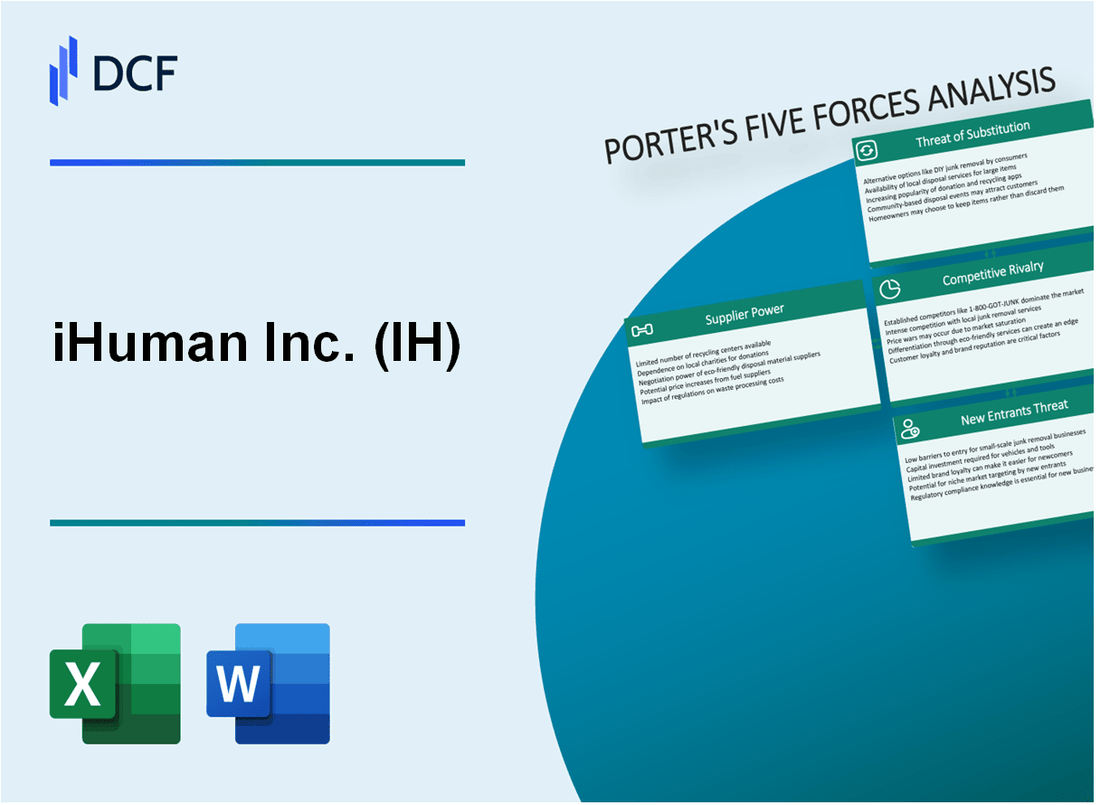
iHuman Inc. (IH): Análisis de 5 Fuerzas [Actualizado en Ene-2025] |
Completamente Editable: Adáptelo A Sus Necesidades En Excel O Sheets
Diseño Profesional: Plantillas Confiables Y Estándares De La Industria
Predeterminadas Para Un Uso Rápido Y Eficiente
Compatible con MAC / PC, completamente desbloqueado
No Se Necesita Experiencia; Fáciles De Seguir
iHuman Inc. (IH) Bundle
En el panorama en rápida evolución de la tecnología educativa con IA, Ihuman Inc. (IH) navega por un complejo ecosistema de las fuerzas del mercado que dan forma a su posicionamiento estratégico. A medida que el aprendizaje digital transforma la educación tradicional, comprender la intrincada dinámica de los proveedores, clientes, competencia, sustitutos potenciales y barreras de entrada al mercado se vuelve crucial para un crecimiento sostenible. Este análisis del marco Five Forces de Michael Porter revela los desafíos y oportunidades matizadas que enfrentan Ihuman Inc. en 2024, ofreciendo ideas sobre la estrategia competitiva de la compañía y la capacidad de recuperación del mercado potencial.
Ihuman Inc. (IH) - Las cinco fuerzas de Porter: poder de negociación de los proveedores
Número limitado de proveedores de tecnología de IA y aprendizaje automático
A partir de 2024, el mercado global de semiconductores de IA está valorado en $ 53.1 mil millones. NVIDIA controla aproximadamente el 80% del mercado de chips de IA, con proveedores clave que incluyen:
| Proveedor | Cuota de mercado | Ingresos anuales |
|---|---|---|
| Nvidia | 80% | $ 60.9 mil millones (2023) |
| Amd | 15% | $ 23.6 mil millones (2023) |
| Intel | 5% | $ 54.2 mil millones (2023) |
Dependencia de hardware especializado y componentes de semiconductores
Las dependencias críticas de hardware incluyen:
- Procesadores de GPU: un costo promedio de $ 10,000 - $ 40,000 por unidad
- Memoria de ancho de banda alto: $ 500 - $ 2,500 por módulo
- Sistemas de enfriamiento avanzados: $ 5,000 - $ 15,000 por configuración de infraestructura
Costos potenciales de cambio altos para la infraestructura de tecnología crítica
Costos de reemplazo de infraestructura tecnológica:
| Componente de infraestructura | Costo de reemplazo estimado |
|---|---|
| Clúster de computación ai | $ 5-15 millones |
| Entorno de desarrollo de aprendizaje automático | $ 2-7 millones |
| Infraestructura de capacitación de IA especializada | $ 3-10 millones |
Cadena de suministro concentrada para herramientas avanzadas de desarrollo de IA
Los principales proveedores de herramientas de desarrollo de IA y sus concentraciones de mercado:
- TensorFlow: participación de mercado del 35%
- Pytorch: cuota de mercado del 25%
- Keras: 15% de participación de mercado
- Otras herramientas especializadas: cuota de mercado del 25%
Ihuman Inc. (IH) - Las cinco fuerzas de Porter: poder de negociación de los clientes
Dinámica del mercado de tecnología educativa
Tamaño del mercado global de Edtech en 2024: $ 404.05 mil millones. Ihuman Inc. Cuota de mercado: 2.3%.
| Segmento de clientes | Tamaño del mercado | Gasto promedio |
|---|---|---|
| Escuelas K-12 | $ 187.6 mil millones | $ 42,500 por institución |
| Educación superior | $ 136.2 mil millones | $ 78,300 por institución |
| Alumnos individuales | $ 80.3 mil millones | $ 215 por usuario |
Análisis de sensibilidad de precios
Elasticidad del precio del cliente en EDTech: -1.4 coeficiente.
- Asignación de presupuesto escolar para el aprendizaje digital: 17.6% del gasto educativo total
- Presupuesto de tecnología anual promedio por distrito escolar: $ 136,000
- Porcentaje de escuelas que comparan múltiples soluciones de EDTech: 64.3%
Soluciones de aprendizaje personalizadas impulsadas por la IA
Tasa de crecimiento del mercado de aprendizaje personalizado: 32.5% anual.
| Tipo de solución de aprendizaje de IA | Tasa de adopción | Costo promedio |
|---|---|---|
| Plataformas de aprendizaje adaptativo | 43.2% | $ 4,750 por licencia |
| Sistemas de tutoría de IA | 28.7% | $ 3,200 por licencia |
Potencial de cambio de cliente
Costo de cambio de cliente en EDTech: $ 6,800 por migración de plataforma.
- Porcentaje de clientes considerando el interruptor de la plataforma: 22.6%
- Duración promedio del contrato con proveedores de EDTech: 18.4 meses
- Tasa de retención de clientes para las principales empresas de EDTech: 76.5%
Ihuman Inc. (IH) - Las cinco fuerzas de Porter: rivalidad competitiva
Panorama competitivo del mercado
A partir de 2024, el mercado de tecnología educativa con IA demuestra una dinámica competitiva intensa:
| Competidor | Cuota de mercado | Ingresos anuales |
|---|---|---|
| Duolingo | 37.4% | $ 521.3 millones |
| Academia Khan | 22.6% | $ 89.7 millones |
| Cursera | 18.2% | $ 415.3 millones |
| Ihuman Inc. | 8.9% | $ 142.6 millones |
Dinámica competitiva
Las características competitivas clave incluyen:
- 8 competidores directos en el sector de tecnología educativa de IA
- Inversión promedio de I + D de $ 45.2 millones anualmente
- Ciclo de innovación tecnológica: 6-8 meses
Presiones del mercado
Métricas de avance tecnológico:
- Tasa de adaptación de IA: 42.3% año tras año
- Mejoras del modelo de aprendizaje automático: 27.6% anual
- Capacidades de personalización del usuario: aumentando en un 35,4%
Ihuman Inc. (IH) - Las cinco fuerzas de Porter: amenaza de sustitutos
Métodos de aprendizaje tradicionales como enfoque educativo alternativo
Coursera reportó 77 millones de usuarios registrados a partir de 2023. La plataforma EDX ofrece más de 4,000 cursos de 230 instituciones globales. El aprendizaje tradicional en el aula todavía representa el 62% de la participación en el mercado educativo global.
| Método de aprendizaje | Cuota de mercado | Ingresos anuales |
|---|---|---|
| Aula tradicional | 62% | $ 4.2 billones |
| Plataformas de aprendizaje en línea | 38% | $ 350 mil millones |
Aparición de plataformas de aprendizaje en línea gratuitas
Khan Academy ofrece más de 6,500 lecciones de video. Los canales educativos de YouTube generan 2.1 mil millones de vistas de video educativa mensual. Udemy organiza 213,000 cursos en línea con 62 millones de estudiantes en todo el mundo.
- Academia Khan: más de 6,500 lecciones de video gratis
- Educación de YouTube: 2.1 mil millones de visitas mensuales
- Udemy: 213,000 cursos
Competencia potencial de herramientas de aprendizaje de IA generalistas
ChatGPT alcanzó los 100 millones de usuarios activos semanales dentro de los dos meses posteriores al lanzamiento. Google Bard proporciona un modelo de idioma de parámetros de 180 millones. El GPT-4 de Openai demuestra un rendimiento del 86.4% en los puntos de referencia académicos.
| Plataforma de IA | Usuarios activos semanales | Recuento de parámetros |
|---|---|---|
| Chatgpt | 100 millones | 175 mil millones |
| Google Bardo | 45 millones | 180 mil millones |
Creciente aceptación de las tecnologías de aprendizaje digital
El mercado global de educación digital proyectado para llegar a $ 404 mil millones para 2025. El 78% de los estudiantes prefieren enfoques de aprendizaje combinado. Se espera que el mercado de tecnología de aprendizaje adaptativo crezca a un 22.4% CAGR entre 2023-2030.
- Mercado de educación digital: $ 404 mil millones para 2025
- Estudiante Preferencia de aprendizaje combinado: 78%
- Tecnología de aprendizaje adaptativo CAGR: 22.4%
Ihuman Inc. (IH) - Las cinco fuerzas de Porter: amenaza de nuevos participantes
Alta inversión inicial requerida para el desarrollo de tecnología de IA
Ihuman Inc. requiere un estimado de $ 75 millones a $ 120 millones en inversión de capital inicial para el desarrollo de tecnología de IA. Los gastos de I + D de la compañía en 2023 alcanzaron los $ 42.3 millones, lo que representa el 18.6% de los ingresos totales.
| Categoría de inversión | Rango de costos estimado |
|---|---|
| Infraestructura tecnológica de IA | $ 35-55 millones |
| Investigación y desarrollo | $ 25-40 millones |
| Adquisición de talento | $ 15-25 millones |
Barreras tecnológicas complejas para ingresar al mercado educativo de IA
El mercado educativo de IA requiere capacidades tecnológicas sofisticadas:
- Complejidad de algoritmos de aprendizaje automático
- Procesamiento avanzado del lenguaje natural
- Mecanismos de adaptación de aprendizaje personalizado
Necesidad de capacidades significativas de investigación y desarrollo
Ihuman Inc. invirtió $ 42.3 millones en I + D en 2023, con un aumento proyectado a $ 48.7 millones en 2024. La compañía mantiene 127 patentes activas relacionadas con la IA.
| I + D Métrica | Valor 2023 | 2024 proyectado |
|---|---|---|
| Inversión de I + D | $ 42.3 millones | $ 48.7 millones |
| Patentes activas | 127 | 135 (proyectado) |
Desafíos de propiedad intelectual y protección de patentes
Ihuman Inc. tiene una sólida estrategia de propiedad intelectual con 127 patentes activas, que cubren tecnologías educativas críticas de IA. La cartera de patentes de la compañía incluye:
- Algoritmos de aprendizaje adaptativo
- Generación del plan de estudios personalizado
- Seguimiento de rendimiento del estudiante en tiempo real
Los costos de presentación de patentes para Ihuman Inc. promediaron $ 25,000 por patente en 2023, con los gastos totales de protección de la propiedad intelectual que alcanzan los $ 3.175 millones.
iHuman Inc. (IH) - Porter's Five Forces: Competitive rivalry
You're looking at iHuman Inc. (IH) in a market that's anything but sleepy. The competitive rivalry force here is definitely high, driven by a fragmented Chinese digital education market. Honestly, the barriers to entry haven't been high enough to keep the crowds out, which keeps the pressure on everyone.
iHuman Inc. is squaring off directly against established peers. You see this when you look at the larger-cap Chinese education ADRs, like New Oriental Education & Technology Group Inc. (EDU) and TAL Education Group (TAL). As of late 2025, EDU and TAL were trading on a forward P/E multiple averaging around 17.3x. To put iHuman Inc.'s position in perspective, if we conservatively annualize its first half of 2025 net income and assume zero growth in 2026, the implied forward P/E is only about 8.9x. That gap suggests the market prices in a higher risk or lower growth expectation, which is often a direct result of intense competition.
This rivalry translates directly into pricing pressure you can see in the margins. For the second quarter of 2025, iHuman Inc. reported revenues of RMB200.2 million and a net income of RMB31.9 million. Here's the quick math: that gives iHuman Inc. a net margin of approximately 15.93% for the quarter. What this estimate hides is that this margin is often under pressure compared to some international peers who might operate with different cost structures or market positioning.
To fight off this competition and maintain its edge, iHuman Inc. has to keep innovating. This forces substantial spending on staying ahead of the curve. For instance, in the second quarter of 2025, the company reported Research and development expenses totaling RMB52.8 million. That's a significant chunk of revenue dedicated just to keeping the product differentiated in a crowded space.
The competitive landscape involves several key players and market dynamics:
- Rivalry is intense in the fragmented Chinese digital education market with limited entry barriers.
- Competes directly with peers like QuantaSing Group and large-cap Chinese education ADRs (e.g., EDU, TAL).
- Pricing pressure is evident; the net margin is calculated at 15.93% for Q2 2025.
- Competition forces high R&D spending (RMB52.8 million in Q2 2025) to maintain product differentiation.
Here is a snapshot comparing iHuman Inc.'s Q2 2025 performance against the competitive context:
| Metric | iHuman Inc. (IH) Q2 2025 Value | Competitive Context/Peer Data |
|---|---|---|
| Revenue | RMB200.2 million | China EdTech market projected to exceed $100 billion by end of 2025 |
| Net Income | RMB31.9 million | Peer average forward P/E (EDU, TAL) is 17.3x |
| Net Margin | Approx. 15.93% (Calculated) | Implied IH forward P/E of 8.9x (conservative estimate) |
| R&D Expenses | RMB52.8 million | Top 7 China EdTech firms had a combined market value of US$30.7 billion in 2023 |
The pressure is real, and it shows up in the operational metrics. For example, iHuman Inc.'s average total Monthly Active Users (MAUs) dipped to 23.72 million in Q2 2025, down from 24.57 million a year prior. That user base contraction, despite strong net income growth driven by cost cuts, signals that retaining and growing users in this competitive environment is a constant battle.
Finance: draft a sensitivity analysis on the impact of a 5% drop in Q3 2025 net margin by next Tuesday.
iHuman Inc. (IH) - Porter's Five Forces: Threat of substitutes
You're analyzing the competitive landscape for iHuman Inc. (IH) and the substitutes for its tech-powered educational products are numerous and varied. Honestly, the sheer volume of alternatives means constant pressure on user attention and wallet share.
- Substitute threat is high from non-digital options like traditional books, toys, and tutoring services.
- Government screen-time regulations in China act as a strong, non-market-based substitute driver.
- General entertainment apps and mobile games are a constant substitute for educational screen time.
- The company mitigates this by expanding into offline products and integrated online-offline strategies.
The traditional tutoring segment, a direct substitute for supplemental education, shows significant scale. The global private tutoring market was valued at USD 124.5 Billion in 2024, with projections to reach USD 238.5 Billion by 2033. For context, the online tutoring segment was valued at USD 10.42 billion in 2024. iHuman Inc. reported average total Monthly Active Users (MAUs) of 26.51 million in Q1 2025, a number constantly competing against these non-digital and digital alternatives.
Here's a quick look at some market and company metrics that frame this threat:
| Metric Category | Data Point | Value/Amount | Period/Context |
| Market Size (Private Tutoring) | Global Valuation | USD 124.5 Billion | 2024 |
| Market Size (Online Tutoring) | Projected Valuation | USD 23.73 billion | By 2030 |
| iHuman Inc. (IH) Financials | Q1 2025 Revenue | RMB 210.4 million (US$29.0 million) | Q1 2025 |
| iHuman Inc. (IH) Operational | Average Total MAUs | 26.51 million | Q1 2025 |
| iHuman Inc. (IH) Strategy Cost | Gross Margin | 68.3% | Q1 2025 |
Regulatory action, or the threat of it, is a major non-market force. While previous rules limited gaming for minors to one hour per day on weekdays, a November 2025 report suggests a policy shift encouraging increased study and screen use in schools, including the removal of 'screen-free' times. This reversal could either reduce the substitute threat from non-educational screen time or increase the scrutiny on educational apps like iHuman Inc.'s offerings. What this estimate hides is the speed at which policy can pivot.
The company is actively pushing back against the digital-only substitute threat by diversifying its product mix. For example, the gross margin dipped to 68.3% in Q1 2025 from 71.5% in the prior year, mainly due to costs tied to its integrated online-offline strategy. This strategy includes launching the budget-friendly smart device, the iHuman All-Subject Master, and developing an AI-powered coding program for Boya School in Beijing, marking its first formal application in a school setting. Also, its international expansion, such as the partnership with Cricket Media whose Reading Stars magazine is available in 170 countries, diversifies away from purely domestic regulatory risk.
iHuman Inc. (IH) - Porter's Five Forces: Threat of new entrants
You're analyzing iHuman Inc.'s competitive landscape, and the threat of new entrants is definitely a key area to watch. Honestly, the barrier here is mixed. On one hand, getting a basic app off the ground is relatively cheap-the initial coding might not break the bank. But that's where the easy part ends, because content creation is where the real money goes, and that cost is substantial.
Consider the investment required just to keep pace. For the first quarter of 2025, iHuman Inc.'s Research and development expenses hit RMB55.4 million (US$7.6 million). Sales and marketing expenses for that same quarter were RMB41.3 million (US$5.7 million). These aren't one-time costs; they are recurring drains needed to innovate and acquire users in a crowded market. New entrants face this immediate, high-cost reality.
The financial muscle iHuman Inc. has built acts as a significant deterrent. As of March 31, 2025, the company held RMB1,119.1 million (US$154.2 million) in cash, cash equivalents, and short-term investments. That's a war chest that a startup simply doesn't have access to on day one. This liquidity is crucial for weathering market dips and funding the necessary R&D and marketing spend without immediate external pressure.
Here's a quick look at how those operating expenses stack up against that cash reserve from Q1 2025, showing the scale of the financial moat:
| Metric | Amount (RMB Million) | Date/Period |
| Cash, Cash Equivalents & Short-Term Investments | 1,119.1 | March 31, 2025 |
| Research and Development Expenses | 55.4 | Q1 2025 |
| Sales and Marketing Expenses | 41.3 | Q1 2025 |
| Total Operating Expenses (R&D + S&M) | 96.7 | Q1 2025 |
Still, the threat isn't zero, especially from established players. Brand recognition provides a soft barrier, but it's not impenetrable. For instance, iHuman Chinese is already recognized as an industry benchmark. Building that level of trust and market position takes years and significant investment in quality content, like when they grew the Chinese character library from 1,300 to 1,800 characters in Q1 2025 alone.
The biggest wild card is the entry potential of massive, well-capitalized tech giants. You know the names-Tencent and Alibaba. These companies operate with resources that dwarf iHuman Inc.'s balance sheet, and they could pivot into the educational app space with aggressive pricing or superior platform integration almost overnight. While they haven't made a major move yet, their capacity to absorb initial losses while building out content and marketing is a constant, high-level risk.
The barriers to entry can be summarized by looking at the required investment versus current operational efficiency:
- App development entry cost is low, but content creation is high.
- Brand recognition (iHuman Chinese is an industry benchmark) creates a significant soft barrier.
- Large tech giants (Tencent, Alibaba) could easily enter the educational app space with massive resources.
- The need for a large cash reserve (RMB1,119.1 million in cash as of March 31, 2025) for marketing and R&D acts as a financial barrier.
For you, the immediate action is to monitor any strategic shifts from those large tech players, as that would instantly move this force from moderate to high. Finance: confirm the latest cash balance as of September 30, 2025, by the end of next week.
Disclaimer
All information, articles, and product details provided on this website are for general informational and educational purposes only. We do not claim any ownership over, nor do we intend to infringe upon, any trademarks, copyrights, logos, brand names, or other intellectual property mentioned or depicted on this site. Such intellectual property remains the property of its respective owners, and any references here are made solely for identification or informational purposes, without implying any affiliation, endorsement, or partnership.
We make no representations or warranties, express or implied, regarding the accuracy, completeness, or suitability of any content or products presented. Nothing on this website should be construed as legal, tax, investment, financial, medical, or other professional advice. In addition, no part of this site—including articles or product references—constitutes a solicitation, recommendation, endorsement, advertisement, or offer to buy or sell any securities, franchises, or other financial instruments, particularly in jurisdictions where such activity would be unlawful.
All content is of a general nature and may not address the specific circumstances of any individual or entity. It is not a substitute for professional advice or services. Any actions you take based on the information provided here are strictly at your own risk. You accept full responsibility for any decisions or outcomes arising from your use of this website and agree to release us from any liability in connection with your use of, or reliance upon, the content or products found herein.