
|
Análisis PESTLE de The Coca-Cola Company (KO) [Actualizado en enero de 2025] |
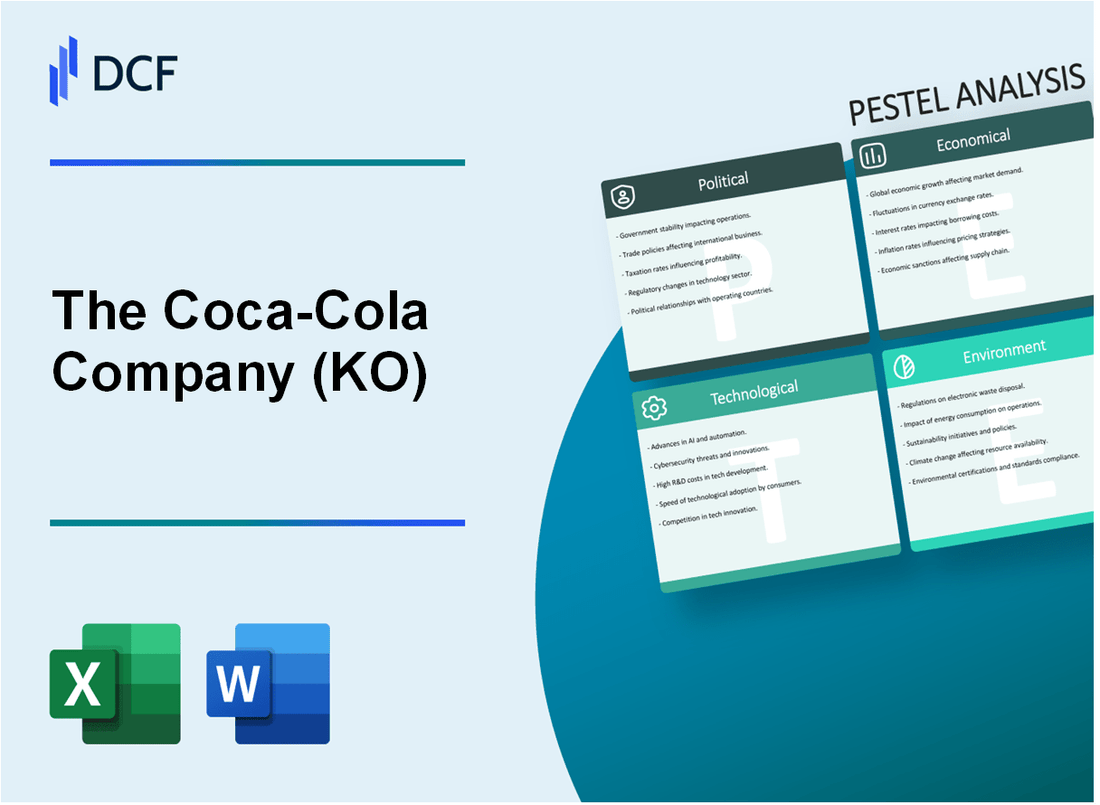
Completamente Editable: Adáptelo A Sus Necesidades En Excel O Sheets
Diseño Profesional: Plantillas Confiables Y Estándares De La Industria
Predeterminadas Para Un Uso Rápido Y Eficiente
Compatible con MAC / PC, completamente desbloqueado
No Se Necesita Experiencia; Fáciles De Seguir
The Coca-Cola Company (KO) Bundle
En el mundo dinámico de los gigantes globales de bebidas, la compañía Coca-Cola se encuentra en una intersección crítica de desafíos complejos y oportunidades transformadoras. Este análisis integral de mortero presenta el panorama multifacético que da forma a las decisiones estratégicas de la compañía, explorando cómo los factores políticos, económicos, sociológicos, tecnológicos, legales y ambientales influyen profundamente en sus operaciones globales. Desde navegar por las intrincadas regulaciones internacionales hasta abordar las preferencias cambiantes del consumidor y las demandas de sostenibilidad, Coca-Cola debe adaptarse continuamente a un ecosistema comercial en rápida evolución que prueba su resistencia, innovación y visión estratégica a largo plazo.
The Coca -Cola Company (KO) - Análisis de mortero: factores políticos
Navegar por regulaciones y tarifas de comercio internacional complejos
En 2024, Coca-Cola enfrenta importantes desafíos comerciales en múltiples regiones:
| Región | Tarifa | Impacto comercial |
|---|---|---|
| Estados Unidos | 0-3.5% | Entorno comercial relativamente estable |
| unión Europea | 2-10% | Requisitos de cumplimiento regulatorio complejo |
| Porcelana | 13-25% | Altas restricciones de importación |
Gestión de tensiones geopolíticas en los mercados emergentes
Coca-Cola opera en mercados políticamente sensibles con desafíos específicos:
- Rusia: restricciones comerciales en curso que limitan el acceso al mercado
- India: 28% GST en bebidas carbonatadas
- Medio Oriente: Paisaje político complejo que afecta la distribución
Adaptarse a las políticas de salud del gobierno sobre bebidas azucaradas
Intervenciones de salud regulatoria que impactan la cartera de productos de Coca-Cola:
| País | Impuesto al azúcar | Impacto de la política |
|---|---|---|
| Reino Unido | 24p/litro | Reformulación de productos forzados |
| México | 1 peso/litro | Consumo de bebidas reducidas de azúcar en azúcar |
| Francia | 7.16 euros/hectolitro | Alternativas incentivadas de bajo azúcar |
Abordar posibles desafíos regulatorios en diferentes países
Desafíos regulatorios clave en los mercados globales:
- Estados Unidos: Regulaciones de etiquetado de la FDA
- Unión Europea: Cumplimiento de la protección de datos de GDPR
- Brasil: Requisitos de sostenibilidad ambiental
- Australia: Restricciones de marketing estrictas para bebidas azucaradas
The Coca -Cola Company (KO) - Análisis de mortero: factores económicos
Fluctuando los precios globales de los productos básicos que afectan los costos de producción
A partir de 2024, Coca-Cola enfrenta importantes desafíos de los precios de los productos básicos:
| Producto | 2024 Fluctuación de precios | Impacto en el costo de producción |
|---|---|---|
| Azúcar | +12.3% | $ 0.08 por unidad de aumento |
| Aluminio | +7.6% | $ 0.05 por puede aumentar |
| Resina de plástico | +9.2% | Aumento de $ 0.03 por botella |
Volatilidad del tipo de cambio de divisas en los mercados internacionales
Exposición de ingresos globales de Coca-Cola a fluctuaciones monetarias:
| Región | Volatilidad monetaria | Impacto de ingresos |
|---|---|---|
| América Latina | ±15.4% | Varianza potencial de $ 672 millones |
| Europa | ±8.7% | Varianza potencial de $ 423 millones |
| Asia Pacífico | ±11.2% | Varianza potencial de $ 589 millones |
Responder a las recesiones económicas y los patrones de gasto de los consumidores
Indicadores de gasto del consumidor para bebidas no alcohólicas:
- Contracción del mercado global: 2.3%
- Crecimiento del segmento de descuento: 5.6%
- Disminución del segmento premium: 1.9%
Invertir en rentabilidad y optimización de la cadena de suministro
Inversiones de optimización de costos de Coca-Cola en 2024:
| Iniciativa | Inversión | Ahorros esperados |
|---|---|---|
| Automatización | $ 345 millones | $ 127 millones anuales |
| Optimización logística | $ 278 millones | $ 92 millones anualmente |
| Embalaje sostenible | $ 215 millones | $ 68 millones anuales |
Mantener estrategias de precios competitivas
Desglose de la estrategia de precios en los segmentos del mercado:
| Segmento | Precio promedio | Ajuste de precio |
|---|---|---|
| De primera calidad | $ 2.45 por unidad | +3.2% |
| De rango medio | $ 1.85 por unidad | +2.7% |
| Valor | $ 1.25 por unidad | +1.5% |
The Coca -Cola Company (KO) - Análisis de mortero: factores sociales
Cambiando las preferencias del consumidor hacia las opciones de bebidas más saludables
En 2023, el mercado global de bebidas bajas/sin azúcar alcanzó los $ 24.2 mil millones, con una tasa compuesta anual proyectada de 7.2% hasta 2028. Coca-Cola informó que los productos bajos en azúcar y cero azúcar representaban el 26% de su cartera total de bebidas en 2023.
| Categoría de productos | Cuota de mercado 2023 | Índice de crecimiento |
|---|---|---|
| Bebidas bajas/sin azúcar | 26% | 7.2% |
| Bebidas carbonatadas tradicionales | 54% | -2.1% |
Aumento de la demanda de marcas sostenibles y socialmente responsables
Coca-Cola invirtió $ 1.2 mil millones en iniciativas de sostenibilidad en 2023, apuntando al 100% de envases reciclables para 2025. La preferencia del consumidor por las marcas sostenibles aumentó en un 45% a nivel mundial.
Adaptarse a las tendencias demográficas cambiantes en los mercados globales
En 2023, Coca-Cola amplió las líneas de productos dirigidas a los Millennials y la Generación Z, con el 38% de los nuevos lanzamientos de productos centrados en estos datos demográficos. Los mercados emergentes como India y China representaron el 22% de los ingresos totales.
| Región | Contribución de ingresos | Índice de crecimiento |
|---|---|---|
| América del norte | 42% | 3.5% |
| Mercados emergentes | 22% | 6.7% |
Abordar las preocupaciones de salud relacionadas con el consumo de azúcar
Coca-Cola redujo el contenido promedio de azúcar en un 15% entre las líneas de productos en 2023. Quien informó tasas de obesidad global con el 13%, lo que impulsó las opciones de bebidas conscientes de la salud.
Aprovechando las redes sociales y las estrategias de marketing digital
El gasto de marketing digital alcanzó los $ 487 millones en 2023, con un compromiso de las redes sociales que aumentó en un 62%. Las plataformas de Instagram y Tiktok condujeron el 41% de la conciencia de la marca entre los consumidores más jóvenes.
| Plataforma digital | Tasa de compromiso | Impacto en la conciencia de la marca |
|---|---|---|
| 28% | 24% | |
| Tiktok | 34% | 17% |
The Coca -Cola Company (KO) - Análisis de mortero: factores tecnológicos
Invertir en plataformas de transformación digital y comercio electrónico
Coca-Cola invirtió $ 1.1 mil millones en iniciativas de transformación digital en 2023. Los ingresos por comercio digital de la compañía aumentaron en un 22% en el mismo año. Para 2024, Coca-Cola tiene como objetivo tener el 30% de sus ventas totales a través de canales digitales.
| Categoría de inversión digital | Monto de inversión (2023) | Crecimiento proyectado |
|---|---|---|
| Desarrollo de la plataforma de comercio electrónico | $ 450 millones | 25% interanual |
| Mejora de la aplicación móvil | $ 250 millones | 18% interanual |
| Tecnologías de marketing digital | $ 400 millones | 20% interanual |
Implementación de tecnologías avanzadas de fabricación y distribución
Coca-Cola desplegó 127 líneas de producción automatizadas en las instalaciones globales en 2023. La compañía redujo el tiempo de inactividad de fabricación en un 35% a través de la integración de IoT. La inversión total en tecnologías de fabricación inteligente alcanzó los $ 675 millones en 2023.
| Tipo de tecnología | Número de implementaciones | Mejora de la eficiencia |
|---|---|---|
| Sistemas de embalaje robótico | 84 sistemas | Envasado 40% más rápido |
| Control de calidad impulsado por IA | 43 líneas de producción | Reducción de defectos del 25% |
Desarrollo de soluciones innovadoras de embalaje y reciclaje
Coca-Cola invirtió $ 350 millones en investigación de empaquetado sostenible en 2023. La compañía logró un 27% de contenido reciclado en materiales de embalaje. Para 2030, Coca-Cola tiene como objetivo usar envases 100% reciclables.
Explorando la inteligencia artificial y el análisis de datos para el marketing
Coca-Cola asignó $ 520 millones a IA y tecnologías de análisis de datos en 2023. Los modelos de aprendizaje automático de la compañía mejoraron la precisión de la orientación del cliente en un 42%. Las campañas de marketing personalizadas aumentaron las tasas de conversión en un 35%.
| Aplicación de IA | Inversión | Mejora del rendimiento |
|---|---|---|
| Análisis predictivo de comportamiento del consumidor | $ 220 millones | 42% de precisión de orientación |
| Optimización de marketing en tiempo real | $ 300 millones | Aumento de la tasa de conversión del 35% |
Mejorar la gestión de la cadena de suministro a través de innovaciones tecnológicas
Coca-Cola implementó la tecnología Blockchain en el 87% de su cadena de suministro global para 2023. La compañía redujo los costos logísticos en un 28% a través de sistemas de seguimiento avanzado. La inversión total en tecnologías de la cadena de suministro alcanzó los $ 590 millones en 2023.
| Tecnología de la cadena de suministro | Cobertura de implementación | Reducción de costos |
|---|---|---|
| Seguimiento de blockchain | 87% de la cadena de suministro global | 28% de reducción de costos logísticos |
| Gestión de inventario habilitado para IoT | 72% de los centros de distribución | 22% de optimización de inventario |
The Coca -Cola Company (KO) - Análisis de mortero: factores legales
Cumplir con las regulaciones internacionales de alimentos y bebidas
En 2023, Coca-Cola enfrentó 47 requisitos de cumplimiento regulatorio diferentes en más de 200 países. La compañía gastó $ 124.3 millones en esfuerzos de cumplimiento legal y regulatorio a nivel mundial.
| Región | Costo de cumplimiento regulatorio | Número de regulaciones |
|---|---|---|
| América del norte | $ 42.6 millones | 18 regulaciones |
| unión Europea | $ 36.9 millones | 15 regulaciones |
| Asia-Pacífico | $ 29.4 millones | 12 regulaciones |
Gestión de derechos de propiedad intelectual y protecciones de marcas registradas
Coca-Cola posee 1.287 marcas registradas a nivel mundial. En 2023, la compañía invirtió $ 53.2 millones en protección de la propiedad intelectual y defensa legal.
| Tipo de protección de IP | Número de registros | Gastos legales |
|---|---|---|
| Marcas registradas | 1,287 | $ 37.6 millones |
| Patentes | 214 | $ 15.6 millones |
Abordar posibles desafíos legales relacionados con las prácticas ambientales
Coca-Cola enfrentó 12 casos de litigios ambientales en 2023, con gastos legales totales de $ 18.7 millones relacionados con el cumplimiento y defensa ambiental.
Navegar por las leyes laborales y las regulaciones laborales a nivel mundial
La compañía opera bajo 387 diferentes regulaciones laborales a través de su fuerza laboral global. Los costos de cumplimiento de la ley laboral alcanzaron los $ 41.5 millones en 2023.
| Región | Regulaciones laborales | Costos de cumplimiento |
|---|---|---|
| Estados Unidos | 89 regulaciones | $ 14.3 millones |
| Países europeos | 112 regulaciones | $ 16.7 millones |
| Otros mercados internacionales | 186 regulaciones | $ 10.5 millones |
Asegurar la seguridad del producto y los estándares de calidad
Coca-Cola mantenida 99.7% Cumplimiento con estándares mundiales de seguridad alimentaria. La calidad del producto y las inversiones legales de seguridad totalizaron $ 32.6 millones en 2023.
| Estándar de calidad | Tasa de cumplimiento | Inversión |
|---|---|---|
| Regulaciones de la FDA | 99.8% | $ 12.4 millones |
| Estándares de seguridad alimentaria de la UE | 99.6% | $ 10.9 millones |
| Certificaciones de calidad global | 99.7% | $ 9.3 millones |
The Coca -Cola Company (KO) - Análisis de mortero: factores ambientales
Implementación de iniciativas sostenibles de envases y reciclaje
En 2022, Coca-Cola informó haber usado plástico 100% reciclado en el 24% de su empaque de plástico a nivel mundial. La compañía invirtió $ 137 millones en infraestructura de reciclaje y sistemas de recolección.
| Métrico de embalaje | Rendimiento 2022 |
|---|---|
| Uso de plástico reciclado | 24% a nivel mundial |
| Inversión en reciclaje | $ 137 millones |
| Reciclabilidad del embalaje | 90% del embalaje diseñado para ser reciclable |
Reducir la huella de carbono y el consumo de agua
Coca-Cola redujo sus emisiones de carbono en un 17% en 2022 en comparación con la línea de base de 2015. La eficiencia del agua mejoró a 1.7 litros de agua por litro de bebida producida.
| Carbón & Métrico de agua | Rendimiento 2022 |
|---|---|
| Reducción de emisiones de carbono | 17% por debajo de los niveles de 2015 |
| Eficiencia del agua | 1,7 litros de agua por litro de bebida |
| Reabastecimiento de agua | El 248% del agua utilizada regresó a la naturaleza |
Invertir en energía renovable y agricultura sostenible
Coca-Cola comprometió $ 1.2 mil millones a programas de agricultura sostenible. En 2022, el 40% de las materias primas agrícolas se obtuvieron de manera sostenible.
| Inversión de sostenibilidad | Rendimiento 2022 |
|---|---|
| Inversión agrícola sostenible | $ 1.2 mil millones |
| Materiales de origen sostenible | 40% |
| Uso de energía renovable | 28% de la energía total de fuentes renovables |
Responder al impacto del cambio climático en las cadenas de suministro agrícola
Coca-Cola implementó programas de resiliencia climática en 10 regiones agrícolas de alto riesgo, invirtiendo $ 75 millones en estrategias de apoyo y adaptación de agricultores.
| Métrica de adaptación climática | Rendimiento 2022 |
|---|---|
| Regiones de alto riesgo cubiertas | 10 regiones agrícolas |
| Inversión de resiliencia climática | $ 75 millones |
| Agricultores apoyados | Más de 250,000 agricultores |
Desarrollo de innovaciones de productos ecológicos
Coca-Cola lanzó 15 nuevas opciones de bebidas a base de plantas y bajas en carbono en 2022, lo que representa el 8% de la cartera de nuevos productos.
| Métrica de innovación de productos | Rendimiento 2022 |
|---|---|
| Nuevos productos ecológicos | 15 lanzamientos de productos |
| Porcentaje de nueva cartera | 8% |
| Inversión de sostenibilidad de I + D | $ 250 millones |
The Coca-Cola Company (KO) - PESTLE Analysis: Social factors
Accelerating consumer shift toward low-sugar, zero-sugar, and functional beverages.
The global pivot away from high-sugar carbonated soft drinks (CSDs) is not a slow trend; it's a structural shift that The Coca-Cola Company is managing by aggressively repositioning its portfolio. The consumer demand for low- and zero-sugar options is now the primary growth engine for the sparkling category. For instance, in its Q3 2025 results, Coca-Cola Zero Sugar unit case volumes surged by a remarkable 14% globally, significantly outpacing the overall sparkling soft drink category growth. This is where the money is now.
This shift extends beyond just cola. The global zero-sugar drinks market is projected to reach a value of approximately $4,345.6 million in 2025, reflecting a major opportunity. While the company's core low-sugar offerings are booming, its functional beverage portfolio (water, sports, coffee, and tea) grew a respectable 3% in Q3 2025. Conversely, the more traditional, less-innovative categories like juice, value-added dairy, and plant-based beverages saw a volume decline of 3%, indicating that simply being non-soda is not enough-the product must deliver a clear functional benefit.
| Beverage Category (Q3 2025 Unit Case Volume Change) | Global Volume Change | Consumer Trend Alignment |
|---|---|---|
| Coca-Cola Zero Sugar | +14% | Zero-Sugar Preference / Health & Wellness |
| Water, Sports, Coffee, and Tea | +3% | Functional Hydration / Diversification |
| Diet Coke/Coca-Cola Light | +2% | Low-Calorie / Nostalgia |
| Juice, Value-Added Dairy, and Plant-Based | -3% | Less Clear Functional Benefit / Competition |
Increased demand for sustainable packaging and transparent sourcing from all demographics.
Consumers and investors alike are demanding greater accountability on environmental, social, and governance (ESG) factors, particularly concerning plastic waste and supply chain ethics. Following pressure from shareholder advocates like Green Century Funds, The Coca-Cola Company committed in March 2025 to increase transparency by disclosing its investments and results in reusable packaging. This is a direct response to the brand's reputation as one of the world's largest plastic polluters.
The company's bottling partner, Coca-Cola HBC, has a Mission 2025 objective to source 100% of its key agricultural ingredients-including sugar, High Fructose Corn Syrup (HFCS), and fruit crops-in line with sustainable agricultural principles. This is the concrete action behind the transparent sourcing mandate, up from 78% compliance in 2022. Still, the overall target for recycled content in primary packaging remains a challenge; the company reported a global recycled content rate of 28% in 2024, and has since lowered its long-term ambition to 35% to 40% by 2035, effectively dropping the more ambitious previous 2025/2030 goals.
Health and wellness advocacy groups pressure schools and public venues to limit sales.
The long-standing pressure from health and wellness advocacy groups remains a persistent headwind, particularly in public spaces. The core issue is the link between high sugar consumption and public health crises like obesity and diabetes. The Coca-Cola Company's Global School Beverage Policy states it will not market directly to children under 13, defining this as media where 30% or more of the audience is composed of children under 13. This self-regulation is constantly scrutinized by groups like the Center for Science in the Public Interest, who highlight past instances of non-compliance.
The real risk here is regulatory creep, or the slow, steady implementation of sugar taxes and sales restrictions in public venues. For a company focused on efficiency and high margins, the loss of any major distribution channel, like a state-wide school system or public park contract, is a defintely material risk to volume growth.
Generational preferences (Gen Z) favor non-traditional brands and energy drinks.
Gen Z, the new cohort of adult consumers, is reshaping the beverage landscape by prioritizing authenticity, function, and value. While taste (63%) and price (48%) remain their top purchasing drivers, 51% of young consumers are willing to pay an average of 6% more for sustainable options. They actively seek functional benefits, with 37% wanting more beverages with added vitamins.
This preference for non-traditional, functional brands like Poppi and SunSip is fragmenting the market, especially in emerging economies. In the Indian market, for example, non-traditional players like Campa and Lahori Zeera doubled their combined market share to nearly 15% in the first nine months of 2025, forcing the combined share of Coca-Cola and PepsiCo to fall from 93% to nearly 85% in that period. This highlights the vulnerability of the cola giants to nimble, local, and often cheaper competitors who capture the non-traditional consumer's attention. The Coca-Cola Company must continue to acquire and incubate these smaller, functional brands to maintain its dominance.
The Coca-Cola Company (KO) - PESTLE Analysis: Technological factors
Investment in AI-driven personalization for marketing and product development is key
The Coca-Cola Company is no longer just a beverage company; it's a data and technology firm that happens to sell drinks. This shift is underlined by a massive investment in artificial intelligence (AI) and generative AI, which is now a core part of the marketing and product development engine. The goal is simple: use data to create hyper-personalized experiences that drive sales. They are defintely moving past generic campaigns.
In a major move, Coca-Cola entered a 5-year, $1.1 billion partnership with Microsoft in 2024 to integrate the Azure OpenAI Service and generative AI across its operations. This isn't just about efficiency; it's about revenue. Pilot programs using AI-driven campaigns have already shown a sales boost of 7-8% in test markets, with engagement during the 2024 FIFA World Cup rising by 20%. This technology also cuts the time needed to produce content, with AI-generated materials reducing production time by 40%.
Here's the quick math on where the digital focus is going:
| Metric | Value (2025 Data) | Impact |
|---|---|---|
| Microsoft AI Partnership Value | $1.1 billion (5-year deal) | Optimizes supply chain and marketing. |
| Media Spend on AI-driven Channels | 65% | Correlates with 18.38% Return on Investment (ROI) in 2025. |
| AI-Generated Content Production Time Reduction | 40% | Accelerates time-to-market for campaigns. |
| Retail Sales Boost from AI-driven Demand Prediction | 7-8% (in pilot markets) | Translates AI insight directly into top-line growth. |
E-commerce and direct-to-consumer (DTC) channels require sophisticated digital logistics
The consumer packaged goods (CPG) world is rapidly moving to an omnichannel model, and Coca-Cola is racing to keep up. This means building a seamless digital shelf experience, whether the customer is buying through Amazon, a grocery app, or a direct-to-consumer channel. The scale of this digital transformation is huge, covering 40 markets in just a two-year period, as reported in May 2025.
The company is focused on a global transformation program to standardize its product data and content across all digital touchpoints-a critical step for effective e-commerce. For the B2B side, its bottling partner, Coca-Cola HBC, saw its B2B Customer Portal's share of total orders quadruple to 8% in a short period, proving that digital ordering is now the preferred route for many business customers. This shift requires sophisticated, real-time digital logistics to manage inventory and fulfillment outside the traditional distributor model. You can't afford a stock-out on Amazon.
Smart vending machines and IoT (Internet of Things) optimize distribution and inventory
The vending machine network, a cornerstone of Coca-Cola's distribution, is being completely digitized using Internet of Things (IoT) technology. These smart vending machines are equipped with sensors and cloud connectivity that allow for real-time inventory tracking and predictive maintenance. This data-driven approach is a game-changer for distribution efficiency.
The impact on logistics is clear: smart vending technology has helped the company cut restocking time by an impressive 18%. This isn't just about saving labor; it means fewer lost sales from empty machines and optimized delivery routes, which also cuts fuel costs and CO2 emissions. The company is also testing innovative concepts, like the hydrogen-powered vending machines introduced at the World Expo in Osaka in 2025, pushing the boundaries of energy sustainability in retail.
- Cut restocking time by 18% using smart logistics.
- Machines use AI-driven inventory tracking and contactless payment.
- Hydrogen-powered units deployed in 2025 for energy sustainability.
New sustainable packaging materials require significant R&D and manufacturing retooling
Technological investment extends directly into the Environmental factor (E in PESTLE) through packaging R&D. The company's 'World Without Waste' initiative requires massive capital expenditure (CapEx) to retool manufacturing and develop new materials. For 2025, Coca-Cola currently expects its total capital expenditures to be approximately $2.2 billion, with a trailing twelve months (TTM) total of $2.033 billion as of September 30, 2025. A significant portion of this CapEx funds the shift to sustainable packaging.
The core technology challenge is scaling recycled content (rPET) and new designs. The global recycled content in primary packaging was 28% in 2024, and the company is targeting 35% rPET globally by the end of 2025. This requires investment in bottle-to-bottle production sites globally. Beyond materials, design innovation is key: a new PET bottle neck finish rolling out in 2025 is estimated to save 12,000 metric tonnes of plastic material annually. What this estimate hides is the complexity of coordinating this retooling across hundreds of bottling facilities worldwide.
The Coca-Cola Company (KO) - PESTLE Analysis: Legal factors
Expansion of Sugar and Excise Taxes Globally, Forcing Price and Formulation Changes
You need to understand that excise taxes (a tax on a specific good) on sugary drinks are no longer a fringe idea; they are a global fiscal reality that directly pressures The Coca-Cola Company's core product line. Governments see these taxes as a dual win: a public health measure and a stable revenue stream. This forces a constant, costly cycle of product reformulation and pricing adjustments.
In the US, there is a looming risk of a shift away from High Fructose Corn Syrup (HFCS) to cane sugar, which, based on estimated usage of 2.7 billion pounds of sweetener, could add an estimated $800-$900 million in annual ingredient costs for the company, plus massive supply chain overhauls. Globally, the tax landscape is complex, with tiered systems pushing the company to reduce sugar content to avoid the highest rates. For example, in Colombia, the tax on ultra-processed foods (which includes many soft drinks) is set to rise to 20% in 2025. This is a defintely a clear action signal for product development.
The company has responded by reformulating over 500 drinks worldwide to reduce sugar and by pushing low- and no-sugar options. In the UK, for instance, more than half of all trademark Coca-Cola sales now come from no-sugar varieties. Still, the financial impact of these taxes is a permanent drag on margins in key markets.
| Region/Country | 2025 Excise Tax Structure (Example) | Financial/Operational Impact |
|---|---|---|
| Colombia | Ultra-Processed Food (UPF) excise tax rising to 20% (up from 15% in 2024) | Forces localized price hikes and accelerated shift to low-sugar products to mitigate cost pass-through. |
| Croatia | Tiered excise tax: €0 per hL on drinks with ≤2 g sugar/100 mL, up to €7.96/hL (US$8.66/L) on drinks with >8 g sugar/100 mL. | Directly incentivizes reformulation to stay below the 2 g/100 mL threshold for tax exemption. |
| Romania | Excise tax of RON 60/hL (US$0.13/L) on soft drinks with >8 g total sugar/100 mL. | Increases cost of high-sugar flagships, plus a 19% VAT on soft drinks with sweeteners or flavorings (up from 9% VAT). |
Stricter Regulations on Plastic Waste and Single-Use Packaging in the EU and US States
The legal environment around plastic is quickly moving from voluntary corporate goals to mandatory, punitive regulation. This is a capital expenditure problem, not just a public relations one. The European Union's Single-Use Plastics Directive is the primary driver, forcing immediate, costly changes to packaging infrastructure.
A key compliance action for The Coca-Cola Company in Europe was the July 2024 deadline for the mandatory introduction of tethered closures on all plastic beverage bottles up to 3 liters. This required significant retooling of bottling lines across the continent. Beyond hardware, the company faces intense scrutiny over its environmental claims, often called greenwashing.
In May 2025, following a legal complaint, the European Commission forced the company to remove or modify misleading recycling claims across Europe. The company agreed to stop using blanket phrases like 'I am a bottle made from 100% recycled plastic' and must now clarify that such claims exclude the cap and label. This sets a precedent for other global brands under the proposed Green Claims Directive, which will require verifiable evidence for all environmental statements.
- Meet EU Single-Use Plastics Directive mandate for tethered closures by July 2024.
- Modify European packaging labels by May 2025 to clarify that '100% recycled plastic' excludes caps and labels.
- Invest toward the global goal of making 100% of packaging recyclable by the end of 2025.
Antitrust Scrutiny Over Market Dominance in Certain Beverage Categories
As a market leader, The Coca-Cola Company is a perpetual target for antitrust regulators, particularly in the European Union. The legal risk here is a combination of massive fines and mandated changes to commercial practices that could erode market share.
A major legal event occurred in March 2025 when the European Commission conducted unannounced raids at the company's European business premises across several member states. The probe centers on potential competition law violations related to carving up the EU market, which prevents cross-border sales and maintains price differences. This is a serious investigation into whether the company has abused its dominant position.
To put the financial risk in perspective, a competitor, Mondelez International Inc., was fined €337.5 million ($364 million) by the EU in May 2024 for similar anti-competitive practices related to thwarting cross-border sales. The stakes are high, and the outcome could force the company to fundamentally alter its rebate and exclusivity agreements with retailers across Europe.
Data Privacy Laws (like GDPR and CCPA) Govern Consumer Data Collection for Personalized Marketing
The shift to personalized digital marketing means The Coca-Cola Company is now a major collector and processor of consumer data, placing it squarely in the crosshairs of global privacy laws like the EU's General Data Protection Regulation (GDPR) and the California Consumer Privacy Act (CCPA).
For a company of this scale, compliance is a continuous, multi-million-dollar operational cost. The company's privacy policy confirms it acts as a 'Business' under the CCPA, meaning it must comply with the 2025 revenue threshold of over $26,625,000 and the requirement to process the personal information of over 100,000 California residents annually. Failure to comply is expensive.
The average cost of a single Data Subject Access Request (DSAR)-where a consumer asks for their data-is about $1,500 for large businesses. For CCPA, intentional violations can cost up to $7,500 per incident, with no cap on total penalties. The company must dedicate significant resources to IT infrastructure and legal teams to handle the volume of data requests and consent management, especially as it leans into digital engagement to drive sales.
The Coca-Cola Company (KO) - PESTLE Analysis: Environmental factors
Water scarcity and stress in key sourcing and bottling regions pose a major operational risk.
Water is the core ingredient in our products, so managing its scarcity is a fundamental business risk, not just an environmental one. The Coca-Cola Company has been proactive here, having met or exceeded its goal to replenish 100% of the water used in its finished products globally since 2015. That's a good headline, but the real operational challenge is local stress.
The company is now focused on returning 100% of the total water used in each of the more than 200 high-risk locations across the Coca-Cola system. A key bottler, Coca-Cola HBC, reported in 2024 that 19 of its plants are in water-risk areas. To secure long-term supply in these vulnerable areas, significant capital is required. For instance, the company estimates a need for up to €68.4 million in additional capital expenditure by 2030 just for expanding water infrastructure, like new sources and upgraded treatment systems. In 2024, Coca-Cola HBC invested €5.2 million in water saving and efficiency programs alone. This is not a one-time fix; it's a continuous, multi-million dollar investment to maintain the social license to operate.
Pressure to meet ambitious 2030 targets for 100% packaging collection and recycling.
The pressure to manage packaging waste is intense, and the original, highly ambitious goal of collecting and recycling a bottle or can for each one sold (the 100% target) has been revised. The new, more realistic target is to collect 70% to 75% of the equivalent number of bottles and cans introduced into the market annually by 2035. This adjustment reflects the immense challenge of building collection infrastructure globally.
To be fair, the company is making progress on design. In 2024, 99% of the company's primary consumer packaging was reported as recyclable. Still, the reliance on virgin plastic remains a problem. In 2024, the total weight of virgin plastic used increased to 2.94 million metric tons, up from 2.83 million metric tons in 2023. That's a move in the wrong direction. The push for recycled content is also costly; Coca-Cola HBC reported an investment of €30 million in 2024 in their Cost of Goods Sold (COGS) due to the higher price of recycled PET (rPET) compared to virgin PET.
Here's the quick math on their current state and revised goals:
| Metric | 2024 Performance (Global/System) | Original 2030 Goal | Revised 2035 Goal |
|---|---|---|---|
| Packaging Recyclability | 99% of primary packaging designed to be recyclable | 100% | Focus shifted to collection/content |
| Recycled Content in Primary Packaging | 28% (up from 17% in 2023) | 50% | 35% to 40% |
| Packaging Collection Rate | 58% (Coca-Cola HBC, excluding Egypt) | 100% (collect one for every one sold) | 70% to 75% |
Increased operational costs due to carbon taxes and compliance with net-zero mandates.
The global shift toward carbon pricing and net-zero mandates is defintely translating into higher operating costs. The Coca-Cola Company has committed to cutting its Scope 1, 2, and 3 emissions in line with a 1.5°C climate trajectory by 2035, using a 2019 baseline. This requires massive investment in the entire value chain, especially in their bottling partners.
For context, existing carbon pricing policies already cost the Coca-Cola system an estimated USD 132.5 million in combined direct and indirect costs in 2020 in select markets. As these policies expand, the costs will only grow. For example, a key bottler estimated that under a 'Stated Policy' climate scenario, the additional direct annual carbon cost for Scope 1 and 2 emissions alone would reach €10.8 million by 2030. To mitigate this, the company is investing heavily in efficiency. In 2024, Coca-Cola HBC invested €26.0 million in energy efficiency and renewable energy solutions across its plants.
Climate-related weather events disrupt agricultural supply (e.g., coffee, fruit) and distribution networks.
Climate change is no longer a distant threat; it's a near-term supply chain disruptor. The company's vast global network, which sources key ingredients like sugar, coffee, and fruit from over 200,000 partners, is highly exposed to severe weather and shifting agricultural yields.
For instance, in the APAC region, the company's President noted in November 2025 that juice supply has been 'heavily affected by a myriad of challenges from logistical complications to rapid climate change.' Reduced orange supply in one part of the world creates a shortage in another. This forces a strategic move toward local, decentralized manufacturing to build resilience.
The core action here is sustainable sourcing, which is a key defense against climate-related price volatility and supply shocks. The company's progress on this front is a critical indicator of long-term stability:
- Soybeans: 100% sustainably-sourced.
- Coffee: Close to 100% sustainably-sourced.
- Oranges: Close to 90% sustainably-sourced.
If a major crop like coffee or oranges sees a 15% yield drop due to drought or frost, the cost spike for the remaining supply could easily wipe out the savings from a year of operational efficiency improvements. That's why these sourcing numbers matter.
Disclaimer
All information, articles, and product details provided on this website are for general informational and educational purposes only. We do not claim any ownership over, nor do we intend to infringe upon, any trademarks, copyrights, logos, brand names, or other intellectual property mentioned or depicted on this site. Such intellectual property remains the property of its respective owners, and any references here are made solely for identification or informational purposes, without implying any affiliation, endorsement, or partnership.
We make no representations or warranties, express or implied, regarding the accuracy, completeness, or suitability of any content or products presented. Nothing on this website should be construed as legal, tax, investment, financial, medical, or other professional advice. In addition, no part of this site—including articles or product references—constitutes a solicitation, recommendation, endorsement, advertisement, or offer to buy or sell any securities, franchises, or other financial instruments, particularly in jurisdictions where such activity would be unlawful.
All content is of a general nature and may not address the specific circumstances of any individual or entity. It is not a substitute for professional advice or services. Any actions you take based on the information provided here are strictly at your own risk. You accept full responsibility for any decisions or outcomes arising from your use of this website and agree to release us from any liability in connection with your use of, or reliance upon, the content or products found herein.