
|
Coca-Cola FEMSA, S.A.B. de C.V. (KOF): Análisis FODA [Actualizado en Ene-2025] |
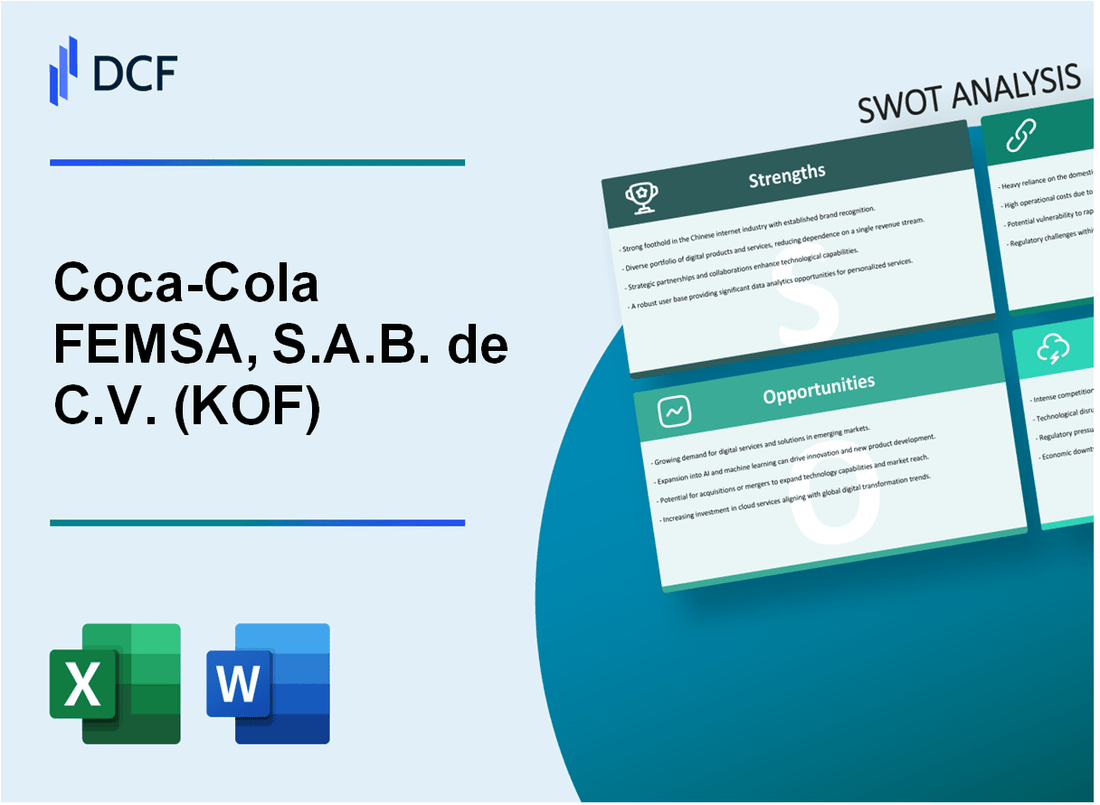
Completamente Editable: Adáptelo A Sus Necesidades En Excel O Sheets
Diseño Profesional: Plantillas Confiables Y Estándares De La Industria
Predeterminadas Para Un Uso Rápido Y Eficiente
Compatible con MAC / PC, completamente desbloqueado
No Se Necesita Experiencia; Fáciles De Seguir
Coca-Cola FEMSA, S.A.B. de C.V. (KOF) Bundle
En el panorama dinámico de la distribución de bebidas latinoamericanas, Coca-Cola FEMSA (KOF) se erige como una potencia, navegando por los desafíos complejos del mercado con destreza estratégica. Este análisis FODA completo revela la intrincada dinámica de una empresa que ha equilibrado el liderazgo del mercado, la diversificación de productos y las estrategias adaptativas en uno de los mercados de bebidas más competitivos del mundo. Desde un sólido desempeño financiero hasta oportunidades emergentes en segmentos de consumidores conscientes de la salud, el posicionamiento estratégico de KOF ofrece una visión fascinante del futuro de la innovación de bebidas y el dominio del mercado regional.
Coca-Cola Femsa, S.A.B. de C.V. (KOF) - Análisis FODA: fortalezas
Liderazgo del mercado en la distribución de bebidas latinoamericanas
Coca-Cola femsa sostiene 53.7% cuota de mercado en el mercado de refrescos mexicanos a partir de 2023. La compañía opera en 10 países En América Latina, incluidos México, Brasil, Colombia y Argentina.
| País | Cuota de mercado | Población atendida |
|---|---|---|
| México | 53.7% | 126 millones |
| Brasil | 38.5% | 212 millones |
| Colombia | 42.3% | 50 millones |
Cartera de productos diversificados
Desglose de la cartera de productos para 2023:
- Refrescos carbonatados: 62%
- Agua: 18%
- Jugo y té: 12%
- Bebidas deportivas: 8%
Red de distribución
Coca-Cola Femsa opera 41 instalaciones de producción en sus territorios, con una red de distribución que cubre 1.7 millones de puntos minoristas.
Desempeño financiero
Lo más destacado financiero para 2023:
- Ingresos totales: $ 10.8 mil millones de USD
- Lngresos netos: $ 1.2 mil millones de USD
- Ebitda: $ 2.1 mil millones de USD
- Tasa de crecimiento de ingresos: 8.3%
Reconocimiento de marca
Métricas de fuerza de la marca:
| Métrico | Valor |
|---|---|
| Valor de marca | $ 4.5 mil millones de USD |
| Índice de lealtad del consumidor | 78% |
| Tasa de reconocimiento de marca | 92% |
Coca-Cola Femsa, S.A.B. de C.V. (KOF) - Análisis FODA: debilidades
Alta dependencia de la región geográfica única (América Latina)
A partir de 2024, Coca-Cola FEMSA opera en 10 países de América Latina, con el 93.4% de los ingresos generados por esta región. La concentración del mercado de la compañía es evidente en el siguiente desglose:
| País | Contribución de ingresos |
|---|---|
| México | 48.7% |
| Brasil | 22.6% |
| Otros países latinoamericanos | 22.1% |
Vulnerabilidad a las fluctuaciones del tipo de cambio de divisas
La volatilidad monetaria afecta significativamente el desempeño financiero de la compañía:
- El peso argentino depreció el 45.2% contra el USD en 2023
- El Real Brasileño perdió el 7,8% del valor contra USD en 2023
- El peso mexicano experimentó una depreciación del 3,5% contra el USD en 2023
Exposición significativa a la volatilidad del precio de la materia prima
Las fluctuaciones de costos de materia prima impactan márgenes operativos:
| Materia prima | Volatilidad de los precios (2023) |
|---|---|
| Azúcar | 17.6% de aumento |
| Latas de aluminio | 12.3% de aumento de precios |
| Plástico para mascotas | 9.7% de escalada de costos |
Altos costos operativos en entornos de distribución complejos
Los desafíos de distribución en América Latina dan como resultado gastos operativos elevados:
- Los costos logísticos representan el 13.4% de los gastos operativos totales
- Costo promedio de distribución por unidad: $ 0.42
- Los gastos de combustible y transporte aumentaron en un 8,9% en 2023
Expansión global limitada en comparación con la compañía matriz Coca-Cola
Comparación de presencia del mercado global:
| Compañía | Países operados | Cuota de mercado global |
|---|---|---|
| Compañía Coca-Cola | 200+ | 48.5% |
| Coca-Cola Femsa | 10 | 5.2% |
Coca-Cola Femsa, S.A.B. de C.V. (KOF) - Análisis FODA: oportunidades
Expandir segmentos de bebidas no carbonatadas con consumidores conscientes de la salud
El mercado global de bebidas no carbonatadas proyectó que alcanzará los $ 1,854.23 mil millones para 2028, con una tasa compuesta anual de 6.2%. Coca-Cola FEMSA se posicionó para capturar la cuota de mercado a través de la diversificación estratégica de productos.
| Categoría de bebida | Tasa de crecimiento del mercado | Segmento de consumo |
|---|---|---|
| Agua | 7.3% | Consumidores conscientes de la salud |
| Té | 5.9% | Millennials y Gen Z |
| Bebidas funcionales | 8.2% | Consumidores orientados al bienestar |
Transformación digital y crecimiento de comercio electrónico en los canales de distribución
Se espera que las ventas de bebidas de comercio electrónico en América Latina alcancen $ 42.5 mil millones para 2025, lo que representa una oportunidad de crecimiento del 15.6% para Coca-Cola FEMSA.
- Inversiones de plataforma digital: $ 87.3 millones en 2023
- Expansión del canal de ventas en línea: 42% de crecimiento año tras año
- Base de usuarios de aplicaciones móviles: 3.2 millones de usuarios activos
Expansión potencial del mercado en mercados emergentes dentro de América Latina
| País | Potencial de mercado | Población |
|---|---|---|
| Brasil | $ 24.5 mil millones | 214 millones |
| Colombia | $ 8.7 mil millones | 51 millones |
| Argentina | $ 12.3 mil millones | 45 millones |
Inversión en embalaje sostenible e iniciativas ambientales
Mercado de envasado sostenible en América Latina proyectada para alcanzar los $ 12.4 mil millones para 2026, con una tasa compuesta anual del 7.5%.
- Uso de plástico reciclado: 35% del embalaje total
- Objetivo de reducción de carbono: 25% para 2030
- Inversión de envases verdes: $ 156 millones
Creciente demanda de productos de bebidas bajas en azúcar y funcionales
Se espera que el mercado de bebidas de bajo azúcar alcance los $ 21.4 mil millones en América Latina para 2025.
| Categoría de productos | Tamaño del mercado | Índice de crecimiento |
|---|---|---|
| Bebidas bajas en azúcar | $ 14.6 mil millones | 9.2% |
| Bebidas funcionales | $ 6.8 mil millones | 11.5% |
Coca-Cola Femsa, S.A.B. de C.V. (KOF) - Análisis FODA: amenazas
Aumento de la conciencia de la salud que conduce a un menor consumo de bebidas azucaradas
El consumo mundial de bebidas azucaradas disminuyó un 3,5% entre 2019-2022. Los mercados latinoamericanos experimentaron una reducción del 2.8% en las compras de bebidas azucaradas. Los consumidores conscientes de la salud están cambiando hacia alternativas de bajo en azúcar y cero azúcar.
| Segmento de mercado | Disminución del consumo (%) | Cambio de preferencias del consumidor |
|---|---|---|
| Bebidas azucaradas | 3.5% | Alternativas de bajo azúcar |
| Mercado latinoamericano | 2.8% | Opciones de azúcar cero |
Intensa competencia de marcas de bebidas locales e internacionales
El panorama competitivo muestra una presión de mercado significativa con múltiples marcas que desafían la participación de mercado de KOF.
- Cuota de mercado de PepsiCo: 22.4%
- Penetración del mercado de marcas locales: 15.7%
- Crecimiento de marcas de bebidas artesanales: 8.3%
Regulaciones gubernamentales estrictas sobre contenido de azúcar y marketing
Entornos regulatorios en países latinoamericanos que implementan directrices de bebidas estrictas:
| País | Impuesto al azúcar (%) | Restricciones de marketing |
|---|---|---|
| México | 10% | Prohibición publicitaria de la zona escolar |
| Brasil | 7.5% | Limitaciones de marketing dirigidas a la juventud |
Inestabilidad económica en países latinoamericanos
Indicadores económicos que destacan los desafíos regionales:
- Tasa de inflación de Argentina: 142.7%
- Venezuela Contracción económica: 35.4%
- Volatilidad del PIB de Brasil: ± 2.5%
Aumento de los costos de producción y transporte
Calificación de costos en áreas operativas clave:
| Componente de costos | Aumento del porcentaje | Impacto |
|---|---|---|
| Materiales de embalaje | 12.6% | Mayores gastos de producción |
| Transporte | 9.3% | Crecimiento de gastos logísticos |
| Materia prima | 7.8% | Presión de la cadena de suministro |
Coca-Cola FEMSA, S.A.B. de C.V. (KOF) - SWOT Analysis: Opportunities
You're looking for clear paths to growth in a complex market, and the opportunities for Coca-Cola FEMSA are rooted in two things: smart capital deployment and a definitive shift in consumer behavior toward low-sugar options. The company is actively investing to secure its future capacity and is seeing impressive, measurable returns from its digital transformation and market diversification.
Capacity Expansion Investment of MX$31.6 Billion in 2025 to Support Future Growth
The most tangible sign of future opportunity is the massive capital expenditure (CAPEX) planned for 2025. Coca-Cola FEMSA is set to receive a record investment of MX$31.6 billion, which represents a significant 6.9% increase over the previous year's spending. This isn't just maintenance; it's a strategic move to debottleneck infrastructure and expand the core business.
Here's the quick math: This allocation makes up 53.7% of FEMSA's total planned CAPEX for 2025, underscoring the parent company's confidence in KOF's long-term growth model. Approximately 40.2% of this investment is earmarked for Mexico, with the remainder targeting the high-potential South American markets. This capital will fund manufacturing and distribution expansion, new returnable packaging, and technology enhancements.
| Investment Component | Strategic Focus |
|---|---|
| Manufacturing & Distribution | Increase production capacity and improve logistics efficiency. |
| Returnable Packaging Acquisition | Enhance sustainability and reduce variable costs over time. |
| Technology Infrastructure | Support the omnichannel strategy, including the Juntos+ platform. |
| Key Market Growth | Targeted expansion in high-growth regions, especially South America. |
Strong Performance in Low-Sugar Categories, Like Coke Zero
Consumer preferences are shifting fast, and KOF is positioned perfectly to capitalize on the demand for low- and no-sugar beverages. In Mexico, a market historically dominated by full-sugar products, the volume of Coca-Cola Zero saw a massive year-on-year increase of 56% in the second quarter of 2025. That's a huge jump.
This growth is critical because it addresses a major public health concern and regulatory risk in Mexico, where an excise tax on sugary drinks exists. By accelerating the transition to zero-calorie options like Coca-Cola Zero, the company is future-proofing its portfolio. The low-sugar category is no longer a niche; it's a primary growth engine.
Digital Platform Growth, as the Juntos+ v4.0 Program Reached 8 Times More Active Users Year-Over-Year
The digital transformation is moving from a project to a core competitive advantage. The Juntos+ B2B omnichannel platform is fundamentally changing how KOF interacts with its customer base (small retailers and traditional trade). The latest version, Juntos+ v4.0, reached 8 times more active users year-over-year in Q2 2025, showing exceptional adoption.
This platform is more than just an ordering app; it's a data-rich ecosystem. It allows for advanced revenue management (RGM) initiatives, personalized promotions, and improved logistics efficiency. By the end of 2024, the platform had already reached 1.3 million active users across Latin America, and this rapid growth in 2025 suggests the network effect is defintely kicking in.
The key benefits of this digital scale are clear:
- Improve salesforce efficiency using AI-enabled tools.
- Increase average ticket size through personalized offers.
- Strengthen customer loyalty via the Premia Juntos+ program.
South America Markets Like Argentina and Uruguay Delivered Volume Growth, Diversifying Regional Reliance
While the Mexico and Central America division faced some volume headwinds in the first half of 2025 due to a challenging macroeconomic backdrop and adverse weather, the South America division showed resilience and diversification. This is a crucial opportunity for balancing risk across the portfolio.
In Q2 2025, the South America division saw a strong 13.2% increase in revenues, with volume growth in Argentina and Uruguay partially offsetting declines in other territories. This trend continued into Q3 2025, where the division's volume increased by 2.6%, driven by growth in Brazil, Colombia, and Argentina. This regional strength provides a necessary hedge against market-specific risks in the core Mexico market.
The strategic action here is simple: double down on the successful revenue management and portfolio execution strategies that are working in these high-inflation, high-growth South American markets.
Coca-Cola FEMSA, S.A.B. de C.V. (KOF) - SWOT Analysis: Threats
Upcoming beverage excise tax increase in Mexico, forecasted to cause low to mid-single digit volume declines in 2026.
The most significant near-term regulatory threat is the proposed beverage excise tax (IEPS) increase in Mexico, which is KOF's largest market. The Mexican House of Representatives approved an 87% hike in the tax on sugar-sweetened beverages, escalating it from Ps. 1.64 to Ps. 3.08 per liter. Plus, a new tax of Ps. 1.5 per liter on non-caloric sweetened beverages is also on the table. This is a massive cost increase that will hit consumers directly.
Management is already forecasting the fallout for 2026, anticipating low to mid-single digit volume declines in the Mexican market. This tax is a direct headwind to volume, and while KOF has a strong track record of using revenue management initiatives to offset such costs, the sheer magnitude of this increase-nearly doubling the current tax-makes it a serious challenge. You must watch the final Senate approval on this one.
Macroeconomic pressures and a softer consumer environment in core markets like Mexico and Brazil.
We are seeing a clear softening in consumer demand, especially in Mexico, which is KOF's core profit engine. The macroeconomic backdrop there remains challenging, and it translated directly into volume contraction in 2025. Here's the quick math on the impact:
- Mexico's volume declined by a significant 10% in the second quarter of 2025.
- The volume decline continued, with Mexico reporting a 3.7% drop in the third quarter of 2025.
While Brazil showed more resilience, with volume increases in Q3 2025, the overall pressure is real. A weaker consumer means KOF has to lean harder on promotional activity and affordability strategies, which, to be fair, puts pressure on the gross margin. The consolidated gross margin for the first nine months of 2025 contracted by 30 basis points to 45.3%, partially driven by this promotional activity and unfavorable mix. That's a direct hit to profitability.
Unfavorable currency translation effects from the depreciation of operating currencies, notably the Argentine peso.
Currency volatility is a constant threat for any multinational operating across Latin America, and 2025 was no exception. The depreciation of operating currencies, particularly the Argentine peso, created an unfavorable translation effect when converting local results back into the Mexican Peso (Ps.) for reporting.
This is a major issue for U.S.-based investors and for KOF's reported consolidated results. For the first nine months of 2025, KOF's total revenues grew by 5.7% on a currency-neutral basis; however, the reported growth was only 5.0%. Here's the simple breakdown of the currency drag:
| Metric (First Nine Months 2025) | As Reported (Ps. Million) | Growth vs. Prior Year | Currency-Neutral Growth | Currency Translation Drag |
| Total Revenues | Ps. 213,984 million | 5.0% | 5.7% | 0.7 percentage points |
| Operating Income | Ps. 29,234 million | 4.3% | 2.9% | (1.4 percentage points) |
What this estimate hides is the impact on raw material costs. KOF pays for many raw materials in U.S. dollars, so a weaker local currency, like the Argentine peso, means higher costs in local terms, which squeezes the gross margin further. It is a double whammy.
Adverse weather conditions in Mexico and Brazil, which have negatively impacted operations in 2025.
Extreme and adverse weather conditions in 2025 have been a tangible operational threat, disrupting the supply chain and consumer demand in key territories. In the second quarter of 2025, the CEO specifically cited adverse weather in Mexico and Brazil as a challenge they had to navigate. The volume decline in Mexico during Q2 2025 (the 10% drop) was partially attributed to this unfavorable weather, including record rainfall.
More recently, the company reported in Q3 2025 that floods in central and Northeast Mexico during October 2025 required a mobilization of support efforts for affected teams and communities. These events don't just reduce sales volume; they also increase non-recurring costs associated with disaster response, logistics, and facility recovery, which defintely strains the operating budget.
Disclaimer
All information, articles, and product details provided on this website are for general informational and educational purposes only. We do not claim any ownership over, nor do we intend to infringe upon, any trademarks, copyrights, logos, brand names, or other intellectual property mentioned or depicted on this site. Such intellectual property remains the property of its respective owners, and any references here are made solely for identification or informational purposes, without implying any affiliation, endorsement, or partnership.
We make no representations or warranties, express or implied, regarding the accuracy, completeness, or suitability of any content or products presented. Nothing on this website should be construed as legal, tax, investment, financial, medical, or other professional advice. In addition, no part of this site—including articles or product references—constitutes a solicitation, recommendation, endorsement, advertisement, or offer to buy or sell any securities, franchises, or other financial instruments, particularly in jurisdictions where such activity would be unlawful.
All content is of a general nature and may not address the specific circumstances of any individual or entity. It is not a substitute for professional advice or services. Any actions you take based on the information provided here are strictly at your own risk. You accept full responsibility for any decisions or outcomes arising from your use of this website and agree to release us from any liability in connection with your use of, or reliance upon, the content or products found herein.