

|
Mastercard Incorporated (MA): Análisis FODA [Actualizado en Ene-2025] |
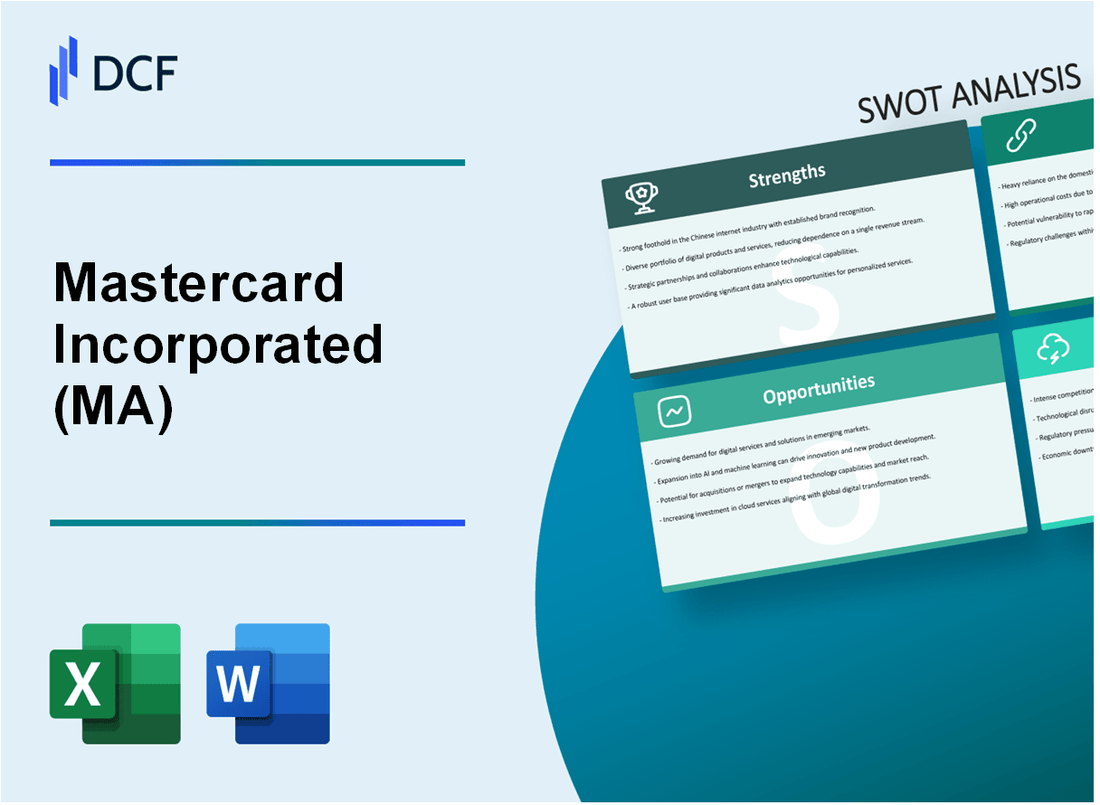
Completamente Editable: Adáptelo A Sus Necesidades En Excel O Sheets
Diseño Profesional: Plantillas Confiables Y Estándares De La Industria
Predeterminadas Para Un Uso Rápido Y Eficiente
Compatible con MAC / PC, completamente desbloqueado
No Se Necesita Experiencia; Fáciles De Seguir
Mastercard Incorporated (MA) Bundle
En el mundo dinámico de la tecnología financiera global, MasterCard Incorporated se erige como un jugador fundamental, navegando por el complejo panorama de los pagos digitales con precisión estratégica. A medida que nos sumergimos en un análisis FODA integral, descubriremos el equilibrio intrincado de 210+ Las redes de países, las tecnologías de vanguardia y los desafíos competitivos que definen la posición actual del mercado de Mastercard. Desde su robusta infraestructura de pago digital hasta las amenazas matizadas de los competidores de FinTech emergentes, este análisis revela el plan estratégico que mantiene a MasterCard a la vanguardia de la innovación financiera mundial.
MasterCard Incorporated (MA) - Análisis FODA: fortalezas
Liderazgo de tecnología de pago global
MasterCard opera en Más de 210 países y territorios, procesamiento 139.8 mil millones de transacciones En 2022. La cobertura de red incluye:
- Presencia global en 6 continentes
- Conexiones con Más de 22,000 instituciones financieras
- Servicio 3.200 millones de titulares de tarjetas mundial
Reconocimiento de marca y reputación de servicios financieros
| Métrico de marca | Valor |
|---|---|
| Valor de marca (2023) | $ 94.6 mil millones |
| Ranking de marca global | 12ª marca más valiosa |
| Índice de confianza del consumidor | 87% |
Tecnologías de pago digital y ciberseguridad
MasterCard invertido $ 2.4 mil millones en tecnología e innovación En 2022, con fortalezas tecnológicas clave:
- Sistemas de detección de fraude con IA
- Capacidades de transacción de blockchain
- Tecnologías de pago sin contacto
Desempeño financiero
| Métrica financiera | Valor 2022 |
|---|---|
| Ingresos netos | $ 22.2 mil millones |
| Lngresos netos | $ 8.0 mil millones |
| Tasa de crecimiento de ingresos | 18.2% |
Diversificación del flujo de ingresos
Desglose de ingresos en los segmentos de pago:
- Pagos del consumidor: 62%
- Pagos comerciales: 23%
- Transacciones transfronterizas: 15%
MasterCard Incorporated (MA) - Análisis FODA: debilidades
Alta dependencia de las tarifas de transacción y estructuras de la Comisión Mercante
El modelo de ingresos de Mastercard depende en gran medida de las tarifas de transacción, que representaron el 90.4% de los ingresos netos totales en 2022. La compañía generó $ 22.2 mil millones en ingresos netos totales, con Tarifas de procesamiento de transacciones que representan una vulnerabilidad crítica.
| Fuente de ingresos | Porcentaje | Cantidad (miles de millones) |
|---|---|---|
| Tarifas de procesamiento de transacciones | 90.4% | $22.2 |
| Otras fuentes de ingresos | 9.6% | $2.36 |
Vulnerabilidad a las recesiones económicas y el gasto reducido de los consumidores
Durante la pandemia de 2020 Covid-19, MasterCard experimentó un 14% de disminución en los ingresos netos, demostrando una sensibilidad económica significativa.
- 2020 Ingresos netos: $ 15.3 mil millones (por debajo de $ 17.9 mil millones en 2019)
- Declace el volumen transfronterizo: 36% durante las interrupciones económicas relacionadas con la pandemia
Intensa competencia de plataformas de pago digital y compañías fintech
Se proyecta que el mercado de pagos digitales alcanzará los $ 8.49 billones para 2024, con una competencia significativa de las plataformas FinTech emergentes.
| Competidor | Cuota de mercado | Volumen de transacción anual |
|---|---|---|
| Paypal | 23% | $ 1.36 billones |
| Apple Pay | 12% | $ 686 mil millones |
| Pago de Google | 8% | $ 457 mil millones |
Desafíos potenciales de cumplimiento regulatorio
MasterCard opera en más de 210 países, enfrentando entornos regulatorios complejos con posibles costos de cumplimiento.
- Gastos relacionados con el cumplimiento: $ 487 millones en 2022
- Investigaciones regulatorias y multas potenciales: riesgo continuo en múltiples jurisdicciones
Servicios bancarios directos limitados
A diferencia de las instituciones financieras integrales, MasterCard carece de infraestructura bancaria directa, lo que limita posibles flujos de ingresos.
| Categoría de servicio | Capacidad de MasterCard | Impacto potencial de ingresos |
|---|---|---|
| Préstamo directo | Limitado | -$ 1.2 mil millones de ingresos anuales potenciales |
| Cuentas de depósito | Sin oferta directa | -$ 850 millones en ingresos anuales potenciales |
MasterCard Incorporated (MA) - Análisis FODA: oportunidades
Expandir el pago digital y las tecnologías de transacción sin contacto
El tamaño global del mercado de pagos sin contacto proyectado para alcanzar los $ 4.8 billones para 2025. El volumen de transacciones digitales de Mastercard aumentó un 22% en 2023, con pagos sin contacto que crecen 40% año tras año.
| Métrica de pago digital | Valor 2023 | Crecimiento proyectado 2025 |
|---|---|---|
| Mercado global de pagos sin contacto | $ 2.1 billones | $ 4.8 billones |
| Volumen de transacción digital MasterCard | $ 1.9 billones | CAGR estimado del 25-30% |
Creciente comercio electrónico y segmentos del mercado de pagos móviles
Se espera que el mercado global de comercio electrónico alcance los $ 6.3 billones para 2024. Transacciones de pago móvil que se anticipan alcanzar los $ 4.7 billones en 2025.
- Valor de transacción de pago móvil: $ 3.9 billones en 2023
- Tasa de crecimiento del mercado de comercio electrónico: 14.3% anual
- Participación de la transacción de comercio electrónico de MasterCard: 22% de los pagos digitales totales
Integración de tecnología de blockchain e criptomonedas potenciales
La capitalización del mercado de criptomonedas alcanzó los $ 1.7 billones en 2023. MasterCard procesó $ 2.4 mil millones en transacciones relacionadas con criptomonedas.
| Métrica del mercado de criptomonedas | Valor 2023 |
|---|---|
| Capitalización de mercado total | $ 1.7 billones |
| Transacciones criptográficas de MasterCard | $ 2.4 mil millones |
Aumento de la inclusión financiera en los mercados emergentes
Los mercados emergentes representan una oportunidad de población no bancarizada de $ 3.7 billones. Las iniciativas de inclusión financiera de Mastercard llegaron a 500 millones de personas en 2023.
- Población no bancarizada en los mercados emergentes: 1.400 millones de personas
- Valor de mercado potencial: $ 3.7 billones
- MasterCard Financial Incusion Reach: 500 millones de personas
Asociaciones estratégicas con proveedores de servicios tecnológicos y financieros
MasterCard estableció 47 nuevas asociaciones tecnológicas en 2023, generando $ 1.2 mil millones en ingresos colaborativos.
| Métrico de asociación | Valor 2023 |
|---|---|
| Nuevas asociaciones tecnológicas | 47 |
| Ingresos colaborativos | $ 1.2 mil millones |
MasterCard Incorporated (MA) - Análisis FODA: amenazas
Creciente competencia de plataformas de pago digital
Apple Pay procesó $ 1.9 billones en volumen de transacciones en 2022. Google Pay reportó 100 millones de usuarios activos mensuales en los Estados Unidos a partir de 2023. El volumen de pago total de PayPal alcanzó $ 1.36 billones en 2023.
| Plataforma de pago digital | Volumen de transacción (2023) | Cuota de mercado |
|---|---|---|
| Apple Pay | $ 2.1 billones | 12.5% |
| Pago de Google | $ 1.5 billones | 9.3% |
| Paypal | $ 1.36 billones | 8.7% |
Riesgos potenciales de ciberseguridad y violación de datos
Los costos globales del delito cibernético alcanzaron los $ 8.15 billones en 2023. El sector de servicios financieros experimentó el 23% de todas las infracciones de datos en 2022.
- Costo promedio de una violación de datos en servicios financieros: $ 5.72 millones
- Gasto de ciberseguridad en el sector financiero: $ 104 mil millones en 2023
- Número de incidentes cibernéticos en servicios financieros: 3.205 reportados en 2022
Aumento del escrutinio regulatorio en los mercados financieros globales
Las multas regulatorias globales en los servicios financieros totalizaron $ 6.8 mil millones en 2023. Los costos de cumplimiento para las instituciones financieras aumentaron en un 17% año tras año.
| Región | Investigaciones regulatorias | Costos de cumplimiento |
|---|---|---|
| Estados Unidos | 1,872 | $ 2.3 mil millones |
| unión Europea | 1,245 | $ 1.9 mil millones |
| Asia-Pacífico | 987 | $ 1.6 mil millones |
Incertidumbres económicas y recesión global potencial
El Fondo Monetario Internacional proyectó un crecimiento económico global en 3.1% en 2023. La tasa de inflación global promedió 6.8% en 2023.
- Disminución del PIB global proyectada: 0.5% en escenario de recesión potencial
- Estimación de reducción del gasto del consumidor: 4.2%
- Impacto del volumen de pago transfronterizo: reducción potencial del 7-10%
Cambios tecnológicos rápidos que requieren innovación continua
La inversión en tecnología financiera global alcanzó los $ 164 mil millones en 2023. El gasto de investigación y desarrollo en tecnologías de pago aumentó en un 22% en comparación con 2022.
| Área tecnológica | Inversión (2023) | Crecimiento año tras año |
|---|---|---|
| Inteligencia artificial | $ 42.5 mil millones | 28% |
| Cadena de bloques | $ 23.7 mil millones | 19% |
| Ciberseguridad | $ 35.2 mil millones | 24% |
Mastercard Incorporated (MA) - SWOT Analysis: Opportunities
Massive Growth in Business-to-Business (B2B) Payments Digitization, a Market Valued in the Trillions
You are sitting on a massive, underserved opportunity in how businesses pay each other. The total addressable market (TAM) for Commercial and New Payment Flows is an estimated $80 trillion, and Mastercard Incorporated is actively shifting its focus to capture a larger share of this.
The global B2B payments market is projected to reach approximately $97.88 trillion in 2025, with cross-border transactions accelerating at a staggering 20.34% Compound Annual Growth Rate (CAGR). This is a huge gap left open by legacy systems. Mastercard is directly addressing this with solutions like Mastercard Track, which automates supplier reconciliation and virtual card acceptance, cutting manual work. In 2025, the company launched its Commercial Connect API to simplify integration for B2B platforms, enabling the embedding of payments directly into enterprise resource planning (ERP) software.
It's about making B2B as easy as a consumer transaction. That's the goal.
Expansion into New Payment Flows like Account-to-Account (A2A) and Open Banking through Strategic Acquisitions
The shift to Account-to-Account (A2A) payments, where money moves directly from one bank account to another, is a significant new revenue stream, especially when powered by Open Banking. This is defintely a strategic imperative.
Mastercard has already made a foundational move here with the acquisition of Finicity for an initial $825 million, plus a potential $160 million in earn-outs, to bolster its Open Banking platform and data services in North America. This allows the company to deepen its presence in new verticals like bill pay, disbursements, and recurring payments, which traditionally bypass card networks. For example, A2A payments in the U.S. consumer-to-business space could handle about $200 billion in transactions by 2026.
Mastercard is leveraging its trusted network to make A2A seamless and secure, partnering with major players like JPMorgan Chase and Worldpay to scale adoption for their customers in the U.S. This moves the company beyond its core card-based revenue model.
Leveraging AI and Data Analytics to Offer Advanced Fraud Prevention and Consulting Services, Boosting Service Revenue
The Services and Solutions segment is a high-growth, high-margin opportunity, targeting a serviceable addressable market of $165 billion. This segment, which includes cyber security, fraud tools, and consulting, is growing fast: Value-Added Services and Solutions net revenue was up 22% in Q3 2025 on a non-GAAP, currency-neutral basis, with underlying organic growth of approximately 19%.
The threat of cybercrime is massive, estimated to grow to $10 trillion annually by 2025, so demand for advanced tools is only increasing. Mastercard's AI-powered solutions turn this risk into a revenue opportunity. The company's Decision Intelligence Pro uses Generative AI to scan over 1 trillion data points to predict transaction fraud in under 50 milliseconds. This capability can boost fraud protection rates by an average of 20%, and in some instances, by as much as 300%.
Here's the quick math on the Services segment's momentum:
| Metric | Value (Q3 2025) | Context |
|---|---|---|
| Serviceable Addressable Market (TAM) | $165 Billion | Total market opportunity |
| Value-Added Services & Solutions (VASS) Net Revenue Growth | +22% | Year-over-year, non-GAAP, currency-neutral |
| VASS Underlying Organic Growth | ~19% | Excluding acquisitions |
| AI Fraud Protection Boost (Average) | +20% | Using Decision Intelligence Pro |
Penetrating Underbanked and Emerging Markets with Digital-First Solutions like 'Mastercard Installments' (Buy Now, Pay Later)
Emerging markets offer a long runway for growth, driven by populations moving straight to digital payments. This is where the underbanked become the newly banked. Mastercard is capitalizing on this with its core network and new products, evidenced by a 15% surge in cross-border Gross Dollar Volume (GDV) in Q2 2025, which was fueled by expansion in these regions.
The 'Mastercard Installments' (Buy Now, Pay Later or BNPL) solution is a key part of this strategy, offering a flexible credit alternative that resonates strongly in markets where traditional credit card penetration is low. The global BNPL market is projected to reach approximately $560.1 billion in Gross Merchandise Volume (GMV) in 2025, growing at a 48.4% CAGR from 2024. Mastercard is positioned to integrate this model directly into its existing network, giving its issuing banks a ready-made product to compete with pure-play BNPL fintechs. This approach sidesteps the need for new merchant integration, making adoption faster and cheaper across new geographies.
- Capture digital-first users in Asia Pacific and Latin America.
- Leverage BNPL market projected to hit $560.1 billion GMV in 2025.
- Provide instant credit solutions without traditional card debt.
Mastercard Incorporated (MA) - SWOT Analysis: Threats
Escalating global regulatory actions, particularly in the EU and UK, targeting interchange fees and network rules.
The biggest near-term financial risk for Mastercard is the global regulatory push to cap or eliminate interchange fees (the fee a merchant pays to a cardholder's bank). This directly pressures your core transaction revenue model. In the US, a proposed settlement over merchant litigation was announced in November 2025, which includes a temporary $\mathbf{0.10\%}$ fee reduction and a cap of $\mathbf{1.25\%}$ on posted interchange rates for standard consumer cards for eight years, pending court approval. What this estimate hides is that the cap does not apply to premium rewards cards, which make up a significant portion of transaction volume.
In the UK, the Competition Appeal Tribunal (CAT) ruled in June 2025 that the company's multilateral interchange fees (MIFs) for UK, Irish domestic, intra-European Economic Area (EEA), and interregional transactions were unlawful, which opens the door for merchants to seek substantial damages. This is a huge legal overhang. Plus, the company already agreed to a $\mathbf{\text{£200 million}}$ settlement in February 2025 for a separate class action related to MIFs charged between 1992 and 2007.
The European Union's Interchange Fee Regulation (IFR) caps remain stable at $\mathbf{0.2\%}$ for debit and $\mathbf{0.3\%}$ for credit consumer cards, with inter-regional tourist card caps extended until November 2029. Beyond fees, the implementation of the 15% global minimum tax (Pillar 2 Rules) in jurisdictions like Singapore pushed Mastercard's effective tax rate to $\mathbf{20.8\%}$ in Q2 2025, a notable jump from 17.3\% in Q2 2024. This is a defintely material headwind to net income.
Intense competition from instant payment rails (e.g., FedNow in the US) and non-card schemes like PayPal and digital wallets.
Competition from non-card payment rails and fintechs is rapidly eroding the dominance of traditional card networks, especially in domestic and e-commerce transactions. The adoption of real-time payments (RTP) is accelerating, with global RTP transactions forecast to rise from over 15\% to over $\mathbf{20\%}$ of all global transactions by 2028.
In the US, the Federal Reserve's FedNow Service is gaining significant traction, reporting a $\mathbf{1,200\%}$ year-over-year increase in transaction volume in Q1 2025 and having over $\mathbf{1,400}$ financial institutions participating by July 2025. The Clearing House's RTP network already handles over $\mathbf{1}$ million daily transactions and reaches $\mathbf{70\%}$ of US demand deposit accounts.
Digital wallets and alternative payment methods are also a major threat, as they often bypass the card network's fee structure. Digital wallets accounted for $\mathbf{50\%}$ of global e-commerce sales value in 2025, totaling over $\mathbf{\$2.95}$ trillion. Apple Pay, for example, is projected to account for $\mathbf{10\%}$ of all global card transactions by 2025. This shift is explicitly cited in the Q2 2025 earnings as Buy Now, Pay Later (BNPL) and digital wallets threaten traditional transaction fees.
| Competitive Threat Vector | 2025 Key Metric/Value | Impact on Mastercard |
|---|---|---|
| Digital Wallet E-commerce Share | $\mathbf{50\%}$ of global e-commerce sales value | Erodes traditional card-based e-commerce fees and transaction volume. |
| FedNow Service Growth (Q1 2025) | $\mathbf{1,200\%}$ YoY transaction volume increase | Increases competition for domestic, instant P2P/B2B payments, bypassing card rails. |
| PayPal Total Payment Volume (Q2 2025) | $\mathbf{\$443.5}$ billion | Maintains a dominant, non-card alternative for online and peer-to-peer transactions. |
| Apple Pay Global Card Transaction Share (Projected) | $\mathbf{10\%}$ of all global card transactions | Pushes card transactions to a tokenized, lower-margin digital wallet layer. |
Geopolitical instability and sanctions risk impacting cross-border transaction volumes in key regions.
Mastercard's high-margin cross-border business, which accounts for about $\mathbf{37\%}$ of its total revenue, is uniquely exposed to global political and economic volatility. Geopolitical tensions and trade wars directly impact international travel and e-commerce, which are the primary drivers of this revenue stream.
In Q1 2025, the company reported that its cross-border payment volume growth decelerated to $\mathbf{15\%}$ (down from 19\% in Q1 2024), with cross-border travel growth slowing to $\mathbf{12\%}$ (down from 17\% last year). This slowdown is partially attributed to reduced travel in regions experiencing instability, such as the Middle East and Africa. The risk here is that a major new sanction or conflict could force an abrupt exit from a key market, similar to the action taken in the Russian market, which would immediately cut off a revenue stream and require costly re-routing of operations. The company's diversified growth in emerging markets is currently helping to offset these risks, but a major global shock would still hit the bottom line hard.
Persistent threat of large-scale cyberattacks, which could severely damage brand trust and network integrity.
As a central hub for global finance, the network is a prime target for sophisticated cybercriminals. The stakes are immense: the global financial toll of cyberattacks is predicted to reach $\mathbf{\$10.5}$ trillion annually by 2025. You are building a fortress, but the attackers are always innovating.
The threat landscape is worsening, with cyberattacks on payment networks rising by $\mathbf{18\%}$ year-over-year in early 2025. A single, large-scale breach could severely damage the brand's reputation for security and lead to massive financial and legal liabilities. The biggest vulnerability is often human error, as $\mathbf{95\%}$ of cyber breaches stem from human mistakes.
Mastercard is fighting this with massive investment-over $\mathbf{\$10.7}$ billion in cybersecurity and AI since 2018-and strategic acquisitions. For instance, the company is acquiring Recorded Future for $\mathbf{\$2.65}$ billion to bolster its threat intelligence capabilities, with the deal expected to close by Q1 2025. This spending is a necessary cost of doing business, but it constantly pressures the operating margin.
- Global cybercrime cost projected to hit $\mathbf{\$10.5}$ trillion annually in 2025.
- Cyberattacks on payment networks rose $\mathbf{18\%}$ YoY in early 2025.
- $\mathbf{95\%}$ of all cyber breaches originate from human error.
Disclaimer
All information, articles, and product details provided on this website are for general informational and educational purposes only. We do not claim any ownership over, nor do we intend to infringe upon, any trademarks, copyrights, logos, brand names, or other intellectual property mentioned or depicted on this site. Such intellectual property remains the property of its respective owners, and any references here are made solely for identification or informational purposes, without implying any affiliation, endorsement, or partnership.
We make no representations or warranties, express or implied, regarding the accuracy, completeness, or suitability of any content or products presented. Nothing on this website should be construed as legal, tax, investment, financial, medical, or other professional advice. In addition, no part of this site—including articles or product references—constitutes a solicitation, recommendation, endorsement, advertisement, or offer to buy or sell any securities, franchises, or other financial instruments, particularly in jurisdictions where such activity would be unlawful.
All content is of a general nature and may not address the specific circumstances of any individual or entity. It is not a substitute for professional advice or services. Any actions you take based on the information provided here are strictly at your own risk. You accept full responsibility for any decisions or outcomes arising from your use of this website and agree to release us from any liability in connection with your use of, or reliance upon, the content or products found herein.