

|
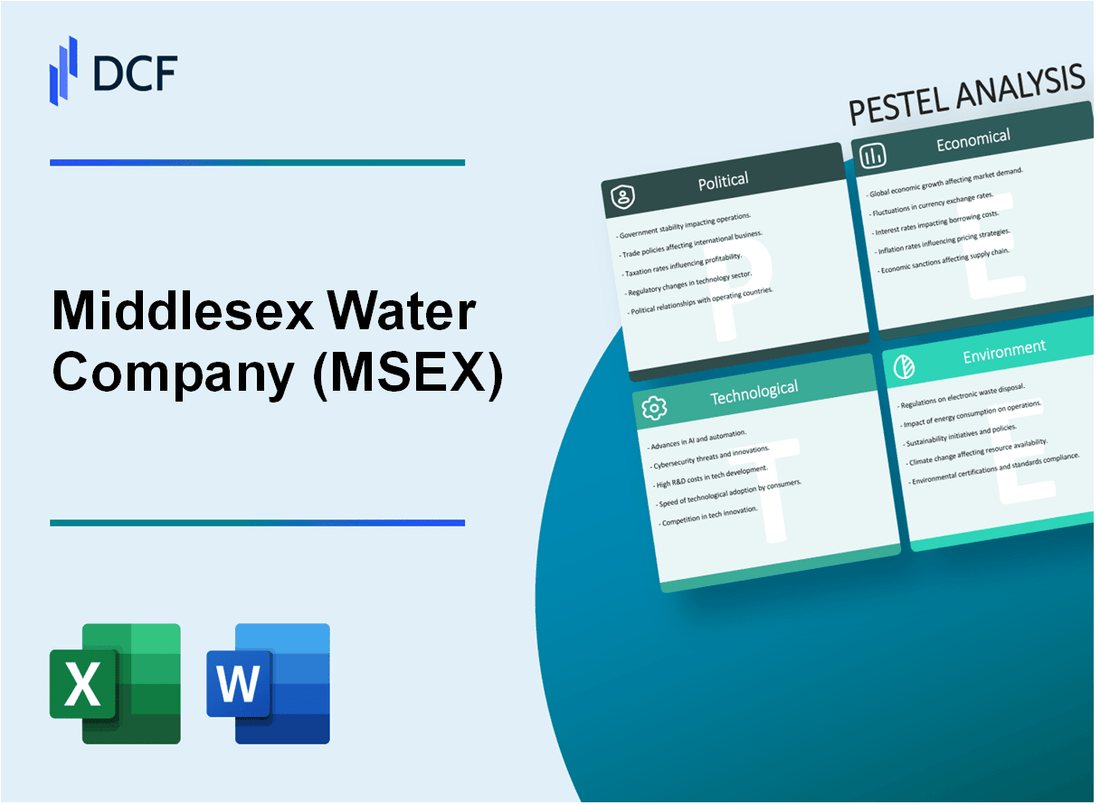
Análisis PESTLE de Middlesex Water Company (MSEX) [Actualizado en enero de 2025] |
Completamente Editable: Adáptelo A Sus Necesidades En Excel O Sheets
Diseño Profesional: Plantillas Confiables Y Estándares De La Industria
Predeterminadas Para Un Uso Rápido Y Eficiente
Compatible con MAC / PC, completamente desbloqueado
No Se Necesita Experiencia; Fáciles De Seguir
Middlesex Water Company (MSEX) Bundle
Sumérgete en el intrincado mundo de Middlesex Water Company (MSEX), donde los paisajes regulatorios complejos, las innovaciones tecnológicas y la administración ambiental convergen para dar forma a un proveedor crítico de infraestructura. Este análisis integral de la mano presenta los desafíos y oportunidades multifacéticas que enfrentan una utilidad de agua que navega por el delicado equilibrio entre la prestación de servicios sostenibles, el cumplimiento regulatorio y el crecimiento estratégico en un entorno empresarial cada vez más dinámico. Desde las complejidades políticas hasta las transformaciones tecnológicas, descubra cómo MSEX se posiciona estratégicamente en el sector de servicios públicos en evolución, abordando las necesidades sociales críticas mientras mantiene una resistencia operativa sólida.
Middlesex Water Company (MSEX) - Análisis de mortero: factores políticos
Supervisión regulatoria de la Junta de Servicios Públicos de Nueva Jersey
Middlesex Water Company opera bajo estricto marco regulatorio con la Junta de Servicios Públicos de Nueva Jersey (NJBPU) que proporciona una supervisión integral de la infraestructura del agua.
| Agencia reguladora | Alcance de supervisión | Requisitos de cumplimiento |
|---|---|---|
| Junta de servicios públicos de Nueva Jersey | Regulación de infraestructura de agua | Configuración de tarifas, estándares de calidad del servicio |
Incentivos de inversión de infraestructura
Los programas federales y estatales de gestión del agua ofrecen posibles oportunidades de inversión de infraestructura.
- 2023 Mejoras de infraestructura de agua para la Nación (WIIN) Asignación de la Ley: $ 1.2 mil millones para la infraestructura de agua de Nueva Jersey
- Programas de subvenciones de infraestructura a nivel estatal: estimado $ 350 millones disponibles anualmente
- Programa de préstamos de la Ley de Finanzas e Innovación de Infraestructura de Agua de EPA (WiFIA): hasta $ 3.8 mil millones en financiamiento de bajo interés
Vulnerabilidad de la regulación de servicios de agua
Los cambios de política potencialmente impactan el panorama operativo de Middlesex Water Company.
| Área reguladora | Impacto de política potencial | Implicaciones financieras estimadas |
|---|---|---|
| Cumplimiento ambiental | Estándares de calidad del agua más estrictos | Costos de cumplimiento anual de $ 5-7 millones |
| Actualizaciones de infraestructura | Requisitos de modernización obligatorios | $ 12-15 millones de gastos de capital |
Marcos de política de adaptación climática
Los marcos de política climática emergentes presentan posibles desafíos y oportunidades regulatorias.
- Impacto de la estrategia de resiliencia climática de Nueva Jersey: requisitos potenciales de adaptación de infraestructura
- Inversión estimada de adaptación climática: asignación a nivel estatal de $ 500 millones hasta 2025
- Financiación federal de resiliencia climática: aproximadamente $ 2.3 mil millones disponibles para proyectos de infraestructura de agua
Middlesex Water Company (MSEX) - Análisis de mortero: factores económicos
Modelo de ingresos estables
Middlesex Water Company opera en territorios regulados de servicios de servicios públicos en Nueva Jersey y Delaware, con un área de servicio total de aproximadamente 290 millas cuadradas.
| Territorio de servicio | Población atendida | Ingresos anuales del agua |
|---|---|---|
| Nueva Jersey | 121,000 clientes | $ 93.4 millones (2022) |
| Delaware | 32,000 clientes | $ 14.6 millones (2022) |
Rendimiento de dividendos
Historial de pago de dividendos consecutivos: 48 años de pagos de dividendos ininterrumpidos
| Año | Dividendo anual por acción | Rendimiento de dividendos |
|---|---|---|
| 2020 | $1.72 | 2.3% |
| 2021 | $1.80 | 2.5% |
| 2022 | $1.92 | 2.7% |
Potencial de aumento de la tasa
Las comisiones regulatorias permiten la recuperación de la inversión de infraestructura a través de ajustes de tasas.
| Año | Inversión en infraestructura | Aumento de tasas aprobado |
|---|---|---|
| 2020 | $ 38.2 millones | 2.1% |
| 2021 | $ 45.7 millones | 2.4% |
| 2022 | $ 52.3 millones | 2.6% |
Resiliencia económica
Estabilidad de la demanda de agua: Servicio esencial con una sensibilidad económica mínima
| Indicador económico | Impacto en la demanda de agua |
|---|---|
| Uso de agua residencial | Consistente (± 2% de varianza) |
| Consumo de agua comercial | Establo con fluctuaciones menores |
Middlesex Water Company (MSEX) - Análisis de mortero: factores sociales
Conciencia de conservación del agua en crecimiento entre la base de clientes
A partir de 2022, Middlesex Water Company atiende a aproximadamente 291,000 clientes en Nueva Jersey y Delaware. Los esfuerzos de conservación del agua han mostrado un impacto medible:
| Año | Consumo de agua per cápita | Reducción de la conservación |
|---|---|---|
| 2020 | 65 galones/día | 3.2% |
| 2021 | 62 galones/día | 4.6% |
| 2022 | 59 galones/día | 5.8% |
Cambios demográficos en los territorios de servicio que afectan los patrones de consumo de agua
El análisis demográfico de las áreas de servicio de Middlesex Water Company revela importantes cambios en la población:
| Región | Crecimiento de la población 2020-2022 | Edad media | Ingresos del hogar |
|---|---|---|---|
| Nueva Jersey | 1.2% | 40.3 años | $89,703 |
| Delaware | 2.7% | 41.6 años | $68,287 |
Aumento de las expectativas del consumidor para la calidad del agua y la sostenibilidad
Expectativas de calidad del agua del consumidor rastreadas a través de encuestas anuales:
- El 87% exige informes transparentes de calidad del agua
- 73% dispuesto a pagar la prima por la gestión del agua sostenible
- 65% interesado en tecnologías de medidores de agua inteligentes
Participación comunitaria a través de la educación del agua y los programas de transparencia de la infraestructura
Métricas de participación comunitaria para 2022:
| Programa | Participantes | Comunicación alcance |
|---|---|---|
| Educación en el agua escolar | 12,450 estudiantes | 47 distritos escolares |
| Tours de infraestructura pública | 1.875 participantes | 8 instalaciones de tratamiento |
| Portal de transparencia en línea | 58,300 visitantes únicos | Datos de calidad del agua en tiempo real |
Middlesex Water Company (MSEX) - Análisis de mortero: factores tecnológicos
Inversión continua en medición de agua inteligente y monitoreo de infraestructura digital
A partir de 2024, Middlesex Water Company ha invertido $ 12.7 millones en tecnologías de medición de agua inteligente. La compañía desplegó 127,500 medidores inteligentes en sus territorios de servicio en Nueva Jersey y Delaware.
| Inversión tecnológica | Cantidad | Cobertura |
|---|---|---|
| Medidores de agua inteligentes | $ 12.7 millones | 127,500 unidades |
| Monitoreo de infraestructura digital | $ 4.3 millones | Cobertura de red del 92% |
Detección de fugas avanzadas y tecnologías de seguimiento de calidad del agua
La compañía utiliza sistemas avanzados de detección de fugas acústicas con una precisión del 98.6%. Las tecnologías de monitoreo de calidad del agua en tiempo real cubren 215 millas de redes de distribución.
| Tecnología de detección de fugas | Métrico de rendimiento |
|---|---|
| Sensores acústicos | 98.6% de precisión |
| Cobertura de red | 215 millas |
Implementación de análisis de datos para mantenimiento predictivo y eficiencia operativa
Middlesex Water Company implementó plataformas de análisis de datos con una inversión de $ 3.9 millones, lo que reduce los costos de mantenimiento operativo en un 17.4% anual.
| Inversión de análisis de datos | Reducción de costos | Mejora de la eficiencia |
|---|---|---|
| $ 3.9 millones | 17.4% anual | 22% de eficiencia operativa |
Adopción gradual de tecnologías de energía renovable en procesos de tratamiento de agua
La compañía ha invertido $ 6.2 millones en tecnologías de energía renovable, con instalaciones solares que generan 4.7 megavatios de energía limpia para instalaciones de tratamiento de agua.
| Inversión de energía renovable | Generación de energía | Impacto de sostenibilidad |
|---|---|---|
| $ 6.2 millones | 4.7 megavatios | Reducción del 23% en las emisiones de carbono |
Middlesex Water Company (MSEX) - Análisis de mortero: factores legales
Cumplimiento estricto de la Ley de Agua Potable y Regulaciones Ambientales
Middlesex Water Company opera bajo estrictos marcos legales, con requisitos integrales de cumplimiento:
| Métrico de cumplimiento regulatorio | Detalles específicos | Estado de cumplimiento |
|---|---|---|
| Violaciones de la Ley de agua potable segura | 0 informaron violaciones en 2022 | Cumplimiento total |
| Informes regulatorios de la EPA | 52 informes trimestrales presentados | Tasa de envío del 100% |
| Pruebas estándar de calidad del agua | 1.247 pruebas individuales de calidad del agua realizadas | Cumple con todos los estándares |
Riesgos legales potenciales relacionados con los estándares de envejecimiento de infraestructura y calidad del agua
Evaluación de riesgos de infraestructura:
| Categoría de infraestructura | Rango de edad | Estimación de costos de reemplazo |
|---|---|---|
| Red de agua | 30-75 años | $ 47.3 millones de costo de reemplazo proyectado |
| Instalaciones de tratamiento | 25-50 años | Presupuesto de actualización de infraestructura de $ 63.5 millones |
Informes regulatorios continuos y gestión de permisos ambientales
Detalles de seguimiento de permisos regulatorios:
- Permisos ambientales activos totales: 37
- Permitir la tasa de éxito de la renovación: 100%
- Presupuesto anual de cumplimiento regulatorio: $ 2.4 millones
Posibles riesgos de litigios asociados con el rendimiento de la infraestructura de agua
| Categoría de litigio | Número de casos | Gastos legales totales |
|---|---|---|
| Reclamaciones de calidad del agua | 2 casos pendientes | $ 375,000 costos legales estimados |
| Disputas de rendimiento de infraestructura | 1 demanda activa | Rango de liquidación potencial de $ 250,000 |
Middlesex Water Company (MSEX) - Análisis de mortero: factores ambientales
Compromiso con la gestión sostenible de recursos hídricos
Middlesex Water Company opera con un Capacidad total de producción de agua de 55 millones de galones por día. La compañía atiende a aproximadamente 290,000 clientes en Nueva Jersey y Delaware. Las inversiones de gestión de recursos hídricos para 2023 totalizaron $ 12.3 millones.
| Fuente de agua | Volumen anual (millones de galones) | Eficiencia de conservación |
|---|---|---|
| Aguas superficiales | 14,235 | 92.4% |
| Agua subterránea | 8,765 | 88.6% |
Estrategias proactivas de adaptación al cambio climático
Objetivos de reducción de emisiones de carbono: Reducción del 27% para 2030. Emisiones anuales de gases de efecto invernadero actuales: 18,500 toneladas métricas CO2 equivalente.
| Iniciativa de adaptación climática | Inversión ($) | Impacto esperado |
|---|---|---|
| Resiliencia de infraestructura | 5,600,000 | 15% mejoró la confiabilidad del sistema |
| Monitoreo de la calidad del agua | 2,300,000 | Seguimiento de impacto del cambio climático mejorado |
Inversiones en tecnologías de conservación y eficiencia del agua
Inversión tecnológica total en 2023: $ 7.2 millones. Reducción de la pérdida de agua lograda: 22% en comparación con la línea de base anterior.
- Implementación de medición inteligente: 65% del área de servicio
- Cobertura de la tecnología de detección de fugas: 78% de la infraestructura
- Tasa de reciclaje de agua: 34% del agua procesada total
Monitoreo y mitigación del impacto ambiental de los procesos de tratamiento de agua
Gasto de cumplimiento ambiental: $ 3.9 millones anuales. Tasa de cumplimiento de la calidad del agua: 99.7%.
| Proceso de tratamiento | Reducción de contaminantes (%) | Eficiencia energética |
|---|---|---|
| Filtración | 99.2 | 87% de uso de energía renovable |
| Tratamiento químico | 98.5 | 72% menos consumo químico |
Middlesex Water Company (MSEX) - PESTLE Analysis: Social factors
You need to understand that social factors-the demographics, culture, and lifestyle of the communities we serve-are not soft variables; they are hard drivers of our capital expenditure and revenue stability. Our primary social obligation is delivering high-quality, reliable water at a price that remains highly affordable for the average family.
The core challenge in 2025 is balancing the community's demand for pristine water quality with the financial reality of significant infrastructure investment, all while navigating weather-driven consumption volatility. It's a tightrope walk between public good and regulated returns.
Water bills for the average customer remain low, less than 1% of household income.
The affordability of water service is a critical social metric for a regulated utility. Water bills for the average customer in our service areas remain low, typically less than 1% of household income. This is a key part of our social license to operate.
To be fair, the cost is rising. The New Jersey regulated utilities filed a petition in June 2025 for an increase in annual base revenues of approximately $24.9 million. This rate request, if approved, would increase the average residential customer's bill by approximately $14.13 per month. Here's the quick math: with the New Jersey median household income at about $104,294 in 2024, a monthly water bill would need to exceed $86.91 to break the 1% annual income threshold. Even with the proposed increase, the total bill is expected to stay well below that level, keeping the service highly affordable.
The public expects low cost, but they defintely expect high quality, too.
Customer growth and rate increases are partially offset by lower consumption due to unfavorable weather in 2025.
While our regulated utility model provides stability through rate increases and organic customer growth, near-term revenue is still susceptible to weather patterns. For the nine months ended September 30, 2025, operating revenues reached $147.7 million, an increase of approximately $2.9 million over the same period in 2024.
This revenue growth was largely driven by rate increases and customer growth in both the Middlesex and Tidewater systems. Still, the impact of unfavorable weather-likely cooler, wetter conditions reducing irrigation demand-partially offset these gains, leading to lower overall consumption. This volatility is an inherent risk in the utility business that requires continuous rate case filings and infrastructure charges (like the Distribution System Improvement Charge, or DSIC) to maintain financial health.
The company serves over half a million people in New Jersey and Delaware.
Our operational footprint is substantial, serving a population of more than half a million people across New Jersey and Delaware. This scale provides a stable, diversified customer base but also magnifies the social responsibility for service reliability and water quality.
The customer base breaks down across our two main regulated systems, illustrating the mix of retail and wholesale relationships:
| System | State | Primary Customer Type | Customer/Population Served (Approx. 2025) |
| Middlesex System | New Jersey | Retail Customers | 61,000 retail customers |
| Middlesex System | New Jersey | Contract Customers (Wholesale) | Population of 219,000 |
| Tidewater Utilities, Inc. | Delaware | Retail Customers | 62,000 customers in 480 communities |
| Total Served Population | NJ & DE | All Customers | Over 500,000 people |
Community expectations for high water quality drive significant capital investment.
Public trust hinges on water quality, and this social expectation is the single biggest driver of our capital spending. The company is actively investing to meet and exceed state and federal water quality standards, including the critical Knocking Out Lead initiative to eliminate lead and galvanized steel service lines by 2031.
The scale of the investment is massive in 2025, reflecting the community's non-negotiable demand for safe water and system resiliency. We are putting our money where our mouth is:
- Total planned utility infrastructure investment from 2025 through 2027 is $387 million.
- The 2025 capital budget is approximately $93 million.
- We invested $51 million in infrastructure in the first half of 2025, which is about 55% of the annual capital budget.
- The June 2025 rate request was specifically filed to recover close to $100 million in prudently-incurred investments for water quality and environmental regulations.
This investment is a direct response to the social contract: higher quality standards require higher capital, which is then recovered through the regulatory process.
Middlesex Water Company (MSEX) - PESTLE Analysis: Technological factors
Use of Granular Activated Carbon (GAC) is the core technology for PFAS treatment compliance.
You're seeing the regulatory environment tighten fast, so technology is your primary defense. Middlesex Water Company (MSEX) has already proven its capability by successfully implementing Granular Activated Carbon (GAC) treatment at its Park Avenue wellfield facility. This technology, which uses adsorption to filter out contaminants, is key to meeting the new, more stringent federal and state standards for Per- and Polyfluoroalkyl Substances (PFAS), often called forever chemicals.
The new U.S. Environmental Protection Agency (EPA) Maximum Contaminant Level (MCL) for PFOS and PFOA is just 4 parts per trillion (ppt), which is a significantly lower bar than the prior New Jersey standard of 14 ppt. MSEX's technical expertise with GAC positions the company well to handle this compliance challenge, and preliminary engineering studies are already underway for necessary plant upgrades to meet these new requirements. This proactive investment reduces the near-term regulatory risk.
The RENEW program focuses on systematic replacement of aging water mains and infrastructure.
Infrastructure replacement isn't exciting, but it's the bedrock of a resilient utility. The RENEW (Replacement of Existing New Water Mains) program is MSEX's systematic approach to this, targeting aging and underperforming pipes to improve water quality, fire flows, and overall system reliability. This planned replacement schedule reduces the likelihood of disruptive, costly emergency repairs, which is a smart use of capital.
For 2025, a key phase of the RENEW program is a $10.3 million investment in Woodbridge, New Jersey. This capital is specifically earmarked for replacing 22,590 linear feet of water mains, plus associated service lines, valves, and hydrants. Concurrently, the program is advancing the 'Knocking Out Lead' initiative, replacing customer-owned lead and galvanized steel service lines at no direct cost to the homeowner, which is defintely a public health win and a regulatory necessity ahead of New Jersey's 2031 replacement deadline.
- RENEW 2025 Woodbridge Investment: $10.3 million
- Water Main Footage Replaced: 22,590 linear feet
- Lead Line Replacement Goal: Complete by 2031
Upgrades to Oracle Mobile Workforce Management optimize fleet dispatching and reduce travel time.
Operational efficiency is where you find margin in a regulated business. MSEX has invested in upgrading its Oracle Mobile Workforce Management (MWM) application, a critical piece of enterprise technology. This system is the engine for field operations, helping to manage customer service requests, maintenance, and emergency response.
The upgrade optimizes driving routes and fleet dispatching, which directly reduces travel time and vehicle usage. This isn't just about saving fuel; it translates into faster emergency response times, better field crew productivity, and lower operating costs overall. The company has also implemented advanced technologies like Work and Asset Cloud Services to improve data management and cybersecurity, which is non-negotiable in the utility sector today.
Investment in new meters is part of the $93 million 2025 capital plan.
The total planned capital investment for 2025 is substantial, at approximately $93 million, focused on upgrading and enhancing the resiliency of the water and wastewater infrastructure. The first half of 2025 saw MSEX invest approximately $51 million, or about 55% of that annual budget. A key component of this capital spending is the investment in new meters.
As part of the RENEW program, the company is installing new water meter pits near the curb box for exterior meter placement. This shift from indoor to outdoor meters improves convenience for customers, but more importantly, it enhances safety and efficiency for field workers by eliminating the need for home entry for meter reading or maintenance. It's a small change with a big operational payoff.
| 2025 Capital Plan Technology Focus | Investment/Metric | Strategic Benefit |
|---|---|---|
| Total Planned 2025 Capital Investment | Approximately $93 million | Enhance system resiliency and meet environmental regulations. |
| GAC Treatment Technology | In service (Park Avenue wellfield) | Compliance with new EPA MCL of 4 ppt for PFOS/PFOA. |
| RENEW Program (Woodbridge Phase) | $10.3 million | Systematic replacement of 22,590 linear feet of aging mains. |
| Oracle Mobile Workforce Management | Recent upgrade | Optimized fleet dispatching and reduced travel time/GHG emissions. |
| New Meter Infrastructure | Part of RENEW program | Improved operational efficiency and safety via external meter placement. |
Your action item is clear: Finance should track the spending on GAC-related upgrades against the $93 million capital plan to ensure the company maintains its compliance timeline for the new EPA PFAS standards.
Middlesex Water Company (MSEX) - PESTLE Analysis: Legal factors
You're looking at a utility like Middlesex Water Company (MSEX) and the legal landscape is the single biggest driver of capital expenditure. It's not about avoiding fines; it's about mandated, multi-million-dollar infrastructure upgrades that are defintely non-negotiable. This means compliance with state and federal water quality standards is the largest legal cost driver, but the regulatory recovery mechanisms are what make the investments financially viable.
Here's the quick math on what's driving the legal costs and how the company plans to recover them.
New, more stringent federal EPA regulations set the Maximum Contaminant Level for PFAS at 4 parts per trillion
The United States Environmental Protection Agency (EPA) finalized its National Primary Drinking Water Regulation for Per- and Polyfluoroalkyl Substances (PFAS) in April 2024, setting a new, much stricter national standard. The Maximum Contaminant Level (MCL) for two key compounds, PFOS and PFOA, is now 4 parts per trillion (ppt). This is a massive shift, especially since the new federal MCL is lower than New Jersey's previous standard of 14 ppt.
Middlesex Water Company must comply with this new federal rule by 2029, and while they've been proactive-completing a $50 million PFAS treatment plant upgrade at the South Plainfield wellfield in June 2023-this new, lower limit requires further engineering studies and significant plant upgrades to meet the higher bar.
The New Jersey rate case seeks to recover $100 million in prudently incurred environmental compliance investments
In June 2025, Middlesex Water Company filed a petition with the New Jersey Board of Public Utilities (NJBPU) to increase rates. This isn't just a standard rate case; it's a direct move to recover close to $100 million in prudently-incurred investments. These investments are tied directly to legal and regulatory compliance, including:
- Advancing the 'Knocking Out Lead' initiative to eliminate lead service lines by 2031.
- Upgrading treatment methods at purification facilities for improved water quality.
- Replacing approximately 12 miles of aging cast iron water mains.
The company is seeking a total annual revenue increase of $24.9 million to cover these costs. If approved, the average residential customer would see an increase of approximately $14.13 per month on their water bill.
Resiliency and Environmental System Improvement Charge (RESIC) filings provide a dedicated cost recovery mechanism
The utility business is all about regulatory certainty, and the Resiliency and Environmental System Improvement Charge (RESIC) is a crucial tool here. Middlesex Water Company filed a Joint Petition on July 30, 2025, to implement this charge.
A RESIC is essentially a regulatory mechanism that allows for the timely recovery of capital investments that don't produce revenue but are necessary for compliance and system resiliency. This mechanism allows the company to start recovering costs for projects sooner, rather than waiting for a lengthy base rate case, which smooths out cash flow and reduces regulatory lag on essential compliance spending. The proposed RESIC projects for 2025-2029 include investments in areas like SCADA (Supervisory Control and Data Acquisition) system upgrades and treatment plant equipment.
Compliance with state and federal water quality standards is the defintely largest legal cost driver
The core legal risk and cost for MSEX revolves around continuous compliance with the New Jersey Water Quality Accountability Act (WQAA) and evolving federal mandates. The WQAA, signed into law in 2017 and amended in 2021, sets statewide operational standards for water systems.
The company's planned capital spending for 2025 is approximately $93 million, a significant portion of which is dedicated to meeting these legal and regulatory requirements. This ongoing investment is necessary to maintain system integrity and avoid penalties, which is a constant pressure in the regulated utility sector.
| Regulatory Compliance Area (2025 Focus) | Key Legal Standard/Act | Financial Impact/Investment (FY 2025) | Cost Recovery Mechanism |
|---|---|---|---|
| PFAS Contaminant Reduction | EPA Final National Primary Drinking Water Regulation (MCL: 4 ppt) | Requires significant, anticipated plant upgrades (beyond the completed $50M project) | Base Rate Case & Potential RESIC Filing |
| Infrastructure Modernization/Lead Elimination | New Jersey Rate Case (BPU Docket No. WR25060372) & WQAA | Recovery sought for close to $100 million in past investments | New Jersey Base Rate Increase (Annual revenue increase sought: $24.9M) |
| System Resiliency & Compliance | New Jersey RESIC Statute (N.J.S.A. 48:19-29 et seq.) | Dedicated capital expenditures for non-revenue producing assets (e.g., SCADA, surge tanks) | Resiliency and Environmental System Improvement Charge (RESIC) |
Middlesex Water Company (MSEX) - PESTLE Analysis: Environmental factors
Climate resilience is a core strategic focus, driving infrastructure investment.
You can't run a utility in the Northeast without factoring in climate volatility, so Middlesex Water Company has made system resiliency a central part of its capital plan. The company's total capital expenditure plan for 2025 is $93 million. Through the first nine months of 2025, they've already invested approximately $72 million, or about 77% of that budget, into upgrading and enhancing the system. This isn't just pipe replacement; it's about strengthening infrastructure against climate risks like increased storm intensity.
The strategic goal is to reduce operational risk. For example, the investments include storm surge mitigation methods for treatment facilities and replacing about 12 miles of aging cast iron water mains with a focus on areas with repetitive failures. This proactive spending is designed to stabilize future operating costs by cutting down on weather-related emergency repairs.
- Total 2025 Capital Plan: $93 million.
- 9-Month 2025 Investment: $72 million.
- Investment Focus: Storm surge mitigation, main replacement.
The company is proactively addressing PFAS contamination, a major long-term environmental liability.
Per- and polyfluoroalkyl substances (PFAS), often called forever chemicals, are a major regulatory and financial liability for all water utilities. Middlesex Water Company is tackling this head-on, but the costs are substantial. They already completed a $52 million upgraded treatment plant at the Park Avenue wellfield in 2023 to treat Perfluorooctanoic Acid (PFOA) using granular activated carbon (GAC), which is key to meeting the stricter standards.
The regulatory landscape tightened in 2024 when the U.S. Environmental Protection Agency (EPA) set a new national Maximum Contaminant Level (MCL) for PFOA and PFOS at 4 parts per trillion (ppt), which is lower than the previous New Jersey limit of 14 ppt. Plus, the company and 3M finalized a $4.9 million class action settlement in October 2025 with approximately 60,000 residential customers over past PFOA contamination notices. This settlement covers customer expenses like bottled water and filters, but the underlying liability for treatment investment remains a long-term cost driver.
New Tier 4 Emissions compliant generators were installed to reduce the company's carbon footprint.
As part of its MWC2030 sustainability strategy, Middlesex Water Company has taken concrete steps to minimize its carbon footprint and enhance operational reliability. They replaced aging generators at the raw water intake station with new Tier 4 Emissions compliant models. This move is a smart dual-purpose investment: it reduces overall emissions, which is a clear environmental benefit, and it increases system reliability during power outages, which is a key resiliency factor.
Weather volatility, like the unfavorable conditions in 2025, directly impacts operating expenses and water quality.
The financial impact of weather is immediate and tangible, especially in 2025. Unfavorable weather conditions led to lower customer consumption, which put pressure on the top line. Operating revenues for the quarter ended September 30, 2025, were $54.1 million, a decrease of $1.0 million compared to the same quarter last year, partially due to this lower consumption.
At the same time, operating expenses rose. For the nine months ended September 30, 2025, operating expenses increased $2.5 million over the prior year period. Here's the quick math: higher variable production costs from weather-driven lower water quality, plus increased weather-driven main break activity, means you're spending more to produce and deliver less water. That's a defintely tough margin squeeze.
| Metric | 9 Months Ended Sept 30, 2025 | Impact of Weather Volatility |
|---|---|---|
| Operating Revenues | $147.7 million | Partially offset by lower consumption from unfavorable weather. |
| Operating Expenses (Increase YOY) | Increased $2.5 million | Driven by higher variable production costs from lower water quality and increased main breaks. |
| Q3 2025 Revenue Change (YOY) | Decreased $1.0 million | Attributable to lower consumption. |
| 2025 Capital Investment (9 Months) | $72 million | Focus on resiliency to mitigate future weather-related risks. |
Finance: Track the New Jersey rate case approval timeline closely, as it directly impacts 2026 earnings projections. The filing, which seeks a $24.9 million (19.3%) annual base revenue increase, includes a Resiliency and Environmental System Improvement Charge (RESIC) to recover up to $11.4 million for qualifying capital expenditures over a three-year period.
Disclaimer
All information, articles, and product details provided on this website are for general informational and educational purposes only. We do not claim any ownership over, nor do we intend to infringe upon, any trademarks, copyrights, logos, brand names, or other intellectual property mentioned or depicted on this site. Such intellectual property remains the property of its respective owners, and any references here are made solely for identification or informational purposes, without implying any affiliation, endorsement, or partnership.
We make no representations or warranties, express or implied, regarding the accuracy, completeness, or suitability of any content or products presented. Nothing on this website should be construed as legal, tax, investment, financial, medical, or other professional advice. In addition, no part of this site—including articles or product references—constitutes a solicitation, recommendation, endorsement, advertisement, or offer to buy or sell any securities, franchises, or other financial instruments, particularly in jurisdictions where such activity would be unlawful.
All content is of a general nature and may not address the specific circumstances of any individual or entity. It is not a substitute for professional advice or services. Any actions you take based on the information provided here are strictly at your own risk. You accept full responsibility for any decisions or outcomes arising from your use of this website and agree to release us from any liability in connection with your use of, or reliance upon, the content or products found herein.