

|
Schlumberger Limited (SLB): Análisis PESTLE [Actualizado en enero de 2025] |
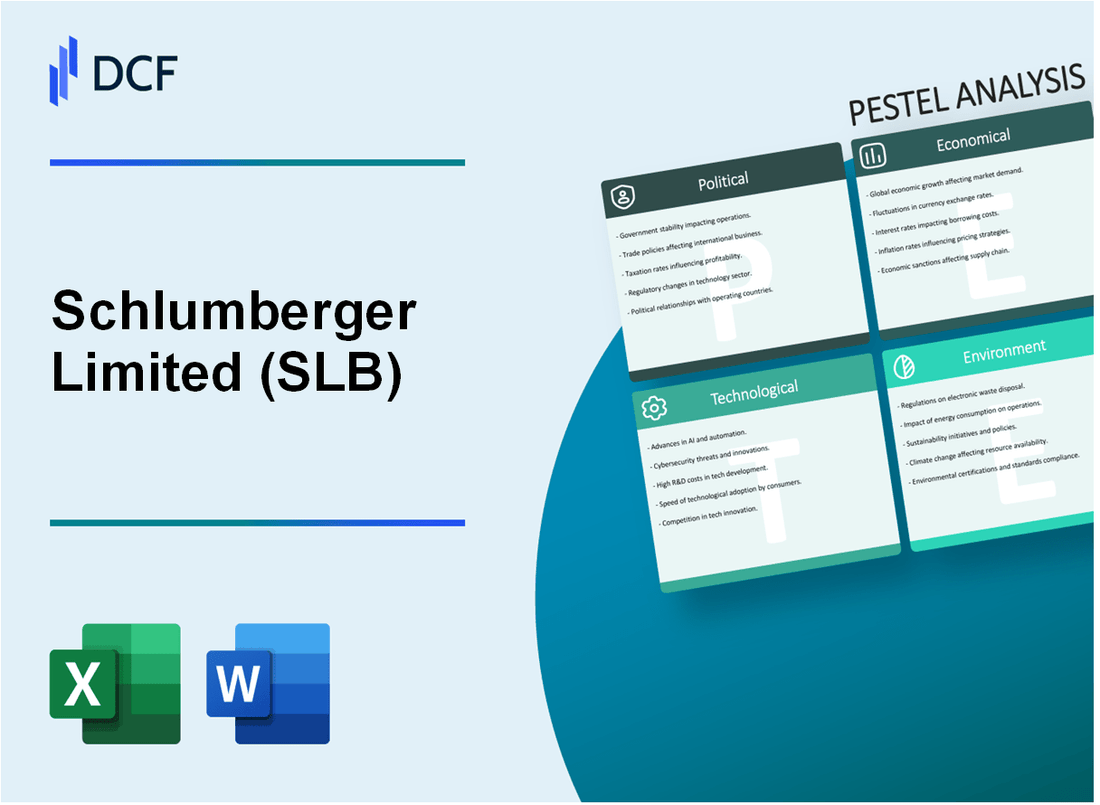
Completamente Editable: Adáptelo A Sus Necesidades En Excel O Sheets
Diseño Profesional: Plantillas Confiables Y Estándares De La Industria
Predeterminadas Para Un Uso Rápido Y Eficiente
Compatible con MAC / PC, completamente desbloqueado
No Se Necesita Experiencia; Fáciles De Seguir
Schlumberger Limited (SLB) Bundle
En el mundo dinámico de los Servicios de Energía Global, Schlumberger Limited (SLB) se destaca como una compleja potencia tecnológica que navega por un intrincado panorama de desafíos geopolíticos, incertidumbres económicas y cambios tecnológicos transformadores. Este análisis integral de mortero presenta los factores externos multifacéticos que dan forma a la trayectoria estratégica de la compañía, revelando cómo un gigante líder de servicios petroleros debe adaptarse constantemente a presiones políticas, económicas, sociológicas, tecnológicas, legales y ambientales que definen el ecosistema de energía moderno.
Schlumberger Limited (SLB) - Análisis de mortero: factores políticos
Regiones operativas geopolíticamente complejas
Schlumberger opera en 120 países con presencia significativa en regiones políticamente sensibles. A partir de 2024, la compañía mantiene operaciones en:
| Región | Nivel de riesgo político | Proyectos activos |
|---|---|---|
| Oriente Medio | Alto | 37 proyectos activos |
| Rusia | Extremo | 12 proyectos activos |
| Venezuela | Crítico | 5 proyectos activos |
| Nigeria | Alto | 16 proyectos activos |
Impacto de sanciones internacionales
Schlumberger enfrenta desafíos significativos de las sanciones internacionales, particularmente en:
- Rusia: impactado por las sanciones de EE. UU. Y la UE desde 2022
- Irán: sanciones económicas integrales continuas
- Venezuela: continuas restricciones económicas de los Estados Unidos
Gestión de la relación gubernamental
La estrategia de participación gubernamental de Schlumberger implica negociaciones complejas en los mercados clave:
| País | Valor del contrato del gobierno | Duración del contrato |
|---|---|---|
| Arabia Saudita | $ 1.2 mil millones | 5 años |
| México | $ 780 millones | 3 años |
| Brasil | $ 650 millones | 4 años |
Exposición a la inestabilidad política
Evaluación de riesgos políticos para países clave productores de petróleo:
- Venezuela: Calificación de riesgo de inestabilidad política 8.7/10
- Libia: Índice de volatilidad política 9.2/10
- Iraq: puntaje de riesgo geopolítico 7.5/10
Desafíos de cumplimiento regulatorio
Costos de cumplimiento regulatorio en 2024: $ 214 millones
Los requisitos de cumplimiento abarcan múltiples jurisdicciones, incluidas las regulaciones ambientales, las restricciones comerciales y las leyes de contenido local.
Schlumberger Limited (SLB) - Análisis de mortero: factores económicos
Fluctuaciones de precios globales de petróleo y gas
Ingresos de Schlumberger para 2023: $ 61.56 mil millones, con correlación directa con los precios mundiales del petróleo. Brent Crude Oil Price promedio en 2023: $ 81.50 por barril.
| Año | Rango de precios del petróleo | Impacto de ingresos de SLB |
|---|---|---|
| 2023 | $ 70- $ 90/barril | $ 61.56 mil millones |
| 2022 | $ 80- $ 120/barril | $ 59.99 mil millones |
Ciclos de inversión del sector energético
Inversiones globales de petróleo y gas aguas arriba en 2023: $ 528 mil millones. Cuota de mercado internacional de Schlumberger: aproximadamente el 19%.
| Categoría de inversión | 2023 gastos | Crecimiento proyectado 2024 |
|---|---|---|
| Inversiones aguas arriba | $ 528 mil millones | 3.5% |
| Presupuesto de exploración | $ 156 mil millones | 2.8% |
Impacto del crecimiento económico global
Pronóstico de demanda de energía global de la Agencia de Energía Internacional para 2024: 101.7 millones de barriles por día. Ingresos de operaciones internacionales de SLB: $ 37.2 mil millones en 2023.
Desafíos de transición de energía renovable
Inversiones de energía renovable en 2023: $ 495 mil millones a nivel mundial. Inversiones de tecnología de energía limpia de Schlumberger: $ 1.2 mil millones.
| Métrica de transición de energía | Valor 2023 | 2024 proyección |
|---|---|---|
| Inversiones globales renovables | $ 495 mil millones | $ 540 mil millones |
| Inversión de tecnología limpia SLB | $ 1.2 mil millones | $ 1.5 mil millones |
Schlumberger Limited (SLB) - Análisis de mortero: factores sociales
Desafíos de diversidad de la fuerza laboral en el sector energético tradicional dominado por los hombres
A partir de 2023, la fuerza laboral global de Schlumberger comprendía 107,000 empleados en 160 países. La representación femenina en la compañía era del 16,4% de la fuerza laboral total, con 6.2% en puestos de liderazgo.
| Categoría de fuerza laboral | Porcentaje | Número total |
|---|---|---|
| Total de empleados | 100% | 107,000 |
| Empleadas | 16.4% | 17,548 |
| Liderazgo femenino | 6.2% | 663 |
Creciente énfasis en la seguridad laboral y el bienestar de los empleados
En 2022, Schlumberger informó una tasa de incidente registrable total (TRIR) de 0.32 por 200,000 horas de trabajo, significativamente por debajo del promedio de la industria de 0.75.
| Métrica de seguridad | Rendimiento 2022 |
|---|---|
| Tasa de incidentes total registrable | 0.32 por cada 200,000 horas de trabajo |
| Trir promedio de la industria | 0.75 por cada 200,000 horas de trabajo |
Aumento de la demanda de prácticas corporativas sostenibles y socialmente responsables
Schlumberger invirtió $ 570 millones en tecnologías bajas en carbono e iniciativas de sostenibilidad en 2022, lo que representa el 4.3% del gasto total de I + D.
| Inversión de sostenibilidad | Cantidad | Porcentaje de I + D |
|---|---|---|
| Tecnologías bajas en carbono | $ 570 millones | 4.3% |
Atracción y retención del talento en campos tecnológicos competitivos
La inversión anual de capacitación de empleados de Schlumberger alcanzó los $ 186 millones en 2022, con un promedio de 48 horas de capacitación por empleado.
| Métrica de entrenamiento | Datos 2022 |
|---|---|
| Inversión de capacitación total | $ 186 millones |
| Horas de capacitación promedio por empleado | 48 horas |
Schlumberger Limited (SLB) - Análisis de mortero: factores tecnológicos
Líder en tecnologías avanzadas de campo petrolero digital y análisis de datos
Schlumberger invirtió $ 1.33 mil millones en I + D en 2023, lo que representa el 4.5% de los ingresos totales. Las soluciones de tecnología digital generaron $ 6.2 mil millones en ingresos para la compañía en 2023.
| Categoría de tecnología | Monto de la inversión | Impacto de ingresos |
|---|---|---|
| Tecnologías digitales de campo petrolero | $ 482 millones | $ 2.7 mil millones |
| Soluciones de análisis de datos | $ 356 millones | $ 1.9 mil millones |
| Infraestructura de computación en la nube | $ 214 millones | $ 1.6 mil millones |
Inversión significativa en inteligencia artificial y soluciones de aprendizaje automático
Schlumberger asignó $ 412 millones específicamente para IA y Machine Learning Research en 2023. La compañía actualmente tiene 287 patentes activas relacionadas con la IA.
| Aplicación de IA | Número de proyectos activos | Ahorros anuales estimados |
|---|---|---|
| Mantenimiento predictivo | 46 | $ 124 millones |
| Modelado de embalses | 38 | $ 93 millones |
| Optimización de perforación | 52 | $ 167 millones |
Desarrollo de tecnologías de exploración y producción de vanguardia
Schlumberger tiene 672 proyectos de desarrollo de tecnología activa en sectores de exploración y producción. La cartera de tecnología incluye 1.243 patentes tecnológicas activas.
| Segmento tecnológico | Proyectos activos | Conteo de patentes |
|---|---|---|
| Imagen subterránea | 124 | 276 |
| Tecnologías de perforación | 203 | 412 |
| Mejora de la producción | 345 | 555 |
Centrarse en la transformación digital y las innovadoras soluciones de ingeniería
Schlumberger comprometió $ 672 millones a iniciativas de transformación digital en 2023. La compañía ha implementado 3,214 soluciones de ingeniería digital en 47 países.
| Área de transformación digital | Inversión | Despliegue global |
|---|---|---|
| Migración en la nube | $ 214 millones | 1.087 soluciones |
| Sistemas de automatización | $ 268 millones | 1.456 soluciones |
| Monitoreo remoto | $ 190 millones | 671 soluciones |
Schlumberger Limited (SLB) - Análisis de mortero: factores legales
Cumplimiento regulatorio complejo en múltiples jurisdicciones internacionales
Schlumberger opera en 120 países, lo que requiere el cumplimiento de diversos marcos legales. A partir de 2024, la compañía administra los requisitos legales en múltiples jurisdicciones con una complejidad regulatoria significativa.
| Región | Número de marcos de cumplimiento legal activo | Gastos estimados de cumplimiento anual |
|---|---|---|
| América del norte | 37 marcos regulatorios | $ 128.5 millones |
| Oriente Medio | 22 marcos regulatorios | $ 93.7 millones |
| Europa | 28 marcos regulatorios | $ 112.3 millones |
| Asia-Pacífico | 25 marcos regulatorios | $ 86.9 millones |
Gestión de desafíos de regulación ambiental y de seguridad
Métricas de cumplimiento de la regulación ambiental:
- 2024 Inversión de seguridad ambiental: $ 342 millones
- Tasa de reducción de violación regulatoria: 14.6%
- Tasa de aprobación de auditoría de cumplimiento de seguridad: 92.3%
Posibles riesgos legales de operaciones internacionales e incidentes ambientales
| Categoría de riesgo | Exposición financiera potencial | Presupuesto de mitigación |
|---|---|---|
| Litigio ambiental | $ 215 millones | $ 87.6 millones |
| Sanciones de cumplimiento operativo | $ 76.4 millones | $ 42.3 millones |
| Disputas contractuales internacionales | $ 129.7 millones | $ 55.2 millones |
Navegar por la protección de la propiedad intelectual en innovaciones tecnológicas
Cartera de propiedades intelectuales:
- Patentes activas totales: 4,237
- Gastos de presentación de patentes en 2024: $ 63.5 millones
- Presupuesto de defensa de litigios de propiedad intelectual: $ 22.8 millones
| Categoría de patente | Número de patentes | Sector tecnológico |
|---|---|---|
| Tecnologías de perforación | 1.342 patentes | Equipo de exploración |
| Imagen subterránea | 987 patentes | Análisis geofísico |
| Soluciones de campo petrolero digital | 763 patentes | Análisis de datos |
| Mejora de la producción | 1.145 patentes | Gestión de embalses |
Schlumberger Limited (SLB) - Análisis de mortero: factores ambientales
Comprometido a reducir la huella de carbono y las emisiones de gases de efecto invernadero
Schlumberger tiene como objetivo reducir el alcance 1 y 2 emisiones de gases de efecto invernadero por 30% Para 2025 de una línea de base de 2016. En 2022, la compañía reportó emisiones totales de gases de efecto invernadero de 4,3 millones de toneladas métricas de CO2 equivalente.
| Tipo de emisión | 2022 emisiones (toneladas métricas CO2E) | Objetivo de reducción |
|---|---|---|
| Alcance 1 emisiones | 3.1 millones | Reducción del 25% para 2025 |
| Alcance 2 emisiones | 1.2 millones | Reducción del 35% para 2025 |
Invertir en tecnologías de energía renovable y baja en carbono
Schlumberger invirtió $ 137 millones en tecnologías bajas en carbono en 2022. La compañía ha desarrollado nuevas soluciones de energía con una cartera dirigida a $ 1 mil millones en ingresos para 2025.
| Área tecnológica | Monto de inversión (2022) | Objetivo de ingresos |
|---|---|---|
| Energía geotérmica | $ 42 millones | $ 350 millones para 2025 |
| Captura de carbono | $ 65 millones | $ 400 millones para 2025 |
| Tecnologías de hidrógeno | $ 30 millones | $ 250 millones para 2025 |
Abordar la sostenibilidad ambiental en los sectores de energía tradicional
Schlumberger ha implementado estrategias de electrificación A través de las operaciones de perforación, reduciendo el consumo de diesel en un 18% en 2022.
| Iniciativa de sostenibilidad | Impacto 2022 | Ahorros proyectados |
|---|---|---|
| Electrificación de plataforma | 18% de reducción diesel | Reducción del 25% para 2025 |
| Uso de energía renovable | 12% de la energía total | 20% para 2025 |
Desarrollo de tecnologías para la captura de carbono y estrategias de reducción de emisiones
Schlumberger ha desarrollado tecnologías de captura de carbono con capacidades actuales del proyecto de 50 millones de toneladas métricas por año. La compañía tiene proyectos activos de captura y almacenamiento de carbono en 7 países.
| Proyecto de captura de carbono | Capacidad de captura (toneladas métricas/año) | Ubicaciones geográficas |
|---|---|---|
| Captura de carbono industrial | 30 millones | Estados Unidos, Noruega |
| Recuperación de petróleo mejorada | 20 millones | Medio Oriente, América del Norte |
Schlumberger Limited (SLB) - PESTLE Analysis: Social factors
The social landscape for Schlumberger Limited (SLB) in 2025 is defined by a critical balancing act: attracting next-generation digital talent while navigating the public's accelerating shift away from fossil fuels. This dynamic creates both an acute talent constraint and a strategic imperative to amplify the company's energy transition narrative to protect brand equity.
Intense competition for highly-skilled digital and engineering talent is a major constraint.
SLB is fundamentally a technology company, and its strategic pivot relies heavily on its Digital & Integration division, which generates roughly an estimated US$3 billion of annual revenue with targeted EBITDA margins of about 35%. But the competition for the necessary software engineers, data scientists, and AI specialists is fierce, coming not just from traditional energy rivals but from high-growth tech firms.
The company is actively recruiting for roles in Digital Technology and Engineering and Manufacturing, but the overall challenge of talent attraction and retention remains a priority in a high-risk operational environment. To be fair, this is a global issue, but for an energy services firm, the competition for top-tier digital talent is defintely a headwind.
- Digital Revenue Target: Approximately US$3 billion annual revenue from SLB Digital.
- Digital Margin Target: Targeted EBITDA margins of about 35% for the digital business.
- Talent Focus: Recruiting for Digital Technology, Engineering, and Manufacturing internships.
Public perception shifts against fossil fuels pressure SLB's recruitment and brand equity.
The global energy transition narrative directly impacts SLB's ability to recruit young talent, as evidenced by the company's rebranding and mission focused on 'driving energy innovation for a balanced planet.' This perception shift is a real retention risk: one survey indicated that more than half (56%) of oil and gas workers expressed a desire to move to renewables jobs, with 43% planning to leave their current positions within five years.
SLB is countering this by positioning itself as a key enabler of decarbonization, with a commitment to achieving net zero emissions by 2050 and interim targets in 2025 and 2030. This clear commitment is a necessary defensive move to maintain brand relevance and appeal to a socially conscious workforce.
Focus on local content requirements in emerging markets to secure operating licenses.
Operating in over 100 countries means SLB must manage complex local content requirements (LCRs) to maintain its operating licenses and secure new contracts. These requirements mandate the use of domestically supplied goods and services, and the recruitment of local personnel.
In key markets like Saudi Arabia, this is a major strategic focus. The Saudi government's Local Content and Government Procurement Authority aims to raise local content in government procurement and projects from about 30% to nearly 50%. Furthermore, a major customer, Saudi Aramco, has an internal goal of achieving 70% local content across its procurement by 2025 through its iktva program. SLB's strategy is to not only comply with these regulatory and contractual requirements but to implement local content plans that support in-country supplier development and enhance regional technical capabilities.
Workforce safety and diversity initiatives are key to reducing operational risk.
In the high-risk environment of energy services, a strong safety culture and a diverse, inclusive workforce are direct mitigants to operational and reputational risk. SLB has a globally diverse workforce, with employees from 172 different nationalities.
The company is on track to meet its gender balance milestone of 25% women in salaried positions by 2025, having reached 24.6% at year-end 2023. Furthermore, women represent 30% of the executive leadership team. On the safety front, the focus has expanded to include psychological safety, recognizing that a culture where employees feel safe to speak up reduces overall operational risk.
| Social Metric Category | 2025 Target / Latest Data | Strategic Implication |
|---|---|---|
| Women in Salaried Workforce | On track for 25% by 2025 (was 24.6% at year-end 2023) | Mitigates talent shortage; improves innovation through diverse perspectives. |
| Executive Leadership Team (Women) | 30% (as of year-end 2023) | Demonstrates commitment to gender parity at the highest level, boosting recruitment and brand equity. |
| Workforce Nationalities | Over 172 nationalities | Essential for local content compliance and global operational agility. |
| Key Customer Local Content Goal (Aramco) | 70% procurement local content by 2025 | Requires significant, ongoing investment in local supply chain development and in-country value programs. |
Schlumberger Limited (SLB) - PESTLE Analysis: Technological factors
Significant R&D Investment Focuses on Digital Solutions
You need to see where Schlumberger Limited (SLB) is putting its money to understand its future competitive edge. The company is defintely prioritizing its shift toward software and low-carbon solutions, which is a smart move to decouple growth from volatile upstream spending. SLB's research and development (R&D) expenses for the twelve months ending September 30, 2025, stood at $714 million. This sustained investment is heavily channeled into digital and AI innovation, which is crucial for enhancing operational efficiency across the entire energy value chain.
This R&D focus isn't just about new tools; it's about fundamentally changing how exploration and production (E&P) gets done. It's a strategic pivot from a purely service-based model to a technology-licensing and software-as-a-service (SaaS) model, which carries a much more favorable margin profile.
Adoption of DELFI Cognitive E&P Environment is Accelerating Field-Level Efficiency Gains
The DELFI cognitive E&P environment is SLB's cloud-based platform that uses artificial intelligence (AI) and machine learning to integrate data and workflows across exploration, drilling, and production. This is how they deliver real, measurable efficiency gains to clients. The platform enables a single source of truth for all data, allowing for faster and more informed decisions.
The financial impact of this digital push is already significant. SLB's digital business is projected to reach around $3 billion in sales by the end of 2025. For perspective, the Digital & Integration division reported revenue of $1.01 billion in the first quarter of 2025 alone.
Here's the quick math on efficiency:
- One customer's subsurface team used AI-enhanced workflows to automatically create and simulate 200 model realizations in just one-sixth of the time it would have taken manually.
- The DrillPlan solution, part of DELFI, helped another client plan eight wells in the time it would normally take to plan one.
That kind of speed directly translates to reduced capital expenditure and faster time-to-production for operators.
Advancements in Carbon Capture, Utilization, and Storage (CCUS) Technology Offer New Revenue Streams
SLB is smartly positioning itself as a key player in the energy transition, which opens up new, high-growth revenue streams outside of traditional oilfield services. The company is a recognized leader in carbon management, deploying its CENOS™ line of capture technologies, which includes solvent, membrane, and storage integration.
The CCUS segment is no longer just a pilot program; it's a commercial business. The global CCUS market is projected to grow from $5.82 billion in 2025. SLB is actively participating, with over a dozen active CCUS projects across industrial sectors like oil, steel, and cement in 2025. Revenue from SLB's low-carbon portfolio, which includes CCUS, geothermal, critical minerals, and data center solutions, is expected to exceed $1 billion in 2025.
| SLB's New Energy Revenue Target (2025) | Core CCUS Technology | Global Market Context (2025) |
|---|---|---|
| Expected to exceed $1 billion (CCUS, Geothermal, etc.) | CENOS™ line (Solvent, Membrane, Storage Integration) | Global CCUS Market projected at $5.82 billion |
Automation of Drilling and Well Intervention Services Reduces Operational Costs
Automation is the clearest path to reducing non-productive time (NPT) and lowering the cost per barrel. SLB is a leader in this space, integrating AI and machine learning into drilling operations for real-time data analysis and optimized parameters.
The shift to autonomous systems directly addresses human error and operational consistency. For example, a successful autonomous drilling project with Equinor in May 2024 achieved a 60% increase in the rate of penetration (ROP), which means wells are drilled much faster and cheaper. In well intervention, the company introduced EWC™ electric well control technologies in Q1 2025, which replace traditional hydraulic systems. This new electric system is designed to reduce both capital and operating costs while simultaneously enhancing the safety of drilling operations.
The technology is already delivering unparalleled consistency in repetitive tasks, which is the key to unlocking the technical limit on every well.
Schlumberger Limited (SLB) - PESTLE Analysis: Legal factors
Strict adherence to international anti-bribery and corruption laws (e.g., FCPA) due to global footprint
Operating in over 120 countries means Schlumberger Limited faces constant, elevated risk from the U.S. Foreign Corrupt Practices Act (FCPA) and similar global anti-bribery laws. This isn't theoretical; it's a proven financial reality. For example, a Schlumberger subsidiary, Schlumberger Oilfield Holdings Ltd., previously agreed to a guilty plea and paid a criminal penalty of over $232,708,356 to the U.S. for conspiring to violate the International Emergency Economic Powers Act (IEEPA) by facilitating illegal trade with Iran and Sudan. More recently, a Houston-based subsidiary was fined approximately $1.4 million by the U.S. Treasury's Office of Foreign Assets Control (OFAC) in 2021 for selling goods to a sanctioned Russian-based energy firm.
The current enforcement environment, even with recent shifts in U.S. Department of Justice (DOJ) priorities, still demands proactive compliance. The key takeaway: you must invest in compliance to avoid catastrophic fines. The company's internal Ethics & Compliance Risk Map (ECRM) is a necessary tool here, measuring country-specific risk profiles to guide their Annual Compliance Plan (ACP).
- Risk: FCPA and sanctions violations carry fines exceeding $232 million.
- Action: Continual, real-time auditing of third-party agents and joint ventures.
- Reality: Whistleblower programs now offer rewards, increasing the likelihood of internal reports.
New EU and US methane emission regulations require specialized monitoring and abatement services
The convergence of U.S. Environmental Protection Agency (EPA) rules and the new European Union Methane Regulation (MER) creates a legal mandate for new services, which is a significant opportunity for Schlumberger. The EU's MER, which went into effect in August 2024, is particularly critical because it applies extraterritorially, forcing global oil and gas producers to monitor and report emissions for any product sold into the EU.
The initial reporting requirements for importers to quantify source-level methane emissions begin on August 5, 2025, establishing a baseline for future compliance. Full compliance, including equivalent monitoring, reporting, and verification (MRV) requirements, is mandated by January 1, 2027. Non-compliance is a serious threat to customers, with potential penalties of up to 20% of the importer's annual turnover. This is why Schlumberger's 'Methane and Flaring Elimination' and 'Emissions Reduction' solutions are defintely a growth engine.
The regulatory timeline is clear, creating a near-term market for specialized services:
| Regulation Milestone | Date (Near-Term) | Impact on SLB's Customers |
|---|---|---|
| EU MER Importer Reporting Begins | August 5, 2025 | Must submit reports on source-level methane emissions. |
| EU MER Full MRV Compliance | January 1, 2027 | Oil and gas imports must demonstrate equivalent monitoring. |
| EU MER Methane Intensity Classes | By 2030 | Imports will be judged and potentially restricted based on emission intensity. |
Complex intellectual property (IP) disputes are common in the highly competitive services sector
The oilfield services business is built on proprietary technology, so constant, costly intellectual property (IP) litigation is just part of the cost of doing business. Schlumberger is both a plaintiff and a defendant, defending its patents and trade secrets against competitors and non-practicing entities (patent trolls). The financial stakes are huge.
For example, a Schlumberger subsidiary, WesternGeco LLC, was awarded a jury verdict that included a lost profits component of $93.4 million for overseas patent infringement by a competitor, ION Geophysical Corp. The fact that this case went all the way to the U.S. Supreme Court to determine the scope of damages for overseas infringement shows the high-value nature of these disputes. You must budget for continuous IP defense.
- IP litigation is a multi-million-dollar annual expense, not a one-off event.
- Trade secret lawsuits against former employees are common, as seen in the 2014 suit against a former Chief IP Counsel.
- The core legal risk is not just losing a case, but the injunctions that could halt the use of key technology, impacting revenue immediately.
Compliance with evolving data privacy laws for digital platform services (DELFI)
Schlumberger's digital platform, DELFI, is a cloud-based environment that processes vast amounts of sensitive, proprietary customer data, making it a target for global data privacy laws like the European Union's General Data Protection Regulation (GDPR) and the California Consumer Privacy Act (CCPA). This is a compliance sprawl problem, as over 79% of the global population is now covered by modern privacy laws as of 2024.
The company has taken clear steps to mitigate this risk, notably achieving SOC 2 Type 2 Accreditation for the DELFI platform. This third-party audit of security and availability is crucial for winning enterprise contracts, as it provides assurance that customer data is protected by audited security standards. Without this, enterprise deals would stall in procurement.
Here's the quick math on the risk: GDPR violations can cost up to €20 million or 4% of a company's global annual revenue, whichever is higher. For a company of Schlumberger's size, that 4% figure is a massive, unacceptable risk. The SOC 2 compliance is a preventative measure that helps secure both the data and the sales pipeline.
Schlumberger Limited (SLB) - PESTLE Analysis: Environmental factors
Commitment to reducing Scope 1 and 2 greenhouse gas emissions by 50% by 2030.
SLB is defintely serious about climate action, making its emissions targets a core part of its value proposition to customers and investors. The official commitment is a 50% absolute reduction in Scope 1 and 2 greenhouse gas (GHG) emissions by 2030, using a 2019 baseline of 1,818,000 Metric Tonnes of CO2 equivalent (mtCO2e). What's critical for 2025 is that SLB achieved its interim target of a 30% reduction ahead of schedule in 2024.
This progress is driven by a clear 'Record, Reduce, Replace' strategy, focusing on high-impact areas like facility operations and field fleet electrification. This isn't just a compliance exercise; it's a competitive edge, especially as major oil companies face their own stringent net-zero deadlines and prefer to work with service providers who can lower their Scope 3 emissions (the emissions from their value chain, which is SLB's customer base). SLB's Scope 3 emissions intensity, for example, was reduced by 18% from 2023 to 2024.
Increasing client demand for low-carbon intensity drilling and completion services.
We are seeing a tangible shift in client spending toward low-carbon solutions, and this is creating a lucrative, higher-margin revenue stream for SLB. The company's Transition Technologies™ portfolio-solutions designed to reduce customer emissions-is expanding rapidly. This is a direct market opportunity.
The clearest signal of this demand is the Q2 2025 earnings call data, which noted a 15% rise in greenfield project inquiries from utility and industrial clients specifically seeking low-carbon solutions. This includes technologies for eliminating routine flaring and for electrification of drilling operations. Simply put, customers are willing to pay a premium for a lower carbon barrel of oil.
| SLB Decarbonization Metrics (2019 Baseline) | Target | 2024 Status (Ahead of Schedule) | Impact |
|---|---|---|---|
| Scope 1 & 2 Emissions Reduction | 50% by 2030 | Achieved 30% reduction | Enhances operational efficiency; reduces regulatory risk. |
| Scope 3 Emissions Reduction | 30% by 2030 | Reduced intensity by 18% (2023-2024) | Directly addresses customer's Scope 1/2 emissions; a key differentiator. |
| Low-Carbon Project Inquiries (Q2 2025) | N/A (Growth Indicator) | 15% year-on-year increase | Validates the business case for the Transition Technologies portfolio. |
Water usage regulations in arid operating regions impose significant operational constraints.
Water is the new oil in arid operating regions like the Permian Basin, and regulatory constraints are tightening fast. This presents a major operational challenge for all oilfield service companies. Texas's Railroad Commission, for example, is imposing new limits on injection pressure and volume for saltwater disposal (SWD) wells to mitigate induced seismicity (earthquakes).
These new regulations, including Texas House Bill 49 which took effect in June 2025, are forcing a costly shift from cheap disposal to expensive treatment and reuse. Analysts project these new wastewater regulations in the Permian Basin alone will increase costs for oil producers by 20-30%. SLB's response is to offer advanced water management services, which is a new business opportunity, but the underlying regulatory risk remains. On the internal side, SLB's facilities reduced freshwater consumption by 9% in 2024 through targeted initiatives.
- New regulations cap injection pressure and volume in the Permian.
- Produced water volumes in the Permian exceeded 20 million barrels per day in 2024.
- Recycling costs are lower, at $0.15 to $0.20 per barrel, versus disposal at up to $2.50 per barrel.
Opportunities in geothermal and hydrogen projects through the New Energy division.
The New Energy division is SLB's long-term hedge against hydrocarbon volatility, leveraging the company's core subsurface expertise for non-oil and gas applications. The unit is targeting billion-dollar opportunities and aims to generate approximately $3 billion in revenue by the end of the decade.
Geothermal energy is a key focus, with SLB using its drilling and reservoir knowledge to tap into the Earth's heat. A recent partnership with Google Cloud and Project InnerSpace, announced in Q2 2025, is focused on accelerating the global adoption of geothermal energy solutions. In the hydrogen space, SLB is focused on developing low-carbon production and storage technologies. Plus, their sustainable lithium production technology, which uses direct lithium extraction, is a powerful example of tech transfer: it is 500 times faster than conventional methods and uses significantly less water.
Here's the quick math: If SLB maintains its current digital momentum, the higher-margin software and technology segments could grow to account for 15% of total operating income by the end of 2026. Still, geopolitical instability remains the single biggest wild card.
Next Step: Finance: Model the impact of a 10% oil price drop on the 2026 capital expenditure guidance by Friday.
Disclaimer
All information, articles, and product details provided on this website are for general informational and educational purposes only. We do not claim any ownership over, nor do we intend to infringe upon, any trademarks, copyrights, logos, brand names, or other intellectual property mentioned or depicted on this site. Such intellectual property remains the property of its respective owners, and any references here are made solely for identification or informational purposes, without implying any affiliation, endorsement, or partnership.
We make no representations or warranties, express or implied, regarding the accuracy, completeness, or suitability of any content or products presented. Nothing on this website should be construed as legal, tax, investment, financial, medical, or other professional advice. In addition, no part of this site—including articles or product references—constitutes a solicitation, recommendation, endorsement, advertisement, or offer to buy or sell any securities, franchises, or other financial instruments, particularly in jurisdictions where such activity would be unlawful.
All content is of a general nature and may not address the specific circumstances of any individual or entity. It is not a substitute for professional advice or services. Any actions you take based on the information provided here are strictly at your own risk. You accept full responsibility for any decisions or outcomes arising from your use of this website and agree to release us from any liability in connection with your use of, or reliance upon, the content or products found herein.