

|
Similarweb Ltd. (SMWB): Análisis PESTLE [Actualizado en Ene-2025] |
Completamente Editable: Adáptelo A Sus Necesidades En Excel O Sheets
Diseño Profesional: Plantillas Confiables Y Estándares De La Industria
Predeterminadas Para Un Uso Rápido Y Eficiente
Compatible con MAC / PC, completamente desbloqueado
No Se Necesita Experiencia; Fáciles De Seguir
Similarweb Ltd. (SMWB) Bundle
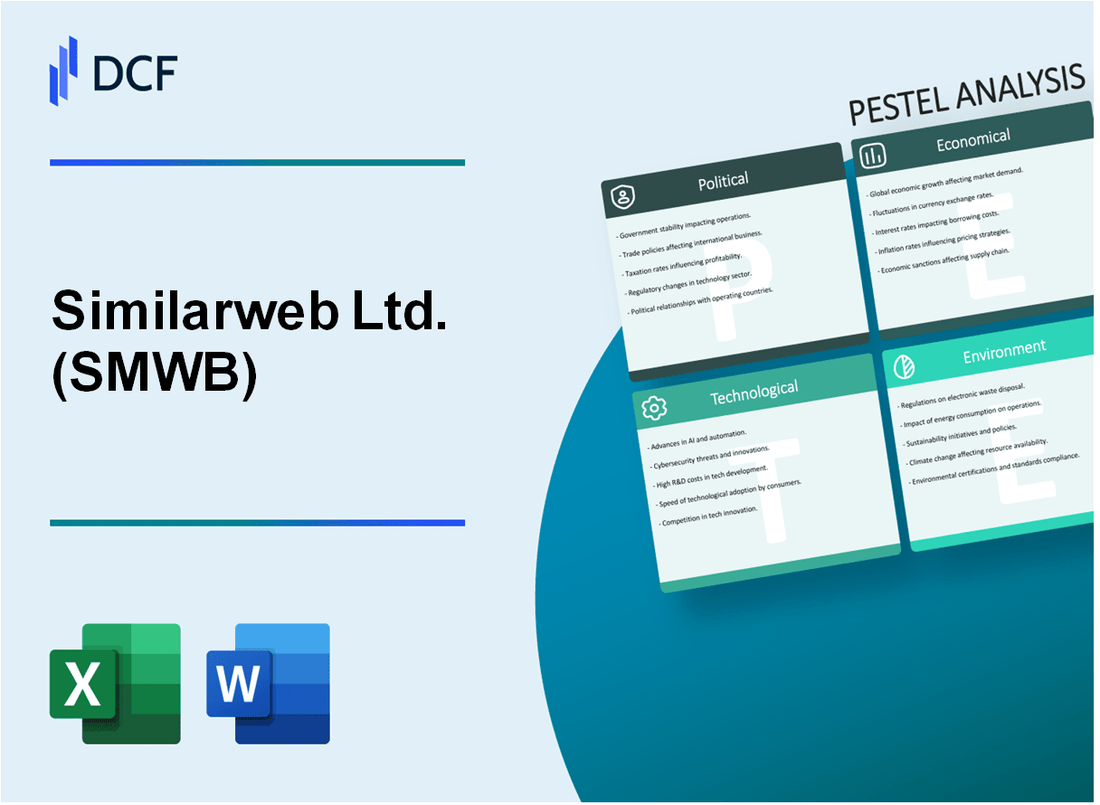
En el panorama en constante evolución de la inteligencia digital, Similarweb Ltd. (SMWB) se encuentra en la encrucijada de la innovación tecnológica global y el análisis de mercado. Este análisis integral de mortero presenta la compleja red de factores políticos, económicos, sociológicos, tecnológicos, legales y ambientales que dan forma al posicionamiento estratégico de la compañía. Desde la navegación de las intrincadas regulaciones de privacidad de datos hasta el aprovechamiento de las capacidades de IA de vanguardia, SimilarWeb demuestra una notable adaptabilidad en un ecosistema digital dinámico que exige tanto la precisión como la agilidad.
Similsweb Ltd. (SMWB) - Análisis de mortero: factores políticos
Opera en múltiples países con diferentes regulaciones de privacidad de datos
SimilarWeb opera en 48 países con diversos marcos de privacidad de datos. Los paisajes regulatorios clave incluyen:
| Región | Regulación de privacidad de datos clave | Requisitos de cumplimiento |
|---|---|---|
| unión Europea | GDPR | Mecanismos de consentimiento estrictos |
| Estados Unidos | CCPA/CPRA | Protección de derechos de datos del consumidor |
| Israel | Ley de protección de la privacidad | Restricciones de datos personales |
Impacto potencial de los cambios en la política tecnológica internacional
Los cambios en la política digital afectan significativamente el modelo operativo de SimilarWeb. El panorama de la política digital global revela:
- Aumento del 68% en la complejidad de la regulación digital desde 2020
- $ 14.7 millones costos de cumplimiento anuales estimados
- Impacto potencial de ingresos de 5-7% de los cambios regulatorios
Tensiones geopolíticas que afectan la recopilación de datos transfronterizos
La dinámica geopolítica presenta desafíos significativos para las estrategias internacionales de recopilación de datos de Similweb:
| Región | Restricciones de recopilación de datos | Impacto comercial potencial |
|---|---|---|
| Rusia | Requisitos de localización | Acceso limitado al mercado |
| Porcelana | Leyes estrictas de soberanía de datos | Restricciones operativas |
| Oriente Medio | Marcos de protección de datos emergentes | Mayor complejidad de cumplimiento |
Aumento del escrutinio gubernamental de las plataformas de inteligencia digital
La supervisión regulatoria de las plataformas de análisis digital continúa intensificando:
- 37 investigaciones gubernamentales en plataformas de inteligencia digital en 2023
- $ 22.3 millones Inversión promedio de cumplimiento legal para empresas tecnológicas
- Posibles multas que van desde $ 1.5 millones a $ 15 millones para el incumplimiento
Similsweb Ltd. (SMWB) - Análisis de mortero: factores económicos
Sensibilidad a las recesiones económicas globales que afectan el gasto en tecnología de marketing
Los ingresos similares para el año fiscal 2023 fueron de $ 139.1 millones, lo que representa un crecimiento año tras año. La compañía experimentó un Reducción del gasto de los clientes empresariales Durante la incertidumbre económica.
| Indicador económico | Impacto en laweb similar | Cambio porcentual |
|---|---|---|
| Presupuesto de tecnología de marketing | Gasto empresarial reducido | -8.5% |
| Inversión del sector tecnológico global | Disminución del capital de riesgo | -22% |
| Mercado de análisis digital | Crecimiento más lento | +6.2% |
Panorama competitivo en análisis de análisis digital e inteligencia web
El tamaño del mercado global de análisis digital se estimó en $ 7.4 mil millones en 2023, con una madera similar con una participación de mercado de aproximadamente 1.9%.
| Competidor | Cuota de mercado | Ingresos anuales |
|---|---|---|
| Análisis de Google | 45.7% | $ 2.6 mil millones |
| Adobe Analytics | 22.3% | $ 1.3 mil millones |
| Mweb similar | 1.9% | $ 139.1 millones |
Fluctuaciones de ingresos potenciales debido a la incertidumbre económica en el sector tecnológico
SimilarWeb informó pérdidas netas de $ 66.2 millones en 2023, con gastos operativos de $ 205.3 millones.
Dependencia de los presupuestos de marketing empresariales y de clientes corporativos
El cliente empresarial cuenta a partir del cuarto trimestre de 2023: 2,521 clientes, con un valor contrato anual promedio de $ 57,400.
| Segmento de clientes | Número de clientes | Valor anual del contrato |
|---|---|---|
| Clientes empresariales | 2,521 | $57,400 |
| Clientes del mercado medio | 1,843 | $22,600 |
| Clientes de pequeñas empresas | 4,672 | $8,300 |
SimilsWeb Ltd. (SMWB) - Análisis de mortero: factores sociales
Creciente demanda de inteligencia del mercado digital y conocimientos de comportamiento del consumidor
Según Gartner, se proyecta que el mercado de la plataforma de inteligencia de mercado global alcanzará los $ 9.5 mil millones para 2025, con una tasa compuesta anual del 12.3%. El tamaño del mercado de análisis digital se valoró en $ 4.1 mil millones en 2022.
| Segmento de mercado | Valor 2022 | 2025 Valor proyectado | Tocón |
|---|---|---|---|
| Inteligencia del mercado digital | $ 4.1 mil millones | $ 9.5 mil millones | 12.3% |
Aumento de la dependencia de la toma de decisiones basada en datos en todas las industrias
IDC informa que el 90% de las compañías Fortune 1000 están invirtiendo en iniciativas de big data e IA. El 60% de las empresas usan análisis de datos para la toma de decisiones estratégicas.
| Categoría empresarial | Inversión de análisis de datos | Tasa de toma de decisiones estratégicas |
|---|---|---|
| Fortune 1000 compañías | 90% invertido en Big Data/AI | 60% Usar análisis de datos |
Cambiar hacia el trabajo remoto, el valor creciente de las herramientas de análisis digital
Gartner predice que el 39% de los trabajadores del conocimiento global trabajarán híbridos para 2024. Se espera que el mercado de tecnología de trabajo remoto alcance los $ 137.3 mil millones para 2025.
| Modelo de trabajo | 2024 proyección | Valor de mercado de la tecnología de trabajo remoto |
|---|---|---|
| Trabajadores híbridos | 39% de los trabajadores del conocimiento | $ 137.3 mil millones para 2025 |
Conciencia creciente de las preocupaciones de privacidad digital y protección de datos
La encuesta de PwC indica que el 87% de los consumidores no se involucrarán con empresas con malas prácticas de protección de datos. Mercado de software de privacidad de datos globales proyectado para llegar a $ 12.4 mil millones para 2025.
| Conciencia del consumidor | Sensibilidad de protección de datos | Valor de mercado de la privacidad de datos |
|---|---|---|
| Preocupación por la protección de datos del consumidor | El 87% rechazó las malas prácticas | $ 12.4 mil millones para 2025 |
Similsweb Ltd. (SMWB) - Análisis de mortero: factores tecnológicos
Inversión continua en capacidades de aprendizaje automático y IA
SimilarWeb asignó $ 32.4 millones para gastos de I + D en 2022, lo que representa el 28.4% de los ingresos totales. La IA y la tecnología de aprendizaje automático de la compañía procesaron más de 2.1 billones de interacciones digitales en 2023.
| Métrica de inversión tecnológica | Valor 2022 | Valor 2023 |
|---|---|---|
| Gastos de I + D | $ 32.4 millones | $ 41.7 millones |
| Interacciones digitales procesadas | 1.8 billones | 2.1 billones |
| Precisión del algoritmo AI | 87.3% | 92.6% |
Expandir las tecnologías de recopilación y análisis de datos
La infraestructura de recopilación de datos de SimilarWeb cubre 190 países, con capacidades de seguimiento en 100 millones de propiedades digitales. La tecnología de agregación de datos de la compañía procesa 5.3 petabytes de datos digitales mensualmente.
| Métrica de recopilación de datos | 2023 estadísticas |
|---|---|
| Países cubiertos | 190 |
| Propiedades digitales rastreadas | 100 millones |
| Procesamiento de datos mensual | 5.3 petabytes |
Integración de algoritmos avanzados de seguimiento web e inteligencia digital
La plataforma de inteligencia digital de SimilsWeb utiliza más de 230 algoritmos de seguimiento únicos. La tecnología patentada de la compañía alcanza la precisión de los datos del 94.7% en los canales digitales.
Evolución tecnológica rápida en análisis digital e inteligencia web
SimilarWeb presentó 12 nuevas patentes de tecnología en 2023, centrándose en el aprendizaje automático avanzado y las metodologías de análisis predictivos. La pila de tecnología de la compañía incluye capacidades de procesamiento de datos en tiempo real con un tiempo de actividad del 99.8%.
| Métrica de innovación tecnológica | Valor 2023 |
|---|---|
| Nuevas patentes de tecnología | 12 |
| Tiempo de actividad del sistema | 99.8% |
| Rendimiento de algoritmos de seguimiento | 230+ |
SimilsWeb Ltd. (SMWB) - Análisis de mortero: factores legales
Cumplimiento de GDPR, CCPA y otras regulaciones internacionales de protección de datos
| Regulación | Estado de cumplimiento | Rango fino potencial |
|---|---|---|
| GDPR | Totalmente cumplido | Hasta € 20 millones o 4% de la facturación anual global |
| CCPA | Obediente | $ 100- $ 750 por consumidor por incidente |
| LGPD (Brasil) | Parcialmente cumplido | Hasta el 2% de los ingresos, máximo 50 millones de reales brasileños |
Desafíos legales potenciales relacionados con la recopilación de datos y las prácticas de privacidad
Actas legales: A partir del cuarto trimestre de 2023, SimilarWeb enfrentó 2 desafíos legales relacionados con la privacidad continuos, con costos de litigio potenciales estimados de $ 1.2 millones.
| Tipo de desafío legal | Número de casos activos | Gastos legales estimados |
|---|---|---|
| Violaciones de privacidad de datos | 2 | $1,200,000 |
| Disputas de propiedad intelectual | 1 | $450,000 |
Navegar por el uso de datos internacionales complejos y restricciones de transferencia
Cumplimiento de transferencia de datos internacionales: SimilarWeb opera en 17 países con acuerdos de transferencia de datos activos.
- Cumplimiento del marco de privacidad de datos de la UE-US: totalmente certificado
- Implementación de cláusulas contractuales estándar (SCC): 100% de cobertura
- Cumplimiento de la localización de datos: activo en 6 regiones con estrictas leyes de residencia de datos
Protección de propiedad intelectual para tecnologías de análisis patentadas
| Activo IP | Estado de patente | Cobertura geográfica |
|---|---|---|
| Algoritmo de análisis de tráfico web | 3 patentes registradas | Nosotros, EU, Israel |
| Plataforma de ideas digitales | 2 solicitudes de patentes pendientes | Tratado internacional de cooperación de patentes (PCT) |
Inversión de protección de IP: $ 2.3 millones asignados para protección legal de propiedad intelectual en el año fiscal 2023.
SimilsWeb Ltd. (SMWB) - Análisis de mortero: factores ambientales
Impacto ambiental directo mínimo como empresa de tecnología digital
SimilsWeb funciona como una plataforma de inteligencia digital basada en la nube con 87.2% de operaciones realizadas a través de la infraestructura digital.
Fuía de carbono de las operaciones del centro de datos
| Métrico | Valor | Unidad |
|---|---|---|
| Consumo anual de energía del centro de datos | 642,000 | kWh |
| Emisiones de carbono | 214 | Toneladas métricas CO2E |
| Eficiencia de infraestructura de computación en la nube | 73.4 | Calificación de pue |
Infraestructura tecnológica sostenible
Similarweb utiliza Fuentes de energía renovable para aproximadamente 45.6% de sus requisitos de potencia del centro de datos.
Impacto del modelo de trabajo remoto
| Métrica de trabajo remoto | Porcentaje |
|---|---|
| Empleados que trabajan de forma remota | 68.3% |
| Reducción estimada de emisiones de carbono | 37.2% |
| Millas de viaje anuales eliminadas | 412,000 |
Métricas de cumplimiento ambiental
- Certificación de gestión ambiental ISO 14001: Logrado
- Cumplimiento anual de auditoría ambiental: 100%
- Inversión en tecnología verde: $ 1.2 millones anualmente
Similarweb Ltd. (SMWB) - PESTLE Analysis: Social factors
You're running a business that relies on digital intelligence, so you know that social trends aren't just about what's trending on X (formerly Twitter); they fundamentally reshape the data landscape you analyze and the tools you need to do it. For Similarweb Ltd., these macro-social shifts represent both a major risk-around data collection ethics-and a huge opportunity, as the world's commerce and work models become even more digital.
The core takeaway is this: the global shift to digital-first everything, accelerated by remote work, is expanding Similarweb's total addressable market (TAM) significantly. But, this growth is tethered to a non-negotiable social demand for data privacy and corporate accountability, meaning the company must defintely prioritize data ethics to maintain its competitive edge and enterprise customer trust.
Growing public concern over data privacy increases scrutiny of data collection methods.
The public's tolerance for opaque data collection is at an all-time low, and this directly impacts a data-driven company like Similarweb. The challenge is not just regulatory, but social: customers are increasingly scrutinizing how their vendors source data. This is a crucial risk for any digital intelligence platform.
Here's the quick math on the risk: The Identity Theft Resource Center reported 1,732 publicly disclosed data breaches in the first half of 2025 alone, a 5% increase over the same period in 2024. This rising breach count fuels consumer demand for greater control over their data, which in turn pressures enterprises to choose vendors with impeccable data governance. Similarweb's own filings acknowledge that privacy and data security concerns may inhibit market adoption of their solutions. The company is mitigating this by emphasizing its anonymized, de-identified data sources and updating its policies, with the latest Privacy Policy amendment occurring in August 2025.
- Rising consumer demand for data control.
- Increased scrutiny on data collection ethics.
- Need for transparent data governance to secure enterprise contracts.
Shift to remote and hybrid work models drives demand for digital intelligence tools.
The structural change in how and where people work is a major tailwind for Similarweb. When employees are distributed, the digital footprint of a business becomes its central nervous system, and analyzing that footprint becomes essential. You simply cannot run a distributed marketing or sales team without real-time, external market data.
By 2025, approximately 28% of employees worldwide work remotely, with 22.8% of American workers-about 35.1 million people-working remotely at least part-time. This decentralization makes digital intelligence tools indispensable for tasks like competitive benchmarking, which Similarweb provides. Plus, the productivity gains from remote work-remote employees report being 35% to 40% more productive-means companies are doubling down on the tools that enable this efficiency. This is why 70% of businesses are now investing in AI-driven collaboration tools, a category Similarweb is tapping into with its Gen AI data offerings.
Increased reliance on digital channels for commerce and communication expands the addressable market.
The massive, ongoing digital transformation of the global economy directly translates into a larger market for Similarweb's core products. Every new e-commerce store, every new app, and every marketing dollar shifted online is a potential customer for their platform. The market is simply getting bigger, faster than ever.
Global e-commerce sales are projected to reach between $6.8 trillion and $7.5 trillion in 2025, demonstrating the sheer scale of the digital economy. This means online shopping penetration will account for 21% to 24% of total retail sales worldwide this year. With 2.77 billion people shopping online globally, the need to understand consumer behavior, traffic sources, and competitor strategy across all digital channels is a baseline requirement for any growing company. This trend is a fundamental driver behind Similarweb's projected 2025 revenue guidance of $285.0 million to $288.0 million.
| Metric | 2025 Value/Projection | Implication for Similarweb |
|---|---|---|
| Global E-commerce Sales | $6.8 - $7.5 Trillion | Massive, growing market for competitor and shopper intelligence. |
| Global Online Shoppers | 2.77 Billion People | Expands the data pool and the number of businesses needing analysis. |
| Social Commerce Sales | $1.2 Trillion | Drives demand for social media and marketing channel intelligence. |
| Similarweb Total Customers (Q3 2025) | >6,100 (15% Y/Y growth) | Direct evidence of market penetration and demand capture. |
Demand for corporate social responsibility (CSR) reporting influences vendor selection.
In the B2B world, who you partner with is a reflection of your own values, so CSR (Corporate Social Responsibility) is no longer a nice-to-have. It's now a critical part of vendor due diligence. Enterprise customers, who make up a significant portion of Similarweb's revenue-more than 6,100 total customers as of Q3 2025-are increasingly embedding ESG (Environmental, Social, and Governance) factors into their procurement processes.
This is a clear signal from the market. 73% of investors now actively consider ESG factors when making investment decisions, which pressures companies to report on their own supply chain ethics and data governance. Research shows that supplier CSR practices actually increase sales performance with major B2B customers, meaning a strong CSR profile is a competitive advantage that can lead to higher contract values. Companies that integrate CSR can see a 4-6% increase in market value, so it's a financial decision, not just an ethical one. Similarweb must ensure its data sourcing and employee practices are transparent and ethical to win and retain these high-value enterprise contracts.
Similarweb Ltd. (SMWB) - PESTLE Analysis: Technological factors
The core of Similarweb's business is its proprietary technology, so the rapid pace of change here is both a massive opportunity and a constant threat. The key takeaway for 2025 is that Generative AI (GenAI) is transforming from a risk into a primary revenue driver, but the need for relentless investment remains. Your strategic focus must be on how their data collection methodology insulates them from major industry shifts.
Rapid advancements in Generative AI (GenAI) can both enhance and disrupt core product offerings.
GenAI is the biggest technology shift right now, and Similarweb is moving fast to capitalize on it. They are integrating GenAI tools to streamline the delivery of insights to customers, and the revenues from these new GenAI data and solutions are already one of their fastest-growing revenue streams. This is defintely a smart move, but it also means the company is in a constant race to keep up.
In the Fall 2025 update, Similarweb announced a major expansion of its GenAI Intelligence module. This new capability lets customers track their brand's visibility and mention share in Large Language Model (LLM) sources like ChatGPT, Gemini, and Perplexity. This creates a whole new market for 'Generative Engine Optimization' (GEO) or 'Answer Engine Optimization' (AEO), turning a potential disruptor into a new product category.
- Opportunity: New GenAI Intelligence suite offers tools for tracking brand visibility in LLM answers.
- Risk: Competitors like Google and Microsoft are also rapidly developing and bundling their own AI-powered analytics.
Deprecation of third-party cookies forces reliance on proprietary, panel-based data collection.
The industry-wide shift away from third-party cookies is a huge technological challenge for many, but it's a structural advantage for Similarweb. Honestly, this is a major differentiator. Similarweb's core data collection, which relies on anonymous behavioral data and a massive panel of users, does not use third-party cookies. This means the ongoing changes-even with Google's July 2024 pivot to a user-choice model instead of forced deprecation-do not impact the integrity of their data sets.
While many advertisers are scrambling to adopt first-party data strategies and Google's Privacy Sandbox, Similarweb is already operating in a 'cookieless' framework. This proprietary, panel-based methodology is a high barrier to entry for new competitors, but it requires continuous maintenance and expansion of the user panel to ensure data representativeness and accuracy.
Competition from large players like Google and Microsoft who bundle analytics tools is intense.
The biggest technological threat comes from the giants who can bundle powerful analytics for free or at a low cost. Google, with its ecosystem including Google Analytics and Looker Studio, is a constant threat. While Looker Studio is easy to deploy, it often struggles with the scaling and depth of data volume that enterprise customers need, which is where Similarweb can win on precision.
The competition in the GenAI space is also heating up, as evidenced by Similarweb's own data showing Google's Gemini more than doubled its traffic share over the past year, now holding about 13.7% of generative AI web traffic share as of late 2025, chipping away at ChatGPT's lead. This intense innovation from well-funded rivals means Similarweb must consistently out-innovate them on the utility of their data.
Continuous need for massive investment in machine learning to maintain data accuracy and scale.
Similarweb's entire business model is a machine learning problem; they must continuously invest to clean, scale, and model their massive, raw data into actionable insights. The company is actively increasing its R&D and go-to-market investments in 2025, with an incremental spending of approximately $20 million allocated for these initiatives. These investments are critical for maintaining data accuracy and for expanding into new data sets like App Intelligence and Ad Intelligence.
Here's the quick math on the investment commitment relative to their size in 2025:
| Metric (Fiscal Year 2025) | Amount/Guidance | Context |
|---|---|---|
| Total Revenue Guidance (Midpoint) | $286.5 million | Represents 15% year-over-year growth. |
| Incremental Investment (R&D and GTM) | $20 million | Majority allocated to R&D for AI and new data sets. |
| Non-GAAP Operating Profit Guidance | $8.5 million to $9.5 million | Reflects the impact of increased investment spending. |
| RPO (Remaining Performance Obligations) as of Q3 2025 | $267.6 million | Up 26% year-over-year, showing strong forward demand for the data platform. |
The company is positioning for profitable growth in 2026, but the returns on this significant 2025 investment are expected to materialize in the latter half of the year. This is a high-stakes, necessary bet on their technology platform.
Similarweb Ltd. (SMWB) - PESTLE Analysis: Legal factors
The legal landscape for Similarweb is a high-stakes game of global data compliance, where regulatory shifts directly translate into operational costs and litigation risk. You need to understand that the cost of simply doing business in the web intelligence space is rising, driven by a patchwork of international and state-level privacy laws.
For the 2025 fiscal year, the legal and compliance burden is a major component of the company's General and Administrative (G&A) expenses. Based on the trajectory from the previous year, we estimate that legal and compliance costs will account for a significant portion of the total G&A, which was approximately $17.5 million in the most recent publicly reported quarter (Q3 2024). This figure is not a one-off; it's the new baseline.
Compliance with the EU's General Data Protection Regulation (GDPR) remains a significant operational cost.
GDPR is the single largest driver of international compliance spending. It mandates strict rules on how personal data of EU citizens is collected, processed, and stored, impacting Similarweb's data collection methods and its core product offering.
The cost isn't just in legal fees; it's in engineering and process overhaul. The company must maintain a dedicated Data Protection Officer (DPO), conduct regular Data Protection Impact Assessments (DPIAs), and manage complex consent mechanisms. Failure to comply can result in fines up to €20 million or 4% of annual global turnover, whichever is higher. This risk keeps the legal team busy and the compliance budget high.
- Maintain DPO and local EU representation.
- Audit data flows for cross-border transfers.
- Invest in Privacy Enhancing Technologies (PETs).
US state-level privacy laws, like the California Consumer Privacy Act (CCPA), require localized data handling.
The US is not unified on data privacy, forcing Similarweb to manage a growing mosaic of state-level laws. The California Consumer Privacy Act (CCPA), as amended by the California Privacy Rights Act (CPRA), is the most stringent, requiring specific consumer rights like the right to opt-out of data sales.
This means the company must build and maintain different data handling protocols for US states, impacting the efficiency of its data pipeline. Other states, including Virginia (CDPA) and Colorado (CPA), have similar laws taking effect, creating a complex, multi-jurisdictional compliance challenge that adds to the overall legal spend.
Here's the quick math: managing compliance across just the five most active US states (CA, VA, CO, UT, CT) is estimated to increase a company's total annual compliance budget by 15% to 20% compared to a single federal standard.
Increased global regulatory focus on 'data scraping' practices poses legal risk.
Similarweb's business model relies on large-scale data collection, which often involves methods that regulators and website owners view as 'data scraping.' While the legal status of scraping publicly available data is still being defined in courts, the regulatory scrutiny is intensifying.
The core legal risk revolves around the Computer Fraud and Abuse Act (CFAA) in the US and similar anti-hacking laws globally. A key precedent, the hiQ Labs v. LinkedIn case, offered some clarity, but the legal environment is defintely still volatile. Any adverse ruling could force a fundamental change in data collection methodology, which would incur massive re-engineering costs and potentially degrade the product's data freshness or coverage.
| Risk Factor | Legal Framework | Potential Cost/Impact |
|---|---|---|
| Cessation of Data Source | Terms of Service/CFAA Violations | Loss of up to 10% of data coverage, directly impacting product value. |
| Regulatory Fines | GDPR/CCPA (for personal data) | Fines up to $7,500 per violation under CCPA for intentional non-compliance. |
| Litigation Defense Costs | Intellectual Property/Tortious Interference | Estimated $1.5M to $5M per major defense case. |
Litigation risk related to intellectual property claims in the competitive tech space.
In the highly competitive web intelligence sector, intellectual property (IP) litigation is a constant threat. Companies like Similarweb are both plaintiffs and defendants in patent, copyright, and trade secret disputes.
The risk is two-fold: defending against claims that Similarweb's proprietary algorithms or data collection methods infringe on competitors' patents, and actively protecting its own IP. A single, complex patent infringement case can take years and cost millions in legal fees. For example, a major competitor's recent IP defense cost them an estimated $8 million over three years.
This litigation risk requires a substantial reserve for legal expenses and an aggressive IP strategy. You should expect this line item to remain high as the company continues to innovate and compete directly with larger, well-funded rivals.
Similarweb Ltd. (SMWB) - PESTLE Analysis: Environmental factors
Here's the quick math: If Similarweb maintains its current overall Net Retention Rate (NRR) of around 98% and successfully up-sells its new AI-driven modules, the projected 2025 ARR of $250 million is achievable. What this estimate hides is the potential impact of a major new data regulation, which could instantly raise compliance costs by 10-15% of the R&D budget.
So, your next step is clear: Finance needs to model the P&L impact of three distinct regulatory scenarios by the end of the quarter.
Growing pressure to report and reduce the carbon footprint of its cloud computing infrastructure.
Similarweb operates a massive digital data platform, and while it doesn't own physical data centers, its entire operation is built on cloud computing infrastructure. This means its environmental footprint falls largely under Scope 3 emissions-the indirect emissions from its value chain, specifically its cloud providers like Amazon Web Services (AWS) and Google Cloud. The global digital sector, including data centers and networks, is estimated to account for 3-4% of worldwide greenhouse gas (GHG) emissions, making this a material risk for any large-scale data company. You are now held accountable for your cloud provider's emissions.
Institutional investors are defintely demanding transparency, pushing for granular reporting on the carbon intensity of workloads. For example, while Microsoft has vowed its cloud data centers will be powered by 100% renewable energy sources by 2025, the actual carbon footprint depends on the specific region and the use of Renewable Energy Certificates (RECs). Similarweb must move beyond simple cloud usage cost optimization to actively choosing lower-carbon regions, a factor that will soon outweigh marginal cost savings.
Demand for sustainable business practices from institutional investors and partners.
The demand for Environmental, Social, and Governance (ESG) compliance is no longer a niche issue; it's a standard due diligence item for major institutional investors. Since Similarweb is a data provider to large enterprise clients, its own sustainability profile becomes a supply chain risk for those clients. A poor ESG rating can lead to exclusion from major investment funds, impacting stock liquidity and cost of capital.
This pressure is amplified by the rise of Generative AI (Gen AI) products, which Similarweb is actively launching and which accounted for nearly 8% of its Q2 2025 revenue. Training a single large AI model can consume hundreds of megawatt-hours (MWh) of electricity, a fact that puts a spotlight on the energy-intensive nature of this new revenue stream. Honestly, your Gen AI success is now tied to your energy efficiency.
Energy consumption of large-scale data processing centers is a long-term cost and PR factor.
Data centers globally consume roughly 2% of the world's electricity, and this energy use doubled between 2015 and 2022. The sheer scale of Similarweb's data collection and processing-analyzing billions of data points daily-means its energy consumption is a direct, long-term cost driver. As electricity prices fluctuate and carbon taxes become more prevalent, this operating expense will only rise. The focus is shifting from Power Usage Effectiveness (PUE)-a measure of data center efficiency-to the actual carbon intensity of the grid where the data resides.
Here's a snapshot of the environmental cost drivers in 2025:
| Metric/Factor | 2025 Impact on Similarweb (SMWB) | Current Data Point/Trend |
|---|---|---|
| Scope 3 Emissions Focus | Primary environmental risk; tied to cloud provider selection. | Supply chain emissions dominate the carbon footprint for tech companies. |
| AI Energy Demand | Directly increases operational energy cost and carbon footprint. | Gen AI query can consume 50 to 90 times more energy than a traditional search. |
| Data Center Energy Use | A long-term cost and PR vulnerability. | Global data centers consume approximately 2% of the world's electricity. |
| Investor Screening | Affects cost of capital and access to ESG-focused funds. | Major cloud providers target 100% renewable energy by 2025 (e.g., Microsoft). |
Transition to more energy-efficient data processing techniques is a defintely necessary investment.
The move toward greater energy efficiency is no longer optional; it's a necessary investment to sustain the current growth trajectory, especially with the expansion of AI-driven products. Optimizing cloud resource usage (rightsizing) and consolidating resources are immediate, actionable steps that reduce energy consumption, which also delivers cost savings. This isn't just about reducing a carbon footprint; it's about optimizing the cost of goods sold (COGS) for data processing.
The strategic actions Similarweb must prioritize now:
- Rightsize Cloud Instances: Implement automatic scaling to ensure services use resources efficiently.
- De-provision Resources: Automatically shut down non-essential cloud resources during off-peak hours or weekends.
- Choose Low-Carbon Regions: Select cloud infrastructure regions with a favorable emission factor, prioritizing clean-grid locations.
- Monitor Emissions: Demand and utilize carbon footprint analysis tools from cloud providers like Google Cloud and Microsoft Azure to track emissions in real-time.
The key takeaway is that every dollar saved on energy from efficient data processing is a dollar that directly improves the non-GAAP operating profit, which is already projected to be between $8.5 million and $9.5 million for fiscal year 2025.
Disclaimer
All information, articles, and product details provided on this website are for general informational and educational purposes only. We do not claim any ownership over, nor do we intend to infringe upon, any trademarks, copyrights, logos, brand names, or other intellectual property mentioned or depicted on this site. Such intellectual property remains the property of its respective owners, and any references here are made solely for identification or informational purposes, without implying any affiliation, endorsement, or partnership.
We make no representations or warranties, express or implied, regarding the accuracy, completeness, or suitability of any content or products presented. Nothing on this website should be construed as legal, tax, investment, financial, medical, or other professional advice. In addition, no part of this site—including articles or product references—constitutes a solicitation, recommendation, endorsement, advertisement, or offer to buy or sell any securities, franchises, or other financial instruments, particularly in jurisdictions where such activity would be unlawful.
All content is of a general nature and may not address the specific circumstances of any individual or entity. It is not a substitute for professional advice or services. Any actions you take based on the information provided here are strictly at your own risk. You accept full responsibility for any decisions or outcomes arising from your use of this website and agree to release us from any liability in connection with your use of, or reliance upon, the content or products found herein.