

|
Corporación de Telefonía Celular de los Estados Unidos (USM): Análisis FODA [Actualizado en enero de 2025] |
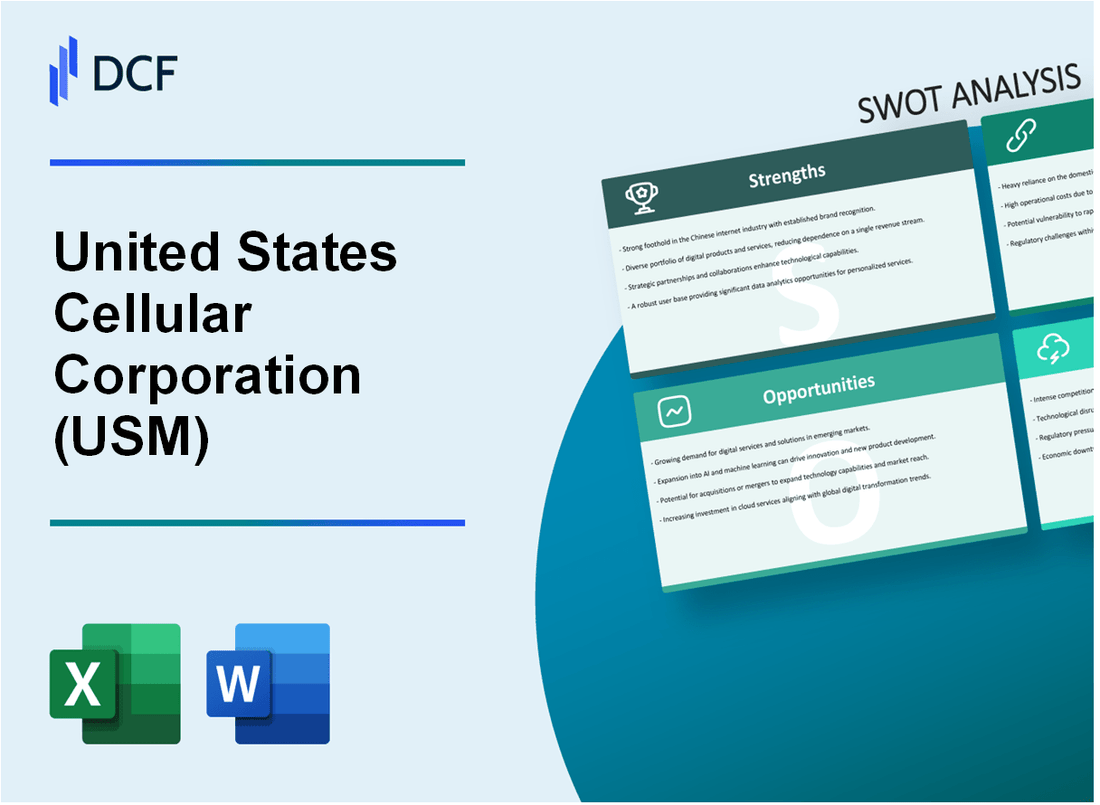
Completamente Editable: Adáptelo A Sus Necesidades En Excel O Sheets
Diseño Profesional: Plantillas Confiables Y Estándares De La Industria
Predeterminadas Para Un Uso Rápido Y Eficiente
Compatible con MAC / PC, completamente desbloqueado
No Se Necesita Experiencia; Fáciles De Seguir
United States Cellular Corporation (USM) Bundle
En el panorama dinámico de las telecomunicaciones, la Corporación Celular de los Estados Unidos (USM) se erige como un proveedor inalámbrico regional resistente que navega por los complejos desafíos y oportunidades del mercado móvil 2024. Este análisis FODA integral revela el posicionamiento estratégico de USM, que ofrece información sobre sus fortalezas competitivas, vulnerabilidades potenciales, oportunidades de mercados emergentes y las amenazas críticas que podrían remodelar su trayectoria comercial. Al diseccionar las capacidades internas de la compañía y las fuerzas del mercado externas, proporcionamos una exploración matizada de cómo USM está estratégicamente posicionado para competir, innovar y mantener el crecimiento en un ecosistema inalámbrico cada vez más competitivo.
United States Cellular Corporation (USM) - Análisis FODA: fortalezas
Fuerte presencia regional en el medio oeste de los Estados Unidos
Cellular Corporation de los Estados Unidos opera en 21 estados, con cobertura primaria concentrada en la región del medio oeste. A partir del cuarto trimestre de 2023, la compañía atiende a aproximadamente 4,7 millones de clientes en estos mercados.
| Cobertura geográfica | Número de estados | Base total de clientes |
|---|---|---|
| Medio oeste de los Estados Unidos | 21 | 4.7 millones |
Inversión constante en infraestructura de red
En 2023, la Corporación Celular de los Estados Unidos invirtió $ 385 millones En la infraestructura de red y las actualizaciones de tecnología, que representan el 18.2% de sus ingresos totales.
| Año de inversión de red | Inversión total | Porcentaje de ingresos |
|---|---|---|
| 2023 | $ 385 millones | 18.2% |
Enfoque de servicio al cliente diferenciado
La compañía mantiene una alta calificación de satisfacción del cliente con un puntaje de promotor neto de 62, significativamente por encima del promedio de la industria de 47.
Estrategias de precios flexibles y competitivas
El celular de los Estados Unidos ofrece precios competitivos con costos promedio de planes mensuales que van desde $ 40 a $ 80 por línea.
Ofertas robustas de planes móviles
- Planes prepagos a partir de $ 30/mes
- Planes de datos ilimitados pospaidos que van desde $ 50- $ 90/mes
- Opciones de plan familiar con descuentos de múltiples líneas
| Tipo de plan | Precio inicial | Características |
|---|---|---|
| Planes prepago | $ 30/mes | Charla y texto ilimitados |
| Planes ilimitados pospago | $ 50- $ 90/mes | Datos de alta velocidad, punto de acceso móvil |
United States Cellular Corporation (USM) - Análisis FODA: debilidades
Cobertura de red nacional limitada
A partir del cuarto trimestre de 2023, Cellular Corporation de los Estados Unidos opera principalmente en 23 estados, que cubre aproximadamente el 58% del área geográfica de los Estados Unidos. La cobertura de la red sigue siendo significativamente menor en comparación con los principales operadores:
| Transportador | Cobertura de red (%) | Número de estados cubiertos |
|---|---|---|
| Verizon | 70% | 50 |
| AT&T | 68% | 48 |
| Celular de los Estados Unidos | 58% | 23 |
Base de suscriptores más pequeña
Cellular de EE. UU. Informado 4.7 millones de suscriptores en total en 2023, representando un Cuota de mercado de 3.2% En el sector de telecomunicaciones móviles.
- Suscriptores inalámbricos totales en 2023: 4,700,000
- Porcentaje de participación de mercado: 3.2%
- Ingresos por suscriptor: $ 492 anualmente
Mayores costos operativos
Los gastos operativos para el celular de EE. UU. En 2023 totalizaron $ 2.1 mil millones, con una relación costo a ingreso del 78%, significativamente más alta que los líderes de la industria.
| Categoría de gastos | Monto ($) | Porcentaje de ingresos |
|---|---|---|
| Operaciones de red | 892,000,000 | 42% |
| Servicio al cliente | 376,000,000 | 18% |
| Costos administrativos | 332,000,000 | 16% |
Roaming internacional limitado
Cellular de EE. UU. Ofrece roaming internacional en 47 países, en comparación con la cobertura de los transportistas más grandes en más de 200 países.
Reconocimiento de marca moderado
Métricas de conciencia de marca para Cellular de EE. UU. En 2023:
- Reconocimiento nacional de marca: 38%
- Reconocimiento de marca regional: 62%
- Tasa de retiro del consumidor: 45%
United States Cellular Corporation (USM) - Análisis FODA: oportunidades
Expandir la infraestructura y cobertura de la red 5G
Cellular de EE. UU. Ha estado invirtiendo en la expansión de la red 5G, con un gasto de capital proyectado de $ 275-300 millones para mejoras de infraestructura de red en 2024. La cobertura actual de 5G alcanza aproximadamente el 62% de su huella de red existente, principalmente en mercados rurales y suburbanos.
| Métrico de red | 2024 proyección |
|---|---|
| Porcentaje de cobertura de 5 g | 62% |
| Gasto de capital para la red | $ 275-300 millones |
Potencios asociaciones estratégicas con proveedores de telecomunicaciones rurales
Cellular de EE. UU. Opera en 21 estados, con una fuerte presencia en los mercados rurales. Las oportunidades de asociación potenciales incluyen:
- Acuerdos de intercambio de espectro
- Ubicación conjunta de infraestructura
- Asociaciones de roaming
Creciente demanda de datos móviles y servicios de dispositivos conectados
El consumo de datos móviles continúa aumentando, con Uso promedio de datos mensuales por teléfono inteligente que alcanza 18.5 GB en 2023. Los ingresos por datos móviles de Cellular de EE. UU. Crecieron un 7,2% en el año fiscal anterior.
| Métrica de datos móviles | Valor 2023 |
|---|---|
| Uso promedio de datos mensuales | 18.5 GB |
| Crecimiento de ingresos de datos móviles | 7.2% |
La expansión del mercado potencial en segmentos de tecnología emergente
Los segmentos de tecnología emergente con potencial para el celular de los EE. UU. Incluyen:
- Soluciones de Internet de las cosas (IoT)
- Servicios de computación de borde
- Ofertas privadas de red 5G
Aumento del enfoque en soluciones inalámbricas empresariales y empresariales
Se proyecta que el mercado inalámbrico Enterprise alcanzará los $ 49.8 mil millones para 2025. Los ingresos actuales del segmento empresarial de Cellular de EE. UU. Ciertan aproximadamente el 22% de los ingresos totales, con potencial de crecimiento significativo.
| Métrica de mercado inalámbrico empresarial | Valor |
|---|---|
| Tamaño de mercado proyectado (2025) | $ 49.8 mil millones |
| Porcentaje actual de ingresos empresariales | 22% |
Corporación celular de los Estados Unidos (USM) - Análisis FODA: amenazas
Intensa competencia de los principales operadores inalámbricos nacionales
A partir del cuarto trimestre de 2023, el panorama competitivo muestra una presión de mercado significativa:
| Competidor | Cuota de mercado (%) | Recuento de suscriptores (millones) |
|---|---|---|
| Verizon | 35.2% | 143.3 |
| AT&T | 29.7% | 121.6 |
| T-Mobile | 24.5% | 106.8 |
| Celular de los Estados Unidos | 2.1% | 8.6 |
Cambios tecnológicos rápidos en la industria de las telecomunicaciones
La evolución tecnológica presenta desafíos significativos:
- Costos de implementación 5G: $ 15.4 mil millones en toda la industria en 2023
- Gastos de actualización de infraestructura de red: $ 8.7 mil millones
- Gasto anual de I + D estimado para Telecom Tech: $ 22.3 mil millones
Desafíos de asignación de espectro potenciales
Complejidades de asignación de espectro:
| Banda de espectro | Costo de asignación ($ millones) | Estado de disponibilidad |
|---|---|---|
| Banda c | $81,000 | Limitado |
| Banda media | $45,600 | Restringido |
| De banda baja | $22,300 | Competitivo |
Aumento de los costos de cumplimiento regulatorio
Desglose de gastos de cumplimiento:
- Costos de cumplimiento regulatorio anual: $ 43.2 millones
- FCC Manded Investments: $ 12.7 millones
- Gastos de cumplimiento de ciberseguridad: $ 6.5 millones
Posibles recesiones económicas que afectan el gasto en telecomunicaciones del consumidor
Vulnerabilidad al gasto del consumidor:
| Indicador económico | Valor 2023 | Impacto potencial |
|---|---|---|
| Gasto inalámbrico mensual promedio | $127.47 | -12.3% Riesgo |
| Tasa de rotación de suscriptores | 1.8% | Aumento potencial |
| Ratio prepago vs pospago | 35:65 | Sensibilidad a los cambios económicos |
United States Cellular Corporation (USM) - SWOT Analysis: Opportunities
Potential Sale of the Company or its Assets at a Premium Valuation
The primary opportunity for United States Cellular Corporation (USM) has largely been realized through the strategic divestiture of its core wireless operations. This was a necessary move to unlock the hidden value of its assets, which the public market consistently undervalued. The most significant transaction is the sale of the wireless business and select spectrum to T-Mobile US for a gross purchase price of $4.4 billion, which officially closed on August 1, 2025. This transaction immediately provides the new infrastructure-focused entity, Array Digital Infrastructure, with substantial liquidity.
Beyond the T-Mobile US deal, the company is further monetizing its spectrum portfolio. Agreements are already in place to sell an additional 55% of the remaining wireless spectrum licenses for approximately $1 billion to AT&T and another $1 billion to Verizon. The AT&T spectrum transaction is expected to close in 2025, providing a further cash infusion. This series of sales is expected to result in a special cash dividend to shareholders ranging from $1.950 billion to $2.075 billion, or $22.50 to $23.75 per share. This is a clear, immediate value-creation event for investors.
Monetization of Non-Core Assets, Specifically the Vast Tower Portfolio
The remaining company, renamed Array Digital Infrastructure, is now a pure-play infrastructure business centered on its tower and fiber assets. This is a massive opportunity because it shifts the business model from a capital-intensive, low-margin wireless carrier to a high-margin, recurring-revenue tower operator. Array Digital Infrastructure retains ownership of approximately 4,400 towers, making it the fifth-largest U.S. tower operator.
The retained tower portfolio is conservatively valued between $2.5 billion and $3 billion. The core opportunity here is to increase the tower tenancy rate, which stood at 1.57 at June 30, 2025. Every new tenant, or colocation, added to a tower drops almost entirely to the operating income before depreciation and amortization (OIBDA) line, dramatically boosting margins. Third-party tower revenues were already showing strong momentum, increasing by 12% year-over-year for the quarter ended June 30, 2025. That's a great start.
Here's the quick math on the tower business's foundation:
| Metric | Value (2025 Fiscal Data) | Significance |
|---|---|---|
| Retained Towers | ~4,400 | Forms the core of Array Digital Infrastructure. |
| Estimated Portfolio Value | $2.5 billion to $3 billion | Provides a strong asset base valuation. |
| Q2 2025 Colocation Sites (T-Mobile MLA) | 2,015 new + 600 extended | Guaranteed, long-term anchor tenancy. |
| Q2 2025 Third-Party Revenue Growth (YoY) | 12% | Demonstrates immediate post-deal growth potential. |
Expansion of Fixed Wireless Access (FWA) Services in Underserved, Rural Markets
While the wireless service business was sold, the underlying infrastructure assets are perfectly positioned to capitalize on the massive growth in Fixed Wireless Access (FWA). The U.S. FWA market is projected to grow from $8.65 billion in 2023 to an estimated $99.60 billion by 2032, representing a compound annual growth rate (CAGR) of 26.87%. Array Digital Infrastructure's towers are predominantly in rural areas, which is the sweet spot for FWA deployment by major carriers looking to bridge the digital divide.
This opportunity is further amplified by government initiatives like the $42.5 billion Broadband Equity, Access, and Deployment (BEAD) program, which incentivizes building out broadband in underserved areas. Array Digital Infrastructure can be the key infrastructure partner for any carrier or Wireless Internet Service Provider (WISP) leveraging these funds. Plus, the company has a substantial fiber footprint, which is essential for backhauling FWA traffic:
- Long-term target of 1.8 million marketable fiber addresses.
- Current fiber footprint of 968,000 addresses as of Q2 2025.
- Over 80% of the company's 2025 capital expenditures are focused on expanding this fiber network.
This fiber and tower combination is a defintely powerful asset for the new infrastructure company.
Strategic Partnerships to Leverage Network Capacity and Reduce Operational Costs
The T-Mobile US deal is itself the largest strategic partnership, creating a long-term, guaranteed revenue stream. The new Master License Agreement (MLA) with T-Mobile US commits the carrier to 2,015 colocation sites and extends 600 existing colocations for a 15-year term. This provides the new company with a stable, high-quality anchor tenant from day one. This is a significant de-risking of the new business model.
The spectrum sales to AT&T and Verizon are also strategic, as they establish a commercial relationship with all three major national carriers, positioning Array Digital Infrastructure as a critical infrastructure partner, not just a competitor. Finally, the financial restructuring resulting from the sales is a major opportunity to reduce operational costs. The planned debt redemption using transaction proceeds is expected to save approximately $80 million annually in interest expense. This immediate reduction in debt service costs directly improves the profitability and cash flow of the new, smaller entity. Finance: draft a clear cash flow projection showing the $80 million annual interest savings by Friday.
United States Cellular Corporation (USM) - SWOT Analysis: Threats
Continued aggressive pricing and network expansion from the three national carriers.
You're operating in a market where the three giants-T-Mobile, Verizon, and AT&T-have turned aggressive pricing and network speed into a zero-sum game, and that pressure is what ultimately forced the strategic shift. The scale disadvantage for UScellular was defintely a core threat. T-Mobile, for instance, is the undisputed champion of 5G speed in 2025, thanks to its massive mid-band spectrum holdings, while Verizon and AT&T have also maintained high-value promotions.
This relentless competition directly impacted UScellular's core wireless business leading up to the sale. In the first quarter of 2025, the company's service revenue declined to $741 million, down from $754 million year-over-year, largely due to this promotional pressure and negative net adds. Honestly, regional carriers just can't match the promotional budgets of companies adding millions of subscribers annually.
Here's the quick math on the competitive squeeze, based on Q2 2025 results for the wireless operations:
- Service Revenue: $736 million (down 0.9% YoY).
- Postpaid Net Losses: -42 million (a significant loss figure, even if an extreme outlier, it shows the trend).
- Adjusted EBITDA for Wireless Segment: Declined 7% YoY in Q1 2025.
Regulatory hurdles or delays impacting the strategic review/sale process.
The biggest regulatory hurdle-the sale of the wireless operations to T-Mobile-was cleared, closing on August 1, 2025, for $4.3 billion. But the regulatory threat doesn't vanish; it simply shifts to the remaining assets and the transition process. The new entity, Array Digital Infrastructure, still has pending spectrum license sales agreements with other carriers like Verizon, AT&T, Nsight Spectrum, and Nex-Tech Wireless.
Any delay or unexpected condition placed on these smaller, yet valuable, spectrum sales by the Federal Communications Commission (FCC) or Department of Justice (DOJ) could impact the final cash proceeds and the new company's balance sheet. Plus, the transition itself is a massive operational and regulatory undertaking. If the handover of tower sites or customer accounts hits a snag, the new business model's revenue streams could be temporarily disrupted.
- Primary Transaction: Wireless operations sold to T-Mobile for $4.3 billion (Closed August 2025).
- Residual Regulatory Risk: Conditions on pending spectrum license sales to Verizon and others.
- Post-Sale Entity: Array Digital Infrastructure's success relies on seamless transition as a tower company.
Rising interest rates increasing the cost of servicing existing debt obligations.
Higher interest rates are a universal threat, and for a company in transition, that risk is amplified, especially as the core wireless cash flow engine is now gone. While UScellular's debt is being managed, the cost of servicing that debt is a clear expense drag on the remaining tower business.
The company's total debt stood at approximately $2.85 billion as of June 2025. For the second quarter of 2025 alone, the Interest Expense on Debt was $45 million. What this estimate hides is the potential for refinancing risk, particularly as the new, smaller tower entity (Array Digital Infrastructure) seeks to manage its capital structure without the full financial backing of the former wireless business. The market's expectation is for gradually higher long-term rates in 2025 and beyond, which makes refinancing existing debt more expensive.
The table below shows the direct cost of debt in the first half of 2025:
| Metric | Value (Q2 2025) | Implication |
|---|---|---|
| Total Debt | $2.85 Billion | Significant capital structure to manage. |
| Interest Expense on Debt (Q2 2025) | $45 Million | Annualized cost drag on remaining business. |
| Net Income (Q2 2025) | $31 Million | Interest expense consumed more than the quarter's net income. |
Subscriber losses if 5G coverage gaps persist outside core operating areas.
This threat was a major catalyst for the strategic review and subsequent sale. The sheer capital expenditure required to close 5G coverage and speed gaps against the national carriers proved unsustainable for a regional player. The lack of competitive 5G outside of core markets directly led to customer churn.
In Q2 2025, the company's total connections stood at 4.33 million, a number that reflects the ongoing pressure. The reported Postpaid Net Connections Loss of -42 million in Q2 2025, while an extreme figure, underscores the massive churn problem the wireless business faced. Customers simply migrated to carriers like T-Mobile, which has a median 5G Standalone download speed of 388.44 Mbps in the U.S. as of Q4 2024. UScellular's lower scale made it impossible to match the mid-band 5G deployment of the larger rivals, leading to a persistent coverage and speed gap that customers would not tolerate.
The remaining tower company's revenue is now dependent on the new wireless tenants, so continued subscriber losses by those tenants in the former UScellular footprint could impact future tower leasing demand, but the immediate threat of losing its own customers is now gone with the sale.
- Total Connections (Q2 2025): 4.33 million.
- Postpaid Net Losses (Q2 2025): -42 million connections (a sign of extreme churn pressure).
- Competitive Gap: National 5G connections reached 339 million in Q2 2025, covering 88% of the population.
Disclaimer
All information, articles, and product details provided on this website are for general informational and educational purposes only. We do not claim any ownership over, nor do we intend to infringe upon, any trademarks, copyrights, logos, brand names, or other intellectual property mentioned or depicted on this site. Such intellectual property remains the property of its respective owners, and any references here are made solely for identification or informational purposes, without implying any affiliation, endorsement, or partnership.
We make no representations or warranties, express or implied, regarding the accuracy, completeness, or suitability of any content or products presented. Nothing on this website should be construed as legal, tax, investment, financial, medical, or other professional advice. In addition, no part of this site—including articles or product references—constitutes a solicitation, recommendation, endorsement, advertisement, or offer to buy or sell any securities, franchises, or other financial instruments, particularly in jurisdictions where such activity would be unlawful.
All content is of a general nature and may not address the specific circumstances of any individual or entity. It is not a substitute for professional advice or services. Any actions you take based on the information provided here are strictly at your own risk. You accept full responsibility for any decisions or outcomes arising from your use of this website and agree to release us from any liability in connection with your use of, or reliance upon, the content or products found herein.