

|
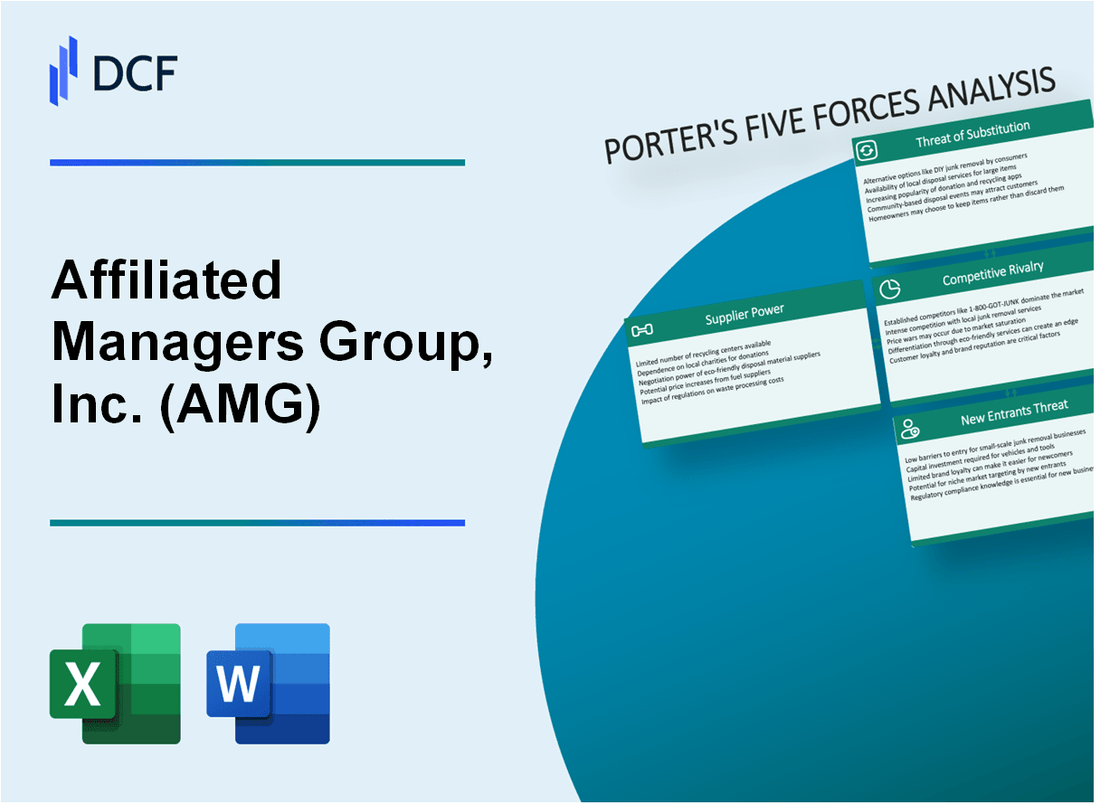
Affiliated Managers Group, Inc. (AMG): 5 Analyse des forces [Jan-2025 MISE À JOUR] |
Entièrement Modifiable: Adapté À Vos Besoins Dans Excel Ou Sheets
Conception Professionnelle: Modèles Fiables Et Conformes Aux Normes Du Secteur
Pré-Construits Pour Une Utilisation Rapide Et Efficace
Compatible MAC/PC, entièrement débloqué
Aucune Expertise N'Est Requise; Facile À Suivre
Affiliated Managers Group, Inc. (AMG) Bundle
Dans le monde dynamique de la gestion des actifs, Affiliated Managers Group, Inc. (AMG) navigue dans un paysage concurrentiel complexe façonné par les cinq forces stratégiques de Michael Porter. De la rareté des talents d'investissement de haut niveau à la pression incessante des perturbations technologiques, l'AMG doit équilibrer stratégiquement plusieurs défis concurrentiels. Cette analyse révèle la dynamique complexe stimulant le positionnement stratégique de l'entreprise, explorant la façon dont le fournisseur est limité, exigeant des clients institutionnels, une rivalité de marché intense, des substituts émergents et des barrières d'entrée élevées définissent collectivement l'écosystème concurrentiel d'AMG en 2024.
Affiliated Managers Group, Inc. (AMG) - Five Forces de Porter: Pouvoir de négociation des fournisseurs
Nombre limité de talents de gestion des investissements spécialisés
En 2024, AMG est confrontée à des défis importants dans le bassin de talents de gestion des investissements. Selon les données de l'industrie:
| Métrique de talent | Données quantitatives |
|---|---|
| Total des détenteurs de charte CFA dans le monde entier | 190,000 |
| Professionnels de l'investissement avec plus de 10 ans d'expérience | 37,500 |
| Compensation annuelle moyenne pour les meilleurs gestionnaires de portefeuille | 1,2 million de dollars |
Haute dépendance à l'égard des principaux professionnels de l'investissement
La dynamique de puissance du fournisseur d'AMG révèle des dépendances critiques:
- Les 50 meilleurs professionnels de l'investissement génèrent 62% des revenus de l'entreprise
- Tenure médiane des cadres supérieurs de portefeuille: 8,3 ans
- Coût de remplacement pour un professionnel de l'investissement senior: 3,5 millions de dollars
Recrutement et frais de rétention
| Catégorie de dépenses de recrutement | Coût annuel |
|---|---|
| Dépenses de recrutement total | 45,6 millions de dollars |
| Bonus de signature moyen pour les meilleurs talents | $750,000 |
| Investissement du programme de rétention des employés | 22,3 millions de dollars |
Capital intellectuel en tant qu'entrée du fournisseur principal
Mesures d'évaluation du capital intellectuel:
- Stratégies d'investissement développées chaque année: 127
- Dossiers de méthodologie des brevets et propriétaires: 43
- Investissement de recherche et développement: 87,4 millions de dollars
Affiliated Managers Group, Inc. (AMG) - Five Forces de Porter: Pouvoir de négociation des clients
Les investisseurs institutionnels exigent des stratégies d'investissement à haute performance
Au quatrième trimestre 2023, AMG a géré 571,8 milliards de dollars d'actifs sous gestion (AUM). Les investisseurs institutionnels représentaient 68,4% du total AUM, totalisant environ 391,1 milliards de dollars.
| Type d'investisseur | Pourcentage d'AUM | Total des actifs (milliards de dollars) |
|---|---|---|
| Investisseurs institutionnels | 68.4% | 391.1 |
| Investisseurs de détail | 31.6% | 180.7 |
Les clients peuvent basculer entre les sociétés de gestion d'actifs relativement facilement
Les faibles coûts de commutation dans la gestion des actifs sont évidents à partir des données de l'industrie. Environ 37% des investisseurs institutionnels modifient les gestionnaires d'actifs dans un délai de 3 ans.
- Temps moyen pour changer les entreprises de gestion d'actifs: 2,7 ans
- Coût de la commutation: 0,5 à 1,2% de la valeur totale du portefeuille
- Raisons principales de la commutation: performance, frais, stratégie d'investissement
Sensibilité aux prix sur le marché de la gestion des investissements concurrentiel
Les frais de gestion moyens d'AMG se situent entre 0,65% et 1,2% de l'AUM, selon la stratégie d'investissement et la classe d'actifs.
| Stratégie d'investissement | Frais de gestion moyens |
|---|---|
| Stratégies passives | 0.65% |
| Stratégies actives | 1.2% |
Demande croissante de solutions d'investissement personnalisées
En 2023, 42% des investisseurs institutionnels ont demandé des solutions d'investissement personnalisées, contre 33% en 2020.
- Croissance de la demande de solution personnalisée: augmentation de 9% depuis 2020
- Coût de personnalisation typique: 0,25-0,5% Frais de gestion supplémentaires
- Les domaines de personnalisation la plupart demandés: intégration ESG, gestion des risques
Affiliate Managers Group, Inc. (AMG) - Five Forces de Porter: rivalité compétitive
Paysage concurrentiel dans la gestion des actifs
En 2024, AMG fait face à une concurrence intense dans l'industrie de la gestion des actifs avec la dynamique concurrentielle suivante:
| Catégorie des concurrents | Nombre de concurrents | Impact de la part de marché |
|---|---|---|
| Grands gestionnaires d'actifs mondiaux | 12 grandes entreprises | 68% de la part de marché totale |
| Entreprises d'investissement de taille moyenne | 37 concurrents actifs | 22% de la part de marché totale |
| Boutiques Investment Managers | 54 entreprises spécialisées | 10% de la part de marché totale |
Facteurs de pression concurrentiels
Les principales mesures de pression concurrentielle pour AMG comprennent:
- Performance d'investissement comparée contre 12 concurrents directs
- Concours annuel de frais de gestion des actifs allant de 0,50% à 1,25%
- Augmentation des tendances de consolidation avec 7 activités de fusion majeures en 2023
Stratégies de différenciation du marché
| Approche de différenciation | Taux de mise en œuvre | Avantage concurrentiel |
|---|---|---|
| Stratégies d'investissement spécialisées | 63% des concurrents | Techniques de gestion de portefeuille uniques |
| Solutions axées sur la technologie | 47% des concurrents | Plateformes de trading algorithmique avancé |
| Focus d'investissement ESG | 38% des concurrents | Cadres d'investissement durables |
Métriques de performance compétitives
Indicateurs de performance concurrentiels clés pour AMG:
- Actif moyen sous gestion (AUM): 239,4 milliards de dollars
- Écart de performance des investissements: ± 2,3% par rapport à la référence du marché
- Revenus annuels de la gestion des investissements: 3,76 milliards de dollars
Affiliated Managers Group, Inc. (AMG) - Five Forces de Porter: Menace de substituts
Montée des fonds indiciels à faible coût et des stratégies d'investissement passives
En 2024, les stratégies d'investissement passives ont capturé 47,8% du marché mutuel et le marché des ETF américains. Les fonds indiciels de Vanguard gèrent 7,5 billions de dollars d'actifs. Les FNB Ishares de BlackRock détiennent 3,2 billions de dollars d'actifs totaux.
| Catégorie d'investissement | Part de marché | Actif total |
|---|---|---|
| Fonds d'index passif | 47.8% | 7,5 billions de dollars |
| BlackRock Ishares ETF | 22.3% | 3,2 billions de dollars |
Augmentation de la popularité des plates-formes de robo-avisage
Les plates-formes de robo-avisage gèrent 460 milliards de dollars d'actifs mondiaux à partir de 2024. Betterment a 32 milliards de dollars d'actifs sous gestion. Wealthfront gère 27,5 milliards de dollars d'actifs clients.
- Assets mondiaux de Robo-Advisory: 460 milliards de dollars
- Betterment Aum: 32 milliards de dollars
- Wealthfront Aum: 27,5 milliards de dollars
Intérêt croissant pour les véhicules d'investissement alternatifs
Les fonds négociés en bourse (ETF) ont atteint 10,3 billions de dollars d'actifs mondiaux. Les plateformes d'investissement de crypto-monnaie gèrent 1,2 billion de dollars d'actifs numériques.
| Véhicule d'investissement | Actif total | Taux de croissance |
|---|---|---|
| ETF mondiaux | 10,3 billions de dollars | 15.6% |
| Plates-formes de crypto-monnaie | 1,2 billion de dollars | 22.3% |
Plates-formes d'investissement numériques
Robinhood compte 23,4 millions d'utilisateurs actifs. La plate-forme numérique de Charles Schwab gère 8,1 billions de dollars d'actifs clients.
- Robinhood Utilisateurs actifs: 23,4 millions
- Charles Schwab Digital Actifs: 8,1 billions de dollars
Affiliated Managers Group, Inc. (AMG) - Five Forces de Porter: Menace de nouveaux entrants
Exigences de capital élevé
Affiliated Managers Group, Inc. nécessite un investissement initial substantiel en capital. En 2024, le capital réglementaire minimum pour l'établissement d'une société de gestion d'actifs varie de 5 millions de dollars à 20 millions de dollars, selon des classifications réglementaires spécifiques.
| Catégorie des besoins en capital | Capital minimum nécessaire |
|---|---|
| Conseiller en investissement enregistré | 5 millions de dollars |
| Firme de courtier | 20 millions de dollars |
| Société de gestion d'actifs spécialisée | 10-15 millions de dollars |
Barrières réglementaires
La conformité réglementaire implique une documentation approfondie et des exigences strictes.
- Coûts d'enregistrement de la SEC: 150 000 $ - 250 000 $ par an
- Range de salaire du personnel de conformité: 100 000 $ - 250 000 $ par an
- Frais de conseil juridique et réglementaire: 50 000 $ - 150 000 $ par an
Boutiennes et confiance des clients
Les actifs moyens sous gestion d'AMG (AUM) de 239 milliards de dollars en 2023 démontrent l'obstacle important pour les nouveaux entrants dans l'établissement de crédibilité.
Infrastructure technologique
L'investissement technologique pour une plate-forme de gestion des actifs concurrentiel varie de 2 millions de dollars à 5 millions de dollars, notamment:
| Composant technologique | Coût estimé |
|---|---|
| Plates-formes de trading | $750,000 |
| Systèmes de gestion des risques | 1,2 million de dollars |
| Infrastructure de cybersécurité | $500,000 |
Expertise et réputation
Les mesures de performance d'AMG indiquent la complexité de l'entrée du marché:
- Expérience professionnelle moyenne de l'investissement: 15-20 ans
- Performance Record Ressegment exigence: minimum de 5 ans de performance cohérente
- Taux de rétention des clients pour les grandes entreprises: 90-95%
Affiliated Managers Group, Inc. (AMG) - Porter's Five Forces: Competitive rivalry
Industry rivalry for Affiliated Managers Group is certainly intense; you are competing against behemoths in the asset management space. The sheer scale of competitors like BlackRock, which reported Assets Under Management (AUM) reaching $13.46 trillion in the third quarter of 2025, dwarfs AMG's own reported AUM of approximately $771 billion as of June 30, 2025. This disparity in size means that competitive pressure on pricing, distribution, and talent acquisition is a constant factor you have to manage. Honestly, when you see those numbers, it's clear that scale is a massive advantage for the largest players.
Here's a quick look at the scale difference between Affiliated Managers Group and one of the largest rivals, based on late 2025 figures:
| Metric | Affiliated Managers Group (AMG) | BlackRock (BLK) (Q3 2025) |
|---|---|---|
| Assets Under Management (AUM) | Approx. $771 billion | $13.46 trillion |
| Q3 2025 Revenue | $528 million | $6.5 billion |
| Q2 2025 Adjusted EBITDA | $220 million | Operating Income: $2.099 billion (Q2 2025) |
Because the overall asset management market is mature, the competition boils down to aggressive pursuit of net inflows, especially in a climate where traditional active equities can see outflows. You saw this dynamic play out in the first half of 2025; while AMG generated more than $8 billion in firmwide net client cash flows in the second quarter alone, this was driven heavily by inflows into alternatives, which offset $11 billion in outflows from active equities during the first half of 2025.
The fight for net flows looks like this:
- Net client cash flows (firmwide) in Q2 2025: More than $8 billion.
- Net client inflows into alternatives (first half of 2025): Approximately $33 billion across private markets and liquid alternatives.
- Net outflows from active equities (first half of 2025): $11 billion.
Affiliated Managers Group is actively managing this rivalry by shifting its business mix toward areas with secular growth tailwinds. The focus on alternatives is clear: these strategies are now driving roughly 55% of run-rate EBITDA, up from over 50% in Q1 2025. This strategic pivot is key to improving earnings quality and stability, as alternatives often carry higher fee structures and longer duration than traditional mandates.
To mitigate the direct, head-to-head competition in specific strategies, Affiliated Managers Group relies on its decentralized model. The firm's product set is diversified across approximately 40 independent affiliates, which allows for specialization in niche strategies. Management emphasized that more than 15 of these affiliates specifically manage alternative AUM, which totals $331 billion on a run-rate basis. This structure helps ensure that a downturn in one area, like traditional long-only equity, doesn't cripple the entire firm, which is a smart way to counter rivalry.
Finance: draft the Q4 2025 competitive positioning memo by January 15th.
Affiliated Managers Group, Inc. (AMG) - Porter's Five Forces: Threat of substitutes
You're looking at the core challenge facing traditional active managers today: the persistent, low-cost alternative offered by passive investment products. This threat is definitely real, and the numbers show why. Passive investment products, like exchange-traded funds (ETFs) and index funds, persistently undercut the cost structure of traditional long-only funds. For instance, actively managed funds typically charge annual fees ranging from 0.5% to 2% of assets, whereas passive index funds usually charge fees in the range of 0.03% to 0.20%. This cost differential compounds significantly over time.
To give you a clearer picture of the cost hurdle active managers face, look at the expense ratios. The asset-weighted average expense ratio for index equity ETFs was a slim 0.14% at year-end 2024. Even active ETFs, which benefit from structural advantages over mutual funds, carried an equal-weighted average expense ratio of 0.63% in a recent report.
This cost pressure is directly linked to performance struggles in the public markets. Academic studies consistently show that active managers in U.S. large-cap equities do not outperform their benchmarks on average. Specifically, only 21% of U.S. active funds survived and beat their average passive peer over the decade through June 2025. This persistent underperformance, coupled with lower costs, has driven massive asset migration. By year-end 2024, index mutual funds and index ETFs together accounted for 51 percent of assets in long-term funds, a huge jump from 19 percent at year-end 2010. As of May 2025 in the US, passively managed assets grew to over USD 16 trillion, eclipsing the USD 14.1 trillion in actively managed assets.
Here's a quick comparison of those fee structures:
| Investment Type | Typical Annual Fee Range | Example Asset-Weighted Expense Ratio (Recent Data) |
|---|---|---|
| Passive Index Funds (ETFs/Mutual Funds) | 0.03% to 0.20% | Index Equity ETFs: 0.14% (Year-end 2024) |
| Actively Managed Funds (Mutual Funds) | 0.5% to 2% | Active Mutual Funds: Average 1.02% (Equal-weighted) |
| Active ETFs | Lower than Mutual Funds | Average 0.63% (Equal-weighted) |
Direct investing platforms and robo-advisors further bypass the traditional asset manager model by offering streamlined, low-friction access to these low-cost products, effectively democratizing the substitution threat. You don't need a traditional intermediary to access the market anymore.
Affiliated Managers Group's move into high-fee, differentiated private markets and liquid alternatives is the direct counter to this substitution pressure. This strategic pivot is already materially changing the firm's profile. Private markets and liquid alternatives now account for 50% of Affiliated Managers Group's earnings, a significant increase from 30% in prior years. As of June 30, 2025, the aggregate assets under management for Affiliated Managers Group reached $771 billion. Of that total, private markets and liquid alternatives were key drivers; in the first half of 2025 alone, affiliates managing these strategies generated net client inflows of approximately $33 billion. Affiliated Managers Group anticipates alternatives will grow to represent approximately two-thirds of its business over the next three years.
Still, the long-only strategies that face the most direct substitution threat must justify their fees with performance. The superior long-term performance track record of many Affiliated Managers Group affiliates is what justifies the higher active management fees when they are achieved. For example, as of Q2 2025, 91% of the latest vintage private market funds and 82% of liquid alternative strategies across AMG's network outperformed their benchmarks over three years. This contrasts sharply with the public equity space where one of Affiliated Managers Group's own large-cap value funds, the AMG Yacktman Fund (Class I), returned 5.12% for the third quarter of 2025, underperforming the S&P 500 Index return of 8.12% for the same period.
The market seems to recognize the value in the differentiated, high-performing alternative segment, even as it discounts the traditional side. For instance, Affiliated Managers Group currently trades at a Price-to-Earnings ratio of 15.6x, which is noticeably below the industry average of 27.1x. The company's ability to generate high returns on equity, with an average Return on Equity of 19.01%, supports the argument that its specialized affiliates deliver value that passive products cannot replicate.
Here's how some of the key performance metrics stack up:
| Strategy Segment | Time Period | Outperformance vs. Benchmark |
|---|---|---|
| Private Markets (Latest Vintage Funds) | 3-Year | 91% Outperformed |
| Liquid Alternatives | 3-Year | 82% Outperformed |
| U.S. Active Funds (vs. Passive Peers) | Decade through 2024 | Less than 22% Survived and Beat |
Finance: draft the Q3 2025 cash flow impact analysis from the Montefiore Investment deal by next Tuesday.
Affiliated Managers Group, Inc. (AMG) - Porter's Five Forces: Threat of new entrants
You're looking at the barriers to entry for a new firm trying to break into the established asset management world, and honestly, the hurdles for Affiliated Managers Group, Inc. (AMG) are substantial. New entrants don't just need a good idea; they need massive, proven infrastructure and regulatory clearance.
Regulatory compliance and capital requirements for global asset management are very high, which immediately filters out most small players. For instance, the cost of compliance, especially around evolving Environmental, Social, and Governance (ESG) mandates, is a major drain. In a finance survey, 89% of participating asset managers reported that ESG costs have risen materially over the last three years. Also, operating internationally means dealing with various jurisdictions that may require minimum capital levels, which can limit capital withdrawals or distributions if those levels drop. You can't just start up overnight and manage global mandates; the regulatory framework demands deep pockets and proven governance.
Significant capital is needed to replicate Affiliated Managers Group, Inc. (AMG)'s scale and global distribution network. As of the third quarter of CY2025, AMG affiliates managed $803.6 billion in Assets Under Management (AUM). To put that in perspective, the entire global asset management industry hit $128 trillion in AuM in 2024, with projections to reach $200 trillion by 2030. A new entrant needs to raise billions just to be a rounding error against that scale, and that's before factoring in the cost of building a distribution network that can reach global institutional clients.
Affiliated Managers Group, Inc. (AMG)'s unique model of acquiring established firms creates a high barrier-to-entry for direct competitors. This partnership approach, where AMG buys stakes in boutique managers while letting them maintain operational independence, is hard to copy. New firms can't easily buy instant credibility or specialized expertise across multiple asset classes. Industry consolidation is expected to continue through 2025, suggesting that the remaining high-quality targets are expensive, further raising the capital bar for any new competitor wanting to build a similar diversified platform organically.
Technology-driven entrants face challenges in building the necessary performance track record and trust. While tech is key, the underlying data infrastructure is often a mess for incumbents, with many firms allocating 60 to 80 percent of their technology budgets just to maintain legacy systems. A new tech-focused entrant might have modern systems, but they still need years of verifiable, alpha-generating performance to win mandates over established names. Furthermore, the industry's focus in 2025 is heavily on transparency and trust, meaning any new AI-driven advice must be explainable and reliable, adding another layer of complexity beyond just having the best algorithm.
Here's a quick look at the scale difference new entrants face:
| Metric | Affiliated Managers Group, Inc. (AMG) (Q3 2025) | Global Asset Management Industry (2024/2025 Est.) |
|---|---|---|
| Total Assets Under Management (AUM) | $803.6 billion | $128 trillion (2024) |
| Alternative AUM Contribution | $353 billion (55% of run rate EBITDA) | Private markets generate ~4x more profit per billion than traditional managers |
| Compliance Cost Pressure (ESG) | Subject to high, evolving costs | 89% of managers report materially higher ESG costs over 3 years |
| Technology Spend Allocation | Leverages scale across ~40 affiliates | 60% to 80% of tech budget spent on legacy maintenance |
Finance: draft a sensitivity analysis on the impact of a 10% AUM drop on fee-related earnings by next Tuesday.
Disclaimer
All information, articles, and product details provided on this website are for general informational and educational purposes only. We do not claim any ownership over, nor do we intend to infringe upon, any trademarks, copyrights, logos, brand names, or other intellectual property mentioned or depicted on this site. Such intellectual property remains the property of its respective owners, and any references here are made solely for identification or informational purposes, without implying any affiliation, endorsement, or partnership.
We make no representations or warranties, express or implied, regarding the accuracy, completeness, or suitability of any content or products presented. Nothing on this website should be construed as legal, tax, investment, financial, medical, or other professional advice. In addition, no part of this site—including articles or product references—constitutes a solicitation, recommendation, endorsement, advertisement, or offer to buy or sell any securities, franchises, or other financial instruments, particularly in jurisdictions where such activity would be unlawful.
All content is of a general nature and may not address the specific circumstances of any individual or entity. It is not a substitute for professional advice or services. Any actions you take based on the information provided here are strictly at your own risk. You accept full responsibility for any decisions or outcomes arising from your use of this website and agree to release us from any liability in connection with your use of, or reliance upon, the content or products found herein.