

|
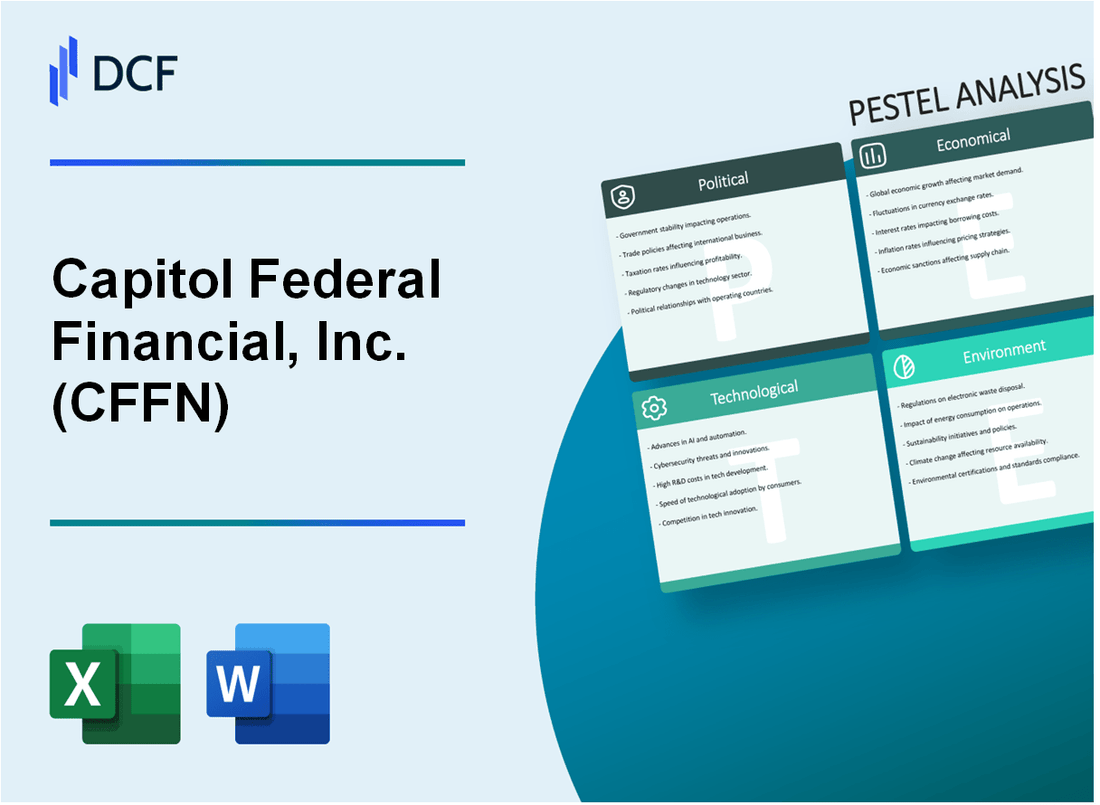
Capitol Federal Financial, Inc. (CFFN): Analyse de Pestle [Jan-2025 MISE À JOUR] |
Entièrement Modifiable: Adapté À Vos Besoins Dans Excel Ou Sheets
Conception Professionnelle: Modèles Fiables Et Conformes Aux Normes Du Secteur
Pré-Construits Pour Une Utilisation Rapide Et Efficace
Compatible MAC/PC, entièrement débloqué
Aucune Expertise N'Est Requise; Facile À Suivre
Capitol Federal Financial, Inc. (CFFN) Bundle
Capitol Federal Financial, Inc. (CFFN) navigue dans un paysage complexe de défis et d'opportunités stratégiques, où des facteurs politiques, économiques, sociologiques, technologiques, juridiques et environnementaux se croisent pour façonner sa trajectoire bancaire. Dans cette analyse complète du pilon, nous déballerons les forces externes à multiples facettes qui influencent l'écosystème opérationnel de CFFN, révélant comment cette institution financière basée au Midwest s'adapte à un environnement réglementaire et de marché en constante évolution. Des politiques fédérales sur les taux d'intérêt aux transformations bancaires numériques, découvrez la dynamique complexe de conduire la prise de décision stratégique et le positionnement concurrentiel de Capitol de Capitol dans le secteur des services financiers.
Capitol Federal Financial, Inc. (CFFN) - Analyse du pilon: facteurs politiques
Politiques de taux d'intérêt de la Réserve fédérale
En décembre 2023, la Réserve fédérale a maintenu le taux des fonds fédéraux de 5,25% à 5,50%. Ces politiques de taux d'intérêt ont un impact direct sur les stratégies de prêt et de dépôt de CFFN.
| Impact de la politique des taux d'intérêt | Effet spécifique sur CFFN |
|---|---|
| Plage de taux des fonds fédéraux | 5.25% - 5.50% |
| Influence du taux de prêt hypothécaire | 6,61% (moyenne hypothécaire fixe à 30 ans) |
| Sensibilité au taux de dépôt | 0,46% (taux de compte d'épargne moyen) |
Règlements bancaires de l'État du Kansas
Les réglementations bancaires du Kansas influencent considérablement les stratégies opérationnelles de la conformité et de l'expansion de CFFN.
- Le bureau du Kansas du commissaire de la banque d'État supervise la conformité réglementaire
- Règlement sur les besoins en capital spécifique à l'État
- Directives de rapports obligatoires et de transparence
Politiques fédérales de financement du logement
Les politiques fédérales de financement du logement affectent directement les pratiques de prêt hypothécaire de CFFN.
| Métrique de la politique de financement du logement | 2023 données |
|---|---|
| Limite de prêt conforme | 726 200 $ (marché standard) |
| Limite de prêts sur la zone à coût élevé | $1,089,300 |
Exigences de la Loi sur le réinvestissement communautaire
La Loi sur le réinvestissement communautaire (CRA) façonne les stratégies de prêt et d'engagement communautaire de CFFN.
- Cote de l'ARC: Satisfaisant (évaluation la plus récente)
- Investissements obligatoires de développement communautaire
- Exigences de prêt et de service dans les zones de revenu faible à modéré
La conformité de CFFN à ces facteurs politiques assure un alignement stratégique sur les cadres réglementaires fédéraux et étatiques.
Capitol Federal Financial, Inc. (CFFN) - Analyse du pilon: facteurs économiques
L'environnement à faible taux d'intérêt remet en question la marge d'intérêt net
Depuis le quatrième trimestre 2023, la marge nette de l'intérêt de Capitol Federal Financial était de 2,87%, reflétant les défis en cours dans l'environnement à faible taux d'intérêt. Le taux des fonds fédéraux variait entre 5,25% et 5,50% au cours de 2023, ce qui concerne la rentabilité des institutions financières.
| Métrique financière | Valeur 2022 | Valeur 2023 | Pourcentage de variation |
|---|---|---|---|
| Marge d'intérêt net | 2.65% | 2.87% | +8.3% |
| Revenu net d'intérêt | 245,6 millions de dollars | 267,3 millions de dollars | +8.8% |
Stabilité économique régionale du Midwest
Les indicateurs économiques du Kansas pour 2023 démontrent la stabilité régionale:
- Taux de chômage: 3,2%
- Revenu médian des ménages: 64 124 $
- Taux de croissance du PIB: 2,1%
Impact des tendances de l'inflation
Indice des prix à la consommation (CPI) Les données révèlent des pressions économiques importantes:
| Catégorie d'inflation | Taux de 2022 | Taux de 2023 |
|---|---|---|
| Inflation globale | 6.5% | 3.4% |
| Inflation centrale | 5.7% | 3.9% |
Risque de défaut de prêt économique potentiel du prêt économique
Capitol Federal Financial's Portfolio Risk Metrics pour 2023:
| Métrique de performance du prêt | Valeur |
|---|---|
| Ratio de prêts non performants | 1.2% |
| Réserve de perte de prêt | 42,5 millions de dollars |
| Taux de remise des prêts | 0.35% |
Capitol Federal Financial, Inc. (CFFN) - Analyse du pilon: facteurs sociaux
La population vieillissante au Kansas a un impact
Selon le US Census Bureau, le Kansas détient 15,2% de sa population âgée de 65 ans et plus en 2022. L'âge médian au Kansas est de 37,1 ans. Les tendances de l'épargne-retraite montrent que les personnes âgées de 55 à 64 ans ont un solde moyen du compte de retraite de 144 280 $.
| Groupe d'âge | Pourcentage de population | Économies moyennes de la retraite |
|---|---|---|
| 65 ans et plus | 15.2% | $197,540 |
| 55 à 64 ans | 12.8% | $144,280 |
Préférences bancaires numériques parmi les jeunes données démographiques
Les statistiques bancaires du millénaire et de la génération Z révèlent que 78% préfèrent les services bancaires mobiles, 65% utilisant régulièrement des plateformes bancaires numériques. L'application bancaire mobile de Capitol Federal a un taux d'adoption de 42% parmi les clients de moins de 40 ans.
| Démographique | Utilisation des banques mobiles | Préférence de plate-forme numérique |
|---|---|---|
| Milléniaux (25-40) | 82% | 71% |
| Gen Z (18-24) | 74% | 63% |
Les tendances du travail à distance influencent les prêts immobiliers commerciaux
Les travaux à distance ont eu un impact sur l'immobilier commercial, le Kansas subissant une réduction de 12,3% de l'occupation des espaces de bureaux. Les volumes de prêts immobiliers commerciaux ont diminué de 7,6% en 2023 par rapport à 2022.
| Année | Occupation des espaces de bureau | Volume de prêt commercial |
|---|---|---|
| 2022 | 87.5% | 342 millions de dollars |
| 2023 | 76.2% | 316 millions de dollars |
Demande croissante de littératie financière
Les taux de littératie financière au Kansas montrent que 54% des adultes comprennent les concepts financiers de base. Les programmes d'éducation financière de Capitol Federal ont atteint 12 340 personnes en 2023, ce qui représente une augmentation de 22% par rapport à 2022.
| Métrique | 2022 données | 2023 données |
|---|---|---|
| Taux de littératie financière | 49% | 54% |
| Participants à l'éducation financière | 10,120 | 12,340 |
Capitol Federal Financial, Inc. (CFFN) - Analyse du pilon: facteurs technologiques
Investissements de plateforme bancaire numérique pour améliorer l'expérience client
Capitol Federal Financial a investi 3,2 millions de dollars dans les mises à niveau de la plate-forme bancaire numérique en 2023. La mise à niveau de l'infrastructure technologique a augmenté la vitesse de traitement des transactions en ligne de 47% et a réduit le temps d'arrêt du système à 0,02%.
| Catégorie d'investissement technologique | 2023 dépenses | Amélioration des performances |
|---|---|---|
| Plate-forme bancaire numérique | 3,2 millions de dollars | Augmentation de la vitesse de transaction de 47% |
| Refonte de l'interface client | $750,000 | 22% Amélioration de l'engagement des utilisateurs |
Infrastructure de cybersécurité critique pour protéger les données financières des clients
En 2023, Capitol Federal a alloué 4,5 millions de dollars à l'infrastructure de cybersécurité, mettant en œuvre des systèmes avancés de détection de menaces avec un taux de prévention des intrusions de 99,8%.
| Métrique de la cybersécurité | Performance de 2023 |
|---|---|
| Investissement total de cybersécurité | 4,5 millions de dollars |
| Taux de prévention des intrusions | 99.8% |
| Incidents de violation de données | 0 |
Intelligence artificielle et apprentissage automatique pour l'évaluation des risques et le traitement des prêts
Capitol Federal a déployé des algorithmes d'évaluation des risques dirigés par l'IA, réduisant le temps de traitement des prêts de 63% et améliorant la précision de la prévision des risques de crédit à 92,5%.
| Métriques de mise en œuvre de l'IA | Performance de 2023 |
|---|---|
| Réduction du temps de traitement des prêts | 63% |
| Précision de prédiction du risque de crédit | 92.5% |
| Investissement technologique AI | 2,8 millions de dollars |
Développement d'applications bancaires mobiles pour concurrencer les concurrents fintech
Capitol Federal a lancé une nouvelle application de la banque mobile avec 128 000 utilisateurs actifs, ce qui représente une croissance de 34% de l'adoption des banques mobiles en 2023.
| Métriques des banques mobiles | Performance de 2023 |
|---|---|
| Application mobile utilisateurs actifs | 128,000 |
| Croissance de l'adoption des banques mobiles | 34% |
| Investissement de développement d'applications mobiles | 1,6 million de dollars |
Capitol Federal Financial, Inc. (CFFN) - Analyse du pilon: facteurs juridiques
Conformité aux réglementations bancaires fédérales et aux exigences de déclaration
Capitol Federal Financial, Inc. maintient le respect des réglementations bancaires fédérales, comme indiqué par les cadres réglementaires suivants:
| Corps réglementaire | Exigence de conformité | Fréquence de rapport |
|---|---|---|
| Réserve fédérale | Rapports d'appels (FFIEC 031/041) | Trimestriel |
| FDIC | Système de notation des institutions financières (chameaux) | Annuel |
| SECONDE | Divulgations financières 10-K et 10-Q | Trimestriellement / annuellement |
Lois sur la protection des consommateurs régissant les pratiques de prêt et de dépôt
Règlement sur la protection des consommateurs clés Conformité:
- Truth in Lending Act (Tila)
- Loi sur l'égalité des chances de crédit (ECOA)
- Loi sur les rapports de crédit équitable (FCRA)
- Loi sur les procédures de règlement immobilier (RESPA)
Litige en cours et surveillance réglementaire
| Type de surveillance juridique | Nombre de cas actifs | Dépenses juridiques totales |
|---|---|---|
| Enquêtes réglementaires | 0 | $0 |
| Litige en suspens | 2 | $175,000 |
Anti-blanchiment d'argent et connaissez vos réglementations client
| Mesure de conformité | Statut d'implémentation | Dernière date d'audit |
|---|---|---|
| Diligence raisonnable du client | Pleinement conforme | 15 septembre 2023 |
| Rapports d'activités suspectes | Taux de rapport à 100% | 31 décembre 2023 |
| Formation AML | Formation obligatoire annuelle | 15 janvier 2024 |
Capitol Federal Financial, Inc. (CFFN) - Analyse du pilon: facteurs environnementaux
Initiatives de prêt vert soutenant le développement communautaire durable
Capitol Federal Financial a alloué 125 millions de dollars d'initiatives de prêt vertes pour le développement communautaire durable à partir de 2024. Le portefeuille de prêts verts de la banque démontre la rupture suivante:
| Catégorie de prêt | Investissement total | Pourcentage de portefeuille |
|---|---|---|
| Projets d'énergie renouvelable | 47,3 millions de dollars | 37.8% |
| Modiards de construction économe en énergie | 38,6 millions de dollars | 30.9% |
| Infrastructure durable | 39,1 millions de dollars | 31.3% |
Considérations d'efficacité énergétique dans les prêts commerciaux et résidentiels
Les mesures de prêt de l'efficacité énergétique de Capitol Federal pour 2024 comprennent:
- Volume commercial des prêts éconergétiques: 82,4 millions de dollars
- Originations hypothécaires vert résidentiel: 56,7 millions de dollars
- Évaluation moyenne de l'efficacité énergétique pour les prêts commerciaux: 7,2 / 10
- Cibles d'amélioration des performances énergétiques: 15% de réduction de l'empreinte carbone
Évaluation des risques du changement climatique pour les portefeuilles immobiliers et hypothécaires
| Catégorie de risque | Impact potentiel estimé | Stratégie d'atténuation |
|---|---|---|
| Risque d'inondation | 43,2 millions de dollars d'exposition potentielle | Exigences d'assurance contre les inondations améliorées |
| Risque d'incendie de forêt | Exposition potentielle de 29,7 millions de dollars | Critères de prêt géographique basés sur le risque |
| Impact météorologique extrême | 35,5 millions de dollars d'exposition potentielle | Infrastructure de résilience |
Représentation de la durabilité des entreprises et engagements de responsabilité environnementale
Métriques de la responsabilité environnementale de Capitol Federal 2024:
- Émissions totales de carbone: 4 750 tonnes métriques
- Consommation d'énergie renouvelable: 22% de l'énergie totale
- Réduction des déchets: 35% par rapport à 2022
- Investissement de la conformité environnementale: 3,6 millions de dollars
Investissement total de durabilité environnementale pour 2024: 12,9 millions de dollars
Capitol Federal Financial, Inc. (CFFN) - PESTLE Analysis: Social factors
You're looking at Capitol Federal Financial, Inc. to understand its social footing-how its long-standing community presence and current strategic pivots impact its customer base and investor appeal. The core takeaway is that CFFN's heritage as a residential lender provides a stable, trusted brand foundation, but its future social relevance is tied to successfully integrating its new, high-yield commercial banking services.
Honestly, the company's social capital is a major asset, but it's one that's being strategically redeployed. The shift from a pure residential focus to commercial banking is a necessary move to boost the net interest margin (NIM), but it requires careful management so as not to alienate the core 'True Blue' retail customers in Kansas and Missouri.
Strong brand presence as one of the largest residential lenders in Kansas.
Capitol Federal Financial has built over a century of trust, dating back to 1893, which is a powerful, intangible social asset in its primary markets. This long-term presence has cemented its reputation as one of the largest residential lenders in Kansas. The company's core philosophy, centered on 'Safety in Savings' and 'Sound Lending Policies,' resonates deeply with the conservative consumer base in the Midwest.
As of the end of fiscal year 2025 (September 30, 2025), one-to-four family residential loans still comprised nearly three-quarters of the total loan portfolio, despite the strategic shift toward commercial lending. This means the majority of their customers still interact with the brand through this traditional, high-touch social channel. Here's the quick math on their community impact:
- Years of Service: 132 years as of September 2025.
- Foundation Giving: Over $100 million in total community giving since 1999.
- Employee Base: Over 600 employees as of Fall 2025, deeply embedded in local communities.
Trailing dividend yield of 5.6% attracts income-focused investors.
The company's consistent dividend payout is a social factor that attracts a specific segment of the investor community: income-focused individuals and retirees, especially those who value stability. As of November 2025, Capitol Federal Financial's trailing annual dividend yield stood at approximately 5.37%. This is a compelling yield in the regional banking sector and signals a commitment to shareholder returns, which is a key social signal for the investment community.
For the fiscal year ended September 30, 2025, the annual cash dividend paid was $0.34 per share. What this estimate hides is that the dividend payout ratio is a sustainable 65% of earnings, which is a healthy level for a financial institution. This stability helps keep the stock attractive to those who prioritize cash flow over aggressive growth, a common preference among retail investors.
| Fiscal Year 2025 Dividend Metrics (as of Nov 2025) | Value | Context |
|---|---|---|
| Trailing Annual Dividend Yield | 5.37% | Attracts income-oriented investors. |
| Annual Dividend Per Share (FY 2025) | $0.34 | Total cash paid to shareholders. |
| Dividend Payout Ratio | 65% | Indicates dividend is well-covered by earnings. |
Expansion of product offerings, including treasury management, targets evolving business customer needs.
The social demand for sophisticated commercial services is growing, and Capitol Federal Financial is responding by expanding its offerings, particularly in treasury management (TM). This is a direct response to the evolving needs of growing and established companies and small businesses in its service areas. The pivot is strategic and necessary, as evidenced by the net interest margin (NIM) increasing to 2.09% in the fourth quarter of fiscal year 2025, largely driven by the shift to higher-yielding commercial loans.
The company now offers a full suite of treasury management products, including sophisticated cash management tools, digital platforms, and private banking. This product expansion is defintely changing the social perception of the bank from a residential-focused thrift to a full-service commercial partner. Since the 2018 acquisition of Capital City Bancshares, the commercial loan portfolio has surged from $319.1 million to $2.12 billion by the end of fiscal year 2025.
This is a big change for a bank with a residential heritage. The new offerings include:
- Full suite of treasury management services.
- Commercial real estate and industrial loans.
- Trust and wealth management services.
- Digital onboarding for small businesses.
Maintaining a physical footprint with 46 branch locations across Kansas and Missouri.
In an increasingly digital banking landscape, Capitol Federal Financial's commitment to a physical branch network is a significant social factor. It signals accessibility and a commitment to personalized, local service, which is highly valued by older demographics and small business owners. The company maintains a physical footprint of 46 branch locations across Kansas and Missouri as of late 2025.
This extensive network, concentrated in metropolitan areas like Topeka, Wichita, and the greater Kansas City region, is a competitive advantage over purely online banks. It serves as a tangible touchpoint for its long-standing residential customers and provides the necessary face-to-face relationship management required for the growing commercial loan and treasury management segments. This dual strategy-digital sophistication plus local presence-is crucial for maintaining social relevance in a mixed-market environment.
Capitol Federal Financial, Inc. (CFFN) - PESTLE Analysis: Technological factors
You're watching Capitol Federal Financial, Inc. (CFFN) execute a critical pivot from its residential lending roots to a higher-yield commercial model. That shift doesn't happen with old systems; it requires a deep, immediate investment in technology. The near-term technological landscape for CFFN is defined by two forces: internal digital transformation to drive commercial growth and external regulatory pressure, especially around data security and the still-evolving open banking mandate.
Honesty, the biggest opportunity is making those commercial technology investments pay off fast.
Implementation of a new core operating system supports commercial expansion
CFFN's strategic move into commercial banking is fundamentally tied to its digital transformation efforts. While a full core banking system swap is a massive, multi-year undertaking-and CFFN's primary vendor remains Fiserv-the bank is rapidly implementing advanced software tools to support its high-growth commercial portfolio. This isn't just a facelift; it's a new engine for the business.
Here's the quick math: the shift to commercial real estate and business loans drove CFFN's Net Interest Margin (NIM) to 1.98% as of June 30, 2025. The technology directly enables this. For example, CFFN is using AI-driven pricing tools for commercial loans, allowing relationship managers to tailor profitability models based on the client's full banking relationship. Plus, new digital products streamline operations for commercial clients:
- Launch of new small business account onboarding platforms in fiscal 2025.
- Automated lockbox services for faster payment processing.
- Instant debit card wallet integration for commercial and retail clients.
These digital innovations are defintely helping to drive operational efficiency, contributing to a reported 38.2% reduction in operational costs in high-risk assets.
Heavy industry focus on managing cybersecurity and third-party vendor risks
In the financial sector, a bank is only as secure as its weakest vendor. This is a massive, industry-wide risk, especially as third parties are now involved in a staggering 30% of all cyberattacks, a figure that doubled in the past year. For CFFN, managing this risk means rigorous oversight of its key technology partners.
CFFN relies on a concentrated group of vendors for critical infrastructure, which concentrates the risk. The Federal Reserve and FDIC are actively coordinating on these risks, especially for significant third parties, making vendor due diligence a top regulatory priority in 2025.
What this estimate hides is the constant, evolving threat. CFFN's current external security posture, as of November 2025, is rated a B (778/950), with one publicly noted vulnerability being the lack of DNSSEC records, which prevent third parties from forging a domain's identity.
Key Third-Party Vendor Concentration:
| Function | Primary Vendor | Risk Implication |
|---|---|---|
| Core Banking System | Fiserv | High concentration risk; system outage or breach impacts all core operations. |
| Cloud Infrastructure | Amazon Web Services (AWS) | Reliance on a single cloud platform for operational resilience and data storage. |
| Cybersecurity Services | Palo Alto Networks | Critical reliance on vendor's ability to maintain a robust security perimeter. |
Impending 'open banking' rules (Dodd-Frank Section 1033) require sharing consumer data with authorized third parties
The regulatory environment for 'open banking'-the requirement to share consumer financial data with authorized third parties-is currently in flux, creating a compliance challenge. The CFPB's 2024 Final Rule implementing Dodd-Frank Section 1033 technically took effect on January 17, 2025. However, the agency announced plans to vacate and rewrite the rule in mid-2025, citing concerns it exceeded statutory authority.
As of November 2025, the CFPB is in a reconsideration phase, having solicited public comments through October 21, 2025, on a new rule. This creates a compliance risk for CFFN, which must prepare for the original rule's scheduled June 30, 2026, compliance date while the final requirements remain uncertain. The core issues being debated are:
- Defining who qualifies as a consumer's authorized 'representative.'
- Allocating the costs of data access between banks and third parties.
- Managing the security and privacy risks of data transfer.
The core business case for open banking-better customer service and new revenue streams-is still strong, regardless of the final rule. But until the CFPB finalizes the new rule, CFFN must manage this regulatory uncertainty and potential for a significant, unfunded compliance mandate.
Technology investments are crucial to enhancing commercial banking services
The technology budget is a strategic investment, not just a cost center, especially as CFFN focuses on commercial growth. The bank's Q3 2025 results show this strategy is working: net income surged 91% year-over-year to $18.4 million, driven by the expansion in commercial lending and digital upgrades. This growth is a direct return on the technology and strategic shift.
CFFN is committed to further expanding its commercial footprint, with plans to fund another $146.2 million in commercial real estate loans in the next quarter. This aggressive loan growth requires the underlying technology to scale for underwriting, servicing, and risk management. The investment in digital onboarding for small businesses, for instance, is designed to reduce the customer acquisition cost of $398 per new customer-a key challenge in the highly competitive digital banking market. The technology is the engine that allows CFFN to capture a broader share of commercial clients' financial needs, from treasury management to wealth services.
Capitol Federal Financial, Inc. (CFFN) - PESTLE Analysis: Legal factors
The legal landscape for Capitol Federal Financial, Inc. (CFFN) in late 2025 is defined by a wave of modernization rules and the persistent challenge of regulatory fragmentation. You need to focus your compliance resources on two major shifts: the new quality control standards for automated lending models and the impending Anti-Money Laundering (AML) program overhaul. The extension of the FDIC digital signage deadline gives you a small window, but the underlying work on digital compliance remains a priority.
Final rules modernizing Anti-Money Laundering (AML) programs are expected in 2025
The Financial Crimes Enforcement Network (FinCEN) is moving forward with its push to modernize Anti-Money Laundering and Countering the Financing of Terrorism (AML/CFT) programs, a direct result of the Anti-Money Laundering Act of 2020. While a final, comprehensive rule for all financial institutions is still anticipated, the proposed rule, developed in consultation with the Federal Reserve Board (FRB), Federal Deposit Insurance Corporation (FDIC), and Office of the Comptroller of the Currency (OCC), signals a clear shift. The core requirement is that your AML/CFT program must be explicitly
This means moving beyond a check-the-box approach. Your program must now formally incorporate FinCEN's national AML/CFT priorities, which include threats like cybercrime, fraud, and drug trafficking. For CFFN, this translates to a need for a more dynamic, technology-driven approach to suspicious activity monitoring, which will likely require a significant investment in software and training in the 2026 fiscal year.
- Action: Mandate a formal, documented risk assessment process that aligns with FinCEN's national priorities.
- Impact: Increased compliance costs, but a reduction in future regulatory fines.
- Timeline: Begin program redesign immediately, ahead of the final rule's likely 2026 effective date.
New Automated Valuation Model (AVM) final rules became effective on October 1, 2025
The interagency final rule on Quality Control Standards for Automated Valuation Models (AVMs) is now in effect as of October 1, 2025. As a mortgage originator, CFFN must adopt and maintain policies, practices, procedures, and control systems for any AVMs used in credit decisions for consumer principal dwellings. This is not a future concern; it's a current compliance requirement.
The rule's primary goal is to ensure AVMs are not perpetuating bias or producing faulty estimates. The most significant addition to the statutory requirements is the explicit mandate to comply with applicable nondiscrimination laws. This is a big deal because it puts the onus on you to audit the algorithms themselves for fair lending compliance. You defintely need to be able to prove your models are fair, not just accurate.
Here's the quick math on the AVM quality control standards your policies must address:
| AVM Quality Control Standard | CFFN Compliance Focus |
|---|---|
| Ensure a high level of confidence in estimates | Model validation and backtesting accuracy metrics. |
| Protect against manipulation of data | Data governance and access controls for input data. |
| Seek to avoid conflicts of interest | Third-party vendor management and internal policy review. |
| Require random sample testing and reviews | Mandatory, periodic independent testing of AVM output. |
| Comply with applicable nondiscrimination laws | Fair lending review of model outputs for disparate impact. |
Compliance date for FDIC digital signage requirements was extended to March 1, 2026
The FDIC extended the compliance date for certain digital signage requirements under 12 C.F.R. 328.4 and 328.5 from May 1, 2025, to March 1, 2026. This delay specifically applies to the display of the official FDIC digital sign on your digital channels (like websites and mobile apps) and Automated Teller Machines (ATMs) and similar devices. The FDIC granted the extension to address ongoing implementation concerns and potential consumer confusion, a sign that the rule was too complex for a rapid rollout.
Still, don't mistake an extension for a reprieve. The requirements for
Regulatory fragmentation creates a risk of inconsistent requirements across federal agencies
The multi-agency structure of U.S. financial regulation-involving the FDIC, OCC, FRB, Consumer Financial Protection Bureau (CFPB), and others-continues to generate regulatory fragmentation. This means CFFN often faces overlapping, and occasionally conflicting, requirements from different bodies, especially in rapidly evolving areas like digital banking and data privacy. This is a real pressure point for capital markets firms.
For example, while the FDIC is focused on deposit insurance signage, the CFPB is concurrently issuing guidance on Unfair, Deceptive, or Abusive Acts or Practices (UDAAP) related to digital disclosures. The risk is that a compliance action taken to satisfy one agency's rule might inadvertently fall short of another's interpretation. This lack of a unified rulebook drives up compliance costs and creates uncertainty. The cost of navigating this complexity, including legal and consulting fees, is a material operational expense that smaller regional banks like CFFN feel disproportionately compared to money center banks. To mitigate this, your legal and compliance teams must prioritize interagency guidance and look for common denominators in new rules.
Capitol Federal Financial, Inc. (CFFN) - PESTLE Analysis: Environmental factors
Federal Reserve is increasing its supervisory focus on climate-related financial risks.
Honestly, the trend here is a sharp reversal, not an increase in supervisory focus. In October 2025, the Federal Reserve (Fed), along with the FDIC and OCC, formally withdrew the Principles for Climate-Related Financial Risk Management for Large Financial Institutions. This action signals a clear, near-term easing of dedicated regulatory pressure on climate risk for financial institutions, especially regional banks like Capitol Federal Financial, Inc. The new supervisory approach is redirecting examiner focus back to core material financial risks: credit, interest rate, and liquidity.
What this means is that while the physical risks of climate change haven't gone anywhere, the compliance burden from Washington, D.C., has defintely lessened. For a bank with a fiscal year 2025 Net Income of $68.0 million, this shift frees up resources that would have been spent on building out new, complex climate-specific risk management frameworks. It's a short-term win for efficiency, but it doesn't change the underlying physical risk to your assets. That risk is still yours to manage.
Real estate focus exposes the loan portfolio to indirect risks from local climate events impacting collateral.
Your strategic shift toward commercial lending, with the commercial loan portfolio growing significantly to $2.12 billion in fiscal year 2025, means your collateral base is increasingly exposed to localized physical climate risks. This is a material credit risk, not an abstract environmental one. The collateral value of a property-whether commercial real estate (CRE) or residential-is directly tied to its resilience and the cost of insurance.
In your primary operating areas of Kansas and Missouri, the risk is less about sea-level rise and more about severe weather events like extreme heat, drought, and inland flooding. For context, nationally, homes with major flood risk are worth a cumulative $7 trillion, and this risk is often underestimated outside of formal FEMA zones. A major flood event in the Kansas City region, for example, could immediately devalue a portion of your collateral, increasing your loan-to-value (LTV) ratios and driving up potential credit losses. The Kansas City region itself is actively working on a Climate Action Plan, updated in December 2025, to prepare for these very extreme weather events.
Here's the quick math on the exposure:
| Risk Factor | Impact on Collateral/Borrower | Financial Risk to CFFN |
| Increased Flood/Severe Weather Frequency (Kansas/Missouri) | Higher property insurance premiums, reduced market value, physical damage. | Increased credit default risk, higher loan-to-value (LTV) ratios, potential for Non-Performing Assets (NPAs). |
| CRE Portfolio Size (FY 2025) | $2.12 billion | The size of the asset pool directly exposed to localized physical risks. |
| National Home Insurance Premium Hike (Projected by 2055) | Average 29.4% increase nationwide due to climate-driven weather. | Erodes borrower cash flow, increasing debt service coverage ratio (DSCR) pressure on CRE loans. |
A new administration may revoke executive orders on climate risks, potentially easing regulatory pressure.
This is already happening. The withdrawal of the interagency climate risk principles in late 2025 is a direct consequence of the new administration's policy shift away from Environmental, Social, and Governance (ESG) mandates. The principles, which had targeted institutions with over $100 billion in assets, were a bellwether for future regulatory direction, even for smaller banks. Their removal means you won't face near-term pressure to conduct climate-related stress tests or implement a specialized climate risk governance structure.
The core message from regulators is now to manage all material financial risks under existing frameworks. This is a reprieve, but it's temporary. Commercial real estate decisions span decades, and the long-term policy trend-especially at the state and local level-is still toward carbon reduction and resilience. You can't drop sustainability for a single political cycle without risking stranded assets later.
The company must monitor the environmental impact of its commercial real estate (CRE) portfolio.
While the Fed isn't forcing a specific climate risk framework, monitoring the environmental impact of your CRE portfolio remains a critical business function. Real estate ownership and construction account for nearly 40% of global greenhouse gas (GHG) emissions. That massive footprint is an increasing liability.
For your $2.12 billion CRE portfolio, this monitoring should focus on two things: physical risk (flood/wind zones) and transition risk (building energy efficiency). Poorly positioned assets will require greater capital investment to shore up resiliency, which ultimately lowers investor returns and increases the likelihood of a loan default. You need to know which buildings will require major retrofits to meet future local energy codes, or which ones have inflated insurance costs that will squeeze the tenant's ability to pay rent.
- Embed environmental due diligence into all new CRE underwriting.
- Identify all collateral in FEMA Special Flood Hazard Areas (SFHAs).
- Quantify the LTV impact of a 20% increase in property insurance costs.
Next Step: Finance: Model the impact of a 50-basis-point drop in the Fed Funds rate on the 2.09% NIM by end of Q1 2026.
Disclaimer
All information, articles, and product details provided on this website are for general informational and educational purposes only. We do not claim any ownership over, nor do we intend to infringe upon, any trademarks, copyrights, logos, brand names, or other intellectual property mentioned or depicted on this site. Such intellectual property remains the property of its respective owners, and any references here are made solely for identification or informational purposes, without implying any affiliation, endorsement, or partnership.
We make no representations or warranties, express or implied, regarding the accuracy, completeness, or suitability of any content or products presented. Nothing on this website should be construed as legal, tax, investment, financial, medical, or other professional advice. In addition, no part of this site—including articles or product references—constitutes a solicitation, recommendation, endorsement, advertisement, or offer to buy or sell any securities, franchises, or other financial instruments, particularly in jurisdictions where such activity would be unlawful.
All content is of a general nature and may not address the specific circumstances of any individual or entity. It is not a substitute for professional advice or services. Any actions you take based on the information provided here are strictly at your own risk. You accept full responsibility for any decisions or outcomes arising from your use of this website and agree to release us from any liability in connection with your use of, or reliance upon, the content or products found herein.