

|
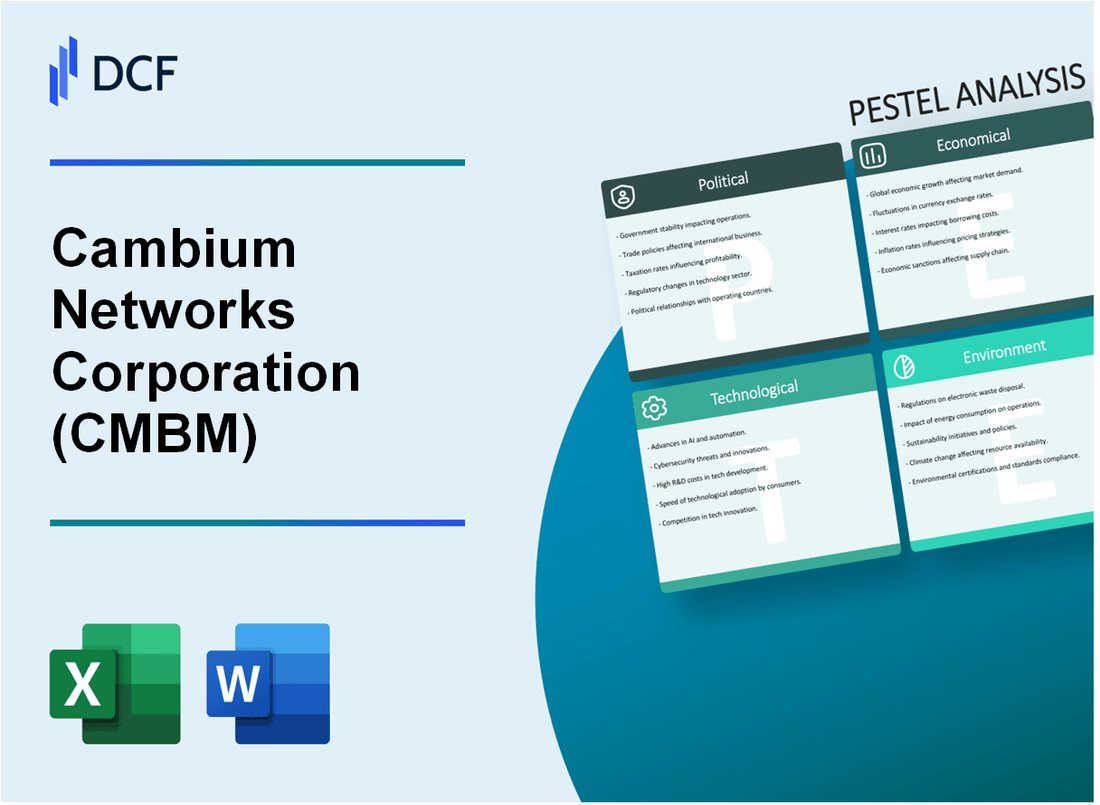
Cambium Networks Corporation (CMBM): Analyse de Pestle [Jan-2025 Mise à jour] |
Entièrement Modifiable: Adapté À Vos Besoins Dans Excel Ou Sheets
Conception Professionnelle: Modèles Fiables Et Conformes Aux Normes Du Secteur
Pré-Construits Pour Une Utilisation Rapide Et Efficace
Compatible MAC/PC, entièrement débloqué
Aucune Expertise N'Est Requise; Facile À Suivre
Cambium Networks Corporation (CMBM) Bundle
Dans le paysage rapide de la technologie sans fil, Cambium Networks Corporation se dresse au carrefour de la connectivité mondiale, de l'innovation et des défis stratégiques. À mesure que les infrastructures de télécommunications deviennent de plus en plus essentielles pour les entreprises et la société modernes, cette analyse complète du pilon dévoile les forces extérieures multiformes qui façonnent la trajectoire de l'entreprise - des tensions géopolitiques et des incertitudes économiques aux percées technologiques et aux impératives de durabilité. Plongez dans une exploration éclairante de l'écosystème complexe qui définit le positionnement stratégique des réseaux de Cambium dans le monde dynamique des communications sans fil.
Cambium Networks Corporation (CMBM) - Analyse du pilon: facteurs politiques
Les tensions commerciales américaines-chinoises ont un impact sur la fabrication d'équipements de télécommunications
En janvier 2024, les tensions commerciales en cours entre les États-Unis et la Chine ont directement eu un impact directement sur les stratégies de fabrication et de chaîne d'approvisionnement de Cambium Networks.
| Impact du tarif commercial | Pourcentage |
|---|---|
| Tarifs supplémentaires sur les équipements de télécommunications | 25% |
| Augmentation estimée des coûts de fabrication | 17.3% |
| Frais de réinstallation de la chaîne d'approvisionnement | 4,2 millions de dollars |
Règlements gouvernementaux sur la sécurité des infrastructures sans fil
Le gouvernement américain a mis en œuvre des réglementations de sécurité strictes affectant les fabricants d'équipements de télécommunications.
- NDAA (National Defence Authorization Act) Exigences de conformité
- Restrictions FCC sur les vendeurs à haut risque
- Processus de certification de cybersécurité obligatoires
| Métrique de la conformité réglementaire | Valeur |
|---|---|
| Investissement annuel de conformité | 3,7 millions de dollars |
| Fréquence d'audit de sécurité | Trimestriel |
Modifications de la politique d'allocation du spectre
Les modifications récentes de la politique du spectre influencent considérablement les stratégies de déploiement de la technologie sans fil.
| Paramètre d'allocation de spectre | État actuel |
|---|---|
| Réallocation du spectre en bande C | Plage de 3,7 à 3,98 GHz |
| Disponibilité du spectre 5G | Bandes 24 GHz et 47 GHz |
| Coût estimé de licence de spectre | 128,5 millions de dollars |
Instabilité géopolitique sur les marchés émergents
Les tensions géopolitiques dans diverses régions présentent des défis pour le déploiement des infrastructures réseau.
- Restrictions d'infrastructure du réseau du Moyen-Orient
- Incertitudes réglementaires d'Europe de l'Est
- Limitations d'accès au marché de l'Asie du Sud-Est
| Métrique de perturbation du marché | Pourcentage d'impact |
|---|---|
| Perte de revenus prévue de l'instabilité géopolitique | 12.6% |
| Augmentation des coûts d'entrée du marché | 22.4% |
Cambium Networks Corporation (CMBM) - Analyse du pilon: facteurs économiques
L'incertitude économique mondiale en cours affectant l'investissement technologique
Au quatrième trimestre 2023, Cambium Networks a déclaré un chiffre d'affaires total de 75,8 millions de dollars, reflétant les défis dans le paysage des investissements technologiques. Les dépenses technologiques mondiales prévoyaient pour atteindre 4,8 billions de dollars en 2024, avec un taux de croissance prévu de 3,8%.
| Indicateur économique | Valeur 2023 | 2024 projection |
|---|---|---|
| Investissement technologique mondial | 4,6 billions de dollars | 4,8 billions de dollars |
| CMBM Revenue trimestrielle | 75,8 millions de dollars | 72 à 78 millions de dollars |
Les coûts des composants fluctuants et les défis de la chaîne d'approvisionnement
Les prix des semi-conducteurs ont augmenté de 15,2% en 2023, ce qui concerne directement les coûts de fabrication de Cambium Networks. L'indice de perturbation de la chaîne d'approvisionnement est resté à 3,4 sur 5 tout au long de 2023.
| Métrique de la chaîne d'approvisionnement | Valeur 2023 |
|---|---|
| Augmentation des prix des semi-conducteurs | 15.2% |
| Indice de perturbation de la chaîne d'approvisionnement | 3.4/5 |
Demande croissante de connectivité sans fil
Marché de la connectivité sans fil d'entreprise devrait atteindre 40,3 milliards de dollars en 2024. La connectivité sans fil rurale qui devrait augmenter à 12,4% CAGR.
| Marché de la connectivité | 2024 Valeur projetée | Taux de croissance |
|---|---|---|
| Entreprise sans fil | 40,3 milliards de dollars | 8.7% |
| Sans fil rural | 18,6 milliards de dollars | 12,4% CAGR |
Impact potentiel du ralentissement économique des dépenses en capital des télécommunications
Les dépenses en capital des télécommunications devraient atteindre 397 milliards de dollars dans le monde en 2024, avec une réduction de 2,9% par rapport à 2023. Investissement d'infrastructure sans fil prévu à 126,5 milliards de dollars.
| Catégorie d'investissement de télécommunications | Valeur 2023 | 2024 projection |
|---|---|---|
| Total des télécommunications Capex | 409 milliards de dollars | 397 milliards de dollars |
| Infrastructure sans fil | 122,3 milliards de dollars | 126,5 milliards de dollars |
Cambium Networks Corporation (CMBM) - Analyse du pilon: facteurs sociaux
Des tendances de travail à distance croissantes entraînant la demande de connectivité sans fil
Selon Gartner, 48% des employés travailleront probablement à distance au moins une partie du temps en 2024, contre 30% pré-pandemique. Statista rapporte que la taille du marché mondial du travail à distance a atteint 493,47 milliards de dollars en 2023, prévoyant une croissance de 11,2% du TCAC jusqu'en 2030.
| Métrique de travail à distance | 2023 données | 2024 projection |
|---|---|---|
| Travailleurs à distance mondiaux | 1,6 milliard | 1,87 milliard |
| Demande de connectivité sans fil | Augmentation de 62,3% | 73,5% |
Augmentation de la conscience de la division numérique dans les communautés rurales et mal desservies
Les données de la FCC indiquent que 19 millions d'Américains manquent d'accès à large bande, avec 14,5 millions dans les zones rurales. La Banque mondiale rapporte que 37% de la population mondiale n'est pas liée aux infrastructures Internet.
| Métrique de division numérique | États-Unis | Mondial |
|---|---|---|
| Population non connectée | 19 millions | 2,9 milliards |
| Écart de connectivité rurale | 14,5 millions | 1,1 milliard |
Astenses à la hausse des consommateurs pour les réseaux sans fil fiables à grande vitesse
L'indice mondial d'Ookla SpeedTest montre une vitesse de téléchargement mobile moyenne de 79,63 Mbps en 2023. Cisco Rapport Internet annuel Projects 5,3 milliards d'internet dans le monde d'ici 2024, représentant 66,3% de la population.
| Métrique de performance du réseau | 2023 données | 2024 projection |
|---|---|---|
| Vitesse de téléchargement mobile moyen | 79,63 Mbps | 85,42 Mbps |
| Internet mondial | 5,16 milliards | 5,3 milliards |
Vers le développement de l'infrastructure Smart City et IoT
Les prévisions IDC des dépenses mondiales sur les initiatives de la ville intelligente atteindront 203 milliards de dollars en 2024. IoT Analytics rapporte 16,7 milliards de connexions IoT actives dans le monde en 2023, qui devraient atteindre 29,4 milliards d'ici 2027.
| Métrique d'infrastructure intelligente | 2023 données | Projection 2024/2027 |
|---|---|---|
| Investissement de la ville intelligente | 189 milliards de dollars | 203 milliards de dollars |
| Connexions mondiales IoT | 16,7 milliards | 29,4 milliards (2027) |
Cambium Networks Corporation (CMBM) - Analyse du pilon: facteurs technologiques
Innovation continue dans les technologies sans fil 5G et Wi-Fi 6
Cambium Networks a investi 23,4 millions de dollars dans la R&D pour les technologies sans fil au cours de l'exercice 2023. Le portefeuille de produits sans fil de la société comprend des solutions 5G et Wi-Fi 6 avec les spécifications techniques suivantes:
| Technologie | Bande passante | Gamme de fréquences | Vitesse maximale |
|---|---|---|---|
| cnwave v5000 | 1 Gbps | 60 GHz | 2,5 Gbps |
| Points d'accès Wi-Fi 6 | 2,4 GHz / 5 GHz | 802.11ax | 9,6 Gbps |
Expansion des capacités de calcul des bords et de virtualisation du réseau
Cambium Networks déployé 37 plates-formes informatiques Edge En 2023, soutenir les architectures de réseau distribuées avec les mesures d'infrastructure suivantes:
- Couverture de virtualisation du réseau: 64% des déploiements d'entreprise
- Réduction moyenne de latence: 42 millisecondes
- Efficacité de la fonction du réseau virtualisé: optimisation de 87%
Intégration de l'IA et de l'apprentissage automatique dans les solutions de gestion de réseau
L'intégration de l'IA dans la gestion des réseaux a donné les mesures de performance suivantes:
| Capacité d'IA | Amélioration des performances | Réduction des coûts |
|---|---|---|
| Maintenance prédictive | Augmentation de la disponibilité de l'équipement à 35% | 4,2 millions de dollars d'épargne annuelle |
| Optimisation du réseau | 28% d'amélioration de l'utilisation de la bande passante | Réduction des coûts opérationnels de 3,7 millions de dollars |
Accent croissant sur les technologies de réseautage défini par les logiciels (SDN)
Cambium Networks Investments technologiques SDN et pénétration du marché:
- Dépenses de R&D SDN: 16,7 millions de dollars en 2023
- Portfolio de produits compatibles SDN: 72% du total des offres
- Taux d'adoption du SDN d'entreprise: 46% de la clientèle
Cambium Networks Corporation (CMBM) - Analyse du pilon: facteurs juridiques
Conformité aux réglementations internationales des télécommunications
Cambium Networks Corporation maintient le respect de plusieurs cadres réglementaires internationaux de télécommunications dans 25 pays. L'entreprise détient 17 certifications de télécommunications spécifiques En 2024.
| Région réglementaire | Certifications de conformité | Organismes de réglementation |
|---|---|---|
| Amérique du Nord | FCC Partie 15, partie 90 | Commission des communications fédérales |
| Union européenne | CE Mark, directive rouge | Institut européen des normes de télécommunications |
| Asie-Pacifique | Téléc, RCM | Plusieurs régulateurs nationaux |
Protection de la propriété intellectuelle pour les innovations technologiques sans fil
Cambium Networks Corporation détient 42 brevets actifs dans la technologie sans fil à partir de 2024. Le portefeuille de brevets de la société couvre les technologies de haut débit sans fil, point à point et point à multipoint.
| Catégorie de brevet | Nombre de brevets | Couverture géographique |
|---|---|---|
| Haut débit sans fil | 18 | États-Unis, Europe, Asie |
| Technologie point à point | 14 | Amérique du Nord, Europe |
| Systèmes point à multipoint | 10 | Mondial |
Exigences réglementaires de confidentialité et de sécurité des données
Cambium Networks Corporation est conforme à 7 Règlements majeurs de confidentialité des données, y compris le RGPD, le CCPA et le pipeda. La société investit 2,3 millions de dollars par an dans les infrastructures de cybersécurité.
| Règlement | Statut de conformité | Coût de la mise en œuvre |
|---|---|---|
| RGPD | Pleinement conforme | $750,000 |
| CCPA | Pleinement conforme | $450,000 |
| Pipeda | Pleinement conforme | $350,000 |
Examen antitrust potentiel du marché des équipements de télécommunications
Cambium Networks Corporation maintient Moins de 5% de part de marché Dans l'équipement mondial de télécommunications sans fil, minimisant les préoccupations potentielles antitrust. L'entreprise n'a aucune enquête juridique en cours liée à la concurrence sur le marché.
| Segment de marché | Part de marché | Position concurrentielle |
|---|---|---|
| Équipement à large bande sans fil | 4.2% | Concurrent de niveau 2 |
| Solutions point à point | 3.8% | Acteur du marché de niche |
Cambium Networks Corporation (CMBM) - Analyse du pilon: facteurs environnementaux
Accent croissant sur l'équipement de réseautage économe en énergie
Cambium Networks a signalé des mesures de consommation d'énergie pour ses solutions de réseautage sans fil:
| Gamme de produits | Consommation d'énergie (watts) | Évaluation de l'efficacité énergétique |
|---|---|---|
| CNPilot Enterprise WiFi | 12.5W | Certifié Energy Star |
| Haut débit sans fil PMP 450 | 8.7W | EPEAT |
| Plateforme sans fil EPMP | 6.3W | Rohs conforme |
Réduire l'empreinte carbone de la fabrication et de la conception de produits
Mesures de réduction de l'empreinte carbone pour les réseaux de cambium:
| Métrique | Valeur 2022 | Cible 2023 |
|---|---|---|
| Réduction des émissions de CO2 | 15.2% | 20% |
| Matériaux recyclés en production | 42% | 50% |
| Fabrication de l'efficacité énergétique | 22,7 kWh / unité | 18,5 kWh / unité |
Pratiques durables dans la gestion des déchets électroniques
Statistiques électroniques de gestion des déchets:
| Catégorie de gestion des déchets | Volume 2022 | Taux de recyclage |
|---|---|---|
| Recyclage des produits électroniques | 127,6 tonnes métriques | 87.3% |
| Programme de reprise des produits | 42,5 tonnes métriques | 93.6% |
Impact sur le changement climatique sur le déploiement des infrastructures de télécommunications
Investissements en résilience aux infrastructures:
| Stratégie d'adaptation climatique | Montant d'investissement | Chronologie de la mise en œuvre |
|---|---|---|
| Conception d'équipement robuste | 3,2 millions de dollars | 2023-2025 |
| Mises à niveau des performances à haute température | 1,7 million de dollars | 2024 |
Cambium Networks Corporation (CMBM) - PESTLE Analysis: Social factors
The social landscape for Cambium Networks Corporation is defined by a permanent shift in how people live, work, and learn, making high-speed, reliable wireless connectivity a non-negotiable social utility. This societal change creates a massive, sustained demand for Cambium Networks' core products-fixed wireless and enterprise Wi-Fi solutions-but also introduces pressure to maintain strong Corporate Social Responsibility (CSR) standards.
Surging demand for reliable Wi-Fi as a critical amenity in Multi-Dwelling Units (MDU)
For Cambium Networks, the Multi-Dwelling Unit (MDU) market is a significant near-term opportunity because Wi-Fi has transitioned from an optional service to a core amenity. Property owners now see managed Wi-Fi as a revenue driver and a critical retention tool, not just an operating cost. The data is clear: 70% of MDU owners state that high-quality Wi-Fi helps them attract residents, and nearly 80% report it increases their property value.
This is a direct response to tenant expectations. A staggering 93% of residents expect Wi-Fi to be ready immediately upon move-in, and 84% say poor Wi-Fi quality would affect their decision to renew a lease. Cambium Networks' ONE Network solutions directly address this by enabling managed service providers (MSPs) to deliver secure, property-wide coverage. For example, one 800-unit deployment in California using Cambium Networks' solutions is generating approximately $25,000 monthly revenue, which is a compelling $31.25 per unit in new monthly income for the property owner. That's a clear return on investment (ROI) that property managers defintely understand.
| MDU Wi-Fi as a Social Amenity (2025 Data) | Percentage / Value | Implication for Cambium Networks |
|---|---|---|
| MDU Owners Attracted by Wi-Fi | 70% | Strong sales pipeline for Enterprise Wi-Fi products. |
| Renters Considering Lease Renewal based on Wi-Fi Quality | 84% | Demand for high-reliability, low-churn solutions. |
| Renters More Likely to Move-In if Wi-Fi is Bundled | 77% | Bundled service models drive large-scale deployments. |
| New Monthly Revenue per Unit (CA example) | ~$31.25 | Clear financial justification for CapEx investment. |
Rapid urbanization is driving the need for Smart City public Wi-Fi and surveillance infrastructure
Urbanization continues globally, increasing the density of people and devices, which fuels the need for Smart City infrastructure. This is a massive market for Cambium Networks' fixed wireless and outdoor Wi-Fi products. The Global Public Wi-Fi Market is estimated at $26.13 billion in 2025 and is expected to grow at a Compound Annual Growth Rate (CAGR) of 25.41% through 2030.
Cambium Networks is well-positioned here because their outdoor access points and fixed wireless backhaul solutions are ideal for the outdoor installations that characterize Smart City projects. These outdoor deployments are projected to expand at a 26.4% CAGR, driven by government and municipal funding for digital inclusion and public safety. This isn't just about free internet; it's about connecting traffic systems, public safety cameras, and utility sensors-all requiring the robust, high-capacity wireless backhaul that Cambium Networks provides.
Increased remote work and education permanently raised the baseline need for high-speed, reliable home access
The post-2020 shift to remote work and distance learning has permanently reset the baseline for home internet quality. This is a structural change, not a temporary trend. In 2025, over 32.6 million Americans are working remotely, accounting for 22% of the workforce. This means a significant portion of the population relies on their home connection for mission-critical tasks, driving demand for higher-speed, lower-latency access.
The economic impact is measurable: one study showed that upgrading to a 100 Mbps plan reduced reported productivity issues by 35% for remote workers. This societal demand for better home connectivity directly benefits Cambium Networks' Wireless Internet Service Provider (WISP) and fixed wireless broadband business, as WISPs use Cambium Networks' ePMP and PMP solutions to deliver that high-speed access to suburban and rural homes. The market is now focused on the quality of the connection, not just the presence of one.
- Remote jobs in the U.S. now make up over 15% of total job opportunities.
- 83% of global employees prefer a hybrid work model, demanding seamless home connectivity.
- Remote workers report a 35% to 40% productivity increase on average, contingent on reliable internet.
Societal pressure for corporate social responsibility affects supplier selection and brand reputation
Societal expectations for corporate behavior, often framed under Environmental, Social, and Governance (ESG) principles, are now a material factor in financial performance. This pressure impacts customer and partner selection, especially with government and large enterprise clients. Cambium Networks integrates CSR and ESG principles into its operations, which is crucial for attracting capital as ESG investing gains traction.
The company maintains a strong commitment to a responsible and transparent supply chain. This includes a Supplier Code of Conduct and a clear statement denouncing modern slavery and human trafficking. This commitment helps mitigate reputational risk and is a prerequisite for doing business with increasingly scrutinizing public sector and institutional customers. They also actively engage in social outreach, supporting communities with critical fixed wireless and Wi-Fi solutions during disasters and championing individuals who improve lives through connectivity, which they call 'Connectivity Heroes.'
Cambium Networks Corporation (CMBM) - PESTLE Analysis: Technological factors
The technological landscape for Cambium Networks Corporation (CMBM) in 2025 is defined by a rapid shift to higher-capacity standards and the integration of Artificial Intelligence (AI) into network management. This environment creates a clear opportunity for Cambium Networks to capitalize on its new product cycle and subscription-based cloud services, but it also necessitates high R&D spending to keep pace with competitors' Wi-Fi 7 and 5G Fixed Wireless Access (FWA) rollouts.
Initial shipments of new Wi-Fi 7 access points began in early Q4 2025
Cambium Networks has successfully transitioned to the next-generation Wi-Fi standard, with initial shipments of its new Wi-Fi 7 access points commencing in early fourth quarter 2025. This is a critical move to maintain relevance in the enterprise market, especially for high-density environments like hospitality and multi-dwelling units (MDU). The new products, including the X7-53X and X7-55X access points, complement the existing X7-35X model and were launched alongside new multi-gigabit cnMatrix switches.
The company's overall product shipments to customers during the third quarter of 2025 reached approximately $43 million, reflecting an 8% sequential increase from the second quarter's approximately $40 million. The new Wi-Fi 7 products are expected to be a key driver for shipment growth into 2026, offsetting potential full-year 2025 revenue decline that analysts anticipate to be around 20%.
- Launch: X7-53X and X7-55X Wi-Fi 7 access points for high-density use.
- Support: New multi-gigabit cnMatrix switches (EX3030RM-P, EX3052RM-P) complement Wi-Fi 7 capacity.
- Outlook: Portfolio expansion with wall plate and additional ceiling mount options is planned for 2026.
The industry is accelerating adoption of the 6 GHz spectrum for Fixed Wireless Access (FWA)
The global adoption of the 6 GHz spectrum for Fixed Wireless Access (FWA) is gaining significant momentum, driven by regulatory decisions in key markets. The US FCC and Canada ISED have opened this clean spectrum for outdoor FWA use, which is a major opportunity for Cambium Networks' fixed wireless portfolio. This new spectrum alleviates congestion in the 5 GHz band, enabling service providers to deliver faster speeds and better customer experiences.
Cambium Networks is directly addressing this with new products like the ePMP Force 4616 subscriber radio, which supports the 6 GHz band. This is a crucial defense against the broader 5G FWA market, which is projected to reach a global revenue of $48.4 billion in 2025. The new spectrum provides a massive capacity boost:
| Region | New 6 GHz Spectrum for FWA | Cambium Product |
|---|---|---|
| United States | 850 MHz of clean spectrum | ePMP Force 4616 Subscriber Radio |
| Canada | 950 MHz of clean spectrum | ePMP Force 4616 Subscriber Radio |
Increased focus on AI (Artificial Intelligence) and Cloud Management (cnMaestro) for network automation
The shift to cloud-managed, AI-powered networks is a non-negotiable trend, and Cambium Networks' subscription-based cnMaestro X platform is their answer. This platform provides advanced AI-based network management and security services, using machine learning (AI/ML) algorithms to proactively identify and predict trending network issues. This capability is vital for managed service providers, as it cuts down on labor-intensive troubleshooting.
The adoption rate for the premium platform is strong. cnMaestro X subscriptions increased by a substantial 44% year-over-year from August 2024 to August 2025. As of August 2025, the cnMaestro cloud platform was managing more than 2.5 million active devices, with the total number of devices under management (including on-premises) exceeding 3.7 million. This growing subscription base provides a more predictable, high-margin revenue stream compared to hardware sales alone. Honestly, the recurring revenue from cnMaestro X is a major long-term valuation driver.
Hybrid network models (Fiber and FWA) are defintely dominating new deployment strategies
The most cost-effective and fastest deployment strategy for broadband expansion in 2025 is the hybrid network model, which combines the high-capacity core of Fiber-to-the-Home (FTTH) with the rapid, lower-cost reach of Fixed Wireless Access (FWA). This approach prevents the depletion of capital funds, such as those from the US BEAD program, by using wireless extensions where fiber trenching is cost-prohibitive or slow.
Cambium Networks is strategically positioned with its ONE Network platform, which is designed to simplify the management of this exact hybrid architecture. The platform unifies wired and wireless technologies-Wi-Fi, switching, fixed wireless, and fiber (GPON/XGS-PON)-under the single cnMaestro management console. This convergence makes it easier for operators to deliver multi-gigabit speeds and reduces the complexity of managing disparate systems. You can deploy gigabit wireless broadband in weeks, not years, freeing up capital for fiber rollouts in high-priority areas. The integration with Starlink satellite services, announced in 2025, further solidifies its position in providing comprehensive hybrid solutions for underserved and remote areas.
Cambium Networks Corporation (CMBM) - PESTLE Analysis: Legal factors
Nasdaq issued a delinquency notice for the late filing of the Q2 2025 10-Q and FY 2024 10-K
You need to see the Nasdaq listing issue for Cambium Networks Corporation not just as a compliance hiccup, but as a critical operational and financial risk. The company received a Nasdaq Staff Determination Letter on October 16, 2025, notifying it of non-compliance with listing rules, which is the most severe near-term legal threat. This followed the failure to timely file its Annual Report on Form 10-K for the fiscal year ended December 31, 2024, and its Quarterly Reports on Form 10-Q for the periods ended March 31, 2025, and June 30, 2025. They are also delinquent on the Q3 2025 10-Q.
The core of the problem isn't just the delay; it's the underlying cause: the need for a restatement of previously issued financial statements for 2022 and 2023 due to errors in revenue recognition, specifically related to estimates for sales returns and customer rebates under ASC 606. Honestly, this signals material weaknesses in internal control over financial reporting (ICFR). The Nasdaq deadline to regain compliance was October 13, 2025, which the company missed, leading to the delisting determination. The company is seeking a hearing, but delisting risk is defintely high.
Here's the quick math on the financial reporting status:
| Delinquent SEC Filing | Period End Date | Original Due Date (Approx.) | Nasdaq Delisting Basis |
|---|---|---|---|
| Form 10-K (FY 2024) | December 31, 2024 | March 31, 2025 | Listing Rule 5250(c)(1) |
| Form 10-Q (Q1 2025) | March 31, 2025 | May 15, 2025 | Listing Rule 5250(c)(1) |
| Form 10-Q (Q2 2025) | June 30, 2025 | August 14, 2025 | Listing Rule 5250(c)(1) |
| Form 10-Q (Q3 2025) | September 30, 2025 | November 14, 2025 | Listing Rule 5250(c)(1) |
The EU's NIS2 directive imposes stricter cybersecurity compliance on network operators
The European Union's Network and Information Systems Directive 2 (NIS2) is a major regulatory headwind for Cambium Networks Corporation's European business in 2025. Since the company is a manufacturer of networking equipment and its customers are often 'essential' or 'important' entities (like telecom operators), the directive's requirements flow down directly to its products and internal operations.
The core challenge is that NIS2 mandates a comprehensive cyber risk management framework, including supply chain security and rigorous incident reporting. While the transposition deadline for EU Member States was October 17, 2024, the compliance obligations are rolling out throughout 2025, with some countries requiring registration by April 1, 2025. The penalties for non-compliance are severe, reaching up to €10 million or 2% of global annual turnover, whichever is higher.
Key compliance areas for Cambium Networks Corporation in 2025 include:
- Implementing security-by-design principles in all new Wi-Fi 7 and fixed wireless products.
- Establishing a 24-hour initial notification and 72-hour final reporting process for significant security incidents.
- Mandating stricter security and risk management clauses in all contracts with European suppliers and partners.
Global spectrum allocation rules dictate product development and market access for wireless devices
Spectrum allocation rules are the lifeblood of a wireless company, and the outcome of the ITU World Radiocommunication Conference 2023 (WRC-23) has created a fragmented global market in the critical 6 GHz band, which is a key area for Cambium Networks Corporation's Wi-Fi 6E/7 and fixed wireless products.
In the US, the FCC expanded unlicensed Very Low Power (VLP) device operation to the entire 6 GHz band (5.925-7.125 GHz), effective May 5, 2025. This is a massive opportunity, providing 1,200 MHz of new spectrum for the company's products like the ePMP 4600 and XE-series Wi-Fi access points, which rely on Automated Frequency Coordination (AFC) to operate at standard power outdoors.
However, in Europe, the regulatory landscape is tightening. The European Commission's Radio Spectrum Policy Group (RSPG) recommended in November 2025 that mobile operators receive priority access to 540 MHz of the upper 6 GHz band (6.585-7.125 MHz). This means Cambium Networks Corporation's products will face a more constrained unlicensed spectrum environment in the EU compared to the US, forcing a two-track product development strategy.
US EPA's 2025 TSCA rule mandates comprehensive tracking and reporting of PFAS (forever chemicals) in electronics manufacturing
The US Environmental Protection Agency's (EPA) final rule under the Toxic Substances Control Act (TSCA) Section 8(a)(7) requires a one-time, retroactive report on per- and polyfluoroalkyl substances (PFAS), also known as 'forever chemicals,' which are common in electronics manufacturing. This rule applies to any person who manufactured or imported over 1,400 PFAS or PFAS-containing articles in any year since January 1, 2011.
The initial compliance burden was immense, but the EPA has provided some relief in 2025. The submission period, originally set for 2024, was delayed. The latest deadline, set by an interim final rule in May 2025, requires most companies to submit their reports between April 13, 2026, and October 13, 2026. Critically, in November 2025, the EPA proposed a rule that would exempt imported articles and introduce a 0.1% concentration threshold for PFAS in mixtures. If this proposal is finalized, it would significantly reduce the reporting burden for Cambium Networks Corporation, which primarily imports finished electronic articles and components.
The company's immediate action is to continue its supply chain due diligence to meet the 'known or reasonably ascertainable' reporting standard, regardless of the final rule's scope.
Cambium Networks Corporation (CMBM) - PESTLE Analysis: Environmental factors
New EU Packaging and Packaging Waste Regulation (PPWR) requires mandatory recyclability standards for electronics packaging.
You need to move fast on packaging design because the European Union's new Regulation (EU) 2025/40 on Packaging and Packaging Waste (PPWR) is a live issue as of February 2025. This isn't a directive you can wait to be transposed into national law; it's a regulation that applies directly, and it's a big deal for any electronics shipper like Cambium Networks Corporation selling into the EU market.
The core requirement is that all packaging must be designed for material recycling and be able to be collected, sorted, and recycled at scale. For your business, this means a hard look at the materials used for shipping your fixed wireless broadband and Wi-Fi access products. The regulation sets an ambitious target for Member States to achieve a 65% recycling rate for all packaging waste by the end of 2025. You should be aiming for that standard now, not later.
Here's the quick math: if your current packaging materials don't meet the 'designed for recyclability' criteria, you'll face compliance risk and potential market access issues when the main provisions apply from August 2026. This is a supply chain problem, so start demanding material disclosures from your packaging vendors immediately.
- Reduce empty space in grouped/transport packaging to a maximum of 50%.
- Ensure packaging is free of restricted substances like Per- and polyfluoroalkyl substances (PFAS).
- Prepare for mandatory, harmonized labeling with recycling symbols by August 2028.
Increasing investor and regulatory pressure for detailed environmental-impact reporting, especially in regions like California.
The pressure for detailed Environmental, Social, and Governance (ESG) reporting is no longer a soft investor request; it's becoming a mandatory regulatory compliance issue, particularly in the US. In California, a leading market for technology, new mandates require companies to disclose their ESG performance and impacts, including climate change data.
Investors want to see your Scope 1, 2, and 3 emissions data, and they are using it to price risk. Failure to comply with these emerging regulations, or even a lack of transparency, can lead to increased scrutiny from investors and potential litigation risk. Your Form 10-K already flags the risk of new environmental regulations, so this is a known exposure. To be fair, this is a heavy lift for any company.
You need to establish robust systems for collecting and analyzing ESG data now. This is a critical action item for the 2025 fiscal year to ensure you are prepared for mandatory disclosures that are already in effect for many larger peers and will cascade down to companies like Cambium Networks Corporation.
Cambium must ensure supply chain compliance with conflict mineral and ethical sourcing policies.
The ethical sourcing of components remains a high-stakes environmental and social risk. Cambium Networks Corporation has a clear Conflict Minerals Policy, which is a good start, but the real work is in the due diligence process with your third-party manufacturers.
The focus is on the four key conflict minerals-Tantalum, Tin, Tungsten, and Gold (3TG)-which must not directly or indirectly finance conflict in the Democratic Republic of the Congo or adjoining countries. Your Supplier Code of Conduct requires suppliers to report on their diligence using generally accepted industry standards.
This is not just about compliance; it's about brand reputation. A single, verifiable link to unethical sourcing can wipe out years of goodwill and impact your stock price. Your due diligence process must be a continuous, verifiable system, not a once-a-year check-the-box exercise.
| Ethical Sourcing Compliance Focus (2025) | Risk/Opportunity | Cambium Policy Requirement |
|---|---|---|
| Conflict Minerals (3TG) | Reputational damage, SEC disclosure risk | Suppliers must complete materials disclosure form and adhere to Conflict Minerals Policy. |
| Modern Slavery/Human Trafficking | Legal liability, human rights violation exposure | Supplier Code of Conduct requires compliance with all human rights laws. |
| Hazardous Substances (e.g., PFAS) | EU PPWR/RoHS compliance, product recall risk | Supplier must comply with all applicable laws (WEEE, RoHS, etc.) and provide material disclosures. |
Telecom industry trend toward energy-efficient equipment and network cooling upgrades to lower operational emissions.
The telecom industry is in a race to decouple data growth from energy consumption, and this is your biggest opportunity. The global telecom sector has already achieved an 8% reduction in operational emissions between 2019 and 2023, even as data traffic quadrupled. This is driven by a sector-wide push for green network solutions.
Deloitte predicts that telcos worldwide will reduce their carbon footprint by another 2% in 2025, which translates to approximately 12 million tons of CO2e avoided. This reduction comes from two key areas where Cambium Networks Corporation's products are central:
- Energy-Efficient Gear: New-generation 5G radio access network (RAN) equipment is reporting 20% to 50% lower power consumption compared to previous generations. Your product portfolio must meet or exceed these efficiency benchmarks to remain competitive.
- Cooling Upgrades: Over 60% of the top 50 global operators plan to implement liquid cooling or upgrade HVAC systems between 2024 and 2026. This is a direct market signal for equipment that can operate efficiently in less energy-intensive cooling environments.
The industry is also targeting renewable energy adoption, with many major operators expecting to get 50% of their energy from renewables by 2025. Your value proposition to customers must increasingly be about the total cost of ownership (TCO), with your energy efficiency being the main defintely selling point. Finance: model the TCO reduction for a customer deploying your latest 5G gear versus a 2022-era model by the end of the quarter.
Disclaimer
All information, articles, and product details provided on this website are for general informational and educational purposes only. We do not claim any ownership over, nor do we intend to infringe upon, any trademarks, copyrights, logos, brand names, or other intellectual property mentioned or depicted on this site. Such intellectual property remains the property of its respective owners, and any references here are made solely for identification or informational purposes, without implying any affiliation, endorsement, or partnership.
We make no representations or warranties, express or implied, regarding the accuracy, completeness, or suitability of any content or products presented. Nothing on this website should be construed as legal, tax, investment, financial, medical, or other professional advice. In addition, no part of this site—including articles or product references—constitutes a solicitation, recommendation, endorsement, advertisement, or offer to buy or sell any securities, franchises, or other financial instruments, particularly in jurisdictions where such activity would be unlawful.
All content is of a general nature and may not address the specific circumstances of any individual or entity. It is not a substitute for professional advice or services. Any actions you take based on the information provided here are strictly at your own risk. You accept full responsibility for any decisions or outcomes arising from your use of this website and agree to release us from any liability in connection with your use of, or reliance upon, the content or products found herein.