

|
Cambium Networks Corporation (CMBM): Análise de Pestle [Jan-2025 Atualizado] |
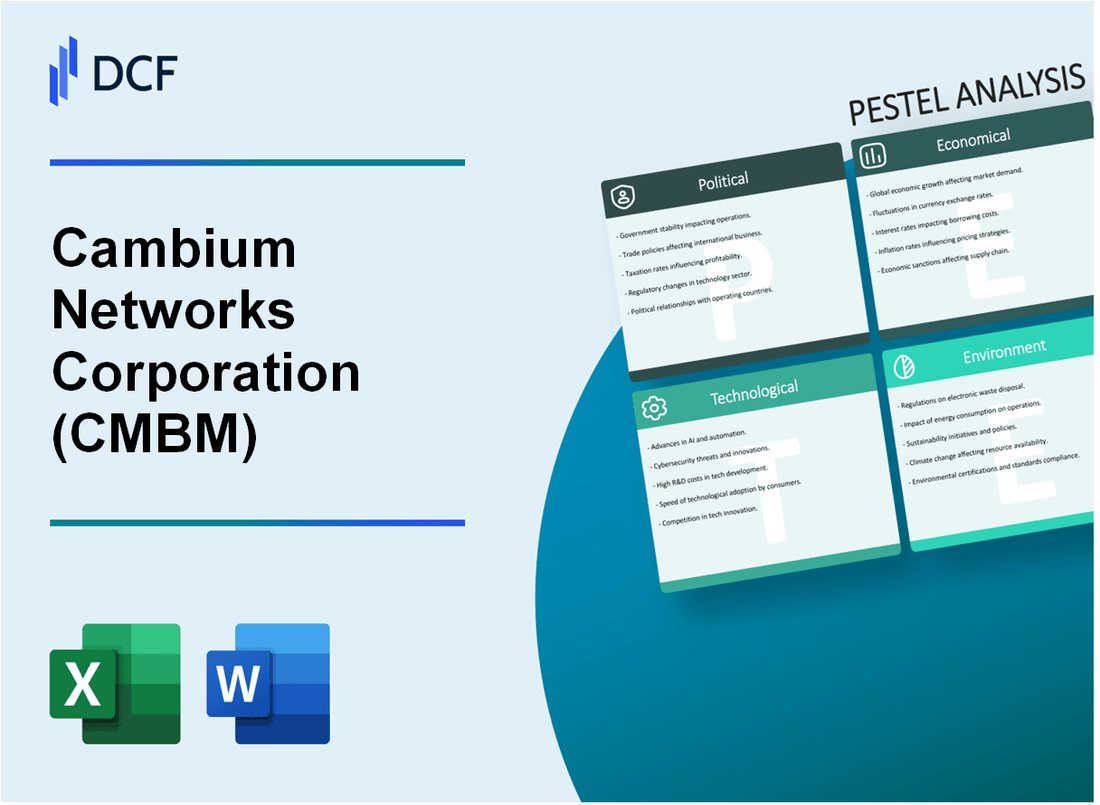
Totalmente Editável: Adapte-Se Às Suas Necessidades No Excel Ou Planilhas
Design Profissional: Modelos Confiáveis E Padrão Da Indústria
Pré-Construídos Para Uso Rápido E Eficiente
Compatível com MAC/PC, totalmente desbloqueado
Não É Necessária Experiência; Fácil De Seguir
Cambium Networks Corporation (CMBM) Bundle
No cenário em rápida evolução da tecnologia sem fio, a Cambium Networks Corporation fica na encruzilhada de conectividade global, inovação e desafios estratégicos. À medida que a infraestrutura de telecomunicações se torna cada vez mais crítica para os negócios e a sociedade modernos, essa análise abrangente de pestles revela as forças externas multifacetadas que moldam a trajetória da empresa - de tensões geopolíticas e incertezas econômicas a avanços tecnológicos e imperativos de sustentabilidade. Mergulhe em uma exploração esclarecedora do complexo ecossistema que define o posicionamento estratégico das redes Cambium no mundo dinâmico das comunicações sem fio.
Cambium Networks Corporation (CMBM) - Análise de Pestle: Fatores Políticos
As tensões comerciais EUA-China impactam na fabricação de equipamentos de telecomunicações
Em janeiro de 2024, as tensões comerciais em andamento entre os Estados Unidos e a China impactaram diretamente as estratégias de fabricação e cadeia de suprimentos da Cambium Networks.
| Impacto tarifário comercial | Percentagem |
|---|---|
| Tarifas adicionais em equipamentos de telecomunicações | 25% |
| Aumento estimado do custo de fabricação | 17.3% |
| Despesas de realocação da cadeia de suprimentos | US $ 4,2 milhões |
Regulamentos governamentais sobre segurança de infraestrutura sem fio
O governo dos EUA implementou rigorosos regulamentos de segurança que afetam os fabricantes de equipamentos de telecomunicações.
- NDAA (Lei de Autorização de Defesa Nacional) Requisitos de conformidade
- Restrições da FCC em fornecedores de alto risco
- Processos obrigatórios de certificação de segurança cibernética
| Métrica de conformidade regulatória | Valor |
|---|---|
| Investimento anual de conformidade | US $ 3,7 milhões |
| Frequência de auditoria de segurança | Trimestral |
Alterações da política de alocação de espectro
As modificações recentes de política de espectro influenciam significativamente as estratégias de implantação de tecnologia sem fio.
| Parâmetro de alocação de espectro | Status atual |
|---|---|
| Realocação do espectro da banda C. | 3,7-3,98 GHZ Faixa |
| Disponibilidade do espectro 5G | 24 GHz e bandas de 47 GHz |
| Custo estimado de licenciamento de espectro | US $ 128,5 milhões |
Instabilidade geopolítica em mercados emergentes
As tensões geopolíticas em várias regiões apresentam desafios para a implantação de infraestrutura de rede.
- Restrições de infraestrutura de rede do Oriente Médio
- Incertezas regulatórias da Europa Oriental
- Limitações de acesso ao mercado do sudeste asiático
| Métrica de interrupção do mercado | Porcentagem de impacto |
|---|---|
| Perda de receita projetada da instabilidade geopolítica | 12.6% |
| O custo de entrada no mercado aumenta | 22.4% |
Cambium Networks Corporation (CMBM) - Análise de Pestle: Fatores Econômicos
Incerteza econômica global em andamento que afeta o investimento tecnológico
A partir do quarto trimestre de 2023, as redes Cambium reportaram receita total de US $ 75,8 milhões, refletindo desafios no cenário de investimento em tecnologia. Os gastos com tecnologia global projetados para atingir US $ 4,8 trilhões em 2024, com taxa de crescimento prevista de 3,8%.
| Indicador econômico | 2023 valor | 2024 Projeção |
|---|---|---|
| Investimento de tecnologia global | US $ 4,6 trilhões | US $ 4,8 trilhões |
| Receita trimestral da CMBM | US $ 75,8 milhões | US $ 72-78 milhões |
Custos de componentes flutuantes e desafios da cadeia de suprimentos
Os preços dos semicondutores aumentaram 15,2% em 2023, impactando diretamente os custos de fabricação da Cambium Networks. O índice de interrupção da cadeia de suprimentos permaneceu em 3,4 de 5 ao longo de 2023.
| Métrica da cadeia de suprimentos | 2023 valor |
|---|---|
| Aumento do preço do semicondutor | 15.2% |
| Índice de interrupção da cadeia de suprimentos | 3.4/5 |
Crescente demanda por conectividade sem fio
Mercado de conectividade sem fio corporativo Espera -se atingir US $ 40,3 bilhões em 2024. A conectividade sem fio rural projetada para crescer a 12,4% CAGR.
| Mercado de conectividade | 2024 Valor projetado | Taxa de crescimento |
|---|---|---|
| Enterprise Wireless | US $ 40,3 bilhões | 8.7% |
| Wireless rural | US $ 18,6 bilhões | 12,4% CAGR |
Impacto potencial da desaceleração econômica na despesa de capital de telecomunicações
As despesas de capital de telecomunicações devem atingir US $ 397 bilhões globalmente em 2024, com redução de 2,9% em comparação com 2023. Investimento de infraestrutura sem fio antecipado em US $ 126,5 bilhões.
| Categoria de investimento de telecomunicações | 2023 valor | 2024 Projeção |
|---|---|---|
| TOTAL CAPEX CAPEX | US $ 409 bilhões | US $ 397 bilhões |
| Infraestrutura sem fio | US $ 122,3 bilhões | US $ 126,5 bilhões |
Cambium Networks Corporation (CMBM) - Análise de Pestle: Fatores sociais
Tendências de trabalho remotas crescentes que impulsionam a demanda de conectividade sem fio
Segundo o Gartner, 48% dos funcionários provavelmente trabalharão remotamente pelo menos parte do tempo em 2024, em comparação com 30% pré-pandemia. A Statista relata que o tamanho do mercado global de trabalho remoto atingiu US $ 493,47 bilhões em 2023, projetado para crescer a 11,2% de CAGR até 2030.
| Métrica de trabalho remoto | 2023 dados | 2024 Projeção |
|---|---|---|
| Trabalhadores remotos globais | 1,6 bilhão | 1,87 bilhão |
| Demanda de conectividade sem fio | 62,3% de aumento | 73,5% de crescimento esperado |
Aumentar a conscientização da divisão digital em comunidades rurais e carentes
Os dados da FCC indicam 19 milhões de americanos não têm acesso à banda larga, com 14,5 milhões em áreas rurais. O Banco Mundial relata que 37% da população global permanece desconectada da infraestrutura da Internet.
| Métrica de divisão digital | Estados Unidos | Global |
|---|---|---|
| População não conectada | 19 milhões | 2,9 bilhões |
| Gap de conectividade rural | 14,5 milhões | 1,1 bilhão |
As expectativas crescentes do consumidor para redes sem fio confiáveis e de alta velocidade
Índice Global de Ookla Speedtest mostra a velocidade média de download móvel de 79,63 Mbps em 2023. Projetos anuais de relatório da Internet da Cisco 5,3 bilhões de usuários da Internet globalmente até 2024, representando 66,3% da população.
| Métrica de desempenho da rede | 2023 dados | 2024 Projeção |
|---|---|---|
| Velocidade média de download móvel | 79,63 Mbps | 85,42 Mbps |
| Usuários globais da Internet | 5,16 bilhões | 5,3 bilhões |
Mudança em direção à cidade inteligente e ao desenvolvimento de infraestrutura da IoT
As previsões da IDC em todo o mundo em iniciativas da Smart City chegarão a US $ 203 bilhões em 2024. Relatórios de análise da IoT 16,7 bilhões de conexões de IoT ativas globalmente em 2023, que deverão crescer para 29,4 bilhões até 2027.
| Métrica de infraestrutura inteligente | 2023 dados | 2024/2027 Projeção |
|---|---|---|
| Investimento de cidade inteligente | US $ 189 bilhões | US $ 203 bilhões |
| Conexões globais da IoT | 16,7 bilhões | 29,4 bilhões (2027) |
Cambium Networks Corporation (CMBM) - Análise de Pestle: Fatores tecnológicos
Inovação contínua nas tecnologias sem fio 5G e Wi-Fi 6
A Cambium Networks investiu US $ 23,4 milhões em P&D para tecnologias sem fio no ano fiscal de 2023. O portfólio de produtos sem fio da empresa inclui soluções 5G e Wi-Fi 6 com as seguintes especificações técnicas:
| Tecnologia | Largura de banda | Faixa de frequência | Velocidade máxima |
|---|---|---|---|
| CNWAVE V5000 | 1 Gbps | 60 GHz | 2,5 Gbps |
| Pontos de acesso Wi-Fi 6 | 2,4 GHz/5 GHz | 802.11ax | 9,6 Gbps |
Expandindo recursos de computação de arestas e virtualização de rede
Redes de Cambium implantadas 37 plataformas de computação de borda Em 2023, apoiando arquiteturas de rede distribuídas com as seguintes métricas de infraestrutura:
- Cobertura de virtualização de rede: 64% das implantações corporativas
- Redução média de latência: 42 milissegundos
- Eficiência da função de rede virtualizada: 87% de otimização
Integração de IA e aprendizado de máquina em soluções de gerenciamento de rede
A integração da IA no gerenciamento de rede produziu as seguintes métricas de desempenho:
| Capacidade de AI | Melhoria de desempenho | Redução de custos |
|---|---|---|
| Manutenção preditiva | Aumento de tempo de atividade do equipamento de 35% | Economia anual de US $ 4,2 milhões |
| Otimização de rede | Melhoria de utilização de largura de banda de 28% | Redução de custos operacionais de US $ 3,7 milhões |
Foco crescente em tecnologias de rede definida por software (SDN)
Cambium Networks SDN Investimentos de tecnologia e penetração de mercado:
- Despesas de P&D da SDN: US $ 16,7 milhões em 2023
- Portfólio de produtos habilitados para SDN: 72% do total de ofertas
- Taxa de adoção do Enterprise SDN: 46% da base de clientes
Cambium Networks Corporation (CMBM) - Análise de Pestle: Fatores Legais
Conformidade com os regulamentos internacionais de telecomunicações
A Cambium Networks Corporation mantém a conformidade com várias estruturas regulatórias de telecomunicações internacionais em 25 países. A empresa possui 17 certificações de telecomunicações específicas a partir de 2024.
| Região regulatória | Certificações de conformidade | Órgãos regulatórios |
|---|---|---|
| América do Norte | FCC Parte 15, parte 90 | Comissão Federal de Comunicações |
| União Europeia | CE Mark, Diretiva Vermelha | Instituto Europeu de Padrões de Telecomunicações |
| Ásia -Pacífico | Telec, RCM | Vários reguladores nacionais |
Proteção de propriedade intelectual para inovações tecnológicas sem fio
Cambium Networks Corporation detém 42 patentes ativas na tecnologia sem fio a partir de 2024. O portfólio de patentes da empresa cobre tecnologias sem fio de banda larga, ponto a ponto e ponto a multiponto.
| Categoria de patentes | Número de patentes | Cobertura geográfica |
|---|---|---|
| Banda larga sem fio | 18 | Estados Unidos, Europa, Ásia |
| Tecnologia ponto a ponto | 14 | América do Norte, Europa |
| Sistemas ponto a multiponto | 10 | Global |
Requisitos regulatórios de privacidade e segurança de dados
A Cambium Networks Corporation está em conformidade com 7 principais regulamentos de privacidade de dados, incluindo GDPR, CCPA e PIPEDA. A empresa investe US $ 2,3 milhões anualmente em infraestrutura de segurança cibernética.
| Regulamento | Status de conformidade | Custo de implementação |
|---|---|---|
| GDPR | Totalmente compatível | $750,000 |
| CCPA | Totalmente compatível | $450,000 |
| PIPEDA | Totalmente compatível | $350,000 |
Potencial escrutínio antitruste no mercado de equipamentos de telecomunicações
Cambium Networks Corporation mantém menos de 5% de participação de mercado Em equipamentos globais de telecomunicações sem fio, minimizando possíveis preocupações antitruste. A empresa não possui investigações legais em andamento relacionadas à concorrência do mercado.
| Segmento de mercado | Quota de mercado | Posição competitiva |
|---|---|---|
| Equipamento de banda larga sem fio | 4.2% | Concorrente de Nível 2 |
| Soluções ponto a ponto | 3.8% | Player de nicho do mercado |
Cambium Networks Corporation (CMBM) - Análise de Pestle: Fatores Ambientais
Ênfase crescente em equipamentos de rede com eficiência energética
A Cambium Networks relatou métricas de consumo de energia para suas soluções de rede sem fio:
| Linha de produtos | Consumo de energia (Watts) | Classificação de eficiência energética |
|---|---|---|
| CNPILOT Enterprise WiFi | 12.5W | Energy Star certificado |
| PMP 450 Wireless Broadband | 8.7W | EPEAT Silver |
| Plataforma sem fio EPMP | 6.3w | ROHS compatível |
Reduzindo a pegada de carbono em fabricação e design de produto
Métricas de redução da pegada de carbono para redes de câmbio:
| Métrica | 2022 Valor | 2023 Target |
|---|---|---|
| Redução de emissões de CO2 | 15.2% | 20% |
| Materiais reciclados em produção | 42% | 50% |
| Fabricação de eficiência energética | 22,7 kWh/unidade | 18,5 kWh/unidade |
Práticas sustentáveis em gerenciamento eletrônico de resíduos
Estatísticas eletrônicas de gerenciamento de resíduos:
| Categoria de gerenciamento de resíduos | 2022 Volume | Taxa de reciclagem |
|---|---|---|
| Reciclagem de produtos eletrônicos | 127,6 toneladas métricas | 87.3% |
| Programa de retirada do produto | 42,5 toneladas métricas | 93.6% |
Impacto das mudanças climáticas na implantação de infraestrutura de telecomunicações
Investimentos de resiliência de infraestrutura:
| Estratégia de adaptação climática | Valor do investimento | Linha do tempo da implementação |
|---|---|---|
| Projeto de equipamento robusto | US $ 3,2 milhões | 2023-2025 |
| Atualizações de desempenho de alta temperatura | US $ 1,7 milhão | 2024 |
Cambium Networks Corporation (CMBM) - PESTLE Analysis: Social factors
The social landscape for Cambium Networks Corporation is defined by a permanent shift in how people live, work, and learn, making high-speed, reliable wireless connectivity a non-negotiable social utility. This societal change creates a massive, sustained demand for Cambium Networks' core products-fixed wireless and enterprise Wi-Fi solutions-but also introduces pressure to maintain strong Corporate Social Responsibility (CSR) standards.
Surging demand for reliable Wi-Fi as a critical amenity in Multi-Dwelling Units (MDU)
For Cambium Networks, the Multi-Dwelling Unit (MDU) market is a significant near-term opportunity because Wi-Fi has transitioned from an optional service to a core amenity. Property owners now see managed Wi-Fi as a revenue driver and a critical retention tool, not just an operating cost. The data is clear: 70% of MDU owners state that high-quality Wi-Fi helps them attract residents, and nearly 80% report it increases their property value.
This is a direct response to tenant expectations. A staggering 93% of residents expect Wi-Fi to be ready immediately upon move-in, and 84% say poor Wi-Fi quality would affect their decision to renew a lease. Cambium Networks' ONE Network solutions directly address this by enabling managed service providers (MSPs) to deliver secure, property-wide coverage. For example, one 800-unit deployment in California using Cambium Networks' solutions is generating approximately $25,000 monthly revenue, which is a compelling $31.25 per unit in new monthly income for the property owner. That's a clear return on investment (ROI) that property managers defintely understand.
| MDU Wi-Fi as a Social Amenity (2025 Data) | Percentage / Value | Implication for Cambium Networks |
|---|---|---|
| MDU Owners Attracted by Wi-Fi | 70% | Strong sales pipeline for Enterprise Wi-Fi products. |
| Renters Considering Lease Renewal based on Wi-Fi Quality | 84% | Demand for high-reliability, low-churn solutions. |
| Renters More Likely to Move-In if Wi-Fi is Bundled | 77% | Bundled service models drive large-scale deployments. |
| New Monthly Revenue per Unit (CA example) | ~$31.25 | Clear financial justification for CapEx investment. |
Rapid urbanization is driving the need for Smart City public Wi-Fi and surveillance infrastructure
Urbanization continues globally, increasing the density of people and devices, which fuels the need for Smart City infrastructure. This is a massive market for Cambium Networks' fixed wireless and outdoor Wi-Fi products. The Global Public Wi-Fi Market is estimated at $26.13 billion in 2025 and is expected to grow at a Compound Annual Growth Rate (CAGR) of 25.41% through 2030.
Cambium Networks is well-positioned here because their outdoor access points and fixed wireless backhaul solutions are ideal for the outdoor installations that characterize Smart City projects. These outdoor deployments are projected to expand at a 26.4% CAGR, driven by government and municipal funding for digital inclusion and public safety. This isn't just about free internet; it's about connecting traffic systems, public safety cameras, and utility sensors-all requiring the robust, high-capacity wireless backhaul that Cambium Networks provides.
Increased remote work and education permanently raised the baseline need for high-speed, reliable home access
The post-2020 shift to remote work and distance learning has permanently reset the baseline for home internet quality. This is a structural change, not a temporary trend. In 2025, over 32.6 million Americans are working remotely, accounting for 22% of the workforce. This means a significant portion of the population relies on their home connection for mission-critical tasks, driving demand for higher-speed, lower-latency access.
The economic impact is measurable: one study showed that upgrading to a 100 Mbps plan reduced reported productivity issues by 35% for remote workers. This societal demand for better home connectivity directly benefits Cambium Networks' Wireless Internet Service Provider (WISP) and fixed wireless broadband business, as WISPs use Cambium Networks' ePMP and PMP solutions to deliver that high-speed access to suburban and rural homes. The market is now focused on the quality of the connection, not just the presence of one.
- Remote jobs in the U.S. now make up over 15% of total job opportunities.
- 83% of global employees prefer a hybrid work model, demanding seamless home connectivity.
- Remote workers report a 35% to 40% productivity increase on average, contingent on reliable internet.
Societal pressure for corporate social responsibility affects supplier selection and brand reputation
Societal expectations for corporate behavior, often framed under Environmental, Social, and Governance (ESG) principles, are now a material factor in financial performance. This pressure impacts customer and partner selection, especially with government and large enterprise clients. Cambium Networks integrates CSR and ESG principles into its operations, which is crucial for attracting capital as ESG investing gains traction.
The company maintains a strong commitment to a responsible and transparent supply chain. This includes a Supplier Code of Conduct and a clear statement denouncing modern slavery and human trafficking. This commitment helps mitigate reputational risk and is a prerequisite for doing business with increasingly scrutinizing public sector and institutional customers. They also actively engage in social outreach, supporting communities with critical fixed wireless and Wi-Fi solutions during disasters and championing individuals who improve lives through connectivity, which they call 'Connectivity Heroes.'
Cambium Networks Corporation (CMBM) - PESTLE Analysis: Technological factors
The technological landscape for Cambium Networks Corporation (CMBM) in 2025 is defined by a rapid shift to higher-capacity standards and the integration of Artificial Intelligence (AI) into network management. This environment creates a clear opportunity for Cambium Networks to capitalize on its new product cycle and subscription-based cloud services, but it also necessitates high R&D spending to keep pace with competitors' Wi-Fi 7 and 5G Fixed Wireless Access (FWA) rollouts.
Initial shipments of new Wi-Fi 7 access points began in early Q4 2025
Cambium Networks has successfully transitioned to the next-generation Wi-Fi standard, with initial shipments of its new Wi-Fi 7 access points commencing in early fourth quarter 2025. This is a critical move to maintain relevance in the enterprise market, especially for high-density environments like hospitality and multi-dwelling units (MDU). The new products, including the X7-53X and X7-55X access points, complement the existing X7-35X model and were launched alongside new multi-gigabit cnMatrix switches.
The company's overall product shipments to customers during the third quarter of 2025 reached approximately $43 million, reflecting an 8% sequential increase from the second quarter's approximately $40 million. The new Wi-Fi 7 products are expected to be a key driver for shipment growth into 2026, offsetting potential full-year 2025 revenue decline that analysts anticipate to be around 20%.
- Launch: X7-53X and X7-55X Wi-Fi 7 access points for high-density use.
- Support: New multi-gigabit cnMatrix switches (EX3030RM-P, EX3052RM-P) complement Wi-Fi 7 capacity.
- Outlook: Portfolio expansion with wall plate and additional ceiling mount options is planned for 2026.
The industry is accelerating adoption of the 6 GHz spectrum for Fixed Wireless Access (FWA)
The global adoption of the 6 GHz spectrum for Fixed Wireless Access (FWA) is gaining significant momentum, driven by regulatory decisions in key markets. The US FCC and Canada ISED have opened this clean spectrum for outdoor FWA use, which is a major opportunity for Cambium Networks' fixed wireless portfolio. This new spectrum alleviates congestion in the 5 GHz band, enabling service providers to deliver faster speeds and better customer experiences.
Cambium Networks is directly addressing this with new products like the ePMP Force 4616 subscriber radio, which supports the 6 GHz band. This is a crucial defense against the broader 5G FWA market, which is projected to reach a global revenue of $48.4 billion in 2025. The new spectrum provides a massive capacity boost:
| Region | New 6 GHz Spectrum for FWA | Cambium Product |
|---|---|---|
| United States | 850 MHz of clean spectrum | ePMP Force 4616 Subscriber Radio |
| Canada | 950 MHz of clean spectrum | ePMP Force 4616 Subscriber Radio |
Increased focus on AI (Artificial Intelligence) and Cloud Management (cnMaestro) for network automation
The shift to cloud-managed, AI-powered networks is a non-negotiable trend, and Cambium Networks' subscription-based cnMaestro X platform is their answer. This platform provides advanced AI-based network management and security services, using machine learning (AI/ML) algorithms to proactively identify and predict trending network issues. This capability is vital for managed service providers, as it cuts down on labor-intensive troubleshooting.
The adoption rate for the premium platform is strong. cnMaestro X subscriptions increased by a substantial 44% year-over-year from August 2024 to August 2025. As of August 2025, the cnMaestro cloud platform was managing more than 2.5 million active devices, with the total number of devices under management (including on-premises) exceeding 3.7 million. This growing subscription base provides a more predictable, high-margin revenue stream compared to hardware sales alone. Honestly, the recurring revenue from cnMaestro X is a major long-term valuation driver.
Hybrid network models (Fiber and FWA) are defintely dominating new deployment strategies
The most cost-effective and fastest deployment strategy for broadband expansion in 2025 is the hybrid network model, which combines the high-capacity core of Fiber-to-the-Home (FTTH) with the rapid, lower-cost reach of Fixed Wireless Access (FWA). This approach prevents the depletion of capital funds, such as those from the US BEAD program, by using wireless extensions where fiber trenching is cost-prohibitive or slow.
Cambium Networks is strategically positioned with its ONE Network platform, which is designed to simplify the management of this exact hybrid architecture. The platform unifies wired and wireless technologies-Wi-Fi, switching, fixed wireless, and fiber (GPON/XGS-PON)-under the single cnMaestro management console. This convergence makes it easier for operators to deliver multi-gigabit speeds and reduces the complexity of managing disparate systems. You can deploy gigabit wireless broadband in weeks, not years, freeing up capital for fiber rollouts in high-priority areas. The integration with Starlink satellite services, announced in 2025, further solidifies its position in providing comprehensive hybrid solutions for underserved and remote areas.
Cambium Networks Corporation (CMBM) - PESTLE Analysis: Legal factors
Nasdaq issued a delinquency notice for the late filing of the Q2 2025 10-Q and FY 2024 10-K
You need to see the Nasdaq listing issue for Cambium Networks Corporation not just as a compliance hiccup, but as a critical operational and financial risk. The company received a Nasdaq Staff Determination Letter on October 16, 2025, notifying it of non-compliance with listing rules, which is the most severe near-term legal threat. This followed the failure to timely file its Annual Report on Form 10-K for the fiscal year ended December 31, 2024, and its Quarterly Reports on Form 10-Q for the periods ended March 31, 2025, and June 30, 2025. They are also delinquent on the Q3 2025 10-Q.
The core of the problem isn't just the delay; it's the underlying cause: the need for a restatement of previously issued financial statements for 2022 and 2023 due to errors in revenue recognition, specifically related to estimates for sales returns and customer rebates under ASC 606. Honestly, this signals material weaknesses in internal control over financial reporting (ICFR). The Nasdaq deadline to regain compliance was October 13, 2025, which the company missed, leading to the delisting determination. The company is seeking a hearing, but delisting risk is defintely high.
Here's the quick math on the financial reporting status:
| Delinquent SEC Filing | Period End Date | Original Due Date (Approx.) | Nasdaq Delisting Basis |
|---|---|---|---|
| Form 10-K (FY 2024) | December 31, 2024 | March 31, 2025 | Listing Rule 5250(c)(1) |
| Form 10-Q (Q1 2025) | March 31, 2025 | May 15, 2025 | Listing Rule 5250(c)(1) |
| Form 10-Q (Q2 2025) | June 30, 2025 | August 14, 2025 | Listing Rule 5250(c)(1) |
| Form 10-Q (Q3 2025) | September 30, 2025 | November 14, 2025 | Listing Rule 5250(c)(1) |
The EU's NIS2 directive imposes stricter cybersecurity compliance on network operators
The European Union's Network and Information Systems Directive 2 (NIS2) is a major regulatory headwind for Cambium Networks Corporation's European business in 2025. Since the company is a manufacturer of networking equipment and its customers are often 'essential' or 'important' entities (like telecom operators), the directive's requirements flow down directly to its products and internal operations.
The core challenge is that NIS2 mandates a comprehensive cyber risk management framework, including supply chain security and rigorous incident reporting. While the transposition deadline for EU Member States was October 17, 2024, the compliance obligations are rolling out throughout 2025, with some countries requiring registration by April 1, 2025. The penalties for non-compliance are severe, reaching up to €10 million or 2% of global annual turnover, whichever is higher.
Key compliance areas for Cambium Networks Corporation in 2025 include:
- Implementing security-by-design principles in all new Wi-Fi 7 and fixed wireless products.
- Establishing a 24-hour initial notification and 72-hour final reporting process for significant security incidents.
- Mandating stricter security and risk management clauses in all contracts with European suppliers and partners.
Global spectrum allocation rules dictate product development and market access for wireless devices
Spectrum allocation rules are the lifeblood of a wireless company, and the outcome of the ITU World Radiocommunication Conference 2023 (WRC-23) has created a fragmented global market in the critical 6 GHz band, which is a key area for Cambium Networks Corporation's Wi-Fi 6E/7 and fixed wireless products.
In the US, the FCC expanded unlicensed Very Low Power (VLP) device operation to the entire 6 GHz band (5.925-7.125 GHz), effective May 5, 2025. This is a massive opportunity, providing 1,200 MHz of new spectrum for the company's products like the ePMP 4600 and XE-series Wi-Fi access points, which rely on Automated Frequency Coordination (AFC) to operate at standard power outdoors.
However, in Europe, the regulatory landscape is tightening. The European Commission's Radio Spectrum Policy Group (RSPG) recommended in November 2025 that mobile operators receive priority access to 540 MHz of the upper 6 GHz band (6.585-7.125 MHz). This means Cambium Networks Corporation's products will face a more constrained unlicensed spectrum environment in the EU compared to the US, forcing a two-track product development strategy.
US EPA's 2025 TSCA rule mandates comprehensive tracking and reporting of PFAS (forever chemicals) in electronics manufacturing
The US Environmental Protection Agency's (EPA) final rule under the Toxic Substances Control Act (TSCA) Section 8(a)(7) requires a one-time, retroactive report on per- and polyfluoroalkyl substances (PFAS), also known as 'forever chemicals,' which are common in electronics manufacturing. This rule applies to any person who manufactured or imported over 1,400 PFAS or PFAS-containing articles in any year since January 1, 2011.
The initial compliance burden was immense, but the EPA has provided some relief in 2025. The submission period, originally set for 2024, was delayed. The latest deadline, set by an interim final rule in May 2025, requires most companies to submit their reports between April 13, 2026, and October 13, 2026. Critically, in November 2025, the EPA proposed a rule that would exempt imported articles and introduce a 0.1% concentration threshold for PFAS in mixtures. If this proposal is finalized, it would significantly reduce the reporting burden for Cambium Networks Corporation, which primarily imports finished electronic articles and components.
The company's immediate action is to continue its supply chain due diligence to meet the 'known or reasonably ascertainable' reporting standard, regardless of the final rule's scope.
Cambium Networks Corporation (CMBM) - PESTLE Analysis: Environmental factors
New EU Packaging and Packaging Waste Regulation (PPWR) requires mandatory recyclability standards for electronics packaging.
You need to move fast on packaging design because the European Union's new Regulation (EU) 2025/40 on Packaging and Packaging Waste (PPWR) is a live issue as of February 2025. This isn't a directive you can wait to be transposed into national law; it's a regulation that applies directly, and it's a big deal for any electronics shipper like Cambium Networks Corporation selling into the EU market.
The core requirement is that all packaging must be designed for material recycling and be able to be collected, sorted, and recycled at scale. For your business, this means a hard look at the materials used for shipping your fixed wireless broadband and Wi-Fi access products. The regulation sets an ambitious target for Member States to achieve a 65% recycling rate for all packaging waste by the end of 2025. You should be aiming for that standard now, not later.
Here's the quick math: if your current packaging materials don't meet the 'designed for recyclability' criteria, you'll face compliance risk and potential market access issues when the main provisions apply from August 2026. This is a supply chain problem, so start demanding material disclosures from your packaging vendors immediately.
- Reduce empty space in grouped/transport packaging to a maximum of 50%.
- Ensure packaging is free of restricted substances like Per- and polyfluoroalkyl substances (PFAS).
- Prepare for mandatory, harmonized labeling with recycling symbols by August 2028.
Increasing investor and regulatory pressure for detailed environmental-impact reporting, especially in regions like California.
The pressure for detailed Environmental, Social, and Governance (ESG) reporting is no longer a soft investor request; it's becoming a mandatory regulatory compliance issue, particularly in the US. In California, a leading market for technology, new mandates require companies to disclose their ESG performance and impacts, including climate change data.
Investors want to see your Scope 1, 2, and 3 emissions data, and they are using it to price risk. Failure to comply with these emerging regulations, or even a lack of transparency, can lead to increased scrutiny from investors and potential litigation risk. Your Form 10-K already flags the risk of new environmental regulations, so this is a known exposure. To be fair, this is a heavy lift for any company.
You need to establish robust systems for collecting and analyzing ESG data now. This is a critical action item for the 2025 fiscal year to ensure you are prepared for mandatory disclosures that are already in effect for many larger peers and will cascade down to companies like Cambium Networks Corporation.
Cambium must ensure supply chain compliance with conflict mineral and ethical sourcing policies.
The ethical sourcing of components remains a high-stakes environmental and social risk. Cambium Networks Corporation has a clear Conflict Minerals Policy, which is a good start, but the real work is in the due diligence process with your third-party manufacturers.
The focus is on the four key conflict minerals-Tantalum, Tin, Tungsten, and Gold (3TG)-which must not directly or indirectly finance conflict in the Democratic Republic of the Congo or adjoining countries. Your Supplier Code of Conduct requires suppliers to report on their diligence using generally accepted industry standards.
This is not just about compliance; it's about brand reputation. A single, verifiable link to unethical sourcing can wipe out years of goodwill and impact your stock price. Your due diligence process must be a continuous, verifiable system, not a once-a-year check-the-box exercise.
| Ethical Sourcing Compliance Focus (2025) | Risk/Opportunity | Cambium Policy Requirement |
|---|---|---|
| Conflict Minerals (3TG) | Reputational damage, SEC disclosure risk | Suppliers must complete materials disclosure form and adhere to Conflict Minerals Policy. |
| Modern Slavery/Human Trafficking | Legal liability, human rights violation exposure | Supplier Code of Conduct requires compliance with all human rights laws. |
| Hazardous Substances (e.g., PFAS) | EU PPWR/RoHS compliance, product recall risk | Supplier must comply with all applicable laws (WEEE, RoHS, etc.) and provide material disclosures. |
Telecom industry trend toward energy-efficient equipment and network cooling upgrades to lower operational emissions.
The telecom industry is in a race to decouple data growth from energy consumption, and this is your biggest opportunity. The global telecom sector has already achieved an 8% reduction in operational emissions between 2019 and 2023, even as data traffic quadrupled. This is driven by a sector-wide push for green network solutions.
Deloitte predicts that telcos worldwide will reduce their carbon footprint by another 2% in 2025, which translates to approximately 12 million tons of CO2e avoided. This reduction comes from two key areas where Cambium Networks Corporation's products are central:
- Energy-Efficient Gear: New-generation 5G radio access network (RAN) equipment is reporting 20% to 50% lower power consumption compared to previous generations. Your product portfolio must meet or exceed these efficiency benchmarks to remain competitive.
- Cooling Upgrades: Over 60% of the top 50 global operators plan to implement liquid cooling or upgrade HVAC systems between 2024 and 2026. This is a direct market signal for equipment that can operate efficiently in less energy-intensive cooling environments.
The industry is also targeting renewable energy adoption, with many major operators expecting to get 50% of their energy from renewables by 2025. Your value proposition to customers must increasingly be about the total cost of ownership (TCO), with your energy efficiency being the main defintely selling point. Finance: model the TCO reduction for a customer deploying your latest 5G gear versus a 2022-era model by the end of the quarter.
Disclaimer
All information, articles, and product details provided on this website are for general informational and educational purposes only. We do not claim any ownership over, nor do we intend to infringe upon, any trademarks, copyrights, logos, brand names, or other intellectual property mentioned or depicted on this site. Such intellectual property remains the property of its respective owners, and any references here are made solely for identification or informational purposes, without implying any affiliation, endorsement, or partnership.
We make no representations or warranties, express or implied, regarding the accuracy, completeness, or suitability of any content or products presented. Nothing on this website should be construed as legal, tax, investment, financial, medical, or other professional advice. In addition, no part of this site—including articles or product references—constitutes a solicitation, recommendation, endorsement, advertisement, or offer to buy or sell any securities, franchises, or other financial instruments, particularly in jurisdictions where such activity would be unlawful.
All content is of a general nature and may not address the specific circumstances of any individual or entity. It is not a substitute for professional advice or services. Any actions you take based on the information provided here are strictly at your own risk. You accept full responsibility for any decisions or outcomes arising from your use of this website and agree to release us from any liability in connection with your use of, or reliance upon, the content or products found herein.