

|
DXC Technology Company (DXC): ANSOFF Matrix Analysis [Jan-2025 Mise à jour] |
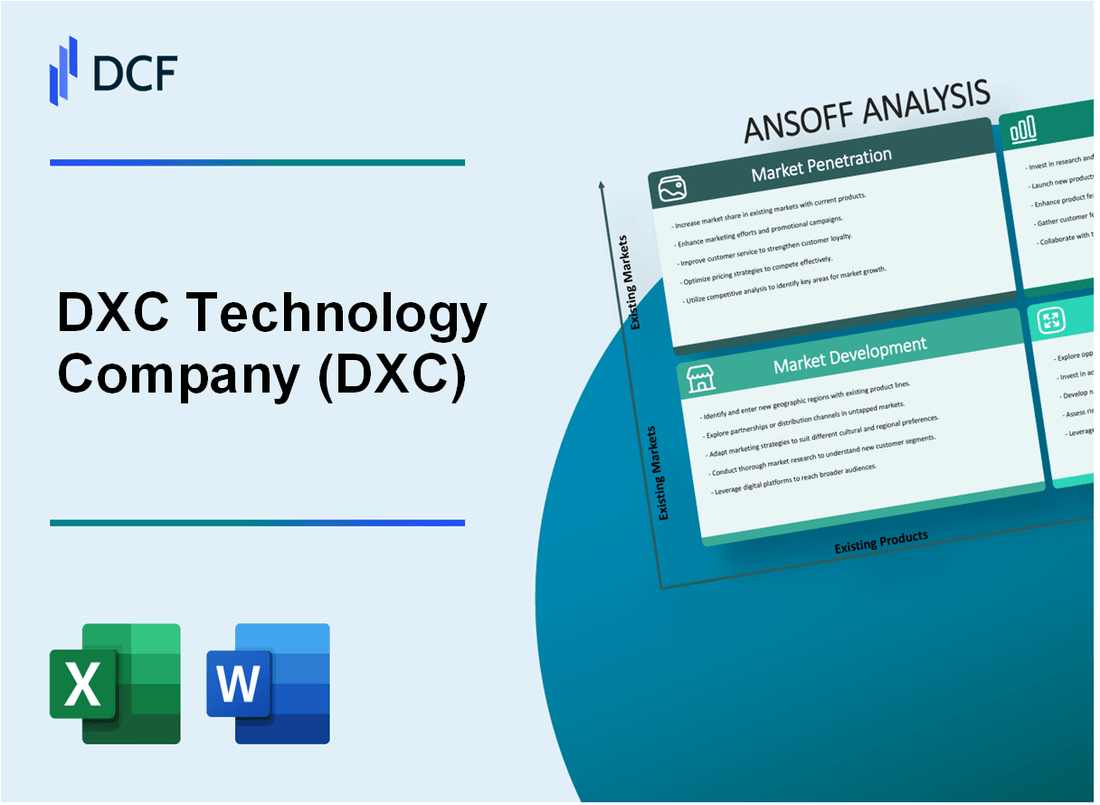
Entièrement Modifiable: Adapté À Vos Besoins Dans Excel Ou Sheets
Conception Professionnelle: Modèles Fiables Et Conformes Aux Normes Du Secteur
Pré-Construits Pour Une Utilisation Rapide Et Efficace
Compatible MAC/PC, entièrement débloqué
Aucune Expertise N'Est Requise; Facile À Suivre
DXC Technology Company (DXC) Bundle
Dans le paysage rapide des services technologiques en évolution, DXC Technology Company se tient à un carrefour pivot, naviguant stratégiquement la dynamique du marché complexe à travers son approche innovante de la matrice Ansoff. En élaborant méticuleusement des stratégies qui couvrent la pénétration du marché, le développement, l'innovation des produits et la diversification audacieuse, DXC se positionne comme une force transformatrice dans l'écosystème informatique mondial. Cette feuille de route stratégique révèle comment l'entreprise prévoit de tirer parti de ses forces existantes tout en explorant agressivement les frontières technologiques émergentes, promettant un parcours convaincant de croissance, d'adaptation et de leadership technologique.
DXC Technology Company (DXC) - Matrice Ansoff: pénétration du marché
Développez les services cloud existants et les solutions de cybersécurité aux clients d'entreprise actuels
DXC Technology a rapporté des revenus de services cloud de 4,6 milliards de dollars au cours de l'exercice 2023. Les services de transformation cloud de l'entreprise ont augmenté de 12,3% d'une année à l'autre.
| Catégorie de service cloud | Revenus annuels | Taux de croissance |
|---|---|---|
| Services de cloud public | 2,1 milliards de dollars | 15.7% |
| Solutions de nuages hybrides | 1,5 milliard de dollars | 10.2% |
| Services cloud de cybersécurité | 1,0 milliard de dollars | 18.5% |
Augmenter la vente croisée des services de conseil en technologie et de transformation numérique
DXC Technology a généré 3,8 milliards de dollars par rapport au conseil en transformation numérique en 2023, avec une augmentation de 14,6% des opportunités de vente croisée.
- Enterprise Digital Transformation Services Revenue: 1,9 milliard de dollars
- Revenus de consultation technologique: 1,2 milliard de dollars
- Valeur du contrat moyen: 2,4 millions de dollars
Améliorer la rétention de la clientèle grâce à une amélioration du soutien et des services gérés
Le taux de rétention de la clientèle pour la technologie DXC a atteint 87,5% en 2023, avec des revenus de services gérés de 2,7 milliards de dollars.
| Catégorie de service | Taux de rétention | Revenus annuels |
|---|---|---|
| Gestion des infrastructures informatiques | 91.2% | 1,3 milliard de dollars |
| Gestion des applications | 85.6% | 0,9 milliard de dollars |
| Services gérés par la cybersécurité | 88.3% | 0,5 milliard de dollars |
Optimiser les stratégies de tarification pour attirer davantage de clients dans les segments de marché actuels
La technologie DXC a mis en œuvre des modèles de tarification flexibles, entraînant une augmentation de 9,7% des nouvelles acquisitions de clients dans les segments de marché existants.
- Réduction moyenne de la valeur du contrat: 6,2%
- Nouveau coût d'acquisition du client: 85 000 $ par client
- Stratégie de tarification Impact d'ajustement: 11,3% de croissance des revenus
Investissez dans des campagnes de marketing ciblées mettant en évidence les solutions informatiques complètes de DXC
L'investissement marketing de 127 millions de dollars en 2023 s'est concentré sur la mise en évidence de solutions informatiques complètes.
| Canal de marketing | Investissement | Génération de leads |
|---|---|---|
| Marketing numérique | 58 millions de dollars | 15 200 pistes qualifiées |
| Parrainages de la conférence de l'industrie | 35 millions de dollars | 8 700 interactions potentielles du client |
| Marketing de compte ciblé | 34 millions de dollars | 6 500 Engagements des clients d'entreprise |
DXC Technology Company (DXC) - Matrice ANSOFF: développement du marché
Développez la présence géographique sur les marchés émergents
DXC Technology a rapporté 16,2 milliards de dollars de revenus au cours de l'exercice 2022, les marchés émergents représentant 23% des revenus géographiques totaux. Les objectifs d'expansion du marché spécifiques comprennent:
| Région | Croissance du marché prévu | Allocation des investissements |
|---|---|---|
| Inde | Croissance annuelle de 12,4% | 87 millions de dollars |
| Asie du Sud-Est | 9,7% de croissance annuelle | 62 millions de dollars |
| l'Amérique latine | 7,3% de croissance annuelle | 45 millions de dollars |
Cibler les entreprises de taille moyenne
Analyse actuelle du segment du marché:
- Entreprise de taille moyenne dépense: 372 milliards de dollars dans le monde entier
- Potentiel du marché inexploité: 37% des entreprises de taille moyenne
- Marché adressable estimé: 138 milliards de dollars
Développer des solutions technologiques spécifiques à l'industrie
| Secteur | Investissement technologique | Taille du marché potentiel |
|---|---|---|
| Soins de santé | 54 millions de dollars | 86,2 milliards de dollars |
| Finance | 42 millions de dollars | 103,5 milliards de dollars |
| Fabrication | 39 millions de dollars | 67,8 milliards de dollars |
Créer des partenariats stratégiques
Métriques de partenariat actuels:
- Partenariats totaux technologiques stratégiques: 47
- Extension du réseau de partenaires régionaux: 22% d'une année à l'autre
- Contribution moyenne des revenus de partenariat: 7,3 millions de dollars
Tirer parti des plateformes numériques
Statistiques de sensibilisation numérique:
- Engagement de la plate-forme numérique: 2,4 millions de clients potentiels
- Investissement en marketing numérique: 23 millions de dollars
- Taux de conversion: 4,7% des plateformes numériques
DXC Technology Company (DXC) - Matrice ANSOFF: Développement de produits
Développer des services avancés de conseil en IA et en apprentissage automatique
DXC Technology a investi 328 millions de dollars dans la recherche et le développement de l'IA et de l'apprentissage automatique en 2022. La société a signalé 47 nouvelles demandes de brevet liées à l'IA au cours de l'exercice.
| Métriques d'investissement en IA | 2022 données |
|---|---|
| Dépenses de R&D | 328 millions de dollars |
| Nouvelles demandes de brevet IA | 47 |
| Spécialistes du conseil en IA | 612 professionnels |
Créer des cadres spécialisés de migration et de modernisation du cloud
La technologie DXC a achevé 237 projets de migration cloud en 2022, avec une valeur totale de contrat de 542 millions de dollars.
- Projets de migration du cloud: 237
- Valeur totale du contrat: 542 millions de dollars
- Spécialistes de la transformation du cloud: 1 124 professionnels
Investissez dans le développement de la solution informatique Blockchain et Edge
DXC a alloué 214 millions de dollars à la recherche informatique blockchain et Edge en 2022, avec 23 nouveaux prototypes de solutions développés.
| Blockchain / Edge Computing Metrics | 2022 statistiques |
|---|---|
| Investissement en R&D | 214 millions de dollars |
| Nouveaux prototypes de solution | 23 |
| Experts en technologie spécialisée | 418 professionnels |
Plates-formes de transformation numériques spécifiques à l'industrie
La technologie DXC a développé 16 plates-formes de transformation numériques spécifiques à l'industrie en 2022, générant 276 millions de dollars de revenus connexes.
- Nouvelles plates-formes de transformation numérique: 16
- Revenus liés à la plate-forme: 276 millions de dollars
- Consultants en transformation numérique: 892 professionnels
Améliorer les offres de technologie de gestion de la cybersécurité et des risques
DXC a investi 392 millions de dollars dans le développement de la technologie de cybersécurité, ce qui a entraîné 31 nouvelles implémentations de solutions de sécurité en 2022.
| Métriques d'investissement en cybersécurité | 2022 données |
|---|---|
| Investissement de R&D de cybersécurité | 392 millions de dollars |
| Nouvelles solutions de sécurité | 31 |
| Spécialistes de la cybersécurité | 764 professionnels |
DXC Technology Company (DXC) - Matrice Ansoff: diversification
Investissements dans la recherche et le développement de l'informatique quantique
La technologie DXC a alloué 87,3 millions de dollars pour la R&D de l'informatique quantique au cours de l'exercice 2022. La société a établi des partenariats avec 3 institutions de recherche sur l'informatique quantique, en se concentrant sur le développement d'algorithmes quantiques pour les solutions d'entreprise.
| Investissement informatique quantique | Montant |
|---|---|
| Budget total de R&D | 87,3 millions de dollars |
| Partenariats de recherche | 3 collaborations institutionnelles |
Solutions technologiques durables pour les marchés de la technologie verte
DXC a investi 62,5 millions de dollars dans le développement de la technologie verte, ciblant une réduction de 40% des émissions de carbone par le biais de solutions technologiques d'ici 2025.
- Investissement de la technologie verte: 62,5 millions de dollars
- Cible de réduction des émissions de carbone: 40%
- Année de mise en œuvre de la cible: 2025
BRAUSE DE CAPITAL VENTIER POUR LES STARUPS DE TECHNOLOGES EMERGINES
DXC Ventures a créé un fonds de 150 millions de dollars pour investir dans des startups de technologie émergentes dans les domaines de l'intelligence artificielle, de la cybersécurité et de l'informatique.
| Détails du capital-risque | Spécification |
|---|---|
| Fonds d'investissement total | 150 millions de dollars |
| Domaines de technologie de concentration | IA, cybersécurité, cloud computing |
Services de conseil IoT et d'infrastructure intelligents intégrés
DXC a développé 17 packages de services de conseil IoT spécialisés, générant 214 millions de dollars de revenus de projets d'infrastructure intelligente en 2022.
- Packages de services de conseil IoT: 17
- Revenu du projet d'infrastructure intelligente: 214 millions de dollars
Extension dans les domaines technologiques émergents
La technologie DXC a engagé 95,6 millions de dollars pour développer des systèmes autonomes et des capacités de robotique avancées, ciblant une part de marché de 25% dans les solutions de robotique d'entreprise d'ici 2024.
| Investissement technologique émergent | Montant |
|---|---|
| Investissement dans des systèmes autonomes | 95,6 millions de dollars |
| Objectif de part de marché | 25% d'ici 2024 |
DXC Technology Company (DXC) - Ansoff Matrix: Market Penetration
You're looking at how DXC Technology Company can grow by selling more of its current services into its existing customer base. This is about maximizing the value from the relationships already established, which often means higher margins and lower acquisition costs.
The focus here is on deepening relationships within the existing client roster, which includes large enterprises that trust DXC Technology Company with mission-critical functions.
Here's a look at the revenue base you are working with from the end of fiscal year 2025:
| Segment | Q4 FY2025 Revenue | Full Year FY2025 Revenue |
| Global Business Services (GBS) | $1.63 billion | Implied from Q1/Q2/Q4 data, GBS revenue was around $6.65 billion for the full year |
| Global Infrastructure Services (GIS) | $1.54 billion | Implied from Q4 data, GIS revenue was around $6.23 billion for the full year |
The overall Book to Bill ratio for the full fiscal year 2025 finished at 1.03x, showing that new orders are slightly outpacing revenue recognized, a good sign for future penetration efforts.
Penetration strategies center on these key actions:
- Target existing Global Infrastructure Services (GIS) clients to migrate more legacy workloads to DXC's cloud offerings.
- Increase cross-selling of Consulting & Engineering Services (CES) to Global Business Services (GBS) clients, leveraging the $1.67 billion GBS revenue base.
- Offer aggressive, outcome-based pricing models to secure larger, multi-year renewals with Fortune 500 customers.
- Deepen the use of Intelligent Operations and AI-powered automation within current client contracts to drive efficiency and stickiness.
- Expand security services adoption among current customers, focusing on the zero-trust strategy for data protection.
For cross-selling, the GBS segment revenue in the first quarter of fiscal year 2025 was $1.67 billion, providing a substantial base to push Consulting & Engineering Services (CES) into. To be fair, the Q4 FY2025 GBS revenue was slightly lower at $1.63 billion, but the overall base remains large.
Securing renewals with major customers is critical. Consider the depth of existing relationships: Twenty-one of the top 25 insurers and 80% of Fortune Global 500 insurers already rely on DXC Technology Company for core system solutions. Aggressive pricing tied to measurable outcomes helps lock in these relationships for longer terms.
Driving efficiency through automation is a clear penetration lever. The Intelligent Operations approach, blending human expertise with AI-powered automation, is already showing results; for instance, Ferrovial is using the AI Workbench with over 30 active AI agents to drive real-time decisions.
Expanding security services means pushing the zero-trust strategy into existing GIS contracts. The company is actively managing security operations centers and enhancing cybersecurity for major clients, such as the February 2025 agreement with Skanska AB to modernize its global IT infrastructure, which includes enhancing cybersecurity across its Azure cloud and on-premises environments.
The strong bookings momentum seen in the fourth quarter of fiscal year 2025, evidenced by a 1.22x Book to Bill ratio, suggests that these penetration strategies are starting to take hold in new order intake.
Finance: review the margin impact of outcome-based pricing models on Q1 FY2026 bookings by next Tuesday.
DXC Technology Company (DXC) - Ansoff Matrix: Market Development
Market Development for DXC Technology centers on taking existing, proven services and platforms into new geographic territories or new customer segments within existing geographies. This strategy relies on the company's established global scale and financial stability to fund the expansion.
Aggressively pursue public sector contracts in new European and Asian countries, replicating US government success. DXC Technology was named a Leader in the IDC MarketScape: Worldwide AI Services for National Civilian Government 2025 Vendor Assessment on November 3, 2025. This success is built on serving more than 280 government customers in 25 countries. The company is actively investing in key growth markets in Asia, exemplified by the launch of a new SAP practice in Japan to address the S/4HANA transition deadline. Furthermore, DXC Technology expanded its European presence by inaugurating a new U.K. office in Farnborough to host its Aerospace and Defense Hub.
Focus the DXC Assure insurance platform, which handles over 1 billion policies globally, into emerging markets like Southeast Asia. The DXC Assure suite, including Assure Life+, is a core component of DXC Technology's offering, which processes more than 1 billion policies across its client base. This platform-led model, anchored by the Assure platform, is being positioned to help insurers modernize operations at scale.
Establish dedicated sales and delivery centers in high-growth, underserved regions to capitalize on the global footprint across 70+ countries. DXC Technology maintains a presence in over 70 countries. A concrete step in this expansion is the official opening of a new office in Buenos Aires, Argentina, on August 8, 2025, designed to serve as a customer engagement and delivery hub to accelerate regional growth. DXC Technology already has Latin American offices in Mexico, Costa Rica, Colombia, Chile, Brazil, Panama, Peru, Ecuador, and Argentina.
Partner with local system integrators in Latin America to offer existing cloud and modern workplace services. The new Buenos Aires hub will support Go-to-Market teams and leaders from Business Process Services, Cloud, ITO, Applications, and Modern Workplace, aiming to deepen partnerships with regional customers.
Leverage the strong 7.9% adjusted EBIT margin to fund expansion into new vertical markets like specialized manufacturing or utilities. The full year fiscal 2025 adjusted EBIT margin for DXC Technology was reported at 7.9%. This financial performance supports strategic investments, such as the recent partnership with Skanska AB to modernize IT infrastructure across Europe and the United States, focusing on Azure cloud and modern workplace solutions.
Here's a quick look at the scale supporting this Market Development push:
| Metric | Value | Source Context |
| Full Year FY25 Adjusted EBIT Margin | 7.9% | Full Year Fiscal 2025 Performance |
| Global Footprint | 70+ Countries | As of November 2024 |
| DXC Assure Policies Handled | Over 1 billion | Global processing volume |
| Government Customers Served | More than 280 | In 25 countries for AI services |
| New LATAM Delivery Hub Opened | 2025 (August 8) | Buenos Aires, Argentina |
The Market Development strategy is supported by specific operational achievements:
- Launched new SAP practice in Japan.
- Consolidated UK operations into a new Aerospace and Defense Hub in Farnborough.
- Strengthened ecosystem partnerships with ServiceNow, SAP, Microsoft, and Amazon Web Services.
- Migrated over 2 million property and casualty policies for Brethren Mutual onto the DXC Assure P&C Policy platform.
DXC Technology Company (DXC) - Ansoff Matrix: Product Development
You're looking at how DXC Technology Company builds new offerings to capture new revenue streams, which is the Product Development quadrant of the Ansoff Matrix. This means taking existing market knowledge and applying it to new or enhanced products.
The focus here is on embedding advanced capabilities directly into the core service portfolio. For instance, the Xponential AI framework is already being used to drive measurable results for clients. At Textron, implementing AI-powered automation led to a 20% reduction in service desk tickets, proactively resolving network issues for 32,000 employees. Similarly, the European Space Agency (ESA) is using the framework for its ASK ESA platform to unify data and speed up research. In healthcare, the solution deployed at Singapore General Hospital achieved 90% accuracy in guiding antibiotic choices for lower respiratory tract infections. This shows a clear path to embedding these new capabilities directly into offerings for faster client adoption. DXC Technology emphasizes that Xponential provides a blueprint combining human expertise with AI, embedding governance and security from day one. The company supports this with a network of approximately 50,000 engineers and AI-focused facilities internationally.
Developing new proprietary software modules for the Insurance Services segment builds directly on established IP leadership. DXC Technology Company is a trusted partner for 21 of the top 25 insurers globally, powering mission-critical processes across more than 1 billion policies processed on DXC software. The platform-led model, anchored by the proprietary Assure platform and domain-specific IP, is key to simplifying AI deployment and enabling continuous modernization for Property and Casualty (P&C) operations at scale.
Here's a look at the scale of the Insurance segment IP footprint:
- Trusted by 21 of the top 25 global insurers.
- Software processes over 1 billion policies.
- Leverages proprietary Assure platform solutions.
- Awarded Star Performer status in Everest Group's P&C BPS PEAK Matrix® Assessment 2025.
The move toward standardized, subscription-based services is evident in the AIOps space, though the immediate focus seems tied to large-scale transformations. For example, DXC Technology Company is executing a digital platform transformation for the London insurance market that will naturally segue into automated predictive and preventative operations, which is the core of AIOps. This shift aims to reduce operational costs and shrink resolution time by moving away from manual responses to outages. You'd want to watch for specific announcements detailing a standardized, subscription-based tier for the mid-market, as that would signal a clear expansion beyond large enterprise contracts.
Launching a dedicated 'Cloud Modernization as a Service' product line is happening through key hyperscaler relationships. The DXC Assure Smart Apps suite, for instance, fully integrates with insurers' core systems through industry-leading cloud capabilities powered by Amazon Web Services (AWS). This modular approach allows innovation to happen at the client's pace without disrupting critical operations.
The financial backing for future product innovation, like quantum-safe security solutions, is supported by the company's cash generation. For the full fiscal year 2025, DXC Technology Company generated $687 million in free cash flow. Investing a portion of this $687 million into Research and Development (R&D) for next-generation security, such as quantum-safe solutions, is a clear Product Development strategy. The full-year guidance for fiscal 2026 projects free cash flow of approximately $600 million.
Here is a summary of the key financial anchor points supporting these product investments:
| Financial Metric | Fiscal Year 2025 Amount | Context |
|---|---|---|
| Full Year Free Cash Flow | $687 million | Source for R&D investment allocation. |
| Q3 Fiscal 2025 Free Cash Flow | $483 million | Quarterly cash generation figure. |
| Q4 Fiscal 2025 Free Cash Flow | $111 million | Quarterly cash generation figure. |
| Fiscal 2026 Projected Free Cash Flow | ~$600 million | Forward-looking guidance. |
Finance: draft R&D allocation proposal using $687 million FCF as the base by Friday.
DXC Technology Company (DXC) - Ansoff Matrix: Diversification
You're looking at how DXC Technology Company (DXC) can move into entirely new markets or offer fundamentally new services, which is the definition of diversification on the Ansoff Matrix. This is about high-risk, high-reward moves, especially when the core business is still navigating a revenue contraction, as seen in the Full Year Fiscal 2025 total revenue of $\text{12.87 billion}$, which was down $\text{5.8%}$ year-over-year.
Consider the move to acquire a specialized FinTech firm to integrate new payment or lending software with the Hogan core banking platform. While I don't have the specific acquisition cost, this targets a new product line (FinTech software) into an existing market (Financial Services, where Hogan resides). The overall company focus on profitability is clear, with Full Year Fiscal 2025 Adjusted EBIT Margin reaching $\text{7.9%}$.
For the joint venture to offer a new, fully managed Industrial IoT (IIoT) platform for the automotive and manufacturing sectors, this is a new product in a new market. This diversification would aim to bolster segments like Global Infrastructure Services (GIS), which saw Q4 Fiscal 2025 revenue of $\text{1.54 billion}$. The margin pressure in that area, with Q4 Fiscal 2025 GIS segment profit margin at $\text{7.0%}$, suggests a need for higher-value offerings.
Developing a new, high-margin consulting practice focused purely on Environmental, Social, and Governance (ESG) technology compliance and reporting represents a new service line. This would be a product development play within the consulting space, likely housed under Global Business Services (GBS). GBS showed a Q4 Fiscal 2025 segment profit margin of $\text{10.9%}$, which is a solid base to build a higher-margin practice upon.
Targeting the healthcare payer market with a new, cloud-native claims processing platform is a clear diversification into a new market with a new product. The closest existing data point showing growth in a specific vertical is the Insurance Services segment, which reported revenue of $\text{320 million}$ for the second quarter of fiscal 2026, representing a $\text{4.6%}$ year-over-year revenue increase in that specific area.
The final proposed move is to use the new Insurance Services and Software segment structure to launch a new, non-IT Business Process Outsourcing (BPO) service line in a different regulated industry. This leverages an existing, albeit small, segment structure. Here's a look at the segment performance context from the end of Fiscal 2025 and the start of Fiscal 2026:
| Segment/Metric | Q4 Fiscal 2025 Revenue | Q4 Fiscal 2025 Segment Profit Margin | Q2 Fiscal 2026 Revenue | Q2 Fiscal 2026 Segment Profit Margin |
| Global Business Services (GBS) | $\text{1.63 billion}$ | $\text{10.9%}$ | N/A | N/A |
| Global Infrastructure Services (GIS) | $\text{1.54 billion}$ | $\text{7.0%}$ | $\text{1,586 million}$ | $\text{7.7%}$ |
| Insurance Services | N/A | N/A | $\text{320 million}$ | $\text{8.8%}$ |
The Insurance Services segment, even with its smaller revenue base in Q2 Fiscal 2026, shows a healthy segment profit margin of $\text{8.8%}$, suggesting a profitable foundation for expanding BPO services into adjacent regulated sectors.
The overall bookings momentum is a positive signal for future revenue realization from these diversification efforts. For Q4 Fiscal 2025, the Book to Bill ratio hit $\text{1.22x}$, up from $\text{0.94x}$ in the prior year quarter, and the Full Year Fiscal 2025 Book to Bill was $\text{1.03x}$.
These diversification paths aim to shift the revenue mix away from the declining core segments, which saw Full Year Fiscal 2025 total revenue decline by $\text{4.6%}$ organically, toward areas with better growth prospects, like the Insurance Services segment's $\text{4.6%}$ YoY revenue increase in Q2 Fiscal 2026.
- Acquisition of FinTech firm targets new software revenue stream.
- IIoT JV targets new market in manufacturing/automotive.
- ESG consulting aims for margins above GBS's Q4 FY25 $\text{10.9%}$.
- Healthcare claims platform targets Insurance Services growth rate of $\text{4.6%}$ (Q2 FY26).
- New BPO service leverages Insurance segment margin of $\text{8.8%}$ (Q2 FY26).
Finance: draft 13-week cash view by Friday.
Disclaimer
All information, articles, and product details provided on this website are for general informational and educational purposes only. We do not claim any ownership over, nor do we intend to infringe upon, any trademarks, copyrights, logos, brand names, or other intellectual property mentioned or depicted on this site. Such intellectual property remains the property of its respective owners, and any references here are made solely for identification or informational purposes, without implying any affiliation, endorsement, or partnership.
We make no representations or warranties, express or implied, regarding the accuracy, completeness, or suitability of any content or products presented. Nothing on this website should be construed as legal, tax, investment, financial, medical, or other professional advice. In addition, no part of this site—including articles or product references—constitutes a solicitation, recommendation, endorsement, advertisement, or offer to buy or sell any securities, franchises, or other financial instruments, particularly in jurisdictions where such activity would be unlawful.
All content is of a general nature and may not address the specific circumstances of any individual or entity. It is not a substitute for professional advice or services. Any actions you take based on the information provided here are strictly at your own risk. You accept full responsibility for any decisions or outcomes arising from your use of this website and agree to release us from any liability in connection with your use of, or reliance upon, the content or products found herein.