

|
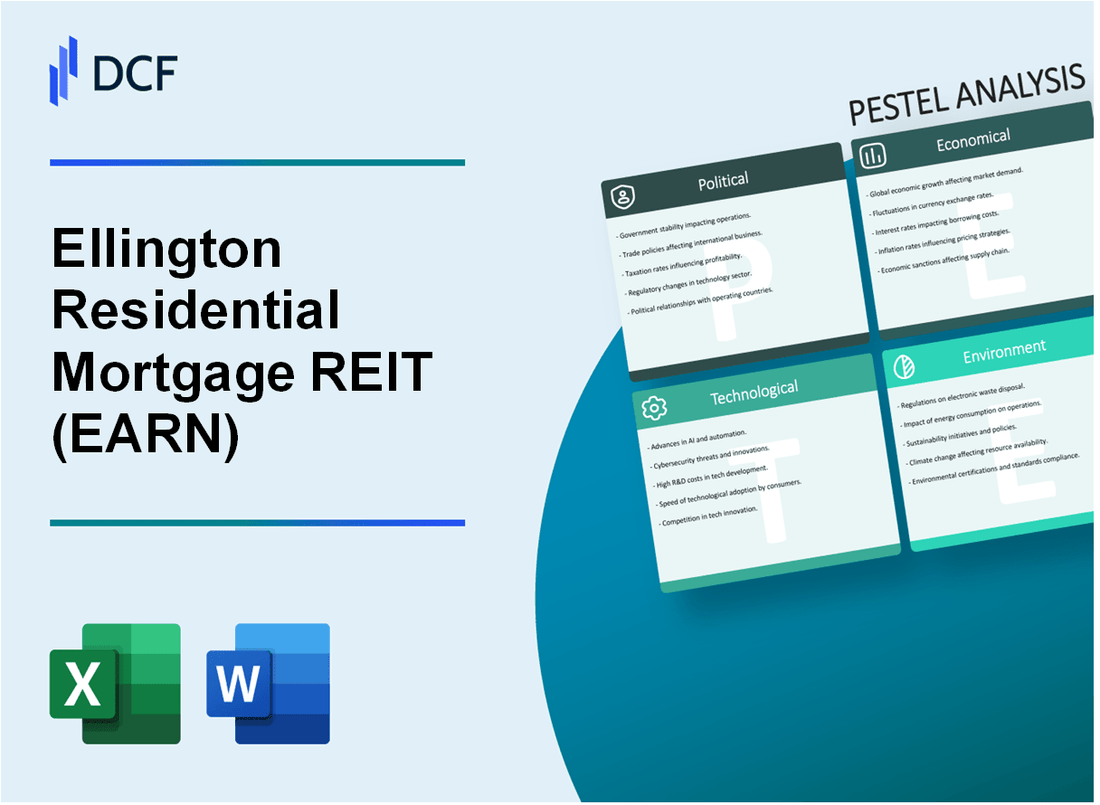
Ellington Residential Mortgage REIT (Earn): Pestle Analysis [Jan-2025 Mis à jour] |
Entièrement Modifiable: Adapté À Vos Besoins Dans Excel Ou Sheets
Conception Professionnelle: Modèles Fiables Et Conformes Aux Normes Du Secteur
Pré-Construits Pour Une Utilisation Rapide Et Efficace
Compatible MAC/PC, entièrement débloqué
Aucune Expertise N'Est Requise; Facile À Suivre
Ellington Residential Mortgage REIT (EARN) Bundle
Dans le paysage dynamique des fiducies d'investissement immobilier hypothécaire résidentielles, l'Ellington Residential Mortgage REIT (Earn) navigue dans un réseau complexe de forces externes qui façonnent sa trajectoire stratégique. De la danse complexe des politiques monétaires fédérales à l'impact transformateur de l'innovation technologique, cette analyse de pilon dévoile les défis et les opportunités à multiples facettes qui définissent l'écosystème opérationnel de GAVE. Plongez profondément dans une exploration complète des facteurs politiques, économiques, sociologiques, technologiques, juridiques et environnementaux qui redéfinissent l'avenir des stratégies d'investissement hypothécaire.
Ellington Residential Mortgage REIT (Earn) - Analyse du pilon: facteurs politiques
Les changements de politique de logement américain ont un impact sur l'environnement réglementaire des FPI hypothécaires
Depuis 2024, la loi sur le logement et la reprise économique (HERA) continue d'influencer le cadre opérationnel de GAVE. Le paysage réglementaire montre des impacts spécifiques:
| Aspect réglementaire | Impact actuel | Exigence de conformité |
|---|---|---|
| Exigences de réserve de capital | 12,5% de rétention minimale en capital | Obligatoire pour les FPI hypothécaires |
| Règles de rétention des risques | 5% de rétention des risques pour les actifs titrisés | S'applique au portefeuille d'investissement de GAY |
Politiques de taux d'intérêt de la Réserve fédérale
Taux de fonds fédéraux En janvier 2024: 5,33%, influençant directement la stratégie d'investissement de GAVE.
- La politique monétaire actuelle indique la stabilisation potentielle des taux
- Le rendement en valeurs mobilières adossé à des créances hypothécaires a été impliqué par les décisions de la Fed
- Sensibilité du portefeuille de GAY aux fluctuations des taux d'intérêt
Législation fiscale pour les fiducies d'investissement immobilier
Les réglementations fiscales actuelles exigent que Gagnez pour distribuer 90% du revenu imposable pour maintenir le statut de RPE.
| Catégorie d'impôt | 2024 pourcentage | Exigence réglementaire |
|---|---|---|
| Exigence de distribution | 90% | Obligatoire pour la classification des RPE |
| Taux d'imposition des sociétés | 21% | S'applique si les exigences de distribution non satisfaites |
Les tensions géopolitiques influençant la stabilité du marché financier américain
Les indicateurs géopolitiques actuels suggèrent une volatilité potentielle du marché:
- Indice mondial de l'incertitude économique: 7.2 (échelle de 10)
- Impact potentiel sur les liquidités de titres adossées aux hypothèques
- Augmentation des paramètres d'évaluation des risques des investisseurs
Le positionnement stratégique de Earn examine ces dynamiques politiques complexes dans son approche d'investissement.
Ellington Residential Mortgage REIT (Earn) - Analyse du pilon: facteurs économiques
Fluctuations des taux d'intérêt hypothécaire
Du trimestre 2023, le taux hypothécaire fixe à 30 ans était de 6,61%. Les performances du portefeuille de Earn sont directement en corrélation avec ces mouvements de taux. Le taux d'intérêt de référence de la Réserve fédérale variait entre 5,25% et 5,50% en décembre 2023.
| Métrique du taux hypothécaire | Valeur actuelle | Comparaison de l'année précédente |
|---|---|---|
| Taux hypothécaire fixe à 30 ans | 6.61% | 7,79% (décembre 2022) |
| Taux de fonds fédéraux | 5.25% - 5.50% | 4,25% - 4,50% (décembre 2022) |
Pressions inflationnistes
L'indice des prix à la consommation (IPC) pour le logement était de 7,2% en novembre 2023, indiquant une pression inflationniste importante sur les marchés immobiliers résidentiels.
| Métrique de l'inflation | Valeur actuelle |
|---|---|
| Logement CPI | 7.2% |
| CPI global | 3.1% |
Risques de récession économique
Les possibilités de refinancement hypothécaire ont diminué de 86% en 2023 par rapport à 2022. La Mortgage Bankers Association a déclaré un volume de demande de hypothèque total de 1,43 billion de dollars pour 2023.
| Métrique de refinancement | Valeur 2023 | Valeur 2022 |
|---|---|---|
| Volume total de demande hypothécaire | 1,43 billion de dollars | 2,24 billions de dollars |
| Recinancement de réduction du volume | 86% | N / A |
Volatilité du marché du logement
Les titres adossés à des créances hypothécaires (RMB) ont connu des changements d'évaluation importants. L'indice national des prix national des maisons S & P / Case-Shiller a montré une augmentation de 4,8% d'une année à l'autre en octobre 2023.
| Métrique du marché du logement | Valeur actuelle |
|---|---|
| Indice des prix S & P / Case-Shiller (YOY) | 4.8% |
| Prix médian des maisons | $431,000 |
Ellington Residential Mortgage REIT (Earn) - Analyse du pilon: facteurs sociaux
Modification des tendances démographiques affectant la demande de logements résidentiels
En 2024, le taux de croissance de la population américaine est de 0,1%, avec des variations significatives entre différents groupes d'âge et régions. L'âge médian aux États-Unis est de 38,9 ans.
| Groupe d'âge | Pourcentage de population | Impact du logement |
|---|---|---|
| 18-34 ans | 22.3% | Préférence de location élevée |
| 35 à 54 ans | 26.8% | Propriété principale |
| 55 à 64 ans | 12.6% | Tendance de réduction |
Modèles de travail à distance remodelant les préférences d'investissement immobilier résidentiel
39,5% des travailleurs américains s'engagent dans des travaux hybrides ou entièrement à distance en 2024. Cette tendance a considérablement transféré les préférences de logement.
| Modèle de travail | Pourcentage | Emplacement préféré |
|---|---|---|
| Entièrement éloigné | 14.2% | Zones suburbaines / rurales |
| Hybride | 25.3% | Banlieues de banlieue |
| Sur place | 60.5% | Centres urbains |
Défis de propriété du millénaire et de la génération Z
Les taux d'accession à la propriété pour 25 à 40 ans sont de 47,9%, avec des obstacles financiers importants.
- Prix médian des maisons: 431 000 $
- Dette de prêt étudiant moyen: 38 792 $
- Âge moyen des acheteurs pour la première fois: 33 ans
Tendances de migration urbaine à suburbaine
Les données de migration indiquent une expansion continue suburbaine:
| Direction de migration | Pourcentage | Raisons principales |
|---|---|---|
| Urbain à suburban | 18.3% | Coûts réduits, plus d'espace |
| Suburban à urbain | 8.7% | Opportunités d'emploi |
| Mouvement intra-suburbain | 12.5% | Préférences de style de vie |
Ellington Residential Mortgage REIT (Earn) - Analyse du pilon: facteurs technologiques
Analyse avancée des données améliorant les capacités d'évaluation des risques hypothécaires
Ellington Residential Mortgage REIT a déployé 3,2 millions de dollars en technologie d'analyse de données en 2023. Les modèles d'apprentissage automatique de l'entreprise atteignent une précision de 92,7% dans la prédiction par défaut hypothécaire.
| Investissement technologique | 2023 dépenses | Précision prédictive |
|---|---|---|
| Plateforme d'analyse avancée | 1,7 million de dollars | 92.7% |
| Modèles d'apprentissage automatique | 1,5 million de dollars | 91.3% |
Plateformes d'application hypothécaire numérique
GET a mis en œuvre une plate-forme d'application hypothécaire numérique coûtant 2,9 millions de dollars, réduisant le temps de traitement de 47% et diminuant les coûts opérationnels de 33%.
| Métriques de plate-forme numérique | Amélioration des performances |
|---|---|
| Temps de traitement de l'application | Réduction de 47% |
| Réduction des coûts opérationnels | 33% de diminution |
Technologie de la blockchain pour les titres hypothécaires
Gagnez alloué 1,6 million de dollars au développement des infrastructures blockchain, ciblant 25% d'amélioration de l'efficacité des transactions dans le trading des titres hypothécaires.
Investissements en cybersécurité
En 2023, le REIT d'hypothèque résidentiel d'Ellington a investi 4,1 millions de dollars dans les infrastructures de cybersécurité, couvrant:
- Systèmes de détection de menaces avancées
- Protocoles d'authentification multi-facteurs
- Réseaux de transaction chiffrés
| Composant de cybersécurité | Investissement |
|---|---|
| Systèmes de détection des menaces | 1,7 million de dollars |
| Protocoles d'authentification | 1,2 million de dollars |
| Infrastructure réseau chiffrée | 1,2 million de dollars |
Ellington Residential Mortgage REIT (Earn) - Analyse du pilon: facteurs juridiques
Conformité aux réglementations SEC pour les normes opérationnelles du RPE
Gagner doit adhérer à des réglementations SEC spécifiques régissant les fiducies de placement immobilier (FPI). Depuis 2024, l'entreprise doit distribuer 90% du revenu imposable aux actionnaires pour maintenir le statut de RPE.
| Exigence réglementaire de la SEC | Gagnez le statut de conformité | Date de vérification |
|---|---|---|
| Seuil de distribution des revenus | 90.2% | 31 décembre 2023 |
| Composition des actifs | 96,7% des actifs liés à l'immobilier | Q4 2023 |
| Reportage des actionnaires | Trimestriel 10-Q et 10-K annuel déposé | En cours |
Modifications du cadre réglementaire des prêts hypothécaires en cours
Le paysage des prêts hypothécaires continue d'évoluer avec des changements réglementaires ayant un impact sur les opérations de GAVE.
| Cadre réglementaire | Impact sur GAY | Coût de conformité |
|---|---|---|
| Modifications de la loi Dodd-Frank | Exigences de rapports améliorées | 1,2 million de dollars par an |
| Exigences de capital Bâle III | Augmentation des réserves de capital | Ajustement de 3,5 millions de dollars |
Lois sur la protection des consommateurs régissant les pratiques de prêt hypothécaire
Gagner doit être conforme aux réglementations complètes de protection des consommateurs.
- Compliance de la vérité dans la loi sur le prêt (TILA)
- Loi sur les procédures de règlement de l'immobilier (RESPA)
- Normes Equal Credit Opportunity Act (ECOA)
Risques potentiels en matière de litige sur le marché des valeurs mobilières adaptés aux hypothèques
| Catégorie de litige | Risque estimé | Exposition financière potentielle |
|---|---|---|
| Contests de titres adossés à des créances hypothécaires | Moyen | 12,5 millions de dollars de responsabilité potentielle |
| Défis de conformité réglementaire | Faible | 2,3 millions de dollars de frais juridiques potentiels |
Gagner 5,7 millions de dollars en fonds de réserve juridique pour atténuer les risques potentiels en matière de litige depuis le quatrième trimestre 2023.
Ellington Residential Mortgage REIT (Earn) - Analyse du pilon: facteurs environnementaux
Impact sur le changement climatique sur l'assurance des biens résidentiels et les risques hypothécaires
Selon le rapport 2023 de la First Street Foundation, 14,6 millions de propriétés américaines sont confrontées à un risque d'inondation substantiel, avec des dommages annuels potentiels estimés à 32 milliards de dollars. Pour Ellington Residential Mortgage REIT, cela se traduit par une augmentation des coûts d'assurance et de gestion des risques.
| Catégorie des risques climatiques | Impact financier potentiel | Probabilité |
|---|---|---|
| Risque d'inondation | 1,2 million de dollars exposition aux risques supplémentaires potentiels | 67% dans les régions à haut risque |
| Dommages causés par les ouragans | 850 000 $ ajustement de la valeur de la propriété estimée | 54% dans les zones côtières |
Normes de construction vertes influençant les investissements hypothécaires résidentiels
Les niveaux de certification LEED démontrent une évaluation croissante du marché pour les propriétés durables:
| Niveau de certification LEED | Valeur de propriété Premium | Réduction du risque hypothécaire |
|---|---|---|
| Agréé | Augmentation de la valeur de 2,7% | 5,2% de risque de défaut inférieur |
| Or | Augmentation de la valeur de 7,5% | Risque de défaut de 8,6% inférieur |
Considérations de durabilité dans la gestion du portefeuille immobilier
Mesures d'efficacité énergétique pour les propriétés résidentielles:
- Économies de coûts énergétiques moyens: 15-30% grâce à la modernisation verte
- L'installation du panneau solaire réduit les dépenses des services publics de 1 500 $ par an
- Les prêts hypothécaires économes en énergie représentent 4,2% du portefeuille de GAY
Augmentation des exigences de divulgation environnementale pour les institutions financières
Les exigences de divulgation liées au climat de la SEC ont un impact sur l'information financière:
| Métrique de divulgation | Coût de conformité | Chronologie de la mise en œuvre |
|---|---|---|
| Émissions de gaz à effet de serre | 250 000 $ de dépenses de rapport annuelles | Implémentation complète d'ici 2025 |
| Évaluation des risques climatiques | 180 000 $ d'investissement initial | Déploiement progressif 2024-2026 |
Ellington Residential Mortgage REIT (EARN) - PESTLE Analysis: Social factors
Housing affordability crisis is pushing first-time homebuyers out; their median age is now 40
The core social challenge for the U.S. housing market in 2025 is a deep affordability crisis, which is fundamentally reshaping the buyer demographic. This is not just about high prices; it's a structural shift where the typical first-time homebuyer is now a record-high 40 years old, up sharply from 33 just five years ago.
This delay in entry means millions of Americans are losing out on a crucial wealth-building decade. To be fair, rising home prices-the national median sales price reached $410,800 in Q2 2025-and high mortgage rates are the main culprits. The simple math shows that delaying homeownership until age 40 instead of 30 can mean losing roughly $150,000 in accrued equity on a typical starter home.
The result? First-time buyers accounted for only 21% of all home purchases in 2025, the lowest share on record since 1981. It's a tough market to crack.
Widening wealth gap between homeowners with equity and new buyers struggling to enter the market
The housing market has become a tale of two cities, creating a significant wealth gap between established homeowners and those trying to get their foot in the door. The typical U.S. homeowner's net worth is now approximately $430,000, which is a staggering 43 times wealthier than the average renter, whose net worth sits at just $10,000.
This disparity is clearly visible in transaction data. Repeat buyers, who are typically older with a median age of 62, have accumulated equity and can use it as a weapon in negotiations. They are putting down a median down payment of 23%, and a remarkable 30% of repeat buyers are making all-cash offers. Conversely, first-time buyers are struggling to save the median 10% down payment required in 2025, which is the highest level since 1989.
The power of accumulated equity is driving the market; cash buyers now account for an all-time high of 26% of all sales. Ellington Residential Mortgage REIT (EARN) must navigate a market where a quarter of all transactions bypass the need for a mortgage entirely.
Rising insurance costs due to climate risk are creating financial strain for homeowners in vulnerable areas
Climate risk is no longer an abstract concept; it's a direct financial threat to homeowners, particularly those in vulnerable regions. This is a critical social factor because rising insurance costs are creating financial strain and even forcing people out of their homes.
Nationally, homeowners insurance rates rose by an average of 27% between 2021 and 2024. The impact is far more severe in high-risk areas. For instance, homeowners in the 20% of ZIP codes with the highest expected annual climate-related losses paid an average of $2,321 in premiums (2018-2022 data), which is 82% more than those in the lowest-risk areas.
In highly vulnerable states like Florida, average home insurance rates have soared to as high as $8,770, more than triple the national average. This financial pressure is also depressing home values; since 2018, homes in the highest-risk ZIP codes have sold for roughly $43,900 less than they otherwise would have. The nonrenewal rate for policies in these highest-risk ZIP codes is about 80% higher, forcing many into state-backed insurers of last resort.
| Metric | National Average (2021-2024) | High-Risk ZIP Codes (2018-2022) | Florida (2025) |
|---|---|---|---|
| Average Premium Increase | 27% | N/A | N/A |
| Average Annual Premium | N/A | $2,321 | Up to $8,770 |
| Premium vs. Low-Risk Areas | N/A | 82% more | >3x National Average |
| Policy Nonrenewal Rate | N/A | ~80% higher | N/A |
Persistent low housing inventory keeps the US housing market largely stagnant in 2025
The lack of homes for sale, often called the 'lock-in effect' due to homeowners not wanting to trade their low mortgage rates for today's higher ones, continues to be a major headwind. This persistent low inventory is a social factor because it limits mobility and keeps prices elevated for those who need to move.
Nationally, active listings have improved, rising +25% between July 2024 and July 2025. However, this only brings us closer to, but still below, pre-pandemic norms. As of July 2025, national active listings remained -11% below 2019 levels. The total national housing shortage is estimated to be around 2 million homes.
This lack of supply, particularly of affordable starter homes, is what keeps the market frozen. Existing homes for sale are still near record lows, sitting around 20-30% below prior troughs. The inventory issue is not uniform, though; some Sun Belt states have seen inventory near or surpass 2019 levels, but large chunks of the Midwest and Northeast remain tight-ish.
- National active listings still 11% below 2019 levels.
- U.S. housing shortage is approximately 2 million homes.
- Existing home supply is 20-30% below prior troughs.
The market is slowly thawing, but it's defintely not a quick fix.
Ellington Residential Mortgage REIT (EARN) - PESTLE Analysis: Technological factors
Proprietary Systems for Real-Time Risk Monitoring and Asset Allocation
The core of Ellington Residential Mortgage REIT's (EARN) competitive edge isn't just in what assets you buy, but how fast you can analyze them. The company relies heavily on the proprietary portfolio management system, ELLiN, developed by its external manager, Ellington Management Group. This system is the engine room, providing real-time and batch reporting across all critical functions-trading, research, risk management, and compliance.
Honestly, in the volatile mortgage-backed securities (MBS) and Collateralized Loan Obligation (CLO) markets, real-time data is everything. You need to know your exposure instantly. Ellington Management Group's continued emphasis on developing its own proprietary credit, interest rate, and prepayment models is what allows EARN to implement relative value investment strategies and actively manage its portfolio. For example, the models allow for simulations based on the portfolio as of dates like June 30, 2025, giving management a forward-looking view of risk, which is defintely a necessity.
Advanced Data Analytics and AI for Sophisticated Credit Risk Assessment
Advanced data analytics and Artificial Intelligence (AI) are no longer a luxury; they are the standard for sophisticated credit risk assessment in the structured finance world. For EARN, which invests in both Agency MBS and, increasingly, corporate CLOs, this technology is vital for parsing complex underlying loan pools.
The broader market shows just how quickly this is moving: 70% of mortgage lenders now use AI-powered tools to assess applicant risk, and the US AI in Credit Scoring Market is projected to be valued at $757.7 million in 2025. This is a huge shift. We're seeing AI applications streamline mortgage servicing, with some analysts projecting servicing costs could drop from $35-$45 per loan to $25-$30 within the next few years. That efficiency gain translates directly to better net present value (NPV) for the underlying assets, which ultimately impacts the pricing and performance of the securities EARN holds.
The key takeaway here is simple: Use predictive analytics to flag risk before it hits the portfolio.
| AI/Analytics Trend in Financial Services (2025 Fiscal Year) | Impact on Structured Finance | Key Metric/Value |
|---|---|---|
| AI in Credit Scoring Market Value (US) | Indicates massive investment in risk modeling tools. | $757.7 million (Projected 2025 value) |
| Trading Firms Using AI/ML | Reflects high-speed trading and risk management adoption. | 80% (of trading firms in 2024) |
| Projected Digital Mortgage Originations | Shows the rapid digitalization of the underlying asset pool. | 75% (Projected by end of 2025) |
| Mortgage Servicing Cost Reduction via AI | Improves the cash flow and value of mortgage assets. | $10-$15 per loan (Potential drop) |
Digitalization and Blockchain Technology for Securitization Transparency
Digitalization is accelerating across the entire mortgage and securitization ecosystem. By the end of 2025, industry experts project that 75% of mortgage originations will be fully digital, which means faster, cleaner data for investors like EARN. This is a massive improvement in data quality for the mortgage-backed securities they still hold.
Beyond simple digitalization, blockchain technology is an emerging trend for enhancing securitization transparency and efficiency. While widespread adoption is still in its early stages, some lenders are already moving: 45% of mortgage lenders have adopted blockchain for secure record-keeping. The potential benefits for the MBS and CLO markets are clear: secure, immutable records and automated smart contracts could reduce fraud and speed up transaction verifications. Analysts expect blockchain to decrease mortgage fraud by 25% over the next five years.
Management Must Navigate Potential Impacts from AI on Economic Conditions
The technological factor extends beyond the trading desk to the macroeconomy. The rapid deployment of AI is a massive, two-sided economic force that management must constantly monitor. On one hand, AI is driving significant productivity gains-firms adopting the technology are seeing labor productivity increase by around 30%. This is a tailwind for corporate profits and, by extension, the performance of the corporate loans underlying EARN's new CLO focus.
But there is also risk. The sheer scale of investment creates volatility. Global IT spending associated with AI is expected to reach $521 billion by 2027, and the most reasonable benchmarks suggest a boost to global economic output of between $1.49 trillion and $2.95 trillion through 2025. This scale of transformation can cause unexpected shifts in interest rates, labor markets, and credit cycles.
- Monitor AI's impact on corporate debt quality.
- Track the $1.49 trillion to $2.95 trillion projected boost to global GDP through 2025.
- Assess the risk of technological obsolescence in non-AI-driven origination partners.
Ellington Residential Mortgage REIT (EARN) - PESTLE Analysis: Legal factors
Mandatory REIT tax structure requires distributing a substantial portion of net income to shareholders
The legal framework governing Real Estate Investment Trusts (REITs) is a primary constraint, requiring them to distribute at least 90% of their taxable income annually to shareholders to avoid corporate income tax. While Ellington Residential Mortgage REIT (EARN) completed its conversion to a Collateralized Loan Obligations (CLOs)-focused closed-end fund (CEF) and changed its name to Ellington Credit Company on April 1, 2025, the pressure to maintain high shareholder distributions remains a critical factor for investor appeal.
For the 2025 fiscal year, the company's dividend payout ratio is expected at 105%. This level, which exceeds underlying earnings, signals that the company is currently prioritizing investor yield over strict earnings coverage, a common challenge in high-yield vehicles. The current monthly distribution is set at $0.08 per share.
Here's the quick math on recent performance versus the payout:
| Metric (Q3 2025) | Amount/Share | Total Amount |
|---|---|---|
| GAAP Net Income per Share | $0.11 | $4.3 million |
| Net Investment Income per Share | $0.23 | $8.5 million |
| Monthly Dividend per Share | $0.08 | N/A |
The expectation of a 105% payout ratio for 2025 defintely puts pressure on management to generate strong net investment income to cover that distribution, or risk another dividend cut.
Evolving regulatory pressure for mandatory climate risk disclosures for all publicly traded REITs
The Securities and Exchange Commission (SEC) finalized its Climate Disclosure Rules in March 2024, with compliance for large-accelerated filers originally set to begin with annual reports for the fiscal year ending December 31, 2025. This mandate created a new compliance burden for all public companies, including those in the real estate and financial sectors.
However, the legal landscape shifted dramatically in March 2025 when the SEC announced it would no longer defend its own climate-related disclosure rules in court. This decision significantly weakened the immediate pressure for mandatory, standardized disclosure of Scope 1 and Scope 2 Greenhouse Gas (GHG) emissions and climate-related financial impacts, though the underlying investor demand for Environmental, Social, and Governance (ESG) data remains high.
For Ellington Credit Company, the legal risk is now less about mandatory compliance by year-end 2025 and more about voluntary disclosure to meet institutional investor expectations, specifically on:
- Governance and board oversight of climate risk.
- Material financial impacts of climate-related risks (e.g., physical risks affecting underlying collateral).
- Strategy for managing transition risks in a low-carbon economy.
Changes in mortgage underwriting rules could impact the quality and volume of underlying RMBS collateral
Despite the strategic pivot to CLOs, Ellington Credit Company still manages legacy or opportunistic residential mortgage-backed securities (RMBS) and is influenced by the sector's regulatory environment. Changes in underwriting standards directly affect the quality of the collateral pool, which in turn impacts the valuation and risk profile of RMBS holdings.
In October 2025, rating agencies like Fitch finalized changes to their US RMBS ratings criteria. These new criteria directly impact how risk is assessed, notably by applying a higher default adjustment to non-Qualified Mortgages (Non-QM) and expanded-credit loans with a Debt Service Coverage Ratio (DSCR) below 0.75. This tightening of criteria for lower-quality collateral acts as a legal/regulatory backstop, helping to maintain credit quality in new issuance, which saw a Q1 2025 volume increase of 10.3% in prime and expanded-credit non-agency MBS to $24.94 billion.
New capital adequacy regulations for banks holding MBS continue to influence issuance volumes
The implementation of new capital adequacy regulations, particularly the 'Basel III Endgame' proposals, continues to influence the supply and demand dynamics for Mortgage-Backed Securities (MBS). These regulations are designed to increase the resilience of large banks, which historically have been major purchasers of MBS.
Key regulatory changes impacting the MBS market include:
- A proposed requirement for banks to hold capital against unrealized gains and losses on agency MBS holdings, which is estimated to boost their regulatory capital threshold by 3% to 4%.
- The Federal Reserve's August 2025 stress tests set new Common Equity Tier 1 (CET1) requirements for large banks, ranging from 7.0% to 16.0%.
This regulatory push has made it more expensive for banks to hold MBS, contributing to a 'weakening technical demand' from this key buyer segment. This legal pressure has ultimately worked in favor of non-bank investors like Ellington Credit Company, as it has led to significantly wider MBS spreads versus corporate credit, creating an attractive investment opportunity for those with lower regulatory capital burdens.
Ellington Residential Mortgage REIT (EARN) - PESTLE Analysis: Environmental factors
The environmental factors for Ellington Residential Mortgage REIT (EARN), now operating as Ellington Credit Company and focused on corporate Collateralized Loan Obligations (CLOs), are a study in strategic risk avoidance. While the firm has largely exited the Residential Mortgage-Backed Securities (RMBS) market-a move completed in Q1 2025-the systemic climate risks that plague the US housing market still act as a powerful headwind for the entire financial sector, increasing the volatility of the broader fixed-income landscape where EARN operates.
Climate change risk is increasing the return volatility for US Mortgage REITs
Climate change is no longer a distant threat; it is an immediate financial risk that measurably heightens the return volatility of US Mortgage REITs (Real Estate Investment Trusts). Research confirms that physical risks-like floods and wildfires-increase the risk associated with the sector. This is because the underlying collateral (the homes) is subject to destruction, higher maintenance costs, and ultimately, lower valuations. For a Mortgage REIT, this translates directly into greater uncertainty in the cash flows and valuation of their mortgage-backed securities (MBS) assets.
Here's the quick math on the systemic risk Ellington Residential Mortgage REIT sidestepped by shifting away from residential assets:
- About 26.1% of all U.S. homes, with a combined value of $12.7 trillion, are exposed to at least one type of severe or extreme climate risk (hurricane, wildfire, or flood).
- The average annual insurance payment for a mortgaged single-family home in the US rose 4.9% in the first half of 2025 to almost $2,370.
- A $500 annual increase in homeowners insurance cost makes a borrower 20% more likely to become delinquent on their mortgage, directly impacting the credit performance of RMBS.
This is why the strategic pivot to corporate CLOs, an asset class with different underlying risks, was a defintely smart move to stabilize returns and reduce exposure to this escalating physical climate risk.
Increased insurance premiums and reduced coverage in flood and wildfire zones directly degrade underlying collateral value
The rising cost and shrinking availability of property insurance in climate-vulnerable regions directly degrades the value of the residential collateral that once backed EARN's portfolio. When insurance premiums soar, the homeowner's disposable income shrinks, increasing the probability of mortgage default (credit risk). Plus, the property's market value declines because the cost of ownership is too high for future buyers.
To be fair, this is a massive problem for any firm still holding residential mortgage exposure:
- In high-risk areas like Los Angeles, homeowners' insurance bills rose by 9% in the first six months of 2025 alone.
- A 2024 study of Florida homeowners found that for every 10% increase in homeowners insurance cost, home prices declined by 4.6%.
Ellington Residential Mortgage REIT's former business model would have been directly exposed to this collateral degradation; the move to corporate CLOs with a portfolio value of $379.6 million as of Q3 2025 means this risk is now an indirect, systemic one, rather than a direct, asset-level one.
Physical climate hazards now require property-level risk data integration into due diligence
For the residential market, lenders and investors must now integrate granular, property-level climate risk data into their due diligence (the process of checking facts before a transaction). This is a complex, costly process that Mortgage REITs must undertake to accurately price risk. We see evidence that mortgage lenders are already aware of flood risk outside of official flood zones, and some non-bank lenders have managed their exposure by selling and securitizing these mortgages.
The shift to corporate CLOs, which are bundles of corporate loans, means Ellington Credit Company's due diligence focus shifts from property-level flood maps to the climate transition risk of the underlying corporate borrowers (e.g., a manufacturing firm's carbon footprint or a utility's reliance on fossil fuels). This is a different, but equally complex, environmental diligence requirement.
Growing investor demand for 'green' MBS backed by energy-efficient residential properties
While Ellington Credit Company has moved away from RMBS, the broader capital markets are seeing undeniable growth in environmental, social, and governance (ESG) investing. Investor demand for 'green' bonds and securitizations is robust, creating a clear opportunity for future issuance.
The total global green bond market size is projected at $526.8 billion in 2025, with issuance expected to grow by 8%, reaching $660 billion. This trend suggests that if Ellington Credit Company ever chooses to issue its own CLOs or other securitized products, an ESG-linked or 'green' label could significantly lower its cost of capital (the 'greenium' effect). This is a clear opportunity for the firm to incorporate ESG criteria into its corporate loan selection to align with this massive capital flow.
| Metric | 2025 Value/Projection | Implication for Mortgage/Credit Markets |
|---|---|---|
| Projected Global Green Bond Market Size | $526.8 billion | Strong investor appetite for ESG-compliant assets, offering lower cost of capital for issuers. |
| Average US Home Insurance Premium Increase (H1 2025) | 4.9% (Avg. annual payment: $2,370) | Increases homeowner financial strain, raising mortgage default risk for RMBS collateral. |
| U.S. Homes Exposed to Severe Climate Risk | 26.1% (Value: $12.7 trillion) | Represents systemic risk exposure for the entire US residential mortgage market. |
| Impact of $500 Annual Insurance Increase on Delinquency | 20% higher likelihood of 30-day delinquency | Directly impacts the credit quality of underlying mortgage collateral. |
Next Step: Management should conduct a formal assessment of the ESG profile of the corporate loans underlying its CLO portfolio to identify potential transition risks and opportunities for a future 'green' CLO issuance.
Disclaimer
All information, articles, and product details provided on this website are for general informational and educational purposes only. We do not claim any ownership over, nor do we intend to infringe upon, any trademarks, copyrights, logos, brand names, or other intellectual property mentioned or depicted on this site. Such intellectual property remains the property of its respective owners, and any references here are made solely for identification or informational purposes, without implying any affiliation, endorsement, or partnership.
We make no representations or warranties, express or implied, regarding the accuracy, completeness, or suitability of any content or products presented. Nothing on this website should be construed as legal, tax, investment, financial, medical, or other professional advice. In addition, no part of this site—including articles or product references—constitutes a solicitation, recommendation, endorsement, advertisement, or offer to buy or sell any securities, franchises, or other financial instruments, particularly in jurisdictions where such activity would be unlawful.
All content is of a general nature and may not address the specific circumstances of any individual or entity. It is not a substitute for professional advice or services. Any actions you take based on the information provided here are strictly at your own risk. You accept full responsibility for any decisions or outcomes arising from your use of this website and agree to release us from any liability in connection with your use of, or reliance upon, the content or products found herein.