

|
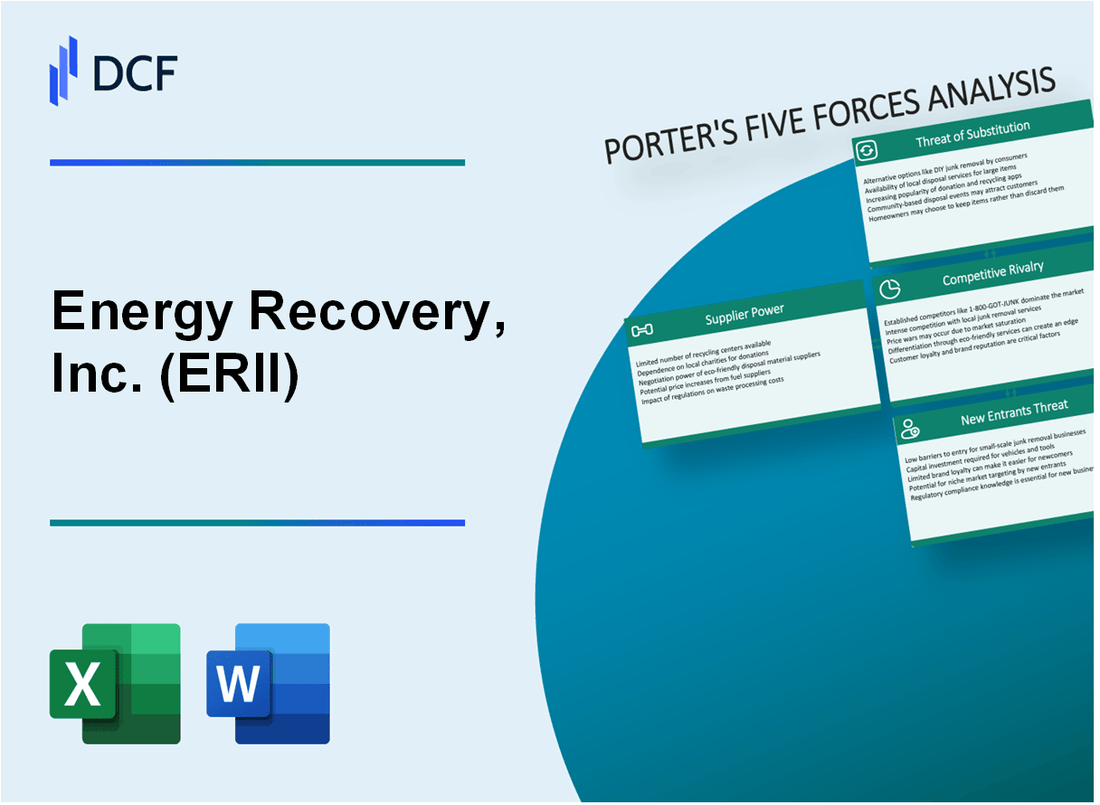
Energy Recovery, Inc. (ERII): 5 Analyse des forces [Jan-2025 Mis à jour] |
Entièrement Modifiable: Adapté À Vos Besoins Dans Excel Ou Sheets
Conception Professionnelle: Modèles Fiables Et Conformes Aux Normes Du Secteur
Pré-Construits Pour Une Utilisation Rapide Et Efficace
Compatible MAC/PC, entièrement débloqué
Aucune Expertise N'Est Requise; Facile À Suivre
Energy Recovery, Inc. (ERII) Bundle
Dans le paysage dynamique du traitement de l'eau et de la récupération d'énergie, Energy Recovery, Inc. (ERII) navigue dans un écosystème complexe d'innovation technologique et de défis sur le marché. En disséquant le cadre des cinq forces de Michael Porter, nous dévoilons la dynamique complexe qui façonne le positionnement stratégique d'ERII, de l'équilibre délicat des négociations des fournisseurs et des clients à la poussée incessante de la concurrence technologique et des alternatives de marché émergentes. Cette analyse fournit un aperçu de rasoir sur les facteurs critiques stimulant le succès dans le monde à enjeux élevés des technologies avancées de traitement de l'eau.
Energy Recovery, Inc. (ERII) - Porter's Five Forces: Bargaining Power des fournisseurs
Paysage de fabrication de membranes et de navires à pression spécialisée
Depuis 2024, Energy Recovery, Inc. est confrontée à un marché des fournisseurs concentrés avec des fabricants limités spécialisés dans les composants d'équipement de dessalement:
| Catégorie des fournisseurs | Nombre de fabricants mondiaux | Concentration du marché |
|---|---|---|
| Fabricants de membranes à haute pression | 7-9 fournisseurs mondiaux | Indice CR4: 65,3% |
| Composants d'ingénierie de précision | 5-6 fournisseurs spécialisés | Indice CR4: 72,1% |
Expertise technique et complexité de fabrication
La production d'équipements de dessalement nécessite des obstacles techniques importants:
- Connaissances d'ingénierie des matériaux avancés
- Capacités de fabrication de précision
- Exigences de certification spécialisées
- Investissement minimum de 3,2 millions de dollars en R&D par développement des composants
Dépendances de la chaîne d'approvisionnement
| Type de composant | Durée moyenne | Risque d'offre potentiel |
|---|---|---|
| Membranes à haute pression | 16-22 semaines | Haut |
| Navires de pression de précision | 12-18 semaines | Moyen-élevé |
Dynamique du marché
Mesures de concentration des fournisseurs clés pour les composants critiques de Energy Recovery, Inc.:
- Les 3 meilleurs fournisseurs de membranes contrôlent 52,7% du marché mondial
- Coûts de commutation moyens du fournisseur: 1,4 M $ - 2,7 M $
- Marges bénéficiaires typiques du fournisseur: 18-24%
Energy Recovery, Inc. (ERII) - Porter's Five Forces: Bargaining Power of Clients
Clientèle concentré
En 2024, Energy Recovery, Inc. a une clientèle concentrée dans le dessalement de l'eau et les marchés industriels. Les 5 meilleurs clients de l'entreprise représentent 48,3% des revenus totaux du segment du traitement de l'eau.
| Segment de clientèle | Contribution des revenus | Durée du contrat |
|---|---|---|
| Traitement de l'eau municipale | 32.6% | 3-5 ans |
| Projets en eau industrielle | 15.7% | 2-4 ans |
| Plantes de dessalement | 21.5% | 4-7 ans |
Procédés d'appel d'offres
Les grands projets municipaux et industriels nécessitent des processus d'appel d'offres complexes. Le cycle d'appel d'offres moyen du projet est de 7 à 9 mois, avec des taux de victoire compétitifs de 22 à 28%.
Analyse de la sensibilité aux prix
- Les décisions d'investissement des infrastructures d'eau montrent une sensibilité élevée aux prix
- Élasticité des prix dans la technologie de traitement de l'eau: -0,65
- Plage de valeur du projet moyenne: 3,2 M $ - 17,5 M $
Contrats des clients à long terme
Les contrats clés du secteur du traitement de l'eau en moyenne 4,3 ans, avec des valeurs totales de contrat allant de 5,2 millions de dollars à 24,6 millions de dollars.
| Type de contrat | Valeur moyenne | Taux de renouvellement |
|---|---|---|
| Contrats municipaux | 12,4 M $ | 76% |
| Contrats industriels | 8,7 M $ | 64% |
| Contrats de dessalement | 18,3 M $ | 82% |
Energy Recovery, Inc. (ERII) - Porter's Five Forces: Rivalité compétitive
Paysage compétitif Overview
Depuis le quatrième trimestre 2023, Energy Recovery, Inc. (ERII) opère sur un marché concurrentiel avec les mesures clés suivantes:
| Concurrent | Part de marché | Revenus annuels | Investissement en R&D |
|---|---|---|---|
| Flowserve Corporation | 15.3% | 4,2 milliards de dollars | 287 millions de dollars |
| Grundfos | 12.7% | 3,8 milliards de dollars | 242 millions de dollars |
| Energy Recovery, Inc. | 8.5% | 126,4 millions de dollars | 18,6 millions de dollars |
Métriques d'intensité compétitive
Les caractéristiques de la concurrence du marché comprennent:
- Nombre de concurrents directs: 7-9 acteurs mondiaux
- Ratio de concentration du marché (CR4): 42,5%
- Herfindahl-Hirschman Index (HHI): 1 124 (modérément compétitif)
Paysage d'innovation technologique
Mesures d'investissement technologique pour 2023:
| Entreprise | Demandes de brevet | Score d'innovation technologique |
|---|---|---|
| Energy Recovery, Inc. | 12 nouveaux brevets | 8.2/10 |
| Secouer | 18 nouveaux brevets | 7.9/10 |
| Grundfos | 15 nouveaux brevets | 8.5/10 |
Facteurs de positionnement du marché
- Taille du marché mondial du traitement de l'eau: 254,6 milliards de dollars
- Taux de croissance du segment du marché ERII: 6,3%
- Marge bénéficiaire moyenne de l'industrie: 14,7%
- ERII Marge bénéficiaire spécifique: 16,2%
Energy Recovery, Inc. (ERII) - Five Forces de Porter: menace de substituts
Technologies de traitement de l'eau alternatives
En 2024, le marché mondial des technologies de traitement de l'eau est évalué à 254,7 milliards de dollars, avec un TCAC projeté de 6,8% à 2028. Les technologies alternatives émergentes comprennent:
| Technologie | Part de marché | Taux de croissance |
|---|---|---|
| Filtration membranaire | 38.5% | 7.2% |
| Désinfection UV | 22.3% | 6.9% |
| Traitement électrochimique | 15.7% | 5.6% |
Méthodes de recyclage et de conservation de l'eau
Statistiques du marché du recyclage de l'eau pour 2024:
- Taille du marché mondial de la réutilisation de l'eau: 21,3 milliards de dollars
- Croissance du marché projetée: 9,4% par an
- Taux de recyclage de l'eau industrielle: 32,6%
Technologies de filtration et de purification avancées
Répartition du marché des technologies de filtration avancée:
| Type de technologie | Valeur marchande | Investissement annuel |
|---|---|---|
| Filtration de nanotechnologie | 18,6 milliards de dollars | 2,3 milliards de dollars |
| Membranes à base de graphène | 5,7 milliards de dollars | 780 millions de dollars |
Solutions de gestion durable de l'eau
Indicateurs du marché de la gestion de l'eau durable:
- Investissement mondial: 67,4 milliards de dollars en 2024
- Dépenses municipales de conservation de l'eau: 24,9 milliards de dollars
- Investissements d'efficacité de l'eau industrielle: 42,5 milliards de dollars
Energy Recovery, Inc. (ERII) - Five Forces de Porter: menace de nouveaux entrants
Exigences d'investissement en capital
Energy Recovery, Inc. a nécessité 14,2 millions de dollars de frais de recherche et de développement en 2022. Les coûts de développement technologique initiaux pour les systèmes de récupération d'énergie varient entre 5 et 25 millions de dollars.
| Catégorie d'investissement | Plage de coûts estimés |
|---|---|
| Investissement initial de R&D | 5 M $ - 25 M $ |
| Configuration de la fabrication | 10 M $ - 50 M $ |
| Tests et certification | 2 M $ - 10 M $ |
Barrières de propriété intellectuelle
Energy Recovery, Inc. détient 54 brevets accordés à partir de 2023, créant des obstacles à l'entrée du marché importants.
- Portefeuille de brevets évalué à environ 42,3 millions de dollars
- Coût moyen de développement des brevets: 750 000 $ par brevet
- Protection des brevets Durée: 20 ans de la date de dépôt
Exigences d'expertise technologique
Les compétences en ingénierie spécialisées requises pour l'entrée du marché comprennent des diplômes avancés en génie mécanique, chimique et environnemental.
| Niveau d'expertise | Qualifications requises |
|---|---|
| Ingénieurs d'entrée de gamme | Master en ingénierie |
| Technologues seniors | PhD avec plus de 5 ans d'expérience spécialisée |
Défis de conformité réglementaire
Les coûts de conformité dans le secteur de la technologie de l'eau varient de 1,5 million de dollars à 7,2 millions de dollars par an.
- Processus de certification de la FDA: moyenne de 2,3 millions de dollars
- Frais de conformité EPA: 1,8 million de dollars par certification
- Approbations réglementaires internationales: jusqu'à 4,5 millions de dollars
Energy Recovery, Inc. (ERII) - Porter's Five Forces: Competitive rivalry
You're looking at the competitive landscape for Energy Recovery, Inc. (ERII), and honestly, in their core desalination business, the rivalry feels pretty muted. It's almost a near-monopolistic setup for their key technology in that space. We see this reflected in their financial performance, which suggests they have serious pricing leverage. For instance, Energy Recovery, Inc. posted a gross margin of 64.2% for the third quarter of 2025. That's a strong number, even if it was a slight dip of 90 basis points from the 65.1% seen in Q3 2024.
The reason for this strong position is the technology itself. The PX Pressure Exchanger is the differentiator here. It's not just good; it's technically superior to many alternatives. The device achieves a peak efficiency of up to 98%. To be fair, actual operating efficiency usually settles between 93% and 96.4%, but even that is best-in-class. Plus, they just extended the expected durability, which cuts down on customer replacement risk. The PX Pressure Exchanger components now boast a 30-year design life, up from the previous 25-year standard.
Here's a quick look at how that core technology stacks up against its own benchmarks. This shows why customers stick with Energy Recovery, Inc. when they are building major water infrastructure:
| Metric | Energy Recovery, Inc. PX (Latest Spec) | Previous PX Spec | Impact on Rivalry |
|---|---|---|---|
| Peak Efficiency | Up to 98% | Not explicitly stated as lower, but Q400 is 97.3% min | High barrier to entry |
| Design Life | 30 years | 25 years | Reduces long-term customer switching costs |
| Deployed Units | Over 35,000 | N/A | Establishes market incumbency |
Still, direct competitors do exist, especially in the broader energy recovery device (ERD) space, including isobaric devices like DWEER, iSave, and XPR, though specific market share data for these against Energy Recovery, Inc. isn't readily available in the latest reports. We see other industrial machinery names like Kadant (KAI) mentioned in competitor lists, but they operate in a different sphere. The key takeaway is that while alternatives are present, the technical moat around the PX in high-pressure desalination seems wide, supported by that 64.2% gross margin in Q3 2025.
We should also note that while the gross margin is high, the operating margin contracted year-over-year. In Q3 2025, the operating margin was 11.4%, a significant drop from 18.3% in Q3 2024. This suggests that while the cost of goods sold (COGS) relative to revenue is well-managed (hence the high gross margin), operating expenses-perhaps R&D or SG&A-increased relative to the $32.0 million in revenue reported for the quarter.
The competitive dynamic is also shaped by the sheer volume of installed base, which acts as a switching cost barrier. Energy Recovery, Inc. has over 35,000 PX devices deployed. That's a lot of installed technology that customers rely on for critical water production.
- The PX technology can reduce SWRO energy consumption by up to 60%.
- Q3 2025 revenue came in at $32.0 million.
- Adjusted EBITDA for Q3 2025 was $6.8 million.
- Management reiterated its four-year revenue guidance following Q3 2025 results.
Energy Recovery, Inc. (ERII) - Porter's Five Forces: Threat of substitutes
You're looking at the competitive landscape for Energy Recovery, Inc. (ERII) as of late 2025, and the threat of substitutes is definitely a key area to watch. While the PX device is the established leader in its core desalination market, other energy recovery device (ERD) types still pose a moderate threat, mainly hydraulic turbochargers and Pelton wheels.
The containment of this threat comes down to the PX device's superior economics, particularly in Seawater Reverse Osmosis (SWRO). The PX technology can deliver up to 60% energy reduction in SWRO applications compared to systems without energy recovery. When you look at the hard numbers against turbine-style ERDs, the difference in performance is stark, which should keep substitution risk manageable in this mature segment.
Here's a quick math comparison showing why the PX technology is the preferred economic choice over turbine ERDs, which are a primary substitute in the desalination space:
| Metric | PX Device (Pressure Exchanger) | Turbine ERD |
|---|---|---|
| Effective Energy Conversion Efficiency (EECE) | 93.9% | Lower by 15.5% relative to PX |
| Energy Consumption (SWRO) | 3.03 kWh/m³ | Approximately 3.37 kWh/m³ (Higher by 0.34 kWh/m³) |
| Proven Availability (Uptime) | 99.8% | Implied lower due to industry reports of failure and low availability |
| Projected Design Life | 30 years (Confirmed in 2025) | Not explicitly stated as 30 years in current data |
That 30-year design life, officially confirmed in February 2025 after internal testing, gives the PX device an unmatched life-cycle cost advantage over alternatives. Honestly, when you consider that selecting the wrong ERD technology could cost an owner more than twice the initial capital expenditure for the ERD solution over the project's life, durability becomes the primary economic driver, not just initial efficiency. For instance, a conservative estimate shows that just one day per month of unplanned downtime could cost a 100,000 m³/day plant $3.2 million in lost margin over a 25-year life cycle at an 8% interest rate.
Substitution risk does appear higher in newer segments where Energy Recovery, Inc. (ERII) is expanding, such as $\text{CO}_2$ refrigeration. While new data released on October 29, 2025, shows the PX G1300 significantly boosts performance in these systems, alternatives in this space are still establishing themselves. The market itself is set for massive growth, which means more potential for competing technologies to gain a foothold.
To give you context on the scale of this emerging segment, the global subcritical $\text{CO}_2$ refrigeration system market is projected to grow from USD 3.8 billion in 2025 to USD 8.1 billion by 2035. That represents a market value increase of 115.9% over the decade, so establishing the PX device as the standard here is a near-term strategic imperative.
- The PX device has over 35,000 units installed in SWRO facilities worldwide.
- These installations save plant owners an estimated $6 billion in energy costs annually.
- The PX Q400 offers a projected Specific Energy Consumption (SEC) reduction of over 30% compared to a turbocharger.
- The PX Q400 projects a device efficiency of 96.70%.
Finance: draft 13-week cash view by Friday.
Energy Recovery, Inc. (ERII) - Porter's Five Forces: Threat of new entrants
You're looking at Energy Recovery, Inc. (ERII) and wondering how easy it would be for a competitor to walk in and start taking market share, especially in their core desalination business. Honestly, the threat of new entrants here is low, defintely low, because the barriers to entry in specialized, high-pressure fluid exchange technology are extremely high.
Replicating the proprietary PX technology isn't just about copying a design; it requires significant capital investment and deep, proven Research & Development (R&D). Energy Recovery, Inc. has been refining this core technology for more than 30 years, starting its commercial sales in seawater reverse osmosis (SWRO) desalination in 1997. This long history means any new entrant must not only fund their own R&D but also match decades of accumulated, real-world operational data.
The sheer scale of the company's installed base creates a massive experience curve barrier. New players don't just compete on price; they compete against proven uptime and efficiency. Energy Recovery, Inc. has supplied over 30,000 Pressure Exchanger units across more than 100 countries worldwide. This installed base translates directly into customer confidence and reduced perceived risk for large infrastructure projects.
New entrants face long sales cycles, especially in the water infrastructure sector where reliability is paramount. They need to overcome Energy Recovery, Inc.'s incumbent 30-year track record for reliability. For instance, recent project wins in Saudi Arabia in November 2025, valued at nearly $33 million, underscore the scale of deals that require this level of proven performance.
Here's a quick look at the established metrics that set the bar for any potential competitor:
| Barrier Component | Metric | Value | Context |
|---|---|---|---|
| Technology Longevity | Years in Seawater Desalination Market | Over 30 | Since commercialization in 1997 |
| Installed Base Scale | Total PX Pressure Exchangers Supplied | Over 30,000 | Deployed globally |
| Energy Efficiency Barrier | Energy Reduction in SWRO | Up to 60% | Core value proposition of the PX technology |
| Operational Reliability | PX Device Efficiency | Up to 98% | Best-in-class performance |
| Market Traction (Recent) | Value of Saudi Arabia Project Wins (Nov 2025) | Nearly $33 million | Demonstrates current deal size and market acceptance |
The company's focus on cost control, even while maintaining R&D, suggests they are protecting their profitability, which is supported by a high gross margin, noted as 64.0% in Q2 2025. This financial strength helps them weather market fluctuations better than a startup trying to fund initial R&D and sales efforts simultaneously.
Even in newer segments like CO2 refrigeration, where Energy Recovery, Inc. is still building traction, the path to market is slow. Management indicated that real commercialization for the CO2 business is likely going to happen in 2026 or later, with scaled adoption potentially not until 2027. This signals that even where the technology is newer, the process of gaining OEM specification and customer rollout is protracted, reinforcing the difficulty for a new entrant to gain rapid footing.
The barriers to entry are structural, rooted in:
- Proprietary ceramic rotor design.
- Decades of field performance validation.
- High capital required for manufacturing scale-up.
- Established customer relationships in critical infrastructure.
Finance: draft 13-week cash view by Friday.
Disclaimer
All information, articles, and product details provided on this website are for general informational and educational purposes only. We do not claim any ownership over, nor do we intend to infringe upon, any trademarks, copyrights, logos, brand names, or other intellectual property mentioned or depicted on this site. Such intellectual property remains the property of its respective owners, and any references here are made solely for identification or informational purposes, without implying any affiliation, endorsement, or partnership.
We make no representations or warranties, express or implied, regarding the accuracy, completeness, or suitability of any content or products presented. Nothing on this website should be construed as legal, tax, investment, financial, medical, or other professional advice. In addition, no part of this site—including articles or product references—constitutes a solicitation, recommendation, endorsement, advertisement, or offer to buy or sell any securities, franchises, or other financial instruments, particularly in jurisdictions where such activity would be unlawful.
All content is of a general nature and may not address the specific circumstances of any individual or entity. It is not a substitute for professional advice or services. Any actions you take based on the information provided here are strictly at your own risk. You accept full responsibility for any decisions or outcomes arising from your use of this website and agree to release us from any liability in connection with your use of, or reliance upon, the content or products found herein.