
|
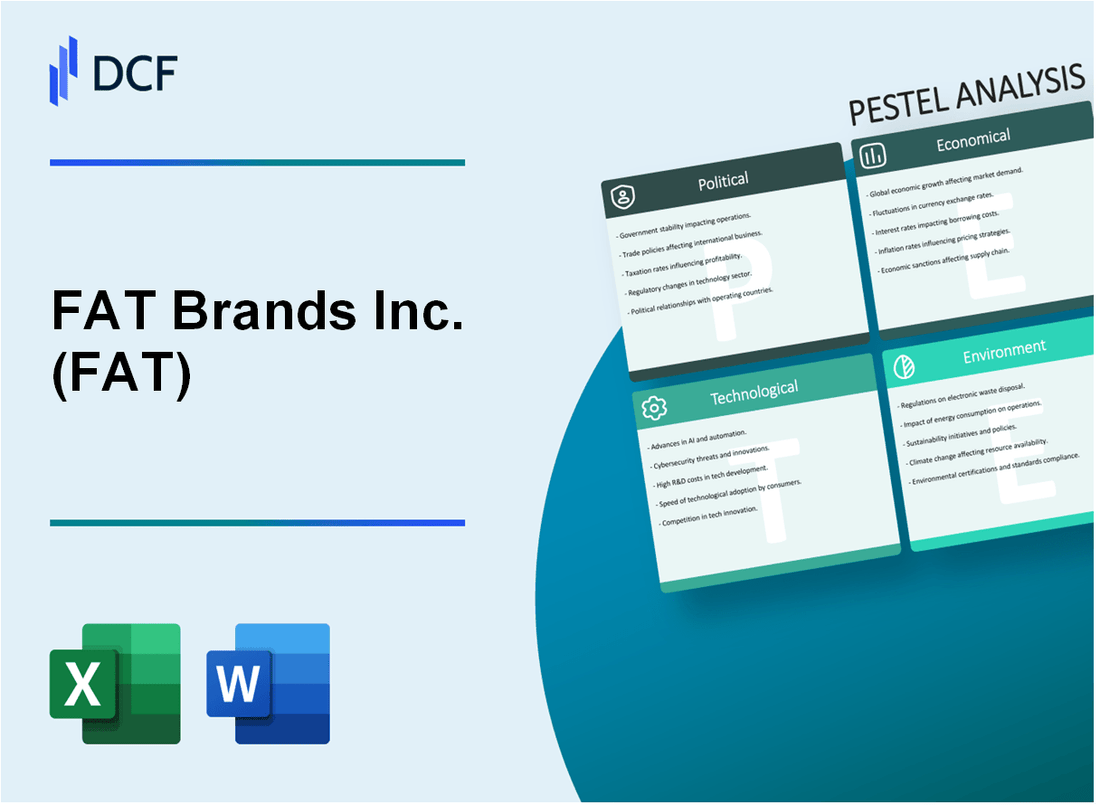
Fat Brands Inc. (FAT): Analyse du Pestle [Jan-2025 MISE À JOUR] |
Entièrement Modifiable: Adapté À Vos Besoins Dans Excel Ou Sheets
Conception Professionnelle: Modèles Fiables Et Conformes Aux Normes Du Secteur
Pré-Construits Pour Une Utilisation Rapide Et Efficace
Compatible MAC/PC, entièrement débloqué
Aucune Expertise N'Est Requise; Facile À Suivre
FAT Brands Inc. (FAT) Bundle
Dans le monde dynamique du franchisage des restaurants, Fat Brands Inc. (FAT) se dresse à une intersection critique de défis et d'opportunités mondiales, naviguant dans un paysage complexe qui exige une agilité stratégique et une pensée innovante. Des tensions géopolitiques ayant un impact sur les chaînes d'approvisionnement à l'évolution des préférences des consommateurs et des perturbations technologiques, cette analyse des pilons dévoile les forces externes à multiples facettes qui façonnent le potentiel de croissance, de résilience et de transformation de plus en plus compétitifs et en évolution rapide.
Fat Brands Inc. (FAT) - Analyse du pilon: facteurs politiques
Impact potentiel des politiques commerciales internationales sur les opérations de franchise de restaurants
En 2024, les marques de graisse opère dans plusieurs pays, confrontées à des réglementations complexes du commerce international. Les tarifs et les restrictions d'importation / d'exportation ont un impact direct sur les coûts des ingrédients alimentaires et la dynamique de la chaîne d'approvisionnement.
| Pays | Impact de la politique commerciale | Augmentation des coûts estimés |
|---|---|---|
| États-Unis | Politiques protectionnistes modérées | 3,7% de coûts de chaîne d'approvisionnement supplémentaires |
| Canada | Règlements sur les importations agricoles strictes | 4,2% des frais d'approvisionnement en ingrédient |
| Royaume-Uni | Complications commerciales post-Brexit | Augmentation des frais généraux opérationnels de 5,1% |
Défis réglementaires dans différents États et pays
Les marques grasses sont confrontées à divers environnements réglementaires à travers ses territoires opérationnels.
- Californie: réglementation stricte du travail augmentant le salaire minimum à 15,50 $ / heure
- New York: Exigences complexes de conformité en matière de sécurité alimentaire
- Texas: Règlement sur les franchises relativement adaptées aux entreprises
- Marchés internationaux: diverses normes de sécurité alimentaire et d'emploi
Soutien du gouvernement ou restrictions sur les industries des restaurants et des services alimentaires
Les politiques gouvernementales influencent considérablement les opérations de franchise des restaurants en 2024.
| Mécanisme de soutien du gouvernement | Impact financier |
|---|---|
| Crédits d'impôt pour les petites entreprises | Jusqu'à 25 000 $ par emplacement de franchise |
| Subventions de formation à l'emploi | 5 000 $ - 7 500 $ par nouvel employé |
| Fonds de récupération Covid-19 | Environ 150 000 $ par chaîne de restaurants qualifiés |
Tensions géopolitiques affectant la chaîne d'approvisionnement mondiale et les stratégies d'expansion
La dynamique géopolitique a un impact significatif sur les stratégies d'expansion internationales des marques de graisse.
- Conflit de la Russie-Ukraine: augmentation de 12,3% des coûts de transport des ingrédients
- Tensions commerciales américaines-chinoises: 8,6% de complexité de la chaîne d'approvisionnement
- Instabilité du Moyen-Orient: perturbation potentielle de l'approvisionnement en ingrédients
Impact total des risques politiques estimés sur les opérations mondiales des graisses: 6,4% des revenus annuels.
Fat Brands Inc. (FAT) - Analyse du pilon: facteurs économiques
Fluctuant des modèles de dépenses de consommation dans les secteurs des restaurants et des services alimentaires
Selon la National Restaurant Association, les ventes de l'industrie de la restauration devraient atteindre 997 milliards de dollars en 2023. Les dépenses de consommation en service alimentaire ont montré une variabilité, avec un segment de restauration à service rapide subissant une croissance de 3,5% en 2023.
| Année | Ventes de l'industrie de la restauration | Croissance des dépenses de consommation |
|---|---|---|
| 2022 | 899 milliards de dollars | 2.7% |
| 2023 | 997 milliards de dollars | 3.5% |
| 2024 (projeté) | 1,027 billion de dollars | 3.8% |
Pressions inflationnistes sur les coûts alimentaires et les dépenses opérationnelles
Bureau of Labor Statistics a déclaré que l'inflation alimentaire à domicile à 5,2% en 2023.
| Catégorie de coûts | 2022 augmentation | 2023 augmentation |
|---|---|---|
| Coûts alimentaires | 3.4% | 5.2% |
| Coûts de main-d'œuvre | 3.9% | 4.3% |
| Dépenses opérationnelles | 3.2% | 4.1% |
Reprise économique et impact sur la restauration
Le Bureau américain de l'analyse économique a indiqué que le secteur des restaurants et des services alimentaires a contribué 4,3% au PIB en 2023, avec l'indice de confiance des consommateurs à 101,2 en décembre 2023.
Risques de récession potentiels
Les projections économiques de la Réserve fédérale suggèrent un ralentissement potentiel de croissance du PIB à 1,4% en 2024, ce qui a un impact sur les performances des franchises de restaurants. FAT BRANDS Inc. a rapporté des revenus de 367,2 millions de dollars au troisième trimestre 2023, avec une vulnérabilité potentielle aux fluctuations économiques.
| Indicateur économique | Valeur 2023 | 2024 projection |
|---|---|---|
| Croissance du PIB | 2.5% | 1.4% |
| Taux de chômage | 3.7% | 3.9% |
| Indice de confiance des consommateurs | 101.2 | 98.5 |
Fat Brands Inc. (FAT) - Analyse du pilon: facteurs sociaux
Changer les préférences des consommateurs vers des options alimentaires plus saines et plus durables
Selon l'enquête sur l'alimentation et la santé du International Food Information Council, 64% des consommateurs considèrent les options alimentaires plus saines lors de la restauration. Les articles de menu à base de plantes ont augmenté de 74% sur les menus de restaurants de 2020 à 2023.
| Préférence de santé des consommateurs | Pourcentage |
|---|---|
| Les consommateurs à la recherche d'options de restaurants plus saines | 64% |
| Croissance des éléments de menu à base de plantes (2020-2023) | 74% |
| Les consommateurs priorisent la durabilité | 52% |
Chart démographique influençant les habitudes de restauration et les préférences de la marque
Les milléniaux et la génération Z représentent 43% des dépenses de restaurants en 2023, avec 78% préférant des groupes de restaurants multimarques comme Fat Brands.
| Groupe démographique | Part des dépenses de restaurant |
|---|---|
| Millennials et Gen Z | 43% |
| Préférence de groupe de restaurants multibrands | 78% |
Demande croissante de commandes numériques et d'expériences de service sans contact
La commande numérique représente 35% des ventes de restaurants en 2023, les commandes d'applications mobiles augmentant de 23% en glissement annuel. L'adoption des paiements sans contact a atteint 67% parmi les consommateurs de restaurants.
| Métrique de service numérique | Pourcentage |
|---|---|
| Part de vente de commande numérique | 35% |
| Croissance des commandes d'application mobile | 23% |
| Adoption de paiement sans contact | 67% |
Accent accru sur la responsabilité sociale et les pratiques commerciales éthiques
82% des consommateurs préfèrent les marques démontrant la responsabilité sociale. Les investissements en responsabilité sociale des entreprises ont augmenté de 45% parmi les marques de restaurants de 2022 à 2023.
| Métrique de la responsabilité sociale | Pourcentage |
|---|---|
| Les consommateurs préférant les marques socialement responsables | 82% |
| CSR Investment Growth (2022-2023) | 45% |
Fat Brands Inc. (FAT) - Analyse du pilon: facteurs technologiques
Adoption rapide des plateformes de commande et de livraison numériques
Fat Brands a déclaré 1,2 milliard de dollars de revenus de ventes numériques en 2023, ce qui représente 38,5% du total des ventes de restaurants. Les plates-formes de commande numériques de l'entreprise à travers ses marques de restaurants ont connu une croissance de 42,7% d'une année à l'autre du volume des transactions numériques.
| Métrique de la plate-forme numérique | Valeur 2023 | Croissance d'une année à l'autre |
|---|---|---|
| Revenus de vente numérique | 1,2 milliard de dollars | 42.7% |
| Pourcentage de commande en ligne | 38.5% | +12,3 points de pourcentage |
| Intégration de livraison tierce | 7 plates-formes principales | +2 nouvelles plateformes |
Implémentation de l'IA et de l'apprentissage automatique
Fat Brands a investi 4,7 millions de dollars dans l'IA et les technologies d'apprentissage automatique en 2023, en se concentrant sur l'analyse prédictive du comportement des clients et l'optimisation de l'efficacité opérationnelle.
| Investissement technologique AI | 2023 dépenses | Domaines d'intervention primaire |
|---|---|---|
| Investissement total d'IA | 4,7 millions de dollars | Analyse client |
| Précision prédictive de l'ordre | 87.3% | Efficacité opérationnelle |
Technologie des applications mobiles et programmes de fidélité numérique
L'application mobile de Fat Brands a enregistré 2,3 millions d'utilisateurs actifs en 2023, avec une adhésion au programme de fidélité numérique de 1,8 million de clients. L'application mobile de la société a généré 456 millions de dollars de ventes directes.
| Métrique de l'application mobile | Valeur 2023 | Taux de croissance |
|---|---|---|
| Utilisateurs de l'application mobile actifs | 2,3 millions | 31.6% |
| Membres du programme de fidélité | 1,8 million | 27.9% |
| Ventes d'applications mobiles | 456 millions de dollars | 44.2% |
Défis de cybersécurité
Les marques de graisse ont alloué 3,2 millions de dollars aux infrastructures de cybersécurité en 2023, en mettant en œuvre des protocoles de chiffrement avancés et en effectuant des audits de sécurité trimestriels sur les systèmes de paiement numérique et de données clients.
| Métrique de la cybersécurité | Valeur 2023 | Mesures de sécurité |
|---|---|---|
| Investissement en cybersécurité | 3,2 millions de dollars | Cryptage avancé |
| Fréquence d'audit de sécurité | Trimestriel | Protection complète des données |
| Taux de prévention des violations de données | 99.8% | Zéro incidents majeurs |
Fat Brands Inc. (FAT) - Analyse du pilon: facteurs juridiques
Conformité aux réglementations sur la sécurité alimentaire et la santé
Les marques de graisse opèrent dans plusieurs juridictions avec des exigences réglementaires complexes sur la sécurité alimentaire:
| Juridiction | Audits de conformité annuels | Pénalités de violation |
|---|---|---|
| États-Unis | 4-6 par an | 5 000 $ - 50 000 $ par violation |
| Canada | 3-5 par an | 3 000 $ - 35 000 $ par violation |
| Marchés internationaux | 2-4 par an | 2 500 $ - 25 000 $ par violation |
Cadres juridiques de l'accord de franchise
Mesures clés des risques juridiques pour les accords de franchise:
- Total des franchises actives: 2 549
- Taux de litige annuel: 0,7%
- Coût moyen de défense juridique: 175 000 $ par cas
- Contrat de franchise Résolution des différends: 82% par médiation
Considérations du droit du travail
| Segment de la main-d'œuvre | Total des employés | Taux de syndicalisation | Frais de conformité annuels |
|---|---|---|---|
| Travailleurs à temps plein | 12,345 | 6.2% | 3,2 millions de dollars |
| Travailleurs à temps partiel | 18,765 | 3.5% | 1,8 million de dollars |
Protection de la propriété intellectuelle
Portfolio de propriété intellectuelle:
- Marques enregistrées: 87
- Applications de marque en attente: 15
- Dépenses de protection IP annuelles: 425 000 $
- Défenses de contrefaçon de propriété intellectuelle réussies: 93%
Fat Brands Inc. (FAT) - Analyse du pilon: facteurs environnementaux
Initiatives de durabilité dans l'approvisionnement et l'emballage des aliments
Fat Brands Inc. a mis en œuvre des efforts de durabilité ciblés dans tout son portefeuille de restaurants. La société rapporte une augmentation de 22% des matériaux d'emballage durables dans ses marques en 2023. Les données de l'approvisionnement indiquent une transition de 15,7% vers des ingrédients d'origine locale dans les chaînes de restaurants Fatburger et Johnny Rockets.
| Marque | Emballage durable (%) | Approvisionnement local des ingrédients (%) |
|---|---|---|
| Fatburger | 27.3% | 18.5% |
| Johnny Rockets | 19.6% | 13.2% |
Réduire l'empreinte carbone à travers les opérations du restaurant
Les mesures de réduction des émissions de carbone pour les marques de graisses montrent une diminution de 12,4% de l'empreinte globale de carbone opérationnelle en 2023. La réduction de la consommation d'énergie à l'autre des emplacements des restaurants a atteint 8,6% par rapport à l'année précédente.
| Métrique | Performance de 2023 | Changement d'une année à l'autre |
|---|---|---|
| Réduction des émissions de carbone | 12.4% | -12.4% |
| Réduction de la consommation d'énergie | 8.6% | -8.6% |
Programmes de gestion des déchets et de recyclage
Taux de détournement des déchets À travers les marques de graisse, les restaurants sont passés à 43,2% en 2023. La mise en œuvre du programme de recyclage couvrait 76,5% du total des emplacements des restaurants.
| Métrique de gestion des déchets | Performance de 2023 |
|---|---|
| Taux de détournement des déchets | 43.2% |
| Couverture du programme de recyclage | 76.5% |
Demande des consommateurs pour les marques alimentaires respectueuses de l'environnement
Les enquêtes sur les préférences des consommateurs indiquent que 64,3% des clients hiérarchisent les marques de restaurants responsables de l'environnement. Fat Brands a signalé une augmentation de 17,9% de l'engagement client avec des campagnes de marketing axées sur la durabilité.
| Préférence de durabilité des consommateurs | Pourcentage |
|---|---|
| Les clients priorisent la responsabilité environnementale | 64.3% |
| Augmentation de l'engagement de la campagne de développement durable | 17.9% |
FAT Brands Inc. (FAT) - PESTLE Analysis: Social factors
You're looking at FAT Brands Inc. (FAT) and trying to gauge how consumer behavior and social trends are actually impacting the bottom line. Honestly, the social landscape for restaurants is a tale of two cities right now: one segment is struggling with value-conscious consumers, but the other is showing real strength. The company's multi-brand strategy is defintely the key shock absorber here.
Overall same-store sales declined 3.5% in Q3 2025, indicating broad consumer pullback on discretionary spending.
The biggest social headwind we see is the pinch on the average US consumer, which is directly translating into fewer visits to quick-service (QSR) and fast-casual restaurants. For Q3 2025, FAT Brands reported an overall same-store sales (SSS) decline of 3.5%. This isn't unique to FAT Brands; it reflects a broad market trend where inflation-weary customers are trading down or simply eating at home more often.
This drop signals a significant shift in consumer psychology. When the cost of living rises, the first thing people cut is discretionary spending, and quick-service meals often fall into that category. The company's total revenue for Q3 2025 was $140.0 million, a 2.3% decrease from the prior year, which shows the real-world effect of this pullback.
Casual dining segment showed resilience with a 3.9% same-store sales growth in Q3 2025.
Here's the quick math on why the portfolio approach works: despite the overall decline, the casual dining segment-anchored by brands like Twin Peaks-is thriving. This segment delivered a robust SSS growth of 3.9% in Q3 2025. This suggests that for a specific type of dining experience, consumers are still willing to spend, often prioritizing atmosphere and a full-service experience over quick convenience.
This bifurcation in performance is a critical social factor. It shows that value-seeking behavior is concentrated in the quick-service categories, while the more experiential, polished casual segment remains relatively inelastic. The company is smart to focus expansion here; they opened 13 new locations in Q3 2025 and 60 year-to-date, with a focus on high-performing brands.
| Q3 2025 Sales Metric | Value | Social Trend Indication |
|---|---|---|
| Overall Same-Store Sales (SSS) | -3.5% | Broad consumer pullback on quick-service/fast-casual dining due to economic pressure. |
| Casual Dining Segment SSS | +3.9% | Resilience in experiential dining; consumers still pay for perceived value and atmosphere. |
| Total Revenue | $140.0 million | The combined effect of sales decline and new store openings. |
FAT Brands Foundation focuses on community support, awarding approximately $325,000 to 70 non-profits in 2024.
Corporate social responsibility (CSR) is no longer optional; it's a social license to operate, especially for consumer-facing brands. The FAT Brands Foundation plays a vital role in building community goodwill, which can translate to consumer preference. In 2024, the foundation awarded approximately $325,000 to 70 local non-profits across 17 states plus Washington D.C. This commitment to giving increased by 36% from 2023.
The foundation's focus areas directly address major social issues, which resonates with socially-aware customers. This is a smart way to connect with communities beyond the transaction. The key areas of support include:
- Youth enrichment programs.
- Food insecurity initiatives.
- Assistance for the unhoused.
This community investment helps mitigate the reputational risks that come with operating a large, diverse portfolio of restaurant concepts.
Diverse portfolio (18 brands) helps mitigate risk from shifting consumer dietary preferences or trends.
The company operates a diverse portfolio of 18 restaurant brands, spanning everything from Fatburger (quick-service) and Round Table Pizza (fast-casual) to Twin Peaks (polished casual) and Marble Slab Creamery (dessert). This diversity is an inherent defense mechanism against the fickle nature of social and dietary trends.
If consumers suddenly pivot hard to plant-based diets, the company isn't solely exposed like a single-concept burger chain would be. Instead, they can pivot marketing and development spend to brands that offer more flexibility or already fit the trend. This strategic diversification is what allows them to absorb a 3.5% overall SSS decline while simultaneously celebrating a 3.9% SSS gain in a different segment. It's a portfolio approach to social risk management.
FAT Brands Inc. (FAT) - PESTLE Analysis: Technological factors
You know that in the restaurant business, technology isn't just an add-on anymore; it's the factory floor, the storefront, and the customer relationship manager all rolled into one. For FAT Brands Inc., the digital strategy is a defintely a core growth engine, allowing them to manage 18 diverse concepts-from Fatburger to Round Table Pizza-with a unified, data-driven approach. This focus on a single tech stack and manufacturing scale is what allows them to grow their footprint without the massive capital expenditure of traditional expansion.
Digital sales are a key growth driver; Great American Cookies digital sales hit 25% of total revenue
The shift to digital ordering is paying off significantly, particularly in the snacks segment. For Great American Cookies, digital sales now represent a substantial 25% of their total revenue as of the second quarter of fiscal year 2025. This isn't just about taking orders online; it's about expanding the brand's reach dramatically through virtual channels, which is a smart, asset-light way to grow.
For example, the August 2025 partnership with Virtual Dining Concepts is projected to nearly double Great American Cookies' market presence to close to 900 locations by the end of 2025, leveraging existing kitchen infrastructure at over 400 Chuck E. Cheese locations nationwide. That's a huge jump in market penetration without building a single new store.
Use of Olo's restaurant technology provides a single data source for online ordering, loyalty, and third-party delivery across 18 brands
Managing 18 distinct restaurant brands, which total approximately 2,300 units worldwide, requires a centralized technology platform, or what we call a single source of truth (SSOT). FAT Brands uses Olo's restaurant technology platform to achieve this across its entire portfolio. This integration is crucial because it consolidates all guest data-from online ordering and third-party delivery to catering and loyalty programs-into one place.
Here's the quick math on why this matters: a unified data view allows the marketing team to create highly targeted customer segments, like frequent guests or those who order a specific menu item often. This level of personalization drives engagement and, ultimately, sales, which is the whole point of a complex tech stack.
Loyalty programs are driving engagement, with Round Table Pizza seeing 21% loyalty-driven sales growth
Loyalty programs are proving to be one of the most effective technological tools for increasing customer lifetime value. The data shows clear, measurable success in Q2 2025:
- Round Table Pizza saw loyalty-driven sales growth of 21%.
- Round Table Pizza also reported 18% higher customer engagement from its loyalty members.
- Great American Cookies' loyalty-driven sales surged by 40%.
This is a strong signal that the investment in customer relationship management (CRM) technology is creating a flywheel effect: better data leads to better personalization, which drives higher sales from the most valuable customer base. You can't argue with a 40% sales lift from a single channel.
Expansion of manufacturing capacity is a strategic priority to support brand reach and product delivery
The technology factor also extends beyond the digital realm into the physical production of goods. FAT Brands' manufacturing facility in Georgia, which produces cookie dough and dry mix, is a key strategic asset. The goal is to maximize the facility's output to support both organic brand growth and new third-party contracts.
The facility is currently operating at only 45% of its total capacity, and the company's strategic plan is to grow factory production to utilize approximately 60% of excess capacity. This scale-up is already contributing meaningful revenue and margin, as shown in the Q3 2025 results.
| Metric | Q3 2025 Performance | Strategic Context |
|---|---|---|
| Factory Sales | $9.6 million | Generated by the Georgia production facility. |
| Factory Adjusted EBITDA | $3.8 million | Profitability from factory operations. |
| Adjusted EBITDA Margin | 39.6% | High margin underscores the value of vertical integration. |
| Current Capacity Utilization | 45% | Significant room for expansion at low incremental cost. |
The Great American Cookies virtual brand expansion, which is expected to utilize the manufacturing facility for cookie dough production, is a direct action tied to this capacity utilization strategy. Finance: Draft a sensitivity analysis on factory utilization, modeling the impact of reaching 60% capacity on the overall Adjusted EBITDA by next quarter.
FAT Brands Inc. (FAT) - PESTLE Analysis: Legal factors
Facing a significant debt restructuring negotiation with noteholders following the $1.2565 billion debt acceleration
You are watching a complex, high-stakes legal drama unfold in real-time with FAT Brands' debt structure. The most immediate and serious legal risk is the acceleration of nearly $1.3 billion in whole business securitization debt.
UMB Bank, the trustee for the securitized financing, issued an 'acceleration notice' to four FAT Brands subsidiaries in November 2025, demanding immediate payment after the company defaulted on a quarterly bond payment. The company has publicly stated it does not have the cash on hand to pay this debt. This action forces the company into urgent debt restructuring negotiations with its noteholders, a process where every legal and financial term is under intense scrutiny. The risk of foreclosure on the collateral, while not yet initiated, remains a material threat.
Here's the quick math on the debt acceleration risk:
| Legal/Financial Event | Amount/Status (Nov 2025) | Near-Term Risk |
|---|---|---|
| Debt Acceleration Demand | Nearly $1.3 billion | Immediate payment demanded, leading to default. |
| Negotiation Status | Active discussions with bondholders | Failure to reach agreement could lead to foreclosure. |
| Securitization Structure | Whole Business Securitization (WBS) | Default on WBS is a complex, systemic risk for the entire company. |
Proposed settlement of derivative lawsuits includes a $10 million cash payment to the company and new corporate governance modifications
The proposed settlement of stockholder derivative lawsuits is a significant legal de-risking event. In October 2025, FAT Brands announced a settlement that, pending court approval, will resolve claims of fiduciary duty breaches related to past financial transactions.
The company is set to receive a net cash injection of $10 million from the defendants' insurers, plus the surrender of 200,000 shares of Twin Hospitality Group, Inc. Class A Common stock. This financial boost, while small compared to the debt, is a win because it cleans up years of legal uncertainty. The settlement hearing is scheduled for December 17, 2025.
More importantly for long-term legal compliance, the settlement mandates key corporate governance reforms:
- Create a standing Related Party Transactions Committee composed of independent directors.
- Hire experienced financial and legal executives.
- Amend the former CEO's consulting agreement to allow the Compensation Committee to determine the reasonableness of his hourly billing.
The company is actively working toward refinancing its three remaining securitization silos ahead of their July 2026 maturity
Beyond the immediate debt acceleration crisis, the company is focused on a proactive legal and financial maneuver: refinancing its remaining securitization silos. The goal is to get this done well ahead of their July 2026 maturity date.
This is a smart, forward-looking action. They've already taken steps to improve cash flow, which helps their legal standing in any refinancing discussion. For instance, they secured a bondholder agreement to convert amortizing bonds to interest-only, which is projected to generate an additional $30 million to $40 million in annual cash flow savings. Plus, they've implemented over $5 million in annual General and Administrative (G&A) expense reductions. These actions show creditors a serious effort to stabilize the balance sheet before the next legal deadline hits.
The company's liquidity position, with a current ratio of 0.21, poses a defintely high legal and financial risk
The company's poor liquidity position is the underlying legal risk factor in every debt negotiation. The current ratio, which measures a company's ability to cover its short-term liabilities with its short-term assets, stands at a concerning 0.21. A ratio this low-well below the safe benchmark of 1.0-means that for every dollar of short-term debt, the company only has about 21 cents in current assets to cover it.
This extreme illiquidity is what triggered the default and subsequent debt acceleration. It puts the company at a defintely high risk of breaching loan covenants (legal agreements with lenders) and raises the specter of bankruptcy if the ongoing restructuring talks fail. The low current ratio is the single biggest legal leverage point for noteholders in the current negotiation, forcing the company to accept potentially unfavorable terms to avoid a legal collapse.
FAT Brands Inc. (FAT) - PESTLE Analysis: Environmental factors
The environmental factor presents a clear, near-term risk for FAT Brands Inc. due to a significant lack of public disclosure and formal climate strategy. While the company is focused on its financial restructuring, its near-zero environmental, social, and governance (ESG) footprint creates a vulnerability to both evolving US state regulations and increasingly eco-conscious consumer behavior.
You need to recognize that this is a cost center today that will become a compliance and customer-retention mandate tomorrow. The current approach is defintely a strategic liability.
Absence of Formal Climate Goals and Emissions Reporting
FAT Brands Inc. has not publicly reported specific carbon emissions data in kilograms of carbon dioxide equivalent (kg CO2e) for its operations, nor has it established documented reduction targets or climate pledges. This lack of transparency is a major outlier, especially for a global franchisor with over 2,300 units worldwide. The absence of formal 2030 or 2050 climate goals aligns the company well below industry benchmarks, creating a quantifiable ESG gap.
The company's DitchCarbon Score is only 25. This score is lower than the Hospitality industry average DitchCarbon Score of 28, indicating a below-average commitment to carbon action and disclosure among peers. This low score suggests a higher long-term cost of capital and increased scrutiny from institutional investors who manage ESG-mandated funds.
| Metric (as of 2025) | FAT Brands Inc. Value | Industry Average/Benchmark |
|---|---|---|
| Reported Carbon Emissions (kg CO2e) | None disclosed | Reported by many peers (e.g., Restaurant Brands International reported 30,091,467,000 kg CO2e in 2024) |
| DitchCarbon Score (0-100) | 25 | 28 (Hospitality Industry Average) |
| Formal 2030/2050 Climate Goals | None publicly committed | Common among large-cap peers (e.g., Nestlé targets 20% reduction by 2025) |
Regulatory and Consumer Pressure on Sourcing and Waste
The restaurant industry, which accounts for approximately 22% to 30% of global food waste, is under immense pressure to adopt circular economy practices (a system that minimizes waste and maximizes resource use). This pressure is translating into concrete, state-level regulations that will directly impact FAT Brands Inc.'s franchisees and company-owned stores, particularly in high-volume US markets.
This is no longer a voluntary choice; it's a compliance issue in key states.
Key regulatory and consumer trends creating risk:
- Single-Use Plastic Bans: Numerous US states, including California and Delaware, have implemented or are implementing bans on expanded polystyrene (EPS) foam containers and other single-use plastics in 2025.
- Food Waste Mandates: States like California and Massachusetts have mandatory organic waste recycling laws. For instance, California's SB 1383 requires a 20% edible food redistribution target by 2025, with a second tier of businesses, including restaurants, required to begin donating edible food.
- Consumer Demand: A significant 73% of consumers are willing to pay more for sustainably sourced food, and 60% consider sustainability an important factor when choosing dining options.
Vulnerability to Future Regulatory Changes and Boycotts
The lack of disclosed environmental initiatives creates a serious vulnerability. As a franchisor, FAT Brands Inc. has a duty to provide its 2,300+ franchisees with a compliant and future-proof supply chain and operating model. Without a centralized environmental strategy, the company is forcing its operators to navigate a patchwork of state and local regulations (like the foam container bans in Rhode Island and Delaware) on their own, which increases their operational costs and compliance risk. This decentralized, reactive approach will lead to higher costs for packaging and waste disposal across the system.
The fact that the company has no public ESG framework means it is exposed to consumer-led boycotts or activist campaigns that target non-compliant brands. Given the financial focus on a debt restructuring plan and the $75 million to $100 million equity raise strategy by the end of Q4 2025, any public relations crisis stemming from an environmental issue could significantly complicate capital market access and valuation. The environmental silence is a hidden financial risk.
Next step: Finance needs to finalize the debt restructuring plan and the $75 million to $100 million equity raise strategy by the end of Q4 2025.
Disclaimer
All information, articles, and product details provided on this website are for general informational and educational purposes only. We do not claim any ownership over, nor do we intend to infringe upon, any trademarks, copyrights, logos, brand names, or other intellectual property mentioned or depicted on this site. Such intellectual property remains the property of its respective owners, and any references here are made solely for identification or informational purposes, without implying any affiliation, endorsement, or partnership.
We make no representations or warranties, express or implied, regarding the accuracy, completeness, or suitability of any content or products presented. Nothing on this website should be construed as legal, tax, investment, financial, medical, or other professional advice. In addition, no part of this site—including articles or product references—constitutes a solicitation, recommendation, endorsement, advertisement, or offer to buy or sell any securities, franchises, or other financial instruments, particularly in jurisdictions where such activity would be unlawful.
All content is of a general nature and may not address the specific circumstances of any individual or entity. It is not a substitute for professional advice or services. Any actions you take based on the information provided here are strictly at your own risk. You accept full responsibility for any decisions or outcomes arising from your use of this website and agree to release us from any liability in connection with your use of, or reliance upon, the content or products found herein.