

|
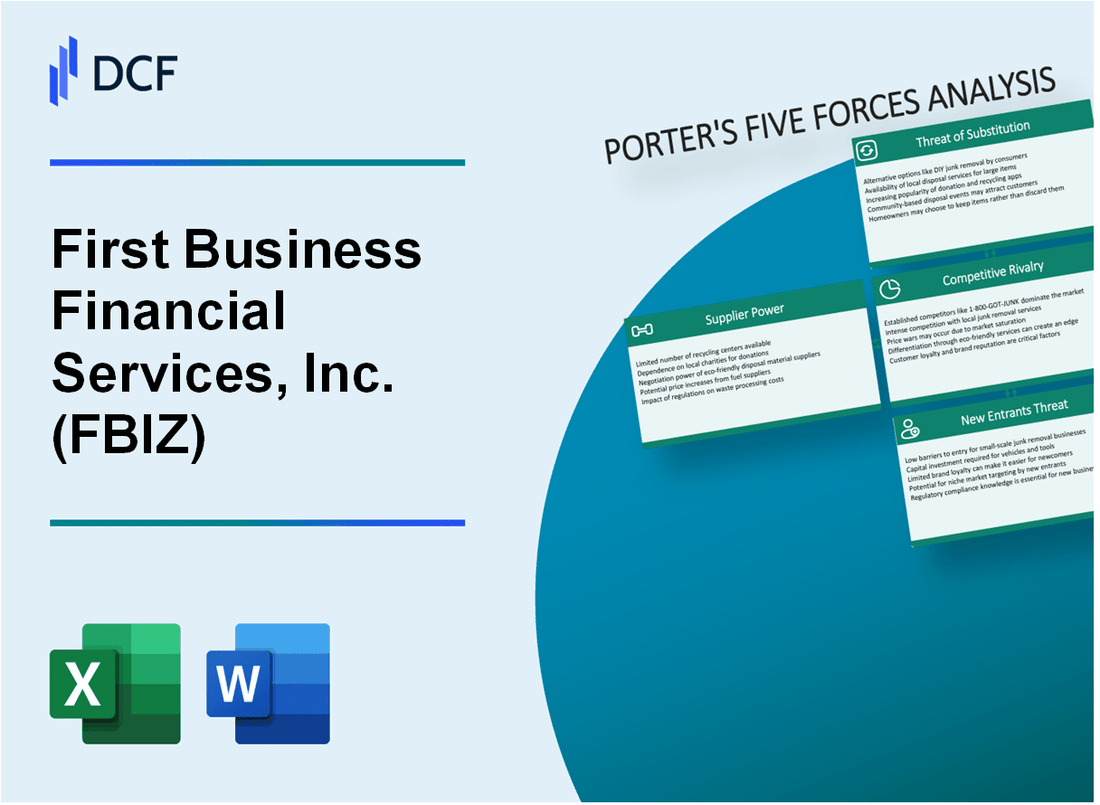
First Business Financial Services, Inc. (FBIZ): 5 Analyse des forces [Jan-2025 Mis à jour] |
Entièrement Modifiable: Adapté À Vos Besoins Dans Excel Ou Sheets
Conception Professionnelle: Modèles Fiables Et Conformes Aux Normes Du Secteur
Pré-Construits Pour Une Utilisation Rapide Et Efficace
Compatible MAC/PC, entièrement débloqué
Aucune Expertise N'Est Requise; Facile À Suivre
First Business Financial Services, Inc. (FBIZ) Bundle
Dans le paysage dynamique de la banque commerciale régionale, First Business Financial Services, Inc. (FBIZ) navigue dans un écosystème complexe de forces concurrentielles qui façonnent son positionnement stratégique. De la danse complexe des dépendances des fournisseurs aux attentes en évolution des clients avertis du numérique, le FBIZ doit habilement manœuvrer grâce à des perturbations technologiques, à des défis réglementaires et à des rivalités de marché intenses dans le Midwest Financial Services Arena. Cette analyse en profondeur du cadre des cinq forces de Michael Porter révèle les pressions stratégiques et les opportunités critiques qui définissent le paysage concurrentiel de FBIZ en 2024, offrant un aperçu de la façon dont l'institution peut maintenir sa pertinence sur le marché et stimuler la croissance stratégique.
First Business Financial Services, Inc. (FBIZ) - Porter's Five Forces: Bargaining Power of Fournissers
Nombre limité de fournisseurs de technologies financières spécialisées
En 2024, le marché des technologies financières pour les infrastructures bancaires montre:
| Catégorie de prestataires | Part de marché | Revenus annuels |
|---|---|---|
| Vendeurs de logiciels bancaires de base | 5 fournisseurs majeurs | Marché total de 2,4 milliards de dollars |
| Provideurs de plate-forme bancaire numérique | 3 vendeurs dominants | Marché total de 1,8 milliard de dollars |
Commutation des coûts pour les infrastructures bancaires
Frais de migration technologique pour les systèmes bancaires FBIZ:
- Coût moyen de transition des infrastructures: 1,2 million de dollars
- Time de mise en œuvre: 12-18 mois
- Perte de productivité potentielle pendant la migration: 15-20%
Dépendances des fournisseurs technologiques
Mesures clés de la concentration des fournisseurs de la technologie:
| Type de vendeur | Nombre de vendeurs primaires | Dépenses technologiques annuelles |
|---|---|---|
| Fournisseurs de services cloud | 2 fournisseurs principaux | 3,6 millions de dollars |
| Fournisseurs de logiciels d'entreprise | 3 vendeurs principaux | 2,9 millions de dollars |
Analyse des risques de concentration
Indicateurs de risque de concentration des fournisseurs:
- Les 2 meilleurs fournisseurs de cloud contrôlent 78% du marché des entreprises
- Risque d'augmentation des prix potentiel: 12-15% par an
- Probabilité de verrouillage des fournisseurs: 65%
First Business Financial Services, Inc. (FBIZ) - Porter's Five Forces: Bargaining Power of Clients
Composition de la clientèle
First Business Financial Services, Inc. dessert 3 742 clients bancaires commerciaux dans 6 États du Midwestern au T4 2023. Les petites et moyennes entreprises représentent 68% du portefeuille total des clients.
| Segment de clientèle | Nombre de clients | Pourcentage |
|---|---|---|
| Petites entreprises | 1,874 | 50.1% |
| Entreprises de taille moyenne | 1,868 | 49.9% |
Dynamique de commutation client
Le coût moyen de commutation client dans les services bancaires commerciaux est estimé à 4 750 $ par compte commercial. Environ 22% des clients envisagent de changer chaque année les institutions financières.
Attentes bancaires numériques
- 87% des clients d'entreprise exigent des capacités de banque mobile
- 72% nécessitent une surveillance des transactions en temps réel
- 64% attendent des solutions de paiement numérique intégrées
Taux d'intérêt compétitifs
FBIZ Les taux d'intérêt actuels des prêts commerciaux varient de 6,25% à 8,75%, avec une moyenne de 7,4% en janvier 2024. Les structures de frais comprennent:
| Service | Structure des frais |
|---|---|
| Compte de chèques commerciaux | 15 $ Frais de maintenance mensuels |
| Virement bancaire | 25 $ par transfert intérieur |
| Banque en ligne | GRATUIT pour les comptes d'entreprise |
Stratégies de rétention de la clientèle
FBIZ rapporte un taux de rétention de la clientèle de 91,3% en 2023, avec une durée moyenne de la relation client de 5,6 ans.
First Business Financial Services, Inc. (FBIZ) - Porter's Five Forces: Rivalry compétitif
Concurrence intense sur le marché régional des banques commerciales
First Business Financial Services, Inc. a déclaré 1,4 milliard de dollars d'actifs totaux au quatrième trimestre 2023. La société opère dans un paysage bancaire régional concurrentiel avec 12 concurrents directs dans le Wisconsin et les États du Midwest environnants.
| Type de concurrent | Nombre de concurrents | Gamme de parts de marché |
|---|---|---|
| Banques nationales | 4 | 35-45% |
| Banques régionales | 5 | 20-30% |
| Banques communautaires | 3 | 10-15% |
Rivaliser avec les grandes banques nationales et les institutions financières de la communauté locale
FBIZ fait face à la concurrence des grandes banques avec des bases d'actifs beaucoup plus importantes:
- Banque américaine: 595 milliards de dollars d'actifs
- Wells Fargo: 1,9 billion de dollars d'actifs
- BMO Banque: 614 milliards de dollars d'actifs
Différenciation par le biais de services bancaires commerciaux personnalisés
La stratégie concurrentielle de FBIZ se concentre sur les services spécialisés avec les mesures suivantes:
| Catégorie de service | Volume de transaction annuel | Taux de rétention de la clientèle moyen |
|---|---|---|
| Prêts commerciaux | 287 millions de dollars | 92% |
| Dépôts commerciaux | 412 millions de dollars | 88% |
| Gestion des espèces | 156 millions de dollars | 85% |
Présence géographique ciblée dans le Wisconsin et les États du Midwest environnants
FBIZ opère dans 5 États avec la distribution des succursales suivante:
- Wisconsin: 27 succursales
- Illinois: 8 succursales
- Minnesota: 5 succursales
- Iowa: 3 branches
- Michigan: 2 succursales
First Business Financial Services, Inc. (FBIZ) - Five Forces de Porter: Menace des substituts
Croissance des plates-formes de prêt alternatives en croissance
En 2024, des plateformes de prêt alternatives ont capturé 12,6% du marché des prêts aux petites entreprises. Les plateformes de prêt en ligne ont traité 18,3 milliards de dollars de prêts commerciaux l'année précédente. LendingClub a déclaré 1,2 milliard de dollars de créations de prêts totales au cours du quatrième trimestre 2023.
| Plate-forme | Prêts totaux 2023 | Part de marché |
|---|---|---|
| Enceinte | 1,5 milliard de dollars | 4.2% |
| Kabbage | 920 millions de dollars | 2.7% |
| Cercle de financement | 780 millions de dollars | 2.3% |
Augmentation des solutions de paiement numérique et de gestion financière
Les plates-formes de paiement numériques ont traité 8,9 billions de dollars de transactions à l'échelle mondiale en 2023. PayPal a déclaré 1,36 billion de dollars de volume de paiement total pour l'année.
- Square traité 197,3 milliards de dollars en volume de paiement brut
- Stripe a géré 817 milliards de dollars de transactions annuelles
- Venmo a traité 245 milliards de dollars de volume de paiement total
Émergence de services bancaires en ligne uniquement
Les banques numériques uniquement ont capturé 7,3% du marché bancaire en 2023. CHIME a déclaré 14,5 millions d'utilisateurs actifs avec 1,1 milliard de dollars de revenus annuels.
| Banque en ligne | Utilisateurs actifs | Revenus annuels |
|---|---|---|
| Carillon | 14,5 millions | 1,1 milliard de dollars |
| Se révolter | 7,2 millions | 682 millions de dollars |
| Sovi | 6,1 millions | 1,6 milliard de dollars |
Crypto-monnaie et alternatives de transaction financière basées sur la blockchain
La capitalisation boursière de la crypto-monnaie a atteint 1,7 billion de dollars en 2023. Bitcoin a maintenu une part de marché de 42% avec une valeur totale de 715 milliards de dollars.
- Capth boursière Ethereum: 278 milliards de dollars
- Binance Coin Bourse Capt: 37,2 milliards de dollars
- Volume de transaction de crypto-monnaie: 32,4 billions de dollars par an
First Business Financial Services, Inc. (FBIZ) - Five Forces de Porter: Menace de nouveaux entrants
Obstacles réglementaires élevés dans le secteur bancaire commercial
En 2024, la Réserve fédérale nécessite un ratio de capital minimum de 8% pour les banques. First Business Financial Services, Inc. est confrontée à des défis de conformité réglementaire importants qui créent des obstacles à l'entrée importants.
| Exigence réglementaire | Coût de conformité |
|---|---|
| Conformité de la Bank Secrecy Act (BSA) | 750 000 $ - 2,3 millions de dollars par an |
| Systèmes anti-blanchiment d'argent (AML) | 500 000 $ - 1,5 million de dollars mise en œuvre |
| Coûts annuels d'examen réglementaire | $350,000 - $750,000 |
Exigences de capital significatives
La FDIC oblige les exigences en capital minimum pour les nouvelles institutions bancaires:
- Capital initial minimum: 10 millions de dollars pour les banques de novo
- Besoin de capital de niveau 1: 8% des actifs pondérés en fonction du risque
- Exigence totale en capital: 10,5% des actifs pondérés en fonction du risque
Processus complexes de conformité et de licence
| Étape de l'octroi de licences | Temps de traitement moyen | Coût estimé |
|---|---|---|
| Préparation initiale de l'application | 6-9 mois | $250,000 - $500,000 |
| Revue réglementaire | 12-18 mois | $350,000 - $700,000 |
| Processus d'approbation finale | 3-6 mois | $150,000 - $300,000 |
Infrastructure technologique et cybersécurité
Investissements en cybersécurité pour les nouveaux participants bancaires en 2024:
- Infrastructure initiale de cybersécurité: 2,1 millions de dollars - 5,3 millions de dollars
- Entretien annuel de la cybersécurité: 750 000 $ - 1,5 million de dollars
- Conformité au cadre de la cybersécurité NIST: investissement requis de 1,2 million de dollars - 3,5 millions de dollars
Ces obstacles financiers et réglementaires substantiels limitent considérablement les nouveaux entrants dans le secteur bancaire commercial pour First Business Financial Services, Inc.
First Business Financial Services, Inc. (FBIZ) - Porter's Five Forces: Competitive rivalry
Rivalry intensity stems from competition against national banks possessing asset bases orders of magnitude larger than First Business Financial Services, Inc. For context, the largest U.S. bank reported total assets of $3,643,099,000,000 as of March 31, 2025. First Business Financial Services, Inc. reported total assets of $4.0B as of Q2 2025. The total number of banks listed by the FDIC as of March 31, 2025, was 4,462.
First Business Financial Services, Inc. contends with 12 direct rivals within its regional market footprint. Competition in this environment pivots heavily on relationship quality and service innovation, rather than solely on scale or price, given the presence of larger entities.
First Business Financial Services, Inc. reported strong Q3 2025 revenue of $44.29 million. This performance occurs while the company maintains a valuation multiple that suggests a discount to competitors, reflecting the market's perception of the competitive environment and future growth expectations.
| Metric | First Business Financial Services, Inc. (Q3 2025) | Peer Group Median (as of 3-31-2025) |
| Revenue | $44.29 million | Not Directly Comparable |
| P/E Ratio (LTM) | 8.57x | 11.40x |
| Net Interest Margin | 3.68% | Not Directly Comparable |
| Private Wealth AUM | $3.814 billion | Not Directly Comparable |
The structure of the business, characterized by specialized assets and a regional focus, contributes to high exit barriers. This specialization ties capital and expertise to the current operational model, making a rapid pivot or sale more complex than for a more diversified or national player.
Key financial indicators from the Q3 2025 period underscore operational strength despite the competitive pressures:
- Net Income Available to Common Shareholders: $14.2 million
- Earnings Per Share (EPS): $1.70
- Year-to-Date Return on Assets (ROA): 1.23%
- Return on Average Tangible Common Equity: Over 15%
- Loan Growth (Annualized, Q3 vs Q2 2025): 10.4%
First Business Financial Services, Inc. (FBIZ) - Porter's Five Forces: Threat of substitutes
You're looking at how external players can steal business from First Business Financial Services, Inc. (FBIZ), and honestly, the competition from non-bank sources is getting sharper, especially as your own Private Wealth segment hits new highs. The threat of substitutes is real across your core lending, deposit gathering, and fee-income lines.
Non-bank lenders offer asset-based and specialty commercial loans
The private credit market, which is essentially non-bank lending, continues to aggressively take share in the commercial lending space where First Business Financial Services, Inc. (FBIZ) focuses on small and medium-sized businesses. This alternative capital source offers flexibility that traditional banks sometimes can't match, particularly with covenant structures. For context, the Federal Reserve estimated that private credit in the U.S. reached $1.7 trillion by early 2024, already surpassing leveraged loans at $1.4 trillion.
This trend is projected to continue its encroachment into the middle market. PitchBook data suggests private credit's market share in middle market lending is projected to hit 40% by 2025. Furthermore, looking at the overall U.S. commercial lending forecast for 2025, non-bank lending is expected to command a market share of 25% of the forecasted $1.2 trillion in activity. This means for every dollar First Business Financial Services, Inc. (FBIZ) lends, a quarter of that market segment is being served by these specialized, non-bank entities, which often use covenant-lite loan structures.
Private wealth management is substituted by independent advisors
First Business Financial Services, Inc. (FBIZ) is seeing success in its Private Wealth segment, which reported assets under management and administration growing to $3.814 billion in Q3 2025, generating $3.7 million in quarterly fee income. This growth is strong, with AUM up 15% year-over-year as of late 2025. However, the broader trend shows a significant shift of advisory talent and assets away from traditional bank-affiliated models toward independent Registered Investment Advisors (RIAs).
The independent advisor channel is a direct substitute for the service model First Business Financial Services, Inc. (FBIZ) offers to high-net-worth individuals. Here's how the growth metrics compare:
| Metric | First Business Financial Services, Inc. (FBIZ) Private Wealth (Q3 2025) | RIA Sector (General Trend) |
|---|---|---|
| AUM/Assets Managed | $3.814 billion (AUM as of Q3 2025) | Total industry AUM reached $144.6 trillion in 2024 |
| AUM Growth (YoY) | 15% growth in AUM | RIAs on track to control nearly one-third of advised assets by 2027 |
| Advisor Count Trend (Historical) | Not specified | RIA sector saw a 66% increase in Financial Advisor (FA) count between 2012-2022 |
The industry sees advisors prioritizing autonomy, which fuels the independent channel. While First Business Financial Services, Inc. (FBIZ) management is confident in its 10% annual fee income growth target, the underlying industry shift means a constant battle to retain both advisors and the clients they manage.
FinTechs provide specialized payment and treasury solutions
For the business banking side of First Business Financial Services, Inc. (FBIZ), specialized FinTechs are substituting traditional treasury and payment processing functions with speed and digital integration. The market is moving toward immediacy, which pressures incumbent providers. For instance, the total value of instant payments transactions in the U.S. is projected to hit $60 trillion in 2025.
FinTechs are driving this by focusing on specific pain points that First Business Financial Services, Inc. (FBIZ) addresses through its commercial banking services. Key areas of substitution include:
- Automated Accounts Receivable & Payable streamlining.
- Enhanced working capital and supply chain finance platforms.
- AI/ML integration for cash forecasting and reconciliation.
- Real-time reporting and dashboarding as a top treasurer priority.
The focus for corporate treasurers is cost optimization and efficiency, often found in digital-first infrastructures offered by these specialized competitors. This forces First Business Financial Services, Inc. (FBIZ) to continually invest in its own technology to keep pace with the expected speed of transactions.
High-yield savings accounts substitute core bank deposits
The threat to First Business Financial Services, Inc. (FBIZ)'s core deposit funding, which grew 8.8% year-over-year in Q3 2025, comes directly from high-yield savings accounts (HYSAs) offered by online-only institutions. These substitutes offer rates that dwarf what many traditional banks pay on standard savings products. For example, the national average APY for savings accounts is only 0.40% APY.
You can see the stark difference in the rates available in late 2025:
- Top HYSA rates in December 2025 reach 5.00% APY.
- Competitive online HYSAs in November 2025 are offering rates around 4.20% APY.
- Some large traditional banks are offering as low as 0.01% APY on savings.
This means that any corporate or individual client looking to hold operating cash or excess liquidity has a very attractive, liquid alternative to First Business Financial Services, Inc. (FBIZ)'s core deposits, putting pressure on your ability to maintain or grow your funding base without increasing the rate paid on deposits, which impacts your Net Interest Margin (NIM) of 3.68% in Q3 2025. Finance: draft 13-week cash view by Friday.
First Business Financial Services, Inc. (FBIZ) - Porter's Five Forces: Threat of new entrants
The threat of new entrants for First Business Financial Services, Inc. (FBIZ) is moderated by significant structural barriers, though the rise of specialized technology firms presents a targeted challenge. You need to understand that while FBIZ is not one of the largest institutions-reporting total assets of $4.0B as of Q2 2025-it still operates within a heavily regulated environment that deters casual entry.
Significant regulatory and compliance burdens act as a barrier.
The sheer cost of operating compliantly in the US financial sector is substantial. North American firms alone shoulder an estimated $61 billion annually just for financial crime compliance. For financial firms generally, direct and indirect compliance costs average 19% of annual revenue. While FBIZ is below the $100 billion asset threshold that subjects institutions to the most stringent stress testing rules, the overall regulatory velocity and complexity remain high. Regulators continue to focus intensely on credit stress testing processes, liquidity, and capital planning, which requires continuous investment in personnel and systems.
High initial capital is required to build a trusted regional brand.
Establishing a new regional financial brand requires more than just meeting minimum capital ratios; it demands the capital to sustain operations through years of regulatory scrutiny and brand building. While specific charter costs are proprietary or highly variable, the industry's capital structure sets a high baseline. For instance, the minimum Common Equity Tier 1 (CET1) capital ratio requirement for large banks is 4.5%, plus a Stress Capital Buffer (SCB) of at least 2.5%. A new entrant must secure capital far exceeding these minimums to gain market trust and withstand initial operational costs before achieving the scale necessary for efficient compliance cost absorption.
FBIZ's relationship-based model is defintely hard to replicate quickly.
First Business Financial Services, Inc. (FBIZ) explicitly executes a relationship-based growth strategy that supports its consistent performance. This model has helped drive double-digit annual growth in loans, deposits, and revenue, with Q2 2025 showing 13.3% year-over-year growth in pre-tax, pre-provision earnings. Adding new commercial relationships is evidenced by an 11% year-over-year growth in treasury management fees as of Q4 2024. Replicating this requires deep, experienced talent and time to cultivate the trust necessary for clients to move significant commercial or private wealth business; it is not a purely transactional model that a new entrant can easily scale via technology alone.
FinTech companies can enter specific product niches without a full charter.
FinTechs pose a threat by targeting specific, less-regulated product niches. The Global Fintech Lending market is projected to reach $828.731 Million by the end of 2025, indicating significant capital flowing into non-traditional lending. Furthermore, niche areas like Decentralized Finance (DeFi) protocols have seen growth rates as high as 300% year-over-year. However, for many complex areas, like uncollateralized lending, FinTechs often remain confined to niche or controlled environments because they lack the comprehensive data collection and contract enforcement mechanisms inherent in a chartered institution.
Here is a quick look at the scale of the barriers and the competitive landscape:
| Metric | Value/Amount | Context |
|---|---|---|
| North American Annual Compliance Spend | $61 billion | Annual investment in financial crime compliance |
| Average Compliance Cost (Financial Firms) | 19% of annual revenue | Direct and indirect cost of maintaining compliance |
| FBIZ Total Assets (Q2 2025) | $4.0B | Size context relative to regulatory thresholds |
| Minimum Large Bank CET1 Ratio | 4.5% plus 2.5% SCB | Baseline capital requirement for larger institutions |
| Projected Global Fintech Lending Market (2025) | $828.731 Million | Indicates capital flowing into non-chartered lending niches |
| FBIZ Annual Loan/Deposit Growth Target | 10%+ | Indicator of success in relationship-based growth |
The competitive pressure from new entrants is shaped by these key factors:
- Regulatory compliance costs average 19% of revenue for financial firms.
- North American compliance spending totals $61 billion annually.
- FinTech lending market projected to hit $828.731 Million in 2025.
- FBIZ's relationship-driven growth shows 10%+ annual loan growth.
- Niche DeFi lending has shown 300% year-over-year growth.
Finance: draft a sensitivity analysis on the impact of a 50 basis point increase in compliance-related IT spend on FBIZ's projected 2026 efficiency ratio by next Tuesday.
Disclaimer
All information, articles, and product details provided on this website are for general informational and educational purposes only. We do not claim any ownership over, nor do we intend to infringe upon, any trademarks, copyrights, logos, brand names, or other intellectual property mentioned or depicted on this site. Such intellectual property remains the property of its respective owners, and any references here are made solely for identification or informational purposes, without implying any affiliation, endorsement, or partnership.
We make no representations or warranties, express or implied, regarding the accuracy, completeness, or suitability of any content or products presented. Nothing on this website should be construed as legal, tax, investment, financial, medical, or other professional advice. In addition, no part of this site—including articles or product references—constitutes a solicitation, recommendation, endorsement, advertisement, or offer to buy or sell any securities, franchises, or other financial instruments, particularly in jurisdictions where such activity would be unlawful.
All content is of a general nature and may not address the specific circumstances of any individual or entity. It is not a substitute for professional advice or services. Any actions you take based on the information provided here are strictly at your own risk. You accept full responsibility for any decisions or outcomes arising from your use of this website and agree to release us from any liability in connection with your use of, or reliance upon, the content or products found herein.