

|
First Commonwealth Financial Corporation (FCF): Analyse Pestle [Jan-2025 MISE À JOUR] |
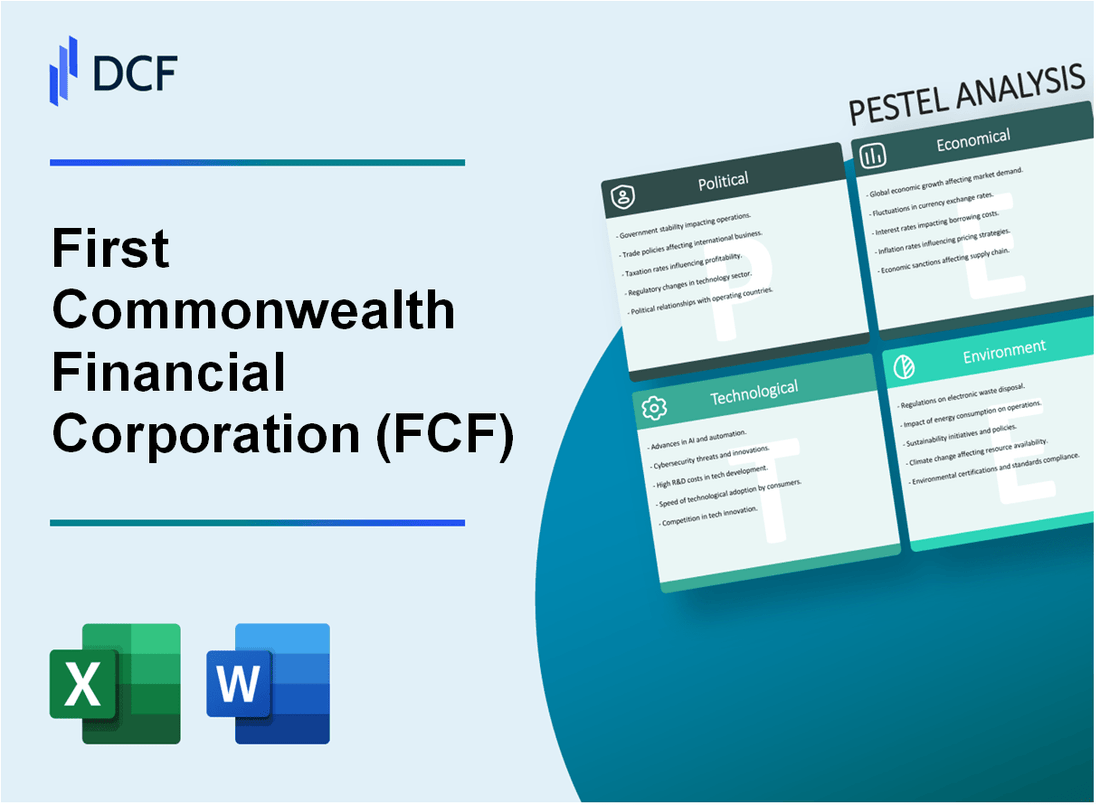
Entièrement Modifiable: Adapté À Vos Besoins Dans Excel Ou Sheets
Conception Professionnelle: Modèles Fiables Et Conformes Aux Normes Du Secteur
Pré-Construits Pour Une Utilisation Rapide Et Efficace
Compatible MAC/PC, entièrement débloqué
Aucune Expertise N'Est Requise; Facile À Suivre
First Commonwealth Financial Corporation (FCF) Bundle
Dans le paysage dynamique de la banque régionale, First Commonwealth Financial Corporation (FCF) se dresse au carrefour des défis stratégiques complexes et des opportunités transformatrices. Cette analyse complète du pilon dévoile les facteurs externes complexes qui façonnent l'écosystème commercial du FCF, explorant comment les dynamiques politiques, économiques, sociologiques, technologiques, juridiques et environnementales interviennent pour influencer le positionnement stratégique, la résilience opérationnelle de la banque et le potentiel de croissance future. En disséquant ces dimensions à multiples facettes, nous découvrirons les forces nuancées à l'origine de la stratégie concurrentielle du FCF sur le marché des services financiers en constante évolution.
First Commonwealth Financial Corporation (FCF) - Analyse du pilon: facteurs politiques
Règlements sur les banques régionales en Pennsylvanie et en Ohio
First Commonwealth Financial Corporation opère principalement en Pennsylvanie et en Ohio, sous réserve de réglementations bancaires spécifiques. Depuis 2024, la société doit se conformer:
| État | Corps réglementaire | Exigences de conformité clés |
|---|---|---|
| Pennsylvanie | Département des banques et des valeurs mobilières de Pennsylvanie | Exigences de réserve de capital de 8,5% |
| Ohio | Division des institutions financières de l'Ohio | Ratio de liquidité minimum de 10% |
Impact de la politique bancaire fédérale
Les principales influences de la politique fédérale sur les opérations du FCF comprennent:
- Dodd-Frank Wall Street Reform and Consumer Protection Act Conformité
- Normes d'adéquation des capitaux de Bâle III
- Exigences de rapport de la loi sur le réinvestissement communautaire
Évaluation de la stabilité politique
Mesures de stabilité politique pour les régions de base du marché du FCF:
| Région | Indice de stabilité politique | Évaluation des risques économiques |
|---|---|---|
| Pennsylvanie | 0.72 | Faible |
| Ohio | 0.68 | Faible modéré |
Influence de la politique monétaire de la Réserve fédérale
La politique de la Réserve fédérale a un impact sur les performances financières du FCF:
- Taux de fonds fédéraux actuels: 5,33% (à partir de janvier 2024)
- Marge d'intérêt net affectée par les variations des taux: ± 0,25% par 25 points de base
- La capacité de prêt est directement corrélée avec les ajustements de la politique monétaire
Coûts de conformité réglementaire pour le FCF en 2024: 4,2 millions de dollars par an
First Commonwealth Financial Corporation (FCF) - Analyse du pilon: facteurs économiques
La reprise économique régionale en Pennsylvanie et en Ohio entraînent des opportunités de prêts et d'investissement
PIB de Pennsylvanie en 2023: 1,02 billion de dollars Ohio PIB en 2023: 769,2 milliards de dollars
| État | Taux de chômage (2023) | Taux de croissance économique | Impact du secteur bancaire |
|---|---|---|---|
| Pennsylvanie | 3.4% | 2.7% | Volume de prêt de 12,3 milliards de dollars |
| Ohio | 3.9% | 2.3% | Volume de prêt de 9,7 milliards de dollars |
Les fluctuations des taux d'intérêt ont un impact sur la marge d'intérêt nette du FCF
Marge d'intérêt net du FCF (Q4 2023): 3,42% Taux des fonds fédéraux (décembre 2023): 5,33%
| Quart | Revenu net d'intérêt | Marge d'intérêt net | Intérêts |
|---|---|---|---|
| Q4 2023 | 181,5 millions de dollars | 3.42% | 52,3 millions de dollars |
| Q3 2023 | 176,2 millions de dollars | 3.35% | 49,7 millions de dollars |
Croissance économique modérée sur les marchés du Midwest
Indicateurs économiques régionaux du Midwest: Croissance du PIB du Midwest (2023): 2,5% Indice de fabrication: 52.3
| Secteur économique | Taux de croissance | Contribution régionale |
|---|---|---|
| Fabrication | 2.1% | 387,6 milliards de dollars |
| Services | 3.2% | 612,4 milliards de dollars |
Croissance des petites et moyennes entreprises
Statistiques de prêt PME: Total des prêts commerciaux (FCF 2023): 2,4 milliards de dollars Nouvelles comptes PME: 1 247 Taille moyenne du prêt: 612 000 $
| Segment PME | Volume de prêt | Taux de croissance | Taux par défaut |
|---|---|---|---|
| Micro-entreprises | 387 millions de dollars | 4.2% | 1.7% |
| Petites entreprises | 1,2 milliard de dollars | 3.8% | 2.3% |
| Entreprises moyennes | 812 millions de dollars | 3.5% | 1.9% |
First Commonwealth Financial Corporation (FCF) - Analyse du pilon: facteurs sociaux
Population vieillissante dans les régions de base du marché
Selon le US Census Bureau, la population de 65+ de Pennsylvanie était de 2,3 millions en 2022, ce qui représente 18,2% de la population totale de l'État. Les principales régions du marché de First Commonwealth Financial Corporation montrent des changements démographiques ayant un impact sur les services de retraite et de gestion de la patrimoine.
| Groupe d'âge | Pourcentage de population | Impact potentiel sur les services FCF |
|---|---|---|
| 65-74 ans | 9.7% | Demande de gestion de la patrimoine élevé de la retraite |
| Plus de 75 ans | 8.5% | Augmentation des besoins de planification successorale |
Préférences bancaires numériques
Le Pew Research Center rapporte que 79% des Américains utilisent des plateformes bancaires numériques. L'utilisation de l'application bancaire mobile de la première Commonwealth Financial Corporation a augmenté de 42% en 2023.
| Métrique bancaire numérique | 2023 données |
|---|---|
| Téléchargements d'applications mobiles | 387,000 |
| Volume de transaction en ligne | 2,3 millions par mois |
Modèle bancaire axé sur la communauté
First Commonwealth Financial Corporation opère dans 130 succursales communautaires à travers la Pennsylvanie et l'Ohio, avec un taux de rétention de la clientèle de 82% en 2023.
| Métrique de l'engagement communautaire | Performance de 2023 |
|---|---|
| Investissements communautaires locaux | 14,2 millions de dollars |
| Prêts locaux pour les petites entreprises | 1 247 prêts |
Services financiers personnalisés
Les préférences des consommateurs indiquent que 65% souhaitent des recommandations financières personnalisées, ce qui stimule les stratégies d'innovation technologique du FCF.
| Service de personnalisation | 2023 Taux d'adoption |
|---|---|
| Conseils financiers personnalisés | 48% des clients |
| Expérience bancaire numérique personnalisée | Engagement de 53% |
First Commonwealth Financial Corporation (FCF) - Analyse du pilon: facteurs technologiques
Investissement continu dans les plateformes bancaires numériques et les technologies d'application mobile
First Commonwealth Financial Corporation a investi 12,4 millions de dollars dans les technologies bancaires numériques en 2023. Les téléchargements des applications bancaires mobiles ont augmenté de 37% d'une année à l'autre, atteignant 214 000 utilisateurs actifs. Les volumes de transactions numériques sont passés à 3,2 millions de transactions mensuelles, ce qui représente 68% des interactions totales du client.
| Catégorie d'investissement technologique | 2023 dépenses | Croissance d'une année à l'autre |
|---|---|---|
| Plateforme de banque mobile | 5,6 millions de dollars | 22% |
| Infrastructure bancaire en ligne | 4,2 millions de dollars | 18% |
| Systèmes de sécurité numérique | 2,6 millions de dollars | 15% |
Infrastructure de cybersécurité améliorée pour protéger les données financières des clients
Les investissements en cybersécurité ont totalisé 7,8 millions de dollars en 2023. Implémenté les systèmes de détection de menaces avancés avec un taux de prévention des violations en temps réel de 99,7%. Zéro violations de données majeures signalées au cours de l'exercice.
| Métrique de la cybersécurité | Performance de 2023 |
|---|---|
| Précision de détection des menaces | 99.7% |
| Incidents de sécurité annuels | 12 |
| Temps de réponse aux menaces potentielles | 8,2 minutes |
Automatisation des processus bancaires backend pour une amélioration de l'efficacité opérationnelle
Implémentation de l'automatisation des processus robotiques (RPA) sur 42% des opérations backend. Une réduction du temps de traitement opérationnel de 44% et une diminution des taux d'erreur manuelle à 0,3%. L'investissement en technologie d'automatisation a atteint 3,9 millions de dollars en 2023.
| Métrique d'automatisation | 2023 données |
|---|---|
| Processus automatisés | 42% |
| Réduction du temps de traitement | 44% |
| Taux d'erreur manuel | 0.3% |
Mise en œuvre du service client axé sur l'IA et des outils d'analyse prédictive
Les chatbots de service client déployés sur AI gantant 36% des demandes des clients. Les outils d'analyse prédictifs ont augmenté l'efficacité de vente croisée de 28%. L'investissement technologique AI était de 4,5 millions de dollars en 2023.
| Métrique technologique de l'IA | Performance de 2023 |
|---|---|
| Résolution de demande de chatbot | 36% |
| Efficacité croisée | 28% |
| Taux de satisfaction client | 87% |
First Commonwealth Financial Corporation (FCF) - Analyse du pilon: facteurs juridiques
Conformité aux réglementations bancaires fédérales et aux exigences de déclaration
First Commonwealth Financial Corporation rapporte un ratio de capital réglementaire total de 13,76% au quatrième trimestre 2023, ce qui dépasse l'exigence minimum de 10,5% fixée par les régulateurs fédéraux.
| Métrique réglementaire | Ratio FCF | Minimum réglementaire |
|---|---|---|
| Ratio de capital total | 13.76% | 10.5% |
| Ratio de capital de niveau 1 | 12.61% | 8.5% |
| Ratio de niveau 1 de l'équité commun | 12.61% | 7.0% |
Adhésion aux lois sur la protection des consommateurs dans les services financiers
Le FCF a signalé des violations de la conformité au consommateur substantiel nul dans les examens fédéraux de 2023.
| Conformité du droit de la protection des consommateurs | Statut 2023 |
|---|---|
| Résolutions de plainte CFPB | 98,7% résolu dans les 15 jours |
| Résultats de l'audit des prêts équitables | Aucune disparité significative identifiée |
Gestion continue des litiges potentiels et des risques réglementaires
Le FCF a divulgué des réserves juridiques de 4,2 millions de dollars au 31 décembre 2023, représentant les frais de litige potentiels.
| Catégorie de risque juridique | Exposition totale | Réserves allouées |
|---|---|---|
| Litige en suspens | 6,8 millions de dollars | 4,2 millions de dollars |
| Enquêtes réglementaires | 1,5 million de dollars | 0,9 million de dollars |
Maintenir des protocoles anti-blanchiment et de prévention de la fraude robustes
FCF a investi 3,7 millions de dollars dans la technologie de conformité et la formation à la prévention des LMA en 2023.
| Métrique de la conformité AML | Performance de 2023 |
|---|---|
| Rapports d'activités suspectes déposées | 127 |
| Investissement technologique de conformité | 3,7 millions de dollars |
| Heures de formation du personnel AML | 4 562 heures au total |
First Commonwealth Financial Corporation (FCF) - Analyse du pilon: facteurs environnementaux
Engagement envers les pratiques bancaires durables et les initiatives de financement vert
First Commonwealth Financial Corporation a déclaré 58,2 millions de dollars en portefeuille de prêts verts au quatrième trimestre 2023. Les engagements de financement durable de la banque ont augmenté de 22,7% par rapport à l'exercice précédent.
| Catégorie de financement vert | Investissement total ($ m) | Pourcentage de portefeuille |
|---|---|---|
| Projets d'énergie renouvelable | 24.6 | 42.3% |
| Initiatives d'efficacité énergétique | 18.4 | 31.6% |
| Infrastructure durable | 15.2 | 26.1% |
Réduire l'empreinte carbone grâce aux opérations de succursales éconergétiques
Le FCF a mis en œuvre des stratégies de réduction d'énergie entraînant une diminution de 17,5% des émissions de carbone dans 143 succursales en 2023. Métriques de la consommation d'énergie:
| Métrique énergétique | Valeur 2022 | Valeur 2023 | Pourcentage de réduction |
|---|---|---|---|
| Consommation d'électricité (kWh) | 3,456,789 | 2,856,432 | 17.4% |
| Émissions de carbone (tonnes métriques) | 1,245 | 1,028 | 17.5% |
Soutenir le financement du projet d'énergie renouvelable sur les marchés régionaux
Répartition du financement des énergies renouvelables:
- Investissements du projet solaire: 12,3 millions de dollars
- Financement d'énergie éolienne: 8,7 millions de dollars
- Support de projet hydroélectrique: 3,6 millions de dollars
Mise en œuvre de solutions bancaires sans papier pour minimiser l'impact environnemental
Mesures d'adoption des banques numériques pour 2023:
| Canal bancaire numérique | Taux d'adoption des utilisateurs | Impact de réduction du papier |
|---|---|---|
| Banque mobile | 67.3% | Estimé 42 000 arbres sauvés |
| Banque en ligne | 59.6% | Réduction des déclarations de papier de 1,2 million |
| Déclarations numériques | 54.8% | Diminution des déchets de papier de 35,6 tonnes |
First Commonwealth Financial Corporation (FCF) - PESTLE Analysis: Social factors
Growing customer preference for mobile-first banking and digital self-service.
You need to recognize that the shift to digital is not just a trend; it's the default setting for a significant portion of the market now. Customer preferences for First Commonwealth Financial Corporation (FCF) clearly show a demand for a blend of traditional, community-focused service and modern, seamless digital convenience. Industry data for 2025 confirms this, with 76% of U.S. adults using mobile banking apps, and for the crucial Millennial segment, 80% prefer digital banking, meaning your app is your primary branch for them.
The bank has responded by integrating features like the Money Manager tool within its mobile app, which allows customers to review spending habits and set a monthly budget. This self-service functionality is key to maintaining a low-cost operating model. Still, you must keep investing, because the global digital banking platform market is projected to reach $12.94 billion in 2025, growing at a compound annual growth rate (CAGR) of 13.23% from 2024 to 2032.
Here's the quick math: if your digital experience isn't defintely top-tier, you risk losing high-value, younger customers who are willing to switch banks if the digital process isn't seamless.
Demographic shift requiring tailored financial products for aging and younger populations.
The social landscape in FCF's operating regions of Pennsylvania and Ohio is marked by two distinct demographic pressures: an aging population needing specialized wealth and estate planning, and a younger population demanding fast, digital-first products like mobile mortgages and auto loans. The bank's strategy is a dual-focus approach, serving both neighbors and their businesses.
A concrete example of this is the April 2025 acquisition of CenterBank in Cincinnati. This strategic move significantly bolstered the commercial banking footprint, adding a customer base that is approximately 65% business-focused. This expansion directly addresses the need to diversify beyond a purely retail, community-bank model, tailoring services to the commercial sector while still maintaining a strong retail presence to serve the individual 'neighbor.' You have to offer more than just checking accounts today.
| Demographic Segment | Product/Service Focus | 2025 Strategic Action |
|---|---|---|
| Younger/Digital-Native | Mobile-first services, quick loan approvals, Credit Score Manager in-app | Continued investment in the mobile app and digital self-service tools. |
| Commercial/Business | Commercial lending, equipment finance, Treasury Management | Acquisition of CenterBank in April 2025, with 65% business-focused customer base. |
| Aging/Wealth Management | Trust and Estate Planning, specialized advisory services | Leveraging existing Wealth Management services across the 127 branch network. |
Increased local community focus demanding visible branch presence and local giving.
Despite the digital push, FCF's core identity remains rooted in community banking, which means a physical presence and local engagement are non-negotiable social requirements. The bank operates a network of 127 branches across 30 counties in Pennsylvania and Ohio, which is a significant asset for customers who still value in-person service or need complex advisory help.
This visible commitment is reinforced by its local giving efforts. The First Community Foundation Partnership of Pennsylvania (FCFP) awarded a total of $339,918 in 112 scholarships to 95 students for the 2024-2025 academic year. This kind of tangible local investment is what differentiates a true community bank from a national competitor and helps build the brand trust that is essential in a volatile financial market.
Talent war for skilled tech and cybersecurity personnel in regional markets.
The intensifying talent war for specialized roles, particularly in technology and cybersecurity, is a major social risk for all regional banks. Community banks face a particular challenge in competing with larger, metropolitan financial institutions for this talent. The average cost of a data breach rose from $5.9 million in 2023 to $6.08 million in 2024, so having a strong defense team is critical.
The skills gap is widening: two out of three organizations report moderate-to-critical skills gaps, and the cyber skills gap has increased by 8% since 2024. FCF's counter-strategy appears to be a focus on culture and employee experience. For a seventh straight year, the bank was named a Top Workplace by the Pittsburgh Post-Gazette in September 2025, based solely on employee feedback from approximately 900 employees in the Greater Pittsburgh area.
This recognition helps mitigate the talent risk by making the bank an employer of choice in its regional markets, a crucial factor when competing for the roughly 28% of bankers who list cybersecurity/data privacy as their most pressing issue.
- Recruit: Highlight Top Workplace recognition for tech roles.
- Retain: Offer competitive compensation for in-demand skills like cybersecurity.
- Upskill: Invest in internal training to close the 8% cyber skills gap.
First Commonwealth Financial Corporation (FCF) - PESTLE Analysis: Technological factors
The core technological challenge for First Commonwealth Financial Corporation is not simply adopting new tools, but integrating them at speed to compete with larger banks and nimble FinTechs, all while managing a rapidly escalating cybersecurity threat landscape. Your technology strategy must be defintely a growth driver, not just a cost center. The near-term focus is on AI-driven fraud defense, deep cloud integration for cost efficiency, and strategic FinTech partnerships to enhance product offerings.
Mandatory investment in AI for fraud detection and process automation.
Artificial Intelligence (AI) is no longer optional; it is the primary defense against sophisticated financial crime. The US financial system saw fraud losses reach $12.5 billion in 2024, an increase of over $2 billion from the previous year, which shows the urgency of this investment. Nearly all financial organizations, 99%, are already using some form of machine learning or AI to combat fraud. FCF must follow this trend by deploying AI models that can analyze customer behavior in real-time, which is essential to reduce the high false positive rates-historically between 30% and 70%-that frustrate customers and waste analyst time.
For process automation, the goal is to use Robotic Process Automation (RPA) and AI to improve the efficiency ratio, which for FCF stood at 52.3% in the third quarter of 2025. We know FCF is already focused on this, as the CEO mentioned continuing to improve productivity through the use of RPA and AI in the Q3 2025 earnings call. For example, an AI-based approach helped one US credit union reduce its check fraud losses by over 90% in two years. That's the kind of concrete efficiency gain we need to see.
Accelerated cloud migration to reduce operational costs and improve scalability.
The shift to cloud computing is critical for regional banks like FCF to gain the scalability and cost structure of national players. By 2025, an estimated 80-91% of financial institutions globally are adopting some form of cloud service. More specifically, 60% of banks are expected to have shifted at least 30% of their critical workloads to the cloud by the end of 2025. This accelerated migration is vital for FCF to reduce the cost of maintaining legacy on-premise data centers.
The trend is heavily skewed toward a hybrid cloud model, which 82% of financial firms are using to balance cost optimization with compliance requirements. Cloud platforms also powered real-time payment processing, cutting transaction times by 53% in 2025, which is a direct competitive advantage for customer experience.
Need to integrate third-party FinTech solutions for competitive mortgage and lending products.
FinTech partnerships are the fastest way for FCF to offer products that match the user experience of digital-native lenders without having to build the technology from scratch. This is a clear, actionable strategy for FCF in 2025, as evidenced by the strategic partnership with Upstart announced in April 2025 to expand personal loan offerings. This move broadens customer access to essential financial products and helps FCF compete for a younger, digitally-focused customer base.
The table below outlines the clear opportunity and risk associated with this strategy:
| FinTech Integration Area | Value to FCF (2025 Focus) | Near-Term Risk |
| Personal Lending (e.g., Upstart) | Expands personal loan access; drives mid-single-digit loan growth. | Data privacy breaches; integration complexity with core banking systems. |
| Digital Mortgage Origination | Reduces time-to-close by up to 50%; improves customer satisfaction. | Vendor lock-in; high initial implementation cost. |
| Wealth Management APIs | Increases fee income; brokerage revenue was up $0.4 million in Q3 2025. | Regulatory compliance for cross-platform data sharing. |
Cybersecurity spending rising to defend against sophisticated ransomware attacks.
The cost of defense is rising faster than general inflation. The financial services industry is seeing an overall security budget growth rate of around 8% in 2024, with a real growth rate of about 5% when adjusted for inflation. FCF's Board of Directors receives regular updates on cybersecurity and operational risk, confirming this is a top-level concern. The primary threat is ransomware, which targets critical infrastructure and can disrupt essential services.
The transition to the cloud does not eliminate security risk; it shifts it. Cybersecurity spending on cloud platforms in financial services is projected to surpass $8.1 billion annually by 2025. This spending is focused on robust measures:
- Implementing Zero Trust Architecture (ZTA) across the network.
- Increasing investment in Security Information and Event Management (SIEM) tools.
- Testing backup procedures to ensure critical data can be rapidly restored if impacted by ransomware.
- Prioritizing software updates for known exploited vulnerabilities identified by CISA.
The need for greater investment is clear. Finance: Review the Q4 2025 capital expenditure forecast to ensure a minimum 5% real-term increase in the cybersecurity budget for 2026.
First Commonwealth Financial Corporation (FCF) - PESTLE Analysis: Legal factors
You're looking for a clear map of the legal landscape for First Commonwealth Financial Corporation (FCF) as of late 2025, and honestly, the biggest legal risks are less about new federal mandates and more about persistent consumer litigation and escalating state-level data security costs. The good news is FCF's size insulates it from the most capital-intensive new rules.
Implementation of Basel III Endgame rules raising capital requirements for assets over $100 billion.
The proposed Basel III Endgame reforms, which begin a phased-in transition starting July 1, 2025, are a major regulatory shift, but they primarily target banks with consolidated assets of $100 billion or more. FCF is not in that bracket. As of June 30, 2025, FCF's total assets were approximately $12.24 billion (USD 12,237,147 thousand), placing it firmly outside the scope of the most burdensome new capital requirements, such as the expanded risk-based approach for credit and operational risk.
This is a defintely a competitive advantage. While larger regional banks are preparing for an estimated average 16% increase in Common Equity Tier 1 (CET1) capital requirements, FCF can allocate its capital more aggressively toward growth and share repurchases. FCF's own capital ratios at September 30, 2025, were strong, with a CET1 ratio of 12.0% and a Total Capital ratio of 14.4%, already exceeding the fully phased-in Basel III minimums for its current category.
Stricter data privacy laws, like the California Consumer Privacy Act (CCPA), influencing data handling.
While the California Consumer Privacy Act (CCPA) does not directly govern FCF's core operations in Pennsylvania and Ohio, the regulatory trend it set is driving up compliance costs everywhere. The real near-term legal pressure comes from FCF's home state, Pennsylvania, which amended its Breach of Personal Information Notification Act (BPINA) in 2025. This change significantly increases the cost of a data breach.
Specifically, FCF must now offer one year of credit monitoring services to individuals whose bank account numbers are exposed in a breach. This is a new, concrete expense. Plus, the average cost per financial data breach across the industry reached $5.56 million in 2025, which sets a clear benchmark for the financial impact of a security failure. To mitigate this, FCF must continue to invest in its cybersecurity infrastructure, especially since the Ohio Data Protection Act offers a 'legal safe harbor' defense against tort claims for companies that comply with recognized frameworks like NIST.
Ongoing litigation risk related to overdraft fees and service charge disclosures.
This is a persistent revenue headwind. FCF, like many regional banks, remains exposed to class action litigation over its non-sufficient funds (NSF) and overdraft practices. First Commonwealth Bank was specifically named in a 2024 investigation concerning the practice of charging multiple NSF fees on a single reprocessed item.
The bank's own terms, updated as of April 15, 2025, detail a high fee structure: an NSF or Overdraft fee of up to $35 per item, capped at 4 per business day. Here's the quick math: that's a maximum daily fee exposure of $140 per customer, which is exactly the kind of fee structure that attracts consumer lawsuits alleging unfair or deceptive practices.
While FCF has not announced a major overdraft settlement in 2025, its general litigation and operational losses for the nine months ended September 30, 2025, totaled $1.85 million (USD 1,845 thousand). This line item reflects the ongoing, baseline cost of managing this litigation risk.
| Risk Category | FCF Action/Practice (2025) | Financial Impact (YTD Sep 30, 2025) |
|---|---|---|
| Overdraft/NSF Litigation | NSF/Overdraft Fee: Up to $35 per item (Max 4/day). | Included in 9M 2025 Litigation & Operational Losses of $1.85 million. |
| Data Breach/Privacy | Compliance with amended PA BPINA (credit monitoring for exposed bank accounts). | Industry Average Breach Cost: $5.56 million per incident. |
New SEC climate disclosure rules impacting corporate client reporting requirements.
The risk from the SEC's climate disclosure rules has significantly diminished in the near term. The SEC adopted the rules in March 2024, but after immediate legal challenges, the Commission voted to end its defense of the rules in March 2025. As of late 2025, the litigation is in abeyance, meaning the rules are effectively paused and unlikely to go into effect in their current form.
This pause is a relief for FCF's commercial clients, especially smaller and mid-sized public companies, as they won't face the immediate, high-cost burden of quantifying and reporting Scope 1 and Scope 2 greenhouse gas emissions, which the rule would have required. The biggest indirect risk for FCF-the requirement for large banks to track 'financed emissions' (Scope 3)-was already removed from the final SEC rule. This legal uncertainty means FCF's commercial lending and advisory teams can avoid a massive, new compliance discussion with their clients for now.
First Commonwealth Financial Corporation (FCF) - PESTLE Analysis: Environmental factors
Growing pressure from institutional investors for transparent ESG (Environmental, Social, Governance) reporting.
You're seeing institutional investors, especially those managing large pools of capital like BlackRock, demand far more than a glossy sustainability brochure. They want verifiable, auditable data on Environmental, Social, and Governance (ESG) performance. For a regional bank like First Commonwealth Financial Corporation, this pressure is real because a significant portion of its market capitalization-around $1.74 billion as of Q2 2025-is held by these large funds. Failing to provide a robust ESG report aligned with frameworks like the Task Force on Climate-related Financial Disclosures (TCFD) or the new ISSB S2 Standard creates a clear risk of capital flight or a higher cost of capital. You need to treat ESG data like financial data: precise, timely, and assured.
Increased demand for green lending products, like solar panel or energy-efficient home loans.
The market for green lending products is no longer niche; it's a growing opportunity, especially in the residential and small commercial segments in the Pennsylvania and Ohio markets where First Commonwealth Financial Corporation operates its 127 branch offices. Customers are actively seeking financing for energy efficiency upgrades. To capture this, the bank must move beyond general commercial real estate lending and create specific, ring-fenced products. For example, a dedicated 'Green Home Equity Line of Credit' (HELOC) for solar or geothermal installations, or a Small Business Administration (SBA) loan product tailored to financing commercial fleet electrification. This is a chance to boost loan growth organically, which is crucial given the expected slowdown in the second half of 2025.
Here's a snapshot of the strategic opportunity in this area:
| Green Lending Product Focus | Strategic Benefit | 2025 Market Imperative |
|---|---|---|
| Residential Energy Efficiency Loans | Reduces credit risk (lower utility bills = better repayment capacity). | Capture a share of the growing US residential solar market, which is expanding rapidly. |
| SBA/Commercial Decarbonization Loans | Diversifies the commercial loan portfolio away from traditional sectors. | Align with federal and state incentives, creating a competitive advantage over local banks. |
| Green Deposit Accounts | Attracts sticky, low-cost deposits from environmentally conscious customers. | Lower the cost of funds, directly supporting the Net Interest Margin (NIM) target of low-to-mid 3.90s by year-end 2025. |
Physical risk assessment for branch locations exposed to severe weather events.
Climate change means physical risk is now a core operational and credit risk. First Commonwealth Financial Corporation needs to model the impact of severe weather on its physical assets and its loan collateral. With 127 branches across 30 counties, you must map the probability of flood, severe storms, and heat-related business interruption. This isn't just about insurance; it's about business continuity and credit quality. A major flood event in a key market like Western Pennsylvania or Ohio could simultaneously damage a branch, halt operations, and impair the value of commercial real estate collateral in the same area. That's a double whammy.
- Map all branch and ATM locations against FEMA flood zones and historical severe weather data.
- Quantify the potential loss of revenue from business interruption for the top 10 at-risk branches.
- Stress-test the commercial real estate (CRE) portfolio for a 1-in-100-year flood event on collateral value.
Need to track and report financed emissions from commercial lending portfolio.
The biggest environmental factor for any bank is its financed emissions (Scope 3, Category 15)-the greenhouse gas emissions tied to its lending and investment activities. While there isn't a federal mandate yet, large financial institutions are already using the Partnership for Carbon Accounting Financials (PCAF) Standard to measure these. For First Commonwealth Financial Corporation, the pressure to start tracking this is coming from the institutional investors who are required to report their own Scope 3 emissions. You defintely need to know the carbon footprint of your commercial loan book.
This is where the rubber meets the road on transition risk. If a significant portion of your commercial lending is to high-emitting sectors-like manufacturing or heavy industry in the Midwest-you face transition risk as those clients struggle to adapt to a lower-carbon economy. This risk translates directly into higher potential loan losses. The bank must begin by collecting industry-specific data from its largest commercial borrowers to establish a baseline financed emissions figure for its portfolio. It's a huge data lift, but it's non-negotiable for long-term credit risk management.
Here's the quick math: FCF, with total assets around $10.5 billion, still needs to budget for the same regulatory compliance software as a much larger bank, but with a smaller revenue base. That's a tough pill to swallow.
Finance: Draft a 13-week cash view by Friday, specifically modeling the impact of a 5 basis point NIM compression on the Q4 2025 forecast.
Disclaimer
All information, articles, and product details provided on this website are for general informational and educational purposes only. We do not claim any ownership over, nor do we intend to infringe upon, any trademarks, copyrights, logos, brand names, or other intellectual property mentioned or depicted on this site. Such intellectual property remains the property of its respective owners, and any references here are made solely for identification or informational purposes, without implying any affiliation, endorsement, or partnership.
We make no representations or warranties, express or implied, regarding the accuracy, completeness, or suitability of any content or products presented. Nothing on this website should be construed as legal, tax, investment, financial, medical, or other professional advice. In addition, no part of this site—including articles or product references—constitutes a solicitation, recommendation, endorsement, advertisement, or offer to buy or sell any securities, franchises, or other financial instruments, particularly in jurisdictions where such activity would be unlawful.
All content is of a general nature and may not address the specific circumstances of any individual or entity. It is not a substitute for professional advice or services. Any actions you take based on the information provided here are strictly at your own risk. You accept full responsibility for any decisions or outcomes arising from your use of this website and agree to release us from any liability in connection with your use of, or reliance upon, the content or products found herein.