

|
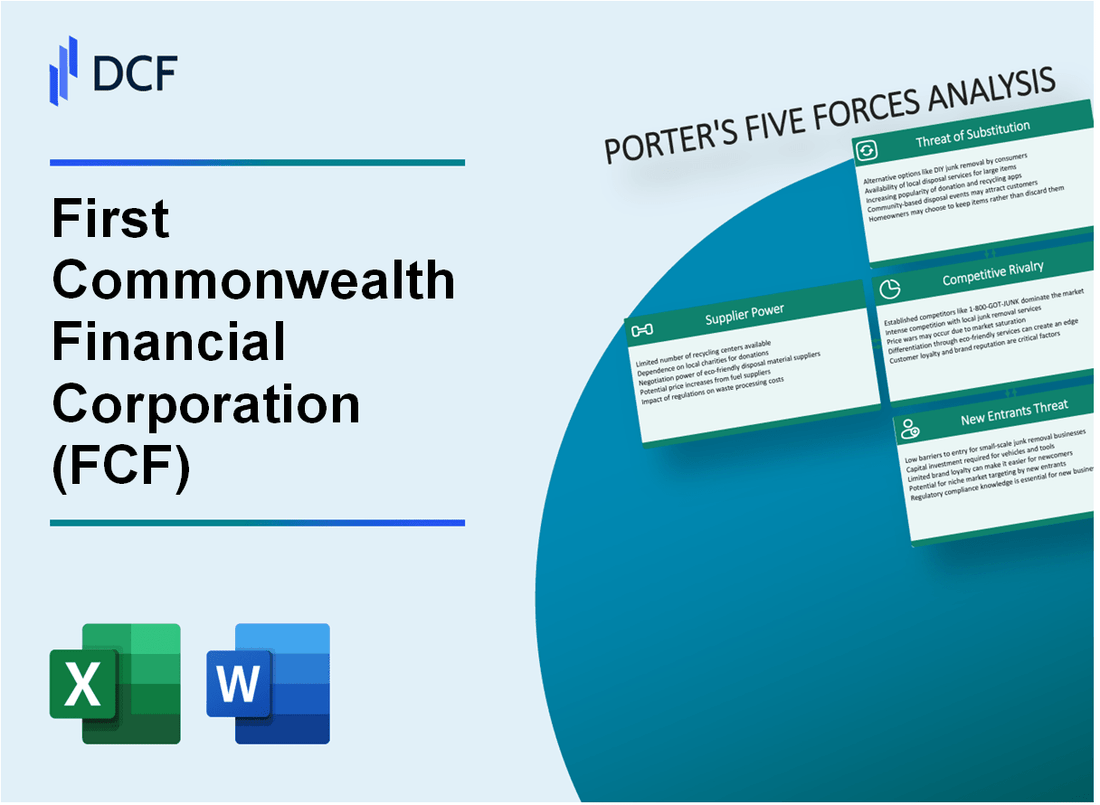
First Commonwealth Financial Corporation (FCF): 5 Analyse des forces [Jan-2025 Mis à jour] |
Entièrement Modifiable: Adapté À Vos Besoins Dans Excel Ou Sheets
Conception Professionnelle: Modèles Fiables Et Conformes Aux Normes Du Secteur
Pré-Construits Pour Une Utilisation Rapide Et Efficace
Compatible MAC/PC, entièrement débloqué
Aucune Expertise N'Est Requise; Facile À Suivre
First Commonwealth Financial Corporation (FCF) Bundle
Dans le paysage dynamique de la banque régionale, First Commonwealth Financial Corporation (FCF) navigue dans un écosystème complexe de forces compétitives qui façonnent son positionnement stratégique. Alors que la transformation numérique remodèle les services financiers et que la concurrence régionale s'intensifie, la compréhension de la dynamique complexe des pressions du marché devient cruciale. Cette analyse des cinq forces de Porter révèle les défis et opportunités stratégiques que FCF est confrontée à maintenir son avantage concurrentiel sur les marchés bancaires de Pennsylvanie et de l'Ohio, offrant des informations sur les facteurs critiques qui détermineront son succès et sa résilience futurs.
First Commonwealth Financial Corporation (FCF) - Porter's Five Forces: Bargaining Power of Fournissers
Paysage des fournisseurs de technologies bancaires de base
First Commonwealth Financial Corporation repose sur un nombre limité de fournisseurs de technologies bancaires de base:
| Fournisseur | Part de marché | Valeur du contrat annuel |
|---|---|---|
| Finerv | 35.6% | 2,3 millions de dollars |
| Jack Henry & Associés | 28.4% | 1,9 million de dollars |
| FIS Global | 22.7% | 1,6 million de dollars |
Analyse de dépendance aux fournisseurs
Les dépendances clés des fournisseurs de technologie comprennent:
- Infrastructure de système bancaire de base
- Plates-formes de cybersécurité
- Solutions bancaires numériques
- Systèmes de traitement des paiements
Évaluation des coûts de commutation
Les coûts de migration des infrastructures bancaires varient de 5,7 millions de dollars à 12,3 millions de dollars, ce qui représente des obstacles financiers importants.
Les fournisseurs de services financiers levier
Les fournisseurs de services financiers spécialisés démontrent un pouvoir de négociation modéré:
| Catégorie des fournisseurs | Indice de puissance de négociation | Durée du contrat moyen |
|---|---|---|
| Technologies bancaires de base | 7.2/10 | 5-7 ans |
| Solutions de cybersécurité | 6.5/10 | 3-5 ans |
| Plateformes bancaires numériques | 6.8/10 | 4-6 ans |
First Commonwealth Financial Corporation (FCF) - Porter's Five Forces: Bargaining Power of Clients
Alternatives bancaires régionales
First Commonwealth Financial Corporation opère en Pennsylvanie et en Ohio, avec 149 succursales totales au quatrième trimestre 2023. Le paysage bancaire concurrentiel comprend:
| Banque | Nombre de branches | Présence du marché |
|---|---|---|
| Banque PNC | 258 | Pennsylvanie |
| Citizens Bank | 183 | Ohio et Pennsylvanie |
| First Commonwealth Bank | 149 | Pennsylvanie |
Analyse des coûts de commutation
Coût moyen de commutation client pour les services bancaires: 150 $ à 250 $ par transfert de compte.
- Coût de transfert de compte à courant personnel: 189 $
- Coût de transfert de banque commerciale: 275 $
- Dépenses de migration du compte numérique: 125 $
Attentes bancaires numériques
Taux d'adoption des banques numériques en 2023:
| Service numérique | Pourcentage d'utilisateur |
|---|---|
| Banque mobile | 76% |
| Payage des factures en ligne | 68% |
| Dépôt de chèques mobiles | 62% |
Sensibilité aux prix
Comparaison des frais bancaires régionaux pour 2024:
| Service | Frais FCF | Moyenne des concurrents |
|---|---|---|
| Frais de vérification mensuels | $8.95 | $12.50 |
| Frais de retrait ATM | $2.50 | $3.25 |
| Frais de découvert | $35 | $38 |
Solutions financières personnalisées
Segments de clients à la recherche de la banque personnalisée:
- Propriétaires de petites entreprises: 42%
- Millennials: 35%
- Individus à haute valeur nette: 23%
First Commonwealth Financial Corporation (FCF) - Five Forces de Porter: rivalité compétitive
Paysage concurrentiel des banques régionales
First Commonwealth Financial Corporation fait face à une pression concurrentielle importante des institutions bancaires régionales en Pennsylvanie.
| Concurrent | Actif total | Part de marché |
|---|---|---|
| Services financiers PNC | 560,1 milliards de dollars | 12.4% |
| Banque M&T | 241,8 milliards de dollars | 5.3% |
| First Commonwealth Bank | 24,3 milliards de dollars | 0.54% |
Comparaison des capacités bancaires numériques
- Téléchargements d'applications bancaires mobiles: 287 000
- Volume de transaction en ligne: 2,1 millions par mois
- Pénétration des utilisateurs de la banque numérique: 68,5%
Taux d'intérêt et structures de frais
| Produit | Taux FCF | Moyenne des concurrents |
|---|---|---|
| Compte d'épargne personnelle | 0.45% | 0.37% |
| Frais mensuels du compte chèque | $8.95 | $12.50 |
Présence du marché régional
First Commonwealth Financial Corporation exploite 138 succursales principalement en Pennsylvanie, avec une présence concentrée sur le marché dans 22 comtés.
- Branches totales: 138
- Comtés servis: 22
- Concentration du marché de la Pennsylvanie: 94%
First Commonwealth Financial Corporation (FCF) - Five Forces de Porter: menace de substituts
Plateformes émergentes FinTech offrant des services financiers alternatifs
En 2024, la taille du marché fintech a atteint 190,23 milliards de dollars dans le monde, avec des services financiers alternatifs augmentant à un TCAC de 13,7%. Des plates-formes comme Robinhood, Sofi et Chime rivalisent directement avec les services bancaires traditionnels.
| Plate-forme fintech | Base d'utilisateurs | Revenus annuels |
|---|---|---|
| Robin | 22,3 millions | 1,81 milliard de dollars |
| Sovi | 4,5 millions | 1,57 milliard de dollars |
| Carillon | 13 millions | 1,1 milliard de dollars |
Montée des solutions bancaires uniquement numériques
Les banques numériques uniquement ont capturé 7,2% du marché bancaire en 2024, avec 89,2 milliards de dollars d'actifs totaux gérés.
- Ally Bank: 2,3 millions de clients
- Capital One 360: 4,1 millions d'utilisateurs
- Marcus par Goldman Sachs: 92 milliards de dollars de dépôts
Crypto-monnaie et technologies de blockchain
La capitalisation boursière de la crypto-monnaie a atteint 1,7 billion de dollars en 2024, avec Bitcoin à 750 milliards de dollars et Ethereum à 280 milliards de dollars.
| Crypto-monnaie | Capitalisation boursière | Volume de transaction quotidien |
|---|---|---|
| Bitcoin | 750 milliards de dollars | 25,3 milliards de dollars |
| Ethereum | 280 milliards de dollars | 12,7 milliards de dollars |
Plates-formes de paiement mobiles
Le volume des transactions de paiement mobile a atteint 4,7 billions de dollars en 2024.
- Apple Pay: 49,4 millions d'utilisateurs
- Google Pay: 39,2 millions d'utilisateurs
- Venmo: 83 millions d'utilisateurs actifs
Plateformes de prêt de peer-to-peer
Le marché des prêts P2P est passé à 67,8 milliards de dollars en 2024, avec des plateformes clés montrant une traction importante.
| Plate-forme | Les prêts totaux ont été originaires | Revenus annuels |
|---|---|---|
| Club de prêt | 14,6 milliards de dollars | 862 millions de dollars |
| Prospérer | 9,3 milliards de dollars | 487 millions de dollars |
First Commonwealth Financial Corporation (FCF) - Five Forces de Porter: menace de nouveaux entrants
Obstacles réglementaires élevés pour entrer dans le secteur bancaire
En 2024, First Commonwealth Financial Corporation est confrontée à des défis réglementaires importants pour les nouveaux entrants du marché. La Réserve fédérale nécessite un ratio de capital de niveau 1 minimum de 6% pour les nouvelles banques. La conformité de la Loi sur le réinvestissement communautaire (CRA) coûte environ 50 000 $ à 250 000 $ par an pour les nouvelles institutions financières.
Exigences de capital significatives
| Catégorie des besoins en capital | Montant minimum |
|---|---|
| Capital de démarrage minimum | 10 millions à 20 millions de dollars |
| Exigences de capital Bâle III | Ratio de capital total de 8,5% |
| Contribution du fonds d'assurance FDIC | 0,125% du total des dépôts |
Processus complexes de conformité et de licence
Coûts de licence pour les nouvelles institutions bancaires varient de 250 000 $ à 500 000 $, y compris les frais de préparation juridique et réglementaire.
Relations clients établies
First Commonwealth Financial Corporation opère en Pennsylvanie avec 104 centres financiers et dessert environ 375 000 clients en 2023.
Investissements technologiques requis
- Coût moyen de développement de la plate-forme bancaire numérique: 1,2 million de dollars à 3,5 millions de dollars
- Investissement d'infrastructure de cybersécurité: 500 000 $ à 2 millions de dollars par an
- Mise en œuvre du système bancaire de base: 750 000 $ à 2,5 millions de dollars
L'investissement total de technologie initiale pour une nouvelle institution bancaire peut se situer entre 2,5 millions de dollars et 7,5 millions de dollars.
First Commonwealth Financial Corporation (FCF) - Porter's Five Forces: Competitive rivalry
You're looking at a crowded field, which is the reality for First Commonwealth Financial Corporation in its core Pennsylvania and Ohio markets. The competitive rivalry here is intense, facing off against approximately 94 tracked regional bank stocks operating in those same geographies. This density means every basis point of margin and every new commercial relationship is a hard-fought win.
The pressure isn't just local; it comes from the national giants and the nimble fintech players, all of whom are actively working to compress net interest margins (NIMs). For First Commonwealth Financial Corporation, the NIM is the key battleground metric. You saw the Net Interest Margin (FTE) for Q2 2025 hit 3.83%, which was an expansion of 21 basis points from the previous quarter, but this level is constantly under threat from competitors vying for deposit share and loan volume. Still, First Commonwealth Financial Corporation managed to post a Net Interest Income (FTE) of $106.6 million for that same quarter.
To put the competitive landscape in perspective, consider the scale difference. While First Commonwealth Financial Corporation reported a Market Capitalization of $1.71 billion as of Q2 2025, a major regional player like PNC Bank, which also operates in these markets, reported total assets of $568.8 billion in Q3 2025. That's a massive difference in scale that national banks bring to the table.
| Metric | First Commonwealth Financial Corporation (FCF) Q2 2025 | Contextual Data Point |
|---|---|---|
| Net Interest Margin (FTE) | 3.83% | Rounded NIM reported at 3.8% |
| Net Interest Income (FTE) | $106.6 million | Up $10.7 million from the previous quarter |
| Core Diluted EPS | $0.38 | Up from $0.32 in the first quarter |
| Market Capitalization | $1.71 billion | KBW Regional Banking Index (KRX) returned 13.20% in 2024 |
However, First Commonwealth Financial Corporation is using specific strengths to fight back against this rivalry. You need to know where they are winning ground:
- Ranked #1 SBA lender in the Pittsburgh district for the SBA fiscal year ending September 30, 2025.
- Moved into the top 5 in the entire state of Ohio rankings.
- Achieved a Core Efficiency Ratio of 54.1% in Q2 2025.
- Reported total loan growth of 8.1% annualized in Q2 2025.
- The bank declared a common stock quarterly dividend of $0.135 per share in Q2 2025.
That #1 SBA ranking in Pittsburgh is a tangible asset in a competitive market. Finance: draft a comparison of FCF's Q2 2025 loan growth versus the 7.3% annualized growth in total average loans reported for the same period.
First Commonwealth Financial Corporation (FCF) - Porter's Five Forces: Threat of substitutes
You're looking at First Commonwealth Financial Corporation's competitive position as of late 2025, and the threat of substitutes is definitely more pronounced than it used to be. The core banking business-taking deposits and making loans-is being chipped away at from several angles, largely driven by technology and investor preference for yield.
Fintech firms and digital banks offer innovative, lower-cost, and specialized services. The shift is clear: in the U.S., fintech adoption hit approximately 74% of users by Q1 2025. This isn't just about payments; it's about core services. For instance, 68% of Gen Z consumers in the U.S. now state a preference for fintechs over traditional banks for their main financial services. These digital-first competitors often boast operational cost advantages, with some non-bank lenders leveraging AI to achieve up to 30% lower operational costs.
Customers can use non-bank investment platforms for wealth management and lending. This is especially evident in the mortgage space, where agility in digital origination is key. By Q1 2025, the nonbank share of total residential mortgage originations had climbed to 66.4%. To put this in perspective against the broader market in 2024, non-bank lenders accounted for 55.7% of all mortgage originations, while banks only managed 28.9%. This signals that for significant lending products, First Commonwealth Financial Corporation is competing against a more technologically streamlined, non-bank ecosystem.
Direct investment in treasuries or money market funds substitutes for bank deposits. This is a direct challenge to First Commonwealth Financial Corporation's funding base. As of 2025, U.S. Money Market Fund (MMF) assets have swelled to $7 trillion, attracting both retail and institutional cash seeking better yields than traditional bank accounts might offer, especially when rates are volatile. Historically, data from 1995 to May 2025 shows a statistically significant substitution effect: a one-percentage-point increase in bank deposits was associated with a 0.2-percentage-point decline in MMF assets. This means when depositors have attractive alternatives, they actively reallocate funds away from institutions like First Commonwealth Financial Corporation.
Non-bank lenders and credit unions compete directly for mortgages and auto loans. The competition for loan volume is fierce. While First Commonwealth Financial Corporation saw its total loans increase by 5.7% (or $137 million) quarter-over-quarter in Q3 2025, the broader trend favors non-banks in key areas. The pressure on deposit costs is also visible internally; First Commonwealth Financial Corporation managed to lower its cost of deposits by 7 basis points to 1.84% in Q3 2025, which helped its Net Interest Margin expand to 3.92%, but maintaining that pricing advantage against high-yield alternatives is a constant battle.
Here's a quick look at the competitive strength of the key substitute channels as of mid-to-late 2025:
| Substitute Category | Key Metric / Data Point (Latest Available) | Relevance to First Commonwealth Financial Corporation |
|---|---|---|
| Fintech/Digital Banks | U.S. Fintech Adoption Rate: 74% (Q1 2025) | Indicates high customer comfort with digital-only financial interactions. |
| Non-Bank Mortgage Lenders | Share of Total Mortgage Originations: 66.4% (Q1 2025) | Directly competes for high-value, long-term assets, often with superior digital processes. |
| Money Market Funds (MMFs) | Total U.S. MMF Assets: $7 trillion | Represents a massive pool of safe, cash-like assets competing directly for deposit dollars. |
| Non-Bank Operational Efficiency | Potential Operational Cost Reduction via AI: Up to 30% | Sets a lower cost-to-serve benchmark that traditional banks must match or beat. |
The pressure on First Commonwealth Financial Corporation's deposit base is real, even as they managed a 4% increase in average deposits in Q3 2025. The loan-to-deposit ratio stood at 95.3% at the end of that quarter, meaning the bank is highly reliant on its current funding structure to support its loan growth.
You need to watch how First Commonwealth Financial Corporation's deposit beta-how quickly their deposit rates adjust to market rates-compares to the faster pass-through seen in MMFs, especially given the historical substitution patterns. The continued growth of MMFs and the dominance of non-banks in lending are structural threats that require a clear, technology-focused response to maintain market share in both funding and lending activities.
First Commonwealth Financial Corporation (FCF) - Porter's Five Forces: Threat of new entrants
Regulatory compliance costs and capital requirements definitely create a high barrier for traditional entrants looking to start a new bank in First Commonwealth Financial Corporation's operating regions. The cost structure for compliance is not uniform; it scales poorly for smaller institutions. For instance, banks with assets between $1 and $10 billion report compliance costs as 2.9% of their non-interest expenses. Compare that to banks with less than $100 million in assets, which spend around 8.7% of their non-interest expenses on these duties. Furthermore, compliance staff, including salary and benefits, can account for approximately 10% of a financial institution's total personnel expenses.
Here's a quick look at how compliance spending as a percentage of non-interest expenses varies by size, based on 2025 data trends:
| Bank Asset Size | Compliance Cost (% of Non-Interest Expenses) |
|---|---|
| $1 Billion to $10 Billion | 2.9% |
| Less than $100 Million | 8.7% |
Digital-only banks, or neobanks, bypass the massive capital outlay required for physical infrastructure. First Commonwealth Financial Corporation, headquartered in Indiana, Pennsylvania, maintains 127 community banking offices across 30 counties throughout western and central Pennsylvania and Ohio. Neobanks face none of these brick-and-mortar entry costs, allowing them to focus capital on technology and customer acquisition within FCF's geographic footprint.
Still, new tailored regulations for community banks could slightly ease the burden for smaller competitors attempting to enter the market, though this is a proposal as of late 2025. The federal banking regulators proposed changes to the Community Bank Leverage Ratio (CBLR) framework:
- Lower the minimum leverage ratio requirement from 9% to 8%.
- Extend the grace period for falling out of compliance from two quarters to four quarters.
- This proposal could allow an additional 475 community banking organizations to qualify for the less burdensome CBLR framework.
- The goal is for a total of 95 percent of community banking organizations to qualify under the new 8 percent requirement.
First Commonwealth Financial Corporation's $1.71 billion market capitalization makes it a smaller target than money center banks, but the resource disparity in technology investment remains a threat vector. While FCF is smaller, the largest banks are allocating significant capital to digital defense and expansion. For example, JP Morgan is reportedly ploughing $18bn into technology for automation and risk assessment in 2025. This massive spending by giants widens the technology gap, which new entrants can exploit by offering superior digital-first experiences.
Disclaimer
All information, articles, and product details provided on this website are for general informational and educational purposes only. We do not claim any ownership over, nor do we intend to infringe upon, any trademarks, copyrights, logos, brand names, or other intellectual property mentioned or depicted on this site. Such intellectual property remains the property of its respective owners, and any references here are made solely for identification or informational purposes, without implying any affiliation, endorsement, or partnership.
We make no representations or warranties, express or implied, regarding the accuracy, completeness, or suitability of any content or products presented. Nothing on this website should be construed as legal, tax, investment, financial, medical, or other professional advice. In addition, no part of this site—including articles or product references—constitutes a solicitation, recommendation, endorsement, advertisement, or offer to buy or sell any securities, franchises, or other financial instruments, particularly in jurisdictions where such activity would be unlawful.
All content is of a general nature and may not address the specific circumstances of any individual or entity. It is not a substitute for professional advice or services. Any actions you take based on the information provided here are strictly at your own risk. You accept full responsibility for any decisions or outcomes arising from your use of this website and agree to release us from any liability in connection with your use of, or reliance upon, the content or products found herein.