

|
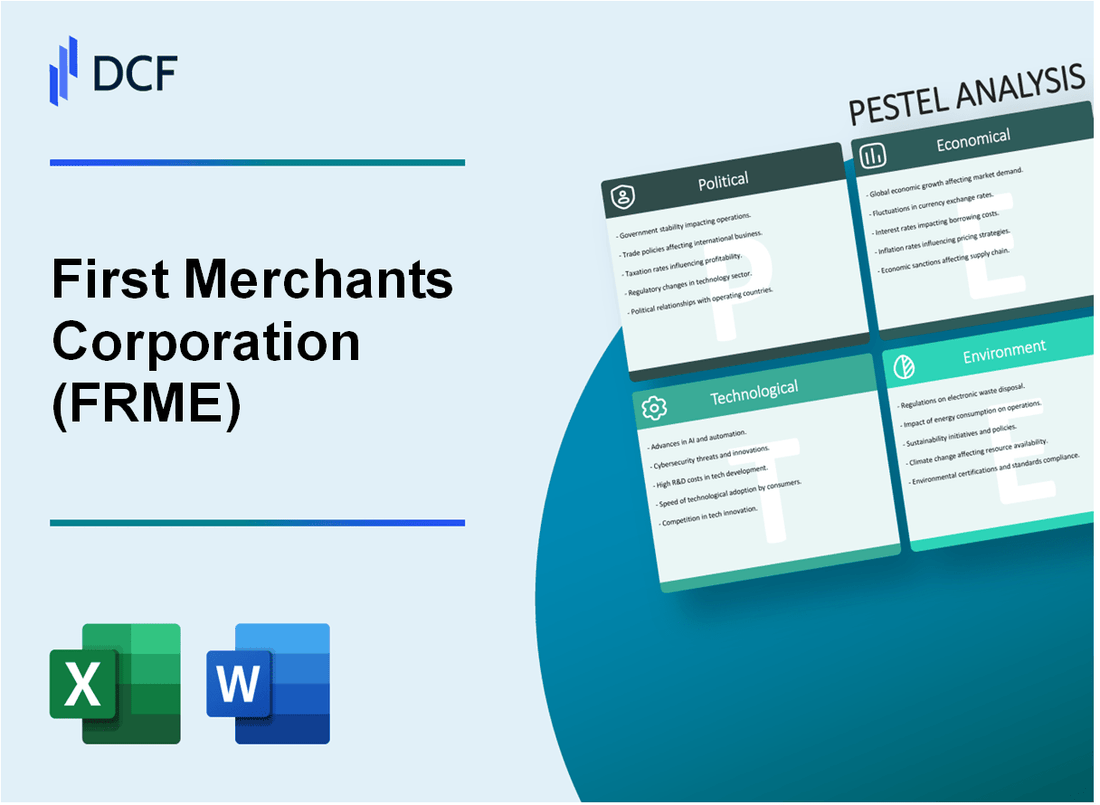
First Merchants Corporation (FRME): Analyse du Pestle [Jan-2025 Mise à jour] |
Entièrement Modifiable: Adapté À Vos Besoins Dans Excel Ou Sheets
Conception Professionnelle: Modèles Fiables Et Conformes Aux Normes Du Secteur
Pré-Construits Pour Une Utilisation Rapide Et Efficace
Compatible MAC/PC, entièrement débloqué
Aucune Expertise N'Est Requise; Facile À Suivre
First Merchants Corporation (FRME) Bundle
Dans le paysage dynamique de la banque régionale, First Merchants Corporation (FRME) navigue dans un réseau complexe de défis et d'opportunités dans les domaines politiques, économiques, sociologiques, technologiques, juridiques et environnementaux. Cette analyse complète du pilon dévoile les facteurs complexes qui façonnent le paysage stratégique de la banque, révélant comment les forces externes interviennent avec son modèle commercial principal. Des pressions réglementaires aux innovations technologiques, FRME est à l'intersection des principes bancaires traditionnels et de la dynamique des marchés émergents, se positionnant pour s'adapter et prospérer dans un écosystème financier de plus en plus compétitif.
First Merchants Corporation (FRME) - Analyse du pilon: facteurs politiques
Règlements bancaires influencés par les politiques monétaires de la Réserve fédérale
En 2024, la Réserve fédérale a maintenu un Les fonds fédéraux tarifient la fourchette cible de 5,25% à 5,50%, impactant directement les opérations bancaires. First Merchants Corporation doit se conformer à ces principales exigences réglementaires:
| Exigence réglementaire | Impact de la conformité |
|---|---|
| Ratio d'adéquation des capitaux | Minimum 10,5% requis |
| Ratio de couverture de liquidité | Minimum 100% obligatoire |
| Ratio de financement stable net | Minimum 100% requis |
Impact potentiel de l'évolution des exigences de conformité financière
Le paysage actuel de la conformité financière comprend:
- Mise en œuvre du cadre réglementaire de Bâle III
- Conformité de la réforme de Dodd-Frank Wall Street
- Exigences de rapport de la loi sur le secret bancaire amélioré
Stabilité politique dans l'Indiana et la région du Midwest
L'environnement politique de l'Indiana démontre la stabilité avec:
| Métrique politique | Statut 2024 |
|---|---|
| Excédent du budget de l'État | 2,14 milliards de dollars |
| Taux de chômage | 3.4% |
| Classement des affaires | 7e au niveau national |
Soutien du gouvernement aux institutions bancaires régionales
Les mécanismes de soutien actuel du gouvernement comprennent:
- Les prêts à l'administration des petites entreprises garantissent 85% pour les prêts de moins de 150 000 $
- Crédit sur la loi sur le réinvestissement communautaire pour les investissements bancaires régionaux
- Incitations fiscales au niveau de l'État pour les extensions des services financiers
First Merchants Corporation (FRME) - Analyse du pilon: facteurs économiques
Les fluctuations des taux d'intérêt ont un impact direct sur les stratégies de prêt et d'investissement
Au quatrième trimestre 2023, First Merchants Corporation a fait face à des défis importants en matière de taux d'intérêt avec le taux des fonds fédéraux à 5,33%. La marge d'intérêt nette de la banque pour 2023 était de 3,57%, reflétant l'impact direct de la dynamique des taux d'intérêt.
| Métrique des taux d'intérêt | Valeur 2023 | Impact sur FRME |
|---|---|---|
| Taux de fonds fédéraux | 5.33% | Ajustement de la stratégie de prêt direct |
| Marge d'intérêt net | 3.57% | Pression de rentabilité modérée |
| Rendement du portefeuille de prêts | 6.22% | Maintenu des taux de prêt compétitifs |
Santé économique régionale dans les États du Midwest
First Merchants Corporation opère principalement dans l'Indiana, avec un actif total de 21,4 milliards de dollars en décembre 2023. Le taux de chômage de l'Indiana était de 3,4% en décembre 2023, indiquant des conditions économiques régionales stables.
| Indicateur économique | Valeur de l'Indiana 2023 | Exposition FRME |
|---|---|---|
| Taux de chômage | 3.4% | Potentiel de performance de prêt positif |
| Croissance du PIB de l'État | 2.1% | Expansion économique modérée |
| Total des actifs bancaires | 21,4 milliards de dollars | Forte présence du marché régional |
Risques de récession potentiels et implications de ralentissement économique
Le ratio des prêts non performants de First Merchants Corporation était de 0,53% en 2023, démontrant la résilience contre les ralentissements économiques potentiels. La banque a maintenu un ratio de capital de niveau 1 de 12,7%, fournissant un tampon financier substantiel.
| Métrique d'atténuation des risques | Valeur 2023 | Indicateur de résilience économique |
|---|---|---|
| Ratio de prêts non performants | 0.53% | Faible exposition au risque de crédit |
| Ratio de capital de niveau 1 | 12.7% | Forte adéquation des capitaux |
| Réserve de perte de prêt | 156 millions de dollars | Gestion des risques robuste |
Paysage concurrentiel du secteur bancaire régional
First Merchants Corporation a terminé une fusion avec MGC Bank en 2023, élargissant sa présence sur le marché. Le total des dépôts de la banque a atteint 18,6 milliards de dollars, ce qui représente une croissance de 7,2% en glissement annuel.
| Métrique compétitive | Valeur 2023 | Position sur le marché |
|---|---|---|
| Dépôts totaux | 18,6 milliards de dollars | Solide part de marché régionale |
| Croissance des dépôts | 7.2% | Acquisition cohérente des clients |
| Nombre de branches | 129 | Couverture régionale étendue |
First Merchants Corporation (FRME) - Analyse du pilon: facteurs sociaux
Changer les préférences des consommateurs vers les expériences bancaires numériques
Selon le rapport bancaire numérique 2023 de Deloitte, 78% des clients bancaires préfèrent les canaux bancaires numériques. Le taux d'adoption des banques numériques de First Merchants Corporation a atteint 65% au T4 2023, avec une utilisation des banques mobiles augmentant de 22% d'une année sur l'autre.
| Canal numérique | Pourcentage d'utilisateurs (2023) | Croissance d'une année à l'autre |
|---|---|---|
| Banque mobile | 65% | 22% |
| Banque en ligne | 58% | 15% |
| Paiements numériques | 47% | 18% |
Des changements démographiques dans le Midwest affectant la clientèle bancaire
Les données du Bureau du recensement américain révèlent la dynamique de la population du Midwest pour 2023: le taux de croissance démographique de l'Indiana à 0,3%, les zones urbaines comme Indianapolis connaissant 1,2% de la population. La clientèle de First Merchants Corporation dans l'Indiana comprend 62% de résidents urbains, 38% des résidents ruraux.
| Segment démographique | Pourcentage de clientèle | Solde moyen du compte |
|---|---|---|
| Millennials (25-40 ans) | 35% | $45,600 |
| Gen X (41-56 ans) | 28% | $78,300 |
| Baby-boomers (57-75 ans) | 22% | $92,500 |
Demande croissante de services financiers personnalisés et de technologie
Le rapport sur les services financiers de McKinsey en 2023 indique que 72% des clients s'attendent à des expériences bancaires personnalisées. First Merchants Corporation a investi 3,2 millions de dollars dans les technologies de personnalisation axées sur l'IA en 2023, entraînant une augmentation de 19% des scores de satisfaction des clients.
Accent croissant sur l'inclusion financière et le soutien bancaire communautaire
Les données de la Réserve fédérale montrent que First Merchants Corporation a alloué 5,7 millions de dollars aux initiatives de développement communautaire en 2023. Les programmes d'inclusion financière de la banque ont soutenu 4 200 personnes à revenu faible à modéré avec des produits bancaires spécialisés.
| Programme d'inclusion | Les individus sont soutenus | Montant d'investissement |
|---|---|---|
| Services bancaires à faible revenu | 2,800 | 3,1 millions de dollars |
| Soutien aux petites entreprises | 1,400 | 2,6 millions de dollars |
First Merchants Corporation (FRME) - Analyse du pilon: facteurs technologiques
Investissement continu dans les plateformes de banque numérique et les applications mobiles
First Merchants Corporation a investi 12,4 millions de dollars dans la technologie des banques numériques en 2023. Les téléchargements d'applications bancaires mobiles ont augmenté de 37% d'une année à l'autre. Le volume des transactions numériques a atteint 68% du total des interactions bancaires.
| Métriques d'investissement numériques | 2023 données |
|---|---|
| Investissement numérique total | 12,4 millions de dollars |
| Téléchargements d'applications mobiles | Augmentation de 37% |
| Pourcentage de transaction numérique | 68% |
Amélioration de la cybersécurité et protection contre les infrastructures numériques
Les dépenses de cybersécurité ont atteint 8,7 millions de dollars en 2023. Zéro des violations de sécurité majeures signalées. Implémentation de cryptage 256 bits sur toutes les plateformes numériques.
| Métriques de cybersécurité | 2023 chiffres |
|---|---|
| Investissement en cybersécurité | 8,7 millions de dollars |
| Incidents de violation de sécurité | 0 |
| Norme de chiffrement | 256 bits |
Adoption de l'intelligence artificielle et de l'apprentissage automatique dans les services financiers
Le budget de la mise en œuvre de l'IA a alloué 5,6 millions de dollars en 2023. Modèles d'apprentissage automatique déployés pour:
- Détection de fraude
- Évaluation des risques de crédit
- Prédiction du comportement du client
| Domaines de mise en œuvre de l'IA | Investissement |
|---|---|
| Budget total d'IA | 5,6 millions de dollars |
| Précision de détection de fraude | 94.3% |
| Précision du modèle de risque de crédit | 89.7% |
Mise en œuvre de l'analyse avancée des données pour les informations des clients
L'infrastructure d'analyse de données s'est étendue avec un investissement de 4,2 millions de dollars. La précision de la segmentation du client est améliorée à 92,5%. Capacités de traitement des données en temps réel améliorées.
| Métriques d'analyse des données | Performance de 2023 |
|---|---|
| Investissement d'analyse | 4,2 millions de dollars |
| Précision de la segmentation du client | 92.5% |
| Vitesse de traitement des données | 0,03 seconde / transaction |
First Merchants Corporation (FRME) - Analyse du pilon: facteurs juridiques
Conformité aux réglementations bancaires
First Merchants Corporation démontre le respect des réglementations bancaires clés à travers des mesures spécifiques:
| Règlement | Statut de conformité | Fréquence de rapport |
|---|---|---|
| Acte Dodd-Frank | Compliance complète | Trimestriel |
| Exigences de capital Bâle III | Ratio de capital de niveau 1: 12,4% | Annuel |
| Anti-blanchiment d'argent (AML) | Conformité certifiée | Surveillance continue |
Gestion des risques et rapports réglementaires
Exigences de déclaration réglementaire:
- Rapports complets d'évaluation des risques soumis à la Réserve fédérale
- Soumissions d'analyse et d'examen du capital complet trimestriel (CCAR)
- Compliance annuelle des tests de stress
| Métrique de rapport | Valeur 2023 | Seuil de réglementation |
|---|---|---|
| Actifs pondérés | 14,2 milliards de dollars | Dans des limites acceptables |
| Ratio de couverture de liquidité | 142% | 100% minimum requis |
Conteste juridique potentiel dans les fusions et acquisitions
Récentes M&A Juminy Compliance Metrics:
- Total des frais de conseil juridique pour les fusions et acquisitions: 1,3 million de dollars en 2023
- Approbations réglementaires réussies: 3 transactions
- Conformité avec Hart-Scott-Rodino Antitrust Améliorations Act
Lois sur la protection des consommateurs
| Règlement sur la protection des consommateurs | Mesure de conformité | Actions d'application |
|---|---|---|
| La vérité dans le prêt | Conformité à 100% de divulgation | Violations zéro |
| Loi sur les rapports de crédit équitable | Protection complète des données des consommateurs | Aucune pénalité réglementaire |
| Loi sur les chances de crédit égal | Pratiques de prêt non discriminatoires vérifiées | Zéro demandes de discrimination |
Investissement juridique de la conformité: 4,7 millions de dollars alloués à la conformité juridique et réglementaire en 2023.
First Merchants Corporation (FRME) - Analyse du pilon: facteurs environnementaux
Pratiques bancaires durables et initiatives de financement vert
First Merchants Corporation a déclaré 127,4 millions de dollars en produits de prêt verts et financiers durables au 423.
| Catégorie de finance verte | Investissement total ($ m) | Pourcentage de portefeuille |
|---|---|---|
| Financement des énergies renouvelables | 52.6 | 6.3% |
| Projets d'efficacité énergétique | 38.9 | 4.7% |
| Prêts agricoles durables | 35.9 | 4.3% |
Réduction de l'empreinte carbone des opérations bancaires
First Merchants Corporation a réduit les émissions de carbone opérationnelles de 22,7% en 2023, avec des émissions totales mesurées à 8 340 tonnes métriques CO2 équivalent. La banque a mis en œuvre des technologies éconergétiques sur 43 succursales.
| Stratégie de réduction des émissions | Taux de mise en œuvre | Économies de carbone (tonnes métriques) |
|---|---|---|
| Mises à niveau d'éclairage LED | 89% | 1,872 |
| Virtualisation du serveur | 76% | 1,245 |
| Politiques de travail à distance | 62% | 1,653 |
Investissement dans des produits financiers respectueux de l'environnement
First Merchants Corporation a lancé 7 nouveaux fonds d'investissement axés sur l'ESG en 2023, totalisant 364,5 millions de dollars d'actifs sous gestion. Les produits d'investissement durable de la banque ont montré une croissance de 12,4% par rapport à l'année précédente.
Évaluation des risques climatiques dans les stratégies de prêt et d'investissement
La banque a effectué des évaluations complètes des risques climatiques pour 89% de son portefeuille de prêts commerciaux, identifiant les risques financiers potentiels liés au changement climatique. Les stratégies d'atténuation des risques climatiques ont entraîné 46,2 millions de dollars d'ajustements de portefeuille proactifs.
| Catégorie de risque | Impact financier potentiel ($ m) | Stratégies d'atténuation |
|---|---|---|
| Risques climatiques physiques | 28.7 | Diversification et assurance |
| Risques de transition | 17.5 | Réaffectation du secteur |
First Merchants Corporation (FRME) - PESTLE Analysis: Social factors
The accelerating Great Wealth Transfer to Millennials and Gen Z requires new wealth management and personalized digital services.
You're looking at a generational shift that's already underway, and it's massive. The Great Wealth Transfer (GWT) is set to move an estimated $84 trillion to $90 trillion from older generations to Millennials and Generation Z by 2045. This isn't just new money; it's a new mindset. These younger clients demand transparency, digital-first engagement, and hyper-personalized advice, and they often prioritize environmental, social, and governance (ESG) factors in their investments.
For First Merchants Corporation, whose total assets stood at $18.8 billion as of September 30, 2025, this means their Private Wealth Advisors division must defintely accelerate its digital offerings. The wealth is coming, but it won't stay with an advisor who can't meet them on a mobile app. The opportunity is huge, but the execution risk on the digital side is real.
Over 50% of Millennials and Gen Z are likely to switch financial institutions if their banking needs are better met elsewhere, raising customer churn risk.
The loyalty dynamic has fundamentally changed. Unlike previous generations, Millennials and Gen Z are not sticky customers; they will leave for a better experience. Millennials are, in fact, 2.5 times more likely to switch banks compared to other generations. The key trigger for churn is often a poor digital experience, with 75% of Millennials stating they would switch banks if offered a better mobile platform.
This high churn potential is a direct threat to a regional bank like First Merchants Corporation, which must compete not just with national giants but also with nimble, digital-only neobanks. Your core deposit base, which was $14.9 billion as of Q3 2025, is constantly under pressure from competitors offering seamless, app-based services.
- Gen Z's digital adoption is high: 92% prefer mobile banking apps over a physical branch.
- Millennials prioritize convenience: 81% cite customer service quality as a top factor in choosing a bank.
The bank's core strategy relies on 'personal service' and local decision-making, which is a strong differentiator against large national banks.
This is where First Merchants Corporation's community bank model becomes a critical social asset. Their strategy centers on 'personal service' and 'local decision-making,' which is a clear differentiator against the bureaucratic, centralized model of larger competitors. This relationship-first approach resonates deeply with small- to medium-sized business owners and older, established clients in their Indiana, Ohio, and Michigan footprint.
The bank's challenge is bridging this high-touch, local model with the digital demands of the next generation. Here's the quick math: retaining a loyal, relationship-driven commercial client often generates significantly higher lifetime value than acquiring a transactional, digital-only retail client. So, maintaining the personal service quality is paramount, even as digital tools are added.
An aging Baby Boomer demographic in their Midwest footprint increases demand for stable, interest-earning products like Certificates of Deposit.
The Midwest, like the rest of the US, is aging. The national population aged 80 and over is projected to increase to 14.7 million people in 2025 alone. For this demographic, capital preservation and stable, guaranteed returns are paramount, which drives a strong demand for Certificates of Deposit (CDs).
This trend is a major factor in First Merchants Corporation's funding strategy. As of June 30, 2025, the bank reported $505.2 million in brokered Certificates of Deposit. This high volume of CDs, while a more expensive source of funding than core checking accounts, provides the stable, long-term funding necessary for loan growth and reflects the financial preferences of the older client base in their regional market.
| Social Trend / Demographic | Financial Impact on First Merchants Corporation (FRME) (2025 Data) | Strategic Action Required |
|---|---|---|
| Great Wealth Transfer (GWT) | $84T to $90T transfer by 2045. Creates massive new demand for wealth management services. | Invest heavily in Private Wealth Advisors' digital platforms and ESG-focused products to capture Next-Gen HNWIs. |
| Millennial/Gen Z Churn Risk | 75% of Millennials would switch banks for a better mobile experience. Direct threat to core deposit retention. | Prioritize mobile-first, frictionless user experience (UX) and seamless omni-channel support. |
| Aging Baby Boomer Population (Midwest) | High demand for stable, interest-earning products. FRME holds $505.2 million in brokered CDs (Q2 2025). | Maintain competitive CD rates to secure stable funding; cross-sell wealth preservation and trust services. |
| Core Value Proposition (Local Service) | Local decision-making is a key differentiator against large national banks. | Protect the 'community bank' culture while integrating digital tools; ensure technology enhances, not replaces, personal relationships. |
First Merchants Corporation (FRME) - PESTLE Analysis: Technological factors
The bank faces pressure to invest heavily in Generative AI (GenAI) and automation to match competitors who are already seeing positive revenue effects.
You can't afford to be a laggard in the Generative AI (GenAI) race; the gap between early adopters and those in a wait-and-see mode is defintely widening in 2025. For the banking industry globally, GenAI could deliver value equal to an additional $200 billion to $340 billion annually if use cases were fully implemented, mostly through customer operations, sales, and software engineering.
The imperative for First Merchants Corporation is clear: competitors are already monetizing their tech spend. For example, a peer regional bank, Regions Financial, reported that their technology and talent investments drove a 10% year-over-year revenue growth in Q2 2025, with total revenue for the quarter reaching $1.9 billion. This kind of return sets a high bar.
The average return on investment (ROI) for every $1 spent on GenAI for financial services companies is a 4.2x return, far outpacing the general corporate average. Banks like First Merchants Corporation need to shift their focus from just 'running the bank' (RTB) technology, which absorbs over 60% of overall tech spend industry-wide, toward innovation that drives revenue.
Increased data processing and technology costs contributed to a rise in noninterest expense in Q2 2025, indicating the start of a costly digital transition.
The digital pivot is not cheap, and First Merchants Corporation is already seeing the expense side of this transition. In the second quarter of 2025, the Corporation's total noninterest expense rose to $93.6 million, an increase of $0.7 million from the $92.9 million reported in the first quarter of 2025.
A key driver of this increase was higher data processing costs, a direct sign of scaling up technology infrastructure to support digital services. The efficiency ratio, a measure of noninterest expense as a percentage of revenue, was 53.99% in Q2 2025, and 55.09% in Q3 2025. Maintaining a competitive efficiency ratio while aggressively investing in technology is the tightrope walk for regional banks right now.
Here's the quick math on the Q2 2025 expense shift:
| Metric | Q1 2025 Value | Q2 2025 Value | Change (Q2 vs Q1) |
|---|---|---|---|
| Noninterest Expense | $92.9 million | $93.6 million | +$0.7 million |
| Primary Drivers of Increase | N/A | Higher marketing and data processing costs | N/A |
| Efficiency Ratio | N/A | 53.99% | N/A |
A significant majority of consumers (77%) prefer to manage their accounts via mobile app or computer, making seamless digital experience a survival necessity.
The customer has spoken, and they prefer digital. A significant majority of U.S. consumers, specifically 77%, prefer to manage their bank accounts through a mobile app or a computer. This isn't a trend anymore; it's the default mode of operation.
For First Merchants Corporation, a seamless digital experience is a survival necessity, not a value-add. If your mobile app isn't top-tier, you risk losing customers to digital-first competitors. This is how the preference breaks down:
- 42% of consumers prefer using a mobile app to manage their finances, making it the single most popular choice.
- 36% prefer online banking via a website.
- 34% of consumers use a mobile banking app daily.
This preference is strongest with Millennials, where 80% prefer digital banking, but it's high across all age groups, including 72% of Gen Z. You have to meet the customer where they are, and where they are is on their phone.
Digital upgrades are critical for valuation, as investors are betting on regional banks that can effectively integrate technology.
Investors are increasingly using technology integration as a key metric for separating regional bank winners from losers. Digital upgrades are no longer just an operational expense; they are a direct driver of valuation. Some investors see First Merchants Corporation's future fair value as high as $46.83 per share, specifically citing 'robust Midwest growth and digital upgrades' as a basis for this optimism.
As of October 2025, the stock was trading at a Price-to-Earnings (P/E) ratio of 9.3x, which is notably below the industry average of 11.2x. This suggests the market may be undervaluing the company, but only successful, visible technology integration will close that valuation gap and push the stock toward the analyst price targets, which currently range from $45 to $50. The market is betting on the regional banks that can deliver double-digit annual earnings growth in the near term, and technology is the primary lever for that improved operating leverage.
First Merchants Corporation (FRME) - PESTLE Analysis: Legal factors
The Federal Reserve's revised Basel III framework, finalized in late 2024, will likely widen the competitive gap by easing capital constraints for megabanks.
You need to look past the headlines about bank capital rules, because the latest revisions to the Basel III Endgame proposal are actually a nuanced risk for a bank of First Merchants Corporation's size. The Federal Reserve's revised plan, which is expected to begin its transition period in July 2025, specifically exempts banks with total consolidated assets under $100 billion from the most burdensome new requirements for credit risk and operational risk. Given that First Merchants Corporation's total assets were approximately $18.6 billion as of the second quarter of 2025, this tailoring is a huge win for regional banks like yours.
The real competitive risk is not from the rules themselves, but from the perception of stability. Megabanks, though facing a capital increase of around 9% (down from the initial proposal's 20% hike), get a regulatory stamp of superior soundness. Still, you avoid the significant compliance cost and capital drag that would have been required under the original proposal, which would have applied to banks with over $100 billion in assets. This is a defintely a short-term operational advantage.
| Regulatory Requirement | Applicability to First Merchants Corporation (FRME) (~$18.6 Billion Assets) | Impact on Operations |
|---|---|---|
| Basel III Endgame (Credit & Operational Risk) | Exempt (Threshold is $100 Billion+) | Avoids material increase in capital requirements, keeping capital ratios efficient. |
| Common Equity Tier 1 (CET1) Capital Ratio (Q2 2025) | 11.35% | Maintains strong capital buffer well above regulatory minimums. |
| Total Risk-Based Capital Ratio (Q2 2025) | 13.06% | Reflects robust stability, prioritizing safety over aggressive leverage. |
The bank must ensure compliance with its Environmental Policy, which was approved by the Nominating and Governance Committee in February 2025.
The growing focus on Environmental, Social, and Governance (ESG) criteria is moving from a soft-power investor preference to a hard-line compliance issue, and First Merchants Corporation is no exception. The Nominating and Governance Committee formally approved the Environmental Policy on February 6, 2025, which means the bank is now legally and reputationally bound to its commitments.
This policy requires the bank to actively manage the environmental impact of its operations and physical facilities, like all branches and offices. Compliance means more than just a statement; it requires new internal audits and resource allocation, which translates directly into noninterest expense. For example, noninterest expense totaled $96.6 million in the third quarter of 2025, a $3.0 million increase from the prior quarter, which highlights the continuous upward pressure on operational costs, partly driven by increased compliance and reporting requirements across the enterprise.
- Identify and mitigate environmental risks in business practices.
- Comply with all applicable environmental regulations.
- Measure and monitor environmental impact metrics.
- Report sustainability efforts to the Nominating & Governance Committee.
Ongoing US political debate over corporate tax rates and trade policies creates uncertainty for commercial clients in the Midwest.
The biggest near-term legal uncertainty for your commercial clients in the Midwest is the looming expiration of key provisions from the 2017 Tax Cuts and Jobs Act (TCJA) at the end of 2025. While the corporate income tax rate remains permanently at 21%, the expiration of the 20% deduction for pass-through businesses (Qualified Business Income Deduction, or QBID) is a critical issue for small and mid-sized businesses-the core of the bank's commercial lending portfolio.
If Congress allows QBID to expire, the top tax rate on pass-through business income could jump from an effective rate of 29.6% to 39.6% for the highest earners. This massive swing in after-tax income creates capital planning paralysis for these clients, directly impacting their willingness to take out new commercial loans for expansion or equipment purchase. Plus, the ongoing political talk about new tariffs and trade policy shifts makes long-term supply chain planning a nightmare for manufacturing and agricultural clients, which are prevalent in the bank's operating states of Indiana, Ohio, Michigan, and Illinois.
The legal framework is primarily designed to protect depositors and the banking system, not shareholders, meaning regulation always prioritizes stability over profit.
This is the foundational truth of banking regulation: your primary regulator, the Federal Reserve, is focused on safety and soundness (macro-stability), not maximizing shareholder returns. Every regulation, from capital requirements to consumer protection laws, is a direct cost to the bank's profitability. For First Merchants Corporation, this is evident in the conservative capital management and the continuous cost of compliance.
The bank's strong capital position, with a Common Equity Tier 1 (CET1) ratio of 11.34% and a Total Risk-Based Capital ratio of 13.04% in the third quarter of 2025, shows a clear adherence to this stability mandate. This robust capital, while comforting to depositors, represents capital that cannot be deployed for higher-return, riskier ventures. The $5.1 million in net charge-offs and the $4.3 million provision for credit losses recorded in Q3 2025 are also a function of the regulatory environment that mandates conservative loss provisioning (Allowance for Credit Losses or ACL), ensuring the system remains protected even during economic stress.
First Merchants Corporation (FRME) - PESTLE Analysis: Environmental factors
The bank has an Environmental Policy and an ESG Committee to oversee strategies, approved in early 2025.
You need a clear signal that the company is taking environmental factors seriously, and First Merchants Corporation delivered that signal early in the 2025 fiscal year. The Board of Directors formally approved the company's Environmental Policy and established its Environmental, Social, and Governance (ESG) Committee on February 6, 2025. This isn't just a paper exercise; the Board delegates oversight of all ESG efforts to the Nominating & Governance Committee, which then works with the executive-level ESG Committee to set strategy and metrics.
This structure shows a top-down commitment, but the real work is in the execution. The policy itself is focused on minimizing the negative environmental impact of their direct operations. Honestly, that's where any regional bank should start.
FRME does not publicly report specific carbon emissions data or formal 2030/2050 climate goals, putting them behind the industry average on disclosure.
Here's the quick math on transparency: right now, First Merchants Corporation is lagging its peers on public disclosure. The company does not currently report specific carbon emissions data-that includes Scope 1 (direct), Scope 2 (electricity-related), or the more challenging Scope 3 (value chain) emissions. Plus, they have not established formal, public-facing climate goals for 2030 or 2050, which is a key expectation for institutional investors like BlackRock and Vanguard.
This lack of quantifiable data is a material risk for your ESG rating. For perspective, the bank's current environmental profile score is around 25, which is lower than 63% of the industry benchmark. That gap is a clear opportunity for improvement and a potential vulnerability to activist shareholders.
There is growing pressure from investors and regulators to assess and disclose climate-related financial risk, despite a November 2025 appeals court pause on a California disclosure law.
The regulatory landscape is in flux, but the direction is clear: mandatory climate disclosure is coming. On November 18, 2025, the U.S. Court of Appeals for the Ninth Circuit temporarily paused enforcement of California's Senate Bill (SB) 261, the Climate-Related Financial Risk Act. This law would have required companies with over $500 million in annual global revenue to file biennial reports aligned with the Task Force on Climate-related Financial Disclosures (TCFD) framework. That's a temporary reprieve.
Still, the court declined to pause SB 253, the Climate Corporate Data Accountability Act. This law, which applies to companies with over $1 billion in annual revenue, is moving forward. It requires the disclosure of Scope 1 and 2 emissions for the 2025 fiscal year, with initial reports due in August 2026. This means that, regardless of the SB 261 pause, the groundwork for emissions accounting must defintely continue.
Here is a snapshot of the near-term regulatory status:
| California Climate Law | Requirement | Annual Revenue Threshold | Status (November 2025) |
|---|---|---|---|
| SB 253 (GHG Emissions) | Annual Scope 1 & 2 reporting for FY 2025 | Over $1 billion | Active. Implementation proceeding. |
| SB 261 (Climate Risk) | Biennial TCFD-aligned financial risk report | Over $500 million | Paused. Enforcement enjoined by Ninth Circuit pending appeal. |
Operational focus is on mitigating environmental impact of physical facilities, including branches and offices, through waste reduction and efficiency.
Since the bank's primary footprint is its physical network-branches and offices-the environmental strategy rightly centers on managing resource consumption. The Environmental Policy explicitly targets four key areas for active management and mitigation of environmental impact.
The key focus areas are:
- Managing Energy (electricity/gas) consumption.
- Monitoring Water usage.
- Reducing Paper consumption.
- Improving Waste management practices.
What this estimate hides is the lack of public metrics. While the intent is clear, the market cannot currently track the bank's progress, for instance, in paper reduction or energy efficiency gains across its facilities. Given the company's Q3 2025 net income of $56.3 million, dedicating a fraction of that to a formal, auditable environmental data collection and public reporting system is an easy win for investor relations and risk mitigation.
Disclaimer
All information, articles, and product details provided on this website are for general informational and educational purposes only. We do not claim any ownership over, nor do we intend to infringe upon, any trademarks, copyrights, logos, brand names, or other intellectual property mentioned or depicted on this site. Such intellectual property remains the property of its respective owners, and any references here are made solely for identification or informational purposes, without implying any affiliation, endorsement, or partnership.
We make no representations or warranties, express or implied, regarding the accuracy, completeness, or suitability of any content or products presented. Nothing on this website should be construed as legal, tax, investment, financial, medical, or other professional advice. In addition, no part of this site—including articles or product references—constitutes a solicitation, recommendation, endorsement, advertisement, or offer to buy or sell any securities, franchises, or other financial instruments, particularly in jurisdictions where such activity would be unlawful.
All content is of a general nature and may not address the specific circumstances of any individual or entity. It is not a substitute for professional advice or services. Any actions you take based on the information provided here are strictly at your own risk. You accept full responsibility for any decisions or outcomes arising from your use of this website and agree to release us from any liability in connection with your use of, or reliance upon, the content or products found herein.