

|
First Merchants Corporation (FRME): Análise de Pestle [Jan-2025 Atualizada] |
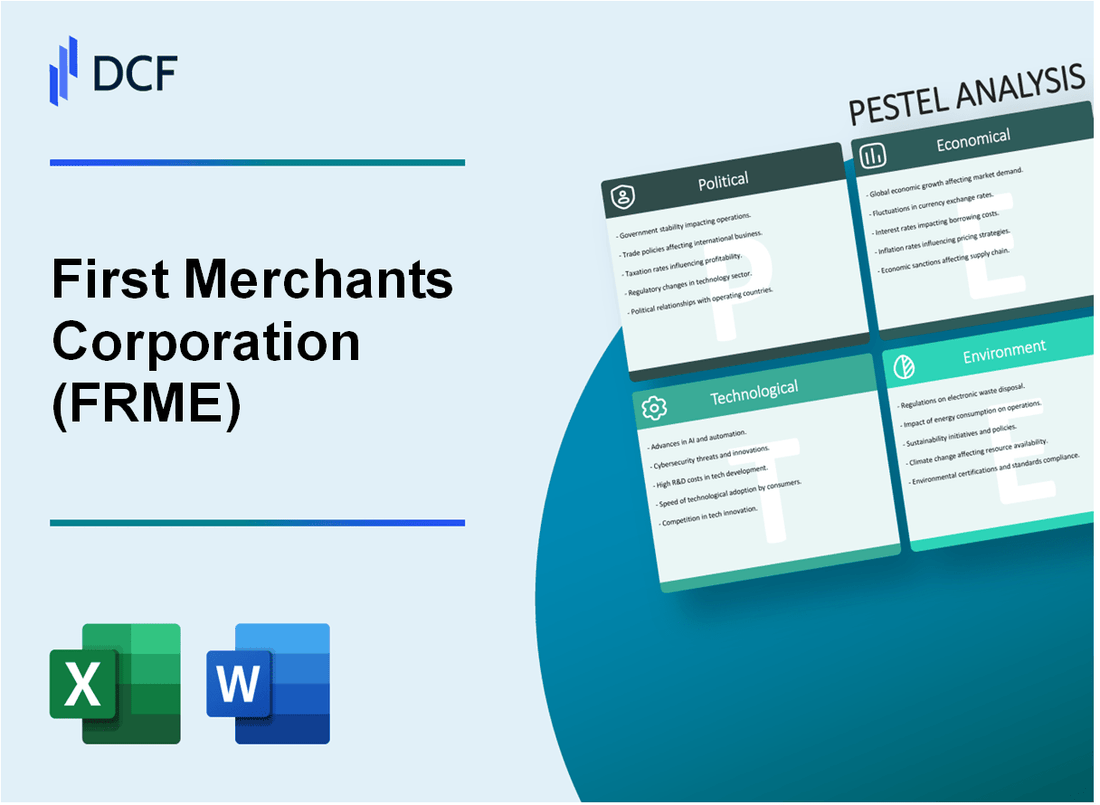
Totalmente Editável: Adapte-Se Às Suas Necessidades No Excel Ou Planilhas
Design Profissional: Modelos Confiáveis E Padrão Da Indústria
Pré-Construídos Para Uso Rápido E Eficiente
Compatível com MAC/PC, totalmente desbloqueado
Não É Necessária Experiência; Fácil De Seguir
First Merchants Corporation (FRME) Bundle
No cenário dinâmico do setor bancário regional, a First Merchants Corporation (FRME) navega em uma complexa rede de desafios e oportunidades entre domínios políticos, econômicos, sociológicos, tecnológicos, legais e ambientais. Essa análise abrangente de pestles revela os fatores complexos que moldam o cenário estratégico do banco, revelando como as forças externas se interagem com seu modelo de negócios principal. Das pressões regulatórias às inovações tecnológicas, a FRME está no cruzamento dos princípios bancários tradicionais e da dinâmica emergente do mercado, posicionando -se para se adaptar e prosperar em um ecossistema financeiro cada vez mais competitivo.
First Merchants Corporation (FRME) - Análise de pilão: fatores políticos
Regulamentos bancários influenciados pelas políticas monetárias do Federal Reserve
A partir de 2024, o Federal Reserve mantinha um Fundos federais Taxa alvo de 5,25% a 5,50%, afetando diretamente as operações bancárias. A First Merchants Corporation deve cumprir esses principais requisitos regulatórios:
| Requisito regulatório | Impacto de conformidade |
|---|---|
| Índice de adequação de capital | Mínimo 10,5% necessário |
| Índice de cobertura de liquidez | Mínimo 100% obrigatório |
| Taxa de financiamento estável líquido | Mínimo 100% necessário |
Impacto potencial da mudança de requisitos de conformidade financeira
O cenário atual de conformidade financeira inclui:
- Implementação da estrutura regulatória de Basileia III
- Dodd-Frank Wall Street Reform Compliance
- Requisitos de relatório aprimorados da Lei de Sigilo Banco
Estabilidade política em Indiana e região do meio -oeste
O ambiente político de Indiana demonstra estabilidade com:
| Métrica política | 2024 Status |
|---|---|
| Excedente do orçamento do estado | US $ 2,14 bilhões |
| Taxa de desemprego | 3.4% |
| Ranking para negócios | 7º nacionalmente |
Apoio ao governo para instituições bancárias regionais
Os mecanismos atuais de apoio ao governo incluem:
- Empréstimo para administração de pequenas empresas garantem até 85% para empréstimos abaixo de US $ 150.000
- Crédito da Lei de Reinvestimento da Comunidade para investimentos bancários regionais
- Incentivos fiscais em nível estadual para expansões de serviços financeiros
First Merchants Corporation (FRME) - Análise de pilão: Fatores econômicos
Flutuações de taxa de juros afetando diretamente estratégias de empréstimos e investimentos
No quarto trimestre 2023, a First Merchants Corporation enfrentou desafios significativos na taxa de juros com a taxa de fundos federais em 5,33%. A margem de juros líquidos do banco para 2023 foi de 3,57%, refletindo o impacto direto da dinâmica da taxa de juros.
| Métrica da taxa de juros | 2023 valor | Impacto na FRME |
|---|---|---|
| Taxa de fundos federais | 5.33% | Ajuste da estratégia de empréstimo direto |
| Margem de juros líquidos | 3.57% | Pressão moderada de lucratividade |
| Rendimento da carteira de empréstimos | 6.22% | Taxas de empréstimos competitivos mantidos |
Saúde Econômica Regional nos Estados do Centro -Oeste
A First Merchants Corporation opera principalmente em Indiana, com ativos totais de US $ 21,4 bilhões em dezembro de 2023. A taxa de desemprego de Indiana foi de 3,4% em dezembro de 2023, indicando condições econômicas regionais estáveis.
| Indicador econômico | Valor de Indiana 2023 | Exposição da FRME |
|---|---|---|
| Taxa de desemprego | 3.4% | Potencial de desempenho de empréstimo positivo |
| Crescimento do PIB do estado | 2.1% | Expansão econômica moderada |
| Total de ativos bancários | US $ 21,4 bilhões | Forte presença do mercado regional |
Riscos potenciais de recessão e implicações econômicas de desaceleração
A taxa de empréstimos sem desempenho da Merchants Corporation foi de 0,53% em 2023, demonstrando resiliência contra possíveis crises econômicas. O banco manteve um índice de capital de Nível 1 de 12,7%, fornecendo um buffer financeiro substancial.
| Mitric mitigação de risco | 2023 valor | Indicador de resiliência econômica |
|---|---|---|
| Razão de empréstimos não-desempenho | 0.53% | Exposição ao risco de baixo crédito |
| Índice de capital de camada 1 | 12.7% | Forte adequação de capital |
| Reserva de perda de empréstimo | US $ 156 milhões | Gerenciamento de risco robusto |
Cenário competitivo do setor bancário regional
A First Merchants Corporation concluiu uma fusão com o MGC Bank em 2023, expandindo sua presença no mercado. O total de depósitos do banco atingiu US $ 18,6 bilhões, representando um crescimento de 7,2% ano a ano.
| Métrica competitiva | 2023 valor | Posição de mercado |
|---|---|---|
| Total de depósitos | US $ 18,6 bilhões | Forte participação de mercado regional |
| Crescimento de depósito | 7.2% | Aquisição consistente do cliente |
| Número de ramificações | 129 | Extensa cobertura regional |
First Merchants Corporation (FRME) - Análise de pilão: Fatores sociais
Mudança de preferências do consumidor para experiências bancárias digitais
De acordo com o relatório bancário digital 2023 da Deloitte, 78% dos clientes bancários preferem canais bancários digitais. A taxa de adoção bancária digital da First Merchants Corporation atingiu 65% no quarto trimestre 2023, com o uso bancário móvel aumentando em 22% ano a ano.
| Canal digital | Porcentagem de usuário (2023) | Crescimento ano a ano |
|---|---|---|
| Mobile Banking | 65% | 22% |
| Bancos online | 58% | 15% |
| Pagamentos digitais | 47% | 18% |
Mudanças demográficas no meio -oeste que afetam a base de clientes bancários
Os dados do U.S. Census Bureau revelam a dinâmica populacional do Centro -Oeste para 2023: a taxa de crescimento populacional de Indiana em 0,3%, com áreas urbanas como Indianapolis experimentando 1,2% de aumento da população. A base de clientes da First Merchants Corporation em Indiana compreende 62% dos residentes urbanos, 38% dos residentes rurais.
| Segmento demográfico | Porcentagem de base de clientes | Saldo médio da conta |
|---|---|---|
| Millennials (25-40 anos) | 35% | $45,600 |
| Gen X (41-56 anos) | 28% | $78,300 |
| Baby Boomers (57-75 anos) | 22% | $92,500 |
Crescente demanda por serviços financeiros personalizados e tecnologia
O relatório de serviços financeiros de 2023 da McKinsey indica que 72% dos clientes esperam experiências bancárias personalizadas. A First Merchants Corporation investiu US $ 3,2 milhões em tecnologias de personalização orientadas pela IA em 2023, resultando em um aumento de 19% nas pontuações de satisfação do cliente.
Ênfase crescente na inclusão financeira e apoio bancário da comunidade
Os dados do Federal Reserve mostram que a First Merchants Corporation alocou US $ 5,7 milhões para iniciativas de desenvolvimento comunitário em 2023. Os programas de inclusão financeira do banco suportaram 4.200 indivíduos de renda de baixa a moderada com produtos bancários especializados.
| Programa de inclusão | Indivíduos apoiados | Valor do investimento |
|---|---|---|
| Serviços bancários de baixa renda | 2,800 | US $ 3,1 milhões |
| Suporte para pequenas empresas | 1,400 | US $ 2,6 milhões |
First Merchants Corporation (FRME) - Análise de Pestle: Fatores tecnológicos
Investimento contínuo em plataformas bancárias digitais e aplicativos móveis
A First Merchants Corporation investiu US $ 12,4 milhões em tecnologia bancária digital em 2023. Downloads de aplicativos de mobile bancos aumentaram 37% ano a ano. O volume de transações digitais atingiu 68% do total de interações bancárias.
| Métricas de investimento digital | 2023 dados |
|---|---|
| Investimento digital total | US $ 12,4 milhões |
| Downloads de aplicativos móveis | Aumentou 37% |
| Porcentagem de transações digitais | 68% |
Melhoria de segurança cibernética e proteção de infraestrutura digital
Os gastos com segurança cibernética atingiram US $ 8,7 milhões em 2023. Zero grandes violações de segurança relatadas. Implementou criptografia de 256 bits em todas as plataformas digitais.
| Métricas de segurança cibernética | 2023 Figuras |
|---|---|
| Investimento de segurança cibernética | US $ 8,7 milhões |
| Incidentes de violação de segurança | 0 |
| Padrão de criptografia | 256 bits |
Adoção de inteligência artificial e aprendizado de máquina em serviços financeiros
O orçamento de implementação da IA alocou US $ 5,6 milhões em 2023. Modelos de aprendizado de máquina implantados para:
- Detecção de fraude
- Avaliação de risco de crédito
- Previsão de comportamento do cliente
| Áreas de implementação da IA | Investimento |
|---|---|
| Orçamento total da IA | US $ 5,6 milhões |
| Precisão da detecção de fraude | 94.3% |
| Modelo de risco de crédito Precisão | 89.7% |
Implementação de análises de dados avançadas para insights do cliente
A infraestrutura de análise de dados expandiu -se com investimentos de US $ 4,2 milhões. A precisão da segmentação do cliente melhorou para 92,5%. Os recursos de processamento de dados em tempo real aprimorados.
| Métricas de análise de dados | 2023 desempenho |
|---|---|
| Investimento de análise | US $ 4,2 milhões |
| Precisão da segmentação do cliente | 92.5% |
| Velocidade de processamento de dados | 0,03 segundos/transação |
First Merchants Corporation (FRME) - Análise de pilão: fatores legais
Conformidade com os regulamentos bancários
A First Merchants Corporation demonstra conformidade com os principais regulamentos bancários por meio de métricas específicas:
| Regulamento | Status de conformidade | Frequência de relatório |
|---|---|---|
| Lei Dodd-Frank | Conformidade total | Trimestral |
| Requisitos de capital Basileia III | Tier 1 Capital Ratio: 12,4% | Anual |
| Lavagem anti-dinheiro (AML) | Conformidade certificada | Monitoramento contínuo |
Gerenciamento de riscos e relatórios regulatórios
Requisitos de relatórios regulatórios:
- Relatórios abrangentes de avaliação de risco enviados ao Federal Reserve
- Envios abrangentes de análise e revisão de capital (CCAR) (CCAR)
- Conformidade anual de teste de estresse
| Métrica de relatório | 2023 valor | Limiar regulatório |
|---|---|---|
| Ativos ponderados por risco | US $ 14,2 bilhões | Dentro dos limites aceitáveis |
| Índice de cobertura de liquidez | 142% | 100% mínimo necessário |
Possíveis desafios legais em fusões e aquisições
Métricas recentes de conformidade com fusões e aquisições:
- Custos de consultoria jurídica total para fusões e aquisições: US $ 1,3 milhão em 2023
- Aprovações regulatórias bem -sucedidas: 3 transações
- Conformidade com a Lei de Melhorias Antitruste Hart-Scott-Rodino
Leis de proteção ao consumidor
| Regulamento de proteção ao consumidor | Medida de conformidade | Ações de execução |
|---|---|---|
| Lei da verdade em empréstimos | 100% de conformidade de divulgação | Zero violações |
| Lei de Relatórios de Crédito Justo | Proteção abrangente de dados do consumidor | Sem penalidades regulatórias |
| Lei de Oportunidade de Crédito Igual | Práticas de empréstimos não discriminatórios verificados | Zero reivindicações de discriminação |
Investimento de conformidade legal: US $ 4,7 milhões alocados para conformidade legal e regulatória em 2023.
First Merchants Corporation (FRME) - Análise de Pestle: Fatores Ambientais
Práticas bancárias sustentáveis e iniciativas de financiamento verde
A First Merchants Corporation reportou US $ 127,4 milhões em produtos de empréstimos verdes e financiamento sustentável a partir do quarto trimestre 2023. O banco comprometido em alocar 15% de sua carteira total de empréstimos para projetos ambientalmente responsáveis até 2025.
| Categoria de finanças verdes | Investimento total ($ m) | Porcentagem de portfólio |
|---|---|---|
| Financiamento de energia renovável | 52.6 | 6.3% |
| Projetos de eficiência energética | 38.9 | 4.7% |
| Empréstimos agrícolas sustentáveis | 35.9 | 4.3% |
Redução da pegada de carbono nas operações bancárias
A First Merchants Corporation reduziu as emissões operacionais de carbono em 22,7% em 2023, com as emissões totais medidas a 8.340 toneladas de Toneladas de CO2 equivalentes. O banco implementou tecnologias com eficiência energética em 43 localizações de agências.
| Estratégia de redução de emissões | Taxa de implementação | Economia de carbono (toneladas métricas) |
|---|---|---|
| Atualizações de iluminação LED | 89% | 1,872 |
| Virtualização do servidor | 76% | 1,245 |
| Políticas de trabalho remotas | 62% | 1,653 |
Investimento em produtos financeiros ambientalmente responsáveis
A First Merchants Corporation lançou 7 novos fundos de investimento focados na ESG em 2023, totalizando US $ 364,5 milhões em ativos sob gestão. Os produtos de investimento sustentável do banco mostraram um crescimento de 12,4% em comparação com o ano anterior.
Avaliação de risco climático em estratégias de empréstimo e investimento
O banco realizou avaliações abrangentes de risco climático para 89% de sua carteira de empréstimos comerciais, identificando possíveis riscos financeiros relacionados às mudanças climáticas. Estratégias de mitigação de riscos climáticos resultaram em US $ 46,2 milhões em ajustes proativos de portfólio.
| Categoria de risco | Impacto financeiro potencial ($ m) | Estratégias de mitigação |
|---|---|---|
| Riscos climáticos físicos | 28.7 | Diversificação e seguro |
| Riscos de transição | 17.5 | Realocação do setor |
First Merchants Corporation (FRME) - PESTLE Analysis: Social factors
The accelerating Great Wealth Transfer to Millennials and Gen Z requires new wealth management and personalized digital services.
You're looking at a generational shift that's already underway, and it's massive. The Great Wealth Transfer (GWT) is set to move an estimated $84 trillion to $90 trillion from older generations to Millennials and Generation Z by 2045. This isn't just new money; it's a new mindset. These younger clients demand transparency, digital-first engagement, and hyper-personalized advice, and they often prioritize environmental, social, and governance (ESG) factors in their investments.
For First Merchants Corporation, whose total assets stood at $18.8 billion as of September 30, 2025, this means their Private Wealth Advisors division must defintely accelerate its digital offerings. The wealth is coming, but it won't stay with an advisor who can't meet them on a mobile app. The opportunity is huge, but the execution risk on the digital side is real.
Over 50% of Millennials and Gen Z are likely to switch financial institutions if their banking needs are better met elsewhere, raising customer churn risk.
The loyalty dynamic has fundamentally changed. Unlike previous generations, Millennials and Gen Z are not sticky customers; they will leave for a better experience. Millennials are, in fact, 2.5 times more likely to switch banks compared to other generations. The key trigger for churn is often a poor digital experience, with 75% of Millennials stating they would switch banks if offered a better mobile platform.
This high churn potential is a direct threat to a regional bank like First Merchants Corporation, which must compete not just with national giants but also with nimble, digital-only neobanks. Your core deposit base, which was $14.9 billion as of Q3 2025, is constantly under pressure from competitors offering seamless, app-based services.
- Gen Z's digital adoption is high: 92% prefer mobile banking apps over a physical branch.
- Millennials prioritize convenience: 81% cite customer service quality as a top factor in choosing a bank.
The bank's core strategy relies on 'personal service' and local decision-making, which is a strong differentiator against large national banks.
This is where First Merchants Corporation's community bank model becomes a critical social asset. Their strategy centers on 'personal service' and 'local decision-making,' which is a clear differentiator against the bureaucratic, centralized model of larger competitors. This relationship-first approach resonates deeply with small- to medium-sized business owners and older, established clients in their Indiana, Ohio, and Michigan footprint.
The bank's challenge is bridging this high-touch, local model with the digital demands of the next generation. Here's the quick math: retaining a loyal, relationship-driven commercial client often generates significantly higher lifetime value than acquiring a transactional, digital-only retail client. So, maintaining the personal service quality is paramount, even as digital tools are added.
An aging Baby Boomer demographic in their Midwest footprint increases demand for stable, interest-earning products like Certificates of Deposit.
The Midwest, like the rest of the US, is aging. The national population aged 80 and over is projected to increase to 14.7 million people in 2025 alone. For this demographic, capital preservation and stable, guaranteed returns are paramount, which drives a strong demand for Certificates of Deposit (CDs).
This trend is a major factor in First Merchants Corporation's funding strategy. As of June 30, 2025, the bank reported $505.2 million in brokered Certificates of Deposit. This high volume of CDs, while a more expensive source of funding than core checking accounts, provides the stable, long-term funding necessary for loan growth and reflects the financial preferences of the older client base in their regional market.
| Social Trend / Demographic | Financial Impact on First Merchants Corporation (FRME) (2025 Data) | Strategic Action Required |
|---|---|---|
| Great Wealth Transfer (GWT) | $84T to $90T transfer by 2045. Creates massive new demand for wealth management services. | Invest heavily in Private Wealth Advisors' digital platforms and ESG-focused products to capture Next-Gen HNWIs. |
| Millennial/Gen Z Churn Risk | 75% of Millennials would switch banks for a better mobile experience. Direct threat to core deposit retention. | Prioritize mobile-first, frictionless user experience (UX) and seamless omni-channel support. |
| Aging Baby Boomer Population (Midwest) | High demand for stable, interest-earning products. FRME holds $505.2 million in brokered CDs (Q2 2025). | Maintain competitive CD rates to secure stable funding; cross-sell wealth preservation and trust services. |
| Core Value Proposition (Local Service) | Local decision-making is a key differentiator against large national banks. | Protect the 'community bank' culture while integrating digital tools; ensure technology enhances, not replaces, personal relationships. |
First Merchants Corporation (FRME) - PESTLE Analysis: Technological factors
The bank faces pressure to invest heavily in Generative AI (GenAI) and automation to match competitors who are already seeing positive revenue effects.
You can't afford to be a laggard in the Generative AI (GenAI) race; the gap between early adopters and those in a wait-and-see mode is defintely widening in 2025. For the banking industry globally, GenAI could deliver value equal to an additional $200 billion to $340 billion annually if use cases were fully implemented, mostly through customer operations, sales, and software engineering.
The imperative for First Merchants Corporation is clear: competitors are already monetizing their tech spend. For example, a peer regional bank, Regions Financial, reported that their technology and talent investments drove a 10% year-over-year revenue growth in Q2 2025, with total revenue for the quarter reaching $1.9 billion. This kind of return sets a high bar.
The average return on investment (ROI) for every $1 spent on GenAI for financial services companies is a 4.2x return, far outpacing the general corporate average. Banks like First Merchants Corporation need to shift their focus from just 'running the bank' (RTB) technology, which absorbs over 60% of overall tech spend industry-wide, toward innovation that drives revenue.
Increased data processing and technology costs contributed to a rise in noninterest expense in Q2 2025, indicating the start of a costly digital transition.
The digital pivot is not cheap, and First Merchants Corporation is already seeing the expense side of this transition. In the second quarter of 2025, the Corporation's total noninterest expense rose to $93.6 million, an increase of $0.7 million from the $92.9 million reported in the first quarter of 2025.
A key driver of this increase was higher data processing costs, a direct sign of scaling up technology infrastructure to support digital services. The efficiency ratio, a measure of noninterest expense as a percentage of revenue, was 53.99% in Q2 2025, and 55.09% in Q3 2025. Maintaining a competitive efficiency ratio while aggressively investing in technology is the tightrope walk for regional banks right now.
Here's the quick math on the Q2 2025 expense shift:
| Metric | Q1 2025 Value | Q2 2025 Value | Change (Q2 vs Q1) |
|---|---|---|---|
| Noninterest Expense | $92.9 million | $93.6 million | +$0.7 million |
| Primary Drivers of Increase | N/A | Higher marketing and data processing costs | N/A |
| Efficiency Ratio | N/A | 53.99% | N/A |
A significant majority of consumers (77%) prefer to manage their accounts via mobile app or computer, making seamless digital experience a survival necessity.
The customer has spoken, and they prefer digital. A significant majority of U.S. consumers, specifically 77%, prefer to manage their bank accounts through a mobile app or a computer. This isn't a trend anymore; it's the default mode of operation.
For First Merchants Corporation, a seamless digital experience is a survival necessity, not a value-add. If your mobile app isn't top-tier, you risk losing customers to digital-first competitors. This is how the preference breaks down:
- 42% of consumers prefer using a mobile app to manage their finances, making it the single most popular choice.
- 36% prefer online banking via a website.
- 34% of consumers use a mobile banking app daily.
This preference is strongest with Millennials, where 80% prefer digital banking, but it's high across all age groups, including 72% of Gen Z. You have to meet the customer where they are, and where they are is on their phone.
Digital upgrades are critical for valuation, as investors are betting on regional banks that can effectively integrate technology.
Investors are increasingly using technology integration as a key metric for separating regional bank winners from losers. Digital upgrades are no longer just an operational expense; they are a direct driver of valuation. Some investors see First Merchants Corporation's future fair value as high as $46.83 per share, specifically citing 'robust Midwest growth and digital upgrades' as a basis for this optimism.
As of October 2025, the stock was trading at a Price-to-Earnings (P/E) ratio of 9.3x, which is notably below the industry average of 11.2x. This suggests the market may be undervaluing the company, but only successful, visible technology integration will close that valuation gap and push the stock toward the analyst price targets, which currently range from $45 to $50. The market is betting on the regional banks that can deliver double-digit annual earnings growth in the near term, and technology is the primary lever for that improved operating leverage.
First Merchants Corporation (FRME) - PESTLE Analysis: Legal factors
The Federal Reserve's revised Basel III framework, finalized in late 2024, will likely widen the competitive gap by easing capital constraints for megabanks.
You need to look past the headlines about bank capital rules, because the latest revisions to the Basel III Endgame proposal are actually a nuanced risk for a bank of First Merchants Corporation's size. The Federal Reserve's revised plan, which is expected to begin its transition period in July 2025, specifically exempts banks with total consolidated assets under $100 billion from the most burdensome new requirements for credit risk and operational risk. Given that First Merchants Corporation's total assets were approximately $18.6 billion as of the second quarter of 2025, this tailoring is a huge win for regional banks like yours.
The real competitive risk is not from the rules themselves, but from the perception of stability. Megabanks, though facing a capital increase of around 9% (down from the initial proposal's 20% hike), get a regulatory stamp of superior soundness. Still, you avoid the significant compliance cost and capital drag that would have been required under the original proposal, which would have applied to banks with over $100 billion in assets. This is a defintely a short-term operational advantage.
| Regulatory Requirement | Applicability to First Merchants Corporation (FRME) (~$18.6 Billion Assets) | Impact on Operations |
|---|---|---|
| Basel III Endgame (Credit & Operational Risk) | Exempt (Threshold is $100 Billion+) | Avoids material increase in capital requirements, keeping capital ratios efficient. |
| Common Equity Tier 1 (CET1) Capital Ratio (Q2 2025) | 11.35% | Maintains strong capital buffer well above regulatory minimums. |
| Total Risk-Based Capital Ratio (Q2 2025) | 13.06% | Reflects robust stability, prioritizing safety over aggressive leverage. |
The bank must ensure compliance with its Environmental Policy, which was approved by the Nominating and Governance Committee in February 2025.
The growing focus on Environmental, Social, and Governance (ESG) criteria is moving from a soft-power investor preference to a hard-line compliance issue, and First Merchants Corporation is no exception. The Nominating and Governance Committee formally approved the Environmental Policy on February 6, 2025, which means the bank is now legally and reputationally bound to its commitments.
This policy requires the bank to actively manage the environmental impact of its operations and physical facilities, like all branches and offices. Compliance means more than just a statement; it requires new internal audits and resource allocation, which translates directly into noninterest expense. For example, noninterest expense totaled $96.6 million in the third quarter of 2025, a $3.0 million increase from the prior quarter, which highlights the continuous upward pressure on operational costs, partly driven by increased compliance and reporting requirements across the enterprise.
- Identify and mitigate environmental risks in business practices.
- Comply with all applicable environmental regulations.
- Measure and monitor environmental impact metrics.
- Report sustainability efforts to the Nominating & Governance Committee.
Ongoing US political debate over corporate tax rates and trade policies creates uncertainty for commercial clients in the Midwest.
The biggest near-term legal uncertainty for your commercial clients in the Midwest is the looming expiration of key provisions from the 2017 Tax Cuts and Jobs Act (TCJA) at the end of 2025. While the corporate income tax rate remains permanently at 21%, the expiration of the 20% deduction for pass-through businesses (Qualified Business Income Deduction, or QBID) is a critical issue for small and mid-sized businesses-the core of the bank's commercial lending portfolio.
If Congress allows QBID to expire, the top tax rate on pass-through business income could jump from an effective rate of 29.6% to 39.6% for the highest earners. This massive swing in after-tax income creates capital planning paralysis for these clients, directly impacting their willingness to take out new commercial loans for expansion or equipment purchase. Plus, the ongoing political talk about new tariffs and trade policy shifts makes long-term supply chain planning a nightmare for manufacturing and agricultural clients, which are prevalent in the bank's operating states of Indiana, Ohio, Michigan, and Illinois.
The legal framework is primarily designed to protect depositors and the banking system, not shareholders, meaning regulation always prioritizes stability over profit.
This is the foundational truth of banking regulation: your primary regulator, the Federal Reserve, is focused on safety and soundness (macro-stability), not maximizing shareholder returns. Every regulation, from capital requirements to consumer protection laws, is a direct cost to the bank's profitability. For First Merchants Corporation, this is evident in the conservative capital management and the continuous cost of compliance.
The bank's strong capital position, with a Common Equity Tier 1 (CET1) ratio of 11.34% and a Total Risk-Based Capital ratio of 13.04% in the third quarter of 2025, shows a clear adherence to this stability mandate. This robust capital, while comforting to depositors, represents capital that cannot be deployed for higher-return, riskier ventures. The $5.1 million in net charge-offs and the $4.3 million provision for credit losses recorded in Q3 2025 are also a function of the regulatory environment that mandates conservative loss provisioning (Allowance for Credit Losses or ACL), ensuring the system remains protected even during economic stress.
First Merchants Corporation (FRME) - PESTLE Analysis: Environmental factors
The bank has an Environmental Policy and an ESG Committee to oversee strategies, approved in early 2025.
You need a clear signal that the company is taking environmental factors seriously, and First Merchants Corporation delivered that signal early in the 2025 fiscal year. The Board of Directors formally approved the company's Environmental Policy and established its Environmental, Social, and Governance (ESG) Committee on February 6, 2025. This isn't just a paper exercise; the Board delegates oversight of all ESG efforts to the Nominating & Governance Committee, which then works with the executive-level ESG Committee to set strategy and metrics.
This structure shows a top-down commitment, but the real work is in the execution. The policy itself is focused on minimizing the negative environmental impact of their direct operations. Honestly, that's where any regional bank should start.
FRME does not publicly report specific carbon emissions data or formal 2030/2050 climate goals, putting them behind the industry average on disclosure.
Here's the quick math on transparency: right now, First Merchants Corporation is lagging its peers on public disclosure. The company does not currently report specific carbon emissions data-that includes Scope 1 (direct), Scope 2 (electricity-related), or the more challenging Scope 3 (value chain) emissions. Plus, they have not established formal, public-facing climate goals for 2030 or 2050, which is a key expectation for institutional investors like BlackRock and Vanguard.
This lack of quantifiable data is a material risk for your ESG rating. For perspective, the bank's current environmental profile score is around 25, which is lower than 63% of the industry benchmark. That gap is a clear opportunity for improvement and a potential vulnerability to activist shareholders.
There is growing pressure from investors and regulators to assess and disclose climate-related financial risk, despite a November 2025 appeals court pause on a California disclosure law.
The regulatory landscape is in flux, but the direction is clear: mandatory climate disclosure is coming. On November 18, 2025, the U.S. Court of Appeals for the Ninth Circuit temporarily paused enforcement of California's Senate Bill (SB) 261, the Climate-Related Financial Risk Act. This law would have required companies with over $500 million in annual global revenue to file biennial reports aligned with the Task Force on Climate-related Financial Disclosures (TCFD) framework. That's a temporary reprieve.
Still, the court declined to pause SB 253, the Climate Corporate Data Accountability Act. This law, which applies to companies with over $1 billion in annual revenue, is moving forward. It requires the disclosure of Scope 1 and 2 emissions for the 2025 fiscal year, with initial reports due in August 2026. This means that, regardless of the SB 261 pause, the groundwork for emissions accounting must defintely continue.
Here is a snapshot of the near-term regulatory status:
| California Climate Law | Requirement | Annual Revenue Threshold | Status (November 2025) |
|---|---|---|---|
| SB 253 (GHG Emissions) | Annual Scope 1 & 2 reporting for FY 2025 | Over $1 billion | Active. Implementation proceeding. |
| SB 261 (Climate Risk) | Biennial TCFD-aligned financial risk report | Over $500 million | Paused. Enforcement enjoined by Ninth Circuit pending appeal. |
Operational focus is on mitigating environmental impact of physical facilities, including branches and offices, through waste reduction and efficiency.
Since the bank's primary footprint is its physical network-branches and offices-the environmental strategy rightly centers on managing resource consumption. The Environmental Policy explicitly targets four key areas for active management and mitigation of environmental impact.
The key focus areas are:
- Managing Energy (electricity/gas) consumption.
- Monitoring Water usage.
- Reducing Paper consumption.
- Improving Waste management practices.
What this estimate hides is the lack of public metrics. While the intent is clear, the market cannot currently track the bank's progress, for instance, in paper reduction or energy efficiency gains across its facilities. Given the company's Q3 2025 net income of $56.3 million, dedicating a fraction of that to a formal, auditable environmental data collection and public reporting system is an easy win for investor relations and risk mitigation.
Disclaimer
All information, articles, and product details provided on this website are for general informational and educational purposes only. We do not claim any ownership over, nor do we intend to infringe upon, any trademarks, copyrights, logos, brand names, or other intellectual property mentioned or depicted on this site. Such intellectual property remains the property of its respective owners, and any references here are made solely for identification or informational purposes, without implying any affiliation, endorsement, or partnership.
We make no representations or warranties, express or implied, regarding the accuracy, completeness, or suitability of any content or products presented. Nothing on this website should be construed as legal, tax, investment, financial, medical, or other professional advice. In addition, no part of this site—including articles or product references—constitutes a solicitation, recommendation, endorsement, advertisement, or offer to buy or sell any securities, franchises, or other financial instruments, particularly in jurisdictions where such activity would be unlawful.
All content is of a general nature and may not address the specific circumstances of any individual or entity. It is not a substitute for professional advice or services. Any actions you take based on the information provided here are strictly at your own risk. You accept full responsibility for any decisions or outcomes arising from your use of this website and agree to release us from any liability in connection with your use of, or reliance upon, the content or products found herein.