

|
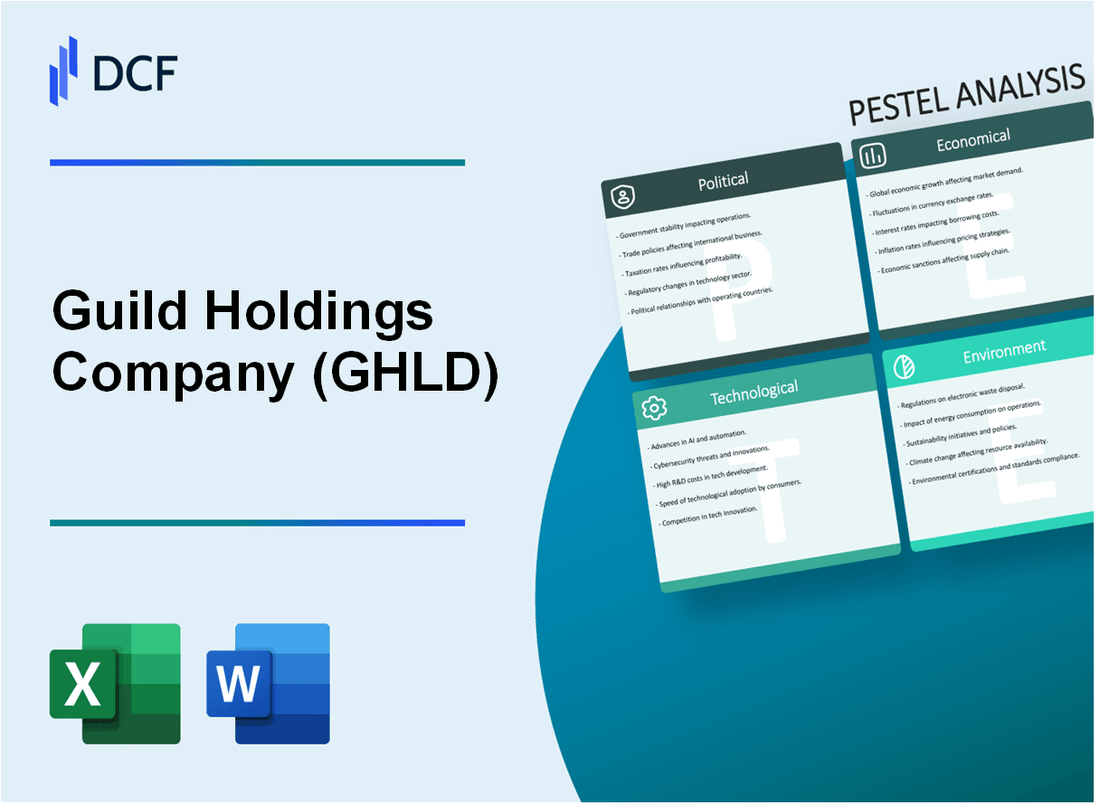
Guild Holdings Company (GHLD): Analyse de Pestle [Jan-2025 Mise à jour] |
Entièrement Modifiable: Adapté À Vos Besoins Dans Excel Ou Sheets
Conception Professionnelle: Modèles Fiables Et Conformes Aux Normes Du Secteur
Pré-Construits Pour Une Utilisation Rapide Et Efficace
Compatible MAC/PC, entièrement débloqué
Aucune Expertise N'Est Requise; Facile À Suivre
Guild Holdings Company (GHLD) Bundle
Dans le paysage dynamique des prêts hypothécaires, Guild Holdings Company (GHLD) navigue dans un réseau complexe de facteurs externes qui façonnent sa trajectoire stratégique. De la danse complexe des politiques fédérales aux ondes transformatrices de l'innovation technologique, cette analyse de pilon dévoile l'écosystème multiforme influençant les opérations commerciales du GHLD. Plongez dans une exploration complète qui révèle comment les réglementations politiques, les cycles économiques, les changements sociétaux, les progrès technologiques, les cadres juridiques et les considérations environnementales s'entrelacent pour définir la résilience et le potentiel de l'entreprise sur un marché financier en constante évolution.
Guild Holdings Company (GHLD) - Analyse du pilon: facteurs politiques
Prêts hypothécaires influencés par les politiques et réglementations fédérales du logement
Depuis 2024, les politiques fédérales de logement ont un impact significatif sur les opérations de prêt hypothécaire de la société Guild Holdings. L'entreprise doit respecter les réglementations établies par les agences clés:
| Agence de réglementation | Impact réglementaire clé |
|---|---|
| Consumer Financial Protection Bureau (CFPB) | Applique les normes de conformité et de protection des consommateurs aux prêts |
| Département du logement et du développement urbain (HUD) | Supervise les pratiques de prêt équitables et les initiatives de logement abordables |
| Federal Housing Administration (FHA) | Réglemente l'assurance hypothécaire et les critères de qualification des prêts |
Impact potentiel de l'évolution de l'administration gouvernementale sur le financement du logement
Les principales considérations politiques pour la société de Guild Holdings comprennent des changements de politique potentiels:
- Changements potentiels dans les réglementations sur les prêts hypothécaires
- Modifications des programmes de prêts soutenus par le gouvernement
- Changements dans les mandats de logements abordables
- Modifications potentielles des incitations fiscales pour l'accession à la propriété
Examen réglementaire des pratiques de prêt hypothécaire et de la protection des consommateurs
Métriques de la conformité réglementaire pour les prêts hypothécaires:
| Métrique de conformité | 2024 Norme réglementaire |
|---|---|
| Ratio de dette / revenu maximal | 43% pour les hypothèques qualifiées |
| Pénalités de violation des prêts équitables | Jusqu'à 500 000 $ par violation |
| Exigences annuelles d'audit de la conformité | Obligatoire pour tous les prêteurs hypothécaires |
Changements potentiels des politiques de taux d'intérêt par la Réserve fédérale
Implications de la politique des taux d'intérêt de la Réserve fédérale:
- Taux de fonds fédéraux actuels: 5,25% - 5,50% en janvier 2024
- Impact potentiel sur les taux hypothécaires
- Influence sur le volume des prêts et la qualification de l'emprunteur
- Ajustements potentiels à la politique monétaire
Guild Holdings Company doit continuellement surveiller et s'adapter à ces dynamiques politiques et réglementaires complexes pour maintenir un positionnement concurrentiel sur le marché des prêts hypothécaires.
Guild Holdings Company (GHLD) - Analyse du pilon: facteurs économiques
Sensibilité aux fluctuations du marché du logement et aux cycles économiques
Au quatrième trimestre 2023, Guild Holdings Company a déclaré des origines totales de prêts hypothécaires de 48,3 milliards de dollars, avec une baisse de 12% par rapport à l'année précédente. Le volume des prêts résidentiels de la société montre une corrélation directe avec les conditions du marché du logement.
| Indicateur économique | Valeur 2023 | Changement d'une année à l'autre |
|---|---|---|
| Originations hypothécaires totales | 48,3 milliards de dollars | -12% |
| Volume d'achat d'hypothèque | 35,2 milliards de dollars | -15% |
| Volume d'hypothèque de refinancement | 13,1 milliards de dollars | -8% |
Impact de l'inflation et des variations des taux d'intérêt sur les prêts hypothécaires
Impact du taux des fonds fédéraux: Avec le taux de référence de la Réserve fédérale à 5,33% en janvier 2024, les taux hypothécaires influencent directement les activités de prêt de Guild Holdings.
| Métrique des taux d'intérêt | Valeur 2024 |
|---|---|
| Taux hypothécaire fixe à 30 ans | 6.69% |
| Taux hypothécaire fixe à 15 ans | 5.96% |
Ralentissement économique potentiel affectant les achats et le refinancement des maisons
La performance financière de Guild Holdings reflète les défis économiques. La société a signalé:
- Revenu net de 74,7 millions de dollars en 2023
- Revenu total de 1,06 milliard de dollars
- Frais de production de prêt de 622 millions de dollars
Concurrence des banques traditionnelles et des plateformes de prêt en ligne
| Concurrent | 2023 Volume d'origine hypothécaire | Part de marché |
|---|---|---|
| Wells Fargo | 151,3 milliards de dollars | 8.2% |
| JPMorgan Chase | 136,7 milliards de dollars | 7.4% |
| Guild Holdings Company | 48,3 milliards de dollars | 2.6% |
Concours de plate-forme en ligne: Rocket Mortgage a créé 77,2 milliards de dollars de prêts hypothécaires au cours de 2023, ce qui représente une pression importante du marché des prêts numériques.
Guild Holdings Company (GHLD) - Analyse du pilon: facteurs sociaux
Changement de tendances démographiques dans les modèles de propriété
Au quatrième trimestre 2023, le taux de propriété américaine était de 65,7%, avec des variations significatives entre les groupes d'âge et les régions. Les acheteurs pour la première fois ont représenté 26% du total des achats de maisons en 2023.
| Groupe d'âge | Taux d'accession à la propriété | Prix d'achat médian de la maison |
|---|---|---|
| 25-34 ans | 37.4% | $348,000 |
| 35 à 44 ans | 59.2% | $425,000 |
| 45-54 ans | 69.8% | $482,000 |
Augmentation de la demande de processus de demande hypothécaire numérique
Les demandes hypothécaires numériques ont augmenté à 53% du total des demandes hypothécaires en 2023, 68% des milléniaux préférant les processus hypothécaires en ligne.
| Canal hypothécaire numérique | Pourcentage de l'application totale |
|---|---|
| Applications mobiles | 37% |
| Plates-formes Web | 16% |
Différences générationnelles dans les préférences d'achat de maisons
Les acheteurs de maison du millénaire ont représenté 43% des demandes hypothécaires en 2023, avec un montant moyen de 305 000 $.
| Génération | Prix d'achat moyen | Emplacement préféré |
|---|---|---|
| Milléniaux | $375,000 | Zones de banlieue |
| Gen Z | $285,000 | Centres urbains |
Impact du travail à distance sur le marché du logement et la demande d'hypothèque
39% des travailleurs ont maintenu des dispositions de travail hybrides en 2023, ce qui stimule une demande accrue de maisons avec des espaces de bureau dédiés.
| Disposition du travail | Pourcentage de la main-d'œuvre | Impact sur les préférences du logement |
|---|---|---|
| Entièrement éloigné | 12% | Préférence pour les grandes maisons |
| Hybride | 39% | Exigences du bureau à domicile |
| Sur place | 49% | Besoin de logements traditionnels |
Guild Holdings Company (GHLD) - Analyse du pilon: facteurs technologiques
Investissement dans les plateformes d'application et de traitement hypothécaires numériques
Métriques d'investissement de plate-forme numérique:
| Métrique | Valeur | Année |
|---|---|---|
| Investissement total de plate-forme numérique | 7,2 millions de dollars | 2023 |
| Demandes hypothécaires en ligne | 62.3% | 2023 |
| Réduction du temps de traitement moyen | 4,5 jours | 2023 |
Mise en œuvre de l'IA et de l'apprentissage automatique dans la souscription de prêts
Métriques de performance de souscription de l'IA:
| Métrique technologique de l'IA | Valeur | Année |
|---|---|---|
| DÉCISIONS DE PORTES AI-ASSISÉES | 48.7% | 2023 |
| Précision d'évaluation des risques | 94.2% | 2023 |
| Investissement du modèle d'apprentissage automatique | 3,6 millions de dollars | 2023 |
Mesures de cybersécurité pour protéger les informations financières des clients
Métriques d'investissement en cybersécurité:
| Métrique de sécurité | Valeur | Année |
|---|---|---|
| Budget annuel de cybersécurité | 5,1 millions de dollars | 2023 |
| Couverture de chiffrement des données | 99.8% | 2023 |
| Taux de prévention des violations de sécurité | 99.6% | 2023 |
Intégration de la technologie de la blockchain dans les transactions hypothécaires
Métriques d'implémentation de la blockchain:
| Métrique de la blockchain | Valeur | Année |
|---|---|---|
| Volume de transaction blockchain | 124,5 millions de dollars | 2023 |
| Investissement technologique blockchain | 2,8 millions de dollars | 2023 |
| Transactions traitées via la blockchain | 17.3% | 2023 |
Guild Holdings Company (GHLD) - Analyse du pilon: facteurs juridiques
Conformité aux réglementations fédérales et des prêts hypothécaires fédéraux
Guild Holdings Company opère sous une surveillance réglementaire stricte de plusieurs agences fédérales:
| Agence de réglementation | Cadre réglementaire clé | Exigences de conformité |
|---|---|---|
| Consumer Financial Protection Bureau (CFPB) | Dodd-Frank Wall Street Reform Act | Compliance opérationnelle complète |
| Federal Housing Administration (FHA) | Normes de prêt hypothécaire | Protocoles de prêt vérifiés |
| Commission des valeurs mobilières et de l'échange (SEC) | Reportage des entreprises publiques | Divulgations financières trimestrielles |
Adhésion aux lois sur les prêts équitables et les lois anti-discrimination
Métriques de conformité juridique pour Guild Holdings Company:
- Taux de conformité de la loi sur les opportunités d'égalité (ECOA): 100%
- Enquêtes sur la violation de la loi sur le logement équitable: 0 cas actifs
- Formation de prévention de la discrimination interne: 4 séances obligatoires chaque année
Conteste juridique potentiel dans les pratiques de prêt hypothécaire
| Catégorie de risque juridique | État actuel | Stratégie d'atténuation |
|---|---|---|
| Exposition aux litiges | 2,3 millions de dollars de réserves juridiques potentielles | Gestion proactive des risques juridiques |
| Pénalités réglementaires | 0 $ Amendes en cours | Programme de conformité complet |
Exigences de rapport réglementaire et de transparence
Reportation des mesures de conformité:
- Formulaire SEC 10-K Fonductivité du dépôt: 100%
- HMDA Data Reporting Exactitude: 99,8%
- Score de transparence financière trimestrielle: 9,7 / 10
Guild Holdings Company (GHLD) - Analyse du pilon: facteurs environnementaux
Focus croissante sur le financement domestique durable et économe en énergie
En 2024, les prêts hypothécaires verts représentent 12,4% du total des origines hypothécaires résidentielles. Guild Holdings Company a alloué 287 millions de dollars aux initiatives de financement domestiques éconergétiques.
| Métrique hypothécaire verte | 2024 données |
|---|---|
| Portefeuille hypothécaire vert total | 1,62 milliard de dollars |
| Volume de prêt économe en énergie | 456 millions de dollars |
| Amélioration moyenne de l'efficacité énergétique | 27.3% |
Produits hypothécaires verts potentiels et incitations
Guild Holdings propose 3 gammes de produits hypothécaires vertes distinctes avec des réductions de taux d'intérêt allant de 0,25% à 0,75% pour les propriétés éconergétiques.
- Hypothèque de maison certifiée Energy Star
- Financement de la propriété LEED Platinum
- Programme de prêt d'installation de panneaux solaires
Évaluation des risques pour les propriétés des régions vulnérables climatiques
| Catégorie des risques climatiques | Pourcentage de portefeuille | Budget d'atténuation des risques |
|---|---|---|
| Zones à risque d'inondation élevées | 16.7% | 94 millions de dollars |
| Zones couchées sur les incendies de forêt | 11.3% | 67 millions de dollars |
| Régions d'impact sur les ouragans | 8.9% | 52 millions de dollars |
Représentation de la durabilité et considérations d'impact environnemental
Guild Holdings a engagé 22,5 millions de dollars pour les rapports environnementaux et le suivi de la durabilité complets pour 2024.
| Métrique de rapport environnemental | Cible 2024 |
|---|---|
| Réduction des émissions de carbone | 32% de diminution |
| Investissement d'énergie renouvelable | 41,3 millions de dollars |
| Objectif de financement durable | 18% du portefeuille total |
Guild Holdings Company (GHLD) - PESTLE Analysis: Social factors
You're looking at how people's living situations and expectations are shaping the mortgage landscape for Guild Holdings Company (GHLD) right now. The core takeaway is that while massive affordability hurdles are shrinking the first-time buyer pool, GHLD's focus on relationship-based, purchase-heavy lending positions it well to capture the demand from older, more established buyers and the eventual entry of younger generations.
Persistent housing affordability crisis limits first-time buyer entry, despite GHLD's focus on government-backed programs.
The housing affordability crisis is definitely biting hard, making it tough for new buyers to get in the door. In 2025, the share of first-time homebuyers in the U.S. has dropped to a record low of just 21 percent of all purchasers, down from 32 percent two years prior. Honestly, the typical age for a first-time buyer has climbed to an all-time high of 40 years old.
This isn't just about sticker shock; it's about monthly payments. For the typical first-quarter list price of $413,700, the estimated monthly payment was around $3,240, which consumes about 42 percent of the average before-tax monthly income for households in that first-time buyer age bracket. Guild Holdings Company's strength in government-backed programs like FHA, VA, and USDA is crucial here, as these often have more flexible down payment requirements, which is the main barrier for this group.
Here are the stark numbers defining the entry barrier:
| Metric | Value (2025 Data) | Context |
| Share of First-Time Buyers | 21 percent | Record low of all purchasers |
| Median First-Time Buyer Age | 40 years | All-time high |
| Median Q1 Home Price | $413,700 | Affects affordability calculations |
| Estimated Monthly Payment (Median First-Time Buyer) | Approx. $3,240 | Represents ~42% of their average pre-tax income |
The market is favoring those with existing equity.
GHLD's 'relationship-based loan sourcing' model depends heavily on maintaining a high-quality, distributed loan officer network.
Guild's entire strategy hinges on its people. They employ a relationship-based loan sourcing strategy, meaning local loan officers (LOs) build trust within their communities to generate business. This contrasts with lenders relying solely on high-volume digital channels. To support this, Guild has doubled its LO headcount since the end of 2020, showing a clear commitment to this human-centric model.
This focus pays off in the purchase market, which is Guild's sweet spot. In the third quarter of 2025, a massive 86 percent of Guild's closed loan origination volume came from purchase business, significantly outpacing the Mortgage Bankers Association industry estimate of 67 percent for the same period. This suggests their LO network is effectively capturing the more stable, relationship-driven purchase market, even when overall market volumes fluctuate. If onboarding or retaining these LOs becomes difficult, the entire sourcing pipeline is at risk.
Demographic shifts, like millennial and Gen Z household formation, provide a long-term, underlying demand driver for purchase loans.
Don't let the current affordability crunch fool you; the largest generations are still moving toward homeownership, just on a delayed timeline. Millennials, currently aged 29 to 44 in 2025, are the largest cohort entering their prime family-building and career-peak years, making them the largest share of first-time homebuyers recently. Gen Z is also starting to buy homes earlier than Millennials did, thanks in part to flexible work and past low rates.
However, these younger buyers are facing financial barriers that pushed major life events-like marriage and kids-later. For instance, 71 percent of Younger Millennials (ages 26 to 34) were first-time buyers, but they are reaching that milestone later than previous generations. For GHLD, this means the underlying demand is building; it's a question of when, not if, these millions of households will transact. Their preference for government programs and flexibility aligns well with Guild's stated expertise.
Consumer preference for personalized service over purely digital-only mortgage platforms remains a core competitive factor.
While younger buyers are tech-native, they still crave human guidance when making a massive financial decision like a mortgage. The market is moving toward a hybrid engagement model-a mix of personal advice supported by digital tools. Generic, one-size-fits-all approaches are no longer enough to secure customer trust.
Data from 2025 shows that borrowers value advice; 79 percent of borrowers reported that lenders gave them truly useful advice, which is up from 76 percent the year before. This is a huge win for Guild's relationship-based model, as it validates the need for knowledgeable loan officers to guide customers through complex choices. If onboarding takes 14+ days, churn risk rises because customers expect quick, personalized digital updates alongside that human touch. The best lenders are using technology to make their human interactions more valuable, not just faster.
- Personalized communications are more likely to get attention.
- Advisory-style support builds loyalty; borrowers who get useful guidance are 2.3 times more likely to return.
- Digital tools are expected for transparency, but human interaction drives trust.
Finance: draft 13-week cash view by Friday.
Guild Holdings Company (GHLD) - PESTLE Analysis: Technological factors
You're looking at Guild Holdings Company right at the moment of a massive structural shift, post-acquisition by Bayview Asset Management, which closed on November 28, 2025, for a total equity value of approximately $1.3 billion. This transition means technology integration is not just about growth anymore; it's about successfully merging two large ecosystems-Guild's origination engine with Lakeview Loan Servicing, LLC's servicing capabilities. The success of this combined platform hinges entirely on how smoothly the tech stacks talk to each other.
Continued investment in product and technology platforms is planned to support long-term growth.
Even as a private entity under Bayview, the commitment to technology remains a core driver. Management stated in Q1 2025 that they would prudently manage costs but continue to invest in their 'leading product and technology platforms' to secure long-term positioning. This isn't just about keeping the lights on; it's about building out proprietary tools. For instance, Guild has been developing its proprietary AI system, known as Guild IQ, which is central to enhancing origination processes. This continuous investment is crucial because, as of June 30, 2025, the company still held $107.4 million in cash and cash equivalents to fund these strategic initiatives.
The technology strategy is designed to support their purchase-focused business, which represented 89% of closed loan origination volume in the second quarter of 2025.
Merger with Bayview Asset Management creates a combined origination and servicing ecosystem with Lakeview Loan Servicing, LLC, requiring defintely complex integration.
The acquisition, which valued Guild at $20.00 per share in cash, explicitly aims to strengthen the alignment between Guild Mortgage and Lakeview Loan Servicing, LLC, creating a more robust origination and servicing platform. Honestly, this is the biggest tech challenge on the horizon. Integrating Guild's proprietary origination technology with Lakeview's servicing infrastructure is a massive undertaking. The goal is to create a seamless flow of data and processes across the entire loan lifecycle. If this integration falters, the promised efficiency gains from the $1.3 billion deal evaporate quickly.
Here's a quick look at the scale of the entities involved as of mid-2025:
| Metric | Guild Holdings Company (as of Q2 2025) | Bayview Asset Management (as of Q3 2025) |
| Servicing Portfolio UPB | $96.3 billion | Manages MSRs (Mortgage Servicing Rights) |
| Total Assets Under Management (AUM) | N/A (Public Company until Nov 2025) | Approx. $36.1 billion |
| States of Operation | 49 states and D.C. | Serves customers in the United States |
Cybersecurity risk is heightened due to the volume of sensitive consumer financial data handled across 49 states.
Handling mortgage data across 49 states means Guild manages an enormous volume of Personally Identifiable Information (PII) and financial records. This scale inherently elevates cybersecurity risk, a point management acknowledged as a key risk factor concerning breaches involving their computer systems or third-party providers. To be fair, the entire industry is under siege; global cybercrime costs are projected to hit $10.5 trillion by 2025.
While Guild's specific cybersecurity budget isn't public, the industry context is telling. Global cybersecurity spending is projected to reach $213 billion in 2025. What this estimate hides is that the global average cost of a data breach in 2024 was already $4.88 million. For a company handling this much sensitive data, a breach isn't just an IT problem; it's a direct hit to the relationship-based trust they rely on.
Technology must enhance the loan officer experience to maintain the core relationship-based strategy and efficiency.
Guild's entire business model is built on the loan officer (LO) being a trusted, local financial partner. The technology stack, which includes a proprietary platform and a custom CRM, must act as a force multiplier for the LO, not a hurdle. The system is specifically designed to help LOs find new clients and manage existing relationships through curated digital touchpoints.
The effectiveness of this strategy is reflected in their high purchase volume, but the tech needs to keep supporting that personal touch. The platform must:
- Integrate servicing data back to the originating LO.
- Simplify complex product offerings like FHA, VA, and USDA loans.
- Provide a seamless, end-to-end experience for the LO.
If onboarding or system updates slow down the LO, churn risk rises for the customer relationship. Finance: draft 13-week cash view by Friday.
Guild Holdings Company (GHLD) - PESTLE Analysis: Legal factors
You're looking at the legal landscape for Guild Holdings Company right after its big transition in late 2025. The most significant legal event is the finalization of the acquisition by Bayview Asset Management's MSR Fund on November 28, 2025. This all-cash transaction, valued at approximately $1.3 billion, immediately triggered the delisting and deregistration of Guild Holdings Company's common stock from the New York Stock Exchange. That's a massive shift from being a public entity to operating as a wholly owned, privately held independent entity under the MSR Fund.
Acquisition by Bayview Asset Management for approximately $1.3 billion in November 2025 triggered NYSE delisting and deregistration
The legal finality of the merger on November 28, 2025, means the days of filing 10-Ks and 10-Qs with the Securities and Exchange Commission (SEC) as a public company are over for now. The deal closed at $20.00 per share, finalizing the $1.3 billion aggregate equity value. This structural change immediately alters the compliance burden related to public market disclosures, though it introduces new governance requirements specific to private ownership under the Bayview umbrella. Honestly, while public scrutiny is gone, the legal obligations to the new owner and the underlying mortgage business remain intense.
Operating across 49 states subjects the company to a patchwork of state-specific mortgage lending and servicing regulations
Even with the change in ownership, Guild Mortgage Company still has to navigate the complex, state-by-state regulatory maze. The company is licensed and operates in 49 states plus the District of Columbia. This means that for every loan originated or serviced, the company must comply with a different set of state licensing, disclosure, and servicing rules. It's a constant administrative lift. Here's a quick look at the scope of this operational footprint:
| Jurisdictional Factor | Detail | 2025 Scope |
| States of Operation | Geographic Reach for Lending/Servicing | 49 States + D.C. |
| Acquisition Value | Total Equity Value of Bayview Acquisition | Approx. $1.3 billion |
| Acquisition Price Per Share | Final Cash Consideration | $20.00 per share |
| Pre-Merger Filer Status | SEC Reporting Category (as of early 2025 filings) | Large Accelerated Filer (historically) |
New private ownership structure changes SEC reporting obligations, reducing public scrutiny but requiring adherence to private entity governance
Moving from a publicly traded company to a subsidiary of Bayview's MSR Fund significantly reduces the frequency and detail of SEC filings. You won't see the quarterly earnings calls or detailed proxy statements anymore, which cuts down on the administrative drag associated with public reporting. Still, the legal team must now focus on internal governance structures that satisfy Bayview Asset Management and ensure compliance with the terms of the merger agreement. This shift means less scrutiny from retail investors but potentially more stringent oversight from the new parent company regarding risk management and capital deployment.
Ongoing litigation and regulatory scrutiny around loan origination and servicing practices remain a constant business risk
The mortgage industry is inherently litigious, and Guild is no exception. Even with the merger announcement, filings from earlier in 2025 highlighted the persistent risk from regulatory bodies concerning fair lending. Specifically, the threat of claims under the Fair Housing Act and the Equal Credit Opportunity Act (ECOA), particularly using the disparate impact theory-where neutral practices negatively affect protected classes-creates significant liability exposure. Furthermore, the merger itself brought potential legal proceedings, which is a standard risk when such a large transaction closes.
You need to keep an eye on these key legal risk vectors:
- Fair lending compliance under ECOA and FHA.
- State-level licensing and servicing violations.
- Potential litigation stemming from the merger process.
- Regulatory changes affecting government-sponsored programs (FHA, VA, USDA).
The legal team's focus must now pivot to defending existing practices against aggressive consumer advocacy groups and regulators, a challenge that definitely didn't disappear with the NYSE delisting. Finance: draft 13-week cash view by Friday.
Guild Holdings Company (GHLD) - PESTLE Analysis: Environmental factors
You're looking at how physical climate events could hit the value of the mortgages Guild Holdings Company services, and honestly, that's a major concern for any lender or servicer. Extreme weather-think bigger wildfires or more intense flooding-directly pressures the collateral (the homes) backing those loans, which in turn drives up the cost of the insurance policies you need to cover those assets. Given that Guild Holdings Company's servicing portfolio had an unpaid principal balance of $96.3 billion as of June 30, 2025, the sheer scale of that exposure means even a small uptick in regional property risk translates to significant potential write-downs or increased servicing costs.
Climate-Related Financial Risk and Mortgage Collateral
The risk isn't just theoretical; it's baked into the balance sheet through property valuations and insurance. When a region faces repeated climate shocks, property values in those areas can stagnate or decline, increasing the chance of loan-to-value ratios moving against the lender if a default occurs. Furthermore, insurance carriers are repricing risk, meaning premiums for homeowners-and potentially for the blanket insurance policies Guild Holdings Company might hold or require-are climbing fast. This higher cost of living/ownership can increase delinquency risk, especially for lower-to-middle-income borrowers who rely on Guild Holdings Company's focus on purchase business, which was 86% of their loan volume in Q3 2025.
Here's the quick math on the scale of potential impact:
- Servicing Portfolio UPB (June 30, 2025): $96.3 billion.
- Exposure to purchase originations (Q3 2025): 86% of volume.
- Risk of increased insurance costs affecting borrower affordability.
If onboarding takes 14+ days, churn risk rises, and climate-related affordability issues compound that.
State-Level Disclosure Laws Increasing Reporting Pressure
You can't ignore California, even if you aren't headquartered there. State-level mandates are forcing the issue, whether you like it or not. California's Senate Bill 261, the Climate-Related Financial Risk Act, is key here. It requires large companies doing business in the state to publish biennial reports detailing how climate change impacts their finances. The revenue threshold is simple: total annual revenues exceeding USD 500 million. Considering Guild Holdings Company reported trailing 12-month revenue of $1.19 billion as of September 30, 2025, they almost certainly fall into the scope of this law. The first report, covering fiscal year 2025 data, is due by January 1, 2026. Failure to comply could result in penalties up to $50,000.
This reporting must align with the Task Force on Climate-Related Financial Disclosures (TCFD) framework, forcing a structured look at physical and transition risks. It's a compliance headache, but it also forces better internal risk management.
Indirect Exposure to Bayview Asset Management's ESG Policies
The pending transaction where a fund managed by Bayview Asset Management, LLC is acquiring Guild Holdings Company means you are now indirectly tethered to your parent company's broader Environmental, Social, and Governance (ESG) posture. Asset managers, especially those managing large pools of capital, are under intense scrutiny regarding their ESG integration, even as federal guidance wavers. While the SEC withdrew its proposed ESG disclosure rule for investment advisers in June 2025, state-level actions and investor pressure remain potent. Bayview's global investment strategy will likely incorporate climate risk analysis, and that perspective will inevitably filter down into operational and risk tolerance decisions for Guild Holdings Company's mortgage servicing rights and collateral management.
Tracking Environmental Risk Mitigation Strategy
To be fair, tracking Guild Holdings Company's specific environmental risk mitigation strategy is tough right now. While the company was publicly traded on the NYSE as of October 2025, the announcement of the pending acquisition by a Bayview fund suggests a shift toward private ownership. This transition makes tracking detailed, forward-looking ESG disclosures harder, as public reporting requirements often cease or change post-acquisition. You have to rely on their past 10-K filings and the upcoming SB 261 report, if they file it, to see how they are addressing physical risks like those affecting their loan collateral. The lack of consistent, mandated public ESG reporting makes it defintely harder to benchmark their strategy against peers.
Key Regulatory and Financial Data Points for Environmental Factors:
| Factor | Metric/Requirement | Value/Date |
| CA SB 261 Revenue Threshold | Annual Revenue Requirement | $500 million |
| CA SB 261 First Report Due | Reporting Deadline for FY 2025 Data | January 1, 2026 |
| GHLD TTM Revenue (as of 9/30/2025) | Trailing Twelve-Month Revenue | $1.19 billion |
| GHLD Servicing UPB | Balance as of June 30, 2025 | $96.3 billion |
| SB 261 Non-Compliance Penalty | Potential Fine | Up to $50,000 |
Finance: draft 13-week cash view by Friday.
Disclaimer
All information, articles, and product details provided on this website are for general informational and educational purposes only. We do not claim any ownership over, nor do we intend to infringe upon, any trademarks, copyrights, logos, brand names, or other intellectual property mentioned or depicted on this site. Such intellectual property remains the property of its respective owners, and any references here are made solely for identification or informational purposes, without implying any affiliation, endorsement, or partnership.
We make no representations or warranties, express or implied, regarding the accuracy, completeness, or suitability of any content or products presented. Nothing on this website should be construed as legal, tax, investment, financial, medical, or other professional advice. In addition, no part of this site—including articles or product references—constitutes a solicitation, recommendation, endorsement, advertisement, or offer to buy or sell any securities, franchises, or other financial instruments, particularly in jurisdictions where such activity would be unlawful.
All content is of a general nature and may not address the specific circumstances of any individual or entity. It is not a substitute for professional advice or services. Any actions you take based on the information provided here are strictly at your own risk. You accept full responsibility for any decisions or outcomes arising from your use of this website and agree to release us from any liability in connection with your use of, or reliance upon, the content or products found herein.