

|
Guild Holdings Company (GHLD): Análise de Pestle [Jan-2025 Atualizada] |
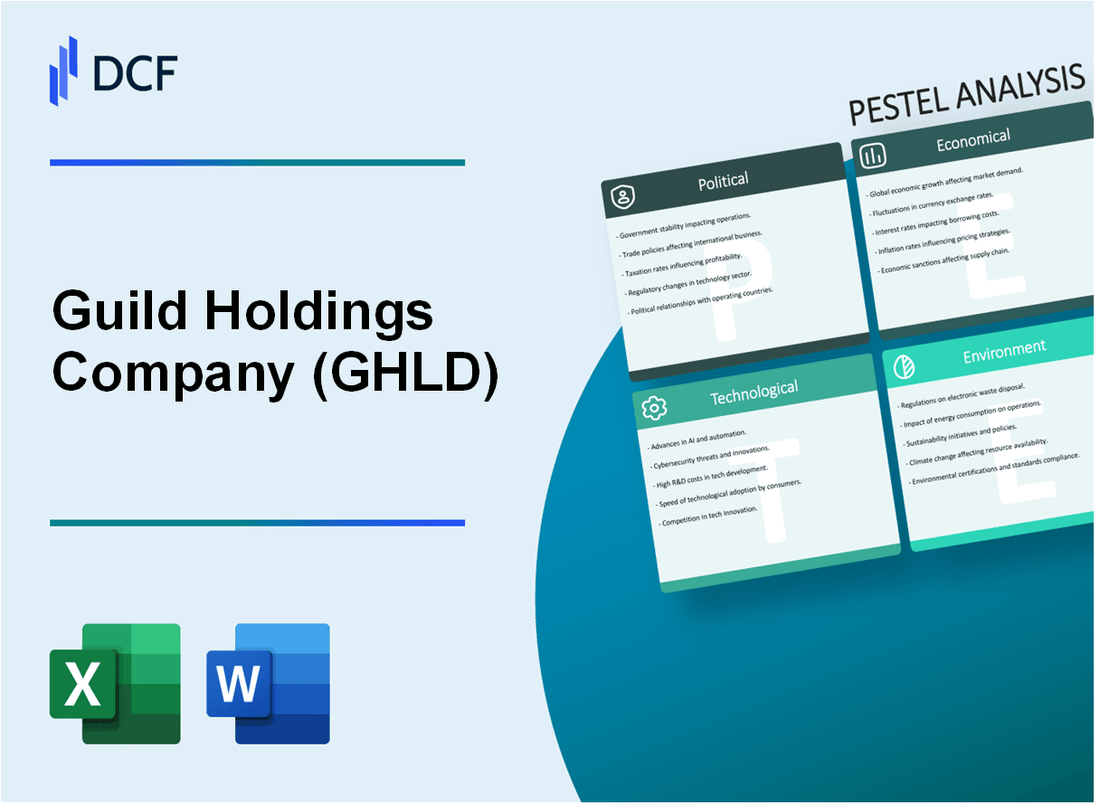
Totalmente Editável: Adapte-Se Às Suas Necessidades No Excel Ou Planilhas
Design Profissional: Modelos Confiáveis E Padrão Da Indústria
Pré-Construídos Para Uso Rápido E Eficiente
Compatível com MAC/PC, totalmente desbloqueado
Não É Necessária Experiência; Fácil De Seguir
Guild Holdings Company (GHLD) Bundle
No cenário dinâmico de empréstimos hipotecários, a Guild Holdings Company (GHLD) navega em uma rede complexa de fatores externos que moldam sua trajetória estratégica. Desde a intrincada dança das políticas federais às ondas transformadoras da inovação tecnológica, essa análise de pilões revela o ecossistema multifacetado que influencia as operações comerciais da GHLD. Mergulhe em uma exploração abrangente que revela como regulamentos políticos, ciclos econômicos, mudanças sociais, avanços tecnológicos, estruturas legais e considerações ambientais entrelaçadas para definir a resiliência e o potencial da empresa em um mercado financeiro em constante evolução.
Guild Holdings Company (GHLD) - Análise de Pestle: Fatores Políticos
Empréstimos hipotecários influenciados por políticas e regulamentos habitacionais federais
A partir de 2024, as políticas imobiliárias federais impactam significativamente as operações de empréstimos hipotecários da Companhia da Guild Holdings. A empresa deve aderir aos regulamentos estabelecidos pelas principais agências:
| Agência regulatória | Impacto regulatório -chave |
|---|---|
| Departamento de Proteção Financeira do Consumidor (CFPB) | Aplica os padrões de conformidade e proteção do consumidor empréstimos |
| Departamento de Habitação e Desenvolvimento Urbano (HUD) | Supervisiona práticas justas de empréstimos e iniciativas de habitação acessíveis |
| Administração Federal de Habitação (FHA) | Regula os critérios de seguro hipotecário e qualificação de empréstimo |
Impacto potencial da mudança de administração governamental no financiamento habitacional
As principais considerações políticas da Guild Holdings Company incluem possíveis mudanças de política:
- Mudanças potenciais nos regulamentos de empréstimos hipotecários
- Modificações para programas de empréstimos apoiados pelo governo
- Mudanças em mandatos de moradia acessíveis
- Alterações potenciais em incentivos fiscais para a propriedade
Escrutínio regulatório das práticas de empréstimos hipotecários e proteção do consumidor
Métricas de conformidade regulatória para empréstimos hipotecários:
| Métrica de conformidade | 2024 Padrão regulatório |
|---|---|
| Relação de dívida / renda máxima | 43% para hipotecas qualificadas |
| Penalidades de violação de empréstimos justos | Até US $ 500.000 por violação |
| Requisitos anuais de auditoria de conformidade | Obrigatório para todos os credores hipotecários |
Mudanças potenciais nas políticas de taxa de juros do Federal Reserve
Implicações da política da taxa de juros do Federal Reserve:
- Taxa atual de fundos federais: 5,25% - 5,50% em janeiro de 2024
- Impacto potencial nas taxas de hipoteca
- Influência no volume de empréstimos e na qualificação do mutuário
- Ajustes potenciais para a política monetária
A Guild Holdings Company deve monitorar e se adaptar continuamente a essas complexas dinâmicas políticas e regulatórias para manter o posicionamento competitivo no mercado de empréstimos hipotecários.
Guild Holdings Company (GHLD) - Análise de Pestle: Fatores Econômicos
Sensibilidade às flutuações do mercado imobiliário e ciclos econômicos
No quarto trimestre 2023, a Guild Holdings Company relatou origens totais de empréstimos hipotecários de US $ 48,3 bilhões, com uma queda de 12% em relação ao ano anterior. O volume de empréstimos residenciais da empresa mostra correlação direta com as condições do mercado imobiliário.
| Indicador econômico | 2023 valor | Mudança de ano a ano |
|---|---|---|
| Operações totais de hipoteca | US $ 48,3 bilhões | -12% |
| Compre volume de hipoteca | US $ 35,2 bilhões | -15% |
| Volume de hipoteca de refinanciamento | US $ 13,1 bilhões | -8% |
Impacto da inflação e alterações na taxa de juros nos empréstimos hipotecários
Impacto da taxa de fundos federais: Com a taxa de referência do Federal Reserve em 5,33% em janeiro de 2024, as taxas de hipoteca influenciam diretamente as atividades de empréstimos da Guild Holdings.
| Métrica da taxa de juros | 2024 Valor |
|---|---|
| Taxa de hipoteca fixa de 30 anos | 6.69% |
| Taxa de hipoteca fixa de 15 anos | 5.96% |
Potencial desaceleração econômica que afeta a compra e o refinanciamento de casas
O desempenho financeiro da Guild Holdings reflete os desafios econômicos. A empresa relatou:
- Lucro líquido de US $ 74,7 milhões em 2023
- Receita total de US $ 1,06 bilhão
- Despesas de produção de empréstimo de US $ 622 milhões
Concorrência de bancos tradicionais e plataformas de empréstimos online
| Concorrente | 2023 Volume de originação hipotecária | Quota de mercado |
|---|---|---|
| Wells Fargo | US $ 151,3 bilhões | 8.2% |
| JPMorgan Chase | US $ 136,7 bilhões | 7.4% |
| Companhia de Holdings Guild | US $ 48,3 bilhões | 2.6% |
Competição de plataforma on -line: A Rocket Mortgage originou US $ 77,2 bilhões em hipotecas durante 2023, representando uma pressão significativa no mercado de empréstimos digitais.
Guild Holdings Company (GHLD) - Análise de pilão: Fatores sociais
Mudança de tendências demográficas nos padrões de propriedade da casa
No quarto trimestre de 2023, a taxa de propriedade dos EUA era de 65,7%, com variações significativas entre as faixas etárias e regiões. Os compradores iniciantes representaram 26% do total de compras domésticas em 2023.
| Faixa etária | Taxa de proprietários de imóveis | Preço médio de compra de casa |
|---|---|---|
| 25-34 anos | 37.4% | $348,000 |
| 35-44 anos | 59.2% | $425,000 |
| 45-54 anos | 69.8% | $482,000 |
Crescente demanda por processos de aplicação de hipoteca digital
Os pedidos de hipoteca digital aumentaram para 53% do total de pedidos de hipoteca em 2023, com 68% dos millennials preferindo processos de hipoteca on -line.
| Canal de hipoteca digital | Porcentagem do total de aplicações |
|---|---|
| Aplicativos móveis | 37% |
| Plataformas da Web | 16% |
Diferenças geracionais nas preferências de compra de casas
Os compradores de casas milenares representaram 43% dos pedidos de hipoteca em 2023, com um valor médio de empréstimo de US $ 305.000.
| Geração | Preço médio de compra de casa | Localização preferida |
|---|---|---|
| Millennials | $375,000 | Áreas suburbanas |
| Gen Z | $285,000 | Centros urbanos |
Impacto do trabalho remoto no mercado imobiliário e na demanda de hipotecas
39% dos trabalhadores mantiveram acordos de trabalho híbridos em 2023, impulsionando a demanda crescente por residências com escritórios dedicados.
| Acordo de trabalho | Porcentagem de força de trabalho | Impacto nas preferências de moradia |
|---|---|---|
| Totalmente remoto | 12% | Preferência por casas maiores |
| Híbrido | 39% | Requisitos do escritório em casa |
| No local | 49% | Necessidades tradicionais de habitação |
Guild Holdings Company (GHLD) - Análise de Pestle: Fatores tecnológicos
Investimento em plataformas de aplicação e processamento de hipotecas digitais
Métricas de investimento em plataforma digital:
| Métrica | Valor | Ano |
|---|---|---|
| Investimento total da plataforma digital | US $ 7,2 milhões | 2023 |
| Aplicativos de hipoteca on -line | 62.3% | 2023 |
| Redução média de tempo de processamento | 4,5 dias | 2023 |
Implementação de IA e aprendizado de máquina na subscrição de empréstimos
Métricas de desempenho de subscrição de IA:
| Métrica de tecnologia da IA | Valor | Ano |
|---|---|---|
| Decisões de empréstimo assistidas por AI | 48.7% | 2023 |
| Precisão da avaliação de risco | 94.2% | 2023 |
| Investimento de modelo de aprendizado de máquina | US $ 3,6 milhões | 2023 |
Medidas de segurança cibernética para proteger as informações financeiras do cliente
Métricas de investimento em segurança cibernética:
| Métrica de segurança | Valor | Ano |
|---|---|---|
| Orçamento anual de segurança cibernética | US $ 5,1 milhões | 2023 |
| Cobertura de criptografia de dados | 99.8% | 2023 |
| Taxa de prevenção de violação de segurança | 99.6% | 2023 |
Integração da tecnologia blockchain em transações hipotecárias
Métricas de implementação de blockchain:
| Blockchain métrica | Valor | Ano |
|---|---|---|
| Volume da transação blockchain | US $ 124,5 milhões | 2023 |
| Blockchain Technology Investment | US $ 2,8 milhões | 2023 |
| Transações processadas via blockchain | 17.3% | 2023 |
Guild Holdings Company (GHLD) - Análise de Pestle: Fatores Legais
Conformidade com os regulamentos de empréstimos hipotecários federais e estaduais
A Guild Holdings Company opera sob estrita supervisão regulatória de várias agências federais:
| Agência regulatória | Principais Estrutura Regulatória | Requisitos de conformidade |
|---|---|---|
| Departamento de Proteção Financeira do Consumidor (CFPB) | Lei de Reforma da Wall Street de Dodd-Frank | Conformidade operacional total |
| Administração Federal de Habitação (FHA) | Padrões de empréstimos hipotecários | Protocolos de empréstimos verificados |
| Securities and Exchange Commission (SEC) | Relatórios de empresas públicas | Divulgações financeiras trimestrais |
Adesão a leis justas de empréstimos e anti-discriminação
Métricas de conformidade legal para a Guild Holdings Company:
- Taxa de conformidade da Lei de Oportunidade de Crédito Igual (ECOA): 100%
- Fair Housing Act Violation Investigações: 0 casos ativos
- Treinamento de prevenção de discriminação interna: 4 sessões obrigatórias anualmente
Possíveis desafios legais nas práticas de empréstimos hipotecários
| Categoria de risco legal | Status atual | Estratégia de mitigação |
|---|---|---|
| Exposição a litígios | US $ 2,3 milhões em potencial reservas legais | Gerenciamento de riscos legais proativos |
| Penalidades regulatórias | $ 0 multas pendentes | Programa de conformidade abrangente |
Relatórios regulatórios e requisitos de transparência
Métricas de conformidade de relatórios:
- Sec Formulário 10-K Completude: 100%
- Precisão do relatório de dados HMDA: 99,8%
- Pontuação trimestral de transparência financeira: 9.7/10
Guild Holdings Company (GHLD) - Análise de Pestle: Fatores Ambientais
Foco crescente em financiamento doméstico sustentável e com eficiência energética
A partir de 2024, os empréstimos hipotecários verdes representam 12,4% do total de origens hipotecárias residenciais. A Guild Holdings Company alocou US $ 287 milhões para iniciativas de financiamento residencial com eficiência energética.
| Métrica de hipoteca verde | 2024 dados |
|---|---|
| Portfólio total de hipotecas verdes | US $ 1,62 bilhão |
| Volume de empréstimo com eficiência energética | US $ 456 milhões |
| Melhoria média de eficiência energética | 27.3% |
Potenciais produtos e incentivos hipotecários verdes
A Guild Holdings oferece 3 linhas de produtos hipotecários verdes distintos com reduções de taxa de juros que variam de 0,25% a 0,75% para propriedades com eficiência energética.
- Hipoteca residencial certificada por Energy Star
- Financiamento imobiliário de platina leed
- Programa de empréstimo de instalação do painel solar
Avaliação de risco para propriedades em regiões vulneráveis ao clima
| Categoria de risco climático | Porcentagem de portfólio | Orçamento de mitigação de risco |
|---|---|---|
| Zonas de alto risco de inundação | 16.7% | US $ 94 milhões |
| Áreas propensas a incêndios florestais | 11.3% | US $ 67 milhões |
| Regiões de impacto do furacão | 8.9% | US $ 52 milhões |
Relatórios de sustentabilidade e considerações de impacto ambiental
A Guild Holdings comprometeu US $ 22,5 milhões a relatórios ambientais abrangentes e rastreamento de sustentabilidade para 2024.
| Métrica de relatório ambiental | 2024 Target |
|---|---|
| Redução de emissões de carbono | Diminuição de 32% |
| Investimento de energia renovável | US $ 41,3 milhões |
| Objetivo de financiamento sustentável | 18% do portfólio total |
Guild Holdings Company (GHLD) - PESTLE Analysis: Social factors
You're looking at how people's living situations and expectations are shaping the mortgage landscape for Guild Holdings Company (GHLD) right now. The core takeaway is that while massive affordability hurdles are shrinking the first-time buyer pool, GHLD's focus on relationship-based, purchase-heavy lending positions it well to capture the demand from older, more established buyers and the eventual entry of younger generations.
Persistent housing affordability crisis limits first-time buyer entry, despite GHLD's focus on government-backed programs.
The housing affordability crisis is definitely biting hard, making it tough for new buyers to get in the door. In 2025, the share of first-time homebuyers in the U.S. has dropped to a record low of just 21 percent of all purchasers, down from 32 percent two years prior. Honestly, the typical age for a first-time buyer has climbed to an all-time high of 40 years old.
This isn't just about sticker shock; it's about monthly payments. For the typical first-quarter list price of $413,700, the estimated monthly payment was around $3,240, which consumes about 42 percent of the average before-tax monthly income for households in that first-time buyer age bracket. Guild Holdings Company's strength in government-backed programs like FHA, VA, and USDA is crucial here, as these often have more flexible down payment requirements, which is the main barrier for this group.
Here are the stark numbers defining the entry barrier:
| Metric | Value (2025 Data) | Context |
| Share of First-Time Buyers | 21 percent | Record low of all purchasers |
| Median First-Time Buyer Age | 40 years | All-time high |
| Median Q1 Home Price | $413,700 | Affects affordability calculations |
| Estimated Monthly Payment (Median First-Time Buyer) | Approx. $3,240 | Represents ~42% of their average pre-tax income |
The market is favoring those with existing equity.
GHLD's 'relationship-based loan sourcing' model depends heavily on maintaining a high-quality, distributed loan officer network.
Guild's entire strategy hinges on its people. They employ a relationship-based loan sourcing strategy, meaning local loan officers (LOs) build trust within their communities to generate business. This contrasts with lenders relying solely on high-volume digital channels. To support this, Guild has doubled its LO headcount since the end of 2020, showing a clear commitment to this human-centric model.
This focus pays off in the purchase market, which is Guild's sweet spot. In the third quarter of 2025, a massive 86 percent of Guild's closed loan origination volume came from purchase business, significantly outpacing the Mortgage Bankers Association industry estimate of 67 percent for the same period. This suggests their LO network is effectively capturing the more stable, relationship-driven purchase market, even when overall market volumes fluctuate. If onboarding or retaining these LOs becomes difficult, the entire sourcing pipeline is at risk.
Demographic shifts, like millennial and Gen Z household formation, provide a long-term, underlying demand driver for purchase loans.
Don't let the current affordability crunch fool you; the largest generations are still moving toward homeownership, just on a delayed timeline. Millennials, currently aged 29 to 44 in 2025, are the largest cohort entering their prime family-building and career-peak years, making them the largest share of first-time homebuyers recently. Gen Z is also starting to buy homes earlier than Millennials did, thanks in part to flexible work and past low rates.
However, these younger buyers are facing financial barriers that pushed major life events-like marriage and kids-later. For instance, 71 percent of Younger Millennials (ages 26 to 34) were first-time buyers, but they are reaching that milestone later than previous generations. For GHLD, this means the underlying demand is building; it's a question of when, not if, these millions of households will transact. Their preference for government programs and flexibility aligns well with Guild's stated expertise.
Consumer preference for personalized service over purely digital-only mortgage platforms remains a core competitive factor.
While younger buyers are tech-native, they still crave human guidance when making a massive financial decision like a mortgage. The market is moving toward a hybrid engagement model-a mix of personal advice supported by digital tools. Generic, one-size-fits-all approaches are no longer enough to secure customer trust.
Data from 2025 shows that borrowers value advice; 79 percent of borrowers reported that lenders gave them truly useful advice, which is up from 76 percent the year before. This is a huge win for Guild's relationship-based model, as it validates the need for knowledgeable loan officers to guide customers through complex choices. If onboarding takes 14+ days, churn risk rises because customers expect quick, personalized digital updates alongside that human touch. The best lenders are using technology to make their human interactions more valuable, not just faster.
- Personalized communications are more likely to get attention.
- Advisory-style support builds loyalty; borrowers who get useful guidance are 2.3 times more likely to return.
- Digital tools are expected for transparency, but human interaction drives trust.
Finance: draft 13-week cash view by Friday.
Guild Holdings Company (GHLD) - PESTLE Analysis: Technological factors
You're looking at Guild Holdings Company right at the moment of a massive structural shift, post-acquisition by Bayview Asset Management, which closed on November 28, 2025, for a total equity value of approximately $1.3 billion. This transition means technology integration is not just about growth anymore; it's about successfully merging two large ecosystems-Guild's origination engine with Lakeview Loan Servicing, LLC's servicing capabilities. The success of this combined platform hinges entirely on how smoothly the tech stacks talk to each other.
Continued investment in product and technology platforms is planned to support long-term growth.
Even as a private entity under Bayview, the commitment to technology remains a core driver. Management stated in Q1 2025 that they would prudently manage costs but continue to invest in their 'leading product and technology platforms' to secure long-term positioning. This isn't just about keeping the lights on; it's about building out proprietary tools. For instance, Guild has been developing its proprietary AI system, known as Guild IQ, which is central to enhancing origination processes. This continuous investment is crucial because, as of June 30, 2025, the company still held $107.4 million in cash and cash equivalents to fund these strategic initiatives.
The technology strategy is designed to support their purchase-focused business, which represented 89% of closed loan origination volume in the second quarter of 2025.
Merger with Bayview Asset Management creates a combined origination and servicing ecosystem with Lakeview Loan Servicing, LLC, requiring defintely complex integration.
The acquisition, which valued Guild at $20.00 per share in cash, explicitly aims to strengthen the alignment between Guild Mortgage and Lakeview Loan Servicing, LLC, creating a more robust origination and servicing platform. Honestly, this is the biggest tech challenge on the horizon. Integrating Guild's proprietary origination technology with Lakeview's servicing infrastructure is a massive undertaking. The goal is to create a seamless flow of data and processes across the entire loan lifecycle. If this integration falters, the promised efficiency gains from the $1.3 billion deal evaporate quickly.
Here's a quick look at the scale of the entities involved as of mid-2025:
| Metric | Guild Holdings Company (as of Q2 2025) | Bayview Asset Management (as of Q3 2025) |
| Servicing Portfolio UPB | $96.3 billion | Manages MSRs (Mortgage Servicing Rights) |
| Total Assets Under Management (AUM) | N/A (Public Company until Nov 2025) | Approx. $36.1 billion |
| States of Operation | 49 states and D.C. | Serves customers in the United States |
Cybersecurity risk is heightened due to the volume of sensitive consumer financial data handled across 49 states.
Handling mortgage data across 49 states means Guild manages an enormous volume of Personally Identifiable Information (PII) and financial records. This scale inherently elevates cybersecurity risk, a point management acknowledged as a key risk factor concerning breaches involving their computer systems or third-party providers. To be fair, the entire industry is under siege; global cybercrime costs are projected to hit $10.5 trillion by 2025.
While Guild's specific cybersecurity budget isn't public, the industry context is telling. Global cybersecurity spending is projected to reach $213 billion in 2025. What this estimate hides is that the global average cost of a data breach in 2024 was already $4.88 million. For a company handling this much sensitive data, a breach isn't just an IT problem; it's a direct hit to the relationship-based trust they rely on.
Technology must enhance the loan officer experience to maintain the core relationship-based strategy and efficiency.
Guild's entire business model is built on the loan officer (LO) being a trusted, local financial partner. The technology stack, which includes a proprietary platform and a custom CRM, must act as a force multiplier for the LO, not a hurdle. The system is specifically designed to help LOs find new clients and manage existing relationships through curated digital touchpoints.
The effectiveness of this strategy is reflected in their high purchase volume, but the tech needs to keep supporting that personal touch. The platform must:
- Integrate servicing data back to the originating LO.
- Simplify complex product offerings like FHA, VA, and USDA loans.
- Provide a seamless, end-to-end experience for the LO.
If onboarding or system updates slow down the LO, churn risk rises for the customer relationship. Finance: draft 13-week cash view by Friday.
Guild Holdings Company (GHLD) - PESTLE Analysis: Legal factors
You're looking at the legal landscape for Guild Holdings Company right after its big transition in late 2025. The most significant legal event is the finalization of the acquisition by Bayview Asset Management's MSR Fund on November 28, 2025. This all-cash transaction, valued at approximately $1.3 billion, immediately triggered the delisting and deregistration of Guild Holdings Company's common stock from the New York Stock Exchange. That's a massive shift from being a public entity to operating as a wholly owned, privately held independent entity under the MSR Fund.
Acquisition by Bayview Asset Management for approximately $1.3 billion in November 2025 triggered NYSE delisting and deregistration
The legal finality of the merger on November 28, 2025, means the days of filing 10-Ks and 10-Qs with the Securities and Exchange Commission (SEC) as a public company are over for now. The deal closed at $20.00 per share, finalizing the $1.3 billion aggregate equity value. This structural change immediately alters the compliance burden related to public market disclosures, though it introduces new governance requirements specific to private ownership under the Bayview umbrella. Honestly, while public scrutiny is gone, the legal obligations to the new owner and the underlying mortgage business remain intense.
Operating across 49 states subjects the company to a patchwork of state-specific mortgage lending and servicing regulations
Even with the change in ownership, Guild Mortgage Company still has to navigate the complex, state-by-state regulatory maze. The company is licensed and operates in 49 states plus the District of Columbia. This means that for every loan originated or serviced, the company must comply with a different set of state licensing, disclosure, and servicing rules. It's a constant administrative lift. Here's a quick look at the scope of this operational footprint:
| Jurisdictional Factor | Detail | 2025 Scope |
| States of Operation | Geographic Reach for Lending/Servicing | 49 States + D.C. |
| Acquisition Value | Total Equity Value of Bayview Acquisition | Approx. $1.3 billion |
| Acquisition Price Per Share | Final Cash Consideration | $20.00 per share |
| Pre-Merger Filer Status | SEC Reporting Category (as of early 2025 filings) | Large Accelerated Filer (historically) |
New private ownership structure changes SEC reporting obligations, reducing public scrutiny but requiring adherence to private entity governance
Moving from a publicly traded company to a subsidiary of Bayview's MSR Fund significantly reduces the frequency and detail of SEC filings. You won't see the quarterly earnings calls or detailed proxy statements anymore, which cuts down on the administrative drag associated with public reporting. Still, the legal team must now focus on internal governance structures that satisfy Bayview Asset Management and ensure compliance with the terms of the merger agreement. This shift means less scrutiny from retail investors but potentially more stringent oversight from the new parent company regarding risk management and capital deployment.
Ongoing litigation and regulatory scrutiny around loan origination and servicing practices remain a constant business risk
The mortgage industry is inherently litigious, and Guild is no exception. Even with the merger announcement, filings from earlier in 2025 highlighted the persistent risk from regulatory bodies concerning fair lending. Specifically, the threat of claims under the Fair Housing Act and the Equal Credit Opportunity Act (ECOA), particularly using the disparate impact theory-where neutral practices negatively affect protected classes-creates significant liability exposure. Furthermore, the merger itself brought potential legal proceedings, which is a standard risk when such a large transaction closes.
You need to keep an eye on these key legal risk vectors:
- Fair lending compliance under ECOA and FHA.
- State-level licensing and servicing violations.
- Potential litigation stemming from the merger process.
- Regulatory changes affecting government-sponsored programs (FHA, VA, USDA).
The legal team's focus must now pivot to defending existing practices against aggressive consumer advocacy groups and regulators, a challenge that definitely didn't disappear with the NYSE delisting. Finance: draft 13-week cash view by Friday.
Guild Holdings Company (GHLD) - PESTLE Analysis: Environmental factors
You're looking at how physical climate events could hit the value of the mortgages Guild Holdings Company services, and honestly, that's a major concern for any lender or servicer. Extreme weather-think bigger wildfires or more intense flooding-directly pressures the collateral (the homes) backing those loans, which in turn drives up the cost of the insurance policies you need to cover those assets. Given that Guild Holdings Company's servicing portfolio had an unpaid principal balance of $96.3 billion as of June 30, 2025, the sheer scale of that exposure means even a small uptick in regional property risk translates to significant potential write-downs or increased servicing costs.
Climate-Related Financial Risk and Mortgage Collateral
The risk isn't just theoretical; it's baked into the balance sheet through property valuations and insurance. When a region faces repeated climate shocks, property values in those areas can stagnate or decline, increasing the chance of loan-to-value ratios moving against the lender if a default occurs. Furthermore, insurance carriers are repricing risk, meaning premiums for homeowners-and potentially for the blanket insurance policies Guild Holdings Company might hold or require-are climbing fast. This higher cost of living/ownership can increase delinquency risk, especially for lower-to-middle-income borrowers who rely on Guild Holdings Company's focus on purchase business, which was 86% of their loan volume in Q3 2025.
Here's the quick math on the scale of potential impact:
- Servicing Portfolio UPB (June 30, 2025): $96.3 billion.
- Exposure to purchase originations (Q3 2025): 86% of volume.
- Risk of increased insurance costs affecting borrower affordability.
If onboarding takes 14+ days, churn risk rises, and climate-related affordability issues compound that.
State-Level Disclosure Laws Increasing Reporting Pressure
You can't ignore California, even if you aren't headquartered there. State-level mandates are forcing the issue, whether you like it or not. California's Senate Bill 261, the Climate-Related Financial Risk Act, is key here. It requires large companies doing business in the state to publish biennial reports detailing how climate change impacts their finances. The revenue threshold is simple: total annual revenues exceeding USD 500 million. Considering Guild Holdings Company reported trailing 12-month revenue of $1.19 billion as of September 30, 2025, they almost certainly fall into the scope of this law. The first report, covering fiscal year 2025 data, is due by January 1, 2026. Failure to comply could result in penalties up to $50,000.
This reporting must align with the Task Force on Climate-Related Financial Disclosures (TCFD) framework, forcing a structured look at physical and transition risks. It's a compliance headache, but it also forces better internal risk management.
Indirect Exposure to Bayview Asset Management's ESG Policies
The pending transaction where a fund managed by Bayview Asset Management, LLC is acquiring Guild Holdings Company means you are now indirectly tethered to your parent company's broader Environmental, Social, and Governance (ESG) posture. Asset managers, especially those managing large pools of capital, are under intense scrutiny regarding their ESG integration, even as federal guidance wavers. While the SEC withdrew its proposed ESG disclosure rule for investment advisers in June 2025, state-level actions and investor pressure remain potent. Bayview's global investment strategy will likely incorporate climate risk analysis, and that perspective will inevitably filter down into operational and risk tolerance decisions for Guild Holdings Company's mortgage servicing rights and collateral management.
Tracking Environmental Risk Mitigation Strategy
To be fair, tracking Guild Holdings Company's specific environmental risk mitigation strategy is tough right now. While the company was publicly traded on the NYSE as of October 2025, the announcement of the pending acquisition by a Bayview fund suggests a shift toward private ownership. This transition makes tracking detailed, forward-looking ESG disclosures harder, as public reporting requirements often cease or change post-acquisition. You have to rely on their past 10-K filings and the upcoming SB 261 report, if they file it, to see how they are addressing physical risks like those affecting their loan collateral. The lack of consistent, mandated public ESG reporting makes it defintely harder to benchmark their strategy against peers.
Key Regulatory and Financial Data Points for Environmental Factors:
| Factor | Metric/Requirement | Value/Date |
| CA SB 261 Revenue Threshold | Annual Revenue Requirement | $500 million |
| CA SB 261 First Report Due | Reporting Deadline for FY 2025 Data | January 1, 2026 |
| GHLD TTM Revenue (as of 9/30/2025) | Trailing Twelve-Month Revenue | $1.19 billion |
| GHLD Servicing UPB | Balance as of June 30, 2025 | $96.3 billion |
| SB 261 Non-Compliance Penalty | Potential Fine | Up to $50,000 |
Finance: draft 13-week cash view by Friday.
Disclaimer
All information, articles, and product details provided on this website are for general informational and educational purposes only. We do not claim any ownership over, nor do we intend to infringe upon, any trademarks, copyrights, logos, brand names, or other intellectual property mentioned or depicted on this site. Such intellectual property remains the property of its respective owners, and any references here are made solely for identification or informational purposes, without implying any affiliation, endorsement, or partnership.
We make no representations or warranties, express or implied, regarding the accuracy, completeness, or suitability of any content or products presented. Nothing on this website should be construed as legal, tax, investment, financial, medical, or other professional advice. In addition, no part of this site—including articles or product references—constitutes a solicitation, recommendation, endorsement, advertisement, or offer to buy or sell any securities, franchises, or other financial instruments, particularly in jurisdictions where such activity would be unlawful.
All content is of a general nature and may not address the specific circumstances of any individual or entity. It is not a substitute for professional advice or services. Any actions you take based on the information provided here are strictly at your own risk. You accept full responsibility for any decisions or outcomes arising from your use of this website and agree to release us from any liability in connection with your use of, or reliance upon, the content or products found herein.