

|
Guild Holdings Company (GHLD): Análisis PESTLE [Actualizado en Ene-2025] |
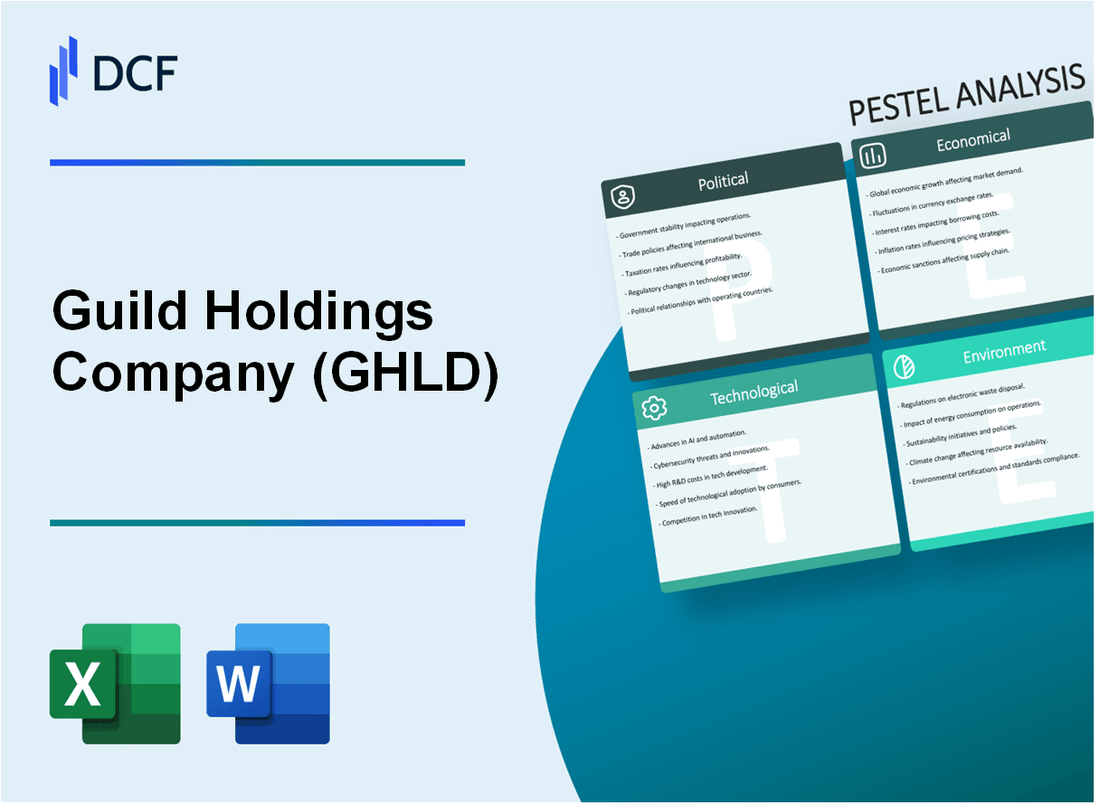
Completamente Editable: Adáptelo A Sus Necesidades En Excel O Sheets
Diseño Profesional: Plantillas Confiables Y Estándares De La Industria
Predeterminadas Para Un Uso Rápido Y Eficiente
Compatible con MAC / PC, completamente desbloqueado
No Se Necesita Experiencia; Fáciles De Seguir
Guild Holdings Company (GHLD) Bundle
En el panorama dinámico de los préstamos hipotecarios, Guild Holdings Company (GHLD) navega por una red compleja de factores externos que dan forma a su trayectoria estratégica. Desde la intrincada danza de las políticas federales hasta las ondas transformadoras de la innovación tecnológica, este análisis de mano presenta el ecosistema multifacético que influye en las operaciones comerciales de GHLD. Sumerja una exploración integral que revela cómo las regulaciones políticas, los ciclos económicos, los cambios sociales, los avances tecnológicos, los marcos legales y las consideraciones ambientales se entrelazan para definir la resiliencia y el potencial de la empresa en un mercado financiero en constante evolución.
Guild Holdings Company (GHLD) - Análisis de mortero: factores políticos
Préstamos hipotecarios influenciados por políticas y reglamentos de vivienda federal
A partir de 2024, las políticas federales de vivienda afectan significativamente las operaciones de préstamos hipotecarios de Guild Holdings Company. La Compañía debe cumplir con las regulaciones establecidas por agencias clave:
| Agencia reguladora | Impacto regulatorio clave |
|---|---|
| Oficina de Protección Financiera del Consumidor (CFPB) | Haga cumplir los estándares de cumplimiento de préstamos y protección del consumidor |
| Departamento de Vivienda y Desarrollo Urbano (HUD) | Supervisa prácticas de préstamos justos e iniciativas de vivienda asequible |
| Administración Federal de Vivienda (FHA) | Regula los criterios de calificación de seguro hipotecario y préstamos |
Impacto potencial de cambiar la administración gubernamental en la financiación de la vivienda
Consideraciones políticas clave para la compañía de tenencias de gremios incluyen cambios potenciales de políticas:
- Cambios potenciales en las regulaciones de préstamos hipotecarios
- Modificaciones a los programas de préstamos respaldados por el gobierno
- Cambios en los mandatos de vivienda asequible
- Posibles alteraciones en los incentivos fiscales para la propiedad de vivienda
Escrutinio regulatorio de prácticas de préstamos hipotecarios y protección del consumidor
Métricas de cumplimiento regulatorio para préstamos hipotecarios:
| Métrico de cumplimiento | 2024 Estándar regulatorio |
|---|---|
| Relación de deuda / ingreso máxima | 43% para hipotecas calificadas |
| Sanciones de violación de préstamos justos | Hasta $ 500,000 por violación |
| Requisitos anuales de auditoría de cumplimiento | Obligatorio para todos los prestamistas hipotecarios |
Cambios potenciales en las políticas de tasas de interés por parte de la Reserva Federal
Implicaciones de la política de tasas de interés de la Reserva Federal:
- Tasa actual de fondos federales: 5.25% - 5.50% a partir de enero de 2024
- Impacto potencial en las tasas hipotecarias
- Influencia en el volumen de préstamos y la calificación del prestatario
- Ajustes potenciales a la política monetaria
Guild Holdings Company debe monitorear y adaptarse continuamente a estas complejas dinámicas políticas y reguladoras para mantener un posicionamiento competitivo en el mercado de préstamos hipotecarios.
Guild Holdings Company (GHLD) - Análisis de mortero: factores económicos
Sensibilidad a las fluctuaciones del mercado inmobiliario y ciclos económicos
A partir del cuarto trimestre de 2023, Guild Holdings Company reportó originaciones totales de préstamos hipotecarios de $ 48.3 mil millones, con una disminución del 12% del año anterior. El volumen de préstamos residenciales de la compañía muestra una correlación directa con las condiciones del mercado inmobiliario.
| Indicador económico | Valor 2023 | Cambio año tras año |
|---|---|---|
| Originaciones de hipotecas totales | $ 48.3 mil millones | -12% |
| Comprar volumen de hipoteca | $ 35.2 mil millones | -15% |
| Volumen de hipoteca de refinanciamiento | $ 13.1 mil millones | -8% |
Impacto de la inflación y los cambios en la tasa de interés en los préstamos hipotecarios
Impacto de la tasa de fondos federales: Con la tasa de referencia de la Reserva Federal en 5.33% a partir de enero de 2024, las tasas hipotecarias influyen directamente en las actividades de préstamos del Gremio.
| Métrica de tasa de interés | Valor 2024 |
|---|---|
| Tasa de hipoteca fija a 30 años | 6.69% |
| Tasa de hipoteca fija a 15 años | 5.96% |
La desaceleración económica potencial que afecta la compra y la refinanciación de las viviendas
El desempeño financiero de Guild Holdings refleja los desafíos económicos. La compañía informó:
- Ingresos netos de $ 74.7 millones en 2023
- Ingresos totales de $ 1.06 mil millones
- Gastos de producción de préstamos de $ 622 millones
Competencia de bancos tradicionales y plataformas de préstamos en línea
| Competidor | Volumen de origen de la hipoteca 2023 | Cuota de mercado |
|---|---|---|
| Wells Fargo | $ 151.3 mil millones | 8.2% |
| JPMorgan Chase | $ 136.7 mil millones | 7.4% |
| Guild Holdings Company | $ 48.3 mil millones | 2.6% |
Competencia de plataforma en línea: Rocket Mortgage originó $ 77.2 mil millones en hipotecas durante 2023, lo que representa una presión significativa del mercado de préstamos digitales.
Guild Holdings Company (GHLD) - Análisis de mortero: factores sociales
Cambiando las tendencias demográficas en los patrones de propiedad de la vivienda
A partir del cuarto trimestre de 2023, la tasa de propiedad de vivienda de EE. UU. Era del 65,7%, con variaciones significativas entre grupos de edad y regiones. Los compradores de viviendas por primera vez representaban el 26% del total de compras de viviendas en 2023.
| Grupo de edad | Tasa de propiedad de vivienda | Precio promedio de compra de la casa |
|---|---|---|
| 25-34 años | 37.4% | $348,000 |
| 35-44 años | 59.2% | $425,000 |
| 45-54 años | 69.8% | $482,000 |
Aumento de la demanda de procesos de solicitud de hipotecas digitales
Las solicitudes de hipotecas digitales aumentaron al 53% de las solicitudes de hipotecas totales en 2023, con el 68% de los millennials que prefieren procesos hipotecarios en línea.
| Canal de hipotecas digitales | Porcentaje de aplicaciones totales |
|---|---|
| Aplicaciones móviles | 37% |
| Plataformas web | 16% |
Diferencias generacionales en las preferencias de compra de viviendas
Los compradores de viviendas Millennial representaban el 43% de las solicitudes de hipotecas en 2023, con un monto promedio del préstamo de $ 305,000.
| Generación | Precio promedio de compra de la casa | Ubicación preferida |
|---|---|---|
| Millennials | $375,000 | Áreas suburbanas |
| Gen Z | $285,000 | Centros urbanos |
Impacto del trabajo remoto en el mercado inmobiliario y la demanda hipotecaria
El 39% de los trabajadores mantuvieron acuerdos de trabajo híbridos en 2023, impulsando una mayor demanda de viviendas con espacios de oficina dedicados.
| Arreglo de trabajo | Porcentaje de la fuerza laboral | Impacto en las preferencias de vivienda |
|---|---|---|
| Completamente remoto | 12% | Preferencia por casas más grandes |
| Híbrido | 39% | Requisitos de la oficina en casa |
| In situ | 49% | Necesidades de vivienda tradicionales |
Guild Holdings Company (GHLD) - Análisis de mortero: factores tecnológicos
Inversión en aplicaciones de hipotecas digitales y plataformas de procesamiento
Métricas de inversión de plataforma digital:
| Métrico | Valor | Año |
|---|---|---|
| Inversión total de plataforma digital | $ 7.2 millones | 2023 |
| Solicitudes de hipotecas en línea | 62.3% | 2023 |
| Reducción promedio del tiempo de procesamiento | 4.5 días | 2023 |
Implementación de IA y aprendizaje automático en suscripción de préstamos
AI suscripción de métricas de rendimiento:
| Métrica de tecnología de IA | Valor | Año |
|---|---|---|
| Decisiones de préstamo asistidas por AI-AI | 48.7% | 2023 |
| Precisión de la evaluación de riesgos | 94.2% | 2023 |
| Inversión del modelo de aprendizaje automático | $ 3.6 millones | 2023 |
Medidas de ciberseguridad para proteger la información financiera del cliente
Métricas de inversión de ciberseguridad:
| Métrica de seguridad | Valor | Año |
|---|---|---|
| Presupuesto anual de ciberseguridad | $ 5.1 millones | 2023 |
| Cobertura de cifrado de datos | 99.8% | 2023 |
| Tasa de prevención de violación de seguridad | 99.6% | 2023 |
Integración de la tecnología blockchain en transacciones hipotecarias
Métricas de implementación de blockchain:
| Métrica de blockchain | Valor | Año |
|---|---|---|
| Volumen de transacciones de blockchain | $ 124.5 millones | 2023 |
| Inversión en tecnología blockchain | $ 2.8 millones | 2023 |
| Transacciones procesadas a través de blockchain | 17.3% | 2023 |
Guild Holdings Company (GHLD) - Análisis de mortero: factores legales
Cumplimiento de las regulaciones de préstamos hipotecarios federales y estatales
Guild Holdings Company opera bajo una estricta supervisión regulatoria de múltiples agencias federales:
| Agencia reguladora | Marco regulatorio clave | Requisitos de cumplimiento |
|---|---|---|
| Oficina de Protección Financiera del Consumidor (CFPB) | Ley de reforma de Dodd-Frank Wall Street | Cumplimiento operativo completo |
| Administración Federal de Vivienda (FHA) | Normas de préstamos hipotecarios | Protocolos de préstamos verificados |
| Comisión de Bolsa y Valores (SEC) | Informes de empresas públicas | Divulgaciones financieras trimestrales |
Adhesión a las leyes de préstamos y antidiscriminatorios justos
Métricas de cumplimiento legal para Guild Holdings Company:
- Tasa de cumplimiento de la Ley de Oportunidades de Crédito Igual (ECOA): 100%
- Investigaciones de violación de la Ley de Vivienda Justa: 0 casos activos
- Capacitación de prevención de discriminación interna: 4 sesiones obligatorias anualmente
Desafíos legales potenciales en las prácticas de préstamos hipotecarios
| Categoría de riesgo legal | Estado actual | Estrategia de mitigación |
|---|---|---|
| Exposición de litigios | $ 2.3 millones posibles reservas legales | Gestión de riesgos legales proactivos |
| Sanciones regulatorias | $ 0 Multas sobresalientes | Programa de cumplimiento integral |
Requisitos de informes regulatorios y transparencia
Informes de métricas de cumplimiento:
- SEC Formulario 10-K de integración de presentación: 100%
- Precisión de informes de datos HMDA: 99.8%
- Puntaje trimestral de transparencia financiera: 9.7/10
Guild Holdings Company (GHLD) - Análisis de mortero: factores ambientales
Creciente enfoque en financiamiento de viviendas sostenible y eficiente en energía
A partir de 2024, los préstamos hipotecarios verdes representan el 12.4% de las originaciones de hipotecas residenciales totales. Guild Holdings Company ha asignado $ 287 millones para iniciativas de financiamiento de viviendas con eficiencia energética.
| Métrica de hipoteca verde | 2024 datos |
|---|---|
| Cartera total de hipotecas verdes | $ 1.62 mil millones |
| Volumen de préstamo de eficiencia energética | $ 456 millones |
| Mejora promedio de la eficiencia energética | 27.3% |
Posibles productos e incentivos de hipotecas verdes
Guild Holdings ofrece 3 líneas distintas de productos de hipotecas verdes con reducciones de tasas de interés que varían de 0.25% a 0.75% para propiedades de eficiencia energética.
- Energy Star Certified Home Mortgage
- Financiación de propiedad de LEED Platinum
- Programa de préstamos de instalación de panel solar
Evaluación de riesgos para propiedades en regiones climáticas vulnerables
| Categoría de riesgo climático | Porcentaje de cartera | Presupuesto de mitigación de riesgos |
|---|---|---|
| Altas zonas de riesgo de inundación | 16.7% | $ 94 millones |
| Áreas propensas a incendios forestales | 11.3% | $ 67 millones |
| Regiones de impacto de huracanes | 8.9% | $ 52 millones |
Informes de sostenibilidad y consideraciones de impacto ambiental
Guild Holdings ha comprometido $ 22.5 millones a informes ambientales integrales y seguimiento de sostenibilidad para 2024.
| Métrica de informes ambientales | Objetivo 2024 |
|---|---|
| Reducción de emisiones de carbono | 32% disminución |
| Inversión de energía renovable | $ 41.3 millones |
| Objetivo de financiamiento sostenible | 18% de la cartera total |
Guild Holdings Company (GHLD) - PESTLE Analysis: Social factors
You're looking at how people's living situations and expectations are shaping the mortgage landscape for Guild Holdings Company (GHLD) right now. The core takeaway is that while massive affordability hurdles are shrinking the first-time buyer pool, GHLD's focus on relationship-based, purchase-heavy lending positions it well to capture the demand from older, more established buyers and the eventual entry of younger generations.
Persistent housing affordability crisis limits first-time buyer entry, despite GHLD's focus on government-backed programs.
The housing affordability crisis is definitely biting hard, making it tough for new buyers to get in the door. In 2025, the share of first-time homebuyers in the U.S. has dropped to a record low of just 21 percent of all purchasers, down from 32 percent two years prior. Honestly, the typical age for a first-time buyer has climbed to an all-time high of 40 years old.
This isn't just about sticker shock; it's about monthly payments. For the typical first-quarter list price of $413,700, the estimated monthly payment was around $3,240, which consumes about 42 percent of the average before-tax monthly income for households in that first-time buyer age bracket. Guild Holdings Company's strength in government-backed programs like FHA, VA, and USDA is crucial here, as these often have more flexible down payment requirements, which is the main barrier for this group.
Here are the stark numbers defining the entry barrier:
| Metric | Value (2025 Data) | Context |
| Share of First-Time Buyers | 21 percent | Record low of all purchasers |
| Median First-Time Buyer Age | 40 years | All-time high |
| Median Q1 Home Price | $413,700 | Affects affordability calculations |
| Estimated Monthly Payment (Median First-Time Buyer) | Approx. $3,240 | Represents ~42% of their average pre-tax income |
The market is favoring those with existing equity.
GHLD's 'relationship-based loan sourcing' model depends heavily on maintaining a high-quality, distributed loan officer network.
Guild's entire strategy hinges on its people. They employ a relationship-based loan sourcing strategy, meaning local loan officers (LOs) build trust within their communities to generate business. This contrasts with lenders relying solely on high-volume digital channels. To support this, Guild has doubled its LO headcount since the end of 2020, showing a clear commitment to this human-centric model.
This focus pays off in the purchase market, which is Guild's sweet spot. In the third quarter of 2025, a massive 86 percent of Guild's closed loan origination volume came from purchase business, significantly outpacing the Mortgage Bankers Association industry estimate of 67 percent for the same period. This suggests their LO network is effectively capturing the more stable, relationship-driven purchase market, even when overall market volumes fluctuate. If onboarding or retaining these LOs becomes difficult, the entire sourcing pipeline is at risk.
Demographic shifts, like millennial and Gen Z household formation, provide a long-term, underlying demand driver for purchase loans.
Don't let the current affordability crunch fool you; the largest generations are still moving toward homeownership, just on a delayed timeline. Millennials, currently aged 29 to 44 in 2025, are the largest cohort entering their prime family-building and career-peak years, making them the largest share of first-time homebuyers recently. Gen Z is also starting to buy homes earlier than Millennials did, thanks in part to flexible work and past low rates.
However, these younger buyers are facing financial barriers that pushed major life events-like marriage and kids-later. For instance, 71 percent of Younger Millennials (ages 26 to 34) were first-time buyers, but they are reaching that milestone later than previous generations. For GHLD, this means the underlying demand is building; it's a question of when, not if, these millions of households will transact. Their preference for government programs and flexibility aligns well with Guild's stated expertise.
Consumer preference for personalized service over purely digital-only mortgage platforms remains a core competitive factor.
While younger buyers are tech-native, they still crave human guidance when making a massive financial decision like a mortgage. The market is moving toward a hybrid engagement model-a mix of personal advice supported by digital tools. Generic, one-size-fits-all approaches are no longer enough to secure customer trust.
Data from 2025 shows that borrowers value advice; 79 percent of borrowers reported that lenders gave them truly useful advice, which is up from 76 percent the year before. This is a huge win for Guild's relationship-based model, as it validates the need for knowledgeable loan officers to guide customers through complex choices. If onboarding takes 14+ days, churn risk rises because customers expect quick, personalized digital updates alongside that human touch. The best lenders are using technology to make their human interactions more valuable, not just faster.
- Personalized communications are more likely to get attention.
- Advisory-style support builds loyalty; borrowers who get useful guidance are 2.3 times more likely to return.
- Digital tools are expected for transparency, but human interaction drives trust.
Finance: draft 13-week cash view by Friday.
Guild Holdings Company (GHLD) - PESTLE Analysis: Technological factors
You're looking at Guild Holdings Company right at the moment of a massive structural shift, post-acquisition by Bayview Asset Management, which closed on November 28, 2025, for a total equity value of approximately $1.3 billion. This transition means technology integration is not just about growth anymore; it's about successfully merging two large ecosystems-Guild's origination engine with Lakeview Loan Servicing, LLC's servicing capabilities. The success of this combined platform hinges entirely on how smoothly the tech stacks talk to each other.
Continued investment in product and technology platforms is planned to support long-term growth.
Even as a private entity under Bayview, the commitment to technology remains a core driver. Management stated in Q1 2025 that they would prudently manage costs but continue to invest in their 'leading product and technology platforms' to secure long-term positioning. This isn't just about keeping the lights on; it's about building out proprietary tools. For instance, Guild has been developing its proprietary AI system, known as Guild IQ, which is central to enhancing origination processes. This continuous investment is crucial because, as of June 30, 2025, the company still held $107.4 million in cash and cash equivalents to fund these strategic initiatives.
The technology strategy is designed to support their purchase-focused business, which represented 89% of closed loan origination volume in the second quarter of 2025.
Merger with Bayview Asset Management creates a combined origination and servicing ecosystem with Lakeview Loan Servicing, LLC, requiring defintely complex integration.
The acquisition, which valued Guild at $20.00 per share in cash, explicitly aims to strengthen the alignment between Guild Mortgage and Lakeview Loan Servicing, LLC, creating a more robust origination and servicing platform. Honestly, this is the biggest tech challenge on the horizon. Integrating Guild's proprietary origination technology with Lakeview's servicing infrastructure is a massive undertaking. The goal is to create a seamless flow of data and processes across the entire loan lifecycle. If this integration falters, the promised efficiency gains from the $1.3 billion deal evaporate quickly.
Here's a quick look at the scale of the entities involved as of mid-2025:
| Metric | Guild Holdings Company (as of Q2 2025) | Bayview Asset Management (as of Q3 2025) |
| Servicing Portfolio UPB | $96.3 billion | Manages MSRs (Mortgage Servicing Rights) |
| Total Assets Under Management (AUM) | N/A (Public Company until Nov 2025) | Approx. $36.1 billion |
| States of Operation | 49 states and D.C. | Serves customers in the United States |
Cybersecurity risk is heightened due to the volume of sensitive consumer financial data handled across 49 states.
Handling mortgage data across 49 states means Guild manages an enormous volume of Personally Identifiable Information (PII) and financial records. This scale inherently elevates cybersecurity risk, a point management acknowledged as a key risk factor concerning breaches involving their computer systems or third-party providers. To be fair, the entire industry is under siege; global cybercrime costs are projected to hit $10.5 trillion by 2025.
While Guild's specific cybersecurity budget isn't public, the industry context is telling. Global cybersecurity spending is projected to reach $213 billion in 2025. What this estimate hides is that the global average cost of a data breach in 2024 was already $4.88 million. For a company handling this much sensitive data, a breach isn't just an IT problem; it's a direct hit to the relationship-based trust they rely on.
Technology must enhance the loan officer experience to maintain the core relationship-based strategy and efficiency.
Guild's entire business model is built on the loan officer (LO) being a trusted, local financial partner. The technology stack, which includes a proprietary platform and a custom CRM, must act as a force multiplier for the LO, not a hurdle. The system is specifically designed to help LOs find new clients and manage existing relationships through curated digital touchpoints.
The effectiveness of this strategy is reflected in their high purchase volume, but the tech needs to keep supporting that personal touch. The platform must:
- Integrate servicing data back to the originating LO.
- Simplify complex product offerings like FHA, VA, and USDA loans.
- Provide a seamless, end-to-end experience for the LO.
If onboarding or system updates slow down the LO, churn risk rises for the customer relationship. Finance: draft 13-week cash view by Friday.
Guild Holdings Company (GHLD) - PESTLE Analysis: Legal factors
You're looking at the legal landscape for Guild Holdings Company right after its big transition in late 2025. The most significant legal event is the finalization of the acquisition by Bayview Asset Management's MSR Fund on November 28, 2025. This all-cash transaction, valued at approximately $1.3 billion, immediately triggered the delisting and deregistration of Guild Holdings Company's common stock from the New York Stock Exchange. That's a massive shift from being a public entity to operating as a wholly owned, privately held independent entity under the MSR Fund.
Acquisition by Bayview Asset Management for approximately $1.3 billion in November 2025 triggered NYSE delisting and deregistration
The legal finality of the merger on November 28, 2025, means the days of filing 10-Ks and 10-Qs with the Securities and Exchange Commission (SEC) as a public company are over for now. The deal closed at $20.00 per share, finalizing the $1.3 billion aggregate equity value. This structural change immediately alters the compliance burden related to public market disclosures, though it introduces new governance requirements specific to private ownership under the Bayview umbrella. Honestly, while public scrutiny is gone, the legal obligations to the new owner and the underlying mortgage business remain intense.
Operating across 49 states subjects the company to a patchwork of state-specific mortgage lending and servicing regulations
Even with the change in ownership, Guild Mortgage Company still has to navigate the complex, state-by-state regulatory maze. The company is licensed and operates in 49 states plus the District of Columbia. This means that for every loan originated or serviced, the company must comply with a different set of state licensing, disclosure, and servicing rules. It's a constant administrative lift. Here's a quick look at the scope of this operational footprint:
| Jurisdictional Factor | Detail | 2025 Scope |
| States of Operation | Geographic Reach for Lending/Servicing | 49 States + D.C. |
| Acquisition Value | Total Equity Value of Bayview Acquisition | Approx. $1.3 billion |
| Acquisition Price Per Share | Final Cash Consideration | $20.00 per share |
| Pre-Merger Filer Status | SEC Reporting Category (as of early 2025 filings) | Large Accelerated Filer (historically) |
New private ownership structure changes SEC reporting obligations, reducing public scrutiny but requiring adherence to private entity governance
Moving from a publicly traded company to a subsidiary of Bayview's MSR Fund significantly reduces the frequency and detail of SEC filings. You won't see the quarterly earnings calls or detailed proxy statements anymore, which cuts down on the administrative drag associated with public reporting. Still, the legal team must now focus on internal governance structures that satisfy Bayview Asset Management and ensure compliance with the terms of the merger agreement. This shift means less scrutiny from retail investors but potentially more stringent oversight from the new parent company regarding risk management and capital deployment.
Ongoing litigation and regulatory scrutiny around loan origination and servicing practices remain a constant business risk
The mortgage industry is inherently litigious, and Guild is no exception. Even with the merger announcement, filings from earlier in 2025 highlighted the persistent risk from regulatory bodies concerning fair lending. Specifically, the threat of claims under the Fair Housing Act and the Equal Credit Opportunity Act (ECOA), particularly using the disparate impact theory-where neutral practices negatively affect protected classes-creates significant liability exposure. Furthermore, the merger itself brought potential legal proceedings, which is a standard risk when such a large transaction closes.
You need to keep an eye on these key legal risk vectors:
- Fair lending compliance under ECOA and FHA.
- State-level licensing and servicing violations.
- Potential litigation stemming from the merger process.
- Regulatory changes affecting government-sponsored programs (FHA, VA, USDA).
The legal team's focus must now pivot to defending existing practices against aggressive consumer advocacy groups and regulators, a challenge that definitely didn't disappear with the NYSE delisting. Finance: draft 13-week cash view by Friday.
Guild Holdings Company (GHLD) - PESTLE Analysis: Environmental factors
You're looking at how physical climate events could hit the value of the mortgages Guild Holdings Company services, and honestly, that's a major concern for any lender or servicer. Extreme weather-think bigger wildfires or more intense flooding-directly pressures the collateral (the homes) backing those loans, which in turn drives up the cost of the insurance policies you need to cover those assets. Given that Guild Holdings Company's servicing portfolio had an unpaid principal balance of $96.3 billion as of June 30, 2025, the sheer scale of that exposure means even a small uptick in regional property risk translates to significant potential write-downs or increased servicing costs.
Climate-Related Financial Risk and Mortgage Collateral
The risk isn't just theoretical; it's baked into the balance sheet through property valuations and insurance. When a region faces repeated climate shocks, property values in those areas can stagnate or decline, increasing the chance of loan-to-value ratios moving against the lender if a default occurs. Furthermore, insurance carriers are repricing risk, meaning premiums for homeowners-and potentially for the blanket insurance policies Guild Holdings Company might hold or require-are climbing fast. This higher cost of living/ownership can increase delinquency risk, especially for lower-to-middle-income borrowers who rely on Guild Holdings Company's focus on purchase business, which was 86% of their loan volume in Q3 2025.
Here's the quick math on the scale of potential impact:
- Servicing Portfolio UPB (June 30, 2025): $96.3 billion.
- Exposure to purchase originations (Q3 2025): 86% of volume.
- Risk of increased insurance costs affecting borrower affordability.
If onboarding takes 14+ days, churn risk rises, and climate-related affordability issues compound that.
State-Level Disclosure Laws Increasing Reporting Pressure
You can't ignore California, even if you aren't headquartered there. State-level mandates are forcing the issue, whether you like it or not. California's Senate Bill 261, the Climate-Related Financial Risk Act, is key here. It requires large companies doing business in the state to publish biennial reports detailing how climate change impacts their finances. The revenue threshold is simple: total annual revenues exceeding USD 500 million. Considering Guild Holdings Company reported trailing 12-month revenue of $1.19 billion as of September 30, 2025, they almost certainly fall into the scope of this law. The first report, covering fiscal year 2025 data, is due by January 1, 2026. Failure to comply could result in penalties up to $50,000.
This reporting must align with the Task Force on Climate-Related Financial Disclosures (TCFD) framework, forcing a structured look at physical and transition risks. It's a compliance headache, but it also forces better internal risk management.
Indirect Exposure to Bayview Asset Management's ESG Policies
The pending transaction where a fund managed by Bayview Asset Management, LLC is acquiring Guild Holdings Company means you are now indirectly tethered to your parent company's broader Environmental, Social, and Governance (ESG) posture. Asset managers, especially those managing large pools of capital, are under intense scrutiny regarding their ESG integration, even as federal guidance wavers. While the SEC withdrew its proposed ESG disclosure rule for investment advisers in June 2025, state-level actions and investor pressure remain potent. Bayview's global investment strategy will likely incorporate climate risk analysis, and that perspective will inevitably filter down into operational and risk tolerance decisions for Guild Holdings Company's mortgage servicing rights and collateral management.
Tracking Environmental Risk Mitigation Strategy
To be fair, tracking Guild Holdings Company's specific environmental risk mitigation strategy is tough right now. While the company was publicly traded on the NYSE as of October 2025, the announcement of the pending acquisition by a Bayview fund suggests a shift toward private ownership. This transition makes tracking detailed, forward-looking ESG disclosures harder, as public reporting requirements often cease or change post-acquisition. You have to rely on their past 10-K filings and the upcoming SB 261 report, if they file it, to see how they are addressing physical risks like those affecting their loan collateral. The lack of consistent, mandated public ESG reporting makes it defintely harder to benchmark their strategy against peers.
Key Regulatory and Financial Data Points for Environmental Factors:
| Factor | Metric/Requirement | Value/Date |
| CA SB 261 Revenue Threshold | Annual Revenue Requirement | $500 million |
| CA SB 261 First Report Due | Reporting Deadline for FY 2025 Data | January 1, 2026 |
| GHLD TTM Revenue (as of 9/30/2025) | Trailing Twelve-Month Revenue | $1.19 billion |
| GHLD Servicing UPB | Balance as of June 30, 2025 | $96.3 billion |
| SB 261 Non-Compliance Penalty | Potential Fine | Up to $50,000 |
Finance: draft 13-week cash view by Friday.
Disclaimer
All information, articles, and product details provided on this website are for general informational and educational purposes only. We do not claim any ownership over, nor do we intend to infringe upon, any trademarks, copyrights, logos, brand names, or other intellectual property mentioned or depicted on this site. Such intellectual property remains the property of its respective owners, and any references here are made solely for identification or informational purposes, without implying any affiliation, endorsement, or partnership.
We make no representations or warranties, express or implied, regarding the accuracy, completeness, or suitability of any content or products presented. Nothing on this website should be construed as legal, tax, investment, financial, medical, or other professional advice. In addition, no part of this site—including articles or product references—constitutes a solicitation, recommendation, endorsement, advertisement, or offer to buy or sell any securities, franchises, or other financial instruments, particularly in jurisdictions where such activity would be unlawful.
All content is of a general nature and may not address the specific circumstances of any individual or entity. It is not a substitute for professional advice or services. Any actions you take based on the information provided here are strictly at your own risk. You accept full responsibility for any decisions or outcomes arising from your use of this website and agree to release us from any liability in connection with your use of, or reliance upon, the content or products found herein.