

|
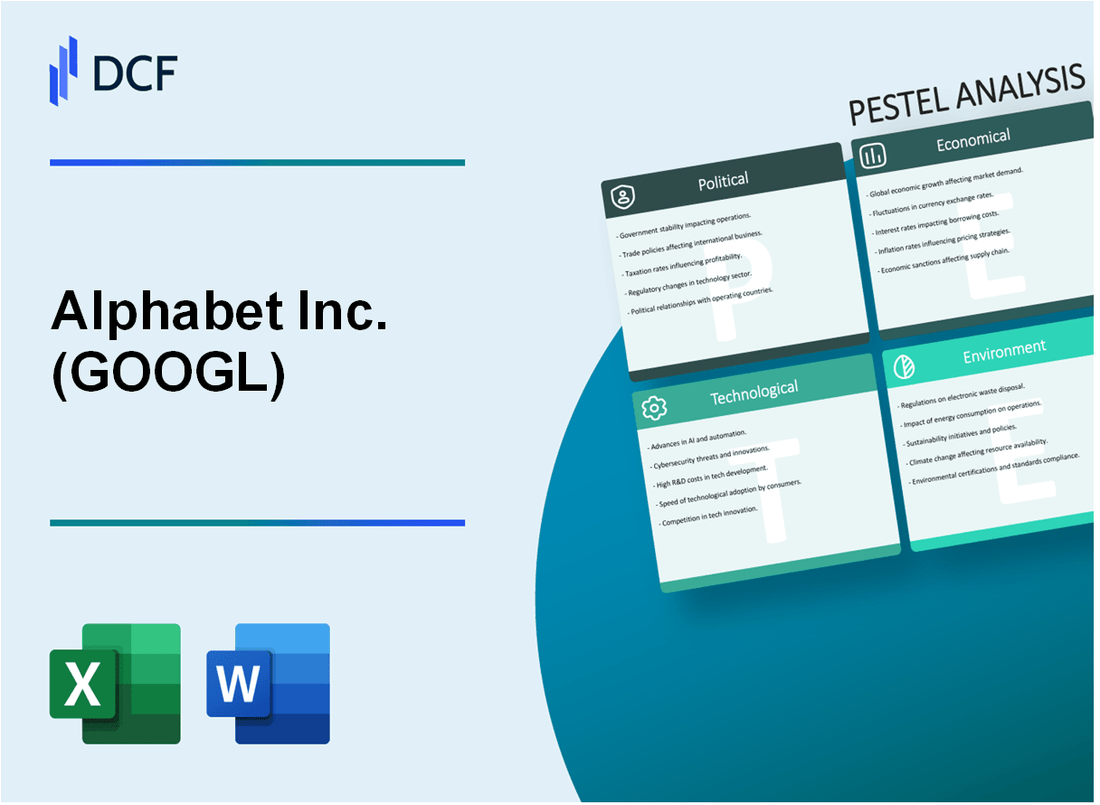
Alphabet Inc. (GOOGL): Analyse du Pestle [Jan-2025 Mise à jour] |
Entièrement Modifiable: Adapté À Vos Besoins Dans Excel Ou Sheets
Conception Professionnelle: Modèles Fiables Et Conformes Aux Normes Du Secteur
Pré-Construits Pour Une Utilisation Rapide Et Efficace
Compatible MAC/PC, entièrement débloqué
Aucune Expertise N'Est Requise; Facile À Suivre
Alphabet Inc. (GOOGL) Bundle
Dans le domaine dynamique de la technologie mondiale, Alphabet Inc. (GOOGL) est un colosse, naviguant dans un paysage complexe de défis politiques, économiques, sociologiques, technologiques, juridiques et environnementaux. De l'intelligence artificielle pionnière à la confrontation de l'examen réglementaire complexe, le parcours du géant de la technologie reflète les pressions multiformes auxquelles sont confrontés les sociétés numériques modernes. Cette analyse complète du pilon dévoile les facteurs externes nuancés en façonnant les décisions stratégiques d'Alphabet, offrant un aperçu éclairant de la façon dont l'une des entreprises les plus influentes du monde s'adapte et prospère dans un écosystème mondial de plus en plus complexe.
Alphabet Inc. (Googl) - Analyse du pilon: facteurs politiques
Accrutation mondiale accrue sur les réglementations de confidentialité des données des entreprises technologiques et antitrust
Le règlement général de la protection des données de l'Union européenne (RGPD) a infligé des amendes totalisant 1,5 milliard d'euros sur Google entre 2019-2023 pour les violations de la confidentialité. Aux États-Unis, le ministère de la Justice a intenté une plainte antitrust contre Google en octobre 2020, cherchant à briser l'activité de publicité numérique de l'entreprise.
| Corps réglementaire | Montant fin | Année |
|---|---|---|
| Commission européenne | 1,49 milliard d'euros | 2019 |
| Autorité française de protection des données | 50 millions d'euros | 2019 |
| Département de justice américain | Part de justice antitrust en attente | 2020-2024 |
Paysage réglementaire international complexe affectant les services numériques et les technologies de l'IA
Alphabet est confronté à des défis réglementaires importants dans plusieurs juridictions:
- Chine: Interdiction complète des services Google depuis 2010
- Union européenne: la loi sur les marchés numériques restreignant les pratiques de plate-forme
- Inde: Enquête sur la Commission de la compétition sur l'écosystème Android
- États-Unis: Discussions sur la réglementation technologique de l'IA au Congrès
Les tensions technologiques en cours américano-chinoises ont un impact sur les opérations commerciales mondiales
Le découplage technologique en cours entre les États-Unis et la Chine a des implications directes pour la stratégie mondiale d'Alphabet. En 2024, Google reste limité à l'exploitation des services de base en Chine, représentant une perte de marché potentielle d'environ 70 milliards de dollars par an.
| Pays | Valeur marchande potentielle | Restrictions opérationnelles |
|---|---|---|
| Chine | 70 milliards de dollars | Blocus de service complet |
| Russie | 1,5 milliard de dollars | Limitations de service partiels |
Interventions gouvernementales potentielles dans la domination du marché de Big Tech
Plusieurs gouvernements envisagent des actions législatives pour limiter le pouvoir de marché de Big Tech. Le Sénat américain a proposé le Acte en ligne de l'innovation et du choix américain, ce qui pourrait potentiellement forcer les changements structurels dans le modèle commercial d'Alphabet.
- Législation proposée ciblant les monopoles de plate-forme numérique
- Séparations potentielles d'unités commerciales obligatoires
- Mécanismes d'application antitrust améliorés
- Augmentation des exigences de transparence pour la prise de décision algorithmique
Alphabet Inc. (Googl) - Analyse du pilon: facteurs économiques
Capitalisation boursière importante et fortes performances financières dans la publicité numérique
Au quatrième trimestre 2023, la capitalisation boursière d'Alphabet s'élevait à 1,79 billion de dollars. Le chiffre d'affaires total de la société pour 2023 a atteint 307,4 milliards de dollars, avec Google, les revenus publicitaires représentant 224,5 milliards de dollars.
| Métrique financière | Valeur 2023 |
|---|---|
| Revenus totaux | 307,4 milliards de dollars |
| Revenus publicitaires Google | 224,5 milliards de dollars |
| Revenu net | 59,97 milliards de dollars |
| Capitalisation boursière | 1,79 billion de dollars |
Investissement continu dans les technologies émergentes
Dépenses de recherche et développement: Alphabet a investi 39,5 milliards de dollars en R&D en 2023, en se concentrant sur les technologies de l'IA, du cloud computing et de l'informatique quantique.
| Zone d'investissement technologique | 2023 Investissement |
|---|---|
| Recherche d'IA | 15,2 milliards de dollars |
| Cloud computing | 12,3 milliards de dollars |
| Calcul quantique | 5,6 milliards de dollars |
Incertitudes économiques mondiales
Les revenus publicitaires numériques ont connu une croissance de 2,6% en 2023, reflétant des défis économiques potentiels. Google Cloud Revenue a augmenté de 22,4% pour atteindre 23,7 milliards de dollars au cours de la même période.
Sources de revenus diversifiés
La répartition des revenus d'Alphabet pour 2023:
- Services Google: 78,7% (241,8 milliards de dollars)
- Google Cloud: 9,5% (23,7 milliards de dollars)
- Autres paris: 0,5% (1,4 milliard de dollars)
| Flux de revenus | Pourcentage | Valeur |
|---|---|---|
| Services Google | 78.7% | 241,8 milliards de dollars |
| Google Cloud | 9.5% | 23,7 milliards de dollars |
| Autres paris | 0.5% | 1,4 milliard de dollars |
Alphabet Inc. (Googl) - Analyse du pilon: facteurs sociaux
Conscience et demande de consommation croissante pour la confidentialité des données et la technologie éthique
En 2023, 86% des consommateurs ont exprimé leurs préoccupations concernant la confidentialité des données, 73% exigeant plus de transparence des entreprises technologiques. Alphabet a été confronté à 12 défis juridiques liés à la confidentialité des données majeures, les amendes réglementaires totales atteignant 392 millions de dollars dans le monde.
| Métrique de la confidentialité | Pourcentage | Impact sur l'alphabet |
|---|---|---|
| Préoccupations de confidentialité des données des consommateurs | 86% | Haut |
| Les utilisateurs exigeant la transparence | 73% | Critique |
| Amendes réglementaires mondiales | 392 millions de dollars | Significatif |
Augmentation de la dépendance numérique et de la dépendance aux services Internet
Google Services a enregistré 4,3 milliards d'utilisateurs actifs en 2023, avec une utilisation quotidienne sur Internet passant à 6,8 heures par personne dans le monde. YouTube a atteint 2,5 milliards d'utilisateurs actifs mensuels, représentant une croissance de 12% sur l'autre.
| Service numérique | Base d'utilisateurs | Taux de croissance |
|---|---|---|
| Services Google | 4,3 milliards | 8% |
| Youtube | 2,5 milliards | 12% |
| Utilisation mondiale quotidienne d'Internet | 6,8 heures | N / A |
Défis de diversité et d'inclusion de la main-d'œuvre dans le secteur de la technologie
Le rapport sur la diversité d'Alphabet en 2023 a révélé: 34,5% des employés de 5,7% d'employés noirs, 6,6% d'employés hispaniques. Les rôles de leadership technologique ont montré une représentation féminine de 25,8%.
| Catégorie démographique | Pourcentage |
|---|---|
| Employés | 34.5% |
| Employés noirs | 5.7% |
| Employés hispaniques | 6.6% |
| Rôles de leadership féminin | 25.8% |
Changer la dynamique du travail avec des modèles de travail à distance et hybride
Alphabet a mis en œuvre un modèle de travail hybride affectant 70% de sa main-d'œuvre. L'adoption du travail à distance a augmenté la satisfaction des employés de 22%, les mesures de productivité montrant une amélioration de 15% des tâches collaboratives.
| Métrique du modèle de travail | Pourcentage |
|---|---|
| Employés en modèle hybride | 70% |
| Augmentation de la satisfaction des employés | 22% |
| Amélioration de la productivité collaborative | 15% |
Alphabet Inc. (Googl) - Analyse du pilon: facteurs technologiques
Leadership in Artificiel Intelligence and Machine Learning Research
Google AI Research Division a investi 38,1 milliards de dollars dans la recherche et le développement de l'IA en 2023. Deepmind, une filiale de Google, a publié 198 articles de recherche évalués par des pairs en apprentissage automatique en 2023.
| Métrique de recherche sur l'IA | 2023 données |
|---|---|
| Investissement total de recherche sur l'IA | 38,1 milliards de dollars |
| Articles de recherche publiés | 198 |
| Demandes de brevet IA | 647 |
| Modèles d'apprentissage automatique développés | 53 |
Innovation continue dans le cloud computing, l'informatique quantique et les technologies autonomes
Google Cloud Platform a généré 23,5 milliards de dollars de revenus au quatrième trimestre 2023. La recherche informatique quantique à Google a obtenu la suprématie quantique avec un processeur de 72 qubit.
| Domaine technologique | 2023 Métriques de performance |
|---|---|
| Revenus de cloud computing | 23,5 milliards de dollars (Q4 2023) |
| Qubits informatiques quantiques | 72 Qubits |
| Miles de véhicules autonomes testés | 2,1 millions de miles |
Investissements importants dans la recherche et le développement
Alphabet a alloué 39,5 milliards de dollars à la recherche et au développement en 2023, ce qui représente 16,4% des revenus totaux.
| Catégorie d'investissement de R&D | 2023 Montant |
|---|---|
| Investissement total de R&D | 39,5 milliards de dollars |
| Pourcentage de revenus | 16.4% |
| Nombre de projets de recherche actifs | 342 |
Écosystème croissant des plateformes numériques interconnectées
L'écosystème numérique de Google comprend 9 plateformes avec plus d'un milliard d'utilisateurs actifs mensuels: Google Search, Gmail, Android, Chrome, Google Maps, YouTube, Google Play, Google Drive et Google Photos.
| Plate-forme | Utilisateurs actifs mensuels |
|---|---|
| Recherche Google | 4,3 milliards |
| Gmail | 1,8 milliard |
| Androïde | 2,5 milliards |
| Youtube | 2,7 milliards |
Alphabet Inc. (Googl) - Analyse du pilon: facteurs juridiques
Investigations antitrust en cours et défis réglementaires potentiels
En janvier 2024, Alphabet fait face à plusieurs enquêtes antitrust à l'échelle mondiale:
| Juridiction | Corps réglementaire | Fine / pénalité estimée | Statut |
|---|---|---|---|
| États-Unis | Ministère de la Justice | 2,3 milliards de dollars amende potentielle | Enquête active |
| Union européenne | Commission européenne | 4,34 milliards d'euros amende existante | Procédure de conformité en cours |
| Royaume-Uni | Autorité de la concurrence et des marchés | 1,6 milliard de £ de pénalité potentielle | Enquête préliminaire |
Litiges complexes de propriété intellectuelle et litiges de brevet
Paysage actuel des litiges en matière de brevets:
| Cas | Demandeur | Dommages recherchés | État actuel |
|---|---|---|---|
| Oracle c. Google | Oracle Corporation | 9,3 milliards de dollars | Résolu en faveur de Google |
| LIET DE BURET SONOS | Sonos Inc. | 255 millions de dollars | Litige en cours |
Conformité à la confidentialité des données dans plusieurs juridictions internationales
Dépenses de conformité et amendes réglementaires:
- Coûts de conformité du RGPD: 37,5 millions d'euros par an
- Dépenses de mise en œuvre du CCPA: 22,3 millions de dollars
- Budget de conformité globale du règlement mondial de la confidentialité: 62,8 millions de dollars en 2024
| Juridiction | Cadre réglementaire | Fine maximale potentielle |
|---|---|---|
| Union européenne | RGPD | 20 millions d'euros ou 4% du chiffre d'affaires mondial |
| Californie, États-Unis | CCPA | 7 500 $ par violation intentionnelle |
| Brésil | LGPD | 2% des revenus, max 50 millions de reais |
Défis réglementaires liés au développement et au déploiement de l'IA
Métriques de la conformité réglementaire de l'IA:
- Équipe de conformité en matière d'éthique AI: 127 employés à temps plein
- Investissement annuel de gouvernance de l'IA: 45,6 millions de dollars
- Budget d'atténuation des biais algorithmiques: 18,2 millions de dollars
| Juridiction réglementaire | Statut de réglementation de l'IA | Exigences de conformité |
|---|---|---|
| ACT de l'Union européenne | Passé décembre 2023 | Certification des systèmes AI à haut risque requis |
| États-Unis | Règlements fédéraux d'IA proposés | Cadres de transparence et de responsabilité |
| Chine | Règlement sur l'IA existant | Divulgations obligatoires de recommandation algorithmique |
Alphabet Inc. (Googl) - Analyse du pilon: facteurs environnementaux
Engagement à la neutralité du carbone et aux investissements en énergie renouvelable
Alphabet Inc. s'est engagé à fonctionner sur une énergie sans carbone 24/7 d'ici 2030. En 2023, la société a déjà égalé 100% de sa consommation mondiale d'électricité annuelle avec les achats d'énergie renouvelable.
| Métrique d'énergie renouvelable | 2023 données |
|---|---|
| Énergie renouvelable totale achetée | 7,5 gigawatts |
| Investissement d'énergie renouvelable | 5,3 milliards de dollars |
| Projets de compensation de carbone | 32 projets mondiaux |
Investissements importants dans les technologies de centre de données durables
Les centres de données de Google sont conçus avec des technologies de refroidissement avancées et des mécanismes d'efficacité énergétique.
| Métrique d'efficacité du centre de données | Performance |
|---|---|
| Efficacité de l'utilisation du pouvoir (PUE) | 1.10 (référence de l'industrie) |
| Réduction de la consommation d'eau | 20% d'une année à l'autre |
| Optimisation d'énergie dirigée par l'IA | Économies d'énergie à 40% |
Développer des solutions technologiques vertes et des outils de surveillance environnementale
Google Earth et Google Environmental Insights Explorer offrent des capacités de suivi environnemental avancées.
| Technologie environnementale | Capacité |
|---|---|
| Google Earth Engine | Surveille 3,5 millions de m² de forêt par an |
| Explorer des informations environnementales | Couvre plus de 9 000 villes dans le monde entier |
Initiatives de durabilité des entreprises et stratégies de réduction des émissions de carbone
Alphabet a mis en œuvre des stratégies complètes de réduction du carbone à travers ses opérations.
| Initiative de durabilité | 2023 Impact |
|---|---|
| Émissions totales de carbone | 4,3 millions de tonnes métriques CO2E |
| Cible de réduction des émissions | 50% de réduction d'ici 2030 |
| Projets d'économie circulaire | Investissement de 500 millions de dollars |
Alphabet Inc. (GOOGL) - PESTLE Analysis: Social factors
Persistent global shift to mobile devices for content consumption and search.
The global population's migration to mobile devices is not a trend; it is the fundamental infrastructure for digital life, and Alphabet Inc. (GOOGL) is positioned at the center of this shift through its Android operating system and mobile-first search dominance. As of 2025, over 64% of all website traffic originates from mobile devices, a figure that continues to climb. Think about that: nearly two-thirds of the world's web activity happens on a phone. This is critical because it means Alphabet's advertising revenue, which is the core of its business, is now intrinsically linked to the mobile experience.
The sheer scale is staggering. The number of smartphone users globally reached approximately 5.78 billion in 2025. In the U.S., a key market, roughly 63% of all Google searches are performed on a mobile device. Alphabet's Android operating system captures the lion's share of this traffic, holding a global mobile OS market share of approximately 71.85%. This massive reach makes the mobile platform the primary social conduit for billions of people.
- Global smartphone users in 2025: 5.78 billion.
- Global mobile OS market share (Android): 71.85%.
- Daily global mobile screen time: 4.9 hours.
Growing consumer demand for digital literacy and internet access in emerging markets.
Future growth is tied directly to the next billion users, which reside almost exclusively in emerging markets where digital literacy remains a significant barrier. While over 60% of the world is online, only about 50% of adults in developing countries are considered digitally literate. This gap presents both a social responsibility and a massive commercial opportunity for Alphabet.
The company leverages its low-cost Android platform to penetrate these markets. For example, in India, a country with immense growth potential, Android powers over 95% of all mobile devices accessing the web. To capitalize on this, Alphabet must invest in programs that build the digital skills necessary to use its products effectively. The global digital literacy training market is expected to reach $10 billion by 2025, showing the scale of the need. Alphabet's large capital expenditure (CapEx) for FY2025, projected at between $91 billion and $93 billion, is primarily dedicated to AI and cloud infrastructure, which will ultimately support the services delivered to these new users.
Increased public concern over data privacy and algorithmic bias in search and AI.
The social contract between Alphabet and its users is under immense strain, driven by escalating concerns over data privacy and the fairness of algorithmic decision-making. Consumers are defintely more aware of the trade-off: 85% of global adults now express a desire to take greater steps to protect their online privacy. This is not just a regulatory issue; it's a trust issue that directly impacts user adoption and retention.
The financial consequences for violating this trust are severe and material to the 2025 fiscal year. For instance, Alphabet's Google was ordered to pay $425 million in a September 2025 class action lawsuit over allegations of collecting user data even after tracking features were disabled. Earlier in the year, in May 2025, Google agreed to a massive $1.375 billion settlement in a Texas lawsuit concerning unlawful tracking of users' location and incognito activity. These fines map a clear risk to the bottom line.
Furthermore, the rise of powerful AI models like Gemini has introduced new social risks, particularly algorithmic bias. A significant 70% of consumers report having little to no trust in companies to make responsible decisions about how they use AI in their products. The average cost of a U.S. data breach climbed to $10.22 million in 2025, illustrating the cost of failure in a single incident.
| Privacy & Algorithmic Risk (FY 2025) | Amount/Percentage | Context |
|---|---|---|
| Texas Privacy Lawsuit Settlement | $1.375 billion | Settlement for unlawful user tracking (May 2025). |
| Class Action Privacy Verdict | $425 million | Ordered penalty for collecting data after opt-out (September 2025). |
| Global Adults Concerned About Privacy | 85% | Percentage of adults wanting to take more steps to protect online privacy. |
| Consumer Mistrust in Ethical AI Use | 70% | Percentage of consumers with little to no trust in companies' responsible AI decisions. |
Localization of content and cultural sensitivity are vital for global user adoption.
To maintain its global revenue distribution-where the Europe, Middle East, and Africa (EMEA) region accounted for 29% of revenue in 2024, and the Asia-Pacific (APAC) region added 16%-Alphabet must master localization, not just translation. The localization industry itself is projected to grow to $75.7 billion in 2025, underscoring its strategic importance.
Localization is a direct driver of revenue, as 76% of online shoppers are more likely to buy products when the information is in their native language. Alphabet is addressing this with AI-powered multilingual support. The company expanded its AI Mode in Search to over 180 countries in September 2025, supporting languages like Spanish, French, German, and various Asian dialects. This scale is possible because its underlying AI technology, the Multitask Unified Model (MUM), can process over 75 languages, allowing it to understand and serve culturally nuanced content globally. This is a smart move: speak the language, win the market.
Alphabet Inc. (GOOGL) - PESTLE Analysis: Technological factors
Aggressive Investment in AI and Data Processing Scale
Alphabet Inc.'s technological edge is now defined by its aggressive, full-stack approach to Artificial Intelligence (AI), moving from software models to proprietary hardware. This strategy is paying off in massive scale and efficiency. For instance, the company's first-party models, like Gemini, are now processing an incredible 7 billion tokens per minute via direct API use by customers, demonstrating a level of computational throughput few competitors can match.
This scale is crucial because AI is no longer a niche product; it is the core of the business. The Gemini App alone now has over 650 million monthly active users, integrating advanced multimodal capabilities that handle text, images, and audio simultaneously. This rapid user adoption validates the company's significant research and development spending.
High CapEx is Driving Expansion of AI Infrastructure and Data Centers
You can see the AI commitment directly in the Capital Expenditure (CapEx) numbers, which are soaring. Alphabet is investing ahead of the demand curve, which is a smart but defintely costly move. The company's full-year 2025 CapEx is now guided to be in a range of $91 billion to $93 billion, primarily funding this AI infrastructure build-out.
Here's the quick math on where that money is going: Q3 2025 CapEx alone was $23.95 billion, representing an 83% year-over-year increase. Approximately 60% of that investment is allocated to servers-the specialized hardware running the AI models-with the remaining 40% going toward expanding data centers and networking equipment to house it all. This massive spending is the foundation for future revenue growth, but it will pressure short-term free cash flow.
The Efficiency of Ironwood TPU AI Chips
The core of Alphabet's vertical integration strategy is its custom silicon, the Tensor Processing Units (TPUs). The latest, seventh-generation chip, codenamed Ironwood, is purpose-built for high-volume AI inference (the process of using a trained AI model to generate a response). This chip offers a 10X peak performance improvement over TPU v5p. More importantly for long-term sustainability and cost control, the Ironwood TPU architecture is nearly 30 times more energy efficient than the original TPUs launched in 2013, which is a game-changer for operating costs at this scale.
Continuous Innovation in Quantum Computing and Cloud Services is Essential
While AI dominates the near-term narrative, the company is also pushing the frontier of computing with its Quantum AI division. This long-term bet is crucial because it promises to solve problems that are currently impossible for classical supercomputers. The recent breakthrough with the Willow quantum chip is a concrete example.
- The Willow chip achieved a verifiable quantum advantage in October 2025.
- It performed a calculation 13,000 times faster than the world's most powerful classical supercomputers.
- This milestone is a key step toward commercializing quantum applications in areas like materials science and medicine.
Rapid Adoption of Cloud Services Worldwide Fuels Google Cloud's Growth
The technological investments directly translate into the success of Google Cloud, which is a key growth engine. The rapid adoption of AI-driven cloud services worldwide is fueling its acceleration. In Q3 2025, Google Cloud revenue surged to $15.2 billion, representing a 34% year-over-year growth. This growth rate continues to outpace some competitors and is a direct result of the AI infrastructure investments.
The strong demand is further evidenced by the massive revenue backlog (contracted future revenue that has not yet been recognized) which hit $155 billion by the end of Q3 2025. This backlog, up 82% from the previous year, provides a clear view of the long-term structural uplift tied to its AI infrastructure leadership.
| Metric (Q3 2025) | Value / Rate | Significance |
|---|---|---|
| Google Cloud Revenue | $15.2 billion | First time Google Cloud exceeded $15 billion in quarterly revenue. |
| Google Cloud Year-over-Year Growth | 34% | Strong growth driven by AI infrastructure and generative AI solutions. |
| Full-Year 2025 CapEx Guidance | $91 billion - $93 billion | Massive investment in AI servers and data centers. |
| Gemini Token Processing (API) | 7 billion tokens per minute | Demonstrates unmatched scale and computational throughput of AI models. |
| Ironwood TPU Efficiency | Nearly 30X more energy efficient (vs. original TPU) | Drives down the long-term cost of running large-scale AI services. |
Alphabet Inc. (GOOGL) - PESTLE Analysis: Legal factors
European Commission fine of $3.5 billion accrued in Q3 2025 for competition infringement.
You need to factor in the direct financial hit from the European Union's ongoing antitrust enforcement. The European Commission fined Alphabet Inc. €2.95 billion, which is roughly $3.5 billion, in September 2025 for anti-competitive practices in its ad technology business. This is a massive, immediate liability that Alphabet Inc. expects to record in its Q3 2025 financial results.
The core issue is that the Commission found Alphabet Inc. unfairly favored its own display ad services, hurting rival providers and publishers. The fine is significant, but the required behavioral changes-fixing conflicts of interest in its ad-tech supply chain-will likely have a far greater long-term impact on the company's advertising revenue model. Alphabet Inc. has stated it plans to appeal the decision.
Ongoing US DOJ antitrust lawsuits threaten structural changes to the ad business.
The US Department of Justice (DOJ) antitrust lawsuit against Alphabet Inc. over its advertising technology is now at a critical remedies phase, with closing arguments wrapping up in November 2025. A federal judge already ruled in April 2025 that Alphabet Inc. holds two illegal monopolies in the open-web display advertising market.
The DOJ is pushing for a structural remedy, which means forcing Alphabet Inc. to sell off its ad exchange, AdX, and other parts of its Ad Manager suite. This is not just a fine; it's a threat to the fundamental structure of the company's $200+ billion core advertising business. Alphabet Inc. argues a breakup is technically impossible and would cost billions, but the risk of forced divestiture remains high and will likely lead to years of appeals.
Here's the quick math: a forced sale of AdX could reshape the entire digital advertising ecosystem, creating new, formidable competitors overnight.
Compliance costs for global data privacy laws like GDPR and CCPA are rising.
The cost of regulatory compliance is no longer a minor line item; it is a strategic investment to mitigate massive risk. Alphabet Inc. committed to spending at least $500 million over the next decade on global compliance initiatives as part of a July 2025 shareholder derivative litigation settlement. This money is earmarked for strengthening corporate governance and regulatory readiness, particularly around antitrust and data privacy.
The regulatory landscape is tightening globally, which translates directly into recurring operational costs:
- GDPR (Europe): Cumulative fines across the industry reached approximately €5.88 billion by January 2025, showing the intensity of enforcement.
- CCPA/CPRA (California): Compliance with the California Consumer Privacy Act and its amendments requires constant updates to data handling and consumer request mechanisms.
- EU AI Act: Fully in force in 2025, this landmark legislation introduces new compliance challenges for AI systems, with potential fines up to €35 million or 7% of global turnover for violations.
What this estimate hides is the opportunity cost: engineering time spent on compliance is time not spent on innovation. The risk is that a single data breach or compliance failure could trigger a fine that dwarfs the annual compliance budget.
Managing intellectual property (IP) is critical, with thousands of new patents filed annually.
Alphabet Inc.'s massive and strategically managed Intellectual Property (IP) portfolio is a critical legal asset that underpins its competitive advantage in AI, Cloud, and Search. The company actively files thousands of new patents each year to protect its core technologies and emerging 'Other Bets.'
In the 2025 Patent 300 list, Alphabet Inc. was ranked 8th among all organizations for US Patents granted in 2024, securing 2,698 patents. This volume reflects a 6% year-over-year increase, demonstrating a sustained, high-level investment in R&D protection.
This IP strength is a key defensive tool in the face of litigation and a revenue source through licensing. The strategic focus is on creating ecosystems of interconnected patents in areas like AI, cloud computing, and IoT, making it harder for competitors to innovate without infringing.
| Legal Risk Area | 2025 Financial/Structural Impact | Key Regulatory Action (2025) |
|---|---|---|
| European Commission Antitrust Fine | Accrued fine of approx. $3.5 billion in Q3 2025. | Fine levied for anti-competitive ad-tech practices; ordered to cease self-preferencing. |
| US DOJ Antitrust Lawsuit (Ad-Tech) | Threat of structural change, including divestiture of AdX. | Judge ruled illegal monopolies in April 2025; closing arguments on remedies in November 2025. |
| Global Data Privacy Compliance | Committed spend of at least $500 million over 10 years on global compliance. | EU AI Act fully in force; continued enforcement of GDPR, CCPA, and CPRA. |
| Intellectual Property (IP) Management | Protection of core revenue streams (Search, Cloud) and future growth (AI). | Filed 2,698 US Patents in 2024 (ranked 8th), a 6% YoY increase. |
Next Step: Legal and Finance teams must model the revenue impact of a forced AdX divestiture and allocate the $500 million compliance budget to prioritize EU AI Act readiness by Q1 2026.
Alphabet Inc. (GOOGL) - PESTLE Analysis: Environmental factors
Alphabet Inc. is navigating a difficult environmental challenge: decarbonizing rapidly while its core business-especially AI and Cloud-drives massive, new energy demand. The company is leaning hard on record clean energy procurement and next-generation technologies like Small Modular Reactors (SMRs) to meet its 2030 net-zero goals, but overall emissions are still rising due to supply chain growth.
Commitment to 100% renewable energy matching for all global operations.
You know the headline: Alphabet has matched 100% of its annual electricity consumption with renewable energy purchases since 2017. That's a great PR win, but the real work is the push for 24/7 carbon-free energy (CFE), which means matching every hour of consumption with clean energy generation in the same grid region.
In 2024, the company achieved 66% CFE globally, up from 64% in 2023. This is a tough, granular goal, and it's where the rubber meets the road on true decarbonization. The gap between 100% annual matching and 24/7 CFE highlights the intermittency problem of solar and wind, and it's why the company is aggressively pursuing firm, carbon-free power sources like geothermal and advanced nuclear.
Data center emissions were reduced by 12% despite increased energy demand.
This is a critical operational win you shouldn't overlook. Despite a 27% increase in electricity consumption at the data centers in 2024-driven heavily by the AI boom-Alphabet managed to reduce its data center energy emissions by 12% year-over-year.
Here's the quick math: The only way to achieve that is through a combination of massive clean energy procurement and significant efficiency gains. They are getting six times more computing power per unit of electricity than five years ago, largely thanks to custom chips like the Ironwood Tensor Processing Unit (TPU), which is nearly 30 times more power efficient than the 2018 model.
Replenished 4.5 billion gallons of water in 2025 to local watersheds.
Water use for cooling data centers is a growing environmental risk, especially in water-stressed regions. Alphabet is addressing this with a goal to replenish 120% of the freshwater it consumes by 2030. In 2024, the company replenished 4.5 billion gallons of water through stewardship projects, which is a huge jump that covered 64% of its freshwater consumption, up from 18% in 2023.
This is more than just balancing the ledger; it's about improving local watershed health. These 112 projects span 68 watersheds globally, focusing on things like stormwater management and supporting efficient agricultural irrigation in areas near their data center operations.
Procured over 8 GW of clean energy to meet growing power needs.
To fuel the AI revolution, you need power, and Alphabet is buying it at a record pace. In 2024, the company signed contracts to purchase over 8 GW (gigawatts) of new clean energy generation, which is the largest annual total in its history and double the amount procured the previous year.
This procurement, which includes a massive framework agreement for up to 3 GW of carbon-free hydroelectric capacity, is essential to keep up with the demand curve. The total clean energy portfolio now stands at over 22 GW since 2010. This is a huge capital outlay that secures long-term, fixed-price energy, which is a smart financial hedge against volatile fossil fuel markets.
Signed the first corporate agreement for nuclear energy from small modular reactors (SMRs).
The push for 24/7 CFE requires reliable, non-intermittent power sources, so the company is innovating beyond traditional solar and wind. Alphabet signed the world's first corporate power purchase agreement for nuclear energy from multiple Small Modular Reactors (SMRs) developed by Kairos Power.
This deal is expected to enable up to 500 megawatts (MW) of new, 24/7 carbon-free power for U.S. electricity grids by 2035, with the first SMR coming online by 2030. This move signals a strategic shift in the tech sector, acknowledging that AI-driven energy demand is so high that only advanced, non-variable clean power can meet the need for continuous operation.
Here is a snapshot of the company's 2024 environmental performance, as reported in its 2025 Environmental Report:
| Metric | 2024 Performance (2025 Report) | Strategic Context |
|---|---|---|
| Data Center Emissions Reduction | 12% reduction (energy emissions) | Achieved despite a 27% rise in electricity consumption. |
| Freshwater Replenishment | 4.5 billion gallons replenished | Increased replenishment rate to 64% of consumption. |
| Clean Energy Procurement | Over 8 GW of new contracts signed | Largest annual total in company history. |
| Carbon-Free Energy (CFE) Rate | 66% CFE globally | Progress toward the 24/7 CFE goal by 2030. |
| Scope 3 Emissions (Supply Chain) | Rose by more than 20% | The main driver of the company's rising overall carbon footprint. |
You defintely need to track the CapEx-to-Revenue ratio; if that $91 billion investment doesn't translate to proportional revenue growth, profitability will suffer, so watch the Q4 numbers closely.
Next Step: Finance: Model the impact of the 15% global minimum tax on Q4 net income by month-end.
Disclaimer
All information, articles, and product details provided on this website are for general informational and educational purposes only. We do not claim any ownership over, nor do we intend to infringe upon, any trademarks, copyrights, logos, brand names, or other intellectual property mentioned or depicted on this site. Such intellectual property remains the property of its respective owners, and any references here are made solely for identification or informational purposes, without implying any affiliation, endorsement, or partnership.
We make no representations or warranties, express or implied, regarding the accuracy, completeness, or suitability of any content or products presented. Nothing on this website should be construed as legal, tax, investment, financial, medical, or other professional advice. In addition, no part of this site—including articles or product references—constitutes a solicitation, recommendation, endorsement, advertisement, or offer to buy or sell any securities, franchises, or other financial instruments, particularly in jurisdictions where such activity would be unlawful.
All content is of a general nature and may not address the specific circumstances of any individual or entity. It is not a substitute for professional advice or services. Any actions you take based on the information provided here are strictly at your own risk. You accept full responsibility for any decisions or outcomes arising from your use of this website and agree to release us from any liability in connection with your use of, or reliance upon, the content or products found herein.