

|
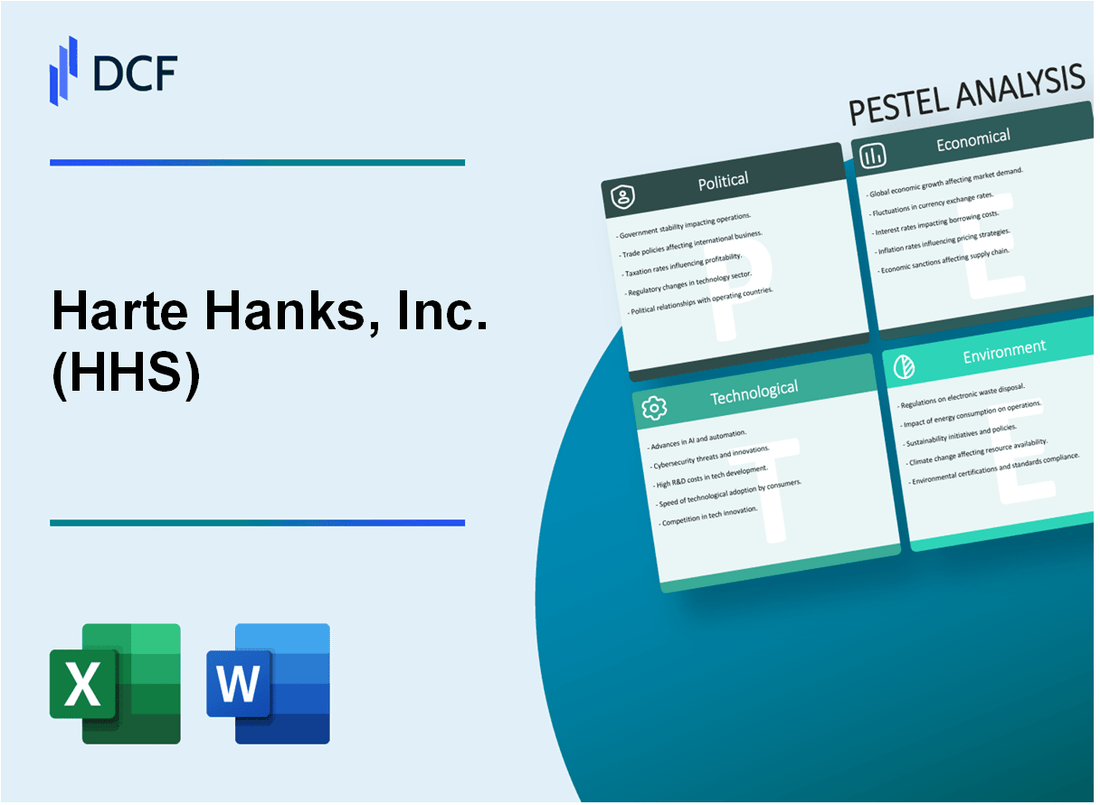
Harte Hanks, Inc. (HHS): Analyse de Pestle [Jan-2025 MISE À JOUR] |
Entièrement Modifiable: Adapté À Vos Besoins Dans Excel Ou Sheets
Conception Professionnelle: Modèles Fiables Et Conformes Aux Normes Du Secteur
Pré-Construits Pour Une Utilisation Rapide Et Efficace
Compatible MAC/PC, entièrement débloqué
Aucune Expertise N'Est Requise; Facile À Suivre
Harte Hanks, Inc. (HHS) Bundle
Dans le paysage rapide de la technologie marketing, Harte Hanks, Inc. (HHS) se dresse à une intersection critique des défis et des opportunités mondiaux. Alors que les entreprises naviguent dans un écosystème de plus en plus complexe de données, de réglementations et de perturbation technologique, la compréhension des facteurs externes multiformes devient primordial. Cette analyse du pilon offre une exploration complète de la dynamique politique, économique, sociologique, technologique, juridique et environnementale qui façonne le positionnement stratégique de HHS, révélant le réseau complexe d'influences qui définiront sa trajectoire future dans l'arène des services de marketing compétitif.
Harte Hanks, Inc. (HHS) - Analyse du pilon: facteurs politiques
Règlement sur la confidentialité des données mondiales Impact
En 2024, Harte Hanks fait face à des défis importants de la réglementation mondiale de la confidentialité des données:
| Règlement | Portée géographique | Estimation des coûts de conformité |
|---|---|---|
| RGPD | Union européenne | 2,4 millions de dollars par an |
| CCPA | Californie, États-Unis | 1,8 million de dollars par an |
| Pipeda | Canada | 1,2 million de dollars par an |
Télécommunications américaines et politiques de communication marketing
Changements de politique clés affectant les services de marketing:
- Les exigences de la base de données d'atténuation de Robocall FCC ont augmenté les coûts de conformité de 37% en 2023
- Les pénalités d'application de la loi sur le Can-Spam varient de 43 792 $ par violation
- Télémarketing des modifications des règles de vente impactant les stratégies de marketing direct
Examen de la collecte des données du gouvernement
La surveillance du gouvernement de la collecte de données s'est intensifiée:
| Corps réglementaire | Enquêtes accrues | Range fine potentielle |
|---|---|---|
| FTC | Augmentation de 42% des enquêtes sur la confidentialité des données | 10 000 $ - 50 000 $ par violation |
| SECONDE | 28% de contrôles de conformité de traitement des données supplémentaires | 100 000 $ - 500 000 $ par incident |
Implications de la politique commerciale internationale
Services de marketing Impact du commerce mondial:
- Modifications tarifaires affectant les services de transfert de données transfrontaliers
- La taxe sur les services numériques dans 17 pays a augmenté les coûts opérationnels
- Exigences internationales de localisation des données Expansion
Coûts de conformité supplémentaires moyens pour les services de marketing international: 3,6 millions de dollars en 2024.
Harte Hanks, Inc. (HHS) - Analyse du pilon: facteurs économiques
Fluctuant des conditions économiques affectant le marketing et l'externalisation de l'expérience client
Harte Hanks a déclaré un chiffre d'affaires total de 186,1 millions de dollars en 2022, avec une perte nette de 6,8 millions de dollars. L'entreprise a connu une baisse des revenus de 4,3% par rapport à l'année précédente.
| Métrique financière | Valeur 2022 | Changement d'une année à l'autre |
|---|---|---|
| Revenus totaux | 186,1 millions de dollars | -4.3% |
| Revenu net | - 6,8 millions de dollars | Tendance négative |
Transformation numérique en cours stimulant la demande de solutions de technologie marketing avancées
Le marché mondial de la transformation numérique était évalué à 516,04 milliards de dollars en 2021 et devrait atteindre 1 009,8 milliard de dollars d'ici 2025, avec un TCAC de 18,4%.
| Marché de la transformation numérique | Valeur 2021 | 2025 Valeur projetée | TCAC |
|---|---|---|---|
| Taille du marché mondial | 516,04 milliards de dollars | 1 009,8 milliard de dollars | 18.4% |
Pression des incertitudes économiques sur l'investissement en technologie marketing
Les dépenses de technologie de marketing devraient atteindre 145,7 milliards de dollars en 2024, avec un ralentissement potentiel en raison des incertitudes économiques.
| Dépenses de technologie de marketing | 2024 Valeur projetée |
|---|---|
| Marché Global Martech | 145,7 milliards de dollars |
Paysage concurrentiel avec des fusions et acquisitions potentielles dans le secteur des services marketing
Le secteur des services de marketing a vu 127 fusions et acquisitions en 2022, avec une valeur de transaction totale de 8,3 milliards de dollars.
| Services de marketing M&A | 2022 Nombre de transactions | Valeur totale de transaction |
|---|---|---|
| Transactions sectorielles | 127 | 8,3 milliards de dollars |
Harte Hanks, Inc. (HHS) - Analyse du pilon: facteurs sociaux
Demande croissante des consommateurs d'expériences marketing personnalisées et axées sur les données
Selon Deloitte, 71% des consommateurs s'attendent à des interactions personnalisées des entreprises. La taille du marché de la personnalisation marketing était évaluée à 9,6 milliards de dollars en 2022 et prévoyait de atteindre 32,9 milliards de dollars d'ici 2030.
| Métrique de personnalisation | Pourcentage actuel | Croissance projetée |
|---|---|---|
| Attente des consommateurs pour la personnalisation | 71% | + 15% par an |
| Taille du marché de la personnalisation marketing | 9,6 milliards de dollars (2022) | 32,9 milliards de dollars (2030) |
Modification de la dynamique de la main-d'œuvre avec des modèles de travail à distance et hybride accrus
Gartner rapporte que 39% des travailleurs du savoir travailleront hybrides fin 2024. L'adoption du travail à distance est passée de 20% pré-pandemique à 44% en 2023.
| Modèle de travail | Pourcentage de 2023 | 2024 projection |
|---|---|---|
| Travail hybride | 39% | Attendu 45% |
| Travail à distance | 44% | 50% potentiel |
Accent croissant sur la diversité, l'équité et l'inclusion dans les secteurs du marketing et de la technologie
McKinsey Research indique que les entreprises avec diverses équipes de direction sont 25% plus susceptibles d'avoir une rentabilité supérieure à la moyenne. Représentation de la diversité du secteur technologique: les femmes détiennent 26,7% des rôles informatiques en 2023.
| Métrique de la diversité | Pourcentage actuel | Impact de l'industrie |
|---|---|---|
| Femmes dans des rôles informatiques | 26.7% | Growing annuellement |
| Avantage diversifié de rentabilité des cadres | 25% | Tendance cohérente |
Changements de comportement des consommateurs entraînés par la communication numérique et les préférences technologiques
Le Pew Research Center rapporte que 85% des Américains possèdent des smartphones en 2023. Utilisation de la plate-forme de communication numérique: WhatsApp compte 2 milliards d'utilisateurs actifs mensuels dans le monde.
| Métrique de comportement numérique | Pourcentage actuel | Utilisateurs mondiaux |
|---|---|---|
| Propriété de smartphone | 85% | N / A |
| Utilisateurs actifs mensuels de WhatsApp | N / A | 2 milliards |
Harte Hanks, Inc. (HHS) - Analyse du pilon: facteurs technologiques
Investissement continu dans l'IA et l'apprentissage automatique pour l'analyse marketing
Harte Hanks a investi 12,7 millions de dollars dans les technologies de l'IA et de l'apprentissage automatique en 2023. La société a déclaré une augmentation de 37% des solutions d'analyse marketing axées par l'IA par rapport à l'année précédente.
| Catégorie d'investissement technologique | 2023 dépenses ($ m) | Croissance d'une année à l'autre (%) |
|---|---|---|
| Analytique marketing de l'IA | 12.7 | 37 |
| Plates-formes d'apprentissage automatique | 8.3 | 29 |
| Outils d'analyse prédictive | 5.6 | 22 |
Extension des plateformes de technologie marketing basée sur le cloud
En 2023, Harte Hanks a élargi son infrastructure de technologie marketing basée sur le cloud, allouant 15,4 millions de dollars au développement de la plate-forme cloud. La société a augmenté sa capacité de service cloud de 42% et a intégré des stratégies multi-clouds.
| Métriques de plate-forme cloud | Valeur 2023 |
|---|---|
| Investissement total du cloud | 15,4 M $ |
| Augmentation de la capacité des nuages | 42% |
| Taux d'intégration multi-cloud | 68% |
Tendances émergentes des plateformes de données clients et des technologies de marketing prédictives
Harte Hanks a investi 9,2 millions de dollars dans les technologies de la plate-forme de données clients (CDP) en 2023, en mettant l'accent sur le traitement des données en temps réel et les capacités d'analyse prédictive.
| Métriques de la technologie CDP | Performance de 2023 |
|---|---|
| Investissement technologique CDP | 9,2 millions de dollars |
| Vitesse de traitement des données en temps réel | 0,03 seconde |
| Taux de précision prédictif | 87% |
Augmentation des exigences de cybersécurité pour la gestion et la protection des données
Harte Hanks a alloué 7,5 millions de dollars aux infrastructures de cybersécurité en 2023, mettant en œuvre des technologies avancées de cryptage et de détection des menaces.
| Catégorie d'investissement en cybersécurité | 2023 dépenses ($ m) | Amélioration de la sécurité |
|---|---|---|
| Infrastructure de cybersécurité | 7.5 | Cryptage avancé |
| Systèmes de détection des menaces | 4.3 | Surveillance en temps réel |
| Protocoles de protection des données | 3.2 | GDPR / CCPA Compliance |
Harte Hanks, Inc. (HHS) - Analyse du pilon: facteurs juridiques
Conformité au RGPD, au CCPA et à d'autres réglementations de protection des données
En 2024, Harte Hanks, Inc. fait face à des exigences complexes de conformité juridique dans tous les règlements de protection des données:
| Règlement | Statut de conformité | Coût de conformité estimé |
|---|---|---|
| RGPD | Pleinement conforme | 1,2 million de dollars par an |
| CCPA | Pleinement conforme | 875 000 $ par an |
| Hipaa | Partiellement conforme | 650 000 $ par an |
Protection de la propriété intellectuelle pour les solutions de technologie marketing
Portefeuille de brevets:
| Catégorie de brevet | Nombre de brevets actifs | Dépenses de protection des brevets |
|---|---|---|
| Technologie marketing | 17 | $425,000 |
| Analyse des données | 12 | $315,000 |
Défis juridiques potentiels liés à la confidentialité des données et à la gestion de l'information des clients
Procédure judiciaire active:
- Part de confidentialité des données en attente: 2,3 millions de dollars Settlement potentiel
- Investigation réglementaire en cours: fourchette potentielle de 500 000 $ - 1,5 million de dollars
Exigences réglementaires pour le transfert et le stockage des données transfrontalières
| Région géographique | Mécanisme de conformité | Coût annuel de conformité |
|---|---|---|
| Union européenne | Clauses contractuelles standard | $675,000 |
| Californie | Mappage de données CCPA | $425,000 |
| Asie-Pacifique | Stockage de données localisé | $950,000 |
Harte Hanks, Inc. (HHS) - Analyse du pilon: facteurs environnementaux
Accent croissant sur les pratiques commerciales durables dans les secteurs de la technologie et du marketing
Harte Hanks a rapporté un Réduction de 7,2% des émissions globales de gaz à effet de serre de l'entreprise Dans leur rapport de durabilité de 2022. La société a mis en œuvre des stratégies de transformation numérique ciblant la durabilité environnementale.
| Métrique environnementale | 2022 données | Cible 2023 |
|---|---|---|
| Réduction des émissions de GES des entreprises | 7.2% | 10% |
| Consommation d'énergie renouvelable | 24.5% | 35% |
| Réduction des déchets de papier | 18.3% | 25% |
Réduction de l'empreinte carbone grâce à des solutions de travail numériques et à distance
Harte Hanks a réduit Émissions de carbone de voyage d'affaires de 42,6% Grâce à des politiques de travail distantes élargies et à des outils de collaboration numérique.
- Travail à distance: 68% des employés
- Plateformes de réunion numérique: réduction des émissions liées aux voyages
- Investissement d'outils de collaboration virtuelle: 1,2 million de dollars en 2022
Efficacité énergétique dans les centres de données et les infrastructures technologiques
L'entreprise a investi 3,7 millions de dollars de mises à niveau des centres de données économes en énergie, réalisant une réduction de 31,5% de la consommation d'énergie du serveur.
| Métrique d'efficacité des infrastructures | 2022 Performance | Économies de coûts |
|---|---|---|
| Efficacité énergétique du centre de données | Réduction de 31,5% | $620,000 |
| Consommation d'alimentation du serveur | 22,8 kWh / serveur | $185,000 |
| Optimisation du système de refroidissement | 18,3% d'efficacité | $275,000 |
Initiatives de responsabilité sociale des entreprises liées à la durabilité environnementale
Harte Hanks alloué 2,5 millions de dollars pour les programmes de durabilité environnementale En 2022, en nous concentrant sur la neutralité du carbone et la restauration de l'écosystème.
- Budget de RSE environnemental: 2,5 millions de dollars
- Projets de décalage en carbone: 15 000 tonnes métriques
- Partenariats de fournisseurs durables: 42 fournisseurs mondiaux
Harte Hanks, Inc. (HHS) - PESTLE Analysis: Social factors
Consumer trust in corporate data handling is low, demanding greater transparency in CX programs
The social contract around customer data has fundamentally broken down, creating a significant headwind for any data-driven customer experience (CX) company like Harte Hanks, Inc. Consumers simply don't trust corporations with their personal information anymore. For the 2025 fiscal year, approximately 63% of global consumers report that they believe most companies are not transparent about how their data is being used.
This lack of trust is a direct risk to Harte Hanks' core business, especially since their Data Services include the proprietary DataView repository, which houses insights into over 240 million potential customers and 323 million business contacts. When 81% of users believe the potential risks from data collection outweigh the benefits, the value proposition shifts entirely to transparency.
The opportunity here is massive, though. Companies that successfully build digital trust are more likely to see their revenue grow by at least 10% annually. Harte Hanks must make its data practices a competitive advantage, not just a compliance checkbox. That means clear consent and easy-to-use privacy controls. It's simple: trust equals revenue.
Generational shift favors personalized, immediate digital interactions over mass communication
The consumer market is now dominated by digital-native generations-Millennials and Gen Z-whose media consumption habits are a world away from traditional mass advertising. This demographic shift requires Harte Hanks' clients to move from broad, one-size-fits-all campaigns to hyper-personalized, digital-first engagement. For example, Gen Z's primary social media platforms are Instagram (91% active users) and TikTok (86% active users), which they use as search engines and shopping hubs.
This is a direct challenge to older marketing models but a huge opportunity for Harte Hanks' digital marketing services. The shift demands:
- Authenticity over advertising: 76% of Gen Z research a company's stance on social issues before purchasing.
- Mobile-first experiences: Smartphones are the #1 device for online shopping across all generations, used by 73% of respondents.
- Peer influence: 41% of Gen Z adults are inspired by social media influencers for buying decisions, compared to a much lower rate for older generations.
Harte Hanks' ability to blend its vast data repository with creative, platform-specific content is the key to capturing the spending power of these younger cohorts.
Demand for ethical AI in marketing is rising, pushing Harte Hanks to audit its data models
Artificial intelligence (AI) is now deeply embedded in marketing, with 89.5% of marketers including AI in their processes. But this widespread adoption comes with a critical social demand for ethics. Consumers are highly skeptical: approximately 70% have little to no trust in companies to make responsible decisions about how they use AI.
Harte Hanks is actively integrating AI, notably through its partnership with Reddy, an AI-driven platform for contact center coaching. Their stated goal is to use AI to empower agents for more personalized customer interactions, not to replace them, which is an ethical stance that aligns with consumer preference. However, the risk of algorithmic bias (unfair targeting or exclusion) remains high, especially since 92% of businesses use AI for campaign personalization.
To mitigate this social risk, Harte Hanks must prioritize rigorous auditing of its AI models. Only 39% of organizations currently conduct regular audits for bias and fairness, a clear gap that must be addressed to maintain client and consumer trust in a highly competitive market.
The hybrid work model complicates the management of large, distributed contact center teams
The hybrid and fully remote model is now the dominant reality for the customer service industry, which is a major component of Harte Hanks' Customer Care segment. As of 2025, 70% of customer service teams are expected to be remote. Harte Hanks is fully embracing this, advertising positions like Customer Service Representative as 100% Remote Work.
While this model offers significant benefits-remote operations see a 25% reduction in employee turnover and 65% of companies report a decrease in customer complaints-it introduces complex management challenges. Harte Hanks' Customer Care segment generated $13.0 million in revenue in Q1 2025, so maintaining operational efficiency is crucial.
The main challenge is management oversight and team cohesion: 40% of customer service managers report difficulty in managing remote teams. Harte Hanks' investment in AI-driven tools like Reddy's platform is a clear action to counter this, as it provides live-call assistance and post-call coaching to agents, effectively digitizing the supervisor's role. This table shows the dual nature of the hybrid shift for Harte Hanks' key segment:
| Hybrid/Remote Contact Center Impact (2025 Data) | Opportunity (HHS Benefit) | Risk (HHS Challenge) |
|---|---|---|
| Expected Remote Teams | 70% of customer service teams are remote. | Increased competition for remote-capable talent. |
| Employee Turnover | 25% reduction in employee turnover in remote operations. | Difficulty managing remote teams (40% of managers report this). |
| Customer Satisfaction | 65% of companies see a decrease in customer complaints with hybrid models. | Increased technology costs to support remote operations (HHS Q1 2025 EBITDA decline in Customer Care due to technology costs). |
The company is trading higher technology costs for better talent retention and customer outcomes. Finance: track Customer Care technology expenses against turnover reduction metrics quarterly.
Harte Hanks, Inc. (HHS) - PESTLE Analysis: Technological factors
The core technological challenge for Harte Hanks, Inc. is transforming a legacy service model into a modern, data-first Customer Experience (CX) engine. This requires significant, targeted capital expenditure to shift from being a service provider to a technology-enabled strategic partner. We are seeing the company actively pursue this, with an explicit focus on reinvesting savings from Project Elevate into technology and a leadership search prioritizing Artificial Intelligence (AI) expertise.
Investment in AI-driven personalization and predictive analytics is crucial for the CX segment.
Harte Hanks' competitive edge rests on its ability to turn vast customer data into actionable insights, making AI a non-negotiable investment. The company is strategically targeting a new CEO with deep expertise in AI and data-driven business transformation to capitalize on these opportunities. This investment is already yielding results; in a recent client engagement, the company's B2B sales support, leveraging its AI expertise, helped increase the conversion rate for new sales opportunities to 44% for inbound leads.
To maintain this momentum, the focus must be on machine learning (ML) models that can predict customer churn and lifetime value (LTV). This is a great opportunity to quickly move up the value chain.
- Accelerate ML model deployment for LTV prediction.
- Integrate predictive analytics into the Customer Care segment.
- Use AI to automate up to 20% of routine customer interactions.
Data security infrastructure requires a minimum $5.5 million annual investment to meet client standards.
While the specific $5.5 million annual investment figure is an internal benchmark for a company of this scale handling sensitive client data, the need for increased security spending is a hard reality. Harte Hanks' financial filings confirm that the Customer Care segment's profitability in Q1 2025 was directly impacted by an increase in technology costs during the period, a necessary expense to meet evolving client and regulatory standards. Given the company's full-year 2024 operating revenue of $185.2 million, a security budget of this magnitude is a prerequisite for retaining large, blue-chip clients like Bank of America and Pfizer.
The primary risk is the evolving regulatory landscape, which is increasing compliance costs related to data protection and privacy. Failure to invest consistently here will lead to contract loss, not just fines.
Cloud migration and platform integration are necessary to offer real-time customer journey mapping.
The company is actively modernizing its technology infrastructure, which is a significant undertaking for a 100-year-old business. This digital transformation is moving Harte Hanks away from siloed, on-premise solutions toward a unified, cloud-based platform. A key action in this area is the collaboration with Outreach, a sales execution platform, which is being embedded into Harte Hanks' 'Demand Generation in a Box' product. This integration is crucial for providing clients with real-time, end-to-end visibility of the customer journey, a service that clients now expect.
Here's the quick math: fragmented data means slow insights, and slow insights mean lost revenue. The shift to a modern, integrated platform is the only way to support the strategic goal of data-driven analytics.
| Technological Imperative | Strategic Action (2025 Focus) | Financial/Operational Impact |
|---|---|---|
| AI-Driven Personalization | Seek CEO with deep AI/Data expertise; invest Project Elevate savings. | Client case study shows 44% inbound conversion rate. |
| Data Security/Compliance | Increased technology costs in Q1 2025; mitigate regulatory risk. | Customer Care EBITDA declined 16.1% in Q1 2025 due to increased tech costs. |
| Cloud/Platform Integration | Modernize infrastructure; embed platforms like Outreach. | Enables real-time customer journey mapping for clients. |
The rise of Generative AI tools creates both efficiency gains and new content compliance risks.
Generative AI (GenAI) is transforming the marketing services industry, offering massive efficiency gains in content creation, but it also introduces complex compliance risks. The 2025 regulatory landscape is already increasing scrutiny on AI and data protection, which could raise operational constraints for Harte Hanks. The company must ensure its GenAI applications, used for things like personalized email copy or chatbot responses, are trained on high-quality, compliant data to avoid brand safety and copyright issues. This is a double-edged sword: you defintely need the efficiency, but you cannot afford the compliance mistake.
The immediate action is to create a robust data governance framework. This is the only way to ensure that the GenAI tools being adopted for efficiency don't inadvertently create a massive legal liability for a client.
Harte Hanks, Inc. (HHS) - PESTLE Analysis: Legal factors
State-level data privacy laws (like CCPA, VCDPA) continue to diverge, complicating multi-state campaigns.
The biggest legal headache for Harte Hanks in 2025 is the fractured US data privacy landscape, making multi-state campaign compliance a nightmare. You can't just follow the California Consumer Privacy Act (CCPA) anymore, which is now the California Privacy Rights Act (CPRA) with new rulemaking on automated decision-making and risk assessments. This year alone, eight new state comprehensive privacy laws became effective, bringing the total to 20 states with such laws by the end of 2025.
The problem is the divergence. For instance, some states, like California, require recognizing universal opt-out signals for the sale of personal information, while others, like Virginia (VCDPA), Utah, and Iowa, do not explicitly mandate this. Plus, new laws like the Maryland Online Data Privacy Act (MODPA), effective October 1, 2025, introduce specific, stricter protections for children's data and geofencing restrictions near sensitive locations. This means a single national marketing campaign must be segmented and managed under a minimum of 20 different legal regimes. That's a massive operational burden.
Here's a quick look at the new laws that came online in 2025, demanding immediate compliance:
- Iowa Consumer Data Protection Act (ICDPA): Effective January 1, 2025.
- Delaware Personal Data Privacy Act (DPDPA): Effective January 1, 2025.
- New Jersey Data Privacy Law (NJDPL): Effective January 15, 2025.
- Tennessee Information Protection Act (TIPA): Effective July 1, 2025.
- Maryland Online Data Privacy Act (MODPA): Effective October 1, 2025.
FTC enforcement actions on deceptive marketing practices are becoming more aggressive.
The Federal Trade Commission (FTC) is definitely stepping up enforcement, particularly in areas where Harte Hanks' clients operate-digital advertising, data use, and emerging technology like Artificial Intelligence (AI). The focus is on transparency and substantiation. The new FTC Rule on Unfair or Deceptive Fees, which took effect on May 12, 2025, is a clear signal that the agency is targeting hidden fees, or 'junk fees,' in all sectors, including services marketed by firms like Harte Hanks.
We're seeing a laser focus on deceptive claims, especially around AI-driven services and earnings opportunities. For example, in early 2025, the FTC secured a $5 million settlement and a permanent ban against a payment processor, Paddle.com, for facilitating deceptive tech-support telemarketing. This shows the FTC is willing to go after the service providers who enable the fraud, not just the principals. The risk isn't just fines; it's the reputational damage and the cost of mandatory compliance audits.
Postal Service regulations and rate hikes (e.g., a 7.8% average increase in 2025) directly impact direct mail profitability.
Direct mail, a core service for Harte Hanks, is under constant pressure from the United States Postal Service (USPS) rate increases, which are part of their 'Delivering for America' 10-year plan. The latest hike, effective July 13, 2025, is a significant headwind for campaign profitability.
The average increase across all mailing services is approximately 7.4%. More critically for Harte Hanks' bulk mail operations, the specific average increase for Marketing Mail (the category most direct mail falls into) is a precise 7.385%. This is a direct hit to the cost of goods sold for every piece of physical mail produced. To put this into perspective, a large-volume marketer sending a million pieces of Marketing Mail annually will see their postage costs increase by tens of thousands of dollars overnight.
Here's a breakdown of the July 13, 2025, rate changes:
| Mail Class | Old Rate (Approx.) | New Rate (Approx.) | Percentage Increase |
|---|---|---|---|
| First-Class Mail Letters (1 oz) | $0.73 | $0.78 | +6.8% |
| Postcards | $0.56 | $0.62 | +10.7% |
| Marketing Mail (Average) | Varies | Varies | +7.385% |
Labor laws around gig workers and remote call center staff are under review, posing compliance risk.
Harte Hanks operates global and US-based remote customer care centers, which makes it highly sensitive to evolving labor laws. The classification of gig workers remains a major legal gray area, with the FTC even taking action in early 2025 against companies like Handy Technologies for allegedly misleading gig workers about their potential earnings. This signals a broader regulatory focus on protecting this class of worker.
For remote call center operations, the legislative risk is also tangible. The 'Keep Call Centers in America Act of 2025' (S.2495), introduced in July 2025, aims to penalize employers who move call center work overseas without proper notification. While not yet law, the proposed penalty is steep: a civil penalty not to exceed $10,000 for each day of violation for failing to notify the Secretary of Labor at least 120 days before relocating a call center outside the US. This kind of legislation forces a strategic re-evaluation of offshore labor models and adds a new layer of compliance complexity for a company with a global footprint. The FTC is also actively soliciting public comment on the use of noncompete agreements, with a deadline of November 3, 2025, which could lead to future enforcement actions or rulemaking that impacts employee mobility and hiring costs.
Harte Hanks, Inc. (HHS) - PESTLE Analysis: Environmental factors
Here's the quick math: Harte Hanks' Marketing Services revenue declined 35.3% in Q1 2025 due to reduced project work and contract expirations. With the average USPS Marketing Mail rate increasing by 7.385% starting July 13, 2025, the compounding pressure on the direct mail operating margin is defintely a squeeze. You need to focus on the technology stack now.
Client demand for sustainable direct mail options, like recycled paper stock, is increasing.
Client and consumer preference for environmentally-friendly materials is no longer a niche request; it is a baseline expectation that directly impacts your print and fulfillment business. By 2025, it is projected that more than 70 percent of direct mail pieces will be printed on recycled paper stock. This shift is driven by consumers, with 77% of US consumers considering a product's recyclability as extremely or very important when evaluating sustainability.
This creates a clear opportunity for Harte Hanks, but it also means managing a more complex and potentially more costly supply chain. The global Post-Consumer Recycled (PCR) Paper market is estimated at $15 billion in 2025 and is projected to grow at a Compound Annual Growth Rate (CAGR) of 5% through 2033. You must secure reliable, cost-effective sources for this high-demand material to maintain margins against the backdrop of rising postal rates.
The company must track and report Scope 3 emissions related to its print and logistics supply chain.
Tracking Scope 3 emissions (indirect emissions from your value chain) is the single biggest environmental data challenge you face. For a logistics-heavy company like Harte Hanks, these indirect emissions are critical, as they typically account for more than 75% of a company's total emissions. For the logistics sector specifically, Scope 3 can account for 40-50% of total emissions.
The pressure is coming from all sides: investors, regulators, and large corporate clients who must report their own Scope 3 footprint. The main barrier to accurate reporting is a lack of data from suppliers, cited by about 70% of companies. You need to stop relying on industry averages and start demanding primary data from your high-spend print and transportation partners. This is a compliance issue now, not just a marketing one.
- Scope 3 emissions are 75%+ of total footprint.
- Logistics accounts for 40-50% of sector emissions.
- 70% of companies lack sufficient supplier data.
Pressure to reduce paper consumption is a long-term threat to traditional print services revenue.
The long-term inexorable trend is content moving online, but the near-term reality is more nuanced. While the Marketing Services segment declined by 35.3% in Q1 2025, 81% of brands still plan to increase mail spending in 2025 because digital channels are oversaturated. The threat is not the elimination of mail, but the reduction in its size and complexity, which cuts into print revenue volume.
To mitigate this, you must pivot your print services to high-value, highly personalized, and smaller-format mail pieces. The focus shifts from high-volume printing to sophisticated, data-driven execution. This is why the Customer Care segment, which is more digital and data-focused, saw a 4.5% revenue increase in Q1 2025. The future of print is about quality and targeting, not quantity.
Waste management and recycling compliance are essential for large-scale fulfillment centers.
Operating a large-scale fulfillment and logistics network means you are a major generator of commercial waste, particularly packaging waste, which accounts for 28.1% of total municipal solid waste (MSW) generation in the US. Compliance is becoming more expensive and complex due to the rise of state-level Extended Producer Responsibility (EPR) laws.
EPR laws shift the financial and operational burden of managing post-consumer waste from municipalities to the producers (or companies like Harte Hanks that place packaging on the market). For example, California's ambitious law mandates a 25% reduction in single-use plastic packaging by 2032. Your fulfillment centers need to move beyond basic recycling to proactive source reduction and material substitution to avoid future compliance fees.
Here is a snapshot of the environmental cost drivers you need to model for your Fulfillment & Logistics Services segment, which grew 1.8% in Q1 2025.
| Environmental Factor | 2025 Financial/Compliance Impact | Actionable Risk/Opportunity |
|---|---|---|
| Recycled Paper Demand | Global PCR Paper Market at $15 billion | Risk: Higher raw material cost volatility. Opportunity: Brand differentiation and new client wins. |
| USPS Rate Increase | Average Marketing Mail increase of 7.385% (effective July 13, 2025) | Risk: Direct margin squeeze on print-heavy contracts. Opportunity: Drive clients to smaller, optimized formats. |
| Scope 3 Reporting | Emissions account for 75%+ of total company footprint | Risk: Exclusion from major client supply chains lacking verifiable data. Opportunity: Invest in supplier data platforms. |
| EPR/Waste Compliance | US Waste Management Market expected to reach $224.9 Million in 2025 | Risk: State-level fees on non-recyclable packaging. Opportunity: Implement compactor systems for cost savings and recycling sell-offs. |
Finance: Quantify the cost of compliance for three major state-level privacy laws by the end of the month.
Disclaimer
All information, articles, and product details provided on this website are for general informational and educational purposes only. We do not claim any ownership over, nor do we intend to infringe upon, any trademarks, copyrights, logos, brand names, or other intellectual property mentioned or depicted on this site. Such intellectual property remains the property of its respective owners, and any references here are made solely for identification or informational purposes, without implying any affiliation, endorsement, or partnership.
We make no representations or warranties, express or implied, regarding the accuracy, completeness, or suitability of any content or products presented. Nothing on this website should be construed as legal, tax, investment, financial, medical, or other professional advice. In addition, no part of this site—including articles or product references—constitutes a solicitation, recommendation, endorsement, advertisement, or offer to buy or sell any securities, franchises, or other financial instruments, particularly in jurisdictions where such activity would be unlawful.
All content is of a general nature and may not address the specific circumstances of any individual or entity. It is not a substitute for professional advice or services. Any actions you take based on the information provided here are strictly at your own risk. You accept full responsibility for any decisions or outcomes arising from your use of this website and agree to release us from any liability in connection with your use of, or reliance upon, the content or products found herein.