

|
Harte Hanks, Inc. (HHS): 5 Analyse des forces [Jan-2025 MISE À JOUR] |
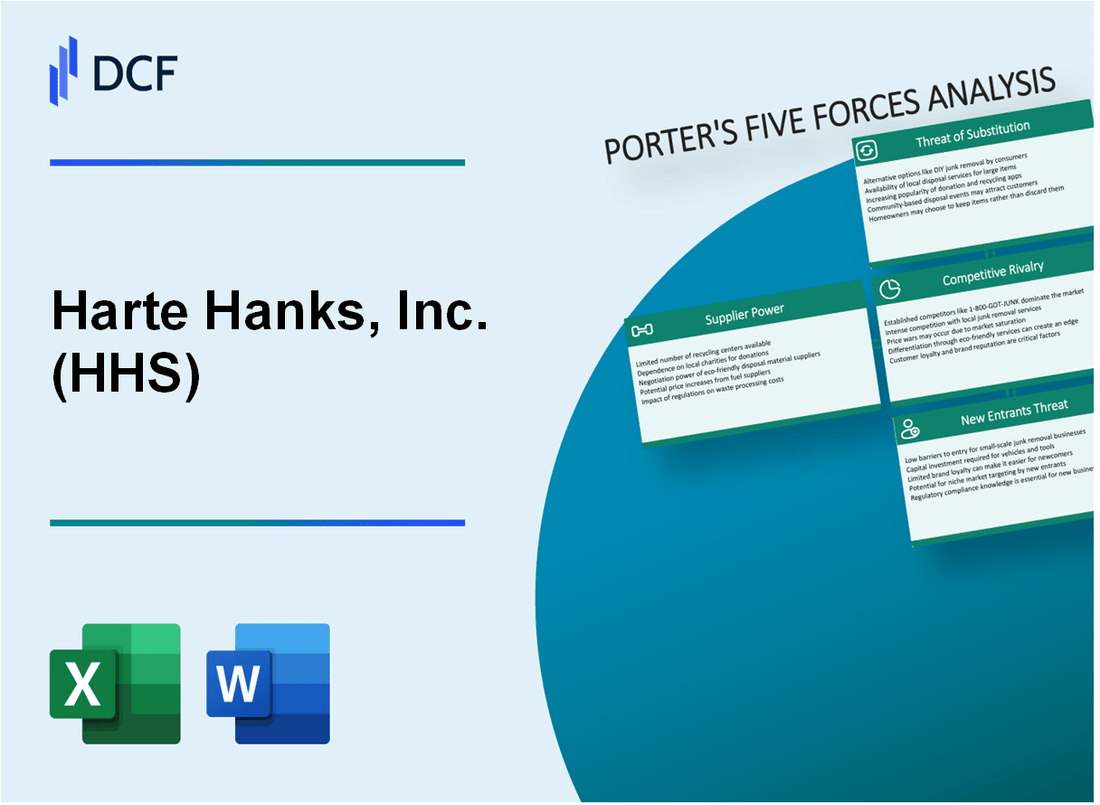
Entièrement Modifiable: Adapté À Vos Besoins Dans Excel Ou Sheets
Conception Professionnelle: Modèles Fiables Et Conformes Aux Normes Du Secteur
Pré-Construits Pour Une Utilisation Rapide Et Efficace
Compatible MAC/PC, entièrement débloqué
Aucune Expertise N'Est Requise; Facile À Suivre
Harte Hanks, Inc. (HHS) Bundle
Dans le paysage rapide de la technologie marketing, Harte Hanks, Inc. (HHS) navigue dans un écosystème complexe de forces concurrentielles qui façonnent son positionnement stratégique. À mesure que la transformation numérique accélère et que les attentes des clients montent en flèche, la compréhension de la dynamique complexe de la puissance des fournisseurs, des demandes des clients, de l'intensité concurrentielle, des substituts technologiques et des participants potentiels devient crucial pour maintenir un avantage concurrentiel. Cette analyse des cinq forces de Porter révèle les défis et les opportunités à multiples facettes confrontées au HHS dans le 2024 Environnement commercial, offrant des informations sur la résilience stratégique de l'entreprise et les trajectoires de croissance potentielles.
Harte Hanks, Inc. (HHS) - Porter's Five Forces: Bargaining Power of Fournissers
Nombre limité de fournisseurs de technologies marketing spécialisés
Au quatrième trimestre 2023, Harte Hanks a identifié 3 fournisseurs de technologies marketing primaires avec des valeurs de contrat annuelles allant de 750 000 $ à 2,3 millions de dollars. Les meilleurs fournisseurs comprennent:
| Fournisseur | Valeur du contrat annuel | Part de marché |
|---|---|---|
| Adobe Marketing Cloud | $1,850,000 | 42% |
| Salesforce Marketing Cloud | $2,300,000 | 38% |
| Plateforme de marketing Oracle | $1,200,000 | 20% |
Dépendances des infrastructures technologiques
Harte Hanks s'appuie sur 4 fournisseurs de services cloud primaires avec les dépenses d'infrastructure suivantes:
- Amazon Web Services (AWS): 3,7 millions de dollars par an
- Microsoft Azure: 2,5 millions de dollars par an
- Google Cloud Platform: 1,8 million de dollars par an
- Cloud IBM: 900 000 $ par an
Augmentation des coûts potentiels
Les risques de consolidation des fournisseurs comprennent des augmentations potentielles de prix de 8-15% par an Sur la base des tendances du marché 2023.
Analyse des coûts de commutation
| Catégorie des fournisseurs | Coût de commutation estimé | Temps de transition |
|---|---|---|
| Technologie marketing | $450,000 | 4-6 mois |
| Infrastructure cloud | $750,000 | 6-9 mois |
| Fournisseurs de données | $250,000 | 2-3 mois |
Harte Hanks, Inc. (HHS) - Porter's Five Forces: Bargaining Power of Clients
Concentration de grands clients d'entreprise avec un pouvoir de négociation important
Depuis le quatrième trimestre 2023, Harte Hanks a rapporté 82 clients de niveau d'entreprise, les 10 meilleurs clients représentant 37,6% des revenus totaux. La valeur du contrat moyen pour les clients d'entreprise était de 2,4 millions de dollars.
| Segment client | Nombre de clients | Contribution des revenus |
|---|---|---|
| Clients de l'entreprise | 82 | 197,3 millions de dollars |
| Clients du marché intermédiaire | 246 | 89,7 millions de dollars |
Demande croissante de solutions de marketing personnalisées
En 2023, 64% des clients de Harte Hanks ont demandé des solutions de marketing personnalisées, avec une augmentation en moyenne de 18% de la complexité des services par rapport à 2022.
- Les demandes de personnalisation sont passées de 52% en 2022 à 64% en 2023
- Augmentation moyenne de complexité: 18%
- Investissement estimé dans les capacités de personnalisation: 7,2 millions de dollars
Clients à la recherche de modèles de tarification flexibles basés sur les performances
Les contrats basés sur le rendement représentaient 42,3% de la valeur totale du contrat de Harte Hanks en 2023, avec une prime de performance moyenne de 12,5% pour la réunion ou le dépassement des KPI du client.
| Type de contrat | Pourcentage du total des contrats | Valeur du contrat moyen |
|---|---|---|
| Prix fixe | 57.7% | 1,8 million de dollars |
| Basé sur la performance | 42.3% | 2,3 millions de dollars |
Des attentes croissantes pour les services axés sur les données et compatibles avec la technologie
Les demandes de services en activité technologique ont augmenté de 29,4% en 2023, les clients investissant en moyenne 350 000 $ en analyse avancée de données et solutions de marketing axées sur l'IA.
- Demandes de services technologiques: croissance de 29,4%
- Investissement moyen du client dans des solutions de données: 350 000 $
- IA et service d'apprentissage automatique: 42,6 millions de dollars en 2023
Harte Hanks, Inc. (HHS) - Five Forces de Porter: Rivalité compétitive
Concurrence intense dans les services de marketing
Au quatrième trimestre 2023, Harte Hanks fait face à une pression concurrentielle importante dans le secteur des services de marketing. L'entreprise est en concurrence avec 37 sociétés de technologie de marketing direct dans le monde.
| Concurrent | Part de marché | Revenus annuels |
|---|---|---|
| Salesforce | 19.5% | 31,4 milliards de dollars |
| Adobe | 15.3% | 17,6 milliards de dollars |
| Harte Hanks | 3.2% | 187,2 millions de dollars |
Paysage de la technologie de marketing
Le paysage concurrentiel révèle la dynamique critique du marché:
- 37 concurrents directs dans les services de marketing
- 89,2 milliards de dollars de marché adressable total en 2023
- 6,7% sur le taux de croissance du marché en glissement annuel
- Taux de consolidation de 22% dans le secteur des technologies marketing
Pressions d'innovation et de différenciation
Harte Hanks investit 12,4 millions de dollars par an en R&D, représentant 6,6% de ses revenus totaux pour maintenir un positionnement concurrentiel.
| Investissement en R&D | Domaines d'intervention technologique | Demandes de brevet |
|---|---|---|
| 12,4 millions de dollars | Technologies marketing AI / ML | 7 brevets en instance |
Impact de consolidation de l'industrie
L'industrie des services de marketing a connu 14 grandes fusions et acquisitions en 2023, ce qui représente 3,6 milliards de dollars de valeur de transaction.
Harte Hanks, Inc. (HHS) - Five Forces de Porter: Menace de substituts
Rise des plateformes de marketing numérique et des outils de marketing en libre-service
Selon Gartner, les dépenses mondiales de marketing numérique ont atteint 521 milliards de dollars en 2022. Des plateformes de marketing en libre-service comme HubSpot ont généré 1,73 milliard de dollars de revenus en 2022, ce qui représente une croissance de 32% d'une année sur l'autre.
| Plate-forme | 2022 Revenus | Part de marché |
|---|---|---|
| Hubspot | 1,73 milliard de dollars | 15.6% |
| Mailchimp | 1,2 milliard de dollars | 10.8% |
| Hootsuite | 825 millions de dollars | 7.4% |
Solutions de marketing de l'IA et de l'apprentissage automatique émergentes
McKinsey rapporte que les technologies de marketing d'IA devraient générer 1,7 billion de dollars en valeur commerciale d'ici 2030.
- Les modèles GPT d'OpenAI ont généré 200 millions de dollars en 2022
- Google AI Marketing Solutions a atteint 350 millions de dollars de revenus
- La plate-forme Adobe Sensei AI a généré 450 millions de dollars
Les capacités de marketing internes deviennent plus sophistiquées
Deloitte Research indique que 67% des entreprises de taille moyenne développent des capacités de technologie de marketing interne.
| Investissement technologique du marketing interne | Pourcentage |
|---|---|
| Petites entreprises | 42% |
| Entreprises de taille moyenne | 67% |
| Grandes entreprises | 85% |
Croissance des technologies d'engagement des clients alternatifs
Forrester rapporte que le marché des technologies d'engagement client atteindra 48,5 milliards de dollars d'ici 2025.
- Marché du chatbot projeté à 15,7 milliards de dollars d'ici 2024
- Les plateformes de données clients devraient augmenter de 34,6% par an
- Les technologies de personnalisation en temps réel augmentent de 28% sur une année sur l'autre
Harte Hanks, Inc. (HHS) - Five Forces de Porter: Menace de nouveaux entrants
Exigences d'investissement initiales élevées
L'investissement en infrastructure de technologie marketing pour les nouveaux entrants varie de 5,2 millions de dollars à 12,7 millions de dollars. Les coûts spécifiques de la configuration des infrastructures technologiques comprennent:
| Composant d'infrastructure | Plage de coûts estimés |
|---|---|
| Plateformes de gestion des données | 1,3 million de dollars - 3,5 millions de dollars |
| Infrastructure de cloud computing | 750 000 $ - 2,1 millions de dollars |
| Systèmes d'analyse avancés | 1,5 million de dollars - 4,2 millions de dollars |
Complexité des capacités technologiques
Les barrières technologiques comprennent:
- Capacités avancées d'apprentissage de l'IA / machine nécessitant 2,8 millions de dollars d'investissement en R&D
- Les plateformes d'analyse prédictives coûtent environ 1,6 million de dollars
- Les écosystèmes de technologie marketing intégrés exigeant 3,4 millions de dollars de développement
Exigences de confidentialité et de conformité des données
Investissement de conformité pour les nouveaux entrants du marché:
| Zone de conformité | Coût annuel |
|---|---|
| Conformité du RGPD | $950,000 |
| Adhésion réglementaire du CCPA | $750,000 |
| Protocoles de cybersécurité | 1,2 million de dollars |
Expertise de l'industrie et relations avec les clients
Coûts d'acquisition des clients et exigences d'expertise:
- Coût d'acquisition moyenne du client: 85 000 $ par client d'entreprise
- Expérience minimale de l'industrie nécessaire: 7-10 ans
- Budget initial de développement de la relation client: 1,9 million de dollars
Harte Hanks, Inc. (HHS) - Porter's Five Forces: Competitive rivalry
You're looking at the competitive landscape for Harte Hanks, Inc. (HHS) right now, and the rivalry force is definitely showing up in the financials. The market you operate in is massive, but your slice of it is relatively small, which means you're fighting hard for every contract.
Competition is intense from smaller, specialized digital firms and large global agencies. This dynamic forces Harte Hanks to compete on more than just price, though the recent results certainly put pressure there. To be fair, the sheer scale difference is stark when you look at the numbers. The company's TTM revenue of $166.84 million as of September 2025 is a drop in the ocean compared to the total estimated direct marketing market size of $203.91 billion for 2025. That gap suggests smaller, nimbler competitors can undercut you on niche services, while the giants can absorb losses to win key accounts.
Rivalry is heightened by the company's Q3 2025 net loss of $2.3 million, pressuring price. When you are losing money, every bid becomes a tightrope walk between winning the work and maintaining margin, which is tough when rivals are hungry. This pressure is visible in the segment performance for the third quarter ended September 30, 2025, where revenue declined across the board.
Here's the quick math on how that revenue pressure manifested in Q3 2025:
| Segment | Q3 2025 Revenue (Millions USD) | Year-over-Year Change | Q3 2025 EBITDA (Millions USD) |
| Fulfillment & Logistics Services | $19.1 | -10.2% | $2.3 |
| Customer Care | $11.6 | -11.6% | $1.1 |
| Marketing Services | $8.8 | -33.4% | $1.8 |
Still, Harte Hanks is actively competing for strategic wins, like the Q3 2025 Samsung partnership. Landing a blue-chip client like Samsung Electronics America, serviced through the new Greenville, South Carolina facility, is a tangible signal that you are still in the game for high-value engagements. This partnership, which supports over 150 new jobs, is management's clear effort to replenish the pipeline with scalable programs, which is a direct action against competitive erosion.
The overall financial strain from the competitive environment is clear when you compare profitability metrics:
- Q3 2025 Operating Income was $509,000 (a 1.3% margin).
- Q3 2024 Operating Income was $1.9 million (a 4.0% margin).
- Year-to-Date 2025 Net Loss stands at $3.0 million.
- The company reported zero debt outstanding as of September 30, 2025.
- Cash and cash equivalents totaled $6.5 million at the end of Q3 2025.
The drop in operating margin from 4.0% to 1.3% year-over-year shows how tough it is to maintain pricing power against rivals.
Finance: draft 13-week cash view by Friday.
Harte Hanks, Inc. (HHS) - Porter's Five Forces: Threat of substitutes
You're looking at the competitive landscape for Harte Hanks, Inc. (HHS) and the substitutes are definitely putting pressure on the traditional service model. Honestly, the numbers from the third quarter of 2025 tell a clear story about where clients are shifting their spend.
For Harte Hanks, Inc., the threat from internal capabilities is substantial. Companies with their own dedicated marketing teams report 25 percent faster campaign execution and 40 percent more consistent brand messaging compared to those relying on outside agencies. Still, Forrester predicts that the growth of in-house agencies will slow as marketers turn to AI-powered content production from external partners, noting that 61% of agencies currently use generative AI in marketing efforts, compared to only 17% of in-house agencies.
The rapid adoption of AI/machine learning tools is replacing the need for traditional data and marketing services. The global Artificial Intelligence in Marketing market is valued at $47.32 billion in 2025, with projections to exceed $107 billion by 2028 at a Compound Annual Growth Rate (CAGR) of 36.6%. Specifically, the U.S. segment of this market is accounted for at $5.97 billion in 2025. Within the technology breakdown, Machine Learning algorithms hold a 36.7% market share, underpinning core functions like predictive modeling.
This technological shift is reflected in Harte Hanks, Inc.'s own segment performance. The Marketing Services segment revenue for the third quarter of 2025 was $8.8 million, a steep decline of 33.4% from the $13.3 million reported in Q3 2024. For the nine months ended September 30, 2025, total revenue for Harte Hanks, Inc. was $119.7 million, down from $138.1 million in the same period of 2024.
Low-cost, purely digital solutions bypass the need for Harte Hanks, Inc.'s physical fulfillment/logistics. The Global Digital Marketing Outsourcing Market size was $25.4 billion in 2024 and is projected to reach approximately $74.76 billion by 2034, growing at a CAGR of 11.4% from 2025 to 2034. Digital Marketing services, which represent the core of these outsourced functions, accounted for 53.7% of the overall outsourced market share in 2024.
Consulting firms offering pure Customer Experience (CX) strategy threaten the high-margin advisory work. The broader global management consulting market is projected to hit $1.07 trillion in 2025, up from $1.02 trillion in 2024. The U.S. management consulting business size alone is $404 billion. Elite strategy firms demonstrate the scale of this advisory threat; for instance, McKinsey & Company posted revenues of $18.8 billion, Boston Consulting Group at $14.1 billion, and Bain & Company at $8 billion.
Here's a quick look at the financial context for Harte Hanks, Inc. as these substitutes gain ground:
| Metric (Harte Hanks, Inc.) | Q3 2025 Actual | Q3 2024 Actual |
|---|---|---|
| Total Revenue | $39.5 million | $47.6 million |
| Marketing Services Revenue | $8.8 million | $13.3 million |
| Net Income (Loss) | ($2.3 million) | $0.1 million |
| Operating Expenses | $39.0 million | $45.7 million |
What this estimate hides is the pace of technology replacement versus the pace of contract renewal. The company's TTM (Trailing Twelve Months) revenue as of late 2025 is reported at $0.17 Billion USD.
The pressure points from substitutes include:
- In-house teams offer 40% more consistent brand messaging.
- AI in Marketing market expected to reach $107.5 billion by 2028.
- Digital Marketing Outsourcing CAGR is 11.4% through 2034.
- Top strategy consulting firms generate billions in revenue, e.g., $18.8 billion for McKinsey & Company.
Finance: draft 13-week cash view by Friday.
Harte Hanks, Inc. (HHS) - Porter's Five Forces: Threat of new entrants
You're looking at the competitive landscape for Harte Hanks, Inc. (HHS) and wondering how easily a new player could step in and take market share. Honestly, the threat isn't uniform across all their segments; it's a tale of two very different entry barriers.
Threat is moderate; high capital is needed for global fulfillment and logistics infrastructure. Harte Hanks maintains significant physical assets to support its Fulfillment & Logistics Services segment, which accounted for 48% of its revenue in Q1 2025, totaling $19.8 million. Building out print-on-demand capabilities, promotional product distribution networks, and temperature-controlled storage on a global scale requires substantial upfront capital expenditure. This physical footprint acts as a meaningful moat against pure digital startups. Still, we must recognize that Harte Hanks ended Q1 2025 with a cash balance of $9.0 million and no debt, suggesting they are not currently investing heavily in new physical expansion, which could allow agile competitors to gain ground in specific geographic niches.
Specialized, AI-focused competitors can enter the data and CX strategy segments easily. The barrier to entry for services like data management, AI integration, and customer experience strategy is significantly lower than for physical logistics. New entrants, especially those focused purely on modern, cloud-native data platforms, face minimal hardware hurdles. They can quickly deploy specialized AI tools to offer predictive or prescriptive analytics, directly challenging Harte Hanks' Data, Marketing, Demand Generation and Managed Marketing Services unit. The risk here is speed; a well-funded, specialized firm can deploy a superior, modern tech stack faster than Harte Hanks can fully realize the benefits of its ongoing transformation.
The company's small market cap of $25.1 million (Jul 2025) makes it a target for disruption. While market capitalization figures fluctuate-we saw it at $25.43 million on November 26, 2025, and as low as $20.76 million in mid-November 2025-the overall Nano-Cap status remains a vulnerability. This small valuation signals to larger, well-capitalized technology or marketing conglomerates that Harte Hanks is an accessible acquisition target or, conversely, that its existing client base and data assets are ripe for a disruptive takeover bid from a competitor looking to quickly buy scale rather than build it organically.
New entrants leverage cloud platforms to avoid the legacy costs Harte Hanks carries. The need for Harte Hanks to manage and modernize its existing systems-a process encapsulated by Project Elevate, which targets $16 million in savings between 2024 and 2026-is a direct cost burden. Cloud-native entrants bypass this entirely. Here's the quick math: a new firm starts with zero legacy data migration headaches and can build its entire operational model on pay-as-you-go cloud services, avoiding the depreciation and maintenance costs associated with older, proprietary infrastructure.
To illustrate the structural difference in capital deployment, consider this comparison:
| Component | Harte Hanks (Legacy/Existing) | New Entrant (Cloud-Native) |
|---|---|---|
| Global Fulfillment Infrastructure | High capital investment in physical assets (storage, kitting) | Asset-light, reliance on 3PL/API integration |
| Data & CX Strategy Setup | Costs associated with integrating/modernizing existing data systems | Primarily software subscription and AI model licensing |
| Regulatory Compliance (e.g., GDPR) | Existing compliance overhead, potential for large fines | Initial setup cost, potential fines up to 4% of global revenue |
| Transformation/Optimization Cost | Project Elevate targeting $16 million in savings (2024-2026) | Lower initial transformation cost, higher initial customer acquisition cost |
The key takeaway for you is where the real fight is happening. While the physical fulfillment side has a higher capital barrier, the data and AI segments are wide open for nimble, tech-first competitors. You should watch for any new entrants securing significant seed funding in the MarTech space, as they will target HHS's lower-moat service lines first.
- Data segment entry requires specialized AI talent.
- Logistics requires significant physical asset investment.
- Cloud platforms reduce initial operating expenditure significantly.
- Customer loyalty to existing providers remains a hurdle.
- Regulatory compliance costs are high for all players.
Finance: draft 13-week cash view by Friday.
Disclaimer
All information, articles, and product details provided on this website are for general informational and educational purposes only. We do not claim any ownership over, nor do we intend to infringe upon, any trademarks, copyrights, logos, brand names, or other intellectual property mentioned or depicted on this site. Such intellectual property remains the property of its respective owners, and any references here are made solely for identification or informational purposes, without implying any affiliation, endorsement, or partnership.
We make no representations or warranties, express or implied, regarding the accuracy, completeness, or suitability of any content or products presented. Nothing on this website should be construed as legal, tax, investment, financial, medical, or other professional advice. In addition, no part of this site—including articles or product references—constitutes a solicitation, recommendation, endorsement, advertisement, or offer to buy or sell any securities, franchises, or other financial instruments, particularly in jurisdictions where such activity would be unlawful.
All content is of a general nature and may not address the specific circumstances of any individual or entity. It is not a substitute for professional advice or services. Any actions you take based on the information provided here are strictly at your own risk. You accept full responsibility for any decisions or outcomes arising from your use of this website and agree to release us from any liability in connection with your use of, or reliance upon, the content or products found herein.