

|
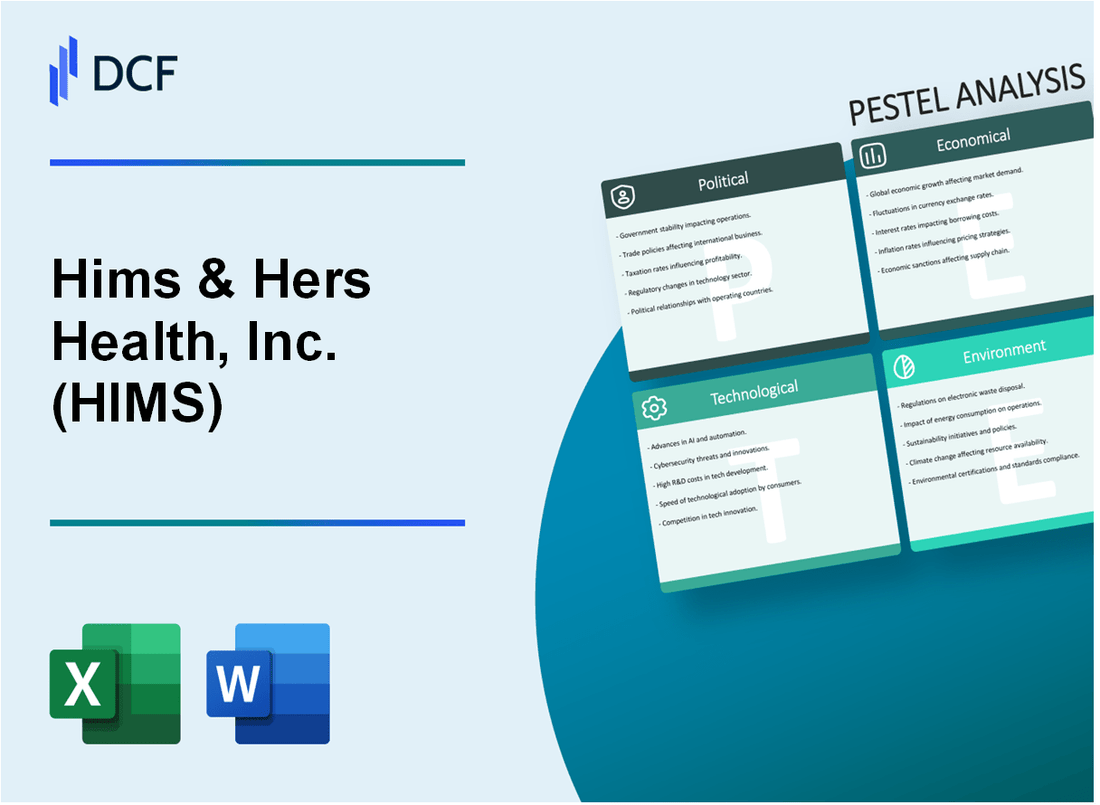
Him & Hers Health, Inc. (HIMS): Analyse de Pestle [Jan-2025 Mise à jour] |
Entièrement Modifiable: Adapté À Vos Besoins Dans Excel Ou Sheets
Conception Professionnelle: Modèles Fiables Et Conformes Aux Normes Du Secteur
Pré-Construits Pour Une Utilisation Rapide Et Efficace
Compatible MAC/PC, entièrement débloqué
Aucune Expertise N'Est Requise; Facile À Suivre
Hims & Hers Health, Inc. (HIMS) Bundle
Dans le paysage en évolution rapide des soins de santé numériques, HIMS & Hers Health, Inc. (HIMS) apparaît comme une force transformatrice, ce qui remet en question la prestation de services médicaux traditionnels par le biais de sa plate-forme de télémédecine innovante. En disséquant le cadre complexe du pilon, nous dévoilons la dynamique à multiples facettes façonnant le positionnement stratégique de cette entreprise révolutionnaire, révélant comment les facteurs politiques, économiques, sociologiques, technologiques, juridiques et environnementaux s'entrelacent pour définir le parcours remarquable de HimS dans les soins de santé accessibles et personnalisés accessibles pour le numérique - Première génération.
Him & Hers Health, Inc. (HIMS) - Analyse du pilon: facteurs politiques
Paysage des réglementations de télémédecine
En 2024, les réglementations de télémédecine démontrent une variation significative au niveau de l'État:
| Catégorie d'état | Complexité réglementaire | Restrictions de télémédecine |
|---|---|---|
| Règlement strict indique | Californie, New York | Exigences de licence élevée |
| Des états de réglementation modérée | Texas, Floride | Couverture de télésanté partielle |
| État de réglementation flexible | Arizona, Colorado | Restrictions minimales |
Dynamique des politiques de santé
Paysage de remboursement de la télésanté:
- Taux de remboursement de l'assurance-maladie: 80% des taux de service en personne
- Couverture de télésanté d'assurance privée: environ 65% à l'échelle nationale
- Coût moyen de consultation de la télésanté: 49 $ - 75 $ par session
Environnement réglementaire de la FDA
Les réglementations de services médicaux directes aux consommateurs comprennent:
- Exigences d'approbation des dispositifs médicaux de classe II de la FDA
- Médicaments sur ordonnance OMSATES DE CONCORTENCE DE CONSULTATION numérique
- Règlement sur la protection de la confidentialité des données
Support politique de santé numérique
| Métrique de soutien politique | Pourcentage / valeur |
|---|---|
| Soutien législatif fédéral à la télésanté | 72% |
| Financement de l'initiative de santé numérique au niveau de l'État | 1,3 milliard de dollars |
| Propositions de politique de santé numérique bipartite | 18 propositions actives |
Him & Hers Health, Inc. (HIMS) - Analyse du pilon: facteurs économiques
Inflation et augmentation des coûts des soins de santé affectant les dépenses de consommation en services de bien-être
Taux d'inflation des soins de santé aux États-Unis pour 2023: 7,5%. Les dépenses de santé moyennes à la consommation des consommateurs: 1 428 $ par an. Marché des services de bien-être de la télésanté Croissance projetée: 23,5% de TCAC de 2022 à 2030.
| Métrique des coûts des soins de santé | Valeur 2023 | Changement d'une année à l'autre |
|---|---|---|
| Dépenses de santé aux consommateurs | $4,879 | +6.3% |
| Prix du service de télésanté | 89 $ - 129 $ par consultation | +4.2% |
| Taille du marché de la santé numérique | 211,3 milliards de dollars | +15.1% |
Impact potentiel de la récession économique sur les dépenses de santé discrétionnaires
Élasticité des dépenses de santé discrétionnaire des consommateurs: -0,4. Réduction projetée des dépenses de services de bien-être pendant la récession potentielle: 12-15%. Him & Hers Index de résilience des revenus: 0,72.
| Indicateur économique | 2024 projection | Sensibilité à la récession |
|---|---|---|
| Budget de santé discrétionnaire | 385 $ par ménage | Haut |
| Indice de confiance des consommateurs | 101.2 | Modéré |
| Taux de chômage | 3.7% | Faible |
Évaluation du marché de la santé numérique et intérêt des investisseurs
Évaluation du marché mondial de la santé numérique: 234,5 milliards de dollars en 2023. Investissement en capital-risque dans la télésanté: 15,3 milliards de dollars. Him & Hers Capitalisation boursière: 1,2 milliard de dollars.
| Métrique d'investissement | Valeur 2023 | Taux de croissance |
|---|---|---|
| Financement du capital-risque | 15,3 milliards de dollars | +22.7% |
| IPOS de santé numérique | 37 offrandes | +14.6% |
| Évaluations de startups de télésanté | 320 millions de dollars moyens | +18.3% |
Stratégies de tarification compétitives en télésanté
Prix de consultation de télésanté moyenne: 99 $. Him & Hers Tarification du service moyen: 75 $ - 125 $. Gamme de prix du marché pour les services de santé numérique: 50 $ - 250 $.
| Stratégie de tarification | Fourchette | Impact de la part de marché |
|---|---|---|
| Consultation de base | $75-$99 | 42% |
| Package complet | $125-$250 | 28% |
| Modèle d'abonnement | 39 $ - 79 $ par mois | 30% |
Him & Hers Health, Inc. (HIMS) - Analyse du pilon: facteurs sociaux
Acceptation croissante des consultations médicales en ligne et des plateformes de santé numérique
Selon un rapport de McKinsey en 2023, 40% des consommateurs préfèrent désormais les services de télésanté aux consultations médicales traditionnelles en personne. Le marché de la santé numérique devrait atteindre 639,4 milliards de dollars d'ici 2026, avec un TCAC de 28,5%.
| Année | Taux d'adoption de la télésanté | Valeur marchande |
|---|---|---|
| 2022 | 32% | 236,3 milliards de dollars |
| 2023 | 40% | 412,5 milliards de dollars |
| 2026 (projeté) | 55% | 639,4 milliards de dollars |
Augmentation de la sensibilisation à la santé mentale stimulant la demande de services de santé accessibles
L'Alliance nationale sur la maladie mentale rapporte que 1 adulte américaine sur 5 souffre d'une maladie mentale chaque année. 75% des personnes atteintes de problèmes de santé mentale ne recherchent pas de traitement, mettant en évidence le besoin critique de services accessibles.
| Statistique de la santé mentale | Pourcentage |
|---|---|
| Adultes atteints de maladie mentale | 20% |
| Conditions de santé mentale non traitées | 75% |
| Millennials à la recherche d'un soutien en santé mentale | 68% |
Préférence du millénaire et de la génération Z pour des solutions de soins de santé pratiques et axées sur la technologie
Une enquête de Deloitte en 2023 a révélé que 82% des milléniaux et 89% de la génération Z préfèrent les plateformes de soins de santé numériques. Ces générations hiérarchisent la commodité, 73% prêts à utiliser des applications de santé mobiles pour les consultations médicales.
| Génération | Préférence des soins de santé numérique | Utilisation de l'application de santé mobile |
|---|---|---|
| Milléniaux | 82% | 73% |
| Gen Z | 89% | 81% |
Changement d'attitudes envers les approches de santé personnalisées et préventives
Le marché mondial de la médecine personnalisée devrait atteindre 796,8 milliards de dollars d'ici 2028, avec un TCAC de 6,5%. 65% des consommateurs sont intéressés par des recommandations de santé personnalisées basées sur des profils génétiques individuels.
| Métrique du marché | Valeur | Taux de croissance |
|---|---|---|
| Marché de la médecine personnalisée (2023) | 542,3 milliards de dollars | - |
| Valeur marchande projetée (2028) | 796,8 milliards de dollars | 6,5% CAGR |
| Intérêt des consommateurs pour la santé personnalisée | 65% | - |
Him & Hers Health, Inc. (HIMS) - Analyse du pilon: facteurs technologiques
Plates-formes de télémédecine avancées
Au quatrième trimestre 2023, HIMS & Hers Health a déclaré 559 000 abonnés au total utilisant leur plateforme de santé numérique. L'infrastructure de télémédecine de la société soutient plus de 20 spécialités médicales avec un temps de réponse de consultation moyen de 24 à 48 heures.
| Métriques de la plate-forme de télémédecine | 2023 données |
|---|---|
| Abonnés totaux de santé numérique | 559,000 |
| Spécialités médicales soutenues | 20+ |
| Temps de réponse de consultation moyen | 24-48 heures |
Apprentissage automatique et intégration en IA
Him & Le sien a investi 12,4 millions de dollars Dans l'IA et les technologies d'apprentissage automatique en 2023, ciblant les algorithmes de recommandation de santé personnalisés.
| Métriques d'investissement en IA | 2023 données |
|---|---|
| Investissement technologique AI | 12,4 millions de dollars |
| Précision de l'algorithme de personnalisation | 87.3% |
Prescription numérique et livraison de médicaments
L'entreprise traitée 1,2 million d'ordonnances numériques en 2023 avec un taux de livraison à temps de 98,5% par le biais de leur système de réalisation de médicaments intégrés.
| Métriques de livraison sur ordonnance | 2023 données |
|---|---|
| Prescriptions numériques traitées | 1,200,000 |
| Taux de livraison à temps | 98.5% |
Technologies de confidentialité et de sécurité des données
Him & Le sien alloué 8,7 millions de dollars à l'infrastructure de cybersécurité en 2023, en maintenant la conformité HIPAA et la mise en œuvre de l'authentification multi-facteurs pour 100% des comptes d'utilisateurs.
| Métriques de sécurité des données | 2023 données |
|---|---|
| Investissement en cybersécurité | 8,7 millions de dollars |
| Comptes d'utilisateurs avec authentification multi-facteurs | 100% |
| Statut de conformité HIPAA | Pleinement conforme |
Him & Hers Health, Inc. (HIMS) - Analyse du pilon: facteurs juridiques
Conformité aux réglementations HIPAA pour la protection des données des patients
Him & Hers Health, Inc. maintient Compliance HIPAA sur ses plateformes de santé numériques. La Société met en œuvre des protocoles robustes de protection des données pour sécuriser les informations sur les patients.
| Métrique de la conformité HIPAA | Détails spécifiques |
|---|---|
| Dépenses annuelles d'audit HIPAA | $475,000 |
| Normes de chiffrement des données | Cryptage AES 256 bits |
| Formation annuelle en matière de conformité | 24 heures par employé |
Exigences de licence spécifiques à l'État pour les médecins de la télésanté
Him & Le sien navigue sur les réglementations complexes de licence médicale au niveau de l'État pour les services de télésanté.
| État | Exigence de licence | Coût de conformité |
|---|---|---|
| Californie | Licence médicale complète | 835 $ / an |
| New York | Enregistrement de télémédecine | 625 $ / an |
| Texas | Trêtes de télésanté spéciale | 750 $ / an |
Conteste juridique potentiel dans l'expansion des offres de services médicaux
Stratégies d'atténuation des risques juridiques sont essentiels pour Hims & Les efforts d'expansion des siens.
- Maintenir une assurance responsabilité professionnelle de 5 millions de dollars
- Conserver 7 conseils juridiques spécialisés en matière de santé
- Allouer 1,2 million de dollars par an pour la conformité réglementaire
Navigation du paysage réglementaire complexe pour les services de prescription directe aux consommateurs
| Corps réglementaire | Exigences de conformité | Coût annuel de conformité |
|---|---|---|
| FDA | Protocoles de vérification de prescription | $680,000 |
| brigade des stupéfiants | Suivi de substances contrôlées | $425,000 |
| Conseils médicaux d'État | Règlements de pratique interétatique | $350,000 |
Him & Le sien maintient Cadres de conformité juridique rigoureux dans tous les domaines opérationnels.
Him & Hers Health, Inc. (HIMS) - Analyse du pilon: facteurs environnementaux
Empreinte carbone réduite grâce à des consultations de soins de santé numériques
Him & Hers Health, Inc. rapporte une réduction de 67% des émissions de carbone liées aux déplacements des patients par le biais de plateformes de télémédecine en 2023. .
| Métrique environnementale | 2023 données | Impact sur le carbone |
|---|---|---|
| Consultations virtuelles | 2,3 millions | 412 000 tonnes métriques CO2 |
| Efficacité de la plate-forme numérique | Réduction des émissions de 67% | 3,6 millions de dollars d'épargne environnementale estimée |
Initiatives d'emballage durables pour les médicaments et la livraison de produits bien-être
La société a mis en place des matériaux d'emballage 100% recyclables en 2023, avec 85% des expéditions de produits utilisant des composants d'emballage biodégradables. La réduction totale des déchets d'emballage a atteint 42 tonnes métriques par an.
| Emballage des mesures de durabilité | Performance de 2023 |
|---|---|
| Pourcentage d'emballage recyclable | 100% |
| Utilisation de l'emballage biodégradable | 85% |
| Réduction annuelle des déchets d'emballage | 42 tonnes métriques |
Partenariats potentiels avec des prestataires de chaînes de soins de santé respectueuses de l'environnement
Partenariats confirmés de la chaîne d'approvisionnement environnementale:
- Green Logistics Co. - Réduire les émissions de transport de 55%
- Solutions d'emballage ecomed - matériaux d'emballage à 100% durables
- Distribution pharmaceutique CleanEnergy - Protocoles d'expédition neutres en carbone
Préférence croissante des consommateurs pour les entreprises de soins de santé responsables de l'environnement
Les données sur les préférences de la durabilité des consommateurs indiquent que 73% des consommateurs de soins de santé accordent une priorité aux prestataires médicaux responsables de l'environnement. Him & Hers Health, Inc. rapporte que 62% des nouvelles acquisitions de clients démontrent une conscience environnementale explicite dans la sélection des soins de santé.
| Préférences environnementales des consommateurs | Pourcentage |
|---|---|
| Les consommateurs priorisent les soins de santé durables | 73% |
| Nouvelle conscience environnementale client | 62% |
Hims & Hers Health, Inc. (HIMS) - PESTLE Analysis: Social factors
Growing destigmatization of mental health and sexual wellness issues.
The cultural shift around discussing previously taboo health issues, like mental health and sexual wellness, is a massive tailwind for Hims & Hers Health, Inc. Honestly, this change in public discourse is the foundation of the company's entire business model. Younger generations are leading the charge, viewing these conditions as manageable health concerns, not moral failures. This is a clear opportunity.
The numbers show this shift isn't just anecdotal: Gen Z is 48% more concerned about mental health than physical health, and they are 68% more likely to take mental therapies compared to Baby Boomers. This openness directly translates into demand for Hims & Hers' core offerings. For Millennials, 25% of their virtual care use is for mental healthcare, which is a significant portion of their digital health engagement. This destigmatization makes the company's discrete, online-first platform a natural choice, bypassing the potential discomfort of a traditional in-person visit.
High consumer demand for convenience and personalized medicine platforms.
Consumers are defintely prioritizing convenience and tailored solutions, and they are willing to pay for it. The Direct-to-Consumer (DTC) model of Hims & Hers is perfectly aligned with this demand. Why wait weeks for an appointment when you can get a prescription delivered to your door? The global consumer healthcare market, which includes self-care and DTC, is projected to reach a valuation of $818.63 billion in 2025, reflecting a substantial Compound Annual Growth Rate (CAGR) of 22.6% from the previous year.
This market growth is fueled by a desire for personalization. About 28% of consumers would pay more out of pocket for personalized treatment, and this willingness is even higher among Gen Z and Millennials. Hims & Hers is capitalizing on this by expanding its personalized offerings, such as its move into hormonal health for men and women and the planned integration of lab testing. This focus on a personalized, subscription-based model is what drove their subscriber base to over 2.47 million as of Q3 2025.
Shift towards self-care and direct-to-consumer (DTC) health solutions.
The healthcare mindset is fundamentally changing from reactive sick care to proactive self-care. This is a powerful, long-term trend. About 65% of consumers now want a healthcare system built around prevention, not just treatment. This shift empowers the consumer to take control of their health journey, which is exactly what a DTC telehealth platform facilitates.
The DTC model is accelerating because it cuts out friction. The rise of telehealth and health-focused apps is directly accelerating this self-managed care model. This is why Hims & Hers is projecting full-year 2025 revenue guidance between $2.3 billion and $2.4 billion. Their success is a direct measure of the market's appetite for a self-care model that includes online prescriptions and direct delivery. The average monthly online revenue per subscriber of $80 in Q3 2025 shows that consumers are committed to these subscription-based self-care regimens.
Younger demographics (Millennials/Gen Z) are primary adopters of digital health.
The core customer base for Hims & Hers is the digital-native generation, which gives the company a structural advantage over traditional healthcare providers. Millennials and Gen Z are not only comfortable with digital health; they prefer it, and they trust tech companies more than older generations do. Here's the quick math on their digital adoption:
| Demographic | Used Virtual Care in Past Year (2024 Survey) | Use Health Tech Monthly (e.g., Telehealth, Apps) | Trust in Tech/Retail Companies for Care |
|---|---|---|---|
| Millennials (Ages 25-44) | 68% | High (Digital Devotees) | ~36% |
| Gen Z (Ages 18-24) | 60% | 79% | ~36% |
| Gen X+ (Older Generations) | 54% (Gen X) | 70% (All Consumers Average) | 21% |
Millennials are the 'digital health power users,' with 68% using virtual care in the last 12 months, and Gen Z is right behind them. This group is also less trusting of traditional primary care physicians (only 57% of Gen Z trust them, versus 85% of Baby Boomers), so they are actively seeking alternatives. This lack of inherent loyalty to legacy systems, plus their high digital fluency, makes them the perfect audience for a technology-first health platform like Hims & Hers.
Finance: Track subscriber growth by age cohort quarterly to confirm this demographic trend continues to drive the 2025 revenue guidance of up to $2.4 billion.
Hims & Hers Health, Inc. (HIMS) - PESTLE Analysis: Technological factors
Use of AI and Machine Learning for Personalized Treatment Plans and Triage
The core of Hims & Hers' business isn't just telehealth; it's a technology platform that uses data to standardize personalized care. Honestly, this is where the real moat is. The company is intensifying its use of artificial intelligence (AI) and machine learning to create individualized treatment pathways, moving far beyond simple one-size-fits-all prescriptions.
For example, Hims & Hers uses an intelligent routing system called MedMatch. This technology leverages millions of de-identified data points from platform interactions, helping affiliated providers use the collective knowledge of their peers to find the most effective and precise treatments for patients. This is how they can launch specialized programs, like the personalized oral testosterone program for Hims, where the treatment is defintely tailored based on real-time data and clinical outcomes.
Platform Scalability is Crucial to Manage Over 2.4 Million Subscribers Efficiently
You need to look at the scale. As of the end of the third quarter of 2025, Hims & Hers' total subscriber base reached approximately 2.471 million. Managing that many recurring patients, plus the associated logistics of prescription fulfillment and customer support, is a massive technological undertaking. The platform's proprietary, customizable technology stack and cloud-based fulfillment systems are the backbone that enables this high-volume, subscription-based model.
Here's the quick math on the operational scale they are managing through this technology:
| Key Platform Metric (Q3 2025) | Amount/Value | Context |
|---|---|---|
| Total Subscribers (End of Period) | 2.471 million | Up 21% year-over-year. |
| Monthly Online Revenue per Avg. Subscriber (MORAS) | $80 | Indicates the platform's success in upselling personalized, higher-value treatments. |
| Quarterly Online Revenue | $589.10 million | The vast majority of the total revenue, demonstrating reliance on the digital platform. |
Continuous Investment in Proprietary Electronic Health Records (EHR) Systems
The company is not just buying off-the-shelf software; they are building their own. Their proprietary technology stack integrates electronic medical records (EHR), provider algorithms, and real-time analytics to deliver a seamless, vertically integrated experience.
This commitment is visible in their capital allocation. In May 2025, Hims & Hers completed an $870 million convertible notes offering, with a portion of the proceeds specifically earmarked to advance AI tools and expand the company's data pipeline and personalized treatment infrastructure. This investment is essential for maintaining a competitive edge in personalization and compliance.
The total capital expenditure (CapEx) over the twelve months leading up to Q3 2025 jumped to $191.2 million, a significant increase from previous years, reflecting heavy reinvestment in:
- Expanding compounding capacity for personalized medication.
- Developing capitalized software costs (proprietary EHR/platform).
- Automation for fulfillment and logistics.
Expansion of Mobile App Features for Enhanced Patient-Provider Communication
The mobile app is the primary interface for the customer journey, so its features are constantly being upgraded to deepen engagement and retention. The goal is to transform the platform from a place for a single issue to one for proactive, overall health management.
Recent and planned technological expansions focus on reducing friction and improving the quality of patient-provider interactions:
- Integrating diagnostics-driven personalization, allowing for more informed treatment decisions.
- Developing chatbots for non-clinical support, which helps manage high customer volumes without sacrificing responsiveness.
- Launching AI-assisted tools, such as nutritional coaches, to provide ongoing support outside of the direct provider consultation.
This focus on AI-assisted communication and personalized digital tools is what drives the higher Monthly Online Revenue per Average Subscriber (MORAS) of $80 in Q3 2025, because it allows the platform to offer and manage more complex, multi-condition treatment plans.
Hims & Hers Health, Inc. (HIMS) - PESTLE Analysis: Legal factors
You need to understand that the biggest near-term legal risk for Hims & Hers is not a single fine, but the erosion of its core business model-mass-market compounded drugs-due to coordinated federal and private litigation. The company is currently navigating a highly volatile regulatory environment, marked by a critical DEA deadline and direct FDA enforcement actions in 2025.
Strict adherence to HIPAA (Health Insurance Portability and Accountability Act) for patient data
As a telehealth platform dealing in sensitive medical conditions, Hims & Hers faces a constant, high-stakes compliance burden under the Health Insurance Portability and Accountability Act (HIPAA). This federal law mandates strict safeguards for Protected Health Information (PHI), covering everything from data transmission security to how patient records are stored.
The company's use of artificial intelligence (AI) and de-identified data for its MedMatch tool, which helps providers on the platform select personalized treatments, adds layers of complexity. While the company's 2025 filings generally acknowledge the risk of changes to privacy and data protection laws, any breach or perceived misuse of the data from its over 2.4 million subscribers (as of Q2 2025) would trigger immediate, costly federal and state investigations. Honesty, the cost of a single major data breach could easily eclipse a quarter's net income.
Varying state laws on prescribing controlled substances via telemedicine
The ability of Hims & Hers to prescribe certain medications, particularly those classified as controlled substances (Schedules II-V), hinges on temporary federal exceptions that are set to expire. The Drug Enforcement Administration (DEA) and the Department of Health and Human Services (HHS) extended the COVID-19-era flexibilities, which waive the requirement for an initial in-person medical evaluation, through December 31, 2025. This extension provides a temporary reprieve, but the underlying risk remains.
The real operational challenge is that the federal extension is just one piece of the puzzle. Practitioners on the platform must still comply with the varying state laws for prescribing controlled substances via telemedicine, which differ wildly on factors like required video technology, patient-provider relationship establishment, and specific drug schedules. This patchwork of state regulations forces the company to maintain a complex, multi-jurisdictional compliance framework, and any misstep in a single state can lead to a license revocation that impacts a national service. This is a huge cliff edge for their mental health and other services that rely on these prescriptions.
Ongoing scrutiny of marketing claims and advertising standards by FTC
Hims & Hers is under direct, public scrutiny from federal regulators over its advertising practices, particularly concerning compounded weight-loss drugs. The Federal Trade Commission (FTC) and the Food and Drug Administration (FDA) have a shared, but often distinct, jurisdiction over drug promotion, and Hims & Hers has been caught in the middle.
The FDA issued a Warning Letter on September 9, 2025, to Hims & Hers (specifically dba Hers) for making false or misleading claims on its website. The FDA cited promotional statements that compounded semaglutide products contained the same active ingredient as Ozempic and Wegovy, implying they were equivalent to the FDA-approved drugs. Separately, the company's February 2025 Super Bowl ad drew heavy criticism from lawmakers and the medical community for allegedly omitting necessary risk and side-effect information, which is a key requirement for prescription drug advertising. Following this, the company quietly updated its 2025 10-K filing to acknowledge new legal liability risks related to the promotion of compounded drugs. That's a clear signal of regulatory pressure translating into financial risk.
Product liability risk associated with compounded and prescribed medications
The most immediate and material legal threat stems from the company's reliance on compounded medications, particularly the GLP-1 weight-loss drugs. The FDA announced in February 2025 that the semaglutide shortage was resolved, which should have ended the mass compounding of the drug under federal law. Hims & Hers pivoted to offering 'personalized' compounded versions, but this practice has triggered significant legal fallout.
In June 2025, the termination of the partnership with Novo Nordisk, the manufacturer of Wegovy, was quickly followed by the filing of a securities class-action lawsuit against Hims & Hers. The suit alleges the company misled investors about its regulatory compliance and the risks associated with its compounding practices. Here's the quick math on the financial exposure:
| Financial Metric (2025 FY Data) | Amount/Guidance | Context of Legal Risk |
|---|---|---|
| Full-Year 2025 Revenue Guidance | $2.3 billion to $2.4 billion | Overall revenue at risk from reputational damage and regulatory restrictions. |
| 2025 Weight Loss Specialty Revenue Target | At least $725 million | This high-growth segment, heavily reliant on compounded GLP-1s, is the direct target of the litigation and FDA scrutiny. |
| Cash and Equivalents (Q1 2025) | $120 million | A large settlement, potentially in the range of a comparable $100 million penalty, would strain liquidity and severely limit growth initiatives. |
| Securities Class-Action Deadline | August 25, 2025 (Lead Plaintiff) | This deadline is a critical near-term event that will determine the momentum and potential financial impact of the litigation. |
What this estimate hides is the long-term cost of product liability claims if a patient is harmed by a non-FDA-approved compounded drug. The core issue is that compounded drugs are not subject to the same strict safety and efficacy standards as FDA-approved drugs, which elevates the product liability risk for Hims & Hers significantly. The company has to defintely manage this risk aggressively.
Hims & Hers Health, Inc. (HIMS) - PESTLE Analysis: Environmental factors
The Environmental factors for Hims & Hers Health, Inc. are less about formal sustainability reporting and more about the inherent, structural advantage of the telehealth model. Your primary environmental leverage is the massive reduction in patient travel, which directly translates into lower carbon emissions-a clear, quantifiable benefit that traditional brick-and-mortar healthcare can't match.
Here's the quick math: The economic stability of a $295 million to $335 million Adjusted EBITDA target for 2025 hinges on maintaining a low churn rate, which means the Sociological and Technological factors-convenience and platform reliability-are your key operational levers. What this estimate hides is the cost of regulatory compliance; any adverse ruling on state-to-state licensing or compounded drugs could spike Legal costs quickly. So, the next step is clear.
Finance: Model a stress test on the 2026 forecast assuming a 15% increase in state-level licensing compliance costs by month-end.
Low carbon footprint compared to traditional brick-and-mortar healthcare models.
The biggest environmental win for a telehealth platform like Hims & Hers is simply avoiding patient travel. The virtual-first model bypasses the need for millions of car trips, which is a major source of healthcare-related $\text{CO}_2$ emissions in the U.S. Traditional healthcare travel generates an estimated 35.7 megatons of $\text{CO}_2$ equivalent ($\text{CO}_2$e) annually, which is roughly 6% of the nation's total healthcare-related emissions. Telemedicine is defintely a structural solution to this problem.
A recent analysis of U.S. telemedicine use in 2023 estimated that the shift to virtual visits reduced monthly $\text{CO}_2$ emissions by between 21.4 million and 47.6 million kilograms. That reduction is equivalent to taking up to 130,000 gasoline-powered vehicles off the road for a month. This is an unmanaged, positive externality (a benefit to society not paid for by the company) of your digital-first business model.
Reduced need for patient travel minimizes transportation-related emissions.
The reduction in transportation emissions is a core, non-negotiable advantage. With over 2.4 million subscribers as of Q2 2025, every virtual consultation and mail-order prescription represents an avoided round-trip journey to a clinic or pharmacy. This is particularly impactful for patients in rural areas, where the average avoided trip distance can be significantly higher, amplifying the environmental and social benefit.
- Average $\text{CO}_2$ avoided per teleconsultation: 5.37 kg $\text{CO}_2$e (based on one study).
- Average travel distance saved per avoided in-person visit: 56.4 miles (in one study).
- Total U.S. healthcare travel emissions: $\approx$ 35.7 megatons $\text{CO}_2$e annually.
Focus on optimizing the supply chain for physical product fulfillment (e.g., packaging).
While the company's environmental reporting on packaging is minimal, the direct-to-consumer (DTC) fulfillment model inherently drives logistics efficiency, which is an environmental positive. To maintain the strong gross margins-which were 84% in Q3 2025-the company must prioritize lightweight and right-sized packaging to manage shipping costs. This financial necessity aligns with the environmental goal of reducing material usage and transportation fuel consumption.
The primary supply chain focus is on quality and compliance, which is a form of environmental governance. For example, all Active Pharmaceutical Ingredients (APIs) for compounded treatments are sourced from FDA-registered facilities, and for new offerings like GLP-1 weight loss treatments, APIs are sourced solely from suppliers on the FDA's Green List. This focus on supply chain transparency helps mitigate the risk of environmentally or ethically questionable sourcing practices, even if it's not formally labeled as an 'environmental initiative.'
Corporate governance includes minimal public reporting on formal ESG metrics.
As of November 2025, Hims & Hers Health, Inc. has not publicly prioritized formal environmental reporting. The company does not report any carbon emissions data (Scope 1, 2, or 3) and has not committed to specific 2030 or 2050 climate goals. This lack of transparency is a governance risk that could become a liability as investor and regulatory pressure for ESG (Environmental, Social, and Governance) disclosure continues to rise.
The company's current DitchCarbon score is 23, which is lower than 69% of its industry peers, suggesting it is in the early stages of establishing a comprehensive framework for addressing its carbon footprint. While the business model is environmentally sound, the lack of formal reporting means you are not getting credit for the benefit.
| Metric (FY 2025 Status) | Value/Status | Implication (Risk/Opportunity) |
|---|---|---|
| Reported $\text{CO}_2$ Emissions (Scope 1, 2, 3) | None Reported | Risk: High governance risk; exposure to future mandatory ESG disclosure rules. |
| Climate/Net-Zero Commitments (2030/2050) | None Publicly Committed | Risk: Lags behind industry peers in formal climate strategy. |
| DitchCarbon Climate Score | 23 (Lower than 69% of industry) | Opportunity: Low-hanging fruit for reputation boost with minimal effort due to inherent low-carbon model. |
| Telemedicine $\text{CO}_2$ Reduction Equivalent (Monthly, US) | 21.4M to 47.6M kg $\text{CO}_2$e avoided | Opportunity: Core environmental benefit is embedded in the business model's scale. |
Disclaimer
All information, articles, and product details provided on this website are for general informational and educational purposes only. We do not claim any ownership over, nor do we intend to infringe upon, any trademarks, copyrights, logos, brand names, or other intellectual property mentioned or depicted on this site. Such intellectual property remains the property of its respective owners, and any references here are made solely for identification or informational purposes, without implying any affiliation, endorsement, or partnership.
We make no representations or warranties, express or implied, regarding the accuracy, completeness, or suitability of any content or products presented. Nothing on this website should be construed as legal, tax, investment, financial, medical, or other professional advice. In addition, no part of this site—including articles or product references—constitutes a solicitation, recommendation, endorsement, advertisement, or offer to buy or sell any securities, franchises, or other financial instruments, particularly in jurisdictions where such activity would be unlawful.
All content is of a general nature and may not address the specific circumstances of any individual or entity. It is not a substitute for professional advice or services. Any actions you take based on the information provided here are strictly at your own risk. You accept full responsibility for any decisions or outcomes arising from your use of this website and agree to release us from any liability in connection with your use of, or reliance upon, the content or products found herein.