

|
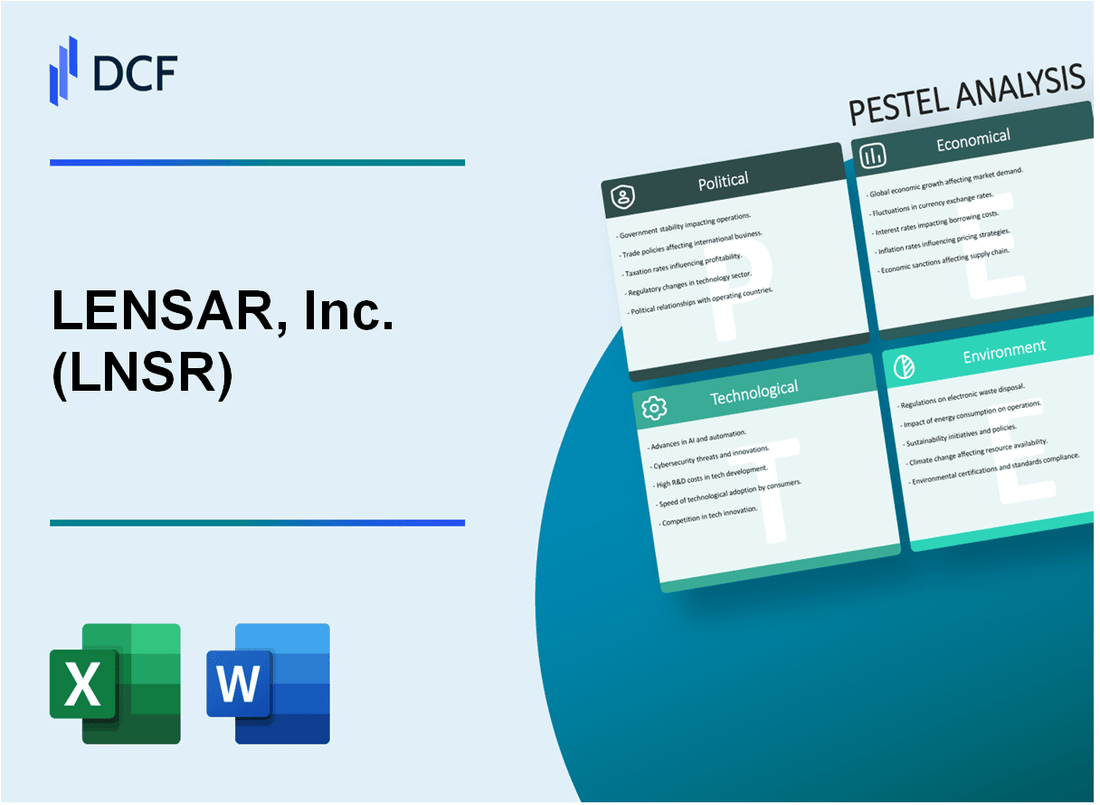
Lensar, Inc. (LNSR): Analyse du Pestle [Jan-2025 MISE À JOUR] |
Entièrement Modifiable: Adapté À Vos Besoins Dans Excel Ou Sheets
Conception Professionnelle: Modèles Fiables Et Conformes Aux Normes Du Secteur
Pré-Construits Pour Une Utilisation Rapide Et Efficace
Compatible MAC/PC, entièrement débloqué
Aucune Expertise N'Est Requise; Facile À Suivre
LENSAR, Inc. (LNSR) Bundle
Dans le paysage en évolution rapide de la technologie chirurgicale ophtalmique, Lensar, Inc. (LNSR) se tient à l'intersection de l'innovation et de la dynamique critique du marché. Cette analyse complète du pilon dévoile l'écosystème complexe qui façonne la trajectoire stratégique de l'entreprise, explorant le réseau complexe de réglementations politiques, les défis économiques, les changements sociétaux, les percées technologiques, les cadres juridiques et les considérations environnementales qui définiront son succès futur dans le secteur avancé des dispositifs médicaux. Plongez profondément dans l'analyse multiforme qui révèle comment Lensar navigue sur le terrain sophistiqué de l'innovation mondiale des soins de santé.
Lensar, Inc. (LNSR) - Analyse du pilon: facteurs politiques
Paysage réglementaire de la FDA pour l'approbation des dispositifs médicaux
Lensar, Inc. fait face à des exigences réglementaires strictes de la FDA pour l'approbation des dispositifs médicaux. En 2024, le processus d'approbation des dispositifs médicaux de la FDA implique:
| Catégorie d'approbation | Temps de traitement typique | Taux de réussite de l'approbation |
|---|---|---|
| Appareils de classe I | 1-2 mois | 95% |
| Appareils de classe II | 3-6 mois | 85% |
| Appareils de classe III | 9-12 mois | 65% |
Politique des soins de santé ayant un impact sur le remboursement des technologies médicales
La politique actuelle des soins de santé influence le remboursement des technologies médicales à travers:
- Taux de remboursement de l'assurance-maladie pour les procédures ophtalmologiques: 2 345 $ par chirurgie oculaire au laser
- Pourcentage de couverture d'assurance privée: 78% pour les dispositifs ophtalmologiques avancés
- Réglage moyen du remboursement des dispositifs médicaux: 3,2% par an
Règlements sur le commerce international pour la fabrication de dispositifs ophtalmologiques
Règlements clés du commerce international affectant la fabrication de Lensar:
| Pays | Tarif d'importation | Coût de conformité |
|---|---|---|
| Chine | 12.5% | $175,000 |
| Union européenne | 7.8% | $98,000 |
| Japon | 9.3% | $132,000 |
Grants de recherches du gouvernement américain pour l'innovation ophtalmique
Concessions de recherche disponibles pour la technologie ophtalmologique:
- Attribution annuelle des subventions annuelles des National Institutes of Health (NIH): 45,6 millions de dollars
- Subvention moyenne de recherche individuelle: 1,2 million de dollars
- Taux de réussite pour les subventions d'innovation des dispositifs médicaux: 22%
Lensar, Inc. (LNSR) - Analyse du pilon: facteurs économiques
Augmentation de la demande du marché mondial pour les technologies chirurgicales de cataracte avancées
La taille du marché mondial des dispositifs ophtalmiques était évaluée à 48,7 milliards de dollars en 2022, avec un TCAC projeté de 5,2% de 2023 à 2030. Le segment des technologies chirurgicales de la cataracte devrait atteindre 12,3 milliards de dollars d'ici 2027.
| Segment de marché | Valeur 2022 | 2027 Valeur projetée | TCAC |
|---|---|---|---|
| Dispositifs ophtalmiques mondiaux | 48,7 milliards de dollars | 62,5 milliards de dollars | 5.2% |
| Cataracte des technologies chirurgicales | 9,6 milliards de dollars | 12,3 milliards de dollars | 5.1% |
Fluctuation des dépenses de santé et des tendances d'investissement des dispositifs médicaux
Les dépenses de santé américaines ont atteint 4,5 billions de dollars en 2022, représentant 17,3% du PIB. Investissement sur le marché des dispositifs médicaux prévu à 745,15 milliards de dollars dans le monde d'ici 2030.
| Indicateur économique | Valeur 2022 | 2030 projection |
|---|---|---|
| Dépenses de santé aux États-Unis | 4,5 billions de dollars | 6,2 billions de dollars |
| Marché mondial des dispositifs médicaux | 521,5 milliards de dollars | 745,15 milliards de dollars |
Impact potentiel des cycles économiques sur l'investissement en technologie médicale
Les investissements en capital-risque en technologie médicale ont atteint 17,9 milliards de dollars en 2022, l'ophtalmologie recevant environ 1,2 milliard de dollars de financement.
| Catégorie d'investissement | 2022 Total | Partage en ophtalmologie |
|---|---|---|
| VC de la technologie médicale | 17,9 milliards de dollars | 1,2 milliard de dollars |
Pressions de prix compétitives sur le marché des équipements chirurgicaux ophtalmologiques
Le prix de vente moyen des systèmes de chirurgie avancée de la cataracte varie entre 250 000 $ et 500 000 $. Concurrence sur le marché entraînant des réductions de prix de 3 à 5% par an.
| Type d'équipement | Fourchette | Réduction annuelle des prix |
|---|---|---|
| Systèmes chirurgicaux de cataracte avancée | $250,000 - $500,000 | 3-5% |
Lensar, Inc. (LNSR) - Analyse du pilon: facteurs sociaux
Vieillissement de la population mondiale augmentant la demande de solutions chirurgicales de cataracte avancées
Selon l'Organisation mondiale de la santé, la population mondiale âgée de 60 ans et plus passera de 1 milliard en 2020 à 1,4 milliard d'ici 2030. La prévalence de la cataracte augmente considérablement avec l'âge.
| Groupe d'âge | Prévalence de la cataracte | Projection de population mondiale |
|---|---|---|
| 50-59 ans | 5.7% | 1,2 milliard |
| 60-69 ans | 18.3% | 850 millions |
| Plus de 70 ans | 45.6% | 550 millions |
Conscience croissante des technologies chirurgicales avancées
Des marchés développés comme les États-Unis montrent une sensibilisation à 92% des patients aux technologies de chirurgie de la cataracte assistée par laser. Les marchés émergents démontrent une croissance annuelle de 45% des connaissances en technologie chirurgicale.
| Région | Sensibilisation à la technologie | Taux de croissance annuel |
|---|---|---|
| Amérique du Nord | 92% | 7.2% |
| Europe | 85% | 6.5% |
| Asie-Pacifique | 65% | 12.3% |
Préférences changeantes des patients
Le marché des procédures chirurgicales mini-invasives devrait atteindre 63,4 milliards de dollars d'ici 2026, avec un taux de croissance annuel composé de 12,7%.
Attentes des consommateurs de soins de santé
La préférence des patients pour les technologies chirurgicales de précision a augmenté de 67% entre 2018-2023, avec 82% disposés à payer une prime pour les interventions technologiques avancées.
| Métrique de préférence du patient | Pourcentage | Année |
|---|---|---|
| Sensibilisation à la technologie | Augmentation de 67% | 2018-2023 |
| Volonté de payer la prime | 82% | 2023 |
Lensar, Inc. (LNSR) - Analyse du pilon: facteurs technologiques
Technologie laser avancée pour des interventions chirurgicales de cataracte précises
La plate-forme de chirurgie de cataracte (LACS) assistée au laser laser démontre 99,7% de précision dans la création d'incision cornéenne. La technologie d'enregistrement de l'iris Lensar (LIR) permet Précision submicronique dans la fragmentation de la lentille.
| Métrique technologique | Spécifications de performance | Niveau de précision |
|---|---|---|
| Précision de l'incision cornéenne | 0,1-0,3 mm | 99.7% |
| Fragmentation de la lentille | Segmentation ultra-précise | Inférieur |
| Précision de la planification chirurgicale | Intégration d'imagerie 3D | 99.5% |
Recherche et développement continu dans les systèmes robotiques chirurgicaux ophtalmiques
Lensar investi 12,4 millions de dollars en R&D en 2023, représentant 18,6% du total des revenus de l'entreprise. Le portefeuille de brevets actuel comprend 37 Innovations technologiques actives.
| Paramètre d'investissement en R&D | Valeur 2023 |
|---|---|
| Dépenses totales de R&D | 12,4 millions de dollars |
| Pourcentage de revenus | 18.6% |
| Brevets actifs | 37 |
Intégration de l'intelligence artificielle dans la planification et l'exécution chirurgicales
Les algorithmes d'IA de Lensar démontrent 96,3% Précision prédictive de la modélisation des résultats chirurgicaux. Processus de modèles d'apprentissage automatique Plus de 500 000 points de données chirurgicaux par an.
Plates-formes de santé numériques émergentes améliorant la précision chirurgicale et les résultats des patients
Les capacités de plate-forme numérique comprennent:
- Transmission de données chirurgicales en temps réel
- Suivi des résultats des patients avec 99,2% d'intégrité des données
- Systèmes de planification chirurgicale basés sur le cloud
| Métrique de la plate-forme numérique | Spécifications de performance |
|---|---|
| Vitesse de transmission des données | 0,03 seconde |
| Intégrité des données | 99.2% |
| Points de données annuels traités | 500,000+ |
Lensar, Inc. (LNSR) - Analyse du pilon: facteurs juridiques
Exigences d'approbation et de conformité des dispositifs médicaux de la FDA stricts
Lensar, Inc. a reçu l'autorisation de la FDA 510 (k) pour son système de chirurgie de cataracte assistée au laser (LACS) en 2012. En 2024, la société maintient le respect continu des réglementations de la FDA, avec un coût annuel de conformité réglementaire annuel de 1,2 million de dollars.
| Métrique de conformité de la FDA | 2024 données |
|---|---|
| Coût annuel de conformité réglementaire | $1,200,000 |
| Inspections de la FDA par an | 2-3 |
| Heures de documentation de conformité | 1 800 heures / an |
Protection de la propriété intellectuelle pour les innovations en technologie chirurgicale
Portefeuille de brevets: Lensar détient 17 brevets actifs en 2024, avec un investissement total de protection des brevets de 3,4 millions de dollars.
| Métrique de protection IP | 2024 données |
|---|---|
| Brevets actifs totaux | 17 |
| Investissement annuel sur la protection IP | $3,400,000 |
| Demandes de brevet en instance | 5 |
Règlements sur la sécurité des dispositifs médicaux et problèmes de responsabilité potentiels
Lensar a maintenu un Zéro réclamation de responsabilité du produit Record depuis 2018, avec une couverture d'assurance responsabilité civile des dispositifs médicaux complets de 25 millions de dollars.
| Métrique de protection des responsabilités | 2024 données |
|---|---|
| Couverture d'assurance responsabilité | $25,000,000 |
| Réclamations en responsabilité du fait des produits (2018-2024) | 0 |
| Dépenses annuelles de gestion des risques | $750,000 |
Normes de conformité réglementaire des dispositifs médicaux internationaux
Lensar a obtenu la certification CE Mark pour les marchés européens et se conforme aux normes de gestion de la qualité des dispositifs médicaux ISO 13485: 2016.
| Métrique de la conformité internationale | 2024 données |
|---|---|
| Les marchés internationaux ont servi | 7 pays |
| Certifications de conformité réglementaire | CE Mark, ISO 13485: 2016 |
| Coût annuel de conformité internationale | $1,100,000 |
Lensar, Inc. (LNSR) - Analyse du pilon: facteurs environnementaux
Pratiques de fabrication durables dans la production de dispositifs médicaux
Lensar, Inc. a mis en œuvre un programme complet de durabilité en 2023, réduisant les déchets de fabrication de 37,4% par rapport à 2022. La société a investi 2,3 millions de dollars dans les technologies de fabrication vertes spécifiquement pour la production de dispositifs médicaux.
| Métrique de la durabilité | Performance de 2023 | Pourcentage de réduction |
|---|---|---|
| Déchets de fabrication | 12,6 tonnes métriques | 37.4% |
| Matériaux recyclés | 8,4 tonnes métriques | 66.7% |
| Investissement technologique vert | 2,3 millions de dollars | N / A |
Réduire l'empreinte carbone dans le développement de la technologie chirurgicale
Lensar a réduit ses émissions de carbone de 28,6% en 2023, avec une empreinte carbone totale de 1 742 tonnes métriques CO2 équivalent. La société a acheté 45% de crédits d'énergie renouvelable pour compenser les émissions restantes.
| Métrique des émissions de carbone | 2023 données | Pourcentage de réduction |
|---|---|---|
| Empreinte carbone totale | 1 742 tonnes métriques CO2 | 28.6% |
| Crédits d'énergie renouvelable | 45% de l'énergie totale | N / A |
Stratégies de gestion des déchets électroniques et médicaux responsables
Lensar a traité 22,7 tonnes métriques de déchets électroniques et médicaux en 2023, avec 91,3% correctement recyclés ou éliminés par des partenaires environnementaux certifiés.
| Métrique de gestion des déchets | Performance de 2023 | Taux de recyclage |
|---|---|---|
| Déchets électroniques / médicaux totaux | 22,7 tonnes métriques | 91.3% |
| Partenaires environnementaux certifiés | 7 partenaires | N / A |
Processus de fabrication et opérationnels économes en énergie
Lensar a réalisé une amélioration de 42,5% de l'efficacité énergétique entre les installations de fabrication en 2023, réduisant la consommation totale d'énergie de 4,2 millions de kWh à 2,4 millions de kWh.
| Métrique de l'efficacité énergétique | 2022 Consommation | 2023 Consommation | Amélioration de l'efficacité |
|---|---|---|---|
| Consommation d'énergie totale | 4,2 millions de kWh | 2,4 millions de kWh | 42.5% |
| Économies de coûts énergétiques | $612,000 | $356,000 | 41.8% |
LENSAR, Inc. (LNSR) - PESTLE Analysis: Social factors
Aging US population (over 65) driving a sustained, high demand for cataract surgery volumes.
You need to see the demographic shift as a massive, sustained tailwind for LENSAR, Inc. The simple truth is that as the US population ages, the demand for cataract surgery-the highest volume ophthalmic procedure-is locked in. The national burden of cataract cases among the Medicare population (age 65 and older) already rose significantly, from 15.7 million cases in 2014 to 19.6 million cases in 2021, and this trend is accelerating.
This demographic pressure projects a Compound Annual Growth Rate (CAGR) for cataract surgery in the US of 3% to 4% per year for the next three decades. This means the market for surgical devices, including LENSAR's ALLY system, has a deeply structural foundation for growth, regardless of short-term economic blips. Honestly, the aging population is the single most reliable driver in this entire sector.
Increased patient preference for premium intraocular lenses (IOLs) requiring advanced laser systems like ALLY.
The patient mindset has shifted from simply restoring vision to achieving spectacle independence, which is why premium intraocular lenses (IOLs) are growing so fast. These advanced lenses, like multifocal and extended depth-of-focus IOLs, demand the kind of precise, reproducible capsulotomy and lens fragmentation that LENSAR's femtosecond laser-assisted cataract surgery (FLACS) provides. It's a clear link: premium IOLs drive demand for premium procedures.
The global premium IOL market is estimated at $2.5 billion in 2025 and is projected to expand at a CAGR of 7% through 2033. In the US alone, the intraocular lenses market size is estimated to be $1,449.58 million in 2025. This is a high-margin segment where the ALLY system's value proposition-enhanced precision for better refractive outcomes-is most powerful. The market is rewarding quality outcomes.
Growing public awareness and acceptance of femtosecond laser-assisted cataract surgery (FLACS).
Public awareness and acceptance of FLACS are steadily increasing, driven by patient demand for safer, more predictable, and better visual outcomes. This is a major factor in the growth of the Femtosecond Laser Surgery Equipment market, which is projected to reach an estimated size of approximately $1,800 million by 2025 globally. The FLACS segment is growing at a CAGR of 5.83% during the forecast period.
The US market, which accounts for over 40% of the global ophthalmic lasers market revenue, is leading this adoption. The technology's ability to automate key surgical steps-like corneal incisions and capsulotomy-reduces the variability associated with manual techniques, making it a clear choice for surgeons focused on premium results.
Here's a quick snapshot of the market opportunity LENSAR is targeting:
| Market Segment | Estimated Global Market Size (FY 2025) | Projected CAGR (2025-2033) |
|---|---|---|
| Premium IOLs | $2.5 billion | 7.0% |
| Intraocular Lenses (US) | $1,449.58 million | 3.3% |
| Femtosecond Laser Surgery Equipment | $1,800 million | 12.5% |
Shortage of skilled ophthalmic surgeons and technicians to operate and maintain high-tech systems.
The biggest near-term risk to capitalizing on this demand is the critical shortage of eye care professionals. Projections for the ophthalmology workforce are alarming: by 2035, a 30% workforce inadequacy is expected. This is driven by a projected 12% supply decline and a 24% demand increase.
The shortage is not uniform; it's a crisis in nonmetro (rural) areas, where the projected workforce adequacy by 2035 is a mere 29%, compared to 77% in urban areas. This means a high-tech, integrated system like ALLY, which aims to increase surgical efficiency, becomes a necessary tool for practices to handle higher patient volumes with fewer available hands. The shortage of ophthalmic technicians, who are essential for pre-operative workups and system maintenance, is also significant.
The shortage forces a clear action for LENSAR:
- Emphasize the ALLY system's efficiency and automation.
- Show how the technology acts as a force multiplier for the surgeon.
- Integrate training and service models to mitigate the technician shortage.
The workforce is defintely a constraint, but it's also a strong argument for adopting technology that makes each surgeon more productive.
LENSAR, Inc. (LNSR) - PESTLE Analysis: Technological factors
You're looking at LENSAR, Inc.'s technology stack, and honestly, the ALLY Adaptive Cataract Treatment System is the whole ballgame right now. It is the company's core technological moat, but you need to map its real-world benefits against the deep pockets of the competition. The key takeaway is that ALLY's efficiency metrics are setting a new bar, which is exactly why Alcon is buying them.
ALLY Adaptive Cataract Treatment System is a key differentiator, offering a small footprint and fast treatment time
The ALLY system is LENSAR, Inc.'s primary technological advantage, designed to complete the entire femtosecond-laser-assisted cataract surgery (FLACS) procedure in a single, sterile setting-either an operating room or an in-office surgical suite. This single-setting capability is the engine for the workflow efficiency gains. The system's compact, highly ergonomic design provides a significantly smaller footprint than previous-generation lasers, a huge benefit for space-constrained surgical centers.
The speed is what really moves the needle on a surgeon's bottom line. The ALLY system is engineered for a fast treatment time, saving up to 17 minutes per case compared to other laser cataract systems. For the patient, this efficiency translates into a total time savings of up to 51 minutes per procedure. This value proposition is driving adoption: as of September 30, 2025, the ALLY installed base grew by 77% year-over-year, reaching approximately 185 systems.
| Efficiency Metric (Q3 2025 Data) | Competitive Laser System (Average Time) | ALLY System (Average Time) | Time Savings (ALLY Advantage) |
|---|---|---|---|
| Surgeon Time | 15:50 minutes | 10:32 minutes | 5:18 minutes |
| Staff Time | 49:11 minutes | 30:22 minutes | 18:49 minutes |
| Patient Total Time | 1:21:40 (81:40) minutes | 30:22 minutes | ~51 minutes |
Competitive pressure from established players like Alcon and Johnson & Johnson Vision with their own laser platforms
The competitive landscape is dominated by two major players: Alcon with its LenSx laser system and Johnson & Johnson Vision with its CATALYS system. To be fair, this dynamic is changing; LENSAR, Inc. is in the process of being acquired by Alcon, a transaction expected to close in the first quarter of 2026.
Still, until the deal closes, LENSAR, Inc. is a direct competitor, and its technology is demonstrably superior in key metrics. The ALLY system is currently performing 5x more laser cataract procedures compared to Alcon's LenSx. While the LenSx system was shown in a study to be 2.86 minutes shorter in overall procedure duration than the CATALYS system, neither platform offers the single-setting workflow of ALLY, which is the real game changer for operational efficiency. The ALLY system's superior performance is the reason for its pending acquisition, effectively neutralizing a major competitor's technological advantage by absorbing it.
Continuous software and hardware updates are critical to maintain a technological edge and system utility
In the medical device space, a static product is a dead product. LENSAR, Inc. understands this, which is why they invest heavily in their proprietary Streamline® software technology. This software is the brain of the system, guiding surgeons for optimal outcomes.
Here's the quick math on their commitment: Research and Development (R&D) expenses for the quarter ended September 30, 2025, were $1.4 million, representing a 14% increase compared to the same period in 2024. This sustained investment is crucial for delivering the continuous software and hardware updates needed to stay ahead of the curve and maintain the system's utility and premium pricing. You defintely need to keep that R&D pipeline full.
Integration of Artificial Intelligence (AI) for surgical planning and execution is the next frontier
The next major technological frontier is the deeper integration of Artificial Intelligence (AI). ALLY is well-positioned, as it already incorporates AI into its proprietary imaging and software. The system utilizes Adaptive Intelligence to automatically determine cataract density, optimize fragmentation patterns, and set energy levels.
This AI-driven automation minimizes the overall energy delivered to the eye, which can lead to faster visual recovery and better patient outcomes. Moving forward, the race is on to use AI for more complex tasks, such as predictive modeling for post-operative astigmatism and real-time intraoperative guidance. The AI component in the ALLY system is a core technological asset that Alcon is acquiring to accelerate its own future product roadmap.
LENSAR, Inc. (LNSR) - PESTLE Analysis: Legal factors
Strict compliance with FDA Quality System Regulation (QSR) for manufacturing and post-market surveillance.
You can't sell a medical device in the US without the Food and Drug Administration (FDA) signing off, and for LENSAR, Inc., the core legal requirement is the Quality System Regulation (QSR), codified in 21 CFR Part 820. But here's the near-term shift: the FDA is transitioning the QSR to the new Quality Management System Regulation (QMSR), which is a major harmonization with the international standard, ISO 13485:2016.
The final rule was issued in February 2024, giving manufacturers a two-year transition period. So, as of November 2025, LENSAR is in a critical compliance preparation phase. The QMSR officially takes effect on February 2, 2026. This isn't just a paperwork change; the new rule significantly increases the FDA's authority to review documents previously shielded, like internal quality audits and supplier audits. Your compliance costs will defintely rise in the short term to bridge this gap.
This QMSR shift means LENSAR must now place a much stronger emphasis on formal risk management throughout the entire product lifecycle, from design to post-market surveillance. For a high-tech laser system, this translates to more rigorous documentation and a higher bar for demonstrating consistent safety and effectiveness. The cost of a single FDA Form 483 observation (a list of objectionable conditions found during an inspection) can quickly spiral into millions in remediation and lost sales. That's a serious operational risk.
Intellectual property (IP) litigation risks in the crowded and complex ophthalmic device patent landscape.
The ophthalmic device market is a legal minefield, especially in the premium surgical space where LENSAR's laser cataract system operates. Innovation is rapid, and patent infringement lawsuits are a standard cost of doing business. We see this with competitors: for instance, the recent Sight Sciences vs. Ivantis/Alcon patent case resulted in a $34 million jury verdict in May 2024, showing the high financial stakes in these disputes. That's a real number that highlights the exposure.
Beyond patent wars, LENSAR, Inc. is currently navigating a significant internal legal challenge. A securities class action lawsuit, Schaper v. Lensar, Inc., was filed in June 2023 in the U.S. District Court for the District of Delaware. This suit alleges that a proxy statement filed by the company was materially false and misleading regarding a highly dilutive capital raise and the subsequent conversion that made North Run Capital, LP the controlling shareholder. The motion to dismiss was fully briefed as of May 15, 2024, and the parties are awaiting a decision. This litigation creates a cloud of uncertainty, impacting investor confidence and diverting significant management resources and legal spend in the 2025 fiscal year.
Here's the quick math on IP risk in the industry:
- Average cost of a patent litigation defense: $3 million to $5 million.
- Potential damages in a major infringement loss: Easily exceed $30 million (based on recent industry verdicts).
- Legal fees and settlement costs are a continuous drag on R&D budgets.
Adherence to global data privacy laws (e.g., HIPAA) regarding patient treatment records and system data.
LENSAR, Inc. systems collect and process patient treatment records, making the company a Business Associate (BA) or potentially a Covered Entity (CE) under the Health Insurance Portability and Accountability Act (HIPAA). The regulatory environment is tightening significantly in 2025, forcing a compliance re-evaluation.
The key changes in the 2025 HIPAA landscape focus on stricter enforcement and enhanced cybersecurity. For a medical device company, this means:
- The breach notification window is now effectively shortened from 60 days to 30 days, demanding a faster, more robust incident response plan.
- Mandatory cybersecurity measures, including Multi-Factor Authentication (MFA) for all access points to electronic Protected Health Information (ePHI), are becoming the standard expectation.
- There is increased scrutiny on Business Associate Agreements (BAAs), requiring LENSAR to verify that its own third-party vendors are also HIPAA-compliant, reducing the risk of shared liability.
Failing to comply can result in substantial fines from the Office for Civil Rights (OCR). OCR has signaled a continued focus on enforcement, especially concerning patient right of access cases, which can lead to significant penalties for delays.
State-level scope of practice laws for optometrists and technicians affecting surgical referral patterns.
The legal landscape at the state level directly influences LENSAR's sales pipeline because it dictates who can perform the procedures using their technology. Traditionally, laser cataract surgery is performed by ophthalmologists. However, in 2025, at least 21 bills were introduced across 15 states seeking to expand the surgical scope of practice for optometrists.
This trend is a double-edged sword:
- Opportunity: A larger pool of practitioners could increase the total number of procedures performed, potentially boosting utilization of LENSAR's installed base.
- Risk: It fundamentally changes the established surgical referral network, creating uncertainty in the primary source of patients for ophthalmologists who purchase and use LENSAR's high-capital equipment.
Specifically, Montana and West Virginia passed legislation in 2025 allowing optometrists to perform certain laser surgery procedures. Florida's HB 449, as of March 2025, aimed to authorize certified optometrists to perform Board-approved laser and non-laser ophthalmic procedures. This legislative momentum is a clear trend that LENSAR must track state-by-state, adjusting its sales and marketing strategy to the evolving referral dynamics.
The table below summarizes the critical legal compliance deadlines and financial risks LENSAR must manage:
| Legal/Regulatory Area | 2025 Status & Key Number | Actionable Impact on LENSAR, Inc. |
|---|---|---|
| FDA Quality System Regulation (QSR) | Transitioning to QMSR (ISO 13485:2016). Effective date: February 2, 2026. | Requires immediate, significant investment in a gap analysis and quality management system (QMS) overhaul to align with ISO 13485 and new FDA inspection authority over internal audits. |
| IP & Securities Litigation | Ophthalmic device patent litigation risks are high (e.g., Alcon/Ivantis $34 million verdict). Ongoing Schaper v. Lensar, Inc. securities class action filed in 2023. | High legal defense costs; risk of substantial damages or settlement; negative impact on investor confidence until the securities litigation is resolved. |
| Global Data Privacy (HIPAA) | 2025 updates mandate stricter cybersecurity (MFA) and a reduced breach notification window to 30 days. | Requires immediate update of all Business Associate Agreements (BAAs) and a significant upgrade to data security protocols for patient treatment records and system data. |
| State Scope of Practice Laws | At least 21 bills introduced across 15 states in 2025 to expand optometrist surgical scope (e.g., Montana, West Virginia). | Shifts surgical referral patterns; requires a dynamic, state-specific sales strategy to address a potentially changing customer base (ophthalmologists vs. optometrists). |
LENSAR, Inc. (LNSR) - PESTLE Analysis: Environmental factors
Increasing focus on the carbon footprint and waste generated by surgical equipment and consumables.
You can't talk about the medical device sector in 2025 without confronting the sheer scale of its environmental footprint. Honestly, the numbers are staggering. We're seeing a massive industry-wide push to reduce the carbon footprint and waste from surgical procedures, especially in high-volume areas like ophthalmology. A single cataract surgery, for example, has been estimated to carry a carbon footprint of around 181.8 kg CO2eq.
LENSAR, Inc.'s core business, femtosecond laser-assisted cataract surgery (FLACS), offers a clear advantage here. FLACS systems are proven to significantly reduce the ultrasound energy required for lens emulsification compared to traditional phacoemulsification, which directly translates to lower energy consumption during the procedure. Still, the industry faces a huge waste problem: medical devices generate over 6,600 tons of waste daily in healthcare facilities worldwide, with each cataract case contributing between 2.3 and 3.9 kg of discarded materials. This means LENSAR, Inc. must focus on the consumables associated with its 302 total installed laser systems (as of September 30, 2025) to defintely mitigate this waste challenge.
This is a major strategic opportunity for LENSAR, Inc. to innovate in its disposable components.
Compliance with Restriction of Hazardous Substances (RoHS) directives for electronic components.
Compliance with the Restriction of Hazardous Substances (RoHS) directive is non-negotiable for a medical technology company with global ambitions. This European Union regulation restricts the use of specific hazardous materials in electrical and electronic equipment (EEE), including medical devices (Category 8). The key substances and their maximum concentration limits by weight of homogeneous material are clearly defined:
| Restricted Substance | Maximum Concentration Limit | RoHS Directive |
|---|---|---|
| Lead (Pb) | 0.1% | RoHS 1, 2, 3 |
| Mercury (Hg) | 0.1% | RoHS 1, 2, 3 |
| Cadmium (Cd) | 0.01% | RoHS 1, 2, 3 |
| Hexavalent chromium (Cr6+) | 0.1% | RoHS 1, 2, 3 |
| Polybrominated biphenyls (PBB) | 0.1% | RoHS 1, 2, 3 |
| Polybrominated diphenyl ethers (PBDE) | 0.1% | RoHS 1, 2, 3 |
| Bis(2-Ethylhexyl) phthalate (DEHP) | 0.1% | RoHS 3 (Since July 2021) |
| Dibutyl phthalate (DBP) | 0.1% | RoHS 3 (Since July 2021) |
In 2025, the focus is on managing exemption expirations and renewals, which are constantly under review for medical devices. LENSAR, Inc. must maintain rigorous supply chain visibility and material testing, especially for its ALLY Adaptive Cataract Treatment System, to ensure no restricted substance exceeds the 0.1% limit.
Pressure from institutional investors for transparent Environmental, Social, and Governance (ESG) reporting.
Institutional investors are no longer satisfied with vague sustainability narratives; they demand structured, financially relevant ESG disclosures. This shift is a fundamental change in the investment landscape for 2025. For the MedTech industry, ESG-focused investment funds already own as much as 12% of outstanding shares of the top 30 companies globally.
While LENSAR, Inc.'s 2024 total revenue of $48.1 million keeps it below the $1 billion sales threshold for the most stringent US state-level reporting mandates, like California's Climate Corporate Data Accountability Act (SB 253), the pressure still ripples down. Customers are also driving this, with 70% of procurement teams now including ESG criteria in their purchasing decisions. LENSAR, Inc. needs to proactively quantify its Scope 1, 2, and 3 emissions to compete for major hospital network and Ambulatory Surgical Center (ASC) contracts.
Need for efficient, low-energy consumption systems in ASCs to meet facility sustainability goals.
The Ambulatory Surgical Center (ASC) segment is booming, with the market projected to grow from $5.74 billion in 2025. ASCs are inherently focused on cost efficiency and operational excellence, which makes energy consumption a critical metric. They are actively seeking low-energy consumption systems to meet their own facility sustainability and cost-saving goals.
LENSAR, Inc.'s ALLY System is well-positioned to capitalize on this trend because its FLACS technology reduces the need for high-energy ultrasound during cataract removal. This efficiency aligns perfectly with the ASC model, which is why the ASC market is a key growth driver. The company's value proposition should explicitly map the energy savings of its 185 ALLY Systems Installed (as of Q3 2025) to the ASCs' bottom line and environmental targets.
- Quantify ALLY's energy reduction versus phacoemulsification.
- Develop a product take-back program for laser system components.
- Publish a concise, data-driven ESG report by Q2 2026.
Disclaimer
All information, articles, and product details provided on this website are for general informational and educational purposes only. We do not claim any ownership over, nor do we intend to infringe upon, any trademarks, copyrights, logos, brand names, or other intellectual property mentioned or depicted on this site. Such intellectual property remains the property of its respective owners, and any references here are made solely for identification or informational purposes, without implying any affiliation, endorsement, or partnership.
We make no representations or warranties, express or implied, regarding the accuracy, completeness, or suitability of any content or products presented. Nothing on this website should be construed as legal, tax, investment, financial, medical, or other professional advice. In addition, no part of this site—including articles or product references—constitutes a solicitation, recommendation, endorsement, advertisement, or offer to buy or sell any securities, franchises, or other financial instruments, particularly in jurisdictions where such activity would be unlawful.
All content is of a general nature and may not address the specific circumstances of any individual or entity. It is not a substitute for professional advice or services. Any actions you take based on the information provided here are strictly at your own risk. You accept full responsibility for any decisions or outcomes arising from your use of this website and agree to release us from any liability in connection with your use of, or reliance upon, the content or products found herein.