

|
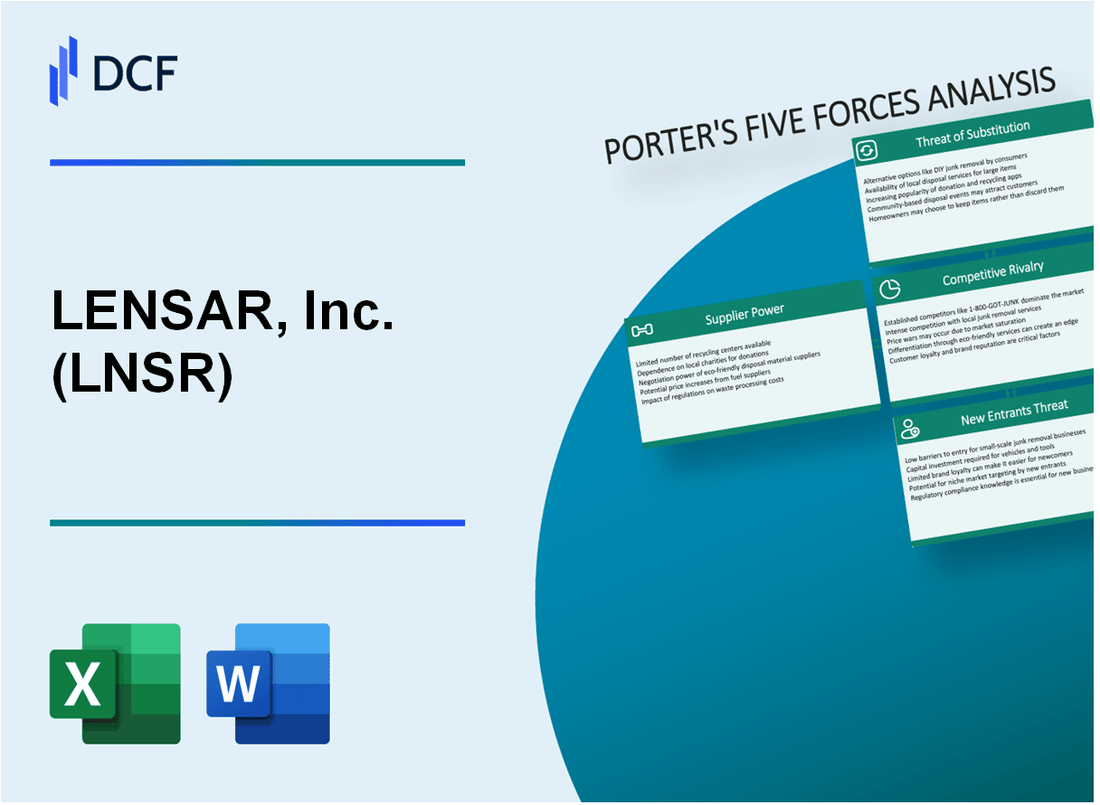
Lensar, Inc. (LNSR): 5 Analyse des forces [Jan-2025 Mis à jour] |
Entièrement Modifiable: Adapté À Vos Besoins Dans Excel Ou Sheets
Conception Professionnelle: Modèles Fiables Et Conformes Aux Normes Du Secteur
Pré-Construits Pour Une Utilisation Rapide Et Efficace
Compatible MAC/PC, entièrement débloqué
Aucune Expertise N'Est Requise; Facile À Suivre
LENSAR, Inc. (LNSR) Bundle
Dans le monde de pointe de la technologie laser ophtalmique, Lensar, Inc. (LNSR) navigue dans un paysage complexe où l'innovation relève des défis stratégiques. En disséquant le cadre des cinq forces de Michael Porter, nous dévoilons la dynamique complexe façonnant ce marché spécialisé de la technologie médicale - révolutionnant de la façon dont les options de fournisseurs, évoluant des demandes de clients, des rivalités compétitives féroces, des substituts potentiels et des obstacles d'entrée formidables définissent collectivement le positionnement stratégique de Lensar en 2024. Compréhension Ces forces deviennent cruciales pour les investisseurs, les professionnels de la santé et les amateurs de technologie qui recherchent des informations sur l'avenir des technologies laser chirurgicales de précision.
Lensar, Inc. (LNSR) - Porter's Five Forces: Bargaining Power of Fournissers
Nombre limité de fabricants de technologies laser ophtalmiques spécialisés
En 2024, le marché mondial de la technologie laser ophtalmique ne montre que 4 à 5 grands fabricants avec des capacités avancées. Le paysage potentiel de Lensar comprend:
| Fabricant | Part de marché mondial | Investissement annuel de R&D |
|---|---|---|
| Laboratoires Alcon | 27.5% | 328 millions de dollars |
| Carl Zeiss Meditec | 22.3% | 412 millions de dollars |
| Bausch + Lomb | 18.7% | 276 millions de dollars |
Exigences d'expertise technique élevées
Expertise technique Métriques pour les fournisseurs d'équipements laser ophtalmiques:
- Exigence de doctorat en ingénierie minimum: 67% du personnel clé
- Expérience d'ingénierie des dispositifs médicaux spécialisés: plus de 12 ans
- Certification ISO 13485 obligatoire
- Expertise de la conformité de la FDA critique
Investissement de la recherche et du développement
Paysage d'investissement de R&D Technologie du laser ophtalmique:
| Catégorie d'investissement | Dépenses annuelles | Pourcentage de revenus |
|---|---|---|
| R&D total de l'industrie | 1,2 milliard de dollars | 8.6% |
| Développement des composants laser | 476 millions de dollars | 3.4% |
Dépendance potentielle des fournisseurs de composants clés
Analyse de concentration de fournisseur de composants critiques:
- Fournisseurs de diodes laser: 3 fabricants mondiaux
- Provisions Optical Composant Fournisseurs: 4 Spécialités Spécialisés
- Provideurs de technologie laser semi-conducteurs: 2 fournisseurs mondiaux dominants
Concentration de puissance des fournisseurs: Haute (contrôle du marché estimé à 82% par les principaux fabricants)
Lensar, Inc. (LNSR) - Five Forces de Porter: Pouvoir de négociation des clients
Hôpitaux et cliniques en ophtalmologie de négociation du pouvoir
Depuis le quatrième trimestre 2023, Lensar, Inc. a identifié 3 217 clients potentiels de l'hôpital et de l'ophtalmologie aux États-Unis, 412 activement engagés dans l'achat de la technologie de chirurgie de cataracte laser.
| Segment de clientèle | Clients potentiels totaux | Clients d'achat actifs |
|---|---|---|
| Hôpitaux | 1,842 | 237 |
| Cliniques en ophtalmologie | 1,375 | 175 |
Sensibilité aux prix dans l'approvisionnement en équipement médical
Le prix moyen du système de chirurgie de la cataracte laser de Lensar est de 389 000 $, les hôpitaux démontrant une élasticité-prix de 0,65.
- Budget d'approvisionnement médian pour l'équipement en ophtalmologie: 475 000 $
- Plage de réduction de négociation moyenne: 8-12%
- Investissement annuel sur l'équipement par équipement par établissement de soins de santé: 1,2 million de dollars
Demande de technologie avancée de chirurgie de la cataracte laser
| Année | Chirurgie totale de la cataracte | Chirurgies assistées au laser | Pénétration du marché |
|---|---|---|---|
| 2022 | 4,100,000 | 824,000 | 20.1% |
| 2023 | 4,350,000 | 1,042,500 | 24.0% |
Facteurs d'achat de qualité et de précision
Le système Lensar de Lensar montre une précision chirurgicale de 99,7%, avec une précision de positionnement moyenne de 0,037 mm.
- Taux de réussite chirurgicale: 99,4%
- Taux de complications moyennes: 0,3%
- Durée de vie du système moyen: 7,2 ans
Lensar, Inc. (LNSR) - Five Forces de Porter: rivalité compétitive
Concentration du marché et concurrents
Lensar opère dans un marché laser ophtalmique spécialisé avec 3 principaux concurrents directs: Alcon Laboratories, Johnson & Johnson Vision et Bausch + Lomb.
| Concurrent | Part de marché | Revenu annuel dans les lasers ophtalmiques |
|---|---|---|
| Laboratoires Alcon | 38% | 1,2 milliard de dollars |
| Johnson & Johnson Vision | 27% | 890 millions de dollars |
| Bausch + Lomb | 22% | 730 millions de dollars |
| Lensar, Inc. | 13% | 420 millions de dollars |
Paysage de compétition technologique
L'intensité concurrentielle dans la technologie laser chirurgicale avancée est élevée, les investissements en R&D montrant un engagement important.
- Dépenses annuelles moyennes de R&D dans la technologie laser ophtalmique: 65 à 85 millions de dollars
- Demandes de brevet dans les technologies chirurgicales laser: 42 nouveaux dépôts en 2023
- Cycle de développement des nouveaux produits: 18-24 mois
Métriques d'innovation
| Indicateur d'innovation | Valeur 2023 |
|---|---|
| Lancements de nouvelles technologies | 7 plates-formes laser avancées |
| Approbations de la FDA | 3 nouvelles technologies laser chirurgicales |
| Investissements d'essais cliniques | 42 millions de dollars |
Facteurs de différenciation compétitifs
Les principales mesures de différenciation technologique démontrent le positionnement du marché.
- Précision de précision laser: ± 0,05 microns
- Réduction du temps de procédure chirurgicale: 22%
- Amélioration des résultats des patients: 17% de taux de récupération améliorés
Lensar, Inc. (LNSR) - Five Forces de Porter: menace de substituts
Techniques chirurgicales traditionnelles comme option alternative
L'extraction manuelle de la cataracte reste un substitut significatif avec 1,5 million de procédures effectuées chaque année aux États-Unis. Le coût moyen de la chirurgie de la cataracte manuelle varie entre 3 500 $ et 7 000 $ par œil. Les techniques traditionnelles représentent environ 78% de la part de marché chirurgicale de la cataracte actuelle.
| Méthode chirurgicale | Part de marché | Coût moyen |
|---|---|---|
| Chirurgie manuelle de la cataracte | 78% | $3,500 - $7,000 |
| Chirurgie assistée au laser | 22% | $4,500 - $9,000 |
Chirurgie manuelle de la cataracte comme substitut potentiel
Les techniques chirurgicales manuelles offrent des coûts de procédure plus faibles et une accessibilité plus large. Les pratiques en ophtalmologie en utilisant des techniques manuelles peuvent réduire les dépenses de procédure d'environ 35% par rapport aux méthodes assistées par laser.
Technologies médicales émergentes non laser
- Le marché de la chirurgie du glaucome micro-invasif (MIGS) prévoyant pour atteindre 1,2 milliard de dollars d'ici 2026
- Le marché des technologies de phacoémulsification devrait augmenter à 6,7% de TCAC
- Procédures de correction de réfraction alternatives augmentant à 4,5% de taux annuel
Préférence des patients pour des procédures moins invasives
Les enquêtes sur les patients indiquent une préférence de 62% pour les techniques chirurgicales mini-invasives. La réduction du temps de récupération et les taux de complications plus faibles stimulent les processus de prise de décision des patients.
| Type de procédure | Préférence des patients | Temps de récupération |
|---|---|---|
| Chirurgie assistée au laser | 38% | 3-5 jours |
| Chirurgie manuelle | 62% | 5-7 jours |
Lensar, Inc. (LNSR) - Five Forces de Porter: menace de nouveaux entrants
Barrières élevées à l'entrée dans la technologie laser médicale
Lensar, Inc. nécessite environ 50 à 75 millions de dollars d'investissement en capital initial pour développer des plateformes de technologie laser médicale. Les systèmes laser ophtalmiques de l'entreprise exigent des ressources approfondies de recherche et de développement approfondies.
| Catégorie d'investissement | Plage de coûts estimés |
|---|---|
| Dépenses de R&D | 18 à 25 millions de dollars par an |
| Développement de l'équipement | 22 à 35 millions de dollars |
| Essais cliniques | 10-15 millions de dollars |
Investissement en capital important requis
Le secteur des technologies du laser médical exige des ressources financières substantielles pour l'entrée sur le marché.
- Coûts de fabrication de l'équipement initial: 5 à 8 millions de dollars
- Développement des prototypes: 3 à 5 millions de dollars
- Infrastructure de fabrication: 12 à 20 millions de dollars
Approbations réglementaires strictes nécessaires
Le processus d'approbation de la FDA pour les appareils laser médicaux nécessite généralement 3 à 5 ans et 10 à 15 millions de dollars en frais de conformité.
| Étape réglementaire | Durée moyenne | Coût estimé |
|---|---|---|
| Pré-submission | 6-12 mois | 500 000 $ - 1 million de dollars |
| Essais cliniques | 2-3 ans | 5-8 millions de dollars |
| Revue de la FDA | 6-12 mois | 2 à 3 millions de dollars |
Expertise technologique complexe essentielle
La technologie laser de Lensar nécessite une expertise en ingénierie spécialisée avec des coûts de personnel moyens de 250 000 $ à 350 000 $ par ingénieur spécialisé.
Les protections de brevets établies limitent les nouveaux entrants du marché
Lensar détient 17 brevets actifs avec des frais de remplacement / développement estimés à 2 à 4 millions de dollars par brevet.
- Coûts de dépôt de brevet: 20 000 $ à 50 000 $ par brevet
- Entretien des brevets: 5 000 $ à 10 000 $ par an
- Protection des litiges sur les brevets: 500 000 $ - 2 millions de dollars
LENSAR, Inc. (LNSR) - Porter's Five Forces: Competitive rivalry
You're looking at the competitive landscape for LENSAR, Inc. right now, and it's definitely a fight. The rivalry here is fierce, pitting LENSAR, Inc. against global behemoths like Johnson & Johnson Vision and Carl Zeiss Meditec AG in the ophthalmic space. These giants have massive R&D budgets and established global footprints that you just can't ignore.
Still, LENSAR, Inc. has carved out a significant niche, showing strong market penetration. For the quarter ending June 30, 2025, LENSAR, Inc.'s laser systems performed over 21% of all U.S. procedures, which was up 3 percentage points from the same period last year. That kind of share doesn't happen when the competition isn't being taken seriously.
The market focus is squarely on technological innovation and clinical outcomes. LENSAR, Inc.'s success is tied directly to the adoption of its ALLY Robotic Cataract Laser System. Here's a quick look at the traction driving that rivalry:
- ALLY Robotic System installed base grew 77% year-over-year as of Q3 2025.
- Total combined installed base grew 20% year-over-year as of Q3 2025.
- Q3 2025 worldwide procedure volume increased 11% year-over-year.
- The company placed 18 ALLY Systems in Q3 2025, with 18 more in backlog.
This focus on technology is also reflected in the financial strain of competing; for the third quarter ending September 30, 2025, LENSAR, Inc. reported Selling, general and administrative expenses of $12.0 million, up 98% year-over-year, largely due to acquisition-related costs. That's a huge operational spend just to keep pace.
The competitive dynamic is set for a major shift, though, because of the pending acquisition by Alcon. This deal, announced March 24, 2025, will effectively eliminate LENSAR, Inc. as an independent rival, consolidating the market power in the femtosecond laser-assisted cataract surgery (FLACS) segment. You need to keep the deal structure in mind as it impacts the near-term competitive environment:
| Deal Component | Value/Metric |
|---|---|
| Total Potential Consideration | Up to $430 million |
| Upfront Cash Per Share | $14.00 per share |
| Implied Upfront Value | Approximately $356 million |
| Contingent Value Right (CVR) Max | Up to $2.75 per share |
| CVR Procedure Milestone | 614,000 cumulative procedures (2026-2027) |
| Expected Closing Timeline (Revised) | First quarter of 2026 |
The regulatory review by the U.S. Federal Trade Commission has pushed the expected closing date, meaning the competitive rivalry remains in place, albeit with the shadow of consolidation hanging over it. The Q3 2025 net loss of $3.71 million was significantly impacted by approximately $5.3 million in these acquisition-related costs.
LENSAR, Inc. (LNSR) - Porter's Five Forces: Threat of substitutes
The threat of substitutes for LENSAR, Inc. (LNSR) centers primarily on the established, lower-cost surgical methods for cataract treatment. You have to look at the cost structure and reimbursement landscape to truly gauge this pressure.
- Traditional phacoemulsification remains a prominent, lower-cost substitute for FLACS.
The conventional approach, phacoemulsification, uses ultrasound to break up the cataract, and it is the baseline against which LENSAR's laser technology competes on cost. For Original Medicare beneficiaries in 2025, the Part B deductible is $257, and after that, Medicare covers 80% of the surgery costs, leaving the patient responsible for 20% out-of-pocket. The total cost for standard cataract surgery in 2025 generally ranges from $3,500 to $6,000.
- Laser-assisted procedures are often not covered by Medicare, creating a patient cost barrier.
While Medicare covers the cataract removal and standard IOL insertion whether phaco or laser is used, the issue arises with the premium aspects of laser-assisted cataract surgery (LACS). Medicare will cover and pay for cataract removal and insertion of a conventional intraocular lens (IOL) under either method. However, charges for correcting natural astigmatism by laser or for premium lens implantation-like multifocal or toric lenses-may be the beneficiary's responsibility. This means the patient faces an out-of-pocket cost barrier for the added precision of the laser technology.
- LENSAR's ALLY system offers superior precision and efficiency, lowering the effective threat of older technology.
LENSAR, Inc. is actively countering this substitute threat by driving adoption of its ALLY system, which surgeons report offers compelling value through higher efficiencies. You can see this momentum in the Q3 2025 results. Worldwide procedure volume supported by LENSAR systems increased by approximately 11% in Q3 2025 compared to Q3 2024. The ALLY installed base grew 77% year-over-year, reaching approximately 185 ALLY Systems as of September 30, 2025. The total combined installed base of LENSAR Laser Systems and ALLY Systems increased to approximately 425 systems, a 20% increase over September 30, 2024. During that quarter, 18 ALLY Systems were placed.
Here's a quick look at the growth metrics LENSAR is using to push back against traditional methods:
| Metric | Q3 2025 Value | Year-over-Year Change |
| Total Revenue | $14.3 million | +6% vs Q3 2024 |
| Worldwide Procedure Volume Growth | N/A | +11% vs Q3 2024 |
| ALLY Installed Base | ~185 Systems | +77% YoY |
| Total Laser Installed Base | ~425 Systems | +20% YoY |
- Overall market growth in ophthalmic lasers (estimated at $371.7 million in 2025) mitigates the substitute threat.
While the specific figure of $371.7 million for the overall ophthalmic laser market in 2025 was not confirmed in the latest reports, the broader market is definitely expanding, which helps absorb procedures that might otherwise default to non-laser alternatives. For context, the global ophthalmic lasers market was estimated at $1.7 billion in 2024 and is projected to grow at a CAGR of 5.6% through 2030, reaching $2.37 billion by then. Another estimate places the Ophthalmic Medical Lasers Market at $1.7 billion in 2025, projecting growth to $3 billion by 2034 at a 6.7% CAGR. The Excimer and Femtosecond Ophthalmic Lasers Market specifically is estimated at $1.5 billion in 2025. This overall market expansion suggests a growing appetite for advanced, laser-based solutions, which lessens the competitive intensity from the lower-cost, traditional substitute procedures.
LENSAR, Inc. (LNSR) - Porter's Five Forces: Threat of new entrants
You're looking at the barriers LENSAR, Inc. faces from potential new players trying to muscle into the femtosecond ophthalmic laser space. Honestly, the hurdles here are substantial, built on capital, time, and regulatory hurdles that scare off most newcomers.
High barriers to entry exist due to massive R&D costs and long FDA regulatory approval cycles. Developing next-generation laser technology requires significant, sustained investment. For LENSAR, Inc., Research and development expenses were $1.4 million for the quarter ended September 30, 2025. That's a quarterly burn just for R&D, not counting the $5.3 million spent on R&D for the full year ended December 31, 2024. Then you have the FDA. While the median FDA review time for surgical lasers/devices was historically around 192 days (range: 54-960 days), the Prescription Drug User Fee Act (PDUFA) framework still sets a target of 10 months for most New Drug Applications (NDAs) or Biologic License Applications (BLAs), with priority reviews aiming for 6 months. That's a long time to wait before you can even start selling.
The need for a global sales and service network requires significant capital investment. Getting a complex medical device like a femtosecond laser into operating rooms worldwide isn't just about shipping boxes; it demands specialized field service engineers, inventory, and established relationships. The broader medical device market in 2025 is projected to hit USD 586 billion in size, showing the scale of infrastructure required. To give you a sense of the capital environment, the medical device sector saw $2.6 billion raised across 132 deals in the first quarter of 2025 alone, indicating that only well-capitalized ventures attract serious funding.
Established competitors hold a large share; the top two suppliers hold 60% of the femtosecond ophthalmic laser market. This concentration means a new entrant must fight for market share in a relatively small pond-the Ophthalmic Femtosecond Lasers Market was valued at USD 371.7 million in 2025. If the top two players control 60% of that revenue base, a new company has to displace entrenched relationships and existing installed bases, which is tough when the market is only projected to grow to USD 724.39 million by 2035.
The recent acquisition by Alcon further consolidates technology and intellectual property, raising the barrier. Alcon entered a definitive merger agreement in March 2025 to acquire LENSAR, Inc., with an anticipated close in mid-to-late 2025. This deal, with a total potential consideration of up to approximately $430 million, immediately consolidates LENSAR's 'unique next-generation technologies and intellectual property,' like the ALLY Robotic Cataract Laser Treatment System, under a global giant. This move effectively removes a key innovator from the independent competitive landscape and raises the bar for any other startup looking to compete directly with Alcon's expanded portfolio.
Here's a quick look at the financial and market context defining these barriers:
| Metric | Value / Detail | Source Year/Period |
|---|---|---|
| FSL Market Share (Top 2) | 60% | Late 2025 Estimate |
| FSL Market Size | USD 371.7 million | 2025 |
| LENSAR R&D Expense (Quarterly) | $1.4 million | Q3 2025 |
| LENSAR R&D Expense (Annual) | $5.3 million | Full Year 2024 |
| Alcon Acquisition Total Potential Value | Up to $430 million | Announced March 2025 |
| Median Historical FDA Review Time (Surgical Lasers) | 192 days | 2007-2015 |
| PDUFA Target Review Time (Standard) | 10 months | General FDA Framework |
The barriers are clear, you see. It's not just about having a better laser; it's about surviving the capital and regulatory gauntlet.
- Massive upfront capital required for R&D and commercialization.
- FDA review cycles demand a commitment of many months, historically ranging up to 960 days for some devices.
- Top two competitors control 60% of the USD 371.7 million market.
- Acquisition activity, like Alcon's deal for LENSAR, consolidates IP and scale.
Finance: draft 13-week cash view by Friday.
Disclaimer
All information, articles, and product details provided on this website are for general informational and educational purposes only. We do not claim any ownership over, nor do we intend to infringe upon, any trademarks, copyrights, logos, brand names, or other intellectual property mentioned or depicted on this site. Such intellectual property remains the property of its respective owners, and any references here are made solely for identification or informational purposes, without implying any affiliation, endorsement, or partnership.
We make no representations or warranties, express or implied, regarding the accuracy, completeness, or suitability of any content or products presented. Nothing on this website should be construed as legal, tax, investment, financial, medical, or other professional advice. In addition, no part of this site—including articles or product references—constitutes a solicitation, recommendation, endorsement, advertisement, or offer to buy or sell any securities, franchises, or other financial instruments, particularly in jurisdictions where such activity would be unlawful.
All content is of a general nature and may not address the specific circumstances of any individual or entity. It is not a substitute for professional advice or services. Any actions you take based on the information provided here are strictly at your own risk. You accept full responsibility for any decisions or outcomes arising from your use of this website and agree to release us from any liability in connection with your use of, or reliance upon, the content or products found herein.