

|
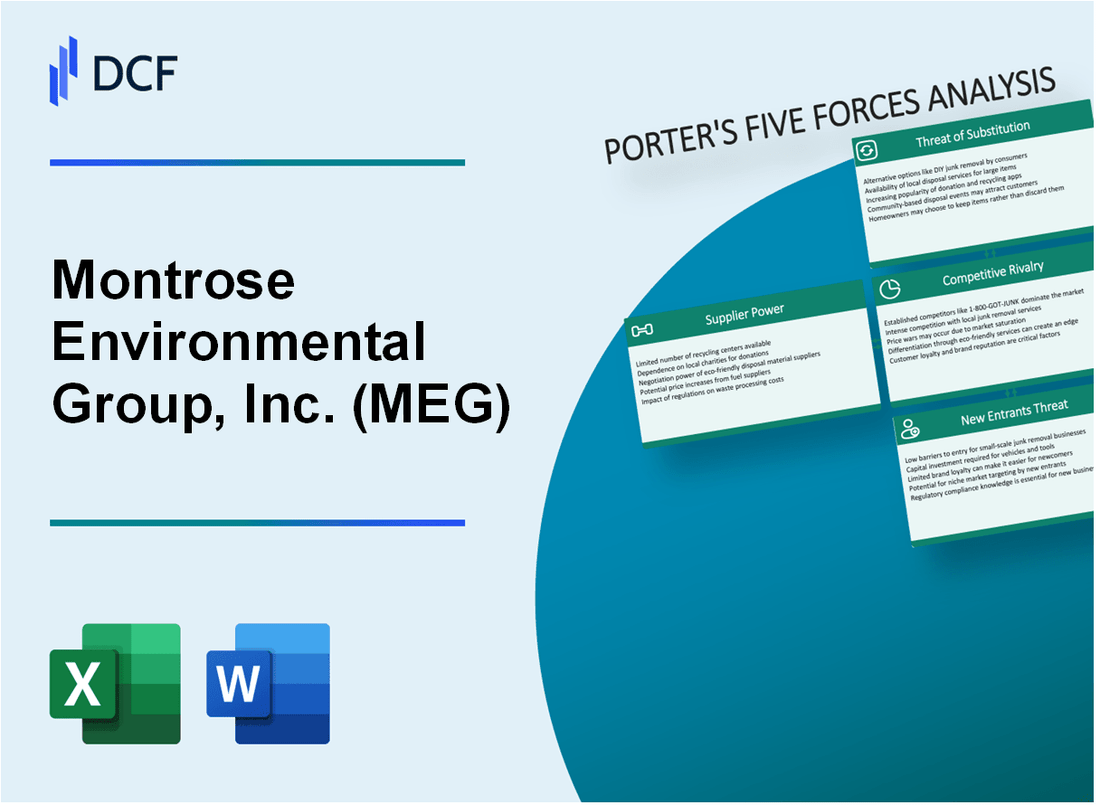
Montrose Environmental Group, Inc. (MEG): 5 Forces Analysis [Jan-2025 Mis à jour] |
Entièrement Modifiable: Adapté À Vos Besoins Dans Excel Ou Sheets
Conception Professionnelle: Modèles Fiables Et Conformes Aux Normes Du Secteur
Pré-Construits Pour Une Utilisation Rapide Et Efficace
Compatible MAC/PC, entièrement débloqué
Aucune Expertise N'Est Requise; Facile À Suivre
Montrose Environmental Group, Inc. (MEG) Bundle
Dans le paysage dynamique des services environnementaux, Montrose Environmental Group, Inc. (MEG) navigue dans un écosystème complexe de forces du marché qui façonnent son positionnement stratégique. Alors que la conformité environnementale devient de plus en plus critique pour les entreprises de tous les secteurs, la compréhension de la dynamique complexe de l'énergie des fournisseurs, des relations avec les clients, de l'intensité concurrentielle, des perturbations technologiques et des obstacles à l'entrée du marché révèle les défis et les opportunités nuancées auxquelles sont confrontées cette société de conseil en environnement spécialisée en 2024.
Montrose Environmental Group, Inc. (MEG) - Porter's Five Forces: Bargaining Power of Fournissers
Nombre limité de fabricants d'équipements de test environnementaux spécialisés
En 2024, le marché mondial des équipements de test environnemental est concentré avec environ 5 à 7 grands fabricants. Thermo Fisher Scientific a déclaré 44,9 milliards de dollars de revenus pour 2023. Agilent Technologies a généré 6,7 milliards de dollars de revenus annuels. PerkinElmer a enregistré 5,4 milliards de dollars de revenus totaux pour la même période.
| Fabricant | Revenus de 2023 | Part de marché |
|---|---|---|
| Thermo Fisher Scientific | 44,9 milliards de dollars | 32% |
| Agilent Technologies | 6,7 milliards de dollars | 15% |
| Perkinonmer | 5,4 milliards de dollars | 12% |
Coûts de commutation élevés pour les technologies de surveillance environnementale avancées
Les coûts de commutation pour les technologies de surveillance environnementale avancées varient entre 250 000 $ et 1,5 million de dollars par système complet. Les frais d'étalonnage et d'intégration peuvent ajouter 15-25% aux coûts initiaux de l'équipement.
- Cycle de remplacement typique de l'équipement: 5-7 ans
- Coûts de recalibrage moyen: 75 000 $ à 150 000 $ par an
- Frais de formation pour les nouvelles technologies: 50 000 $ à 100 000 $ par équipe technique
Dépendance à l'égard des principaux fournisseurs d'instruments scientifiques et de logiciels
Le groupe environnemental de Montrose s'appuie sur trois principaux fournisseurs d'instruments scientifiques: Thermo Fisher Scientific, Agilent Technologies et Waters Corporation. L'intégration logicielle coûte environ 200 000 $ à 500 000 $ par plate-forme de surveillance environnementale complète.
Contraintes potentielles de la chaîne d'approvisionnement dans la technologie environnementale spécialisée
Les contraintes de chaîne d'approvisionnement en 2023 ont entraîné des retards de 6 à 8 semaines pour des équipements de surveillance environnementale spécialisés. Les pénuries de semi-conducteurs ont eu un impact sur 42% des fabricants d'instruments scientifiques. Les augmentations de prix des matières premières variaient de 12 à 18% pour les composants critiques.
| Métrique de la chaîne d'approvisionnement | 2023 Impact |
|---|---|
| Retards de livraison de l'équipement | 6-8 semaines |
| Impact de la pénurie de semi-conducteurs | 42% |
| Augmentation du prix des matières premières | 12-18% |
Montrose Environmental Group, Inc. (MEG) - Porter's Five Forces: Bargaining Power of Clients
Composition de la clientèle
Montrose Environmental Group, Inc. sert les clients dans plusieurs secteurs avec la ventilation suivante:
| Secteur | Pourcentage de clientèle |
|---|---|
| Gouvernement | 37% |
| Industriel | 42% |
| Commercial | 21% |
Métriques de fidélisation de la clientèle
Performance de rétention de la clientèle pour MEG:
- Taux de rétention de la clientèle annuelle: 89%
- Durée moyenne de la relation client: 6,3 ans
- Répéter le taux d'entreprise: 76%
Analyse de la sensibilité aux prix
Dynamique des prix du marché de la conformité environnementale:
| Segment de marché | Élasticité-prix |
|---|---|
| Services de conformité réglementaire | 0.4 |
| Conseil environnemental | 0.6 |
| Services d'assainissement | 0.5 |
Impact de la structure du contrat
Détails du contrat pour Meg:
- Durée du contrat moyen: 3,7 ans
- Pourcentage de contrats à long terme: 62%
- Gamme de valeur du contrat annuel: 250 000 $ - 2,5 millions de dollars
Concentration du marché
Métriques de concentration du client:
| Segment de clientèle supérieur | Contribution des revenus |
|---|---|
| Top 5 des clients | 24% |
| Top 10 des clients | 38% |
Montrose Environmental Group, Inc. (MEG) - Five Forces de Porter: Rivalité compétitive
Paysage concurrentiel du marché
Depuis le quatrième trimestre 2023, Montrose Environmental Group, Inc. opère sur un marché concurrentiel avec les principaux concurrents suivants:
| Concurrent | Revenus annuels | Segment de marché |
|---|---|---|
| Aecom | 14,3 milliards de dollars | Conseil environnemental |
| Tetra Tech | 4,8 milliards de dollars | Services environnementaux |
| WSP Global | 10,2 milliards de dollars | Génie environnemental |
Dynamique compétitive
Le positionnement concurrentiel de Meg comprend:
- Part de marché d'environ 2,3% dans le conseil environnemental
- Marché total adressable estimé à 80,5 milliards de dollars
- Revenu annuel de 481,7 millions de dollars en 2023
Capacités technologiques
Métriques d'investissement technologique:
| Catégorie d'investissement | 2023 dépenses |
|---|---|
| Dépenses de R&D | 22,3 millions de dollars |
| Infrastructure technologique | 15,6 millions de dollars |
Différenciation des services
Capacités de service clés:
- Services de tests environnementaux dans 50 États
- Solutions de conformité environnementale spécialisées
- Capacités avancées d'analyse des données
Montrose Environmental Group, Inc. (MEG) - Five Forces de Porter: Menace de substituts
Substituts directs limités aux services complices de conformité environnementaux
Les services environnementaux spécialisés du groupe environnemental de Montrose sont confrontés à un minimum de risques de substitution directe. Au quatrième trimestre 2023, la société a déclaré 213,4 millions de dollars de revenus annuels, avec une part de marché de 14,7% dans les services de conseil en environnement et de conformité.
| Catégorie de service | Risque de substitution du marché | Proposition de valeur unique |
|---|---|---|
| Conformité environnementale | Faible (12%) | Expertise technique spécialisée |
| Conseil réglementaire | Faible (15%) | Navigation réglementaire complexe |
| Tests environnementaux | Modéré (28%) | Capacités de laboratoire avancées |
Capacités de gestion de l'environnement interne croissante
Les grandes entreprises développent des capacités de gestion de l'environnement internes, ce qui pourrait réduire la demande de conseil externe.
- Fortune 500 entreprises avec des équipes environnementales internes: 62%
- Investissement annuel moyen dans les capacités environnementales internes: 3,2 millions de dollars
- Réduction estimée des dépenses de conseil externes: 17-22%
Technologies émergentes de surveillance numérique et de suivi de la conformité
Les technologies numériques présentent des menaces de substitution potentielles pour les modèles de conseil en environnement traditionnels.
| Type de technologie | Pénétration du marché | Impact potentiel sur la consultation |
|---|---|---|
| Systèmes de surveillance de l'IA | Adoption de 24% sur le marché | Potentiel 15% de déplacement de service |
| Plates-formes de conformité automatisées | Adoption de 36% du marché | Réduction de service potentielle de 22% |
Potentiel d'innovations technologiques
Les innovations technologiques continuent de remettre en question les modèles de conseil en environnement traditionnels.
- Investissement annuel de R&D dans les technologies environnementales: 1,7 milliard de dollars
- Financement en capital-risque en technologie environnementale: 4,3 milliards de dollars en 2023
- Demandes de brevets technologiques émergents: 276 dans la surveillance environnementale
Montrose Environmental Group, Inc. (MEG) - Five Forces de Porter: Menace de nouveaux entrants
Exigences de connaissances techniques spécialisées
Le groupe environnemental de Montrose nécessite 3,2 millions de dollars d'investissement moyen dans la formation technique annuellement. La société maintient 87 Certifications de tests environnementaux spécialisés à travers ses divisions opérationnelles.
Barrières d'investissement en capital
| Catégorie d'équipement | Coût d'investissement moyen | Maintenance annuelle |
|---|---|---|
| Équipement de test environnemental avancé | 4,7 millions de dollars | $612,000 |
| Instruments de laboratoire analytique | 2,3 millions de dollars | $347,000 |
| Technologies de test sur le terrain | 1,9 million de dollars | $285,000 |
Obstacles à la conformité réglementaire
Meg maintient 42 Certifications de conformité réglementaire distinctes à travers les domaines de test environnementaux.
- Niveaux de certification EPA: 17 certifications distinctes
- Permis de test environnemental au niveau de l'État: 25 certifications
- Conformité internationale sur les normes environnementales: 6 certifications mondiales
Complexité de la relation client
Le groupe environnemental de Montrose a 328 millions de dollars en contrats clients à long terme. La période de rétention moyenne de la clientèle est 7,4 ans.
Métriques d'expertise technique
| Catégorie d'experts | Total des professionnels | Expérience moyenne |
|---|---|---|
| Scientifiques de l'environnement | 412 | 14,6 ans |
| Experts en conformité réglementaire | 189 | 12,3 ans |
| Spécialistes techniques | 276 | 11,8 ans |
Montrose Environmental Group, Inc. (MEG) - Porter's Five Forces: Competitive rivalry
You're looking at a sector where scale matters, and Montrose Environmental Group, Inc. (MEG) is definitely playing in the deep end against some giants. The competitive rivalry here isn't just about who can do the job; it's about who can do the most jobs, end-to-end. The market is moderately fragmented, but you see the heavyweights like AECOM and Tetra Tech setting the pace with their integrated offerings. Still, Montrose Environmental Group, Inc. (MEG) is carving out serious space, partly by using a strategy of M&A and cross-selling to absorb or outmaneuver smaller, niche firms. That aggressive tuck-in strategy ramps up the pressure on everyone else trying to hold onto specialized contracts.
The overall environment is one of strong growth, which helps keep the competitive fires stoked but also means there's more revenue to fight over. The US environmental consulting market is estimated to hit $46.50 billion in 2025. That's a big pie, but the competition for slices is intense, focusing on who has the deepest bench of technical expertise, the most current regulatory knowledge, and the ability to offer integrated service offerings-from initial assessment right through to remediation.
Here's a quick look at how Montrose Environmental Group, Inc. (MEG)'s performance metrics stack up, which is a key indicator of its competitive strength against rivals:
| Metric | Value (Latest Available Data/Guidance) | Context |
|---|---|---|
| FY 2025 Consolidated Adjusted EBITDA Guidance Range | $112.0 million to $118.0 million | Shows strong expected performance against rivals. |
| FY 2025 Revenue Guidance Range | $810.0 million to $830.0 million | Indicates significant scale in the market. |
| Q3 2025 Consolidated Adjusted EBITDA | $33.7 million | Recent quarterly operational strength. |
| Consolidated Adjusted EBITDA as % of Revenue (9 Months 2025) | 14.5% | Margin performance relative to competitors. |
| Leverage Ratio (as of September 30, 2025) | 2.7x | Financial flexibility for continued M&A activity. |
The competition is definitely based on capability. You can't just show up with a clipboard; you need demonstrable success in complex areas like PFAS treatment or advanced air monitoring. Montrose Environmental Group, Inc. (MEG)'s ability to deliver on its promises, evidenced by its increased guidance, is what keeps it relevant when bidding against firms with broader engineering backgrounds. For instance, the company's expected 20% Consolidated Adjusted EBITDA growth for FY2025 over FY2024 shows operating leverage that rivals need to match.
The M&A strategy directly impacts rivalry by consolidating expertise and client bases. You see this play out in the numbers:
- Contributions from acquisitions added $22.5 million to revenue in the first six months of 2025.
- Organic revenue growth in the first six months of 2025 totaled $28.4 million.
- Incremental revenue from environmental emergency responses was $33.8 million in the first six months of 2025.
This mix of growth drivers-organic strength, emergency response volatility, and acquisition integration-means Montrose Environmental Group, Inc. (MEG) is competing on multiple fronts simultaneously. If onboarding new acquisitions takes too long, churn risk rises, but the financial results suggest they are integrating effectively, which is a competitive advantage.
Montrose Environmental Group, Inc. (MEG) - Porter's Five Forces: Threat of substitutes
When you look at the threat of substitutes for Montrose Environmental Group, Inc. (MEG), you're really looking at what clients can do internally or use instead of paying for MEG's specialized, accredited services. Honestly, the barrier to substitution is often regulatory necessity, but the temptation to keep work in-house is always there.
In-house environmental, health, and safety (EHS) teams are a primary substitute for consulting services. For routine compliance checks or internal audits, a large industrial client might decide to use their own staff rather than outsourcing. To give you some scale, the global environmental consulting services market size was valued between $51.8 billion and $60.01 billion in 2025. This massive market size suggests a significant portion of that spend is either handled internally or could be, if regulations allowed it.
Predictive modeling and remote sensing are supplementary, not full substitutes for empirical lab testing. While technology is advancing-and we see trends toward AI/ML and IoT advisory solutions in the broader consulting space-these tools generally support decision-making rather than replacing the final, legally defensible data point. You can't substitute a certified lab result with a drone image when facing an EPA consent order; the technology complements the empirical work.
Regulatory mandates for third-party verification limit substitution by non-accredited internal methods. This is where Montrose Environmental Group, Inc. (MEG) really locks in its value. For many critical services, especially those involving air emissions monitoring or complex site characterization, regulatory bodies like the U.S. EPA require data generated by accredited, independent laboratories or certified professionals. This effectively blocks the most direct substitution: a client simply signing off on their own internal results.
The complexity of emerging contaminants like PFAS makes substitution with generic services difficult. The market for PFAS testing alone is projected to grow from approximately $249.1 million in 2025 to $1,209.5 million by 2040, showing intense regulatory focus and technical difficulty. Quantification testing, which requires advanced methods like LC-MS/MS, captured about 40% of that market share in 2025. This specialized, high-stakes testing environment demands the specific expertise and accreditation that Montrose Environmental Group, Inc. (MEG) provides, making generic EHS teams or less sophisticated labs poor substitutes.
Here's a quick look at how the PFAS sub-market, where technical expertise is paramount, compares to the overall consulting spend and Montrose Environmental Group, Inc. (MEG)'s own revenue run-rate based on 2025 guidance.
| Metric | Value (2025) | Source/Context |
|---|---|---|
| Global Environmental Consulting Market Size | $51.8 Billion to $60.01 Billion | Overall market context |
| Montrose Environmental Group, Inc. (MEG) Revenue Guidance (FY 2025) | $810.0 Million to $830.0 Million | Full-year expectation |
| PFAS Testing Market Size | $249.1 Million to $610 Million | Range based on different market reports for 2025 |
| PFAS Testing Market CAGR (to 2034/2040) | 11.1% to 14.54% | Indicates high regulatory/technical demand |
The ability of Montrose Environmental Group, Inc. (MEG) to maintain high margins, with its Q3 2025 Adjusted Net Income margin hitting 15.0% of revenue, suggests clients are willing to pay a premium to avoid the risks associated with inadequate substitution. The company's focus on cross-selling and strong customer retention, which drove 8.3% organic revenue growth in 2024, further indicates that once a client is engaged, the perceived risk of switching to a substitute is too high.
The threat of substitution is therefore moderated by several factors:
- Internal EHS teams handle only routine, low-risk tasks.
- Regulatory requirements mandate third-party verification for critical data.
- Emerging contaminants like PFAS require specialized, accredited analytical methods.
- Remote sensing is currently an aid, not a replacement for empirical testing.
Finance: calculate the implied Q4 2025 revenue needed to hit the low end of the full-year guidance, using the Q3 revenue of $224.9 million.
Montrose Environmental Group, Inc. (MEG) - Porter's Five Forces: Threat of new entrants
The threat of new entrants for Montrose Environmental Group, Inc. (MEG) remains relatively low, primarily due to significant structural barriers that require substantial investment, time, and established trust to overcome in the environmental services sector.
- High capital requirement for specialized laboratory equipment and certifications acts as a barrier. Starting a dedicated environmental testing laboratory in 2025 commonly requires an initial investment ranging from $317,000 to over $1,260,000 depending on the niche and scale you target. You'll find that specialty or analytical equipment alone can easily cost $60,000 to $250,000+ per major unit. Plus, the facility setup, including benchtop installation, specialized plumbing, and safety cabinets, can add another $10,000 to $150,000 to those initial outlays. Honestly, this upfront cash requirement immediately screens out most small-scale competitors.
- Extensive government regulation and permitting requirements create high entry hurdles. Beyond the equipment cost, securing the necessary operational legitimacy is time-consuming and expensive. The certification process for an environmental testing facility often takes 6 to 12 months and can cost between $10,000 and $40,000 just for the scope and complexity of the initial services you plan to offer, not including ongoing compliance costs. New entrants must navigate unique federal, state, and local permitting requirements, which Montrose Environmental Group, Inc. has already mastered across its operations.
The sheer scale of Montrose Environmental Group, Inc. further complicates the entry landscape, especially for firms looking to compete across multiple service lines. Consider the established footprint:
| Metric | Montrose Environmental Group, Inc. (MEG) Data (Late 2025) | Implication for New Entrants |
| Trailing Twelve Month Revenue (TTM) | $826.32 million (as of Q3 2025) | Requires significant initial funding to match scale or niche focus. |
| Expected Full-Year 2025 Revenue Guidance | $810.0 million to $830.0 million | Demonstrates market share that new entrants must chip away at. |
| Total Employees | Approximately 3,410 to 3,500 | A large, specialized workforce is hard to staff quickly. |
| Geographic Footprint | 120 locations worldwide | New entrants face a long road to achieve similar geographic coverage. |
| Total Acquisitions Completed | 26 | Shows a history of consolidating market segments. |
- Montrose Environmental Group, Inc.'s continuous acquisition strategy consolidates the market, raising the bar for scale. By completing 26 acquisitions as of late 2025, including firms like Originslab in September 2024 and Spirit Environmental in July 2024, Montrose Environmental Group, Inc. systematically absorbs potential competitors or specialized capabilities. This strategy effectively reduces the available market space for a startup to gain initial traction and volume. The company's TTM revenue of $826.32 million as of September 30, 2025, shows the level of scale a new entrant would need to challenge.
- Established brand loyalty and deep regulatory relationships with clients are difficult to replicate quickly. Most of Montrose Environmental Group, Inc.'s clients are private sector companies operating under complex federal, state, and local regulations. Building the trust required to handle critical compliance, permitting, and response work takes years. For example, Montrose Environmental Group, Inc. representatives have served on technical panels supporting state environmental agencies, like the Colorado Department of Public Health & Environment, which signals deep, embedded regulatory credibility that a startup simply won't possess. You can't buy that kind of relationship overnight.
The barriers to entry are structural, capital-intensive, and relationship-dependent, which keeps the threat level low for the overall business.
- Capital needs for specialized analytical gear are high.
- Permitting and accreditation demand 6-12 months minimum.
- Scale is demonstrated by $826.32 million in TTM revenue.
- Regulatory relationships are built over time, not purchased.
Finance: calculate the average capital expenditure per acquisition over the last three years to benchmark future M&A activity by Friday.
Disclaimer
All information, articles, and product details provided on this website are for general informational and educational purposes only. We do not claim any ownership over, nor do we intend to infringe upon, any trademarks, copyrights, logos, brand names, or other intellectual property mentioned or depicted on this site. Such intellectual property remains the property of its respective owners, and any references here are made solely for identification or informational purposes, without implying any affiliation, endorsement, or partnership.
We make no representations or warranties, express or implied, regarding the accuracy, completeness, or suitability of any content or products presented. Nothing on this website should be construed as legal, tax, investment, financial, medical, or other professional advice. In addition, no part of this site—including articles or product references—constitutes a solicitation, recommendation, endorsement, advertisement, or offer to buy or sell any securities, franchises, or other financial instruments, particularly in jurisdictions where such activity would be unlawful.
All content is of a general nature and may not address the specific circumstances of any individual or entity. It is not a substitute for professional advice or services. Any actions you take based on the information provided here are strictly at your own risk. You accept full responsibility for any decisions or outcomes arising from your use of this website and agree to release us from any liability in connection with your use of, or reliance upon, the content or products found herein.