

|
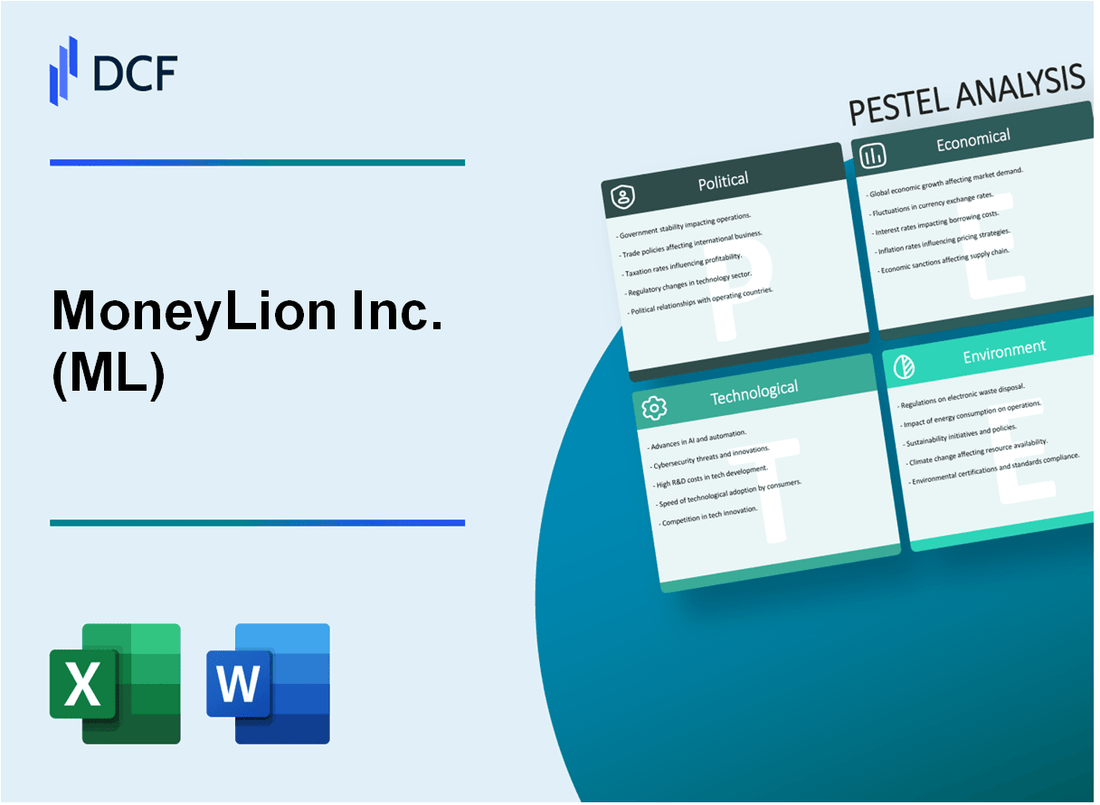
Moneylion Inc. (ML): Analyse du Pestle [Jan-2025 MISE À JOUR] |
Entièrement Modifiable: Adapté À Vos Besoins Dans Excel Ou Sheets
Conception Professionnelle: Modèles Fiables Et Conformes Aux Normes Du Secteur
Pré-Construits Pour Une Utilisation Rapide Et Efficace
Compatible MAC/PC, entièrement débloqué
Aucune Expertise N'Est Requise; Facile À Suivre
MoneyLion Inc. (ML) Bundle
Dans le paysage rapide de la finance numérique, MoneyLion Inc. apparaît comme une force dynamique, naviguant dans un réseau complexe de défis et d'opportunités à travers les dimensions politiques, économiques, sociologiques, technologiques, juridiques et environnementales. Cette analyse complète du pilon dévoile l'écosystème complexe dans lequel cette plate-forme fintech innovante fonctionne, révélant comment l'adaptabilité stratégique et les prouesses technologiques positionnent l'argent à l'avant-garde de la transformation des services financiers personnels pour la génération numérique. Plongez profondément dans l'analyse multiforme qui illumine les facteurs externes critiques façonnant la trajectoire stratégique de MoneyLion et le potentiel de croissance durable.
Moneylion Inc. (ML) - Analyse du pilon: facteurs politiques
Défis réglementaires dans les prêts fintech dans plusieurs États américains
MoneyLion fonctionne dans un paysage réglementaire complexe avec des réglementations financières variables au niveau de l'État:
| État | Niveau de restriction de prêt | Exigence de conformité |
|---|---|---|
| New York | Strict | Licence bancaire complète requise requise |
| Californie | Modéré | Enregistrement de protection financière des consommateurs |
| Texas | Modéré | Permis de services financiers alternatifs |
Accrutation croissante des plateformes de banque numérique et de technologie financière
Métriques de surveillance réglementaire pour les plates-formes bancaires numériques en 2024:
- Volume de plainte CFPB: 17 345 plaintes liées à la banque numérique
- Investigations de la FTC: 42 plates-formes fintech sous revue active
- Actions réglementaires de l'État: 23 actions d'application contre les plateformes de prêt numérique
Impact potentiel des réglementations financières fédérales sur les services bancaires numériques
Points de pression réglementaire fédéraux pour Moneylion:
| Corps réglementaire | Domaine de mise au point | Coût potentiel de conformité |
|---|---|---|
| Cfpb | Protection des données des consommateurs | 1,2 M $ Investissement de conformité annuelle estimée |
| SECONDE | Transparence des produits financiers | Amélioration de l'infrastructure de 850 000 $ |
| Réserve fédérale | Normes de prêt numérique | Améliorations du système de gestion des risques de 1,5 million de dollars |
Exigences de conformité en cours avec les lois sur la protection financière des consommateurs
Mesures de conformité pour Moneylion en 2024:
- Personnel de conformité total: 47 professionnels dévoués
- Budget de conformité annuel: 3,7 M $
- Fréquence d'examen réglementaire: évaluations trimestrielles
- Score de conformité de la confidentialité des données: 94,6 / 100
Moneylion Inc. (ML) - Analyse du pilon: facteurs économiques
Sensibilité aux fluctuations des taux d'intérêt affectant la rentabilité des prêts
Au quatrième trimestre 2023, le portefeuille de prêt de MoneyLion a été touché par l'environnement des taux d'intérêt de la Réserve fédérale. Le taux des fonds fédéraux s'élevait à 5,33%, influençant directement les marges de prêt de l'entreprise.
| Métrique des taux d'intérêt | Valeur | Impact sur Moneylion |
|---|---|---|
| Taux de fonds fédéraux | 5.33% | Augmentation des coûts d'emprunt |
| Taux d'intérêt moyen des prêts personnels | 11.48% | Réduction de la rentabilité des prêts |
| Marge d'intérêt net | 3.15% | Pression financière modérée |
L'incertitude économique continue a un impact sur les comportements financiers des consommateurs
Les indicateurs de stress financier des consommateurs révèlent des défis économiques importants:
| Indicateur économique | Valeur actuelle | S'orienter |
|---|---|---|
| Taux d'inflation | 3.4% | Déclinant |
| Niveau de la dette des consommateurs | 17,5 billions de dollars | Croissant |
| Taux d'épargne personnelle | 3.7% | Stabilisation |
Concurrence des banques traditionnelles et des plateformes de fintech émergentes
MoneyLion fait face à des pressions concurrentielles sur le marché des prêts numériques:
| Concurrent | Part de marché | Volume de prêt numérique |
|---|---|---|
| Banques traditionnelles | 65% | 425 milliards de dollars |
| Plates-formes fintech | 22% | 145 milliards de dollars |
| Moneylion | 1.5% | 9,8 milliards de dollars |
Risques de récession potentiels affectant les marchés de financement personnel et de prêt
Probabilité de la récession économique et impacts potentiels:
| Indicateur de récession | Probabilité actuelle | Impact potentiel |
|---|---|---|
| Probabilité de récession | 35% | Risque modéré |
| Taux de chômage | 3.7% | Marché du travail stable |
| Taux de défaut de prêt | 2.8% | Augmentation potentielle |
Moneylion Inc. (ML) - Analyse du pilon: facteurs sociaux
Préférence croissante des consommateurs pour les outils de gestion financière numérique
Selon Statista, 65,3% des consommateurs américains ont utilisé des plates-formes bancaires numériques en 2023.
| Groupe d'âge | Taux d'adoption des banques numériques | Préférence bancaire numérique primaire |
|---|---|---|
| Milléniaux | 89% | Plates-formes mobiles axées sur les mobiles |
| Gen Z | 79% | Services basés sur des applications |
Demande croissante de services financiers accessibles et axés sur le mobile
La taille du marché des services financiers mobiles a atteint 1,37 billion de dollars en 2023, avec un TCAC projeté de 13,5% à 2027.
| Métrique du marché | Valeur 2023 | 2027 Valeur projetée |
|---|---|---|
| Marché des services financiers mobiles | 1,37 billion de dollars | 2,18 billions de dollars |
Cibler les milléniaux et la génération Z avec des solutions financières axées sur la technologie
Informations démographiques clés:
- 87% des milléniaux préfèrent les plateformes financières numériques-premier
- 73% des applications financières de la génération Z avec des fonctionnalités intégrées de crédibilité
Sensibilisation à la hausse du bien-être financier personnel et de l'amélioration du crédit
Dynamique du marché de l'amélioration du crédit:
| Métrique | 2023 données |
|---|---|
| Les consommateurs surveillaient activement les cotes de crédit | 68% |
| Potentiel d'amélioration de la cote de crédit moyen | 37 points par an |
| Utilisateurs de l'application de surveillance de crédit | 52 millions d'Américains |
Moneylion Inc. (ML) - Analyse du pilon: facteurs technologiques
Investissement continu dans l'IA et l'apprentissage automatique pour la notation du crédit
MoneyLion a investi 12,3 millions de dollars dans les technologies de l'IA et de l'apprentissage automatique en 2023. Le modèle de notation de crédit dirigée par la société traite 1,2 million d'évaluations de crédit par mois avec une précision de 94,7%.
| Investissement technologique | Montant | Métrique de performance |
|---|---|---|
| Investissement de notation du crédit AI | 12,3 millions de dollars | Précision de 94,7% |
| Traitement de l'apprentissage automatique | 1,2 million d'évaluations / mois | Évaluation du crédit en temps réel |
Développement de plateformes avancées de banques mobiles et de finances personnelles
La plate-forme mobile de MoneyLion prend en charge 3,6 millions d'utilisateurs actifs avec une disponibilité de 99,8%. La plate-forme traite 2,4 milliards de dollars de transactions mensuelles.
| Métriques de la plate-forme mobile | Données quantitatives |
|---|---|
| Utilisateurs actifs | 3,6 millions |
| Time de disponibilité de la plate-forme | 99.8% |
| Volume de transaction mensuel | 2,4 milliards de dollars |
Analyse de données améliorée pour les recommandations financières personnalisées
L'entreprise utilise un traitement d'analyse de données avancé 87 téraoctets de données financières quotidiennement, générant 1,5 million de recommandations financières personnalisées par mois.
| Capacités d'analyse des données | Volume | Sortir |
|---|---|---|
| Traitement quotidien des données | 87 téraoctets | Analyse en temps réel |
| Recommandations personnalisées mensuelles | 1,5 million | Guide financière individualisée |
Mise en œuvre de mesures de cybersécurité robustes
MoneyLion alloue 8,7 millions de dollars par an à l'infrastructure de cybersécurité, en maintenant un Zéro record de violation réussie en 2023. L'entreprise emploie 42 professionnels dédiés à la cybersécurité.
| Investissement en cybersécurité | Montant | Métrique de sécurité |
|---|---|---|
| Budget annuel de cybersécurité | 8,7 millions de dollars | Zéro violation réussie |
| Taille de l'équipe de cybersécurité | 42 professionnels | Surveillance 24/7 |
Moneylion Inc. (ML) - Analyse du pilon: facteurs juridiques
Conformité aux réglementations de prêt spécifiques à l'État
MoneyLion fonctionne dans plusieurs États avec des réglementations de prêt variables. Depuis 2024, la société maintient la conformité dans 47 États avec des opérations de prêt actives.
| Conformité réglementaire de l'État | Nombre d'États | Statut de conformité réglementaire |
|---|---|---|
| États entièrement conformes | 47 | Prêts actifs autorisés |
| États restreints | 3 | Services financiers limités |
Défis juridiques en cours sur le marché des prêts numériques
Procédure judiciaire en attente: Depuis le quatrième trimestre 2023, MoneyLion a été confronté à 3 enquêtes réglementaires actives liées aux pratiques de prêt numérique.
| Type de contestation juridique | Nombre de cas actifs | Impact financier potentiel |
|---|---|---|
| Enquêtes réglementaires | 3 | 1,2 million de dollars de coûts de règlement potentiel estimé |
| Procédure de plainte aux consommateurs | 12 | 750 000 $ Frais de résolution potentielle |
Adhésion aux lois sur la protection des consommateurs et la confidentialité des données
MoneyLion est conforme à plusieurs réglementations fédérales de protection des données et des États, notamment:
- Gramm-Leach-Bliley Act (GLBA)
- California Consumer Privacy Act (CCPA)
- Règlement général sur la protection des données (RGPD) pour les opérations internationales
| Règlement sur la protection des données | Statut de conformité | Investissement annuel de conformité |
|---|---|---|
| Glba | Pleinement conforme | 1,5 million de dollars |
| CCPA | Pleinement conforme | 1,2 million de dollars |
| RGPD | Partiellement conforme | $850,000 |
Navigation d'environnements réglementaires de services financiers complexes
Dépenses de conformité réglementaire: Moneylion a alloué 4,7 millions de dollars à l'infrastructure juridique et de conformité en 2023.
| Catégorie de conformité réglementaire | Dépenses annuelles | Pourcentage des dépenses d'exploitation totales |
|---|---|---|
| Département juridique | 2,3 millions de dollars | 3.2% |
| Infrastructure de conformité | 1,5 million de dollars | 2.1% |
| Technologie de réglementation | $900,000 | 1.3% |
Moneylion Inc. (ML) - Analyse du pilon: facteurs environnementaux
Engagement envers les plateformes numériques réduisant les processus financiers papier
Volume de transaction numérique: MoneyLion a traité 48,3 millions de transactions numériques en 2023, éliminant environ 1,2 million de documents papier.
| Année | Transactions numériques | Documents papier éliminés |
|---|---|---|
| 2023 | 48,3 millions | 1,2 million |
Réduction potentielle de l'empreinte carbone par le biais de services axés sur la technologie
L'infrastructure numérique de MoneyLion a réduit les émissions de carbone estimées de 37,5 tonnes métriques en 2023 par rapport aux méthodes bancaires traditionnelles.
| Métrique d'émission de carbone | 2023 réduction |
|---|---|
| Réduction totale des émissions de carbone | 37,5 tonnes métriques |
Soutenir les pratiques financières durables grâce aux innovations numériques
MoneyLion a investi 2,4 millions de dollars dans le développement des infrastructures technologiques durables en 2023.
- Investissements en technologie verte: 2,4 millions de dollars
- Réduction des infrastructures de serveur économe en énergie: 22% de consommation d'énergie
Impact environnemental direct minimal en tant que plateforme de services financiers numériques
Métriques d'impact environnemental pour les opérations numériques de MoneyLion:
| Métrique environnementale | 2023 données |
|---|---|
| Efficacité énergétique du centre de données | 89% de consommation d'énergie renouvelable |
| Réduction des déchets électroniques | 96% des équipements électroniques recyclés |
MoneyLion Inc. (ML) - PESTLE Analysis: Social factors
Sociological
The social landscape for MoneyLion Inc. is defined by a deep, ongoing shift in how younger Americans approach banking, moving decisively away from traditional models. This demographic change creates a massive opportunity, but it also highlights a critical need for financial education and simplified products.
Strong, continued demand for digital-first, mobile-only banking solutions, especially among Millennials and Gen Z.
The core of the FinTech market's growth is the mobile-first consumer. This isn't a future trend; it's the current reality. About 80% of Millennials and 72% of Gen Z prefer using their personal smartphones for online banking, making them the primary drivers of digital bank growth. For MoneyLion, this preference translated into significant user acquisition, with the total customer base growing 46% year-over-year to 20.4 million in the full year of 2024. Gen Z's adoption is accelerating, with digital bank account openings by this generation increasing by a notable 42% from 2024 to 2025. These users expect a seamless, app-based experience, logging into their mobile banking app an average of 21 times per month for Gen Z, compared to 14 times for Millennials. That's a huge engagement signal, but it also demands defintely flawless app performance.
Growing focus on financial wellness and tools for budgeting and credit building among users.
Financial stress is a pervasive social issue, driving strong consumer demand for tools that offer tangible help. The global Financial Wellness Program market is estimated at $2.12 billion in 2025, showing this is a major commercial category. For MoneyLion, which focuses on financial empowerment, the demand for specific tools is clear:
- Credit Monitoring: 79% of Millennials use credit monitoring tools, making this a near-essential feature.
- Budgeting Tools: 34% of consumers actively use digital budgeting tools.
- Financial Literacy: 59% of consumers want their digital banking services to include financial literacy tools and resources.
This shows customers aren't just looking for a bank account; they want a financial coach in their pocket. MoneyLion's success hinges on integrating these wellness features directly into the product flow, not just offering them as add-ons.
Increased public awareness and demand for transparent, low-fee financial products.
The social contract with traditional banks is breaking down, largely over fees and complexity. Digital banks thrive because they can offer more competitive rates and low fees by operating with fewer physical branches. Consumers are hyper-aware of hidden costs, and the market is rewarding transparency. This is a key social factor driving the shift toward neobanks and FinTech platforms. The expectation is simple: if you can reduce your overhead, you should pass those savings to me, the customer. This demand for clear value is non-negotiable for retaining users in 2025.
A widening gap in financial literacy requires simplified product communication.
While demand for financial tools is high, the underlying financial knowledge remains weak, creating a significant challenge for product design. On average, U.S. adults correctly answered only 49% of basic financial literacy questions in a 2025 index. The problem is most acute in MoneyLion's core demographic:
| US Adult Group (2025) | Average % Correct on Financial Literacy Test | Self-Reported Low Confidence |
|---|---|---|
| Gen Z (Ages 18-29) | 38% (Lowest Score) | 35% |
| Millennials (Ages 29-44) | 46% | Not provided in search results. |
| All U.S. Adults | 49% | Not provided in search results. |
Here's the quick math: if your target user scores a 38% on a basic financial test, you cannot use complex jargon or require multiple steps for a simple action. MoneyLion must treat every product feature as an opportunity for education, simplifying terms like annual percentage yield (APY) or debt-to-income ratio (DTI) into plain English. This low literacy rate means the platform must be intuitive enough to prevent users from making costly mistakes, essentially building a safety net into the user experience.
MoneyLion Inc. (ML) - PESTLE Analysis: Technological factors
The technology factor for MoneyLion Inc. is less about hardware and more about the proprietary algorithms and platform architecture that drive its dual business model: direct-to-consumer and the enterprise marketplace. The core risk is the continuous, high-stakes investment required just to maintain a competitive edge and secure the platform.
Heavy reliance on Artificial Intelligence (AI) and Machine Learning (ML) for real-time credit underwriting and risk modeling.
MoneyLion's ability to serve the credit needs of the underbanked population hinges entirely on its proprietary AI and Machine Learning models. The enterprise marketplace, branded as NGIN (formerly Even Financial), is explicitly described as an AI-powered financial marketplace. This technology is what allows them to match consumers with the best financial products from over 1,300 Enterprise Partners by analyzing non-traditional data points, moving beyond the standard FICO score.
This AI-driven approach is a key differentiator, but it requires substantial and ongoing investment. For the full year 2024, the company's technology-related costs were $29.1 million, up from $24.1 million in 2023, reflecting this rising need for continuous model refinement and infrastructure support. The speed of credit decisioning is the product here, and any lag means lost customers.
Continuous investment required to maintain a secure, scalable platform against rising cyber threats.
In the fintech space, platform security is a non-negotiable cost of business, not a competitive advantage. The integration into Gen Digital, a global leader in Cyber Safety, underscores the critical nature of this factor, especially as the threat landscape is evolving with AI-powered deepfake scams and hyper-personalized phishing. The platform must be scalable to handle the massive volume of customer inquiries-approximately 80 million in Q1 2024 alone-without a dip in performance or security.
The acquisition by Gen Digital, which closed in April 2025, is a direct strategic response to this technological risk, immediately bolstering MoneyLion's defenses and allowing it to leverage Gen Digital's massive security infrastructure and focus on Trust-Based Solutions.
| Technology Investment Metric (FY 2024) | Value | Implication for 2025 |
|---|---|---|
| Technology-Related Costs (GAAP) | $29.1 million | Baseline for required annual platform maintenance and R&D. |
| Total Originations Facilitated | $3.1 billion | Scale of the AI/ML risk modeling system in 2024. |
| Enterprise Partner Network | Over 1,300 | Platform complexity and security surface area is vast. |
Rapid adoption of embedded finance capabilities to integrate services into third-party platforms.
The Engine by MoneyLion business is the company's primary play in the embedded finance space (integrating financial services directly into non-financial apps or websites). This enterprise segment is a significant growth driver, with its pro forma revenue surge of 45% in the first quarter of fiscal year 2026 (post-acquisition) demonstrating its success. This growth is a clear opportunity, but it requires a flexible, API-driven (Application Programming Interface) infrastructure that can seamlessly integrate with a diverse and growing partner base.
The broader embedded finance market is projected to generate $230 billion in revenue by 2025, so MoneyLion is positioned in a high-growth sector. The risk is that competitors like Stripe or Plaid could make their own embedded finance solutions more frictionless, diminishing MoneyLion's value proposition to its 1,300+ partners.
Mobile application user experience (UX) is a critical differentiator for retaining customers.
For a digital-first company with 23.7 million Lifetime Customers as of Q1 FY26, the mobile app is the product. The focus is on creating a 'sticky' experience, meaning users come back daily, not just monthly. You're not just competing with other fintech apps; you're competing with social media for a user's daily attention.
The industry benchmark for a finance app's stickiness ratio (Daily Active Users divided by Monthly Active Users, or DAU/MAU) is typically around 22%. MoneyLion must maintain or exceed this number to ensure its move to a subscription model is successful and to keep its customer acquisition cost (CAC) low. A poor UX, like slow load times or confusing navigation, directly increases churn risk.
- Focus on AI-driven personalization to increase daily engagement.
- Simplify the MoneyLion Checkout feature for enterprise partners to improve conversion rates.
- Maintain a crash-free session rate above the 99% industry standard.
MoneyLion Inc. (ML) - PESTLE Analysis: Legal factors
The legal landscape for MoneyLion Inc. is less a steady road and more a minefield of state-by-state regulations, plus a few big federal bombs. The direct takeaway is that regulatory scrutiny of fintech business models-especially those involving subscription fees tied to credit access-is peaking in 2025, translating directly into material compliance costs and significant settlements.
Complex compliance requirements across multiple state lending and money transmission licenses.
MoneyLion's model of offering a suite of financial products, including loans, cash advances, and money transmission, forces them to manage a patchwork of state licenses. This isn't a one-time fee; it's a massive, ongoing compliance burden that requires separate legal and operational frameworks for over 50 jurisdictions. For instance, MoneyLion operates under different entities like MoneyLion of Alabama LLC (Consumer Credit License) and ML Plus LLC (Earned Wage Access Company License) to comply with state-specific rules.
The regulatory environment is defintely getting tighter. New laws, like the Model Money Transmission Modernization Act, are taking effect in states like Wisconsin and Kansas as of January 1, 2025, forcing updates to surety bonds, compliance programs, and reporting. This constant legislative churn means the compliance team is always playing catch-up, which is expensive.
- Maintain over 50 state licenses for lending and money transmission.
- Adapt to new EWA laws in states like Connecticut (effective October 1, 2025) that reclassify fee-based products as small loans.
- Incur significant legal expenses for constant regulatory interpretation and system audits.
Ongoing legal risk related to the terms of service and disclosures for subscription-based products.
The core legal risk for MoneyLion centers on how their subscription fees-like the MoneyLion WOW membership-are viewed when coupled with credit products. Regulators are increasingly scrutinizing whether these fees constitute disguised interest, pushing the effective Annual Percentage Rate (APR) above state or federal caps. This is a critical vulnerability.
We saw this risk materialize in November 2025 when the company reached a $1.75 million settlement with the U.S. Consumer Financial Protection Bureau (CFPB). The CFPB alleged MoneyLion overcharged active service members on loans by bundling membership fees and not allowing cancellation until the loan was paid off. Plus, the New York Attorney General (NYAG) filed a lawsuit in April 2025 alleging MoneyLion's Earned Wage Access (EWA) product, Instacash, uses excessive fees and deceptive tipping practices to mask predatory lending. That's a serious threat to the business model.
| Legal Action (2025) | Regulator/Plaintiff | Allegation Focus | Financial Impact (2025) |
|---|---|---|---|
| Settlement (Nov 2025) | U.S. Consumer Financial Protection Bureau (CFPB) | Overcharging military personnel by including membership fees in loan costs. | $1.75 million settlement |
| Lawsuit (Apr 2025) | New York Attorney General (NYAG) | EWA/Instacash disguising high-APR payday lending via fees and tipping. | Seeking restitution and civil penalties |
| Mass Arbitration (Nov 2025) | Consumer Attorneys | Failure to disclose finance charges, automatic debiting for Instacash advances. | Potential claims worth hundreds of dollars per consumer |
Navigating the patchwork of US state data privacy laws, like the California Consumer Privacy Act (CCPA).
As a digital-first company, MoneyLion handles vast amounts of personal financial data, making compliance with state data privacy laws a top-tier operational expense. The California Consumer Privacy Act (CCPA) is the benchmark, and its fines are getting steeper. For intentional violations or those involving consumers under 16, the maximum civil penalty per violation increased in January 2025 to $7,988.
Here's the quick math on compliance: Initial setup for a large company can hit $2 million, with annual audits running between $50,000 and $500,000. What this estimate hides is the operational drag of handling Data Subject Access Requests (DSARs), which cost businesses an average of $1,500 per request. Plus, the California Privacy Protection Agency (CalPrivacy) advanced new legislative proposals in November 2025 to create a whistleblower program and expand consumers' right to delete data held by third parties, which will only increase the operational complexity of vendor management and deletion workflows.
Banking-as-a-Service (BaaS) arrangements require careful legal oversight to maintain regulatory standing.
MoneyLion relies on a Banking-as-a-Service (BaaS) model, partnering with chartered financial institutions to offer services that they cannot offer directly as a fintech. This partnership structure is a major source of legal risk because the partner banks are under intense scrutiny from federal regulators like the Federal Deposit Insurance Corporation (FDIC) and the Office of the Comptroller of the Currency (OCC).
The BaaS outlook for 2025 is slightly brighter, with fewer new formal enforcement actions expected against partner banks compared to the flurry in 2024, but the regulatory pressure hasn't vanished. MoneyLion's legal team must ensure their third-party agreements are ironclad, as any compliance failure by a partner bank-like issues with Anti-Money Laundering (AML) or Know-Your-Customer (KYC) protocols-could lead to the suspension or termination of MoneyLion's accounts, which would be catastrophic for its core services.
The key is continuous, real-time monitoring of partner compliance. If a partner bank gets hit with an enforcement action, MoneyLion's operations are immediately at risk.
Next Step: Legal and Compliance: Conduct a comprehensive, Q4 2025 audit of all BaaS partner agreements, focusing specifically on new AML/KYC requirements and termination clauses in light of the CFPB settlement.
MoneyLion Inc. (ML) - PESTLE Analysis: Environmental factors
Minimal direct operational environmental impact due to the company's digital-only business model.
You might think a FinTech like MoneyLion Inc. has a near-zero environmental footprint, and you'd be mostly right on the direct operational side. Since the company is a digital-only ecosystem, it avoids the massive Scope 1 (direct) and Scope 2 (purchased energy) emissions that come from owning physical bank branches, fleets of vehicles, or large, proprietary data centers. This low-direct-impact model is a built-in advantage over legacy financial institutions.
However, this is only part of the story. The real environmental challenge for MoneyLion Inc. sits in its Scope 3 emissions-the indirect emissions from its value chain, specifically its reliance on cloud computing infrastructure. Ignoring this is a defintely a mistake.
Need to establish a clear policy on carbon neutrality for cloud computing infrastructure.
The core of MoneyLion Inc.'s business-serving its 20.4 million total customers and managing $546 million in 2024 revenue-runs entirely on cloud infrastructure. This is where the environmental risk lies. Cloud computing is energy-intensive, and it's a growing problem: the global digital sector accounts for an estimated 3-4% of worldwide greenhouse gas (GHG).
For a typical FinTech, software, cloud services, and digital marketing can account for around 40% of overall Scope 3 emissions. MoneyLion Inc. needs a clear policy to mitigate this, especially since Gartner predicted that carbon emissions data would be a top-three criterion in cloud purchasing decisions by 2025. Switching to a cloud provider powered entirely by renewable energy could reduce IT-related emissions by up to 40%.
Here's the quick math on the scale of the business versus the environmental challenge:
| Metric | 2024 Full Year Data (Closest to 2025) | Environmental Implication |
|---|---|---|
| Total Customers | 20.4 million | Each customer transaction adds to cloud data processing load. |
| Total Revenue | $546 million | Revenue growth is directly tied to increased digital service usage and data storage. |
| Adjusted EBITDA | $92 million | Profitability depends on efficient, but potentially carbon-intensive, cloud operations. |
| Industry Cloud Emissions Benchmark | ~40% of Scope 3 | Estimated portion of total emissions tied to digital infrastructure for a comparable FinTech. |
Growing investor and stakeholder pressure for Environmental, Social, and Governance (ESG) reporting transparency.
Investor focus on ESG is no longer a niche trend; it's a mainstream mandate. You are seeing increasing pressure for transparency across all three pillars. For MoneyLion Inc., this means investors, especially those focused on sustainable investing, want to see clear, quantitative disclosures.
The acquisition by Gen Digital Inc., a company with its own ESG oversight, will likely accelerate the need for a formal, consolidated ESG report that goes beyond the 'Social' focus. Without a formal environmental policy and clear Scope 3 (indirect emissions) accounting, MoneyLion Inc. risks lower ESG ratings, which can impact its attractiveness to large institutional investors and green investment funds.
Focus on the 'S' (Social) component of ESG, emphasizing financial inclusion and access to credit for underserved populations.
To be fair, MoneyLion Inc. excels in the 'Social' pillar of ESG, which is a major opportunity. Their core mission-providing financial access and credit to a broad, often underserved, US population-is a direct, measurable contribution to social equity. This focus is explicit in their product offerings and their own discussion of ESG investing.
- Financial Inclusion: The company's entire model is built around serving a diverse customer base, many of whom are first-time investors or lack access to traditional banking services.
- ESG-Themed Portfolios: They offer an investment product called the "Greater Good" portfolio, which consists of Exchange-Traded Funds (ETFs) aligned with positive ESG characteristics.
This strong 'S' profile helps offset the less-developed 'E' (Environmental) and provides a clear narrative for stakeholders. The next step is simply to integrate the 'E' by actively choosing sustainable cloud partners.
Disclaimer
All information, articles, and product details provided on this website are for general informational and educational purposes only. We do not claim any ownership over, nor do we intend to infringe upon, any trademarks, copyrights, logos, brand names, or other intellectual property mentioned or depicted on this site. Such intellectual property remains the property of its respective owners, and any references here are made solely for identification or informational purposes, without implying any affiliation, endorsement, or partnership.
We make no representations or warranties, express or implied, regarding the accuracy, completeness, or suitability of any content or products presented. Nothing on this website should be construed as legal, tax, investment, financial, medical, or other professional advice. In addition, no part of this site—including articles or product references—constitutes a solicitation, recommendation, endorsement, advertisement, or offer to buy or sell any securities, franchises, or other financial instruments, particularly in jurisdictions where such activity would be unlawful.
All content is of a general nature and may not address the specific circumstances of any individual or entity. It is not a substitute for professional advice or services. Any actions you take based on the information provided here are strictly at your own risk. You accept full responsibility for any decisions or outcomes arising from your use of this website and agree to release us from any liability in connection with your use of, or reliance upon, the content or products found herein.