

|
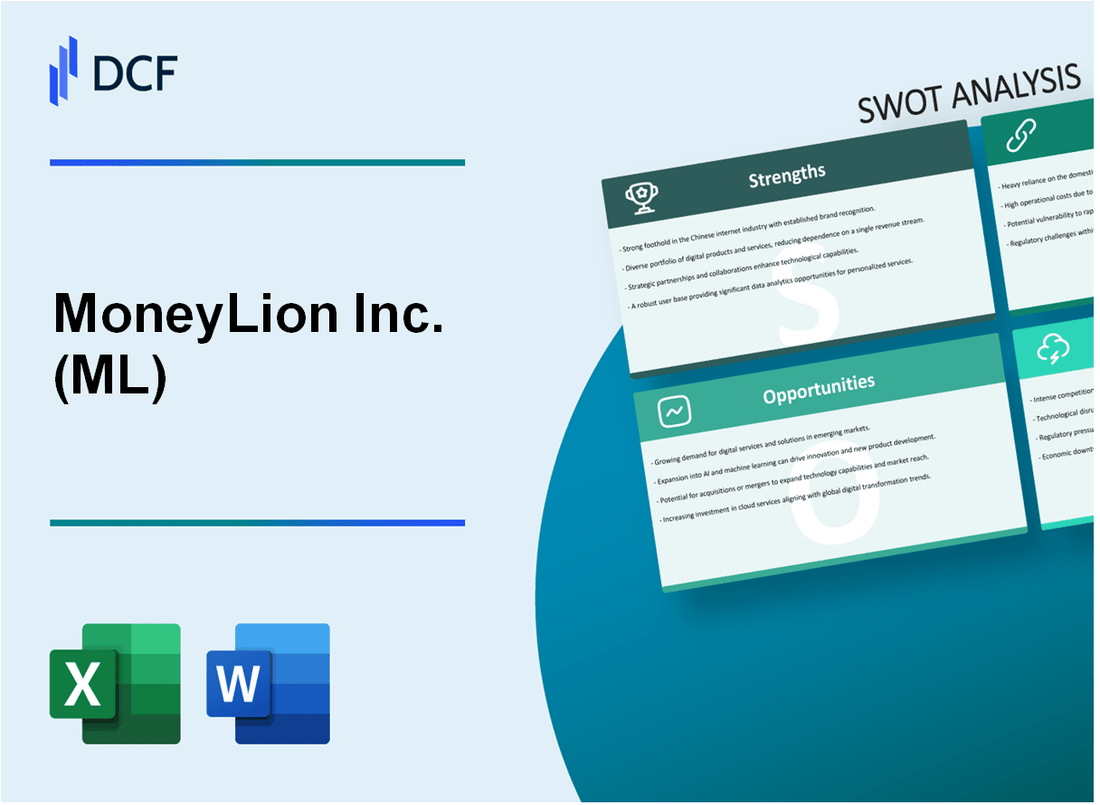
Moneylion Inc. (ML): Analyse SWOT [Jan-2025 MISE À JOUR] |
Entièrement Modifiable: Adapté À Vos Besoins Dans Excel Ou Sheets
Conception Professionnelle: Modèles Fiables Et Conformes Aux Normes Du Secteur
Pré-Construits Pour Une Utilisation Rapide Et Efficace
Compatible MAC/PC, entièrement débloqué
Aucune Expertise N'Est Requise; Facile À Suivre
MoneyLion Inc. (ML) Bundle
Dans le paysage bancaire numérique en évolution rapide, MoneyLion Inc. se dresse à un carrefour critique, mélangeant une technologie financière innovante avec une ambition stratégique. Cette analyse SWOT complète révèle le positionnement complexe de la société fintech, déballant son potentiel pour perturber les services bancaires traditionnels grâce à une approche axée sur la technologie milléniaux et Gen Z. En disséquant les forces, les faiblesses, les opportunités et les menaces de MoneyLion, nous fournissons un instantané perspicace de sa stratégie concurrentielle et de sa trajectoire potentielle dans l'écosystème des services financiers dynamiques de 2024.
Moneylion Inc. (ML) - Analyse SWOT: Forces
Plate-forme bancaire numérique complète
MoneyLion propose une plate-forme financière intégrée avec 6,5 millions de membres au troisième trimestre 2023. La plate-forme fournit plusieurs services financiers via une seule application mobile, générant 187,3 millions de dollars de revenus totaux en 2022.
| Services de plateforme | Pénétration de l'utilisateur |
|---|---|
| Bancaire | 82% des utilisateurs de la plate-forme |
| Investissement | 45% des utilisateurs de la plate-forme |
| Renforcement de crédit | 38% des utilisateurs de la plate-forme |
Solutions de financement personnel axées sur la technologie
Moneylion exploite les informations alimentées par Ai avec Technologie algorithmique propriétaire Cela traite plus de 10 000 points de données financières par utilisateur pour des recommandations personnalisées.
Modèle d'adhésion flexible
La société propose des produits financiers à faible coût avec des niveaux d'adhésion:
- Adhésion de base: 0 $ / mois
- Plus l'adhésion: 19,99 $ / mois
- Les avantages de l'adhésion comprennent des cashback, une surveillance du crédit et des outils d'investissement
Stratégie d'acquisition de clients
Ciblant les milléniaux et la génération Z avec 70% des utilisateurs de moins de 40 ans. A acquis 1,5 million de nouveaux membres en 2022 avec un coût d'acquisition de client de 45 $ par utilisateur.
| DÉMOGRATIONS DE L'AGAGE | Pourcentage |
|---|---|
| 18-29 ans | 42% |
| 30-39 ans | 28% |
| 40-49 ans | 18% |
Capacités financières intégrées
La plate-forme fournit une intégration transparente de:
- Prêts personnels jusqu'à 50 000 $
- Comptes de chèques et d'épargne
- Options d'investissement de crypto et de stock
- Produits de crédits
Moneylion Inc. (ML) - Analyse SWOT: faiblesses
Pertes financières et défis cohérents pour atteindre la rentabilité
MoneyLion a déclaré une perte nette de 48,4 millions de dollars pour le troisième trimestre de 2023, les pertes nettes cumulatives continuant de contester la stabilité financière de l'entreprise. La performance financière de l'entreprise démontre des défis de rentabilité continus.
| Métrique financière | Performance du premier trimestre 2023 |
|---|---|
| Perte nette | 48,4 millions de dollars |
| Revenu | 86,3 millions de dollars |
| Dépenses d'exploitation | 134,7 millions de dollars |
Coûts d'acquisition des clients élevés sur le marché finch concurrentiel
Les coûts d'acquisition des clients de MoneyLion restent considérablement élevés dans le paysage concurrentiel fintech.
- Coût d'acquisition moyenne du client: 175 $ - 225 $ par nouveau client
- Taux de rétention de la clientèle: environ 62%
- Frais de marketing et de vente: 28% du total des dépenses d'exploitation
Présence géographique limitée
MoneyLion fonctionne principalement aux États-Unis, avec une expansion internationale limitée.
| Couverture géographique | Détails |
|---|---|
| États actifs | 47 États américains |
| Présence internationale | Aucun |
Base d'actifs relativement petite
Par rapport aux institutions bancaires traditionnelles, MoneyLion maintient un base d'actifs relativement petite.
| Comparaison des actifs | Montant |
|---|---|
| Total des actifs (T1 2023) | 502,6 millions de dollars |
| Comparaison avec les 10 meilleures banques | Moins de 0,1% des actifs |
Infrastructure technologique et vulnérabilités de cybersécurité
L'approche numérique de MoneyLion crée des risques de technologie et de sécurité potentiels.
- Investissement annuel de cybersécurité: 4,2 millions de dollars
- Incidents de sécurité signalés en 2023: 3 violations mineures
- Coûts de maintenance des infrastructures technologiques: 12,6 millions de dollars par an
Moneylion Inc. (ML) - Analyse SWOT: Opportunités
Marché des banques numériques en expansion
Le marché bancaire numérique devrait atteindre 12,4 billions de dollars d'ici 2030, avec un TCAC de 13,7%. MoneyLion est positionné pour capitaliser sur cette croissance, les utilisateurs de la banque mobile devraient atteindre 2,5 milliards à l'échelle mondiale d'ici 2025.
| Métriques du marché bancaire numérique | 2024 projection |
|---|---|
| Taille du marché mondial | 8,6 billions de dollars |
| Utilisateurs de la banque mobile | 2,3 milliards |
| Taux de croissance annuel | 13.7% |
Expansion du marché international
Les marchés internationaux potentiels de MoneyLion comprennent:
- Canada: Marché fintech d'une valeur de 13,1 milliards de dollars
- Royaume-Uni: le secteur bancaire numérique d'une valeur de 23,4 milliards de dollars
- Australie: le marché fintech augmente à 14,2% par an
Marché de prêts alternatifs
Le marché des prêts alternatifs devrait atteindre 561,4 milliards de dollars d'ici 2027, avec un TCAC de 17,5%. Les solutions financières personnalisées de MoneyLion correspondent aux demandes des consommateurs.
| Segment de prêt alternatif | Valeur 2024 |
|---|---|
| Marché des prêts personnels | 191,2 milliards de dollars |
| Prêts aux petites entreprises | 132,6 milliards de dollars |
| Prêts entre pairs | 67,9 milliards de dollars |
IA et apprentissage automatique dans les finch
L'IA sur le marché des services financiers devrait atteindre 130,8 milliards de dollars d'ici 2028, avec un TCAC de 24,3%.
Opportunités de partenariat stratégique
Le paysage de partenariat potentiel comprend:
- Banques traditionnelles: 68% à la recherche de collaborations fintech
- Compagnies d'assurance: 22,4 milliards de dollars d'investissement de transformation numérique
- Unions de crédit: 55% d'exploration des partenariats technologiques
| Potentiel de partenariat | Indicateur de marché |
|---|---|
| Collaboration du secteur bancaire | 68% ouverts aux partenariats fintech |
| Investissement d'intégration technologique | 45,6 milliards de dollars par an |
| Budget de transformation numérique | 12 à 15% des dépenses |
MoneyLion Inc. (ML) - Analyse SWOT: menaces
Concurrence intense des banques établies et des startups émergentes fintech
MoneyLion fait face à une pression concurrentielle importante de plusieurs prestataires de services financiers:
| Concurrent | Évaluation du marché | Utilisateurs de la banque numérique |
|---|---|---|
| Carillon | 14,5 milliards de dollars | 13,1 millions |
| Sovi | 4,5 milliards de dollars | 4,3 millions |
| Robin | 11,7 milliards de dollars | 22,7 millions |
Environnement réglementaire rigoureux pour les services financiers numériques
Les défis réglementaires comprennent:
- Frais de conformité estimés à 100 millions de dollars par an
- Des amendes potentielles jusqu'à 5% des revenus annuels
- Réglementations financières fédérales et étatiques complexes
Incertitudes économiques affectant les prêts aux consommateurs
Indicateurs économiques clés impactant Moneylion:
| Métrique économique | Valeur actuelle | Impact potentiel |
|---|---|---|
| Taux par défaut du consommateur | 3.1% | Risque élevé pour le portefeuille de prêt |
| Taux d'inflation | 3.4% | Réduction du pouvoir de dépenses de consommation |
| Taux d'intérêt | 5.33% | Augmentation des coûts d'emprunt |
Changements technologiques rapides
Exigences d'investissement technologique:
- Dépenses annuelles de R&D technologique: 45 millions de dollars
- Investissements en cybersécurité: 22 millions de dollars
- Développement de l'IA et de l'apprentissage automatique: 18 millions de dollars
Défis de confidentialité et de sécurité des données
Risques de cybersécurité et de protection des données:
| Catégorie de risque | Coût potentiel | Fréquence |
|---|---|---|
| Violation de données | 4,45 millions de dollars par incident | Augmenter chaque année |
| Pénalités de conformité | Jusqu'à 10 millions de dollars | Par violation |
| Impact de la confiance des clients | 37% de perte potentielle d'utilisateurs | Incident après la sécurité |
MoneyLion Inc. (ML) - SWOT Analysis: Opportunities
Leverage Gen Digital Inc.'s AI for hyper-personalized, trust-based financial solutions.
The acquisition by Gen Digital Inc. (GEN) in April 2025 is a game-changer, moving MoneyLion from a standalone fintech to a core component of a larger 'Trust-Based Solutions' ecosystem. This immediately gives you access to Gen Digital's advanced Artificial Intelligence (AI) and machine learning capabilities, which is the key to true hyper-personalization in finance.
Honestly, consumers are defintely more worried about digital trust than ever. Companies that prioritize trust-combining cybersecurity, data privacy, and ethical AI-are statistically 1.6 times more likely to achieve annual revenue growth of 10% or more. MoneyLion can now weave in Gen Digital's identity protection and scam prevention features to offer financial advice that feels safer and more tailored. This fusion of financial wellness and cyber safety is a powerful differentiator.
Here's the quick math on the user base: MoneyLion's 8.2 million financially active users are now part of Gen Digital's total paid customer base of over 76 million. That's a massive, pre-vetted pool for personalized product recommendations, all backed by a trusted security brand.
Expand embedded finance platform to over 1,200 Enterprise Partners.
Your embedded finance platform, Engine by MoneyLion, is positioned for significant expansion, leveraging Gen Digital's extensive enterprise relationships. The combined ecosystem's partner network has already expanded to 1,300 companies, exceeding the initial 1,200 target. This network is the distribution backbone for your lending, banking, and wealth management tools, embedding them directly into non-financial businesses.
The opportunity here is simple: you can now offer a seamless, one-stop-shop for partners who want to add financial services without the regulatory headache of becoming a bank. This embedded finance model is a major growth driver. What this estimate hides, however, is the quality of these partnerships-the focus must shift to maximizing the revenue per partner, not just the partner count.
The enterprise segment is a high-margin opportunity, especially as MoneyLion's business model has shifted, with 80% of its income now derived from subscription-based services.
Capture market share in the growing $250 billion cyber safety and financial wellness intersection.
The market you're targeting is the sweet spot where digital security and personal finance meet. This intersection is valued at approximately $250 billion. The sheer size of this combined market gives MoneyLion a vast runway for growth, far beyond what it had as a standalone fintech.
The financial services sector (BFSI) already holds the highest share of the overall cybersecurity market, accounting for 21.54% in 2025. This shows a clear, established demand for the integrated product you now offer. You're not just selling a loan or a budget tool; you're selling protected financial freedom. This is a crucial distinction that resonates with consumers worried about identity theft and data breaches.
The market size for the global cybersecurity segment alone is projected to be around $218.98 billion in 2025, growing at a Compound Annual Growth Rate (CAGR) of 14.40% through 2032. MoneyLion is now positioned to capture a piece of this high-growth security spending, which is a major opportunity outside of traditional fintech revenue streams.
Accelerate revenue growth via cross-selling to Gen Digital Inc.'s vast user base.
The most immediate financial opportunity is the bidirectional cross-selling between MoneyLion's financial products and Gen Digital's core cyber safety offerings like Norton and LifeLock. This strategy is already showing explosive results in the combined entity's financial reporting.
The 'Trust-Based Solutions' segment, which houses MoneyLion, saw its revenue contribution soar to $388 million in Q1 2026, representing a 100% year-over-year increase. This dramatic expansion validates the core thesis of the acquisition. For the full fiscal year 2025, MoneyLion's forecasted annual revenue was approximately $660 million, up significantly from the prior year.
The cross-selling synergy is also driving a higher growth rate for MoneyLion itself. MoneyLion's pro forma revenue grew 45% year-over-year in the first quarter post-acquisition, and the company is projected to sustain growth of over 30% for the full fiscal year 2026.
| Metric | 2025 Fiscal Year Data (Forecast/Pro Forma) | Strategic Impact |
|---|---|---|
| MoneyLion Annual Revenue (Forecast) | $660 million | Provides a strong baseline for cross-sell acceleration. |
| MoneyLion Annual EBITDA (Forecast) | $96 million | Indicates a path to profitability, supported by Gen Digital's operational discipline. |
| Trust-Based Solutions Q1 2026 Revenue Contribution (includes ML) | $388 million | Demonstrates immediate, massive revenue contribution post-acquisition. |
| Trust-Based Solutions Q1 2026 Revenue Growth (YoY) | 100% | Quantifies the explosive early success of the cross-selling model. |
| Total Ecosystem Partner Network | 1,300 companies | Confirms the expanded distribution channel for embedded finance. |
MoneyLion Inc. (ML) - SWOT Analysis: Threats
Intense competition from larger, well-funded FinTechs like SoFi and Upgrade.
You are in a fight for the mainstream consumer, and the biggest threat is not the legacy banks, but the hyper-scaling FinTech giants that have secured massive war chests and are growing faster. MoneyLion Inc. (ML) has a large customer base-20.4 million total customers at the end of fiscal year 2024-but its growth rate is being eclipsed by competitors who are hitting scale and profitability simultaneously.
For context, MoneyLion's revenue for the full year 2024 was $546 million, with 2025 revenues expected to climb by 21.3% year-over-year. That's solid, but a competitor like SoFi Technologies is projecting a full-year 2025 revenue growth of 30%, showing a clear acceleration in market share capture. They are simply building more product density per user, so their revenue per user is higher. The table below maps the competitive pressure in key areas as of 2025.
| Metric (as of 2025) | MoneyLion Inc. (ML) | SoFi Technologies | Upgrade Inc. |
|---|---|---|---|
| FY 2024 Revenue | $546 million | N/A (Projected 2025 Revenue Growth: 30%) | $680 million (2022 Data) |
| Total Customers/Members | 20.4 million (FY 2024) | Membership base expanded over 34% (Q2 2025) | Over 7 million (August 2025) |
| Key Product Focus | Financial Super App, Embedded Finance | Lending, Banking, Investing (Bank Charter) | Personal Loans, Credit Cards (Over $40 billion in credit) |
| Valuation/Funding (2025) | Acquired by Gen Digital | Publicly Traded | Valued at $7.3 billion (October 2025) |
This competition forces a higher customer acquisition cost (CAC) and puts constant downward pressure on pricing, which makes it defintely harder to maintain the 17% Adjusted EBITDA margin MoneyLion achieved in FY 2024.
Increased regulatory scrutiny on consumer lending and data practices.
The regulatory environment for FinTechs that serve the subprime or near-prime market, which is MoneyLion's core, is getting tighter. Regulators are focused on transparency, fee structures, and compliance with consumer protection laws. This isn't theoretical; it's a real-time risk.
The most immediate threat is the lawsuit filed by the Consumer Financial Protection Bureau (CFPB) against MoneyLion and its subsidiaries. This case alleges violations of the Military Lending Act (MLA) and the Consumer Financial Protection Act of 2010. The proposed resolution, filed on November 21, 2025, requires the company to pay $1.75 million in consumer redress. This isn't a massive fine, but it signals a clear regulatory focus on their lending and membership practices.
- The CFPB action focuses on charging military servicemembers annual percentage rates that exceeded the allowable MLA rate.
- New York State also filed a separate legal challenge against MoneyLion over alleged predatory lending, citing annual interest rates as high as 750%.
- These actions not only carry financial penalties but also create compliance overhead and significant reputational damage, especially when dealing with vulnerable consumer segments.
Integration risk leading to product dilution or customer churn post-merger.
The biggest structural change for MoneyLion is the acquisition by Gen Digital Inc., a cybersecurity-focused company. The deal, which was expected to close on April 17, 2025, provides a clear exit for shareholders, but it introduces massive integration risk.
MoneyLion's value proposition is a financial super app ecosystem, while Gen Digital's is digital security (Norton, Avast). Integrating a consumer finance platform into a cybersecurity parent could lead to a loss of focus or product dilution. Here's the quick math: the integration of two distinct business models is notoriously difficult, and customer churn often rises when a product's core identity shifts.
- The integration process itself can divert management's attention from core business operations and product development.
- There is a risk of adverse customer reactions, particularly if the perceived value of the financial products is diluted by a new, security-heavy brand identity.
- The merger's success hinges on whether Gen Digital can effectively cross-sell its security products to MoneyLion's 20.4 million customers without disrupting the existing financial ecosystem.
Rising threat of AI-powered financial scams impacting customer trust and brand reputation.
The same AI tools that FinTechs use for credit scoring and personalization are being weaponized by fraudsters, creating a significant and rapidly escalating threat to customer trust. This is a systemic risk for any digital-first financial platform like MoneyLion.
The scale of the problem is staggering: over 50% of fraud incidents now involve AI and deepfakes. For a consumer-facing app, this translates directly to higher losses and a damaged reputation if their security is compromised.
- Consumers reported over $12.5 billion in fraud in 2024, with a projected 25% increase heading into 2025.
- Up to 83% of phishing emails were AI-generated in 2025, making them nearly impossible for the average user to spot.
- The Deloitte Center for Financial Services predicts generative AI will be responsible for $40 billion in fraud losses by 2027.
Gen Digital's core business is cybersecurity, which is a defensive strength, but the sheer volume and sophistication of AI-powered synthetic identity fraud and deepfake scams mean that MoneyLion must continually invest heavily just to maintain the status quo and protect its customer base.
Disclaimer
All information, articles, and product details provided on this website are for general informational and educational purposes only. We do not claim any ownership over, nor do we intend to infringe upon, any trademarks, copyrights, logos, brand names, or other intellectual property mentioned or depicted on this site. Such intellectual property remains the property of its respective owners, and any references here are made solely for identification or informational purposes, without implying any affiliation, endorsement, or partnership.
We make no representations or warranties, express or implied, regarding the accuracy, completeness, or suitability of any content or products presented. Nothing on this website should be construed as legal, tax, investment, financial, medical, or other professional advice. In addition, no part of this site—including articles or product references—constitutes a solicitation, recommendation, endorsement, advertisement, or offer to buy or sell any securities, franchises, or other financial instruments, particularly in jurisdictions where such activity would be unlawful.
All content is of a general nature and may not address the specific circumstances of any individual or entity. It is not a substitute for professional advice or services. Any actions you take based on the information provided here are strictly at your own risk. You accept full responsibility for any decisions or outcomes arising from your use of this website and agree to release us from any liability in connection with your use of, or reliance upon, the content or products found herein.