

|
The Duckhorn Portfolio, Inc. (NAPA): 5 Forces Analysis [Jan-2025 Mis à jour] |
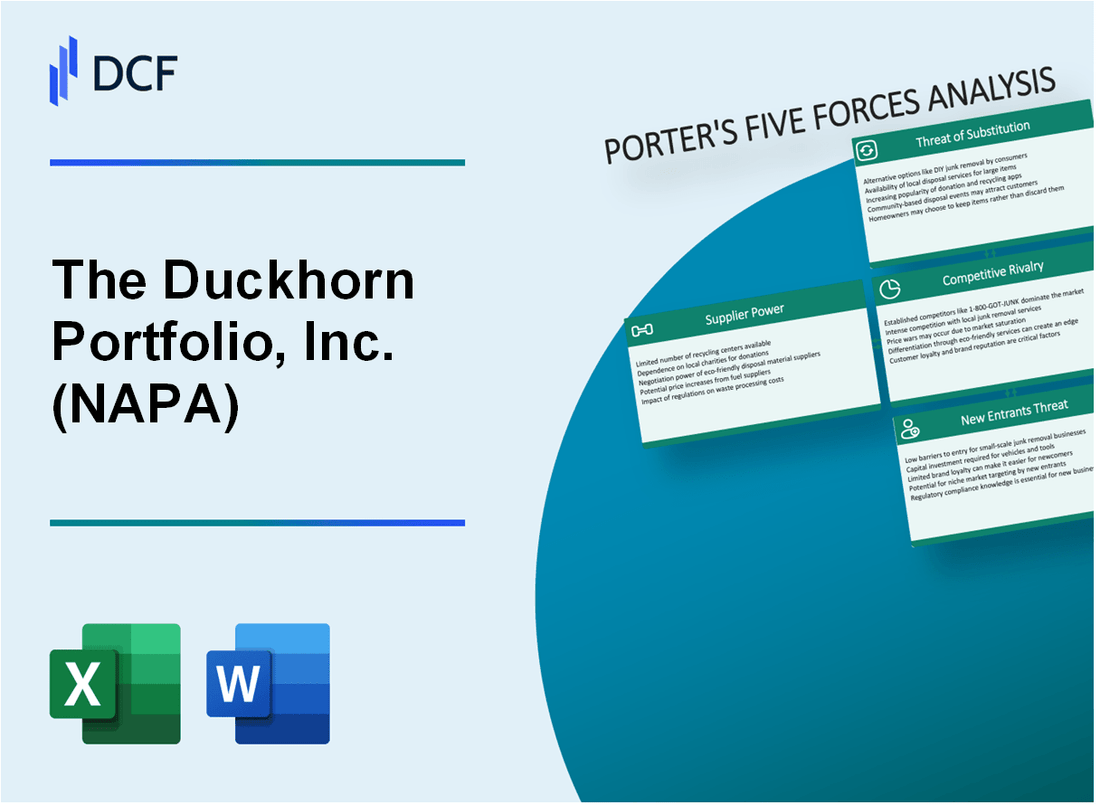
Entièrement Modifiable: Adapté À Vos Besoins Dans Excel Ou Sheets
Conception Professionnelle: Modèles Fiables Et Conformes Aux Normes Du Secteur
Pré-Construits Pour Une Utilisation Rapide Et Efficace
Compatible MAC/PC, entièrement débloqué
Aucune Expertise N'Est Requise; Facile À Suivre
The Duckhorn Portfolio, Inc. (NAPA) Bundle
Plongez dans le paysage stratégique du portefeuille Duckhorn, Inc., où l'art de la vinification rencontre une dynamique de marché complexe. Dans cette analyse de plongée profonde, nous démêlerons les forces complexes qui façonnent le positionnement concurrentiel de cette entreprise viticole, explorant à quel point les fournisseurs de raisin limités, la fidélité de la marque, la consolidation de l'industrie et les tendances des boissons émergentes créent un écosystème fascinant de défis et d'opportunités dans le haut- ENSIGNEMENTS WORLD OF Premium California Wines.
The Duckhorn Portfolio, Inc. (NAPA) - Porter's Five Forces: Bargoughing Power of Fournissers
Nombre limité de grandes producteurs de raisins à Napa Valley
En 2024, Napa Valley comprend environ 45 300 acres de terrains de vignobles, avec seulement 375 vignobles liés. Le marché du raisin premium est concentré parmi un petit nombre de producteurs de haute qualité.
| Métrique de la culture du raisin | Données de Napa Valley |
|---|---|
| Acres totaux de vignobles | 45,300 |
| Nombre de caves liées | 375 |
| Taille moyenne du vignoble | 42 acres |
Rareté terrestre vignoble de haute qualité
Napa Valley Vineyard Land est en moyenne de 400 000 $ par acre en 2024, représentant une barrière importante à l'entrée pour les nouveaux fournisseurs de raisin.
- Prix de terrain moyen de Napa Valley Vineyard: 400 000 $ par acre
- Terroir approprié limité pour la culture de raisin haut de gamme
- Règlements de zonage agricole stricts
Contrats de fournisseurs à long terme
Le portefeuille de Duckhorn maintient des contrats pluriannuels avec des fournisseurs de raisins sélectionnés, avec des durées de contrat typiques allant de 5 à 10 ans.
| Aspect contractuel | Paramètres typiques |
|---|---|
| Durée du contrat | 5-10 ans |
| Mécanisme de stabilité des prix | Ajustements annuels fixes |
Stratégie de propriété de vignoble
En 2024, Duckhorn Portfolio possède environ 287 acres de terrains de vignobles, réduisant la dépendance aux fournisseurs externes.
- ACRES VINEYARD TOTAL OPPRIMÉS: 287
- Pourcentage de propriété estimée: 35 à 40% du total des exigences de raisin
- Emplacements: principalement le comté de Napa Valley et Sonoma
The Duckhorn Portfolio, Inc. (NAPA) - Porter's Five Forces: Bargaining Power of Clients
Diversité des canaux de distribution
Le Duckhorn Portfolio, Inc. fonctionne sur trois canaux de distribution principaux:
| Canal | Pourcentage de ventes |
|---|---|
| Direct à consommateur | 25.3% |
| Restaurants | 38.7% |
| Vente au détail | 36% |
Prix du segment du vin haut de gamme
Le prix moyen de l'entreprise pour les vins premium:
- Duckhorn Vins: 45 $ - 85 $ par bouteille
- Vins leurres: 20 $ - 35 $ par bouteille
- Vins en toile: 35 $ - 65 $ par bouteille
Métriques de fidélité à la marque
Taux de rétention de la clientèle pour les marques de portefeuille Duckhorn:
| Marque | Taux de rétention de la clientèle |
|---|---|
| Vignobles | 68.5% |
| Attirer | 62.3% |
| Goldeneye | 59.7% |
Diversification de la marque de portefeuille
Nombre de marques de vin dans le portefeuille: 7
- Vignobles
- Attirer
- Goldeneye
- Paraduxx
- Migration
- Toile
- Fumer
Analyse de l'énergie de commutation du client
Contrôles de commutation pour les clients du segment du vin haut de gamme: Estimé 15 $ à 25 $ par différence de bouteille nécessaire pour motiver le changement de marque
The Duckhorn Portfolio, Inc. (NAPA) - Porter's Five Forces: Rivalité compétitive
Paysage compétitif Overview
Depuis 2024, le portefeuille Duckhorn fonctionne dans un marché de vins californien haut de gamme hautement compétitif avec la dynamique concurrentielle suivante:
| Concurrent | Part de marché | Revenus annuels |
|---|---|---|
| Vignobles de Caymus | 4.2% | 78,5 millions de dollars |
| Caves en chêne argenté | 3.7% | 65,3 millions de dollars |
| Le portefeuille Duckhorn | 3.5% | 62,1 millions de dollars |
Facteurs d'intensité compétitive
L'industrie du vin démontre des tendances de consolidation importantes:
- L'activité de fusion et d'acquisition de l'industrie du vin a augmenté de 22,6% en 2023
- Segment de vin premium connaissant 15,3% de concentration du marché
- Les 5 meilleurs producteurs de vin contrôlent 38,7% de la part de marché totale
Stratégies de positionnement de la marque
Dépenses de marketing compétitives dans le segment des vins premium:
| Marque | Budget marketing | Marketing numérique% |
|---|---|---|
| Portefeuille de chair de canard | 8,7 millions de dollars | 42% |
| Vignobles de Caymus | 9,2 millions de dollars | 38% |
| Caves en chêne argenté | 7,5 millions de dollars | 45% |
The Duckhorn Portfolio, Inc. (NAPA) - Five Forces de Porter: Menace de substituts
Cultiver le marché de la bière artisanale et des spiritueux
La taille du marché américain de la bière artisanale était évaluée à 22,4 milliards de dollars en 2022, avec un TCAC projeté de 11,8% de 2023 à 2030. Le marché des spiritueux artisanaux a atteint 17,7 milliards de dollars en 2022, montrant un potentiel de concurrence significatif.
| Segment de marché | 2022 Valeur marchande | CAGR projeté |
|---|---|---|
| Bière artisanale | 22,4 milliards de dollars | 11.8% |
| Spiritueux artisanal | 17,7 milliards de dollars | 9.5% |
Augmentation de la popularité des boissons alcoolisées alternatives
Aux États-Unis, le marché dur de Seltzer était évalué à 14,6 milliards de dollars en 2022, avec une croissance attendue à 23,9 milliards de dollars d'ici 2027.
- Marché du kombucha dur prévu pour atteindre 1,2 milliard de dollars d'ici 2025
- Le segment de cocktails prêt à boire devrait atteindre 21,5 milliards de dollars d'ici 2025
Montée des options de boissons à faible alcool et non alcoolisées
Le marché des boissons non alcoolisé devrait atteindre 30,4 milliards de dollars d'ici 2026, avec un TCAC de 7,2%.
| Catégorie de boissons | 2022 Taille du marché | Taille du marché projetée 2026 |
|---|---|---|
| Boissons non alcoolisées | 22,8 milliards de dollars | 30,4 milliards de dollars |
| Boissons à faible alcool | 8,6 milliards de dollars | 12,7 milliards de dollars |
Préférence des consommateurs émergents pour les cocktails et les boissons mélangées
La taille du marché mondial des cocktails était de 26,8 milliards de dollars en 2022, avec un TCAC projeté de 6,5% à 2030.
- Segment de cocktails prémélangé augmentant à 8,3% par an
- Marché de la préparation des cocktails à domicile d'une valeur de 5,4 milliards de dollars en 2022
The Duckhorn Portfolio, Inc. (NAPA) - Five Forces de Porter: Menace de nouveaux entrants
Exigences de capital élevé pour l'établissement de vignobles
Coût moyen des terres pour Vineyard dans la vallée de Napa: 300 000 $ à 500 000 $ par acre. Les coûts d'établissement initial des vignobles varient de 50 000 $ à 75 000 $ par acre. Investissement initial total pour un vignoble de 10 acres: 800 000 $ à 1 250 000 $.
| Catégorie d'investissement | Gamme de coûts |
|---|---|
| Acquisition de terres | 300 000 $ - 500 000 $ par acre |
| Établissement de vignoble | 50 000 $ - 75 000 $ par acre |
| Investissement total de 10 acres | $800,000 - $1,250,000 |
Environnement réglementaire complexe dans la production de vin
Coûts de conformité réglementaire pour les nouveaux producteurs de vin: 50 000 $ à 150 000 $ par an. Frais de licence fédéraux et étatiques: 17 000 $ à 30 000 $.
- Permis d'administration fédérale de l'alcool: 3 000 $
- Licence de cave d'État: 1 500 $ - 15 000 $
- Représentation de la conformité annuelle: 10 000 $ - 25 000 $
Exigences importantes de reconnaissance de la marque
Dépenses de marketing pour les nouvelles marques de vin: 250 000 $ à 500 000 $ au cours des trois premières années. Coût moyen d'acquisition du client: 75 $ par client.
| Catégorie de dépenses de marketing | Coût |
|---|---|
| Développement initial de la marque | $100,000 - $200,000 |
| Marketing numérique | $75,000 - $150,000 |
| Affiche commerciale / participation des événements | $75,000 - $150,000 |
Investissement initial d'infrastructure de production de vin
Équipements et coûts d'infrastructure de la cave: 500 000 $ à 2 000 000 $. Inventaire du baril: 100 000 $ à 250 000 $.
- Réservoirs de fermentation: 150 000 $ - 500 000 $
- Équipement de ligne d'embouteillage: 100 000 $ - 350 000 $
- Installations de stockage: 250 000 $ - 750 000 $
The Duckhorn Portfolio, Inc. (NAPA) - Porter's Five Forces: Competitive rivalry
The competitive rivalry in the North American luxury wine market is definitely high intensity. You are operating in a fiercely competitive arena, even as The Duckhorn Portfolio, Inc. stands as North America's premier luxury wine producer. The market for wines priced at $\mathbf{\$15}$ or higher per $\mathbf{750ml}$ bottle is where the action is, and while the overall U.S. wine market saw volume declines in 2024, the $\mathbf{\$15}$ and up segment still managed $\mathbf{2\%}$ volume growth in 2024 among the top million-case brands.
To be fair, The Duckhorn Portfolio has carved out a commanding position. The company commands an estimated market share exceeding $\mathbf{20\%}$ in the critical ultra-premium ($\mathbf{\$15}$-$\mathbf{\$25}$) and luxury ($\mathbf{\$25+}$) wine segments as of early $\mathbf{2025}$. This leadership is a key defense against rivals. Still, you face giants; rivals include large, diversified players like Constellation Brands, which, despite rumored divestitures of its wine division, remains a major force with brands like Kim Crawford and Meiomi. You also compete against smaller, specialized luxury estates that compete for the same discerning consumer.
Here's a quick look at how The Duckhorn Portfolio's brands stack up against key competitors in the $\mathbf{\$15}$-plus segment based on 2024 volume estimates:
| Brand | Company | 2024 Estimated Volume (Million Cases) | Volume Change from 2023 |
|---|---|---|---|
| La Marca (Prosecco) | E. & J. Gallo Winery | 3.4 | 4.0% |
| Kim Crawford | Constellation Brands | 1.8 | -2.0% |
| Meiomi | Constellation Brands | 1.8 | -1.1% |
| Decoy by Duckhorn | The Duckhorn Portfolio (Butterfly) | 1.5 | 2.7% |
| La Crema | Jackson Family Wines | 1.4 | -1.2% |
The Duckhorn Portfolio's strategy is designed to mitigate some of this internal friction. Its multi-brand portfolio, which includes $\mathbf{11}$ acclaimed winery brands as of $\mathbf{2025}$, segments the market effectively. This structure helps reduce direct competition between their own labels by targeting different price points and consumer tastes within the luxury space. For instance, Decoy by Duckhorn was a growth driver, increasing $\mathbf{2.7\%}$ to $\mathbf{1.5}$ million cases in $\mathbf{2024}$, while other brands anchor the higher luxury tier.
The success of this segmentation is evident in market capture. The Duckhorn Portfolio captured $\mathbf{37\%}$ of the growth in the $\mathbf{\$15}$-$\mathbf{\$50}$ segment over the last $\mathbf{24}$ months, showing strong momentum against the competition. This performance contrasts with the company's recent financial reporting; for fiscal year $\mathbf{2024}$, net sales were $\mathbf{\$403}$ million, but the Q1 $\mathbf{2025}$ net sales reached $\mathbf{\$122.9}$ million, up $\mathbf{19.9\%}$ year-over-year, largely helped by the Sonoma-Cutrer acquisition completed in late $\mathbf{2023}$/early $\mathbf{2024}$.
Key elements defining the rivalry intensity include:
- North American luxury wine market projected to reach $\mathbf{\$48.2}$ billion by $\mathbf{2025}$.
- Portfolio price points range from $\mathbf{\$20}$ to $\mathbf{\$230}$ per bottle.
- CEO Robert Hanson previously headed Constellation Brands' wine and spirits portfolio ($\mathbf{2019}$ to $\mathbf{2024}$).
- The company was acquired in December $\mathbf{2024}$ for $\mathbf{\$1.95}$ billion.
- Core brands (Duckhorn Vineyards, Kosta Browne, Decoy, Sonoma-Cutrer, Goldeneye, Calera, Greenwing) comprise $\mathbf{96\%}$ of net sales as of May $\mathbf{2025}$.
The sheer number of active competitors is also a factor, with The Duckhorn Portfolio having $\mathbf{5941}$ active competitors as of June $\mathbf{2025}$. You need to keep pushing brand equity and distribution to maintain that $\mathbf{20\%+}$ leadership. Finance: draft $\mathbf{13}$-week cash view by Friday.
The Duckhorn Portfolio, Inc. (NAPA) - Porter's Five Forces: Threat of substitutes
You're looking at how other beverage categories are pulling consumer dollars away from The Duckhorn Portfolio, Inc. (NAPA). The pressure is definitely on, as the overall volume trend for wine is moving in the wrong direction, pushing drinkers toward alternatives.
The threat from Ready-to-Drink (RTD) spirits is high. This segment is surging, with spirits-based RTDs showing robust momentum. One report highlights a 28.4% surge in RTD spirits revenue, even as the broader U.S. distilled spirits value market faced a 4% decline. This shows a clear consumer pivot toward convenience and mixed drinks.
Non-alcoholic options are also maturing fast, moving beyond a niche. Non-alcoholic beer purchases in U.S. alcohol-buying households rose by 22% between December 2023 and November 2024. Furthermore, non-alcoholic wine, while smaller, saw its dollar sales increase by 41% last year. The entire alcohol-free category is on track to exceed $1 billion in off-premise sales by the end of 2025.
Overall wine consumption volume is declining globally, which is a structural headwind. Worldwide wine consumption fell to 214 million hectolitres in 2024, which is the lowest level recorded in six decades. This volume contraction, driven by economic factors and lifestyle shifts, means The Duckhorn Portfolio, Inc. (NAPA) must fight harder for every pour.
Still, The Duckhorn Portfolio, Inc. (NAPA)'s luxury positioning acts as a barrier. While volume is down, the market is shifting to value; global wine market revenue is estimated at $347.1 billion in 2025. Consumers prioritizing quality, authenticity, and experience-the core of a luxury brand-are less likely to switch to cheaper, non-premium substitutes, even if they are cutting back on overall volume.
Here's a quick look at how these substitute categories are performing compared to the general wine market contraction:
| Beverage Category | Latest Reported Growth/Decline Metric | Timeframe/Context |
|---|---|---|
| RTD Spirits (Revenue) | Surged 28.4% | Implied 2025 YTD growth |
| Non-Alcoholic Beer (Purchases) | Rose 22% | Dec 2023 to Nov 2024 in U.S. alcohol-buying households |
| Non-Alcoholic Wine (Dollar Sales) | Increased 41% | Last year |
| Global Wine Consumption (Volume) | Fell 3.3% | 2024 vs. prior year |
| Global Wine Consumption (Level) | Lowest in 60 years | 2024 volume |
The key areas where The Duckhorn Portfolio, Inc. (NAPA) faces direct substitution pressure are:
- Spirits-based RTDs, which are capturing convenience-seeking drinkers.
- Non-alcoholic wine, which is growing off a smaller base.
- The general trend of moderation, which impacts all alcoholic beverages.
The premiumization trend within wine is the main defense against the cheapest substitutes, but the growth in premium RTDs is a more direct, high-value threat. For instance, The Duckhorn Portfolio, Inc. (NAPA) reported net sales of $122.9 million for its Fiscal First Quarter 2025. You need to track how much of that premium dollar is being diverted to premium RTD cocktails.
Finance: draft a sensitivity analysis on Q2 2025 revenue assuming a 5% shift of premium wine spend to premium RTDs by Friday.
The Duckhorn Portfolio, Inc. (NAPA) - Porter's Five Forces: Threat of new entrants
The barrier to entry for a new competitor looking to challenge The Duckhorn Portfolio, Inc. in the premium wine space is exceptionally high. You can't just start selling premium Cabernet Sauvignon tomorrow; the industry demands significant upfront investment and patience.
Very high capital barrier to entry due to the cost of acquiring prime, established vineyard land.
Acquiring the right terroir is the first, and perhaps most prohibitive, hurdle. For prime, established vineyard land in Napa Valley, the cost basis is staggering. We see listings for established Cabernet Sauvignon vineyards running about $1 million per acre. To give you a sense of the scale, a rare, historic ranch spanning 809 contiguous hectares (about 2,000 acres) in the heart of Napa wine country was listed for $100 million in early 2025. Even smaller, high-quality parcels command multi-million dollar price tags; for instance, a 20.22-acre vineyard property was listed for $8,000,000. For context, prime Napa County vineyard land values can reach up to $525,000+/acre.
Here's a quick look at the capital intensity required for land acquisition:
| Location/Asset Type | Reported Value/Range (2024/2025 Data) |
|---|---|
| Prime Established Napa Vineyard (Per Acre) | Approximately $1,000,000 |
| Rare 2,000-Acre Napa Ranch Listing Price (Jan 2025) | $100,000,000 |
| Prime Napa County Vineyard Value Range (Per Acre) | Up to $525,000+ |
| Example 20-Acre Listing Price | $8,000,000 |
Long lead time (years) required to establish the necessary brand prestige and quality reputation.
Beyond the land purchase, you are buying time. It takes years, often decades, for a new winery to cultivate the necessary brand equity and quality reputation to command premium pricing, which is The Duckhorn Portfolio, Inc.'s core strategy. Consumers in this segment buy heritage and trust, not just a bottle of wine. This lag in brand recognition means a new entrant faces years of potentially low returns while trying to build the cachet that The Duckhorn Portfolio, Inc. already possesses.
The three-tier US distribution system (wholesale accounts for 79.3% of sales) is a significant regulatory barrier.
Navigating the US distribution maze is a massive regulatory and logistical barrier. The three-tier system-Producer, Distributor, Retailer-is the law of the land post-Prohibition, restricting how producers sell their product. For a new entrant, securing shelf space with established distributors is incredibly difficult, as these wholesalers prioritize brands with proven volume and existing pull-through. Direct-to-consumer shipping, which bypasses the middle tier, is heavily restricted; exceptions like direct shipping for wine account for less than 10% of all wine sales. This forces reliance on the wholesale channel, where The Duckhorn Portfolio, Inc. already has deep, established relationships.
The structure means new entrants face:
- Mandatory sales to Tier 2 distributors.
- State-by-state regulatory complexity.
- Difficulty gaining distributor mindshare.
- Inability to sell directly to most consumers.
Established players prefer acquisition (e.g., LVMH) over organic entry, confirming high barriers.
The actions of established luxury conglomerates confirm the difficulty of organic entry. Instead of building from scratch, major players buy their way in, signaling that the cost of acquiring existing prestige is more efficient than creating it. For example, LVMH acquired Schramsberg Vineyards in 2024 for $800 million, and also acquired Joseph Phelps Vineyards. LVMH completed 2 acquisitions in the Alcoholic Beverage Products sector in 2025 as of October 1, 2025. These multi-hundred-million-dollar transactions are the true entry price for immediate, established market access.
New entrants would struggle to compete with the $403 million scale of The Duckhorn Portfolio.
A new player must contend with the sheer operational scale of The Duckhorn Portfolio, Inc. While their Trailing Twelve Months (TTM) revenue was recently reported at $0.42 Billion USD (or $420 million), the established scale of $403 million-as referenced in the strategic assessment-provides massive advantages in purchasing power, marketing spend, and distribution leverage that a startup simply cannot match. They simply don't have the financial muscle to fight for the same shelf space or marketing dollars.
Finance: draft 13-week cash view by Friday.
Disclaimer
All information, articles, and product details provided on this website are for general informational and educational purposes only. We do not claim any ownership over, nor do we intend to infringe upon, any trademarks, copyrights, logos, brand names, or other intellectual property mentioned or depicted on this site. Such intellectual property remains the property of its respective owners, and any references here are made solely for identification or informational purposes, without implying any affiliation, endorsement, or partnership.
We make no representations or warranties, express or implied, regarding the accuracy, completeness, or suitability of any content or products presented. Nothing on this website should be construed as legal, tax, investment, financial, medical, or other professional advice. In addition, no part of this site—including articles or product references—constitutes a solicitation, recommendation, endorsement, advertisement, or offer to buy or sell any securities, franchises, or other financial instruments, particularly in jurisdictions where such activity would be unlawful.
All content is of a general nature and may not address the specific circumstances of any individual or entity. It is not a substitute for professional advice or services. Any actions you take based on the information provided here are strictly at your own risk. You accept full responsibility for any decisions or outcomes arising from your use of this website and agree to release us from any liability in connection with your use of, or reliance upon, the content or products found herein.