

|
The Duckhorn Portfolio, Inc. (Napa): 5 forças Análise [Jan-2025 Atualizada] |
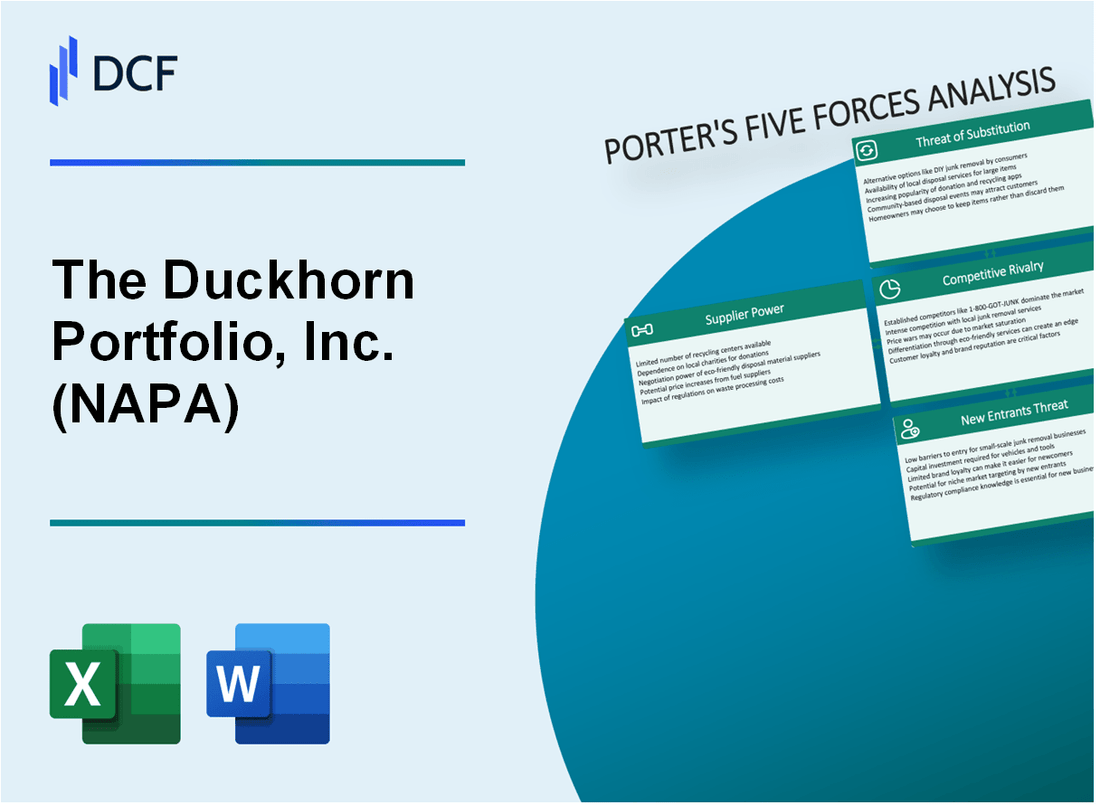
Totalmente Editável: Adapte-Se Às Suas Necessidades No Excel Ou Planilhas
Design Profissional: Modelos Confiáveis E Padrão Da Indústria
Pré-Construídos Para Uso Rápido E Eficiente
Compatível com MAC/PC, totalmente desbloqueado
Não É Necessária Experiência; Fácil De Seguir
The Duckhorn Portfolio, Inc. (NAPA) Bundle
Mergulhe no cenário estratégico do Duckhorn Portfolio, Inc., onde a arte da produção de vinho encontra dinâmicas complexas de mercado. Nesta análise de mergulho profundo, desvendaremos as forças complexas que moldam o posicionamento competitivo desta empresa de vinhos premium, explorando como os fornecedores limitados de uvas, lealdade à marca, consolidação da indústria e tendências emergentes de bebidas criam um ecossistema fascinante de desafios e oportunidades no alto Stakes World of Premium California Wines.
The Duckhorn Portfolio, Inc. (Napa) - Five Forces de Porter: Power de barganha dos fornecedores
Número limitado de produtores de uva premium em Napa Valley
A partir de 2024, o NAPA Valley compreende aproximadamente 45.300 acres de terra de vinha, com apenas 375 vinícolas ligadas. O mercado de uvas premium está concentrado entre um pequeno número de produtores de alta qualidade.
| Métrica em crescimento de uva | Dados de Napa Valley |
|---|---|
| Total Vineyard Acres | 45,300 |
| Número de vinícolas ligadas | 375 |
| Tamanho médio da vinha | 42 acres |
Escassez de terra de vinha de alta qualidade
A terra do Napa Valley Vineyard em média de US $ 400.000 por acre em 2024, representando uma barreira significativa à entrada para novos fornecedores de uva.
- Preço médio da terra do Valley Vineyard: US $ 400.000 por acre
- Terroir adequado limitado para cultivo de uva premium
- Regulamentos de zoneamento agrícola rigorosos
Contratos de fornecedores de longo prazo
O portfólio da Duckhorn mantém contratos de vários anos com fornecedores de uva selecionados, com durações típicas de contratos que variam de 5 a 10 anos.
| Aspecto do contrato | Parâmetros típicos |
|---|---|
| Duração do contrato | 5-10 anos |
| Mecanismo de estabilidade de preços | Ajustes anuais fixos de preços |
Estratégia de Propriedade da Vinha
A partir de 2024, o portfólio de Duckhorn possui aproximadamente 287 acres de terra de vinha, reduzindo a dependência de fornecedores externos.
- Total de vinha de propriedade acres: 287
- Porcentagem de propriedade estimada: 35-40% do total de requisitos de uva
- Locais: principalmente Napa Valley e Sonoma County
The Duckhorn Portfolio, Inc. (NAPA) - As cinco forças de Porter: poder de barganha dos clientes
Diversidade de canais de distribuição
O portfólio Duckhorn, Inc. opera em três canais de distribuição primários:
| Canal | Porcentagem de vendas |
|---|---|
| Direto ao consumidor | 25.3% |
| Restaurantes | 38.7% |
| Varejo | 36% |
Preço de segmento de vinho premium
O preço médio da empresa para vinhos premium:
- Vinhos Duckhorn: US $ 45- $ 85 por garrafa
- Vinhos de engodo: US $ 20 a US $ 35 por garrafa
- Vinhos Canvasback: US $ 35- $ 65 por garrafa
Métricas de fidelidade da marca
Taxas de retenção de clientes para marcas de portfólio Duckhorn:
| Marca | Taxa de retenção de clientes |
|---|---|
| Duckhorn Vineyards | 68.5% |
| Chamariz | 62.3% |
| GoldEneye | 59.7% |
Diversificação da marca do portfólio
Número de marcas de vinho no portfólio: 7
- Duckhorn Vineyards
- Chamariz
- GoldEneye
- Paraduxx
- Migração
- Canvasback
- Fumaça do mar
Análise de energia de troca de clientes
Mudando os custos para os clientes em segmento de vinho premium: Estimado US $ 15 a US $ 25 por diferença de garrafa necessária para motivar a mudança de marca
The Duckhorn Portfolio, Inc. (Napa) - Five Forces de Porter: Rivalidade competitiva
Cenário competitivo Overview
A partir de 2024, o portfólio de Duckhorn opera em um mercado de vinhos premium altamente competitivo da Califórnia com a seguinte dinâmica competitiva:
| Concorrente | Quota de mercado | Receita anual |
|---|---|---|
| Caymus Vineyards | 4.2% | US $ 78,5 milhões |
| Celas de carvalho prateado | 3.7% | US $ 65,3 milhões |
| O portfólio de Duckhorn | 3.5% | US $ 62,1 milhões |
Fatores de intensidade competitivos
A indústria do vinho demonstra tendências significativas de consolidação:
- A atividade de fusão e aquisição da indústria do vinho aumentou 22,6% em 2023
- Segmento de vinho premium com concentração de mercado de 15,3%
- Os 5 principais produtores de vinho controlam 38,7% da participação total de mercado
Estratégias de posicionamento da marca
Despesas de marketing competitivas em segmento de vinho premium:
| Marca | Orçamento de marketing | Marketing Digital % |
|---|---|---|
| Portfólio de Duckhorn | US $ 8,7 milhões | 42% |
| Caymus Vineyards | US $ 9,2 milhões | 38% |
| Celas de carvalho prateado | US $ 7,5 milhões | 45% |
The Duckhorn Portfolio, Inc. (Napa) - As cinco forças de Porter: ameaça de substitutos
Crescendo mercado de cerveja artesanal e bebidas espirituosas
O tamanho do mercado de cervejas artesanais dos EUA foi avaliado em US $ 22,4 bilhões em 2022, com um CAGR projetado de 11,8% de 2023 a 2030. O mercado de espíritos artesanais atingiu US $ 17,7 bilhões em 2022, mostrando um potencial significativo de concorrência.
| Segmento de mercado | 2022 Valor de mercado | CAGR projetado |
|---|---|---|
| Cerveja artesanal | US $ 22,4 bilhões | 11.8% |
| Espíritos artesanais | US $ 17,7 bilhões | 9.5% |
Crescente popularidade de bebidas alcoólicas alternativas
O Hard Seltzer Market nos Estados Unidos foi avaliado em US $ 14,6 bilhões em 2022, com crescimento esperado para US $ 23,9 bilhões até 2027.
- Hard Kombucha Market projetou atingir US $ 1,2 bilhão até 2025
- O segmento de coquetel pronto para beber atingir US $ 21,5 bilhões até 2025
Ascensão de opções de bebida com baixo alcool e não alcoólica
O mercado de bebidas não alcoólicas que deve atingir US $ 30,4 bilhões até 2026, com um CAGR de 7,2%.
| Categoria de bebida | 2022 Tamanho do mercado | Tamanho do mercado projetado 2026 |
|---|---|---|
| Bebidas não alcoólicas | US $ 22,8 bilhões | US $ 30,4 bilhões |
| Bebidas de baixo álcool | US $ 8,6 bilhões | US $ 12,7 bilhões |
Preferência emergente do consumidor por coquetéis e bebidas mistas
O tamanho do mercado global de coquetéis foi de US $ 26,8 bilhões em 2022, com um CAGR projetado de 6,5% a 2030.
- Segmento de coquetéis pré -misturados crescendo a 8,3% ao ano
- Mercado de preparação para coquetéis em casa, avaliado em US $ 5,4 bilhões em 2022
O portfólio de Duckhorn, Inc. (Napa) - Five Forces de Porter: Ameaça de novos participantes
Altos requisitos de capital para estabelecimento de vinhedos
Custo médio da terra para vinha em Napa Valley: US $ 300.000 a US $ 500.000 por acre. Os custos iniciais do estabelecimento da vinha variam de US $ 50.000 a US $ 75.000 por acre. Investimento inicial total para uma vinha de 10 acres: US $ 800.000 a US $ 1.250.000.
| Categoria de investimento | Intervalo de custos |
|---|---|
| Aquisição de terras | US $ 300.000 - US $ 500.000 por acre |
| Estabelecimento de vinhedos | $ 50.000 - US $ 75.000 por acre |
| Investimento total de 10 acres | $800,000 - $1,250,000 |
Ambiente regulatório complexo na produção de vinho
Custos de conformidade regulatória para novos produtores de vinho: US $ 50.000 a US $ 150.000 anualmente. Taxas de licenciamento federal e estadual: US $ 17.000 a US $ 30.000.
- Permissão de Administração Federal de Álcool: US $ 3.000
- Licença estadual de vinícolas: US $ 1.500 - $ 15.000
- Relatório anual de conformidade: US $ 10.000 - US $ 25.000
Requisitos significativos de reconhecimento de marca
Despesas de marketing para novas marcas de vinho: US $ 250.000 a US $ 500.000 nos primeiros três anos. Custo médio de aquisição do cliente: US $ 75 por cliente.
| Categoria de despesa de marketing | Custo |
|---|---|
| Desenvolvimento inicial da marca | $100,000 - $200,000 |
| Marketing digital | $75,000 - $150,000 |
| Feira de feira/participação do evento | $75,000 - $150,000 |
Investimento inicial de infraestrutura de produção de vinho
Custos de equipamentos e infraestrutura da vinícola: US $ 500.000 a US $ 2.000.000. Inventário de barril: US $ 100.000 a US $ 250.000.
- Tanques de fermentação: US $ 150.000 - $ 500.000
- Equipamento de linha de engarrafamento: US $ 100.000 - $ 350.000
- Instalações de armazenamento: US $ 250.000 - US $ 750.000
The Duckhorn Portfolio, Inc. (NAPA) - Porter's Five Forces: Competitive rivalry
The competitive rivalry in the North American luxury wine market is definitely high intensity. You are operating in a fiercely competitive arena, even as The Duckhorn Portfolio, Inc. stands as North America's premier luxury wine producer. The market for wines priced at $\mathbf{\$15}$ or higher per $\mathbf{750ml}$ bottle is where the action is, and while the overall U.S. wine market saw volume declines in 2024, the $\mathbf{\$15}$ and up segment still managed $\mathbf{2\%}$ volume growth in 2024 among the top million-case brands.
To be fair, The Duckhorn Portfolio has carved out a commanding position. The company commands an estimated market share exceeding $\mathbf{20\%}$ in the critical ultra-premium ($\mathbf{\$15}$-$\mathbf{\$25}$) and luxury ($\mathbf{\$25+}$) wine segments as of early $\mathbf{2025}$. This leadership is a key defense against rivals. Still, you face giants; rivals include large, diversified players like Constellation Brands, which, despite rumored divestitures of its wine division, remains a major force with brands like Kim Crawford and Meiomi. You also compete against smaller, specialized luxury estates that compete for the same discerning consumer.
Here's a quick look at how The Duckhorn Portfolio's brands stack up against key competitors in the $\mathbf{\$15}$-plus segment based on 2024 volume estimates:
| Brand | Company | 2024 Estimated Volume (Million Cases) | Volume Change from 2023 |
|---|---|---|---|
| La Marca (Prosecco) | E. & J. Gallo Winery | 3.4 | 4.0% |
| Kim Crawford | Constellation Brands | 1.8 | -2.0% |
| Meiomi | Constellation Brands | 1.8 | -1.1% |
| Decoy by Duckhorn | The Duckhorn Portfolio (Butterfly) | 1.5 | 2.7% |
| La Crema | Jackson Family Wines | 1.4 | -1.2% |
The Duckhorn Portfolio's strategy is designed to mitigate some of this internal friction. Its multi-brand portfolio, which includes $\mathbf{11}$ acclaimed winery brands as of $\mathbf{2025}$, segments the market effectively. This structure helps reduce direct competition between their own labels by targeting different price points and consumer tastes within the luxury space. For instance, Decoy by Duckhorn was a growth driver, increasing $\mathbf{2.7\%}$ to $\mathbf{1.5}$ million cases in $\mathbf{2024}$, while other brands anchor the higher luxury tier.
The success of this segmentation is evident in market capture. The Duckhorn Portfolio captured $\mathbf{37\%}$ of the growth in the $\mathbf{\$15}$-$\mathbf{\$50}$ segment over the last $\mathbf{24}$ months, showing strong momentum against the competition. This performance contrasts with the company's recent financial reporting; for fiscal year $\mathbf{2024}$, net sales were $\mathbf{\$403}$ million, but the Q1 $\mathbf{2025}$ net sales reached $\mathbf{\$122.9}$ million, up $\mathbf{19.9\%}$ year-over-year, largely helped by the Sonoma-Cutrer acquisition completed in late $\mathbf{2023}$/early $\mathbf{2024}$.
Key elements defining the rivalry intensity include:
- North American luxury wine market projected to reach $\mathbf{\$48.2}$ billion by $\mathbf{2025}$.
- Portfolio price points range from $\mathbf{\$20}$ to $\mathbf{\$230}$ per bottle.
- CEO Robert Hanson previously headed Constellation Brands' wine and spirits portfolio ($\mathbf{2019}$ to $\mathbf{2024}$).
- The company was acquired in December $\mathbf{2024}$ for $\mathbf{\$1.95}$ billion.
- Core brands (Duckhorn Vineyards, Kosta Browne, Decoy, Sonoma-Cutrer, Goldeneye, Calera, Greenwing) comprise $\mathbf{96\%}$ of net sales as of May $\mathbf{2025}$.
The sheer number of active competitors is also a factor, with The Duckhorn Portfolio having $\mathbf{5941}$ active competitors as of June $\mathbf{2025}$. You need to keep pushing brand equity and distribution to maintain that $\mathbf{20\%+}$ leadership. Finance: draft $\mathbf{13}$-week cash view by Friday.
The Duckhorn Portfolio, Inc. (NAPA) - Porter's Five Forces: Threat of substitutes
You're looking at how other beverage categories are pulling consumer dollars away from The Duckhorn Portfolio, Inc. (NAPA). The pressure is definitely on, as the overall volume trend for wine is moving in the wrong direction, pushing drinkers toward alternatives.
The threat from Ready-to-Drink (RTD) spirits is high. This segment is surging, with spirits-based RTDs showing robust momentum. One report highlights a 28.4% surge in RTD spirits revenue, even as the broader U.S. distilled spirits value market faced a 4% decline. This shows a clear consumer pivot toward convenience and mixed drinks.
Non-alcoholic options are also maturing fast, moving beyond a niche. Non-alcoholic beer purchases in U.S. alcohol-buying households rose by 22% between December 2023 and November 2024. Furthermore, non-alcoholic wine, while smaller, saw its dollar sales increase by 41% last year. The entire alcohol-free category is on track to exceed $1 billion in off-premise sales by the end of 2025.
Overall wine consumption volume is declining globally, which is a structural headwind. Worldwide wine consumption fell to 214 million hectolitres in 2024, which is the lowest level recorded in six decades. This volume contraction, driven by economic factors and lifestyle shifts, means The Duckhorn Portfolio, Inc. (NAPA) must fight harder for every pour.
Still, The Duckhorn Portfolio, Inc. (NAPA)'s luxury positioning acts as a barrier. While volume is down, the market is shifting to value; global wine market revenue is estimated at $347.1 billion in 2025. Consumers prioritizing quality, authenticity, and experience-the core of a luxury brand-are less likely to switch to cheaper, non-premium substitutes, even if they are cutting back on overall volume.
Here's a quick look at how these substitute categories are performing compared to the general wine market contraction:
| Beverage Category | Latest Reported Growth/Decline Metric | Timeframe/Context |
|---|---|---|
| RTD Spirits (Revenue) | Surged 28.4% | Implied 2025 YTD growth |
| Non-Alcoholic Beer (Purchases) | Rose 22% | Dec 2023 to Nov 2024 in U.S. alcohol-buying households |
| Non-Alcoholic Wine (Dollar Sales) | Increased 41% | Last year |
| Global Wine Consumption (Volume) | Fell 3.3% | 2024 vs. prior year |
| Global Wine Consumption (Level) | Lowest in 60 years | 2024 volume |
The key areas where The Duckhorn Portfolio, Inc. (NAPA) faces direct substitution pressure are:
- Spirits-based RTDs, which are capturing convenience-seeking drinkers.
- Non-alcoholic wine, which is growing off a smaller base.
- The general trend of moderation, which impacts all alcoholic beverages.
The premiumization trend within wine is the main defense against the cheapest substitutes, but the growth in premium RTDs is a more direct, high-value threat. For instance, The Duckhorn Portfolio, Inc. (NAPA) reported net sales of $122.9 million for its Fiscal First Quarter 2025. You need to track how much of that premium dollar is being diverted to premium RTD cocktails.
Finance: draft a sensitivity analysis on Q2 2025 revenue assuming a 5% shift of premium wine spend to premium RTDs by Friday.
The Duckhorn Portfolio, Inc. (NAPA) - Porter's Five Forces: Threat of new entrants
The barrier to entry for a new competitor looking to challenge The Duckhorn Portfolio, Inc. in the premium wine space is exceptionally high. You can't just start selling premium Cabernet Sauvignon tomorrow; the industry demands significant upfront investment and patience.
Very high capital barrier to entry due to the cost of acquiring prime, established vineyard land.
Acquiring the right terroir is the first, and perhaps most prohibitive, hurdle. For prime, established vineyard land in Napa Valley, the cost basis is staggering. We see listings for established Cabernet Sauvignon vineyards running about $1 million per acre. To give you a sense of the scale, a rare, historic ranch spanning 809 contiguous hectares (about 2,000 acres) in the heart of Napa wine country was listed for $100 million in early 2025. Even smaller, high-quality parcels command multi-million dollar price tags; for instance, a 20.22-acre vineyard property was listed for $8,000,000. For context, prime Napa County vineyard land values can reach up to $525,000+/acre.
Here's a quick look at the capital intensity required for land acquisition:
| Location/Asset Type | Reported Value/Range (2024/2025 Data) |
|---|---|
| Prime Established Napa Vineyard (Per Acre) | Approximately $1,000,000 |
| Rare 2,000-Acre Napa Ranch Listing Price (Jan 2025) | $100,000,000 |
| Prime Napa County Vineyard Value Range (Per Acre) | Up to $525,000+ |
| Example 20-Acre Listing Price | $8,000,000 |
Long lead time (years) required to establish the necessary brand prestige and quality reputation.
Beyond the land purchase, you are buying time. It takes years, often decades, for a new winery to cultivate the necessary brand equity and quality reputation to command premium pricing, which is The Duckhorn Portfolio, Inc.'s core strategy. Consumers in this segment buy heritage and trust, not just a bottle of wine. This lag in brand recognition means a new entrant faces years of potentially low returns while trying to build the cachet that The Duckhorn Portfolio, Inc. already possesses.
The three-tier US distribution system (wholesale accounts for 79.3% of sales) is a significant regulatory barrier.
Navigating the US distribution maze is a massive regulatory and logistical barrier. The three-tier system-Producer, Distributor, Retailer-is the law of the land post-Prohibition, restricting how producers sell their product. For a new entrant, securing shelf space with established distributors is incredibly difficult, as these wholesalers prioritize brands with proven volume and existing pull-through. Direct-to-consumer shipping, which bypasses the middle tier, is heavily restricted; exceptions like direct shipping for wine account for less than 10% of all wine sales. This forces reliance on the wholesale channel, where The Duckhorn Portfolio, Inc. already has deep, established relationships.
The structure means new entrants face:
- Mandatory sales to Tier 2 distributors.
- State-by-state regulatory complexity.
- Difficulty gaining distributor mindshare.
- Inability to sell directly to most consumers.
Established players prefer acquisition (e.g., LVMH) over organic entry, confirming high barriers.
The actions of established luxury conglomerates confirm the difficulty of organic entry. Instead of building from scratch, major players buy their way in, signaling that the cost of acquiring existing prestige is more efficient than creating it. For example, LVMH acquired Schramsberg Vineyards in 2024 for $800 million, and also acquired Joseph Phelps Vineyards. LVMH completed 2 acquisitions in the Alcoholic Beverage Products sector in 2025 as of October 1, 2025. These multi-hundred-million-dollar transactions are the true entry price for immediate, established market access.
New entrants would struggle to compete with the $403 million scale of The Duckhorn Portfolio.
A new player must contend with the sheer operational scale of The Duckhorn Portfolio, Inc. While their Trailing Twelve Months (TTM) revenue was recently reported at $0.42 Billion USD (or $420 million), the established scale of $403 million-as referenced in the strategic assessment-provides massive advantages in purchasing power, marketing spend, and distribution leverage that a startup simply cannot match. They simply don't have the financial muscle to fight for the same shelf space or marketing dollars.
Finance: draft 13-week cash view by Friday.
Disclaimer
All information, articles, and product details provided on this website are for general informational and educational purposes only. We do not claim any ownership over, nor do we intend to infringe upon, any trademarks, copyrights, logos, brand names, or other intellectual property mentioned or depicted on this site. Such intellectual property remains the property of its respective owners, and any references here are made solely for identification or informational purposes, without implying any affiliation, endorsement, or partnership.
We make no representations or warranties, express or implied, regarding the accuracy, completeness, or suitability of any content or products presented. Nothing on this website should be construed as legal, tax, investment, financial, medical, or other professional advice. In addition, no part of this site—including articles or product references—constitutes a solicitation, recommendation, endorsement, advertisement, or offer to buy or sell any securities, franchises, or other financial instruments, particularly in jurisdictions where such activity would be unlawful.
All content is of a general nature and may not address the specific circumstances of any individual or entity. It is not a substitute for professional advice or services. Any actions you take based on the information provided here are strictly at your own risk. You accept full responsibility for any decisions or outcomes arising from your use of this website and agree to release us from any liability in connection with your use of, or reliance upon, the content or products found herein.