
|
Standard Lithium Ltd. (SLI): 5 Analyse des forces [Jan-2025 MISE À JOUR] |
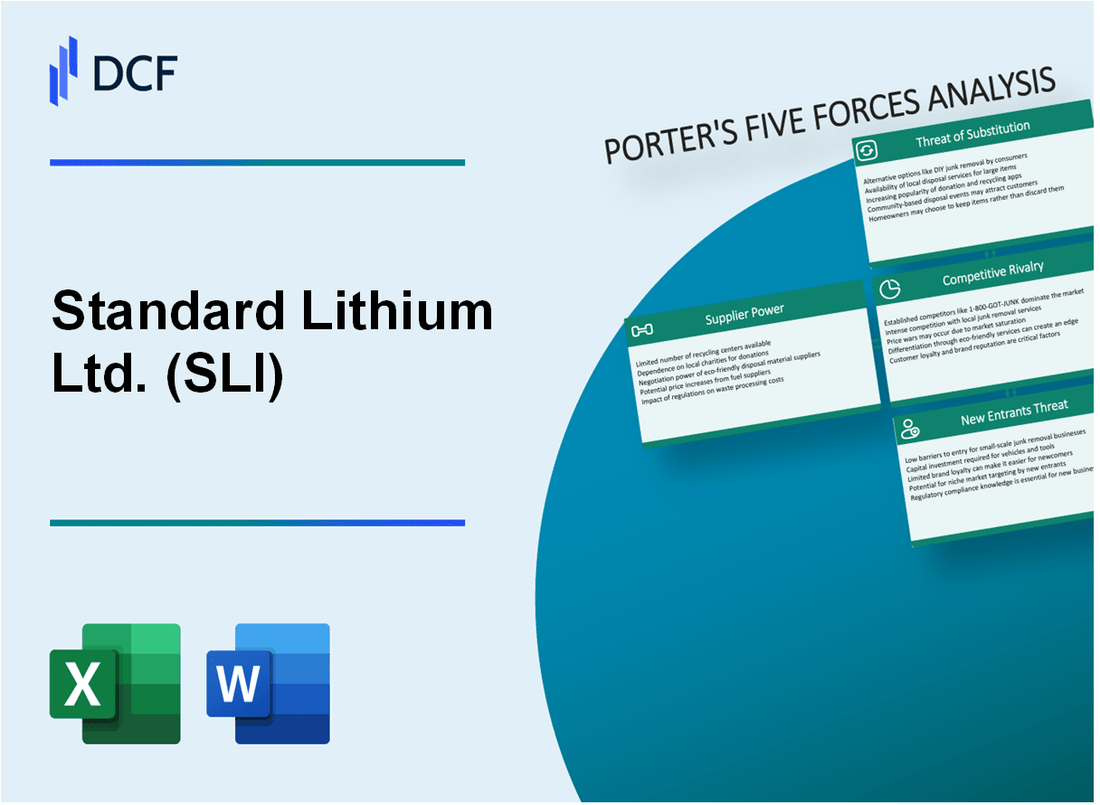
Entièrement Modifiable: Adapté À Vos Besoins Dans Excel Ou Sheets
Conception Professionnelle: Modèles Fiables Et Conformes Aux Normes Du Secteur
Pré-Construits Pour Une Utilisation Rapide Et Efficace
Compatible MAC/PC, entièrement débloqué
Aucune Expertise N'Est Requise; Facile À Suivre
Standard Lithium Ltd. (SLI) Bundle
Dans le paysage rapide de l'extraction du lithium, Standard Lithium Ltd. (SLI) se dresse au carrefour de l'innovation technologique et de la dynamique du marché. Au fur et à mesure que la demande mondiale de technologies de batterie durable augmente, la compréhension des forces complexes façonnant les activités de SLI devient cruciale. Le cadre des cinq forces de Michael Porter offre une lentille pénétrante dans l'écosystème concurrentiel de l'entreprise, révélant l'interaction complexe des fournisseurs, des clients, des rivaux, des substituts et des nouveaux entrants potentiels qui détermineront le positionnement stratégique de SLI dans le 10 milliards de dollars Marché au lithium de 2024.
Standard Lithium Ltd. (SLI) - Porter's Five Forces: Bargaining Power des fournisseurs
Fournisseurs de technologies de traitement de lithium limitées dans le monde entier
En 2024, seuls 3-4 fournisseurs mondiaux majeurs se spécialisent dans la technologie directe d'extraction au lithium (DLE), notamment:
| Fournisseur | Spécialisation technologique | Part de marché |
|---|---|---|
| Veolia Water Technologies | Filtration de membrane avancée | 32% |
| Honeywell uop | Systèmes d'extraction sélectifs | 28% |
| Chimiores | Solutions de traitement chimique | 22% |
Exigences spécialisées d'équipement et d'expertise
Les coûts spécialisés des équipements d'extraction au lithium varient entre 15 et 45 millions de dollars par unité de traitement.
- MEMBRANE TECHNOLOGIES: 22 à 28 millions de dollars par unité
- Systèmes d'échange d'ions: 25 à 35 millions de dollars par unité
- Équipement d'extraction de solvant: 30 à 45 millions de dollars par unité
Dépendance à l'égard des fournisseurs de technologies de traitement chimique avancées
Métriques de concentration du fournisseur de technologie:
| Métrique | Valeur |
|---|---|
| Nombre de fournisseurs de technologies DLE spécialisés | 4 |
| Ratio de concentration du marché mondial | 87% |
| Investissement moyen de R&D par fournisseur | 12,5 millions de dollars par an |
Coûts de commutation élevés potentiels pour des solutions technologiques uniques
Commutation des coûts pour les technologies d'extraction au lithium:
- Frais de reconfiguration de la technologie: 5 à 8 millions de dollars
- Personnel de recyclage: 1,2 à 2,5 millions de dollars
- Temps d'arrêt de la production potentielle: 3 à 6 millions de dollars par mois
Standard Lithium Ltd. (SLI) - Porter's Five Forces: Bargaining Power of Clients
Clients principaux dans la fabrication de la batterie et des véhicules électriques
En 2024, les clients primaires Standard Lithium Ltd. (SLI) incluent:
| Type de client | Part de marché | Demande annuelle de lithium |
|---|---|---|
| Fabricants de véhicules électriques | 62% | 15 000 tonnes métriques |
| Fabricants de batteries | 38% | 9 250 tonnes métriques |
Demande croissante de production de lithium durable
Mesures de demande de production de lithium durable:
- Le marché mondial du lithium durable prévu pour atteindre 8,5 milliards de dollars d'ici 2024
- Taux de croissance de la demande de lithium en énergie renouvelable: 17,3% par an
- Prime de production de lithium neutre en carbone: 22-27% au-dessus des prix standard
De grands clients et des contrats à long terme
| Client majeur | Durée du contrat | Volume annuel (tonnes métriques) |
|---|---|---|
| Tesla | 5 ans | 7,500 |
| Volkswagen | 4 ans | 5,200 |
| BMW | 3 ans | 3,800 |
Sensibilité aux prix motivée par les fluctuations mondiales du marché du lithium
Indicateurs de volatilité des prix au lithium:
- Gamme de prix au carbonate de lithium: 12 000 $ - 25 000 $ par tonne métrique
- Indice de volatilité des prix: 38,5%
- Effort de négociation des prix du client: 15-20%
Standard Lithium Ltd. (SLI) - Porter's Five Forces: Rivalry compétitif
Emerging Direct Lithium Extraction Technology Concurrent
En 2024, Standard Lithium Ltd. fait face à la concurrence de plusieurs acteurs clés de la technologie d'extraction directe au lithium:
| Entreprise | Type de technologie | Capacité estimée du projet |
|---|---|---|
| Solutions lilas | Technologie d'échange d'ions | 20 000 tonnes métriques par an |
| Energyx | Extraction à base de membrane | 15 000 tonnes métriques par an |
| Aqualung Technologies | Extraction directe avancée | 10 000 tonnes métriques par an |
Concurrence intense dans la production de lithium nord-américaine
Le paysage de production de lithium nord-américain révèle des pressions concurrentielles importantes:
- Capacité totale de production du lithium nord-américain: 87 500 tonnes métriques en 2023
- Croissance du marché projetée: 22,3% par an jusqu'en 2030
- Nombre de projets d'extraction au lithium actifs: 17
Nombre limité de projets d'extraction au lithium à l'échelle commerciale
| Région | Projets opérationnels | Capacité projetée |
|---|---|---|
| États-Unis | 6 projets à l'échelle commerciale | 45 000 tonnes métriques par an |
| Canada | 3 projets à l'échelle commerciale | 25 000 tonnes métriques par an |
Différenciation à travers des processus d'extraction innovants
Le positionnement concurrentiel du lithium standard repose sur:
- Efficacité technologique d'extraction au lithium direct (DLE): taux d'extraction de 85%
- Réduction de la consommation d'eau: 70% inférieure par rapport aux méthodes traditionnelles
- Temps de traitement: 24 à 48 heures par cycle d'extraction
Standard Lithium Ltd. (SLI) - Five Forces de Porter: Menace des substituts
Technologies de batterie alternatives
Le marché des batteries à semi-conducteurs prévoyait de 8,24 milliards de dollars d'ici 2029, augmentant à 24,2% du TCAC à partir de 2022.
| Technologie de la batterie | Taille du marché 2024 | Croissance projetée |
|---|---|---|
| Batteries à semi-conducteurs | 3,5 milliards de dollars | 24,2% CAGR |
| Batteries sodium-ion | 540 millions de dollars | CAGR 18,5% |
Technologie de batterie sodium-ion
La technologie de batterie sodium-ion devrait atteindre une valeur marchande de 1,8 milliard de dollars d'ici 2030.
- Les batteries en sodium-ion coûtent environ 50-70 $ / kWh
- Les batteries au lithium-ion coûtent actuellement 130 à 150 $ / kWh
Recherche de stockage d'énergie alternative
Le marché mondial du stockage d'énergie devrait atteindre 435,83 milliards de dollars d'ici 2031.
| Domaine de recherche | Investissement 2024 |
|---|---|
| R&D de batterie alternative | 3,2 milliards de dollars |
| Innovation du stockage d'énergie | 2,7 milliards de dollars |
Avancées technologiques
Les investissements de Batter Material Innovation devraient atteindre 5,6 milliards de dollars en 2024.
- Les technologies d'anodes à base de silicium augmentent la densité d'énergie de 30 à 40%
- Recherche de batteries en graphène montrant 5x capacités de chargement plus rapides
Standard Lithium Ltd. (SLI) - Five Forces de Porter: Menace de nouveaux entrants
Exigences de capital pour l'extraction du lithium
Standard Lithium Ltd. fait face à des obstacles en capital importants avec des coûts d'investissement initiaux estimés allant de 300 millions de dollars à 500 millions de dollars pour une installation d'extraction au lithium typique. La dépense en capital moyenne pour une nouvelle usine de transformation du lithium est d'environ 250 $ à 350 $ par tonne métrique annuelle de capacité de production équivalente (LCE).
Barrières technologiques
| Aspect technologique | Investissement requis | Niveau de complexité |
|---|---|---|
| Technologie directe d'extraction au lithium | 50 à 75 millions de dollars | Haut |
| Équipement de traitement avancé | 30 à 45 millions de dollars | Très haut |
| Techniques d'extraction propriétaires | 20 à 35 millions de dollars | Extrêmement élevé |
Exigences d'investissement des infrastructures
Les investissements clés de l'infrastructure comprennent:
- Traitement Construction des usines: 150 $ - 250 millions de dollars
- Installations de traitement de l'eau: 25 à 40 millions de dollars
- Infrastructure de transport: 30 à 50 millions de dollars
Coûts de conformité réglementaire
La conformité environnementale et réglementaire pour les projets d'extraction au lithium nécessite généralement de 20 à 35 millions de dollars en frais initiaux, avec des frais de conformité annuels en cours de 5 à 10 millions de dollars.
Barrières d'expertise technique
Les exigences d'expertise technique spécialisées comprennent:
- Expertise géologique: Salaire annuel moyen 120 000 $ - 180 000 $
- Spécialistes du génie chimique: Salaire annuel moyen 130 000 $ à 200 000 $
- Experts en optimisation des processus: Salaire annuel moyen 110 000 $ - 170 000 $
Défis d'entrée sur le marché
| Barrière d'entrée | Coût estimé | Niveau de difficulté |
|---|---|---|
| Exploration initiale | 10 à 25 millions de dollars | Haut |
| Développement du projet pilote | 50 millions de dollars | Très haut |
| Production commerciale à grande échelle | 300 à 500 millions de dollars | Extrêmement élevé |
Standard Lithium Ltd. (SLI) - Porter's Five Forces: Competitive rivalry
You're looking at a market where Standard Lithium Ltd. (SLI) is trying to carve out space against giants and nimble, tech-focused peers. The rivalry intensity is high, driven by established capacity, technological competition, and market price swings.
The competition with established, large-scale producers using traditional methods like hard rock mining and evaporation ponds is significant. These players command massive output and benefit from economies of scale, even as they face their own cost pressures. Consider the scale of these incumbents as of late 2025:
| Producer | Recent Financial/Operational Metric | Value/Amount |
|---|---|---|
| SQM | Q3 2025 Revenue | $1.17 billion |
| SQM | Raised 2025 Global Demand Growth Forecast | More than 20% |
| Albemarle (Silver Peak) | Targeted 2025 Lithium Carbonate Production Increase | From 5,000 t/y - 10,000 t/y |
| SQM (Atacama Expansion) | Potential Annual Lithium Carbonate Capacity | Up to 180,000 tonnes |
Direct rivalry is heating up with other developers focused on Direct Lithium Extraction (DLE) technology, which is the core of Standard Lithium Ltd. (SLI)'s strategy. You have to watch Lithium Americas Corp. (LAC) and American Battery Technology Company (ABTC) closely. They are all racing to commercialize and secure long-term offtake agreements.
For instance, Lithium Americas Corp. (LAC) is pushing its Thacker Pass project, targeting nominal design capacity of 40,000 tpa of battery-quality lithium carbonate from Phase 1, with mechanical completion targeted for late 2027. Meanwhile, American Battery Technology Company (ABTC) is advancing its claystone-to-lithium hydroxide process with a planned commercial-scale refinery capacity of 30,000 tonnes of lithium hydroxide per year.
Here is a snapshot of how these DLE-focused rivals are progressing on the revenue and funding fronts as of late 2025:
- American Battery Technology Company (ABTC) FY2025 Revenue: $4.3 million.
- ABTC Q4 FY2025 Revenue: Increased to $2.8 million.
- ABTC secured a U.S. DOE grant for a second recycling facility: $144 million.
- Lithium Americas Corp. (LAC) on-site construction personnel (Q3 2025): Approximately 700.
Standard Lithium Ltd. (SLI) is positioning itself on cost, which is critical in a volatile market. The Definitive Feasibility Study (DFS) for the South West Arkansas (SWA) Project projects an average cash operating cost of $4,516/t. This cost structure is intended to place Standard Lithium Ltd. (SLI) in the first cost quartile for lithium carbonate production. The all-in costs were estimated at $5,924/t, with a Class III capital expenditure estimate of $1.45 billion.
Lithium pricing itself is a major factor intensifying the rivalry, as it directly impacts the profitability of every producer. The market is grappling with volatility, with a projected oversupply of just 10,000 tonnes in 2025, a significant tightening from prior years. Still, prices have seen sharp drops; battery-grade lithium carbonate was trading around $8,329.08/mt as of June 24, 2025. Lithium hydroxide prices, for example, plummeted 89 percent between 2022 and 2025.
Standard Lithium Ltd. (SLI) - Porter's Five Forces: Threat of substitutes
You're evaluating the competitive landscape for Standard Lithium Ltd. (SLI) as it pushes toward commercial production; understanding substitutes is key to framing your risk assessment. The threat of substitution isn't just about a different product; it's about a different solution to the energy storage problem that bypasses the need for Standard Lithium Ltd.'s primary output.
Alternative Battery Chemistries for Grid Storage
Sodium-ion (Na-ion) batteries present a clear, cost-driven substitute, especially for stationary energy storage where energy density is less critical than cost and material availability. Sodium is far more abundant than lithium, which directly challenges the long-term cost structure of lithium-based materials. The market reflects this growing confidence in the alternative.
The global sodium-ion battery market was estimated to be valued at USD 410.4 Million in 2025, or potentially USD 1.82 billion depending on the reporting firm's scope for the same year. Regardless of the exact starting figure, the growth trajectory is steep, with projections showing a CAGR of 10.86% through 2034, or 19.24% through 2032, depending on the source. For grid applications, the stationary energy storage segment is expected to be a major driver, capturing an estimated 71.7% of the Na-ion market share in 2025, or 50% according to another analysis. The transportation segment, while lower density, still commands a significant portion, holding 35% of the Na-ion market share in 2025 for cost-efficient EV solutions.
Here's a quick look at how the projected market values for this substitute compare:
| Metric | Sodium-Ion Battery Market (2025 Estimate) | Sodium-Ion Battery Market (2032/2034 Projection) |
|---|---|---|
| Market Value (Source A) | USD 22.07 Bn | USD 55.26 Bn (by 2032) |
| Market Value (Source B) | USD 410.4 Million | USD 1,037.8 Million (by 2034) |
| Market Value (Source C) | USD 1.82 Billion | USD 6.25 Billion (by 2032) |
If onboarding takes 14+ days, churn risk rises, and similarly, if Na-ion cost parity arrives faster than expected, Standard Lithium Ltd.'s competitive advantage in brine extraction cost could be eroded for certain market segments.
Solid-State Battery Density Improvements
Advancements in solid-state batteries (SSBs) threaten to reduce the total lithium required per kilowatt-hour (kWh) by enabling higher energy density and potentially shifting to lithium metal anodes, which theoretically offer a 10-fold energy storage capacity increase within the anode compared to graphite. While SSBs are still scaling, the performance metrics are compelling.
For instance, some next-generation solid-state prototypes are demonstrating specific energies of 450 watt-hours per kilogram (Wh/kg). Other pilot lines are achieving specific energies of 280 Wh/kg and 310 Wh/kg. This increased energy density means that for the same vehicle range, a smaller, lighter battery pack is needed, thus lowering the overall lithium demand per vehicle, even if the chemistry remains lithium-based. The consensus suggests production cars with SSBs could be on the roads before the 2030s, though traditional lithium-ion will likely maintain the majority market share for a while longer.
Closed-Loop Supply from Battery Recycling
Increased investment in battery recycling creates a direct alternative supply stream for battery-grade materials, bypassing the need for virgin extraction like that pursued by Standard Lithium Ltd. This circular economy approach is being heavily incentivized by regulation and private capital.
The global Li-ion battery recycling market is estimated to be valued between USD 19.31 billion and USD 26.28 billion in 2025. Current global capacity is around 1.6 million tons annually, with projections indicating this will exceed 3 million tons when planned facilities come online. Regionally, Asia leads with over 1.2 million tons per year capacity, followed by Europe at 200,000 tons, and North America at 144,000 tons. A major domestic development in the U.S. saw Redwood Materials kick off operations at a new $3.5 billion battery recycling and materials-production facility in November 2025. Resource scarcity is driving this, with recycling projected to supply 20% of lithium demand by 2030.
- Recycling aims to recover critical materials like cobalt, nickel, and lithium.
- Direct recycling methods promise up to 95% recovery with low energy use.
- The U.S. Department of Energy committed $375 million to support facility construction.
- Lithium demand is projected to increase sevenfold by 2040.
Lithium's Inescapable Role (For Now)
Despite the rise of alternatives, no current technology completely removes lithium from the high-energy-density electric vehicle (EV) battery segment, which is the primary target for Standard Lithium Ltd.'s battery-quality lithium carbonate. While Na-ion is a threat for grid storage, high-performance EVs still rely on lithium chemistries, whether current NMC/LFP or future solid-state.
The SWA Project, for example, targets initial production capacity of 22,500 tonnes per annum of battery-quality lithium carbonate, with all-in costs estimated at $5,924/t. This production is aimed at a market where lithium remains indispensable for the highest performance applications. The challenge for Standard Lithium Ltd. is to maintain a cost-competitive position against both virgin brine competitors and the emerging recycling/sodium-ion threats.
Finance: draft 13-week cash view by Friday.
Standard Lithium Ltd. (SLI) - Porter's Five Forces: Threat of new entrants
The threat of new entrants for Standard Lithium Ltd. remains relatively low, primarily due to the massive financial and technological hurdles required to establish a comparable domestic lithium brine operation in the United States as of late 2025.
Extremely high capital barrier to entry, with SWA Phase 1 capex at $1.45 billion.
Entering the commercial-scale Direct Lithium Extraction (DLE) space requires capital commitments that immediately screen out most smaller players. The Definitive Feasibility Study (DFS) for the South West Arkansas (SWA) Project pegs the all-in Class III capital expenditure (capex) estimate at $1.45 billion for Phase 1 alone. This figure, informed by an 18-month front-end engineering design, sets a formidable initial cost base for any competitor looking to replicate Standard Lithium Ltd.'s scale. Furthermore, the project is structured as a joint venture where Standard Lithium Ltd. holds a 55% stake, with its partner, Equinor, holding the remaining 45%, indicating the necessity of securing major, well-capitalized partners.
The required investment level is starkly illustrated when compared to the company's recent liquidity:
| Metric | Value (as of Q3 2025) |
| SWA Phase 1 Estimated CAPEX (Class III) | $1.45 billion |
| DOE Grant Secured (Conditional) | $225 million |
| Cash and Working Capital (Q3 2025) | $32.1 million |
| Recent Equity Raise | $130 million |
Need for proprietary, proven Direct Lithium Extraction (DLE) technology is a significant hurdle.
New entrants cannot simply rely on older, slower extraction methods; the market demands the efficiency of DLE. Standard Lithium Ltd. is advancing with the Aquatech Lithium Selective Sorption (LSS) process, which has demonstrated strong operational metrics in its demonstration plant. This de-risked technology provides a clear advantage over a newcomer who would need to prove their own novel DLE process at a commercial scale.
- Average lithium recovery efficiency achieved: 95.4%
- Average key contaminant rejection: +99%
- Operational cycles completed at demo plant: Nearly 10,000
You're looking at a company that has already processed over 24 million gallons of brine using the technology they plan to deploy commercially. That operational history is a massive barrier.
Long project development timelines, with first production targeted in 2028, deter new players.
The time required to move from resource definition to cash flow is extensive, which tests the patience and funding runway of potential competitors. Standard Lithium Ltd.'s SWA Phase 1 is targeting first commercial production in 2028, following a targeted Final Investment Decision (FID) by the end of 2025. This multi-year development cycle, involving detailed engineering, permitting, and construction, means a new entrant would likely not see revenue until the late 2020s or early 2030s, assuming they started today.
Favorable U.S. government grants, like the $225 million DOE grant, favor incumbent domestic projects.
The U.S. government is actively de-risking projects deemed critical to the domestic supply chain, creating a 'first-mover' advantage for established developers. Standard Lithium Ltd. and Equinor finalized a $225 million conditional grant from the U.S. Department of Energy (DOE) to support the construction of SWA Phase 1. This non-dilutive funding significantly lowers the effective capital burden for Standard Lithium Ltd. and signals strong regulatory endorsement, which is difficult for a brand-new entrant to secure quickly. The project is also expected to create approximately 100 direct, long-term jobs and 300 construction jobs, further cementing local and federal support.
Disclaimer
All information, articles, and product details provided on this website are for general informational and educational purposes only. We do not claim any ownership over, nor do we intend to infringe upon, any trademarks, copyrights, logos, brand names, or other intellectual property mentioned or depicted on this site. Such intellectual property remains the property of its respective owners, and any references here are made solely for identification or informational purposes, without implying any affiliation, endorsement, or partnership.
We make no representations or warranties, express or implied, regarding the accuracy, completeness, or suitability of any content or products presented. Nothing on this website should be construed as legal, tax, investment, financial, medical, or other professional advice. In addition, no part of this site—including articles or product references—constitutes a solicitation, recommendation, endorsement, advertisement, or offer to buy or sell any securities, franchises, or other financial instruments, particularly in jurisdictions where such activity would be unlawful.
All content is of a general nature and may not address the specific circumstances of any individual or entity. It is not a substitute for professional advice or services. Any actions you take based on the information provided here are strictly at your own risk. You accept full responsibility for any decisions or outcomes arising from your use of this website and agree to release us from any liability in connection with your use of, or reliance upon, the content or products found herein.