
|
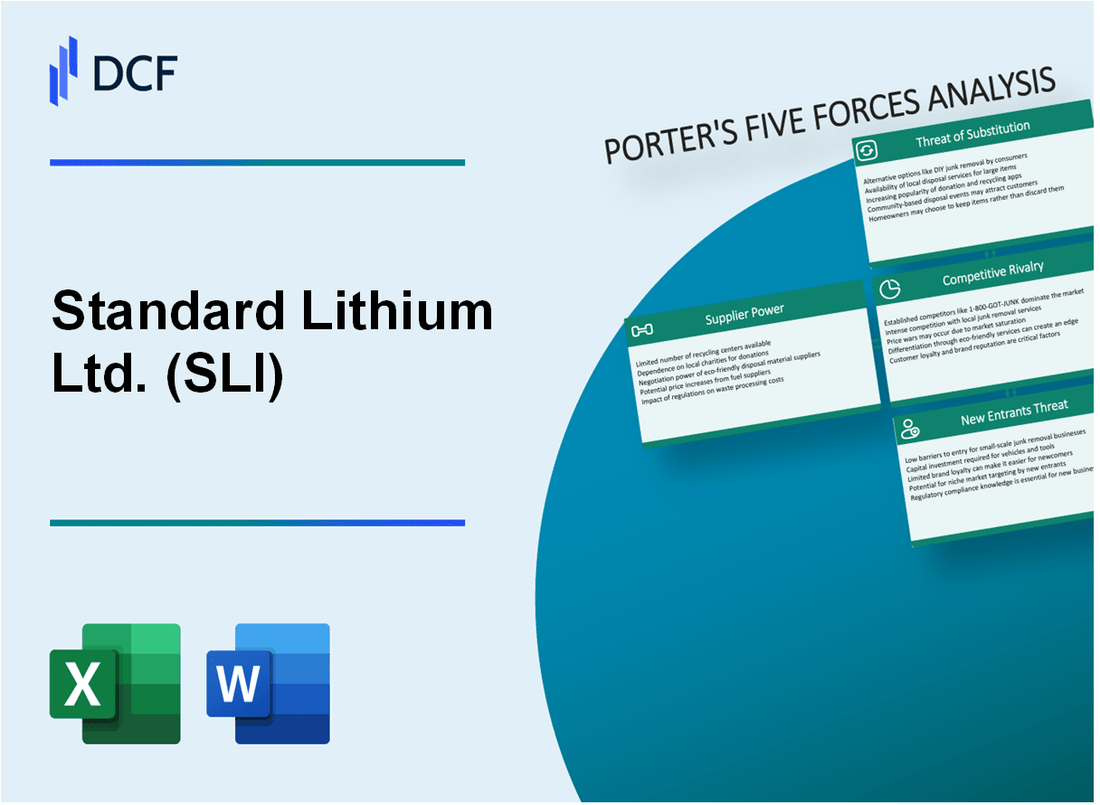
Standard Lithium Ltd. (SLI): 5 forças Análise [Jan-2025 Atualizada] |
Totalmente Editável: Adapte-Se Às Suas Necessidades No Excel Ou Planilhas
Design Profissional: Modelos Confiáveis E Padrão Da Indústria
Pré-Construídos Para Uso Rápido E Eficiente
Compatível com MAC/PC, totalmente desbloqueado
Não É Necessária Experiência; Fácil De Seguir
Standard Lithium Ltd. (SLI) Bundle
Na paisagem em rápida evolução da extração de lítio, a Standard Lithium Ltd. (SLI) fica na encruzilhada da inovação tecnológica e da dinâmica do mercado. À medida que a demanda global por tecnologias de bateria sustentável aumenta, entender as forças complexas que moldam os negócios da SLI se torna crucial. A estrutura das cinco forças de Michael Porter oferece uma lente penetrante no ecossistema competitivo da empresa, revelando a complexa interação de fornecedores, clientes, rivais, substitutos e novos participantes em potencial que determinarão o posicionamento estratégico da SLI no US $ 10 bilhões Mercado de lítio de 2024.
Standard Lithium Ltd. (SLI) - As cinco forças de Porter: poder de barganha dos fornecedores
Fornecedores de tecnologia de processamento de lítio limitados globalmente
A partir de 2024, apenas 3-4 principais fornecedores globais são especializados em tecnologia direta de extração de lítio (DLE), incluindo:
| Fornecedor | Especialização em tecnologia | Quota de mercado |
|---|---|---|
| VEOLIA TECHNOLOGIAS DE ÁGUA | Filtração avançada da membrana | 32% |
| Honeywell Uop | Sistemas de extração seletiva | 28% |
| Chemours | Soluções de processamento químico | 22% |
Requisitos de equipamentos e conhecimentos especializados
Os custos especializados de equipamentos de extração de lítio variam entre US $ 15 milhões e US $ 45 milhões por unidade de processamento.
- Tecnologias de membrana: US $ 22-28 milhões por unidade
- Sistemas de troca iônica: US $ 25-35 milhões por unidade
- Equipamento de extração de solvente: US $ 30-45 milhões por unidade
Dependência de fornecedores avançados de tecnologia de processamento químico
Métricas de concentração de provedores de tecnologia:
| Métrica | Valor |
|---|---|
| Número de provedores de tecnologia DLE especializados | 4 |
| Taxa de concentração de mercado global | 87% |
| Investimento médio de P&D por provedor | US $ 12,5 milhões anualmente |
Potenciais custos de troca de soluções tecnológicas exclusivas
Custos de troca de tecnologias de extração de lítio:
- Despesas de reconfiguração de tecnologia: US $ 5-8 milhões
- Pessoal de reciclagem: US $ 1,2-2,5 milhão
- Tempo de inatividade potencial de produção: US $ 3-6 milhões por mês
Standard Lithium Ltd. (SLI) - As cinco forças de Porter: poder de barganha dos clientes
Clientes principais em fabricação de bateria e veículos elétricos
A partir de 2024, os clientes primários da Standard Lithium Ltd. (SLI) incluem:
| Tipo de cliente | Quota de mercado | Demanda anual de lítio |
|---|---|---|
| Fabricantes de veículos elétricos | 62% | 15.000 toneladas métricas |
| Fabricantes de baterias | 38% | 9.250 toneladas métricas |
Crescente demanda por produção sustentável de lítio
Métricas sustentáveis de demanda de produção de lítio:
- O mercado global de lítio sustentável projetado para atingir US $ 8,5 bilhões até 2024
- Taxa de crescimento da demanda de lítio de energia renovável: 17,3% anualmente
- Prêmio de produção de lítio neutro em carbono: 22-27% acima dos preços padrão
Grandes clientes e contratos de longo prazo
| Principal cliente | Duração do contrato | Volume anual (toneladas métricas) |
|---|---|---|
| Tesla | 5 anos | 7,500 |
| Volkswagen | 4 anos | 5,200 |
| BMW | 3 anos | 3,800 |
Sensibilidade ao preço impulsionada pelas flutuações globais do mercado de lítio
Indicadores de volatilidade do preço do lítio:
- Faixa de preço do carbonato de lítio: US $ 12.000 - US $ 25.000 por tonelada
- Índice de Volatilidade dos Preços: 38,5%
- Negociação do preço do cliente Alavancagem: 15-20%
Standard Lithium Ltd. (SLI) - As cinco forças de Porter: rivalidade competitiva
Concorrentes emergentes de tecnologia direta de extração de lítio
A partir de 2024, a Standard Lithium Ltd. enfrenta a concorrência de vários participantes importantes na tecnologia direta de extração de lítio:
| Empresa | Tipo de tecnologia | Capacidade estimada do projeto |
|---|---|---|
| Soluções lilás | Tecnologia de troca de íons | 20.000 toneladas métricas por ano |
| Energyx | Extração baseada em membrana | 15.000 toneladas métricas por ano |
| Aqualung Technologies | Extração direta avançada | 10.000 toneladas métricas por ano |
Concorrência intensa na produção norte -americana de lítio
O cenário da produção de lítio norte -americano revela pressões competitivas significativas:
- Capacidade total de produção de lítio norte -americana: 87.500 toneladas métricas em 2023
- Crescimento do mercado projetado: 22,3% anualmente até 2030
- Número de projetos ativos de extração de lítio: 17
Número limitado de projetos de extração de lítio em escala comercial
| Região | Projetos operacionais | Capacidade projetada |
|---|---|---|
| Estados Unidos | 6 projetos de escala comercial | 45.000 toneladas métricas por ano |
| Canadá | 3 projetos de escala comercial | 25.000 toneladas métricas por ano |
Diferenciação através de processos de extração inovadores
O posicionamento competitivo do lítio padrão depende de:
- Eficiência tecnológica direta de extração de lítio (DLE): taxa de extração de 85%
- Redução do consumo de água: 70% menor em comparação aos métodos tradicionais
- Tempo de processamento: 24-48 horas por ciclo de extração
Standard Lithium Ltd. (SLI) - As cinco forças de Porter: ameaça de substitutos
Tecnologias alternativas de bateria
O mercado de baterias de estado sólido se projetou para atingir US $ 8,24 bilhões até 2029, crescendo a 24,2% da CAGR de 2022.
| Tecnologia da bateria | Tamanho do mercado 2024 | Crescimento projetado |
|---|---|---|
| Baterias de estado sólido | US $ 3,5 bilhões | 24,2% CAGR |
| Baterias de íons de sódio | US $ 540 milhões | 18,5% CAGR |
Tecnologia de bateria de íons de sódio
A tecnologia de bateria de íons de sódio que atinge um valor de mercado de US $ 1,8 bilhão até 2030.
- As baterias de íons de sódio custam aproximadamente US $ 50-70/kWh
- Atualmente, as baterias de íons de lítio custam US $ 130-150/kWh
Pesquisa alternativa de armazenamento de energia
O mercado global de armazenamento de energia se projetou para atingir US $ 435,83 bilhões até 2031.
| Área de pesquisa | Investimento 2024 |
|---|---|
| P&D da bateria alternativa | US $ 3,2 bilhões |
| Inovação de armazenamento de energia | US $ 2,7 bilhões |
Avanços tecnológicos
Os investimentos em inovação de materiais da bateria que devem atingir US $ 5,6 bilhões em 2024.
- Tecnologias de ânodo à base de silício aumentando a densidade de energia em 30-40%
- Pesquisa de bateria de grafeno mostrando 5x recursos de carregamento mais rápidos
Standard Lithium Ltd. (SLI) - As cinco forças de Porter: ameaça de novos participantes
Requisitos de capital para extração de lítio
A Standard Lithium Ltd. enfrenta barreiras de capital significativas com custos iniciais estimados de investimento que variam de US $ 300 milhões a US $ 500 milhões para uma instalação típica de extração de lítio. O gasto médio de capital para uma nova planta de processamento de lítio é de aproximadamente US $ 250 a US $ 350 por tonelada métrica anual de capacidade de produção equivalente a carbonato de lítio (LCE).
Barreiras tecnológicas
| Aspecto tecnológico | Investimento necessário | Nível de complexidade |
|---|---|---|
| Tecnologia direta de extração de lítio | $ 50- $ 75 milhões | Alto |
| Equipamento de processamento avançado | US $ 30 a US $ 45 milhões | Muito alto |
| Técnicas de extração proprietárias | US $ 20 a US $ 35 milhões | Extremamente alto |
Requisitos de investimento em infraestrutura
Os principais investimentos em infraestrutura incluem:
- Processando a construção da planta: US $ 150 a US $ 250 milhões
- Instalações de tratamento de água: US $ 25 a US $ 40 milhões
- Infraestrutura de transporte: US $ 30 a US $ 50 milhões
Custos de conformidade regulatória
A conformidade ambiental e regulatória para projetos de extração de lítio normalmente exigem US $ 20 a US $ 35 milhões em custos iniciais, com despesas anuais de conformidade em andamento de US $ 5 a US $ 10 milhões.
Barreiras de conhecimento técnico
Os requisitos especializados de conhecimento técnico incluem:
- Experiência geológica: Salário médio anual $ 120.000 a US $ 180.000
- Especialistas em engenharia química: Salário médio anual $ 130.000 a US $ 200.000
- Especialistas em otimização de processos: Salário médio anual $ 110.000 a US $ 170.000
Desafios de entrada no mercado
| Barreira de entrada | Custo estimado | Nível de dificuldade |
|---|---|---|
| Exploração inicial | US $ 10 a US $ 25 milhões | Alto |
| Desenvolvimento de projetos piloto | US $ 50- $ 100 milhões | Muito alto |
| Produção comercial em larga escala | $ 300- $ 500 milhões | Extremamente alto |
Standard Lithium Ltd. (SLI) - Porter's Five Forces: Competitive rivalry
You're looking at a market where Standard Lithium Ltd. (SLI) is trying to carve out space against giants and nimble, tech-focused peers. The rivalry intensity is high, driven by established capacity, technological competition, and market price swings.
The competition with established, large-scale producers using traditional methods like hard rock mining and evaporation ponds is significant. These players command massive output and benefit from economies of scale, even as they face their own cost pressures. Consider the scale of these incumbents as of late 2025:
| Producer | Recent Financial/Operational Metric | Value/Amount |
|---|---|---|
| SQM | Q3 2025 Revenue | $1.17 billion |
| SQM | Raised 2025 Global Demand Growth Forecast | More than 20% |
| Albemarle (Silver Peak) | Targeted 2025 Lithium Carbonate Production Increase | From 5,000 t/y - 10,000 t/y |
| SQM (Atacama Expansion) | Potential Annual Lithium Carbonate Capacity | Up to 180,000 tonnes |
Direct rivalry is heating up with other developers focused on Direct Lithium Extraction (DLE) technology, which is the core of Standard Lithium Ltd. (SLI)'s strategy. You have to watch Lithium Americas Corp. (LAC) and American Battery Technology Company (ABTC) closely. They are all racing to commercialize and secure long-term offtake agreements.
For instance, Lithium Americas Corp. (LAC) is pushing its Thacker Pass project, targeting nominal design capacity of 40,000 tpa of battery-quality lithium carbonate from Phase 1, with mechanical completion targeted for late 2027. Meanwhile, American Battery Technology Company (ABTC) is advancing its claystone-to-lithium hydroxide process with a planned commercial-scale refinery capacity of 30,000 tonnes of lithium hydroxide per year.
Here is a snapshot of how these DLE-focused rivals are progressing on the revenue and funding fronts as of late 2025:
- American Battery Technology Company (ABTC) FY2025 Revenue: $4.3 million.
- ABTC Q4 FY2025 Revenue: Increased to $2.8 million.
- ABTC secured a U.S. DOE grant for a second recycling facility: $144 million.
- Lithium Americas Corp. (LAC) on-site construction personnel (Q3 2025): Approximately 700.
Standard Lithium Ltd. (SLI) is positioning itself on cost, which is critical in a volatile market. The Definitive Feasibility Study (DFS) for the South West Arkansas (SWA) Project projects an average cash operating cost of $4,516/t. This cost structure is intended to place Standard Lithium Ltd. (SLI) in the first cost quartile for lithium carbonate production. The all-in costs were estimated at $5,924/t, with a Class III capital expenditure estimate of $1.45 billion.
Lithium pricing itself is a major factor intensifying the rivalry, as it directly impacts the profitability of every producer. The market is grappling with volatility, with a projected oversupply of just 10,000 tonnes in 2025, a significant tightening from prior years. Still, prices have seen sharp drops; battery-grade lithium carbonate was trading around $8,329.08/mt as of June 24, 2025. Lithium hydroxide prices, for example, plummeted 89 percent between 2022 and 2025.
Standard Lithium Ltd. (SLI) - Porter's Five Forces: Threat of substitutes
You're evaluating the competitive landscape for Standard Lithium Ltd. (SLI) as it pushes toward commercial production; understanding substitutes is key to framing your risk assessment. The threat of substitution isn't just about a different product; it's about a different solution to the energy storage problem that bypasses the need for Standard Lithium Ltd.'s primary output.
Alternative Battery Chemistries for Grid Storage
Sodium-ion (Na-ion) batteries present a clear, cost-driven substitute, especially for stationary energy storage where energy density is less critical than cost and material availability. Sodium is far more abundant than lithium, which directly challenges the long-term cost structure of lithium-based materials. The market reflects this growing confidence in the alternative.
The global sodium-ion battery market was estimated to be valued at USD 410.4 Million in 2025, or potentially USD 1.82 billion depending on the reporting firm's scope for the same year. Regardless of the exact starting figure, the growth trajectory is steep, with projections showing a CAGR of 10.86% through 2034, or 19.24% through 2032, depending on the source. For grid applications, the stationary energy storage segment is expected to be a major driver, capturing an estimated 71.7% of the Na-ion market share in 2025, or 50% according to another analysis. The transportation segment, while lower density, still commands a significant portion, holding 35% of the Na-ion market share in 2025 for cost-efficient EV solutions.
Here's a quick look at how the projected market values for this substitute compare:
| Metric | Sodium-Ion Battery Market (2025 Estimate) | Sodium-Ion Battery Market (2032/2034 Projection) |
|---|---|---|
| Market Value (Source A) | USD 22.07 Bn | USD 55.26 Bn (by 2032) |
| Market Value (Source B) | USD 410.4 Million | USD 1,037.8 Million (by 2034) |
| Market Value (Source C) | USD 1.82 Billion | USD 6.25 Billion (by 2032) |
If onboarding takes 14+ days, churn risk rises, and similarly, if Na-ion cost parity arrives faster than expected, Standard Lithium Ltd.'s competitive advantage in brine extraction cost could be eroded for certain market segments.
Solid-State Battery Density Improvements
Advancements in solid-state batteries (SSBs) threaten to reduce the total lithium required per kilowatt-hour (kWh) by enabling higher energy density and potentially shifting to lithium metal anodes, which theoretically offer a 10-fold energy storage capacity increase within the anode compared to graphite. While SSBs are still scaling, the performance metrics are compelling.
For instance, some next-generation solid-state prototypes are demonstrating specific energies of 450 watt-hours per kilogram (Wh/kg). Other pilot lines are achieving specific energies of 280 Wh/kg and 310 Wh/kg. This increased energy density means that for the same vehicle range, a smaller, lighter battery pack is needed, thus lowering the overall lithium demand per vehicle, even if the chemistry remains lithium-based. The consensus suggests production cars with SSBs could be on the roads before the 2030s, though traditional lithium-ion will likely maintain the majority market share for a while longer.
Closed-Loop Supply from Battery Recycling
Increased investment in battery recycling creates a direct alternative supply stream for battery-grade materials, bypassing the need for virgin extraction like that pursued by Standard Lithium Ltd. This circular economy approach is being heavily incentivized by regulation and private capital.
The global Li-ion battery recycling market is estimated to be valued between USD 19.31 billion and USD 26.28 billion in 2025. Current global capacity is around 1.6 million tons annually, with projections indicating this will exceed 3 million tons when planned facilities come online. Regionally, Asia leads with over 1.2 million tons per year capacity, followed by Europe at 200,000 tons, and North America at 144,000 tons. A major domestic development in the U.S. saw Redwood Materials kick off operations at a new $3.5 billion battery recycling and materials-production facility in November 2025. Resource scarcity is driving this, with recycling projected to supply 20% of lithium demand by 2030.
- Recycling aims to recover critical materials like cobalt, nickel, and lithium.
- Direct recycling methods promise up to 95% recovery with low energy use.
- The U.S. Department of Energy committed $375 million to support facility construction.
- Lithium demand is projected to increase sevenfold by 2040.
Lithium's Inescapable Role (For Now)
Despite the rise of alternatives, no current technology completely removes lithium from the high-energy-density electric vehicle (EV) battery segment, which is the primary target for Standard Lithium Ltd.'s battery-quality lithium carbonate. While Na-ion is a threat for grid storage, high-performance EVs still rely on lithium chemistries, whether current NMC/LFP or future solid-state.
The SWA Project, for example, targets initial production capacity of 22,500 tonnes per annum of battery-quality lithium carbonate, with all-in costs estimated at $5,924/t. This production is aimed at a market where lithium remains indispensable for the highest performance applications. The challenge for Standard Lithium Ltd. is to maintain a cost-competitive position against both virgin brine competitors and the emerging recycling/sodium-ion threats.
Finance: draft 13-week cash view by Friday.
Standard Lithium Ltd. (SLI) - Porter's Five Forces: Threat of new entrants
The threat of new entrants for Standard Lithium Ltd. remains relatively low, primarily due to the massive financial and technological hurdles required to establish a comparable domestic lithium brine operation in the United States as of late 2025.
Extremely high capital barrier to entry, with SWA Phase 1 capex at $1.45 billion.
Entering the commercial-scale Direct Lithium Extraction (DLE) space requires capital commitments that immediately screen out most smaller players. The Definitive Feasibility Study (DFS) for the South West Arkansas (SWA) Project pegs the all-in Class III capital expenditure (capex) estimate at $1.45 billion for Phase 1 alone. This figure, informed by an 18-month front-end engineering design, sets a formidable initial cost base for any competitor looking to replicate Standard Lithium Ltd.'s scale. Furthermore, the project is structured as a joint venture where Standard Lithium Ltd. holds a 55% stake, with its partner, Equinor, holding the remaining 45%, indicating the necessity of securing major, well-capitalized partners.
The required investment level is starkly illustrated when compared to the company's recent liquidity:
| Metric | Value (as of Q3 2025) |
| SWA Phase 1 Estimated CAPEX (Class III) | $1.45 billion |
| DOE Grant Secured (Conditional) | $225 million |
| Cash and Working Capital (Q3 2025) | $32.1 million |
| Recent Equity Raise | $130 million |
Need for proprietary, proven Direct Lithium Extraction (DLE) technology is a significant hurdle.
New entrants cannot simply rely on older, slower extraction methods; the market demands the efficiency of DLE. Standard Lithium Ltd. is advancing with the Aquatech Lithium Selective Sorption (LSS) process, which has demonstrated strong operational metrics in its demonstration plant. This de-risked technology provides a clear advantage over a newcomer who would need to prove their own novel DLE process at a commercial scale.
- Average lithium recovery efficiency achieved: 95.4%
- Average key contaminant rejection: +99%
- Operational cycles completed at demo plant: Nearly 10,000
You're looking at a company that has already processed over 24 million gallons of brine using the technology they plan to deploy commercially. That operational history is a massive barrier.
Long project development timelines, with first production targeted in 2028, deter new players.
The time required to move from resource definition to cash flow is extensive, which tests the patience and funding runway of potential competitors. Standard Lithium Ltd.'s SWA Phase 1 is targeting first commercial production in 2028, following a targeted Final Investment Decision (FID) by the end of 2025. This multi-year development cycle, involving detailed engineering, permitting, and construction, means a new entrant would likely not see revenue until the late 2020s or early 2030s, assuming they started today.
Favorable U.S. government grants, like the $225 million DOE grant, favor incumbent domestic projects.
The U.S. government is actively de-risking projects deemed critical to the domestic supply chain, creating a 'first-mover' advantage for established developers. Standard Lithium Ltd. and Equinor finalized a $225 million conditional grant from the U.S. Department of Energy (DOE) to support the construction of SWA Phase 1. This non-dilutive funding significantly lowers the effective capital burden for Standard Lithium Ltd. and signals strong regulatory endorsement, which is difficult for a brand-new entrant to secure quickly. The project is also expected to create approximately 100 direct, long-term jobs and 300 construction jobs, further cementing local and federal support.
Disclaimer
All information, articles, and product details provided on this website are for general informational and educational purposes only. We do not claim any ownership over, nor do we intend to infringe upon, any trademarks, copyrights, logos, brand names, or other intellectual property mentioned or depicted on this site. Such intellectual property remains the property of its respective owners, and any references here are made solely for identification or informational purposes, without implying any affiliation, endorsement, or partnership.
We make no representations or warranties, express or implied, regarding the accuracy, completeness, or suitability of any content or products presented. Nothing on this website should be construed as legal, tax, investment, financial, medical, or other professional advice. In addition, no part of this site—including articles or product references—constitutes a solicitation, recommendation, endorsement, advertisement, or offer to buy or sell any securities, franchises, or other financial instruments, particularly in jurisdictions where such activity would be unlawful.
All content is of a general nature and may not address the specific circumstances of any individual or entity. It is not a substitute for professional advice or services. Any actions you take based on the information provided here are strictly at your own risk. You accept full responsibility for any decisions or outcomes arising from your use of this website and agree to release us from any liability in connection with your use of, or reliance upon, the content or products found herein.