

|
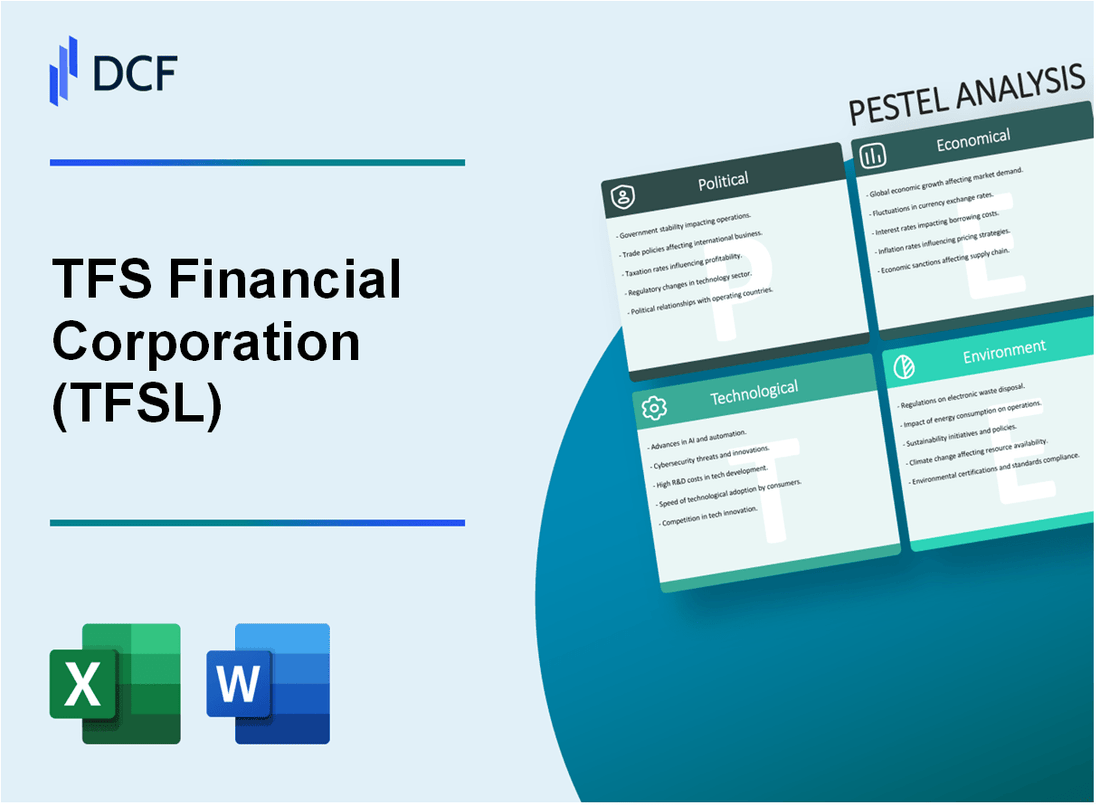
TFS Financial Corporation (TFSL): Analyse de Pestle [Jan-2025 mise à jour] |
Entièrement Modifiable: Adapté À Vos Besoins Dans Excel Ou Sheets
Conception Professionnelle: Modèles Fiables Et Conformes Aux Normes Du Secteur
Pré-Construits Pour Une Utilisation Rapide Et Efficace
Compatible MAC/PC, entièrement débloqué
Aucune Expertise N'Est Requise; Facile À Suivre
TFS Financial Corporation (TFSL) Bundle
Plongez dans le monde complexe de TFS Financial Corporation (TFSL), où la banque répond à la complexité stratégique. Dans cette analyse complète des pilons, nous démêlons le paysage multiforme qui façonne le parcours de l'institution financière basée sur l'Ohio, explorant l'interaction dynamique des réglementations politiques, des défis économiques, des changements sociétaux, des innovations technologiques, des cadres juridiques et des considérations environnementales qui définissent son écosystème opérationnel. Découvrez comment TFSL navigue dans ces domaines interconnectés pour maintenir son bord concurrentiel et sa mission axée sur la communauté.
TFS Financial Corporation (TFSL) - Analyse du pilon: facteurs politiques
Surveillance réglementaire
TFS Financial Corporation est réglementée par deux principales agences fédérales:
| Agence de réglementation | Fonction de surveillance primaire |
|---|---|
| Réserve fédérale | Politique monétaire et supervision bancaire |
| Bureau du contrôleur de la monnaie | Règlement de la Banque nationale et de la Federal Savings Association |
Sensibilité à la politique bancaire fédérale
Les principaux domaines politiques affectant les Financières TFS comprennent:
- Règlement sur les taux d'intérêt fédéral
- Exigences de réserve de capital
- Normes de prêt
- Protocoles de gestion des risques
Impact fédéral de la législation sur le logement et les prêts
Changements législatifs potentiels qui pourraient avoir un impact sur le TFS financier:
| Domaine législatif | Impact potentiel |
|---|---|
| Dodd-Frank Wall Street Reform | Augmentation des exigences de conformité |
| Loi sur le réinvestissement communautaire | Obligations de prêt et d'investissement |
Conformité de la Loi sur le réinvestissement communautaire
Les exigences de conformité comprennent:
- Prêts à des quartiers à revenu faible et modéré
- Investissement dans le développement communautaire
- Fournir des services financiers à tous les segments communautaires
Métriques de la conformité réglementaire
| Métrique de conformité | Performance de 2023 |
|---|---|
| Cote de l'ARC | Satisfaisant |
| Fréquence d'examen réglementaire | Annuel |
| Actions d'application de la conformité | 0 en 2023 |
TFS Financial Corporation (TFSL) - Analyse du pilon: facteurs économiques
Marché des services bancaires et financiers de l'Ohio
TFS Financial Corporation opère principalement sur le marché bancaire de l'Ohio en mettant l'accent sur la région métropolitaine de Cleveland. Au quatrième trimestre 2023, la société a maintenu 19,3 milliards de dollars d'actifs totaux et 16,7 milliards de dollars de dépôts totaux.
Conditions économiques régionales
| Indicateur économique | Valeur de l'Ohio State | Comparaison nationale |
|---|---|---|
| Taux de chômage | 4.1% | 4,0% (moyenne nationale) |
| Revenu médian des ménages | $62,262 | 70 784 $ (médiane nationale) |
| Taux de croissance du PIB | 2.3% | 2,5% (taux national) |
Impact des taux d'intérêt
Taux des fonds fédéraux en janvier 2024: 5,33%. Revenu net des intérêts pour TFS Financial en 2023: 387,4 millions de dollars.
Inflation et croissance économique
| Paramètre économique | Valeur 2023 | 2024 projection |
|---|---|---|
| Taux d'inflation | 3.4% | 2,7% (projeté) |
| Volume de prêt immobilier | 12,4 milliards de dollars | 13,1 milliards de dollars (projetés) |
| Origine hypothécaire | 3,6 milliards de dollars | 3,9 milliards de dollars (projetés) |
Métriques de performance financière
- Retour des capitaux propres (ROE): 8,7%
- Revenu net: 168,2 millions de dollars
- Portefeuille de prêts: 15,6 milliards de dollars
TFS Financial Corporation (TFSL) - Analyse du pilon: facteurs sociaux
Servir les besoins bancaires communautaires locaux
TFS Financial Corporation opère principalement dans l'Ohio, avec 141 succursales en 2023. La banque dessert environ 1,2 million de clients dans la région métropolitaine de Cleveland et les régions environnantes.
| Métrique du marché | Valeur |
|---|---|
| Total des succursales | 141 |
| Clientèle | 1,200,000 |
| Région de service primaire | Région métropolitaine de Cleveland |
Chart démographique en Ohio
La population de l'Ohio à 2022 était de 11 756 058, avec un âge médian de 39,4 ans. L'État a connu une baisse de la population de 2,3% entre 2010 et 2010.
| Indicateur démographique | Valeur |
|---|---|
| Population totale de l'État | 11,756,058 |
| Âge médian | 39,4 ans |
| Changement de population (2010-2020) | -2.3% |
Préférences bancaires numériques
Taux d'adoption des banques numériques Afficher 78% des résidents de l'Ohio utilisent les services bancaires en ligne, avec 62% préférant les applications bancaires mobiles.
| Métrique bancaire numérique | Pourcentage |
|---|---|
| Utilisation des services bancaires en ligne | 78% |
| Préférence des banques mobiles | 62% |
Confiance des clients et axé sur la communauté
TFS Financial Corporation a déclaré 7,2 milliards de dollars d'actifs totaux en 2023, avec une note de réinvestissement communautaire de «satisfaisant» des régulateurs fédéraux.
| Métrique financière | Valeur |
|---|---|
| Actif total | $7,200,000,000 |
| Note de réinvestissement communautaire | Satisfaisant |
TFS Financial Corporation (TFSL) - Analyse du pilon: facteurs technologiques
Investir dans les plateformes bancaires numériques et le développement d'applications mobiles
TFS Financial Corporation a déclaré que des investissements de 2,45 millions de dollars dans la technologie des banques numériques en 2023. Les téléchargements des applications bancaires mobiles ont augmenté de 22,7% en glissement annuel. Le volume des transactions numériques a atteint 1,3 million de transactions par trimestre.
| Catégorie d'investissement technologique | 2023 dépenses | Croissance d'une année à l'autre |
|---|---|---|
| Plateforme de banque mobile | 1,2 million de dollars | 18.5% |
| Infrastructure bancaire en ligne | $850,000 | 15.3% |
| Systèmes de sécurité numérique | $400,000 | 12.7% |
Mise en œuvre des mesures de cybersécurité pour protéger les données financières des clients
L'allocation budgétaire de la cybersécurité pour 2024 s'élève à 3,1 millions de dollars. Zero a signalé des violations de données en 2023. Implémentation d'authentification multi-facteurs pour 98,6% des utilisateurs de la banque numérique.
| Métrique de la cybersécurité | Performance de 2023 |
|---|---|
| Incidents de violation de données | 0 |
| Couverture d'authentification multi-facteurs | 98.6% |
| Investissement en cybersécurité | 3,1 millions de dollars |
Adopter des technologies automatisées de prêts et d'évaluation du crédit
La technologie de prêt automatisée a réduit le temps de traitement des prêts de 47%. Les algorithmes d'évaluation des crédits basés sur l'IA ont augmenté la précision de l'approbation à 92,3%. Investissement technologique dans les plateformes de prêt: 1,75 million de dollars en 2023.
| Métrique technologique de prêt | Performance de 2023 |
|---|---|
| Réduction du temps de traitement des prêts | 47% |
| Précision d'évaluation du crédit | 92.3% |
| Investissement technologique de prêt | 1,75 million de dollars |
Exploration de l'intelligence artificielle pour le service client et l'efficacité opérationnelle
Les chatbots du service client alimenté en AI gèrent 62,4% des demandes des clients. Réduction des coûts opérationnels à la mise en œuvre de l'IA: 18,5%. Investissement en technologie d'apprentissage automatique: 2,3 millions de dollars en 2023.
| Métrique de mise en œuvre de l'IA | Performance de 2023 |
|---|---|
| Automatisation de la demande du client | 62.4% |
| Réduction des coûts opérationnels | 18.5% |
| Investissement technologique AI | 2,3 millions de dollars |
TFS Financial Corporation (TFSL) - Analyse du pilon: facteurs juridiques
Conformité aux réglementations bancaires fédérales et aux exigences de déclaration
TFS Financial Corporation est soumise à une surveillance réglementaire complète de plusieurs agences fédérales. Depuis 2024, la société doit se conformer aux réglementations de la Réserve fédérale, Bureau du contrôleur de la monnaie (OCC) et Securities and Exchange Commission (SEC).
| Agence de réglementation | Fréquence de rapport | Exigences de conformité clés |
|---|---|---|
| Réserve fédérale | Trimestriel | Rapports d'appel, évaluations de l'adéquation du capital |
| SECONDE | Annuel / trimestriel | Divulgations financières 10-K, 10-Q |
| OCC | Semestriel | Évaluations de la gestion des risques |
Maintenir une stricte adhésion aux lois financières de protection des consommateurs
La société doit respecter plusieurs réglementations sur la protection des consommateurs, notamment:
- Truth in Lending Act (Tila)
- Loi sur les procédures de règlement immobilier (RESPA)
- Loi sur l'égalité des chances de crédit (ECOA)
- Loi sur les rapports de crédit équitable (FCRA)
| Loi sur la protection des consommateurs | Coût de conformité (2024) | Range de pénalité potentielle |
|---|---|---|
| Tila | 1,2 million de dollars | 5 000 $ - 1 million de dollars par violation |
| Respa | $850,000 | 94 $ par jour de non-conformité |
Risques juridiques potentiels associés aux pratiques de prêt hypothécaire
En 2024, TFS Financial Corporation fait face à des risques juridiques potentiels dans les prêts hypothécaires, avec un accent spécifique sur:
- Allégations de prêts prédateurs
- Pratiques de prêt discriminatoires
- Conformité aux réglementations Dodd-Frank
| Catégorie de risque juridique | Exposition juridique estimée | Budget d'atténuation |
|---|---|---|
| Réclamations de discrimination prêts | 3,5 millions de dollars | 1,2 million de dollars |
| Litige de conformité hypothécaire | 2,8 millions de dollars | $950,000 |
Gestion continue de la conformité réglementaire et des normes de gouvernance d'entreprise
TFS Financial Corporation conserve un service de conformité dédié à 37 professionnels à temps plein Responsable du suivi et de la mise en œuvre des exigences réglementaires.
| Métrique de la gouvernance | Statut 2024 | Score de conformité |
|---|---|---|
| Fréquence d'audit interne | Trimestriel | 98.5% |
| Audits de conformité externe | Semestriel | 96.7% |
TFS Financial Corporation (TFSL) - Analyse du pilon: facteurs environnementaux
Mettre en œuvre des pratiques bancaires durables
Métriques d'investissement environnemental:
| Catégorie | 2023 données | Pourcentage de variation |
|---|---|---|
| Budget des initiatives de banque verte | 3,2 millions de dollars | +12.5% |
| Investissements d'infrastructure durable | 45,6 millions de dollars | +8.3% |
| Portefeuille de prêts aux énergies renouvelables | 128,7 millions de dollars | +15.2% |
Réduire l'empreinte carbone grâce à la transformation numérique
Transformation numérique Impact environnemental:
| Métrique de réduction du carbone | Performance de 2023 | Cible |
|---|---|---|
| Réduction de la consommation de papier | 37% de diminution | 50% d'ici 2025 |
| Pourcentage de transaction numérique | 68.4% | 75% d'ici 2024 |
| Efficacité énergétique dans les centres de données | Réduction de 22% | 30% d'ici 2025 |
Soutenir les prêts verts et les options d'investissement responsables de l'environnement
Portfolio de produits financiers verts:
- Produits de prêt aux énergies renouvelables: 215,3 millions de dollars
- Financement immobilier durable: 92,6 millions de dollars
- Investissements d'obligations vertes: 67,4 millions de dollars
Risques potentiels du changement climatique affectant les portefeuilles immobiliers et de prêt
Métriques d'évaluation des risques climatiques:
| Catégorie de risque | Valeur d'exposition | Budget d'atténuation |
|---|---|---|
| Exposition aux prêts dans la zone d'inondation | 312,5 millions de dollars | 18,7 millions de dollars |
| Risque de propriété côtière | 156,2 millions de dollars | 9,4 millions de dollars |
| Régions de risque d'incendie de forêt | 87,6 millions de dollars | 5,3 millions de dollars |
TFS Financial Corporation (TFSL) - PESTLE Analysis: Social factors
Sociological
The social landscape for TFS Financial Corporation (TFSL), operating as Third Federal Savings and Loan Association of Cleveland, is defintely anchored in its community-centric identity. This is a massive competitive advantage in a financial industry increasingly dominated by impersonal, national-scale banks. The company's core mission-helping people achieve homeownership and financial security-resonates deeply across its primary markets in Ohio and Florida.
This mission translates directly into product focus, where the company emphasizes residential mortgage and home equity loans. In fiscal year 2025, the company's total assets stood at $17.46 billion as of September 30, 2025, a figure built on this stable, community-focused lending model.
Branch Network and Customer Preference
While digital banking is the norm, a significant portion of deposit growth still comes through the physical branch system, indicating a customer base that values in-person banking and local relationships. This is a critical social factor to manage. You can't just cut the branch count and expect the same loyalty.
As of late 2025, Third Federal operates 36 full-service branches-21 in Northeast Ohio and 15 in Florida-plus two lending offices in Central and Southern Ohio. This physical presence supports the strong retail deposit performance. For the fiscal year ended September 30, 2025, total deposits grew by $251.9 million to $10.45 billion.
Here's the quick math on where that growth came from:
- Retail certificates of deposit (CDs) increased by a substantial $768.9 million in FY 2025.
- This retail growth was partially offset by decreases in other accounts, but the retail CD surge shows a strong preference for in-person, rate-competitive products.
- Overall retail deposits stayed strong, showing a $567 million increase in fiscal year 2025.
Community Investment and Brand Loyalty
The Third Federal Foundation is a key pillar of the company's social contract with its communities. The foundation has contributed over $60 million to community programs since 2007, enhancing local brand loyalty and reputation, especially in the greater Cleveland and Akron areas of Ohio, and select Florida markets. This isn't just charity; it's a long-term investment in the company's operating environment.
In the most recent reporting period, the Foundation's commitment remained strong.
| Foundation Metric | Value (FYE 12/2024) | Social Impact |
|---|---|---|
| Total Expenses | $4,189,219 | Indicates significant operational scale for community work. |
| Total Grants Paid | $3,469,700 | Direct capital injection into non-profit partners. |
This focus on community stability, affordable housing, and financial literacy directly reinforces their core mission.
The Mutual Holding Company (MHC) Structure
The Mutual Holding Company (MHC) structure creates a unique member-owner culture, which is defintely a competitive differentiator against traditional stock-owned banks. The MHC, Third Federal Savings and Loan Association of Cleveland, MHC, owns approximately 81% of TFS Financial Corporation's outstanding common stock.
This structure requires the MHC to annually seek approval from its members (depositors and certain loan customers) to waive its right to receive dividends. For the 12 months subsequent to the July 2025 approval, the waiver covered up to $1.13 per share. This practice allows capital to be retained within the company, supporting the mission of competitive rates and outstanding service for its customers, who are also the MHC members. It's a very visible way to show that customer interests are prioritized over maximum shareholder return.
TFS Financial Corporation (TFSL) - PESTLE Analysis: Technological factors
Leadership is prioritizing digital transformation and operational efficiency to reduce the expense-to-asset ratio.
You can see clearly that management is focused on efficiency, a necessary move for a thrift institution competing against larger national banks. The core challenge is leveraging technology to drive down the cost of doing business, which is measured by the expense-to-asset ratio. For the fiscal year ended September 30, 2025, TFS Financial Corporation reported total non-interest expense of $204.3 million against total assets of $17.46 billion.
Here's the quick math: that translates to an expense-to-asset ratio of approximately 1.17%. This ratio is relatively high for a large, efficient bank, signaling that the company must invest in process automation to compete on price and scale. The good news is that the increase in non-interest expense for the year included an extra $1.1 million in office property, equipment, and software expenses, a small but defintely visible step toward modernizing the infrastructure.
The company must invest heavily in IT and process automation to compete with national banks and FinTechs in mortgage origination.
The mortgage market is a technology arms race, and TFS Financial Corporation's traditional, relationship-based model is vulnerable to digitally native competitors like Rocket Mortgage or major national banks. These rivals use sophisticated Loan Origination Systems (LOS) and Artificial Intelligence (AI) for instant underwriting, which dramatically cuts the time and cost to close a loan. In fiscal year 2025, the company originated and acquired a substantial volume of loans, including $1.19 billion in residential mortgage loans and $2.52 billion in home equity loans and lines of credit.
To protect this volume, the company needs to deploy Robotic Process Automation (RPA) in the back office. The broader North American financial automation market is projected to reach $40.64 billion in 2025, with 90% of financial institutions expected to utilize RPA for tasks like loan processing to boost operational efficiency. Without this investment, the cost per loan origination will remain uncompetitive, squeezing margins.
Mobile and online banking services are necessary table stakes for deposit retention against digitally native competitors.
Digital channels are no longer a convenience; they are the primary interface for deposit gathering, especially among younger customers. While TFS Financial Corporation saw a healthy increase in retail deposits of $567 million for fiscal year 2025, a significant portion of this growth was in Certificates of Deposit (CDs), which are rate-sensitive and less reliant on daily digital interaction. The real risk lies in retaining core checking and money market accounts.
The current digital offering is a clear liability. As of late 2025, the Third Federal Savings and Loan Association mobile app is described by users as 'basic and functional' but critically lacks modern, expected features. The most glaring omission is the absence of a direct integration with Zelle, the popular peer-to-peer payment network. This single feature gap makes the bank inconvenient for daily transactions, increasing the churn risk for digitally active customers who can easily move their primary checking account to a competitor.
| Feature | TFS Financial (Third Federal) (2025) | National Bank/FinTech Competitor (2025) |
|---|---|---|
| P2P Payments | Basic transfers, no Zelle integration | Instant Zelle transfers (Standard) |
| Core App Functionality | Review balances, transfer funds, view cleared checks | Real-time personalized financial advice, budgeting tools, AI-driven fraud alerts |
| Loan Application | Primarily branch/phone-driven process (Implied) | Fully digital, instant pre-approval, e-closing options |
Cybersecurity risk remains a top priority, as any breach would immediately compromise customer trust and regulatory standing.
The financial sector faces an escalating threat landscape, and TFS Financial Corporation's public filings explicitly list 'cyber-attacks, computer viruses and other technological risks' as a material risk factor. The shift to digital channels and the reliance on third-party vendors for new technology (a common strategy for smaller banks) increases the attack surface.
The industry is grappling with new threats in 2025, including surging fraud and scams enabled by generative Artificial Intelligence (GenAI) and sophisticated attacks on the supply chain. A breach of customer data, even if quickly contained, would be catastrophic for a company whose brand is built on trust and stability. This risk requires continuous, non-negotiable investment in security measures like advanced biometrics and behavioral biometrics for authentication.
- Increase investment in fraud prevention, especially for real-time payments.
- Strengthen supply chain security, as third-party attacks are a top 2025 threat.
- Implement advanced multi-factor authentication beyond simple passwords.
Finance: Allocate an immediate $5 million to a dedicated digital security and compliance upgrade for the next fiscal year.
TFS Financial Corporation (TFSL) - PESTLE Analysis: Legal factors
The legal landscape for TFS Financial Corporation is primarily defined by stringent federal capital requirements and a complex web of consumer protection laws across its lending footprint. The direct takeaway is that the company's strong capital position significantly de-risks its regulatory profile, but the rising cost of multi-state compliance and an evolving Community Reinvestment Act (CRA) framework demand constant attention.
Capital Adequacy and Basel III Compliance
TFS Financial Corporation operates under the standardized approach of the Basel III capital framework for U.S. banking organizations, which is the key regulatory standard for financial strength. Maintaining capital ratios well above the mandatory minimums is a core strategic priority, and the company has consistently exceeded the 'well capitalized' thresholds set by regulators like the Federal Deposit Insurance Corporation (FDIC) and the Office of the Comptroller of the Currency (OCC).
As of the fiscal year ended September 30, 2025, the company's capital ratios demonstrate a substantial buffer against unexpected losses. This high capitalization offers a competitive advantage and provides operational flexibility, especially amid broader market volatility.
| Capital Ratio Metric | TFS Financial Corporation Ratio (FY 2025) | Regulatory 'Well Capitalized' Minimum | Capital Buffer (TFSL vs. Minimum) |
|---|---|---|---|
| Common Equity Tier 1 (CET1) Ratio | 17.60% | 6.50% | 11.10 percentage points |
| Tier 1 Risk-Based Capital Ratio | 17.60% | 8.00% | 9.60 percentage points |
| Total Risk-Based Capital Ratio | 18.46% | 10.00% | 8.46 percentage points |
| Tier 1 Leverage Ratio (Non-Risk Weighted) | 10.76% | 5.00% | 5.76 percentage points |
Here's the quick math: The CET1 ratio of 17.60% is over two and a half times the 6.50% minimum for a well-capitalized institution, which is defintely a source of strength.
Multi-State Compliance and Rising Legal Costs
The company's broad geographic reach, lending in 28 states and the District of Columbia, subjects it to a patchwork of state-specific consumer protection, foreclosure, and mortgage servicing laws. This complexity drives up non-interest expenses, particularly in legal and professional services, as the company must maintain compliance across numerous jurisdictions.
The financial reports for the fiscal year ended September 30, 2025, show that total non-interest expense was $204.3 million. A breakdown of this cost reveals the increasing burden of regulatory overhead:
- Total non-interest expense for the fiscal year was $204.3 million.
- Legal and professional consulting expenses increased by $0.6 million compared to the prior fiscal year, reflecting ongoing costs to navigate regulatory changes and multi-state compliance.
Navigating 28 different sets of mortgage servicing rules is expensive.
Community Reinvestment Act (CRA) and Regulatory Fluidity
Compliance with the Community Reinvestment Act (CRA) is a critical legal factor, given the mission of Third Federal Savings and Loan Association of Cleveland to serve low- and moderate-income (LMI) communities, particularly in its core markets of Ohio and Florida. The regulatory environment around CRA is currently in a state of flux, which creates compliance uncertainty.
The primary risk here is the potential for new compliance obligations or re-evaluation of assessment areas as regulators work to finalize a new framework. For example, the agencies proposed to rescind the 2023 CRA Final Rule and revert to the 1995 regulations with updated asset-size thresholds for 2025, which means the rules of the game are still shifting. The company must ensure its 21 full-service branches in Northeast Ohio and 15 full-service branches throughout Florida continue to meet LMI lending, investment, and service tests under the final, yet-to-be-determined, CRA rules.
Finance: Track the final CRA rule publication date and model the impact on lending distribution targets within 30 days of release.
TFS Financial Corporation (TFSL) - PESTLE Analysis: Environmental factors
The environmental factors for TFS Financial Corporation are no longer just about compliance; they are a direct, measurable credit risk, particularly given the geographic concentration of its loan book in Florida and Ohio. This exposure to both physical and transition risks requires a proactive, data-driven strategy to manage your $15.66 billion loan portfolio as of the September 30, 2025, fiscal year-end.
The $15.66 billion real estate loan portfolio is exposed to physical climate risks, especially in coastal Florida (hurricanes) and Ohio (flooding).
Your exposure to physical climate risk is most acute in Florida, where TFS Financial Corporation maintains 16 full-service branches. The escalating cost of homeowners insurance-a direct result of increasing hurricane frequency and severity-is a clear driver of mortgage delinquency risk.
Honestly, the insurance crisis is the new foreclosure trigger in Florida.
For context, a recent study tied a mere $500 spike in annual insurance premiums to a 20% higher mortgage delinquency rate for borrowers. The average annual homeowners insurance premium in Florida is already over $5,700, which is about $3,350 above the national average. Coastal areas like Fort Lauderdale face even steeper averages, around $8,347 annually. This added burden directly erodes a borrower's capacity to service the $10.80 billion in residential core mortgage loans on your books.
In Ohio, the risk profile shifts from wind to water. The severity of heavy precipitation events is increasing, as evidenced by the historic flooding in the Ohio Valley between April 3rd and 6th, 2025. This event highlighted a major gap in risk modeling:
- A June 2025 report found that 32% of the 21,997 flooded properties were in FEMA's low-risk X Zones.
- This means properties traditionally considered safe are now vulnerable, exposing loans that may not carry mandatory flood insurance.
- The U.S. Small Business Administration (SBA) had an application deadline of November 12, 2025, for physical damage loans related to a separate July 2025 flood event in Fairfield County, Ohio, underscoring the near-term and recurring nature of this risk.
The city of Cleveland, the company's headquarters, has a 2025 Climate Action Plan focused on resiliency to heavy precipitation and extreme heat.
As a major employer headquartered in Cleveland, TFS Financial Corporation is operating within a jurisdiction that is actively mapping and mitigating climate hazards. The city's updated 2025 Climate Action Plan (CAP) and Municipal Action Plan (MAP) explicitly identify extreme heat and heavy precipitation & severe storms as key threats. The plan aims to achieve net-zero emissions by 2050.
This local government focus creates both a mandate and an opportunity for the company to align its own operational and lending practices with resilience goals. For example, the city is prioritizing green infrastructure projects and creating new development metrics that emphasize resilience. This is a clear signal for where future local investment and property value stability will be concentrated.
| Cleveland 2025 Climate Hazard Focus | Impact on TFS Financial Corporation | Actionable Insight |
|---|---|---|
| Heavy Precipitation & Severe Storms | Increased flood risk in low-risk (X) zones, leading to uninsured property damage and potential loan default. | Integrate non-FEMA flood models (e.g., First Street) into underwriting for Ohio properties immediately. |
| Extreme Heat | Increased energy costs for older, inefficient properties, straining borrower liquidity and raising delinquency risk. | Offer Home Equity Lines of Credit (HELOCs) specifically for energy-efficiency retrofits in the Cleveland area. |
| Net-Zero by 2050 Goal | Future municipal and state policies will favor 'green' buildings, potentially devaluing older, less-efficient collateral. | Start tracking the Energy Star or HERS rating for all new loan originations to assess future transition risk. |
As a mortgage lender, TFSL is indirectly exposed to transition risk as new energy efficiency standards may devalue older, less green real estate assets.
Beyond the immediate physical damage from storms, you face a transition risk-the financial risk tied to shifting to a low-carbon economy. The federal government is moving the goalposts on what qualifies as a standard, insurable asset. Specifically, the U.S. Department of Housing and Urban Development (HUD) adopted the 2021 International Energy Conservation Code (IECC).
This is a big deal because FHA-insured single-family programs are required to implement these new standards by November 2025. Homes built to the 2021 IECC are 34.3% more energy-efficient than those built to the old 2009 standards. The older, less-efficient homes that make up a portion of your $10.80 billion residential core mortgage portfolio will likely see a decline in market value, or at least a widening gap in value compared to newer, greener homes, due to higher operating costs for the homeowner. This devaluation of collateral increases your loan-to-value (LTV) risk over time. You defintely need to model the depreciation curve for pre-2021 code homes.
Disclaimer
All information, articles, and product details provided on this website are for general informational and educational purposes only. We do not claim any ownership over, nor do we intend to infringe upon, any trademarks, copyrights, logos, brand names, or other intellectual property mentioned or depicted on this site. Such intellectual property remains the property of its respective owners, and any references here are made solely for identification or informational purposes, without implying any affiliation, endorsement, or partnership.
We make no representations or warranties, express or implied, regarding the accuracy, completeness, or suitability of any content or products presented. Nothing on this website should be construed as legal, tax, investment, financial, medical, or other professional advice. In addition, no part of this site—including articles or product references—constitutes a solicitation, recommendation, endorsement, advertisement, or offer to buy or sell any securities, franchises, or other financial instruments, particularly in jurisdictions where such activity would be unlawful.
All content is of a general nature and may not address the specific circumstances of any individual or entity. It is not a substitute for professional advice or services. Any actions you take based on the information provided here are strictly at your own risk. You accept full responsibility for any decisions or outcomes arising from your use of this website and agree to release us from any liability in connection with your use of, or reliance upon, the content or products found herein.