

|
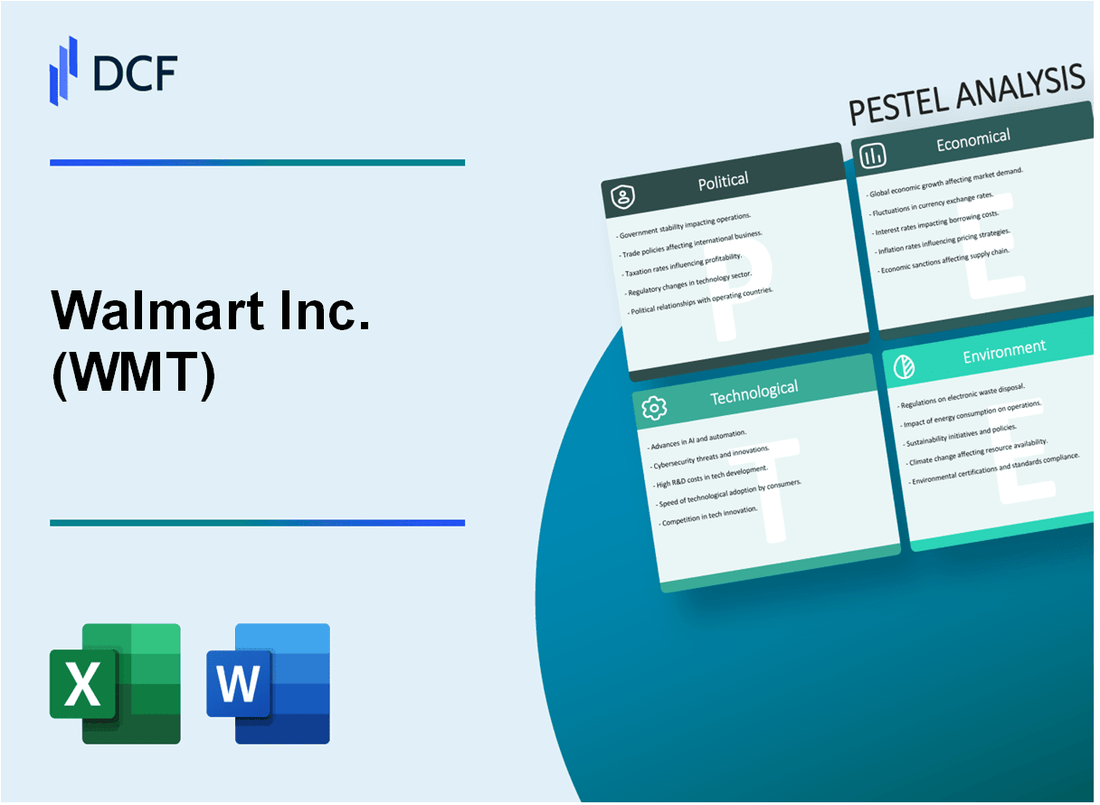
Walmart Inc. (WMT): Analyse de Pestle [Jan-2025 MISE À JOUR] |
Entièrement Modifiable: Adapté À Vos Besoins Dans Excel Ou Sheets
Conception Professionnelle: Modèles Fiables Et Conformes Aux Normes Du Secteur
Pré-Construits Pour Une Utilisation Rapide Et Efficace
Compatible MAC/PC, entièrement débloqué
Aucune Expertise N'Est Requise; Facile À Suivre
Walmart Inc. (WMT) Bundle
Dans le paysage dynamique de Global Retail, Walmart Inc. est une entreprise colossale naviguant dans un réseau complexe de défis et d'opportunités. Cette analyse complète du pilon dévoile les facteurs externes complexes qui façonnent le plus grand détaillant du monde, des tensions géopolitiques et des fluctuations économiques aux innovations technologiques et aux engagements environnementaux. En disséquant les dimensions politiques, économiques, sociologiques, technologiques, juridiques et environnementales, nous explorerons comment Walmart s'adapte stratégiquement à un marché mondial en constante évolution, démontrant sa résilience et sa approche avant-gardiste dans un monde de plus en plus interconnecté.
Walmart Inc. (WMT) - Analyse du pilon: facteurs politiques
Tensions commerciales en cours entre les États-Unis et la Chine
Depuis 2024, Walmart est confronté à des défis importants des tensions commerciales américano-chinoises. La société a importé environ 27,5 milliards de dollars de marchandises en provenance de Chine en 2023.
| Métrique d'impact commercial | Valeur |
|---|---|
| Total des importations chinoises | 27,5 milliards de dollars |
| Augmentation des coûts de la chaîne d'approvisionnement | 10-15% |
| Catégories de produits affectés | Électronique, vêtements, articles de maison |
Examen réglementaire sur les pratiques de travail
Les principaux défis réglementaires comprennent:
- Conformité au salaire minimum dans 50 États
- Application du mandat des soins de santé
- Règlement sur la classification et les avantages sociaux des travailleurs
| Métrique de la conformité du travail | 2024 données |
|---|---|
| Salaire horaire moyen | $15.47 |
| Couverture de soins de santé des employés à temps plein | 68% |
| Coûts annuels de conformité de la main-d'œuvre | 3,2 milliards de dollars |
Changements de politique de salaire minimum et de santé
Walmart continue de s'adapter à l'évolution des réglementations du travail. Actuellement, le salaire de démarrage minimum de l'entreprise varie entre 14 $ et 17 $ l'heure, selon l'emplacement et les conditions du marché.
Instabilité géopolitique sur les marchés internationaux
Walmart opère dans 24 pays, avec une exposition significative aux risques géopolitiques. Les marchés internationaux représentent environ 23,7% du total des revenus de l'entreprise en 2024.
| Marché international | Contribution des revenus | Niveau de risque politique |
|---|---|---|
| Mexique | 28,5 milliards de dollars | Modéré |
| Chine | 22,3 milliards de dollars | Haut |
| Canada | 19,7 milliards de dollars | Faible |
Walmart Inc. (WMT) - Analyse du pilon: facteurs économiques
Inflation persistante affectant les dépenses de consommation et les stratégies de tarification au détail
Taux d'inflation aux États-Unis en décembre 2023: 3,4%. L'augmentation moyenne des prix de Walmart: 2,8% au cours de l'exercice 2024. Indice des prix à la consommation (IPC) pour les marchandises de vente au détail: 4,1%.
| Indicateur économique | Valeur | Impact sur Walmart |
|---|---|---|
| Taux d'inflation | 3.4% | Ajustements de prix modérés |
| Indice des prix à la consommation | 4.1% | Augmentation des coûts opérationnels |
| Augmentation des prix Walmart | 2.8% | Stratégie de tarification compétitive |
Fluctuant les taux de change impactant les opérations commerciales internationales
Volatilité des devises sur les marchés clés: peso mexicain (-3,2%), dollar canadien (-2,7%), roupie indienne (-1,9%). Les revenus internationaux de Walmart: 118,3 milliards de dollars en 2023.
| Pays | Fluctuation de la monnaie | Contribution internationale des revenus |
|---|---|---|
| Mexique | -3.2% | 32,6 milliards de dollars |
| Canada | -2.7% | 27,5 milliards de dollars |
| Inde | -1.9% | 5,2 milliards de dollars |
Reprise économique continu post-pandémique influençant le comportement d'achat des consommateurs
Taux de croissance du PIB américain: 2,5% en 2023. Croissance des ventes de commerce électronique de Walmart: 11,5%. Indice de confiance des consommateurs: 61,3 en décembre 2023.
| Métrique économique | Valeur | Importance |
|---|---|---|
| Taux de croissance du PIB | 2.5% | Momentum économique positif |
| Croissance des ventes de commerce électronique | 11.5% | Transformation numérique |
| Indice de confiance des consommateurs | 61.3 | Dépenses de consommation modérées |
Risques de récession potentiels affectant les modèles de dépenses discrétionnaires
Probabilité de récession en 2024: 35%. Revenu du segment de réduction de Walmart: 42,7 milliards de dollars. Taux de chômage: 3,7% en décembre 2023.
| Facteur de risque économique | Valeur | Stratégie Walmart |
|---|---|---|
| Probabilité de récession | 35% | Prix défensif |
| Revenus de segment de réduction | 42,7 milliards de dollars | Offres axées sur la valeur |
| Taux de chômage | 3.7% | Marché du travail stable |
Walmart Inc. (WMT) - Analyse du pilon: facteurs sociaux
Changements de préférences des consommateurs vers des expériences de magasinage en ligne et omnicanal
Les ventes de commerce électronique de Walmart ont atteint 52,4 milliards de dollars au cours de l'exercice 2023, ce qui représente une croissance de 17% par rapport à l'année précédente. Les ventes d'épicerie en ligne ont augmenté de 22% au cours de la même période.
| Canal | Volume des ventes 2023 | Croissance d'une année à l'autre |
|---|---|---|
| Total du commerce électronique | 52,4 milliards de dollars | 17% |
| Épicerie en ligne | 28,7 milliards de dollars | 22% |
| Ventes de marché | 15,6 milliards de dollars | 19% |
Demande croissante de produits durables et d'origine éthique
Walmart a engagé 2 milliards de dollars pour hiérarchiser les produits de divers fournisseurs en 2023. La société a obtenu 78% de ses produits totaux de fermes américaines et a augmenté les offres de produits durables de 15%.
| Métrique de la durabilité | Valeur 2023 |
|---|---|
| Investissement diversifié des fournisseurs | 2 milliards de dollars |
| Les États-Unis produisent l'approvisionnement | 78% |
| Croissance durable des produits | 15% |
Changements démographiques entraînant diverses offres de produits et stratégies de marketing
Walmart dessert 230 millions de clients chaque semaine dans 24 pays. Les consommateurs hispaniques représentent 16,7% de la clientèle de Walmart, avec des investissements marketing ciblés de 75 millions de dollars en 2023.
| Métrique démographique | Valeur 2023 |
|---|---|
| Clientèle hebdomadaire | 230 millions |
| Pays desservis | 24 |
| Pourcentage de consommation hispanique | 16.7% |
| Investissement marketing ciblé | 75 millions de dollars |
Accent croissant sur les segments de produits de santé et de bien-être
Le segment de la santé et du bien-être de Walmart a augmenté de 12,5% en 2023, avec 8,3 milliards de dollars de ventes de produits dédiés. L'entreprise a élargi ses services de santé à 32 États, offrant plus de 4 700 cliniques de soins de santé.
| Métrique de la santé et du bien-être | Valeur 2023 |
|---|---|
| Croissance du segment | 12.5% |
| Ventes de produits | 8,3 milliards de dollars |
| États avec des services de santé | 32 |
| Cliniques de soins de santé | 4,700+ |
Walmart Inc. (WMT) - Analyse du pilon: facteurs technologiques
Investissements importants dans l'IA et l'apprentissage automatique pour l'optimisation de la chaîne d'approvisionnement
Walmart a investi 13,8 milliards de dollars dans la technologie et le commerce électronique en 2023. La société a déployé plus de 8 000 caméras propulsées par l'IA dans les magasins pour le suivi des stocks et la prévention des pertes. Les algorithmes d'apprentissage automatique optimisent la gestion des stocks dans 10 500 magasins dans le monde.
| Catégorie d'investissement technologique | 2023 dépenses ($) |
|---|---|
| IA et apprentissage automatique | 3,2 milliards |
| Optimisation de la chaîne d'approvisionnement | 2,7 milliards |
| Analytique prédictive | 1,5 milliard |
Expansion des capacités de commerce électronique et des technologies de paiement numérique
Walmart.com a généré 73,2 milliards de dollars de revenus de commerce électronique en 2023. La société prend en charge 15 méthodes de paiement numérique, y compris les portefeuilles mobiles et les paiements sans contact. Walmart Pay a traité 2,5 milliards de transactions en 2023.
| Métrique du commerce électronique | Valeur 2023 |
|---|---|
| Revenus en ligne | 73,2 milliards de dollars |
| Utilisateurs d'applications mobiles | 62 millions |
| Méthodes de paiement numérique | 15 |
Mise en œuvre de la robotique avancée dans les entrepôts et les centres de distribution
Walmart a déployé 1 500 épurateurs de plancher autonomes et 670 robots de balayage autonome autonome dans les magasins. L'entreprise utilise 350 systèmes de stockage et de récupération automatisés dans les centres de distribution, ce qui réduit les coûts opérationnels de 23%.
| Technologie robotique | Nombre d'unités | Réduction des coûts |
|---|---|---|
| Épurateurs au sol | 1,500 | 15% |
| Robots de balayage des étagères | 670 | 18% |
| Systèmes de stockage automatisés | 350 | 23% |
Développement d'analyses de données avancées pour des expériences client personnalisées
La plate-forme d'analyse de données de Walmart traite 2.5 Petaoctets de données clients par jour. L'entreprise utilise l'apprentissage automatique pour générer des recommandations personnalisées pour 145 millions d'acheteurs hebdomadaires. Les algorithmes de segmentation des clients améliorent l'efficacité marketing ciblée de 37%.
| Métrique d'analyse des données | Valeur 2023 |
|---|---|
| Traitement quotidien des données | 2,5 pétaoctets |
| Acheteurs hebdomadaires | 145 millions |
| Amélioration de l'efficacité marketing | 37% |
Walmart Inc. (WMT) - Analyse du pilon: facteurs juridiques
Conformité continue aux réglementations du travail complexes dans plusieurs juridictions
En 2024, Walmart fait face à des défis de la réglementation du travail dans plusieurs juridictions:
| Juridiction | Défis clés de la réglementation du travail | Coût annuel de conformité |
|---|---|---|
| États-Unis | Conformité de la loi sur les normes de travail équitable | 87,3 millions de dollars |
| Mexique | Règlement sur la classification des travailleurs | 42,6 millions de dollars |
| Chine | Règlement sur le salaire minimum et les heures supplémentaires | 35,2 millions de dollars |
| Inde | Contracte de la main-d'œuvre | 28,9 millions de dollars |
Investigations potentielles antitrust liées à la domination du marché
La part de marché de Walmart et les préoccupations antitrust potentielles:
| Segment de marché | Part de marché | Examen réglementaire potentiel |
|---|---|---|
| Épicerie de détail | 26.3% | Haut |
| Commerce électronique | 5.8% | Modéré |
| Remise de vente au détail | 33.7% | Très haut |
Protection de la propriété intellectuelle
Portfolio de propriété intellectuelle de Walmart:
- Brevets totaux enregistrés: 1 237
- Dépenses de protection IP annuelles: 54,6 millions de dollars
- Demandes de brevet en instance: 312
Lois de confidentialité des données et de protection des consommateurs
Dépenses de conformité pour les réglementations de confidentialité des données:
| Règlement | Coût de conformité | Statut d'implémentation |
|---|---|---|
| RGPD | 23,4 millions de dollars | Pleinement conforme |
| CCPA | 18,7 millions de dollars | Pleinement conforme |
| LGPD (Brésil) | 12,3 millions de dollars | 90% mis en œuvre |
Walmart Inc. (WMT) - Analyse du pilon: facteurs environnementaux
Engagement à l'énergie renouvelable et à la réduction des émissions de carbone
En 2024, Walmart a atteint 46% de couverture d'énergie renouvelable entre les opérations mondiales. La société a investi 2,7 milliards de dollars dans des projets d'énergie renouvelable, ciblant 100% d'énergie renouvelable d'ici 2035.
| Métrique d'énergie renouvelable | État actuel | Année cible |
|---|---|---|
| Couverture des énergies renouvelables | 46% | 2035 |
| Investissement total | 2,7 milliards de dollars | N / A |
| Réduction des émissions de carbone | 230 millions de tonnes métriques | 2030 |
Initiatives durables d'emballages et de réduction des déchets
Walmart vise à obtenir des emballages 100% recyclables, réutilisables ou compostables d'ici 2025. Actuellement, la société a réduit les déchets d'emballage de 33% dans ses marques de marque privée.
| Emballage Métrique de la durabilité | État actuel | Année cible |
|---|---|---|
| Réduction des déchets d'emballage | 33% | 2025 |
| Objectif d'emballage recyclable | 100% | 2025 |
Mise en œuvre des principes de l'économie circulaire dans la gestion de la chaîne d'approvisionnement
Walmart a engagé 500 millions de dollars dans les initiatives de l'économie circulaire, en se concentrant sur l'agriculture régénérative et la réduction des déchets dans sa chaîne d'approvisionnement mondiale.
| Investissement en économie circulaire | Montant | Domaines de concentration |
|---|---|---|
| Investissement total | 500 millions de dollars | Agriculture régénérative, réduction des déchets |
Investir dans les technologies de la flotte de véhicules électriques et de la logistique verte
Walmart s'est engagé à électrifier 100% de sa flotte de livraison au milieu et au dernier kilomètre d'ici 2040. La société a déjà déployé 120 camions électriques et investi 1,2 milliard de dollars dans une infrastructure logistique verte.
| Métrique du véhicule électrique | État actuel | Année cible |
|---|---|---|
| Camions électriques déployés | 120 | N / A |
| Investissement en logistique verte | 1,2 milliard de dollars | N / A |
| Objectif de conversion de la flotte électrique | 100% | 2040 |
Walmart Inc. (WMT) - PESTLE Analysis: Social factors
Consumers are prioritizing value and private-label brands over national brands.
The persistent focus on value has become a core social factor driving consumer behavior, especially in an inflationary environment. For Walmart, this trend is a significant tailwind, allowing them to gain market share among all income levels, including higher-income households who are increasingly seeking savings. This shift is evident in the performance of their private-label (store) brands, which offer a lower-cost alternative to national brands.
Honestly, affordability remains king: a survey showed that 61% of Walmart customers prioritize affordability as the most important shopping factor. This focus has fueled the growth of Walmart's owned brands, with the company announcing in April 2025 that it has 21 private brands each generating over $1 billion in annual sales, and an impressive five of those brands exceeding $5 billion annually. Shoppers are defintely responding to the expanded assortment and stronger quality of these private-label options.
| Metric (Fiscal Year 2025) | Value/Amount | Context |
|---|---|---|
| Customer Priority: Affordability | 61% | Percentage of customers citing this as the most important shopping factor. |
| Private Brands > $1 Billion Annual Sales | 21 brands | Number of Walmart U.S. private brands reaching this sales threshold. |
| Private Brands > $5 Billion Annual Sales | 5 brands | Number of Walmart U.S. private brands reaching this higher sales threshold. |
Growing demand for ethically sourced goods and supply chain transparency.
Social consciousness is no longer a niche market; it is a mainstream expectation, translating into a demand for supply chain transparency and ethically sourced products. Walmart must meet this evolving consumer desire for environmental, social, and governance (ESG) alignment, or risk losing the business of the conscientious shopper.
The numbers show this is an active concern: 45% of Walmart customers are likely to choose products labeled as sustainable or eco-friendly over alternatives. Walmart is tackling this through its Project Gigaton, which aims to reduce 1 billion metric tons of greenhouse gases (GHG) from its global supply chain by 2030. As of the end of 2024, suppliers had already reported over 750 million metric tons of reductions. Plus, the company is making progress on packaging, with 82.6% of its global private brand plastic packaging designed for recycling in calendar year 2024.
Focus on employee wages, benefits, and workplace culture to reduce turnover.
The retail labor market remains tight, making investment in human capital a critical competitive factor. Walmart's strategy is to reduce costly turnover and attract better talent by improving compensation and career pathways, which is a direct response to social pressure for better working conditions and fairer pay.
In 2025, the company is investing over $1 billion into pay raises and benefits enhancements, impacting approximately 1.6 million employees globally. The average U.S. hourly wage for associates is now more than $17.50, reflecting a significant investment. For management roles, the starting base pay for market managers increased from $130,000 to $160,000, with their total annual compensation potential now exceeding $600,000 with full bonuses and stock grants. This creates a clear path to a high-paying career, which is key to retention.
- Average U.S. hourly wage for associates: More than $17.50.
- Internal promotion rate for above-entry-level U.S. roles: 86% in FY2024.
- 401(k) company match in the U.S. (FY2024): $1.6 billion.
Digital literacy and mobile shopping adoption continue to reshape the customer journey.
The widespread adoption of mobile technology and increasing digital literacy has fundamentally changed how customers shop, demanding a seamless omnichannel (online and in-store) experience. Walmart's success hinges on integrating its vast physical footprint with a high-speed digital platform.
The shift is profound: in fiscal year 2025, e-commerce accounted for 18% of Walmart's total company revenue, with U.S. e-commerce sales growing 20% in Q4 FY2025 alone. The physical stores are now critical fulfillment nodes, allowing the company to reach 93% of U.S. households with same-day delivery. This speed and convenience are essential, as 70% of customers cite an easy-to-navigate app or website as a deciding factor. The payoff is clear: omnichannel shoppers buy three times more often than single-channel customers.
Walmart Inc. (WMT) - PESTLE Analysis: Technological factors
Massive investment in e-commerce infrastructure and last-mile delivery.
Walmart's strategy is simple: use its massive store footprint-over 4,600 U.S. stores-as a competitive advantage against pure-play e-commerce rivals. For fiscal year 2025 (FY2025), the company estimated capital expenditures would reach $17 billion, with a significant portion dedicated to store upgrades and supply chain optimization to support this omnichannel push. This is a clear action to turn stores into fulfillment hubs.
This investment is paying off in speed and volume. In Q3 of the current calendar year (CY) 2025, global e-commerce sales grew 27%, with the U.S. segment surging 28%. Critically, delivery speed is now a major differentiator. Store-fulfilled delivery volumes jumped nearly 50% in Q3, and expedited deliveries (three hours or less) increased 70%. This means you can get what you need, fast.
- Global E-commerce Sales Growth (Q3 CY2025): 27%
- U.S. E-commerce Sales Growth (Q3 CY2025): 28%
- Digital Orders Delivered in Under 3 Hours (Q3 CY2025): 35%
AI and machine learning optimize inventory, pricing, and supply chain logistics.
The core of Walmart's operational efficiency now runs on Artificial Intelligence (AI) and Machine Learning (ML). The company uses its proprietary ML platform, Element, to deploy AI rapidly and at scale across its business. This isn't just theory; it's a tangible cost-saver. AI-powered inventory management has been shown to reduce stockouts by 15% and excess inventory costs by 20% in the retail sector, a direct benefit Walmart is realizing.
The AI is also being used to empower the workforce. Walmart is rolling out new AI tools to its 1.5 million associates, helping to streamline tasks like shift planning, which has been reduced from 90 minutes to just 30 minutes. They even use an AI engine to accelerate product development-the Trend-to-Product system-cutting the time to respond to consumer trends from months to weeks. That's defintely a competitive edge.
Increased use of automation and robotics in fulfillment centers and stores.
Automation is the engine driving down unit costs. Walmart is aggressively scaling its robotic systems, such as the Alphabot used in Market Fulfillment Centers (MFCs), to handle online orders. The impact is clear: automated fulfillment centers are about twice as productive as older, legacy facilities.
The goal is to automate the entire supply chain. By the end of fiscal year 2026 (FY2026), Walmart expects roughly 65% of its stores to be serviced by automation, and 55% of its fulfillment center volume will move through automated facilities. This push is already showing up in the financials, with automated fulfillment helping to keep shipping costs down consistently in the 30% range for several quarters. Here's the quick math on the expected efficiency gains:
| Metric | FY2026 Target/Result | Source/Impact |
|---|---|---|
| Stores Serviced by Automation | 65% (Target by end of FY2026) | Improves delivery service and requires less physical labor. |
| E-commerce Volume in Automated Facilities | >50% (Current, Q3 CY2025) | Automated centers are 2x more productive than legacy ones. |
| Unit Cost Improvement | ~20% (Target by end of FY2026) | Direct result of supply chain automation. |
| Shipping Cost Reduction | Consistently in the 30% range | Attributed to automated fulfillment. |
Cybersecurity defense against sophisticated attacks on customer and payment data.
Protecting customer data is a non-negotiable cost of doing business at this scale. Walmart's systems are massive, consuming millions of events per minute to monitor for threats. The company takes a proactive, build-your-own approach to security, developing internal capabilities that are now blocking hundreds of millions of potential attacks annually.
A major focus is protecting the e-commerce channel from malicious automation. The company has deployed automated, purpose-built capabilities to eliminate Grinch Bots, blocking about 8.5 billion bot attacks per month in the last year alone. While its AI-generated cybersecurity score of 750/1000 is considered 'Fair' by some third-party analysts, the absence of major recorded incidents in 2025 suggests the defenses are holding up against the persistent threat landscape. What this estimate hides is the sheer volume of attacks a global retailer faces daily, making the sustained defense itself a huge technological achievement.
Walmart Inc. (WMT) - PESTLE Analysis: Legal factors
You might not think of a retailer as a legal minefield, but for a company the size of Walmart, legal compliance is a massive, costly, and constant operational risk. The sheer scale of its global workforce and customer data base means the legal department is always playing defense, especially in the areas of labor, data privacy, and expansion logistics. This isn't just about fines; it's about the friction that slows down growth and eats into your margins.
Complex compliance with global data privacy laws like CCPA and GDPR
Managing the data of millions of customers across 19 countries is a huge legal undertaking. The regulatory landscape is fragmenting, meaning Walmart must comply with a patchwork of laws, not a single standard. In the U.S., the California Consumer Privacy Act (CCPA), which was strengthened by the CPRA, is the benchmark. For fiscal year 2025, the CCPA's revenue threshold for a covered business increased to $26,625,000, which Walmart obviously clears.
The financial risk is real, even in the U.S. For 2025, administrative fines for CCPA violations are capped at $2,663 per violation, or up to $7,988 for intentional violations or those involving minors. Plus, consumers can sue for damages between $107 and $799 per consumer per incident, which can quickly turn into a massive liability with a class action. Internationally, the General Data Protection Regulation (GDPR) in the European Union and the Personal Information Protection Law (PIPL) in China impose even stricter requirements, particularly around cross-border data transfer, which is a constant headache for a global e-commerce operation like Walmart International, which generated net sales of $121.9 billion in fiscal 2025.
Ongoing risk of labor-related lawsuits and wage-hour class actions
With approximately 2.1 million associates worldwide, Walmart is a perpetual target for labor litigation, especially in states with strong worker protection laws like California. These lawsuits often allege systemic violations of wage and hour laws, such as failure to pay for all time worked or providing inaccurate wage statements. This is a recurring cost of doing business.
Here's the quick math on recent settlements, all from the 2025 fiscal year timeline:
- $5.2 million settlement: Granted final approval in January 2025 to resolve a class action in California over unpaid time spent by employees waiting for mandatory COVID-19 screenings before clocking in.
- $2.25 million settlement: Sought preliminary approval in April 2025 for a class action by nearly 2,000 former and current hourly employees alleging underpaid wages at a California distribution center.
- $35 million settlement: Agreed upon to resolve claims that Walmart failed to provide accurate, itemized wage statements to California hourly associates.
These settlements, while a fraction of Walmart's fiscal 2025 total revenue of $681.0 billion, are a clear indicator of the constant legal pressure and the need for flawless, automated payroll and time-keeping systems. Honestly, the labor risk is defintely a structural issue for any massive hourly employer.
Zoning and permitting regulations slow the pace of new store or fulfillment center expansion
The process of opening a new store or fulfillment center is a strategic imperative, but it is frequently bogged down by local land use laws, zoning ordinances, and community opposition. After a period of focusing on remodels, Walmart began breaking ground on new stores in 2024 and 2025, only to be met with resistance.
For example, in June 2025, the planning commission in Edmond, Oklahoma, denied plans for a 44,000-square-foot Walmart Neighborhood Market grocery store after nearly 100 residents voiced concerns. Community resistance centers on issues like:
- Increased traffic and congestion.
- Noise and light pollution.
- Impact on local residential character.
This local-level legal friction-the need for numerous permits, environmental reviews, and public hearings-can add months, or even years, to a project timeline, directly impacting the capital expenditure schedule and the company's ability to quickly build out its omnichannel infrastructure to support its $462.4 billion U.S. segment.
International anti-corruption laws (e.g., FCPA) govern global operations
Operating in 19 countries means strict adherence to international anti-corruption laws, most notably the U.S. Foreign Corrupt Practices Act (FCPA). The shadow of Walmart's major 2019 FCPA resolution still informs its current compliance efforts, which involved a combined payment of $282.7 million to the Department of Justice (DOJ) and the Securities and Exchange Commission (SEC).
The original investigation found that the company's foreign subsidiaries in Brazil, Mexico, India, and China used third-party intermediaries to make improper payments to government officials to obtain store permits and licenses. What this estimate hides is the total cost: Walmart reported spending over $900 million on the FCPA investigation, compliance enhancements, and organizational changes in the years leading up to the settlement. This massive expenditure is the true cost of failing to maintain sufficient anti-corruption controls, and it mandates continuous, high-level investment in its Global Anti-Corruption Compliance Program to protect its International segment.
The financial statements for the third quarter of fiscal 2025 even noted a discrete impact of a legal settlement, with the adjusted EPS of $0.62 excluding the net-of-tax effect of $0.02 related to the settlement of a certain legal matter. This shows that legal matters continue to be a factor in quarterly earnings.
| Legal Risk Area | Fiscal 2025/Recent Financial Impact | Core Compliance Challenge |
|---|---|---|
| Data Privacy (CCPA/GDPR) | CCPA fines up to $7,988 per intentional violation. | Managing fragmented global regulations and securing massive customer data sets. |
| Labor & Wage-Hour | $5.2 million settlement (Jan 2025) for unpaid COVID-19 screening time. | Systemic compliance with complex state-level wage laws for a 2.1 million-person workforce. |
| Expansion Permitting | Delays and denials (e.g., Edmond, OK) slow capital deployment. | Overcoming local zoning resistance and securing permits for new 44,000 sq. ft. stores. |
| Anti-Corruption (FCPA) | Prior settlement cost $282.7 million; total compliance spend over $900 million. | Maintaining robust internal controls across all international operations (International net sales: $121.9 billion). |
Walmart Inc. (WMT) - PESTLE Analysis: Environmental factors
Pressure to meet net-zero carbon emission and renewable energy targets
You need to understand that while Walmart Inc. is committed to net-zero, the near-term progress is non-linear, which increases operational risk. The company's aspirational goal remains net-zero operational emissions (Scope 1 and 2) by 2040, a target set in 2020. Still, the company anticipates missing its interim goal of a 35% reduction in Scope 1 and 2 greenhouse gas (GHG) emissions by the end of 2025, relative to a 2015 baseline.
For the 2024 fiscal year, Walmart's absolute Scope 1 and 2 emissions actually saw a 1.1% year-over-year increase, reaching 15.7 million metric tons of GHG. This rise is largely attributed to growth in transportation and challenges in clean energy infrastructure availability. However, the company's emissions intensity-operational emissions per million dollars of revenue-decreased by 3.7% in 2024, showing a decoupling of emissions from revenue growth.
On the renewable energy front, Walmart is close to its 2025 goal, which is a good sign. The goal is to supply 50% of global electricity needs from renewable sources by 2025, and as of 2024, they had reached 48.5%. They are also making headway on their value chain emissions (Scope 3), having already achieved their Project Gigaton goal of avoiding 1 billion metric tons of emissions six years ahead of schedule.
- Target: Net-zero operational emissions by 2040.
- 2024 Scope 1 & 2 Emissions: 15.7 million metric tons.
- 2024 Renewable Energy: 48.5% of global electricity needs.
Sustainable sourcing mandates for key products like beef, soy, and palm oil
Walmart's commitment to sustainable sourcing is a critical risk-management tool, especially for high-impact commodities that face deforestation pressure. The company's 2025 pledge covers sustainably sourcing 20 key commodities. The focus is shifting from simply meeting basic certification to driving regenerative agriculture practices in the supply chain.
For beef, a major commodity, the focus is on soil health, animal welfare, and antibiotics. The company is actively working with producers to implement and measure conservation practices across 12 million acres of grazing land. This is defintely a concrete action that links environmental goals to their core product supply. The 2022 investment in Sustainable Beef LLC, which began shipping to Walmart stores in late 2024, provides greater visibility and control over a portion of their beef supply chain.
In palm oil, the mandate is moving toward higher-integrity certification. Walmart is asking private brand suppliers to transition from sourcing Roundtable on Sustainable Palm Oil (RSPO) Mass Balance-certified palm oil to the more stringent segregated certified palm oil. Progress on soy has been slower, with the company noting challenges in sourcing deforestation-free soy at scale, despite a previous 2023 goal for critical landscapes in South America.
Significant focus on reducing packaging waste and promoting a circular economy
The push for a circular economy (reducing waste by keeping products and materials in use) is a major focus, but the company is struggling to hit its 2025 packaging targets, which is a clear headwind. Walmart expects to fall short of its ambitious 2025 goals for its global private-brand packaging.
Here's the quick math on their packaging progress as of the end of 2023, which informs the 2025 outlook:
| 2025 Goal | 2023 Progress | Gap/Status |
|---|---|---|
| 100% Recyclable/Reusable/Compostable Packaging | 68% | Anticipated Miss |
| 15% Virgin Plastic Reduction (vs. 2020 baseline) | 6% Increase | Reverse Progress |
| 17% Global Post-Consumer Recycled (PCR) Content | 8% | Anticipated Miss |
The increase in virgin plastic use is primarily attributed to business growth in product categories like food. The company has successfully diverted 83.5% of its global operational waste from landfills or incineration as of the end of 2023, moving closer to its 90% zero-waste aspirational target.
Climate change impacts supply chain resilience and store operations in extreme weather
The financial and operational impact of climate change is no longer a theoretical risk; it is a tangible cost. Walmart has a strategic focus on enhancing the resilience of its operations and supply chains to ensure surety of supply and maintain its everyday low cost model.
A concrete example of climate impact was cited in the 2024 fiscal year, where a decline in renewable energy output in its Mexico and Central America markets was linked to heat and droughts in the region, contributing to the 1.1% rise in operational emissions. This shows how extreme weather directly affects the energy mix and operational costs.
To mitigate these physical risks, Walmart is investing in operational resilience. This includes installing 10 MW of onsite energy storage capacity across 44 facilities by the end of 2024, which helps maintain power during grid disruptions. The company also uses a formal Climate Change Impact Scenario Analysis, aligning with the Task Force on Climate-related Financial Disclosures (TCFD), to better understand and prepare for potential climate-related financial implications across the business.
Disclaimer
All information, articles, and product details provided on this website are for general informational and educational purposes only. We do not claim any ownership over, nor do we intend to infringe upon, any trademarks, copyrights, logos, brand names, or other intellectual property mentioned or depicted on this site. Such intellectual property remains the property of its respective owners, and any references here are made solely for identification or informational purposes, without implying any affiliation, endorsement, or partnership.
We make no representations or warranties, express or implied, regarding the accuracy, completeness, or suitability of any content or products presented. Nothing on this website should be construed as legal, tax, investment, financial, medical, or other professional advice. In addition, no part of this site—including articles or product references—constitutes a solicitation, recommendation, endorsement, advertisement, or offer to buy or sell any securities, franchises, or other financial instruments, particularly in jurisdictions where such activity would be unlawful.
All content is of a general nature and may not address the specific circumstances of any individual or entity. It is not a substitute for professional advice or services. Any actions you take based on the information provided here are strictly at your own risk. You accept full responsibility for any decisions or outcomes arising from your use of this website and agree to release us from any liability in connection with your use of, or reliance upon, the content or products found herein.