
|
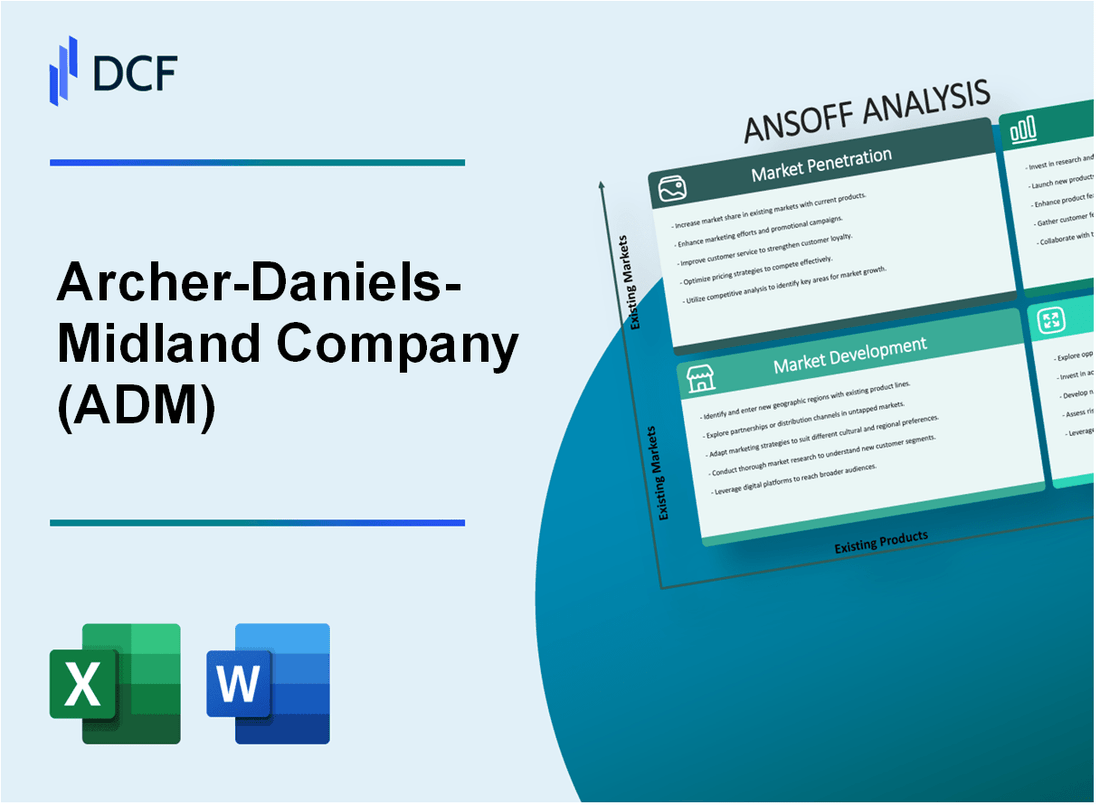
Archer-Daniels-Midland Company (ADM): ANSOFF MATRIX [Dec-2025 Updated] |
Fully Editable: Tailor To Your Needs In Excel Or Sheets
Professional Design: Trusted, Industry-Standard Templates
Investor-Approved Valuation Models
MAC/PC Compatible, Fully Unlocked
No Expertise Is Needed; Easy To Follow
Archer-Daniels-Midland Company (ADM) Bundle
You need to know where Archer-Daniels-Midland Company (ADM) is finding real growth, and the answer for the 2025 fiscal year is a tight, dual focus: aggressive cost discipline plus high-margin nutrition expansion. The market is defintely challenging-we see adjusted earnings per share (EPS), which is a company's profit divided by its outstanding shares, at the lower end of the $4.00 to $4.75 guidance range-but management is pushing for over $250 million in operating cost cuts this year to stabilize margins. This means every growth quadrant, from optimizing core commodity sales (Market Penetration) to launching new fermentation-derived ingredients (Product Development), is now tied to a clear efficiency mandate. The real upside is in their Nutrition segment, which is on target to deliver operating profit between $1.25 billion and $1.5 billion, so that's where the strategic capital is flowing. Let's dig into the four growth paths and the concrete actions driving them.
Archer-Daniels-Midland Company (ADM) - Ansoff Matrix: Market Penetration
Market Penetration for Archer-Daniels-Midland Company (ADM) is about driving higher sales volume and efficiency from existing product lines-like refined oils, corn sweeteners, and core animal feed-within their current customer base of food manufacturers, processors, and farmers. The goal is to capture market share and increase 'share of wallet' in a challenging 2025 environment.
ADM's primary focus here is on internal execution, what they call their 'self-help agenda,' to offset external pressures like volatile crush margins and regulatory uncertainty around biofuels. They are on track to deliver between $200 million to $300 million in total cost savings for the full year 2025, which directly supports aggressive pricing and margin protection needed for penetration efforts.
Increase Share of Wallet with Key Food and Beverage Manufacturers
The strategy here is to move beyond simple commodity sales by selling a wider range of ingredients to the same large customers. For example, a beverage client buying corn sweeteners (Carbohydrate Solutions) is now targeted for natural colors and flavors (Nutrition). This is working: the Nutrition segment's operating profit was up a strong 24% in Q3 2025, reaching $130 million, with record revenue achieved in Flavors North America.
To be fair, the core commodity segments face headwinds. The Carbohydrate Solutions segment saw its Q3 2025 operating profit drop 26% to $336 million, largely due to lower global demand for Starches and Sweeteners. This means penetration must be driven by price competitiveness and operational excellence, not just organic market growth. It's a tough market, so you have to fight for every percentage point of share.
Optimize Logistics to Cut Delivery Costs by $150 Million in 2025
Logistics optimization is a critical component of the broader 2025 cost-saving plan. By focusing on optimizing rail, barge, and truck routes, and improving load occupancy rates, ADM can lower the effective price to the customer while protecting its own margin. This is defintely where the self-help agenda pays off. The Ag Services subsegment, which handles much of the logistics, saw its operating profit climb 78% in Q3 2025, driven primarily by higher export activity in North America, showing that their network is running efficiently and capturing volume when trade flows are favorable.
Offer Bundled Contracts for Feed and Oilseeds to Regional Processors
Bundling is a classic market penetration tactic, essentially increasing the average transaction value with an existing buyer. For regional processors, offering a single contract for both soybean meal (animal feed) and refined soybean oil (food/industrial use) provides them with supply chain simplicity and a volume discount. This is crucial in the Ag Services & Oilseeds (AS&O) segment, where overall Q3 2025 operating profit fell 21% to $379 million, largely because the Crushing subsegment saw a massive 93% drop in profit due to low margins. Bundled contracts stabilize volume and margin in this volatile area.
| ADM Segment (Existing Products) | Q3 2025 Operating Profit | Year-over-Year Change | Market Penetration Implication |
|---|---|---|---|
| Ag Services & Oilseeds (AS&O) | $379 million | Down 21% | Requires aggressive cost-cutting and bundling to stabilize volume against 93% drop in Crushing profit. |
| Carbohydrate Solutions | $336 million | Down 26% | Needs deep pricing and operational efficiency to counter lower global demand for Starches and Sweeteners. |
| Nutrition | $130 million | Up 24% | Strongest penetration success; focus on cross-selling specialty ingredients (Flavors, Health & Wellness) to existing food clients. |
Aggressively Price Key Commodity Exports in High-Volume Regions
When you have excess capacity, you price to move volume. ADM's massive global asset network allows them to aggressively price key commodity exports, especially in the US Gulf and South America, to keep their facilities running at high utilization rates. The fact that the Ag Services subsegment's profit was up 78% in Q3 2025 shows they are successfully capturing export volume. This is a short-term, opportunistic penetration play that relies on their superior logistics and asset scale to outcompete smaller players on price.
Actionable Penetration Levers
Here's the quick math: if you can save $150 million in logistics costs, you can afford to drop your export price by a fraction of a cent per bushel, which is enough to win a major contract from a competitor.
- Use the $200M-$300M cost savings to fund strategic price reductions.
- Target food manufacturers buying corn sweeteners with a 15% discount on a bundled natural color/flavor package.
- Increase North American export volumes by another 5% in Q4 2025 to capitalize on strong Ag Services performance.
Finance: Track the margin impact of bundled contracts versus single-product sales by the end of Q4 2025.
Archer-Daniels-Midland Company (ADM) - Ansoff Matrix: Market Development
The core of Market Development for Archer-Daniels-Midland Company (ADM) is taking your existing, proven products-like specialty ingredients, high-purity chemicals, or grain origination services-and successfully introducing them to entirely new geographies or customer industries. ADM's strategy for the 2025 fiscal year focuses on penetrating high-growth emerging markets and non-traditional industrial customers to drive revenue growth, especially as the Ag Services & Oilseeds segment faces challenging margins.
This path is about calculated risk: you are using a known product, so the product risk is low, but the market risk is higher due to new logistics, regulations, and consumer preferences. The company's Nutrition segment, which delivered $114 million in operating profit in the second quarter of 2025, a 5% increase year-over-year, is the primary engine for this expansion.
Expand grain origination services into high-growth Eastern European markets.
ADM is deepening its operational footprint in Eastern Europe, moving beyond simple trading to integrated supply chain management. The strategy centers on its regenerative agriculture program (re:generations™), which is a modern form of origination, securing future supply while providing incentives to farmers.
This initiative expanded to countries like Poland and Germany in 2025, aiming to enroll 5 million acres globally in regenerative practices this year. In Germany alone, the goal for 2025 is to enroll 60,000 acres (approximately 24,281 hectares) of wheat, oilseed rape, and soy. This not only secures high-quality, traceable supply for European processing but also strengthens ADM's position in a region where Ukrainian wheat production for the 2025/2026 season is projected to be around 20.3 million tons.
Introduce plant-based protein isolates to the rapidly growing APAC foodservice sector.
The Asia-Pacific (APAC) foodservice sector is a massive opportunity, driven by a global shift toward flexitarian diets-a group that ADM's 2025 research identifies as comprising approximately 46% of global consumers. ADM's plant-based protein isolates, particularly soy and chickpea proteins, are specifically positioned for this market in ready meals, snacks, and foodservice applications.
The focus is on taste and texture, which are critical for the 'carefree' consumer cohort (those not actively seeking plant-based but open to it), and for whom taste is often prioritized over nutrition in alternatives. The company is leveraging its flavor and formulation expertise to customize these ingredients for local Asian palates, which is essential for mass adoption in markets like South Korea, a country ADM identifies as a leader in the flexitarian movement.
Target pharmaceutical and cosmetic industries with high-purity ethanol derivatives.
This is a play on a high-margin, high-purity product. ADM has over a century of experience making ethanol, which it is now marketing as a plant-based, high-purity excipient (an inactive substance that serves as a vehicle for a drug) for the pharmaceutical and cosmetic sectors.
The global cosmetic ethanol market alone is valued at approximately $1.5 billion in 2025 and is projected to grow at a Compound Annual Growth Rate (CAGR) of 5% through 2033. ADM is a major player, offering products that meet stringent regulatory standards, including those for parenteral nutrition (intravenous feeding) and topical formulations.
Here's the quick math on the market size and ADM's position:
| Market Segment | Global Market Value (2025) | Projected CAGR (2025-2033) | ADM Product Focus |
|---|---|---|---|
| Cosmetic Ethanol | $1.5 billion | 5% | High-purity, bio-based ethanol |
| Pharmaceutical Ethanol | $1.27 billion | 1.08% | Excipient, solvent, preservative |
The slow growth in the pharmaceutical ethanol market (1.08% CAGR) means ADM must win market share through its reputation for consistent, high-purity, plant-based sourcing to defintely capture the more aggressive growth in cosmetics.
Establish new distribution hubs in Sub-Saharan Africa for animal nutrition products.
ADM's strategy in Sub-Saharan Africa is currently anchored in building market access through social investment and technical expertise, which is a smart, long-term approach before committing to large capital expenditures on new distribution hubs.
The company is partnering with Conservation International on the Herding for Health (H4H) program across seven African countries. This initiative, which received ADM technical support in August 2025, is focused on improving livestock health and rangeland management. While not a direct commercial hub investment, this partnership creates a crucial foundation:
- Builds trust and local knowledge in seven African countries.
- Establishes a need for ADM's animal nutrition products (e.g., feed additives, premixes).
- Provides a low-cost, high-impact entry point for future commercial distribution.
The long-term play is to transition these communities from basic livestock management to commercial-scale animal nutrition, which will then justify the capital investment in a physical distribution network.
Secure $400 million in new sales from Latin American aquaculture feed.
Achieving a $400 million new sales target in Latin American aquaculture feed is an aggressive but achievable goal, given the region's market dynamics. The South American aqua feed market is on a strong growth trajectory, projected to expand at a Compound Annual Growth Rate of 5.20% from 2025 to 2033.
ADM is already a key player, focusing on high-value, data-driven solutions like its SINCRO services, which optimize feed formulation and animal performance. The Latin American aqua feed additives market, a high-margin component of the total feed market, is forecasted to see growth rates accelerate from 6.1% in the first half of 2025 to 6.4% in the second half of 2025. Brazil is the regional powerhouse, dominating the market for shrimp and tilapia feed.
ADM's investment in precision nutrition and feed additives is designed to capture a disproportionate share of this growth, particularly by helping producers in countries like Indonesia and Mexico improve efficiency. For example, one key aqua feed producer in Indonesia using ADM's SINCRO services saw full-year estimated sales grow over 60% compared to the previous year. This success story is the model for reaching the $400 million Latin American goal.
Finance: Track Q4 2025 revenue from the Nutrition segment's Flavors and Specialty Ingredients subsegments in APAC and Latin America against the $400 million new sales objective.
Archer-Daniels-Midland Company (ADM) - Ansoff Matrix: Product Development
This strategy involves creating new offerings for ADM's existing customers, primarily within the Nutrition and Carbohydrate Solutions segments, to capture higher-margin business. The goal here is to sell more valuable, specialized ingredients to the food, beverage, and animal nutrition companies already in the client portfolio.
Focusing Capital on High-Value Innovation
You're seeing ADM double down on internal innovation, which is the core of a Product Development strategy. While the company set an ambitious target of $1.25 billion to $1.5 billion in operating profit for its Nutrition segment by 2025, the focus is now on disciplined capital allocation to drive margin improvement and new product rollouts.
A key capital project supporting this is the $300 million investment announced in 2022, with completion expected in the first quarter of 2025, to expand alternative protein production at the Decatur, Illinois, facility. This investment includes a new Protein Innovation Center, which is exactly where the next-generation products are born. It's a smart move to vertically integrate R&D and production, and it's defintely where the future margin expansion lies.
Fermentation and Biotics for Human Health
The push into functional foods is strong, leveraging ADM's fermentation expertise to create high-margin ingredients. This is a direct response to consumer demand for health-and-wellness products, which is a key macro trend. The company is launching new, clinically-backed ingredients to support specific health outcomes for its B2B partners.
- Launch three new fermentation-derived ingredients for the functional food space.
- New postbiotics, like Lactobacillus gasseri CP2305, are being highlighted in 2025 for their clinically validated support for sleep quality, stress reduction, and emotional well-being.
- ADM is also showcasing new compound probiotic products, such as the Balance Probiotic Combination, which supports intestinal, metabolic, and liver health.
Next-Generation Sweeteners and Carbohydrate Solutions
The Carbohydrate Solutions segment is moving beyond traditional High Fructose Corn Syrup (HFCS) to address the market's shift toward low-sugar and clean-label products. This is a necessary defensive and offensive move, especially with major clients like Coca-Cola exploring alternatives.
ADM is developing 'Specialty Syrups' which are proprietary, customized blends to help beverage and food clients meet specific sugar reduction and label regulations. They are also focusing on corn-based sugar alternatives to maintain their dominant position as the world's largest corn processor, offering solutions like enzymatically modified corn extracts that provide balanced sweetness with lower caloric intake.
Precision Nutrition for Animal Performance
In Animal Nutrition, the product development strategy is focused on precision and data-driven services to enhance livestock performance and farmer economics. This isn't just about feed; it's about specialized supplements and digital services that reduce cost and improve yield.
For instance, ADM launched the Digest Carb feed additive for dairy cows in September 2025. This specialized combination of ingredients optimizes the rumen's use of energy sources. On-farm trials demonstrated that Holstein cows supplemented with Digest Carb produced an average of 2.7 kg more milk per day, with milk protein increasing by 4.5%. That's a clear return on investment for the farmer. Also, in August 2025, ADM launched new plant-based protein supplements for livestock, supporting sustainability goals and reducing reliance on soy.
Mapping Product Development Risks and Opportunities (2025)
Here's the quick math: The total alternative protein sector saw $443.45 million in investment in the first half of 2025, with fermentation technologies securing $198.7 million. ADM's product development must capture a significant share of this growth, but it faces challenges in a volatile market.
| Product Development Area | 2025 Near-Term Opportunity | Investment & Metric (2025 Data) | Risk/Limit |
|---|---|---|---|
| Fermentation-Derived Ingredients | High-margin functional food & supplement sales (e.g., biotics for mood/sleep). | New postbiotics (CP2305) launched at CPHI 2025. Target: Nutrition segment operating profit of $1.25B to $1.5B. | Market saturation in generic probiotics; need for continued clinical validation to support premium pricing. |
| Low-Sugar Corn Syrup Alternatives | Defensive strategy to retain major beverage clients shifting away from HFCS. | Focus on 'Specialty Syrups' for custom clean-label solutions. Market shift is a $6 billion HFCS market risk. | The political and consumer momentum for cane sugar over corn-based sweeteners is a significant headwind. |
| Cell-Based Meat Culture Media | Positioning ADM as the essential input provider for the cultivated meat industry. | Partnerships with Eat Just and Believer Meats to optimize cell growth media. Part of the $300 million Decatur alternative protein expansion. | Cultivated protein attracted only $30.9 million of the total alternative protein investment in 1H 2025, indicating slower commercialization. |
| Personalized Animal Nutrition | Selling precision solutions for higher yield and cost efficiency. | Digest Carb additive increases milk yield by 2.7 kg per day in trials. Launch of SINCRO data-driven services for precision feeding. | Farmer adoption rates of new, higher-cost precision feeding technology. |
| Sustainable Sourcing Platform | Offering a full-service sustainable sourcing and traceability platform for B2B partners. | Founding partner of Tract, a supply chain intelligence platform that secured $21.6 million (Series A, Oct 2025) to scale traceability. | Compliance with new regulations like the EU Deforestation Regulation requires rapid, complex data integration across the supply chain. |
What this estimate hides is the ongoing impact of the intersegment accounting issues, which have pressured the Nutrition segment's reported profits in the past. Still, the underlying product innovation pipeline remains strong, and that's what drives long-term growth.
Next step: Product Development team needs to quantify the revenue opportunity from the three new postbiotic launches by the end of Q4 2025.
Archer-Daniels-Midland Company (ADM) - Ansoff Matrix: Diversification
This is the highest-risk, highest-reward quadrant: new products in entirely new markets. For ADM, this means leveraging their core science and supply chain into adjacent, high-growth, non-traditional areas like industrial biotechnology and hyper-personalized consumer health. This is where the company is trying to create the next major profit pillar beyond traditional commodity trading and processing.
You're seeing ADM shift capital expenditure (CapEx) from core commodity assets toward these higher-margin, specialized opportunities. The goal is to reduce the volatility that comes from their Ag Services & Oilseeds segment, which saw its crushing profits plunge by 93% in Q3 2025 due to trade and biofuel policy uncertainty. Diversification is defintely a necessary hedge against that kind of market fluctuation.
Bio-Industrial Applications: The BioSolutions Platform
ADM's diversification strategy is centered on its BioSolutions platform, which sits within the Carbohydrate Solutions segment. This platform takes the company's massive corn and oilseed processing capabilities-the core of its business-and uses them to produce high-value, non-food products like bio-based chemicals, industrial enzymes, and sustainable materials. This is a crucial move to capture value from the global push toward decarbonization.
A major component of this is Carbon Capture and Storage (CCS). In November 2025, ADM commenced operations at its new CCS project at the Columbus, Nebraska Corn Processing Complex. This facility is now recognized as the world's largest bioethanol carbon capture site. The captured $\text{CO}_2$ is transported via the repurposed Trailblazer pipeline, which has the capacity to carry more than 10 million tons of $\text{CO}_2$ annually. This isn't just about reducing their own emissions; it's about creating a new, long-term revenue stream from carbon management services and low-carbon ingredients. The federal government has already supported ADM's CCS efforts with $281 million in grants for the Decatur, Illinois project.
Personalized Nutrition and Health & Wellness
The Nutrition segment is the diversification engine for consumer-facing new markets, and it has been a bright spot in a challenging 2025. This segment's operating profit increased by 24% in Q3 2025, driven by higher margins in Human Nutrition and increased demand for biotics. A key diversification play here is personalized nutrition, which moves beyond bulk ingredients to customized solutions.
ADM Ventures, the company's investment arm, is actively funding startups like Remedy Health, which produces the Nourished brand of 3D-printed personalized gummy vitamins. This D2C (direct-to-consumer) model is a new market for ADM, allowing them to monetize their proprietary, science-backed ingredients, such as the $\text{HT-BPL1}{\text{TM}}$ postbiotic, directly to the end-user. The company is targeting a much higher profitability profile for this segment, with a goal of $1.25 billion to $1.5$ billion in operating profit for Nutrition by 2025, which would double its profitability from a few years prior.
Diversification Financial Metrics & Strategic Actions (FY 2025)
The table below maps the diversification strategy's financial impact and key actions for the 2025 fiscal year, highlighting the shift toward value-added, non-commodity revenue streams.
| Diversification Pillar | 2025 Strategic Action/Metric | Financial Impact (FY 2025 Data) | Risk-Return Profile |
|---|---|---|---|
| Industrial BioSolutions (CCS) | Commenced operation of world's largest bioethanol Carbon Capture and Storage (CCS) facility in Nebraska (Nov 2025). | Trailblazer pipeline capacity: >10 million tons of $\text{CO}_2$ annually. Initial Decatur project received $281 million in federal grants. | High Investment, Long-Term Return. Policy-dependent but creates a new, high-margin asset class. |
| Personalized Nutrition (D2C) | Expanded Health & Wellness portfolio with proprietary biotics (e.g., $\text{HT-BPL1}{\text{TM}}$ postbiotic) and D2C investments. | Nutrition Segment Operating Profit: Increased 24% in Q3 2025 to $130 million. Target Operating Profit by 2025: $1.25 billion to $1.5$ billion. | High Growth, High Margin. Requires significant R&D and consumer marketing spend. |
| Sustainable Feedstock | Achieved 2025 regenerative agriculture goal a year early. | Engaged more than 5 million acres globally. Reduced Scope 3 GHG emissions by >1 million metric tons in 2024. | Moderate Risk, Strategic Return. Secures future supply of low-carbon feedstocks for premium products. |
What this estimate hides is the execution risk. While the Nutrition segment is a strong performer, the overall 2025 adjusted EPS guidance was revised down to $3.25 to $3.50 per share, reflecting that the core commodity business is still the dominant earnings driver, and it's facing significant headwinds. So, while the diversification strategy is correct, its impact is not yet large enough to fully offset the volatility of the Ag Services & Oilseeds segment.
Finance: Track Q4 2025 BioSolutions revenue contribution and D2C customer acquisition costs to validate the value-add strategy.
Disclaimer
All information, articles, and product details provided on this website are for general informational and educational purposes only. We do not claim any ownership over, nor do we intend to infringe upon, any trademarks, copyrights, logos, brand names, or other intellectual property mentioned or depicted on this site. Such intellectual property remains the property of its respective owners, and any references here are made solely for identification or informational purposes, without implying any affiliation, endorsement, or partnership.
We make no representations or warranties, express or implied, regarding the accuracy, completeness, or suitability of any content or products presented. Nothing on this website should be construed as legal, tax, investment, financial, medical, or other professional advice. In addition, no part of this site—including articles or product references—constitutes a solicitation, recommendation, endorsement, advertisement, or offer to buy or sell any securities, franchises, or other financial instruments, particularly in jurisdictions where such activity would be unlawful.
All content is of a general nature and may not address the specific circumstances of any individual or entity. It is not a substitute for professional advice or services. Any actions you take based on the information provided here are strictly at your own risk. You accept full responsibility for any decisions or outcomes arising from your use of this website and agree to release us from any liability in connection with your use of, or reliance upon, the content or products found herein.