

|
CorVel Corporation (CRVL): PESTLE Analysis [Nov-2025 Updated] |
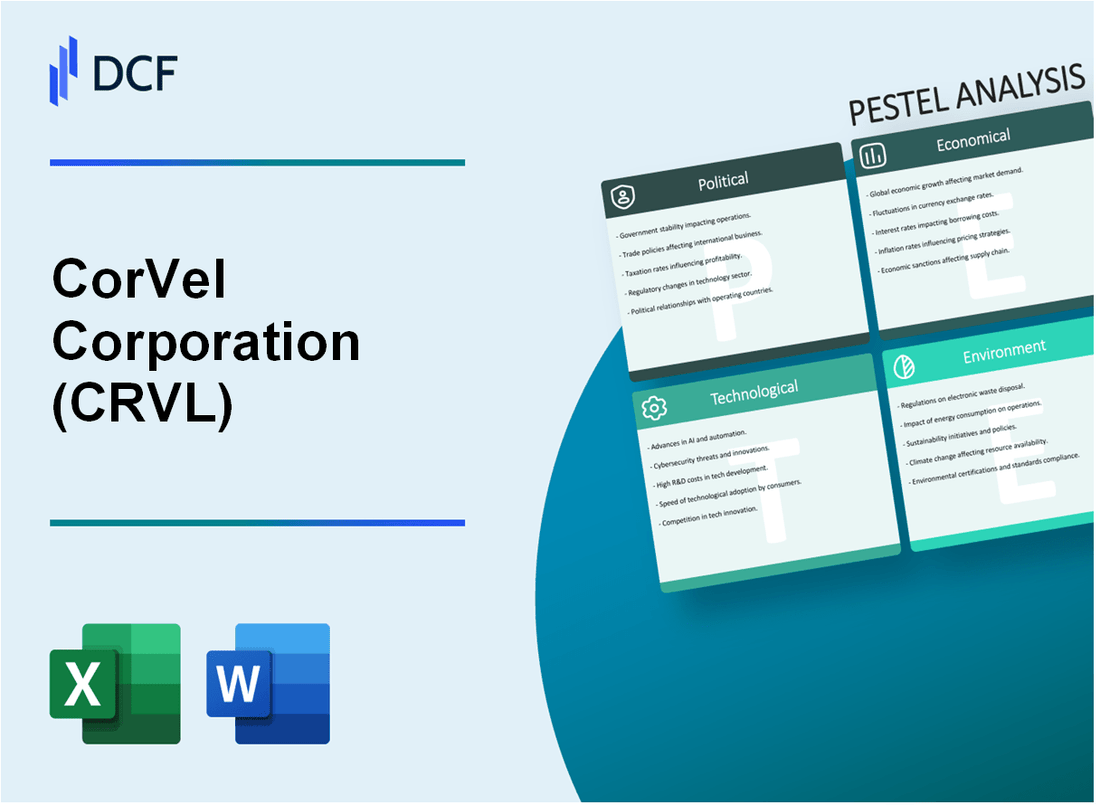
Fully Editable: Tailor To Your Needs In Excel Or Sheets
Professional Design: Trusted, Industry-Standard Templates
Investor-Approved Valuation Models
MAC/PC Compatible, Fully Unlocked
No Expertise Is Needed; Easy To Follow
CorVel Corporation (CRVL) Bundle
You're trying to map out the next few years for CorVel Corporation (CRVL), whose $896 million in fiscal 2025 revenue shows they're a major player, but their success hinges on navigating a minefield of external forces. Honestly, the biggest story right now is the tug-of-war between wildly different state laws governing workers' compensation and the firm's necessary, high-stakes pivot toward Agentic AI for claims processing. To make your next strategic move, you need to see exactly where the political, legal, and tech pressures are hitting hardest-so check out the full PESTLE analysis right below.
CorVel Corporation (CRVL) - PESTLE Analysis: Political factors
National trend of decreasing workers' compensation premium rates pressures revenue.
The political and regulatory environment for CorVel Corporation's core business is a paradox: while the workers' compensation (WC) system remains profitable for insurers, the political pressure to lower employer costs is persistent. This translates to lower premium rates, which can cap CorVel's revenue growth in its Network Solutions segment. For example, the National Council on Compensation Insurance (NCCI) reported that lost-time claim frequency declined by a significant 8%, which is more than double the long-term average decline. This safety improvement is the primary driver allowing state regulators to approve rate cuts, even as wage inflation pushes up indemnity costs.
Here's the quick math: lower claim frequency means less work for CorVel's claims management and bill review services per policy. This political push for cost savings means CorVel must increase market share and service utilization to offset the lower per-claim revenue. The total US Property & Casualty industry wrote $43 billion in workers' compensation premiums in 2023, showing the scale of the market where these rate pressures are applied.
State-level political efforts to curb cost spikes, like Connecticut's, impact benefit structure.
State-level politics directly impact the benefit structure CorVel manages, creating both risk and opportunity. The most recent and dramatic example is in Connecticut, where the legislature acted in May 2025 to mitigate a State Supreme Court decision that threatened to cause a massive 235% jump in workers' compensation insurance premiums for employers. This legislative action, effective July 1, 2025, curbed the cost spike by amending the Workers' Compensation Act to limit temporary partial disability benefits to 60 weeks for certain claimants who have reached maximum medical improvement (MMI) and received a rating.
This is a clear political win for employers, which CorVel serves, but it also means the benefit structure is constantly shifting. Separately, Connecticut regulators approved an average 6.1% cut in voluntary market workers' compensation rates for 2025, marking the 11th consecutive year of rate cuts in the state. CorVel must defintely adapt its claims management technology to these granular, state-by-state legislative changes to ensure compliance and deliver the promised cost savings to its clients.
New federal administration's shifting healthcare policy creates uncertainty for commercial health segment.
The new federal administration's shifting healthcare policy, particularly concerning the Affordable Care Act (ACA) and prescription drug pricing, creates significant uncertainty for CorVel's commercial health segment. The expiration of enhanced ACA premium subsidies at the end of 2025 is a major headwind, projected to cause median ACA marketplace premiums to rise by an average of 15% nationwide. This could lead to a contraction in the commercial health market or a shift in the types of plans CorVel's clients offer.
Also, the 'One Big Beautiful Bill Act' (OBBBA), signed in July 2025, targets over $1 trillion in cuts from federal healthcare programs over the next decade. While CorVel's primary focus is on casualty and commercial health, these massive federal funding shifts ripple across the entire healthcare ecosystem, influencing provider networks, pricing, and utilization management. The likely push for Pharmacy Benefit Manager (PBM) reform and increased price transparency also forces CorVel to continually update its bill review and network solutions to stay ahead of new regulatory requirements.
Government clients (e.g., State of North Carolina) rely on CorVel for claims management.
CorVel's deep integration with government entities provides a stable, high-profile revenue stream, but it also ties the company's performance to public sector needs and political crises. The State of North Carolina, a CorVel partner, was recognized in September 2025 for its crisis management response to Hurricane Helene (September 2024). CorVel's claims management services were crucial in ensuring uninterrupted access to care and wage replacement for injured workers in the 25-county FEMA-designated disaster area.
This partnership success highlights the reliance of large government clients on CorVel's infrastructure. In fact, 100% of the 175 indemnity claimants affected maintained access to compensation without payment gaps during the crisis. Furthermore, the Toll Highway Authority's Finance and Audit Committee voted in November 2025 to renew CorVel's workers' compensation claims administration contract for one year, which includes a 3% increase in claims administration fees, totaling $104,905 for the year. Government contracts are sticky, but they require constant political engagement and flawless execution to maintain.
The table below summarizes the key political factors and their direct financial or operational impact on CorVel, whose total revenue for fiscal year 2025 was $896 million.
| Political Factor | Impact on CorVel (CRVL) | Key 2025 Metric/Value |
|---|---|---|
| National WC Premium Rate Pressure | Caps revenue growth in Network Solutions, requiring market share gains to offset lower per-claim revenue. | Lost-time claim frequency declined 8% (NCCI data). |
| Connecticut State Legislative Action | Creates immediate compliance requirements; limits long-term claim costs for clients. | CT Legislature capped certain benefits to 60 weeks (effective July 1, 2025). |
| Federal Healthcare Policy Shift (ACA/OBBBA) | Creates uncertainty in the commercial health segment; drives demand for cost-containment solutions. | ACA premium subsidies set to expire end of 2025. |
| Government Client Reliance (NC) | Provides stable, high-profile contracts; demonstrates value in crisis management. | 100% of 175 indemnity claimants in NC maintained compensation access during Hurricane Helene. |
CorVel Corporation (CRVL) - PESTLE Analysis: Economic factors
You're looking at CorVel Corporation's recent performance against the backdrop of a tricky economic environment, where rising costs are eating into potential gains. The key takeaway here is that while CorVel posted strong top-line growth, the underlying inflationary pressures in healthcare and labor are significant headwinds that management must navigate carefully.
FY 2025 Revenue Growth and Financial Strength
CorVel Corporation definitely showed its stripes in the last fiscal year. Total annual revenues for the fiscal year ended March 31, 2025, hit $896 million, a solid increase from the $795 million posted in fiscal 2024. That's a healthy jump, largely driven by new customers in patient management and network solutions. Plus, the balance sheet looks rock solid; as of March 31, 2025, CorVel was debt-free with $171 million in cash and cash equivalents on hand. That liquidity is a huge asset when you're facing cost uncertainty.
Here's a quick look at those key numbers:
| Metric | FY 2025 Value (as of Mar 31, 2025) | FY 2024 Value |
| Total Annual Revenues | $896 million | $795 million |
| Cash & Equivalents | $171 million | N/A (Not specified for FY24 end) |
| Gross Profit | $210 million | $172 million |
Impact of Medical Cost Inflation on Claims Liability
The biggest shadow over the claims side of the business is medical inflation. We are operating under the premise that industry-wide medical cost inflation is running at an 8% cost trend for 2025, which directly inflates the liability CorVel must reserve for on its claims. To be fair, some external data suggests a slight moderation, with the Centers for Medicare and Medicaid Services forecasting the Personal Health Care index to rise by 2.6% in 2025, but the overall pressure from hospital and physician services remains high. If the 8% trend holds for the cost components CorVel manages, it puts immediate upward pressure on loss ratios, even if premium growth keeps pace.
Wage Inflation and Indemnity Costs
It's not just medical bills; labor costs are hitting indemnity payments, too. When an injured worker earns more, the indemnity benefit-which pays out a portion of lost wages-is higher. We saw significant wage inflation recently, with the U.S. Bureau of Economic Analysis reporting a 5.6% wage increase in late 2024, a trend expected to continue into 2025 due to the tight labor market. This means that even if claim frequency stays flat or drops, the severity of lost-time claims, measured by indemnity costs, will creep up. This is a defintely real cost that flows through the workers' compensation system.
Key economic pressures affecting indemnity and medical costs include:
- Wage growth driving up indemnity payments.
- Sustained medical inflation impacting claim severity.
- Competition for talent keeping wage pressure high.
- Higher costs for physician services and facilities.
Finance: draft 13-week cash view by Friday.
CorVel Corporation (CRVL) - PESTLE Analysis: Social factors
You're managing claims in a labor market that's fundamentally changing, and that means the nature of the injuries you see-and how much they cost-is shifting, too. The social environment is pushing for better, faster, and more empathetic claims handling, which is a direct challenge to traditional models. Honestly, if your service delivery isn't adapting to these demographic and expectation shifts, you're leaving money on the table and increasing litigation exposure.
Sociological
The aging US workforce is a major driver of claim severity. Older workers bring experience, sure, but when they get hurt, the claims are heavier. Data from 2024 shows employees aged 60 and older had the highest year-over-year increase in new workers' compensation claims, and those claims are 35% more costly than those filed by younger workers. Recovery periods for this group are, on average, nine days longer than the average. This trend is set to continue, as the Bureau of Labor Statistics projects the workforce aged 75 and older will grow by 79% by 2033. Workers aged 55 and older now account for over 25% of serious injury claims.
Here's the quick math: If a standard claim costs $\text{X}$, an older worker's claim costs $\text{X} \times 1.35$, plus more in lost-time indemnity payments due to the longer recovery. What this estimate hides is the complexity added by comorbidities, which can multiply the cost fivefold.
We are also seeing a rapid expansion in compensable mental health claims, which demands entirely new service models. While these claims still make up less than 2% of overall workers' compensation cases, they are far more expensive-costing 3.5 times more and lasting 3.6 times longer than claims without a mental health component. For first responders, like police officers and firefighters, Post-Traumatic Stress Disorder (PTSD) presumption laws are becoming more common, setting a precedent for other high-stress roles. The key action here is early intervention; getting a behavioral health specialist involved within the first 90 days can slash temporary total disability days by 40% to 70%.
The pressure on claims staff is immense because of these complex cases, compounded by labor shortages in critical support roles. The U.S. is projected to face a deficit of approximately 78,610 full-time Registered Nurses (RNs) in 2025 alone. RN vacancy rates hit 9.6% in 2025. This shortage drives up labor costs for patient management, as the cost of turnover for a single bedside RN averages $61,110. You need technology to augment your human capital, not just replace it. CorVel Corporation is leaning into this by investing in AI to enhance its communication platform and improve medical billing, aiming for streamlined, personalized interactions. This is the 'high-tech' part of the 'high-tech, high-touch' model you need to adopt to manage complexity and reduce litigation risk.
To put these social pressures into perspective, look at how demographics and cost severity are intersecting:
| Social Factor Driver | Key Statistic (2025 Context) | Impact on Claim Duration/Cost |
| Aging Workforce (60+) | Account for 13% of injuries, but costs are 15% higher than 34-49 age group | Slower recovery, higher medical spend, longer claim duration |
| Mental Health Claims | Cost 3.5 times more and last 3.6 times longer than non-mental health claims | Drives up total claim severity; early intervention critical |
| Healthcare Labor Shortage (RNs) | Projected deficit of 78,610 RNs in 2025 | Increased labor costs for patient management; potential for delayed care coordination |
| Demand for Experience | 31 states plus D.C. allowed mental health claims as of Jan 2024 | Requires service models that integrate behavioral health specialists early on |
The demand for a better injured worker experience is non-negotiable now. Workers expect faster digital intake, but they also need a real person to guide them through serious medical issues-that's the 'high-touch' element. If your claims process still relies heavily on paper or manual follow-up, you're fighting an uphill battle against expectations set by tech-forward competitors like CorVel Corporation.
- Train managers to spot burnout before it becomes a claim.
- Integrate mental wellness into safety strategy now.
- Use data to segment claims for proactive adjuster assignment.
- Focus on tailored training for older workers to prevent injury.
Finance: draft 13-week cash view by Friday
CorVel Corporation (CRVL) - PESTLE Analysis: Technological factors
You're looking at how CorVel Corporation is using tech to stay ahead in claims management, which is smart because the pace of change is brutal. Honestly, the firm isn't just dabbling; they are embedding Artificial Intelligence (AI) and Machine Learning (ML) deep into their core processes to drive efficiency and better outcomes for fiscal 2025.
Strategic investment in Agentic AI (artificial intelligence) and machine learning for bill review and claims automation
CorVel is definitely pushing the envelope with AI, Machine Learning (ML), and Natural Language Processing (NLP) to manage care episodes and control health-care costs. They are actively researching Agentic AI-systems that handle complex workflows with less human input-to power the next wave of innovation in claims management. This isn't just theory; their rules-based automation, a complement to AI, is projected to reduce manual bill approvals by more than 20% in 2025. Here's the quick math: that saves adjusters about 1.5 to 2 hours each week, which is like getting a full workday back every month for review tasks. The predictive modeling on their CareMC Edge platform already scores claims for risk, helping them spot outliers likely to need extra attention or litigation.
What this estimate hides is that these tools support, but do not replace, human judgment, which is a crucial distinction for regulatory comfort.
Key AI/Automation Metrics for Fiscal 2025:
- Projected reduction in manual approvals: 20%+
- Time saved for adjusters weekly: 1.5 to 2 hours
- AI application focus: Workflow automation, triage, decision support
Use of virtual care and telehealth platforms accelerates medical intervention and access to specialists in remote areas
The 24/7 virtual care platform with nurse triage is a huge differentiator, especially when you consider the time savings. A virtual visit takes injured workers about 30 minutes away from the job site, but a traditional brick-and-mortar visit averages over 4+ hours when you factor in travel and waiting. That immediate intervention helps prevent minor issues from becoming expensive claims. To be fair, the cost difference is stark: the average cost of a virtual visit is just $175, compared to an average of $1,000 for an emergency room visit for after-hours injuries. Plus, their telehealth model ensures narcotics are never prescribed during the initial virtual assessment, a practice seen in 30% of traditional clinic visits.
Proprietary digital communication tools (e.g., IVR, chatbots) streamline personalized communication with injured workers
CorVel uses technology to maintain that critical human connection, which they call a high-tech, high-touch approach. Text-enabled communication keeps workers informed at every step, and secure online portals like CareMC let all parties share info fast. CareMC isn't just a static website; it's where customers can report incidents, schedule appointments, and approve bills for payment in real time. This transparency and guidance is key; when employees feel respected, they are less likely to pursue legal representation, which helps keep costs down.
Cybersecurity risk remains critical due to handling vast amounts of protected health information (PHI) and client data
Handling all that Protected Health Information (PHI) and client data means cybersecurity is a top-tier concern, not just an IT issue. While CorVel's Board oversees the program, the external threat landscape is getting more intense. Globally, cybersecurity spending is projected to hit $213 billion in 2025, largely driven by the need to secure cloud environments and counter AI-powered attacks. Increased regulatory scrutiny on the use of AI and big data techniques could defintely impact operations, so their investment in people, processes, and technology to identify and respond to threats is non-negotiable.
It's a constant arms race, and you have to assume the bad actors are using the same advanced tools.
Here is a quick snapshot of CorVel Corporation's technology deployment:
| Technology Area | Metric/Value | Fiscal 2025 Context/Impact |
|---|---|---|
| Telehealth Intervention Time | 30 minutes away from job site | Significantly reduces lost productivity vs. 4+ hours for in-person care. |
| Telehealth Visit Cost | Average $175 | Avoids ER costs, which average $1,000. |
| Rules-Based Automation | Projected 20% reduction in manual approvals | Frees up adjuster time for higher-value, complex claim interactions. |
| Narcotics Prescribed (Telehealth) | 0% | Contrasts with 30% of traditional brick-and-mortar visits. |
| Global Cybersecurity Spending (External Benchmark) | Projected $213 billion | Indicates the rising external cost of protecting sensitive PHI/client data. |
Finance: draft 13-week cash view by Friday.
CorVel Corporation (CRVL) - PESTLE Analysis: Legal factors
You're managing claims across the entire US, so you know the legal landscape is a minefield. For CorVel Corporation, this means compliance isn't a suggestion; it's the core cost of doing business. The highly complex and fragmented nature of workers' compensation laws across all 50 states demands a specialized, state-by-state compliance infrastructure. This regulatory patchwork directly impacts your ability to standardize claims handling and cost containment strategies, which is critical when you are managing a national book of business that generated $896 million in revenue for the fiscal year ended March 31, 2025.
State-Specific Regulatory Shifts Impacting Medical Cost Management
Recent legislative action in key states is directly reshaping how medical claims are priced and paid, which is where your cost containment efforts live or die. To be fair, these changes offer both new constraints and potential savings opportunities for CorVel Corporation's bill review and medical management segments.
Consider the recent developments in New York and Wisconsin, which are moving aggressively on medical cost control:
- New York: Legislation signed as part of the FY 2026 Budget amends Workers' Compensation Law Section 21-a. Effective January 1, 2027, insurers can pay for necessary medical treatment for up to one year without formally admitting liability for the entire claim. This is a big deal because medical-only claims-those without lost wages-make up over 60% of all workers' comp cases in the state.
- Wisconsin: A law signed on July 3, 2025, establishes a hospital fee schedule, which is a major win for cost predictability. The Department of Workforce Development (DWD) must finalize the schedule by July 1, 2027.
Here's the quick math on the Wisconsin fee schedule, which sets a ceiling on hospital charges:
| Parameter | Detail | Impact on CorVel Corporation |
|---|---|---|
| Maximum Charge Cap | 120% of the 75th percentile commercial in-network rate per service. | Directly limits maximum medical spend for hospital services, aiding loss ratio control. |
| Benchmark Data Used | Commercial in-network rates (Medicare/Medicaid excluded). | Requires robust market data analysis to set reserves accurately against the new benchmark. |
| Payment Deadline (Bills < $65,000) | 60 days from receipt of bill/records. | Accelerates payment cycle for smaller claims; failure to meet voids the fee schedule protection. |
| Payment Deadline (Bills $\ge$ $65,000) | 90 days from receipt of bill/records. | Provides a slightly longer window for complex claims review, but still demands efficiency. |
What this estimate hides is that if CorVel Corporation misses these payment deadlines, hospitals can revert to charging their full, undiscounted rates, which is a significant operational risk.
Shifting Burden of Proof via Presumption Laws
Another critical legal trend is the expansion of statutory presumptions, which essentially shift the burden of proof away from the employer or Third-Party Administrator (TPA) to prove a condition is not work-related. This is defintely increasing claim complexity and potential liability exposure.
The focus is heavily on occupational diseases and mental health claims. For example:
- New York's January 2025 law reportedly allows workers to claim compensation for extreme job stress, not just first responders, which requires carriers to adapt processes for potentially longer recovery times.
- In other jurisdictions, presumptive coverage is expanding to include more healthcare professionals and essential retail workers for conditions like infectious diseases and certain cancers.
When a presumption applies, the claim is assumed compensable unless the employer/TPA can provide sufficient evidence to rebut the legal assumption. This means your clinical review and investigative teams must be prepared to challenge these claims with higher evidentiary standards, directly affecting claims handling time and ultimate loss adjustment expenses.
CorVel Corporation (CRVL) - PESTLE Analysis: Environmental factors
You're looking at the environmental side of CorVel Corporation's operations, and honestly, the picture is relatively clean from a direct manufacturing standpoint. Because the core business is providing services-claims management, bill review, and care coordination-the direct ecological footprint is low compared to, say, a heavy industrial firm. Think about it: your main inputs are data, technology, and people, not smokestacks.
Still, a large service provider with revenues hitting $896 million in fiscal year 2025 and employing over 5,000 team members has some footprint, mostly tied up in office energy use and business travel. The company has a general commitment to high Environmental, Social, and Governance (ESG) standards, which is what investors expect now. However, finding the hard numbers on their specific performance is tough. It seems detailed, public environmental performance metrics or formal sustainability reports are scarce; most ESG data aggregators point to subscriber-only access or note a lack of readily available public reports for CorVel Corporation.
Here's the quick math: for a company of this scale, even small efficiency gains in energy or travel translate to meaningful reductions. What this estimate hides, though, is the actual baseline they are trying to improve upon. We need to see their Scope 1, 2, and 3 emissions data to truly gauge progress.
The biggest environmental tailwind for CorVel Corporation right now is the ongoing shift toward remote work arrangements. This isn't just a perk for employees; it directly helps minimize the company's operational carbon emissions by reducing the need to heat, cool, and power large central offices. Studies suggest that full-time remote workers can see an employment-related carbon footprint reduction as high as 54% compared to fully on-site peers, largely due to eliminating daily commutes.
Even a hybrid setup, where employees might be in the office two to four days a week, can cut emissions by 11% to 29%. For CorVel Corporation, with its technology-driven service model, this flexibility is a natural fit, meaning less energy consumption per employee and lower business travel expenses, which is a win-win for the bottom line and the planet. If onboarding takes 14+ days, churn risk rises, but if remote work adoption is high, operational efficiency improves.
Here is a snapshot of the context surrounding CorVel Corporation's environmental profile as of the 2025 fiscal year end:
| Metric Category | Data Point (FY2025 or Contextual) | Source/Relevance |
|---|---|---|
| Total Annual Revenue | $896 million | Scale indicator for operational footprint. |
| Team Members | More than 5,000 | Scale indicator for office space/utility consumption. |
| Adjusted Annual EPS | $1.83 | Financial health context for ESG investment capacity. |
| Remote Work Emission Reduction Potential (Full-Time) | Up to 54% | General industry trend benefit for service firms. |
| ESG Reporting Transparency | Limited public detail available | Identified gap in public disclosure. |
The environmental opportunities for CorVel Corporation are mostly realized through smart operational choices rather than direct product changes. You should focus on tracking these internal efficiencies:
- Track office energy use post-split.
- Quantify reduction in business travel spend.
- Benchmark against peers on ESG disclosure.
- Incentivize low-carbon home office setups.
To be fair, the environmental benefit shifts somewhat to the employee's home energy use, which is outside the company's direct control. Still, by continuing to support flexible work, CorVel Corporation is structurally aligned with lower transportation emissions. Finance: draft 13-week cash view by Friday.
Disclaimer
All information, articles, and product details provided on this website are for general informational and educational purposes only. We do not claim any ownership over, nor do we intend to infringe upon, any trademarks, copyrights, logos, brand names, or other intellectual property mentioned or depicted on this site. Such intellectual property remains the property of its respective owners, and any references here are made solely for identification or informational purposes, without implying any affiliation, endorsement, or partnership.
We make no representations or warranties, express or implied, regarding the accuracy, completeness, or suitability of any content or products presented. Nothing on this website should be construed as legal, tax, investment, financial, medical, or other professional advice. In addition, no part of this site—including articles or product references—constitutes a solicitation, recommendation, endorsement, advertisement, or offer to buy or sell any securities, franchises, or other financial instruments, particularly in jurisdictions where such activity would be unlawful.
All content is of a general nature and may not address the specific circumstances of any individual or entity. It is not a substitute for professional advice or services. Any actions you take based on the information provided here are strictly at your own risk. You accept full responsibility for any decisions or outcomes arising from your use of this website and agree to release us from any liability in connection with your use of, or reliance upon, the content or products found herein.