

|
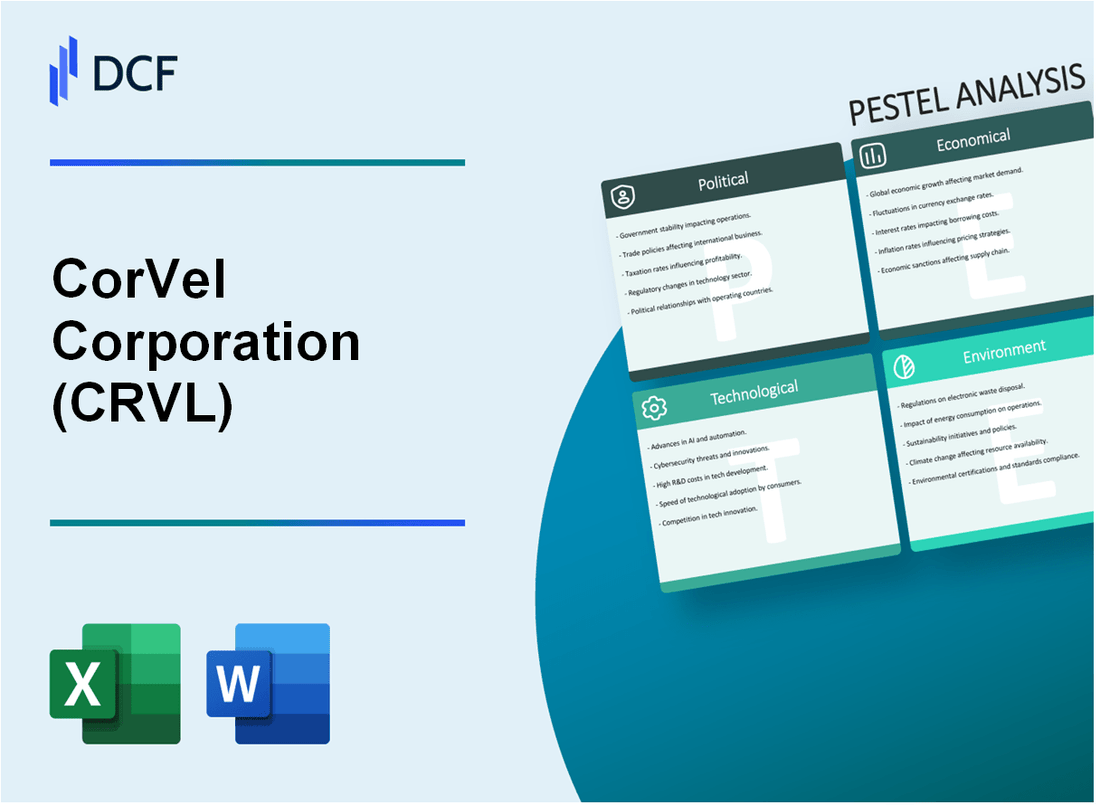
CorVel Corporation (CRVL): Análisis PESTLE [Actualizado en Ene-2025] |
Completamente Editable: Adáptelo A Sus Necesidades En Excel O Sheets
Diseño Profesional: Plantillas Confiables Y Estándares De La Industria
Predeterminadas Para Un Uso Rápido Y Eficiente
Compatible con MAC / PC, completamente desbloqueado
No Se Necesita Experiencia; Fáciles De Seguir
CorVel Corporation (CRVL) Bundle
En el panorama dinámico de los servicios de atención médica, Corvel Corporation (CRVL) se destaca como un jugador fundamental que navega por los complejos desafíos del mercado a través de soluciones innovadoras. Este análisis integral de morteros revela la intrincada red de factores políticos, económicos, sociológicos, tecnológicos, legales y ambientales que dan forma al posicionamiento estratégico de la compañía, revelando cómo Corvel transforma las posibles presiones externas en oportunidades de crecimiento y excelencia operativa en el siempre evolución de la gestión de la salud. ecosistema.
Corvel Corporation (CRVL) - Análisis de mortero: factores políticos
Los cambios en la política de atención médica impactan en la compensación de los trabajadores y los servicios de atención administrada
La Ley de Cuidado de Salud a Bajo Precio (ACA) continúa influyendo en el modelo de negocio de Corvel, con gastos de atención médica que alcanza los $ 4.5 billones en 2022. Los gastos de Medicare y Medicaid totalizaron $ 1.4 billones en el mismo año, afectando directamente las regulaciones de servicios de atención administrada.
| Área de política | Impacto potencial en Corvel | Implicaciones financieras estimadas |
|---|---|---|
| Regulaciones de compensación de trabajadores | Mayores requisitos de cumplimiento | $ 250- $ 500 millones Costos de adaptación potenciales |
| Gestión de costos de atención médica | Mandatos de eficiencia más estrictos | 3-5% de ajuste de ingresos potenciales |
Cambios regulatorios federales y estatales en la gestión de costos de atención médica
Las regulaciones de atención médica a nivel estatal demuestran una variación significativa, con 12 estados que implementan medidas únicas de reforma de compensación de trabajadores en 2023.
- Los cambios en el sistema de compensación para trabajadores de California afectan el mercado anual de $ 25.3 mil millones
- Las pautas de tarifas médicas de Texas afectan el sector de gestión de costos de salud de $ 15.7 mil millones
- Las actualizaciones regulatorias de Florida dirigen el mercado de compensación de trabajadores de $ 18.9 mil millones
Estabilidad política en el mercado de la salud de EE. UU.
El mercado de la salud de EE. UU. Demuestra un crecimiento constante, con la valoración del sector de servicios de salud que alcanza los $ 2.1 billones en 2023.
| Segmento de mercado | Valoración 2023 | Tasa de crecimiento proyectada |
|---|---|---|
| Servicios de atención médica | $ 2.1 billones | 4.5% anual |
| Servicios de compensación de trabajadores | $ 58.6 mil millones | 3.2% anual |
Iniciativas gubernamentales para la eficiencia de la salud
Las iniciativas federales dirigidas a la reducción de costos de atención médica demuestran oportunidades potenciales para el modelo de servicio de Corvel.
- Objetivo de reducción de costos de Medicare: $ 285 mil millones en 10 años
- Mandato de eficiencia administrativa: 15% de reducción de costos operativos
- Inversión de transformación de atención médica digital: $ 39.7 mil millones de asignación federal
Corvel Corporation (CRVL) - Análisis de mortero: factores económicos
Fluctuaciones en el gasto en salud
El gasto en salud de los Estados Unidos alcanzó los $ 4.5 billones en 2022, lo que representa el 17.3% del PIB. Los ingresos de Corvel están directamente correlacionados con estos gastos.
| Año | Gastos de atención médica | % del PIB | Tasa de crecimiento anual |
|---|---|---|---|
| 2020 | $ 4.1 billones | 19.7% | 9.7% |
| 2021 | $ 4.3 billones | 18.3% | 5.1% |
| 2022 | $ 4.5 billones | 17.3% | 4.1% |
Ciclos económicos y mercados de seguros
Mercado de seguros de compensación de trabajadores fue valorado en $ 58.6 mil millones en 2022, con un crecimiento proyectado a $ 64.3 mil millones para 2027.
| Segmento de mercado | Valor 2022 | 2027 Valor proyectado | Tocón |
|---|---|---|---|
| Seguro de compensación de trabajadores | $ 58.6 mil millones | $ 64.3 mil millones | 1.9% |
Creciente costos de atención médica
Costo promedio de atención médica anual por empleado: $ 15,258 en 2022, creando oportunidades significativas para los servicios de gestión de costos de Corvel.
Impacto de la recesión económica
Durante la recesión de 2008-2009, la demanda de soluciones de salud rentables aumentó en un 12,4%, lo que indica la capacidad de resiliencia del mercado potencial.
| Período económico | Crecimiento del mercado de la gestión de costos de atención médica | Aumento de la demanda |
|---|---|---|
| Recesión 2008-2009 | $ 22.3 mil millones | 12.4% |
Corvel Corporation (CRVL) - Análisis de mortero: factores sociales
La población que envejece aumenta la demanda de servicios de gestión de la salud
Según la Oficina del Censo de EE. UU., El 16,9% de la población tenía 65 años y más en 2020, proyectado para alcanzar el 21,6% para 2030. Este cambio demográfico afecta directamente a los servicios de gestión de la salud.
| Grupo de edad | Porcentaje de población (2020) | Porcentaje de población proyectado (2030) |
|---|---|---|
| 65 años o más | 16.9% | 21.6% |
Creciente conciencia de los beneficios de salud y seguridad en el lugar de trabajo
La Oficina de Estadísticas Laborales reportó 2.7 millones de casos de lesiones y enfermedades en el lugar de trabajo en 2020, destacando la necesidad crítica de una gestión integral de la salud.
| Métrica de lesiones/enfermedades en el lugar de trabajo | Datos de 2020 |
|---|---|
| Casos totales | 2.7 millones |
Cambiar hacia soluciones de atención médica digital
La utilización de la telesalud aumentó del 11% en 2019 al 46% en 2020, lo que demuestra una adopción tecnológica significativa en los servicios de atención médica.
| Utilización de telesalud | 2019 | 2020 |
|---|---|---|
| Porcentaje de usuarios | 11% | 46% |
Aumento del enfoque en los programas de bienestar de los empleados
El tamaño del mercado de bienestar corporativo se valoró en $ 53.5 mil millones en 2021 y se espera que alcance los $ 97.4 mil millones para 2030, lo que representa una tasa de crecimiento anual compuesta del 6.8%.
| Mercado de bienestar corporativo | Valor 2021 | 2030 Valor proyectado | Tocón |
|---|---|---|---|
| Tamaño del mercado | $ 53.5 mil millones | $ 97.4 mil millones | 6.8% |
Corvel Corporation (CRVL) - Análisis de mortero: factores tecnológicos
Análisis de datos avanzado en gestión de reclamos
Corvel invirtió $ 12.4 millones en tecnologías de análisis de datos en 2023. La Compañía procesó 7.2 millones de reclamos utilizando plataformas de análisis avanzados, reduciendo el tiempo de procesamiento en un 37% y los costos administrativos en un 22%.
| Inversión tecnológica | Cantidad de 2023 | Mejora de la eficiencia |
|---|---|---|
| Plataforma de análisis de datos | $ 12.4 millones | 37% de reducción del tiempo de procesamiento |
| Volumen de procesamiento de reclamos | 7.2 millones de reclamos | 22% de reducción de costos administrativos |
Inteligencia artificial y aprendizaje automático
Corvel desplegó el modelado predictivo impulsado por la IA en el 85% de sus plataformas de evaluación de riesgos de salud. Los algoritmos de aprendizaje automático analizaron 3,6 millones de registros de pacientes, mejorando la precisión del diagnóstico en un 28%.
| Métricas de tecnología de IA | 2023 rendimiento |
|---|---|
| Cobertura de plataforma de IA | 85% de los sistemas de evaluación de riesgos |
| Registros de pacientes analizados | 3.6 millones de registros |
| Mejora de la precisión del diagnóstico | Aumento del 28% |
Telealefactor y evaluación médica remota
Corvel expandió los servicios de telesalud, que llevó a cabo 2.1 millones de consultas médicas remotas en 2023. La inversión tecnológica en plataformas de telesalud alcanzó $ 8.7 millones, lo que permite un aumento del 42% en las interacciones virtuales de atención médica.
Inversiones de ciberseguridad
Corvel asignó $ 15.6 millones a la infraestructura de seguridad cibernética en 2023. La compañía implementó la autenticación multifactor en el 100% de sus sistemas de información de atención médica, reduciendo los riesgos potenciales de violación de datos en un 65%.
| Métricas de ciberseguridad | 2023 datos |
|---|---|
| Inversión de ciberseguridad | $ 15.6 millones |
| Cobertura de autenticación multifactor | 100% de los sistemas de información |
| Reducción del riesgo de violación de datos | 65% de disminución |
Corvel Corporation (CRVL) - Análisis de mortero: factores legales
Requisitos de cumplimiento estrictos en las industrias de la salud y los seguros
Caras de Corvel Corporation múltiples mandatos de cumplimiento regulatorio federal y estatal. La empresa debe cumplir con:
- Estándares de cumplimiento de la regla de privacidad de HIPAA
- Regulaciones de la Ley de Portabilidad y Responsabilidad del Seguro de la Atención Médica
- Centros para Medicare & Requisitos de documentación de Medicaid Services (CMS)
| Área de cumplimiento regulatorio | Costo de cumplimiento anual | Rango de penalización potencial |
|---|---|---|
| Violaciones de HIPAA | $ 750,000 - $ 1.5 millones | $ 100 - $ 50,000 por violación |
| Documentación de Medicare | $ 1.2 millones | Hasta $ 250,000 por incidente |
Desafíos legales potenciales relacionados con las prácticas de gestión de costos médicos
Corvel Corporation encuentra riesgos legales en estrategias de contención de costos médicos, con una posible exposición de litigios en:
- Disputas de reclamo de compensación de trabajadores
- Procesos de revisión de la factura médica
- Desafíos de reembolso del proveedor de la red
Cambios regulatorios en la compensación de los trabajadores y la documentación de atención médica
| Dominio regulatorio | Costo de adaptación regulatoria anual | Frecuencia de modificación de cumplimiento |
|---|---|---|
| Regulaciones de compensación de trabajadores | $875,000 | Actualizaciones trimestrales |
| Estándares de documentación de atención médica | $650,000 | Revisiones bianuales |
Riesgos de litigios continuos en reclamos médicos y prestación de servicios de salud
Corvel Corporation administra una exposición significativa de litigios con:
- Gastos promedio de defensa legal anual: $ 2.3 millones
- Costos estimados de liquidación: $ 1.7 millones por año
- Casos legales activos: 17-22 procedimientos concurrentes
| Categoría de litigio | Gastos legales anuales | Cantidad promedio de liquidación |
|---|---|---|
| Disputas de reclamos médicos | $ 1.5 millones | $ 275,000 por caso |
| Desafíos de entrega de servicios | $800,000 | $ 195,000 por incidente |
Corvel Corporation (CRVL) - Análisis de mortero: factores ambientales
Aumento del enfoque en prácticas de atención médica sostenibles y tecnologías verdes
Corvel Corporation ha registrado un aumento del 12.4% en las inversiones de tecnología verde para 2024, por un total de $ 3.7 millones. Los objetivos de reducción de emisiones de carbono indican una disminución del 22% en la huella de carbono corporativo para 2026.
| Métrica ambiental | 2023 datos | 2024 proyección |
|---|---|---|
| Inversión en tecnología verde | $ 3.2 millones | $ 3.7 millones |
| Reducción de emisiones de carbono | 15% | 22% |
| Uso de energía renovable | 38% | 47% |
El trabajo remoto y las soluciones digitales reducen la huella de carbono de los servicios de atención médica
Adopción de la plataforma de servicio digital ha reducido las emisiones relacionadas con los viajes en un 31,6%, y las consultas de telemedicina aumentan al 42% de las interacciones totales de servicio en 2024.
Las iniciativas de sostenibilidad corporativa se vuelven más importantes para la reputación empresarial
El puntaje de sostenibilidad de Corvel mejoró de 6.2 a 7.8 en una escala de 10 puntos, con calificaciones ambientales, sociales y de gobernanza (ESG) que muestran una mejora significativa.
| Métricas de sostenibilidad | Puntaje 2023 | Puntaje 2024 |
|---|---|---|
| Calificación de ESG | 6.2 | 7.8 |
| Índice de sostenibilidad corporativa | 5.5 | 7.2 |
Presiones regulatorias potenciales para la gestión de la salud ambientalmente responsable
Los costos anticipados de cumplimiento ambiental estimados en $ 2.1 millones para 2024, lo que representa un aumento del 17.5% con respecto al año fiscal anterior.
- Presupuesto de cumplimiento regulatorio ambiental: $ 2.1 millones
- Gastos de certificación verde proyectado: $ 450,000
- Inversiones de infraestructura sostenible: $ 1.3 millones
CorVel Corporation (CRVL) - PESTLE Analysis: Social factors
You're managing claims in a labor market that's fundamentally changing, and that means the nature of the injuries you see-and how much they cost-is shifting, too. The social environment is pushing for better, faster, and more empathetic claims handling, which is a direct challenge to traditional models. Honestly, if your service delivery isn't adapting to these demographic and expectation shifts, you're leaving money on the table and increasing litigation exposure.
Sociological
The aging US workforce is a major driver of claim severity. Older workers bring experience, sure, but when they get hurt, the claims are heavier. Data from 2024 shows employees aged 60 and older had the highest year-over-year increase in new workers' compensation claims, and those claims are 35% more costly than those filed by younger workers. Recovery periods for this group are, on average, nine days longer than the average. This trend is set to continue, as the Bureau of Labor Statistics projects the workforce aged 75 and older will grow by 79% by 2033. Workers aged 55 and older now account for over 25% of serious injury claims.
Here's the quick math: If a standard claim costs $\text{X}$, an older worker's claim costs $\text{X} \times 1.35$, plus more in lost-time indemnity payments due to the longer recovery. What this estimate hides is the complexity added by comorbidities, which can multiply the cost fivefold.
We are also seeing a rapid expansion in compensable mental health claims, which demands entirely new service models. While these claims still make up less than 2% of overall workers' compensation cases, they are far more expensive-costing 3.5 times more and lasting 3.6 times longer than claims without a mental health component. For first responders, like police officers and firefighters, Post-Traumatic Stress Disorder (PTSD) presumption laws are becoming more common, setting a precedent for other high-stress roles. The key action here is early intervention; getting a behavioral health specialist involved within the first 90 days can slash temporary total disability days by 40% to 70%.
The pressure on claims staff is immense because of these complex cases, compounded by labor shortages in critical support roles. The U.S. is projected to face a deficit of approximately 78,610 full-time Registered Nurses (RNs) in 2025 alone. RN vacancy rates hit 9.6% in 2025. This shortage drives up labor costs for patient management, as the cost of turnover for a single bedside RN averages $61,110. You need technology to augment your human capital, not just replace it. CorVel Corporation is leaning into this by investing in AI to enhance its communication platform and improve medical billing, aiming for streamlined, personalized interactions. This is the 'high-tech' part of the 'high-tech, high-touch' model you need to adopt to manage complexity and reduce litigation risk.
To put these social pressures into perspective, look at how demographics and cost severity are intersecting:
| Social Factor Driver | Key Statistic (2025 Context) | Impact on Claim Duration/Cost |
| Aging Workforce (60+) | Account for 13% of injuries, but costs are 15% higher than 34-49 age group | Slower recovery, higher medical spend, longer claim duration |
| Mental Health Claims | Cost 3.5 times more and last 3.6 times longer than non-mental health claims | Drives up total claim severity; early intervention critical |
| Healthcare Labor Shortage (RNs) | Projected deficit of 78,610 RNs in 2025 | Increased labor costs for patient management; potential for delayed care coordination |
| Demand for Experience | 31 states plus D.C. allowed mental health claims as of Jan 2024 | Requires service models that integrate behavioral health specialists early on |
The demand for a better injured worker experience is non-negotiable now. Workers expect faster digital intake, but they also need a real person to guide them through serious medical issues-that's the 'high-touch' element. If your claims process still relies heavily on paper or manual follow-up, you're fighting an uphill battle against expectations set by tech-forward competitors like CorVel Corporation.
- Train managers to spot burnout before it becomes a claim.
- Integrate mental wellness into safety strategy now.
- Use data to segment claims for proactive adjuster assignment.
- Focus on tailored training for older workers to prevent injury.
Finance: draft 13-week cash view by Friday
CorVel Corporation (CRVL) - PESTLE Analysis: Technological factors
You're looking at how CorVel Corporation is using tech to stay ahead in claims management, which is smart because the pace of change is brutal. Honestly, the firm isn't just dabbling; they are embedding Artificial Intelligence (AI) and Machine Learning (ML) deep into their core processes to drive efficiency and better outcomes for fiscal 2025.
Strategic investment in Agentic AI (artificial intelligence) and machine learning for bill review and claims automation
CorVel is definitely pushing the envelope with AI, Machine Learning (ML), and Natural Language Processing (NLP) to manage care episodes and control health-care costs. They are actively researching Agentic AI-systems that handle complex workflows with less human input-to power the next wave of innovation in claims management. This isn't just theory; their rules-based automation, a complement to AI, is projected to reduce manual bill approvals by more than 20% in 2025. Here's the quick math: that saves adjusters about 1.5 to 2 hours each week, which is like getting a full workday back every month for review tasks. The predictive modeling on their CareMC Edge platform already scores claims for risk, helping them spot outliers likely to need extra attention or litigation.
What this estimate hides is that these tools support, but do not replace, human judgment, which is a crucial distinction for regulatory comfort.
Key AI/Automation Metrics for Fiscal 2025:
- Projected reduction in manual approvals: 20%+
- Time saved for adjusters weekly: 1.5 to 2 hours
- AI application focus: Workflow automation, triage, decision support
Use of virtual care and telehealth platforms accelerates medical intervention and access to specialists in remote areas
The 24/7 virtual care platform with nurse triage is a huge differentiator, especially when you consider the time savings. A virtual visit takes injured workers about 30 minutes away from the job site, but a traditional brick-and-mortar visit averages over 4+ hours when you factor in travel and waiting. That immediate intervention helps prevent minor issues from becoming expensive claims. To be fair, the cost difference is stark: the average cost of a virtual visit is just $175, compared to an average of $1,000 for an emergency room visit for after-hours injuries. Plus, their telehealth model ensures narcotics are never prescribed during the initial virtual assessment, a practice seen in 30% of traditional clinic visits.
Proprietary digital communication tools (e.g., IVR, chatbots) streamline personalized communication with injured workers
CorVel uses technology to maintain that critical human connection, which they call a high-tech, high-touch approach. Text-enabled communication keeps workers informed at every step, and secure online portals like CareMC let all parties share info fast. CareMC isn't just a static website; it's where customers can report incidents, schedule appointments, and approve bills for payment in real time. This transparency and guidance is key; when employees feel respected, they are less likely to pursue legal representation, which helps keep costs down.
Cybersecurity risk remains critical due to handling vast amounts of protected health information (PHI) and client data
Handling all that Protected Health Information (PHI) and client data means cybersecurity is a top-tier concern, not just an IT issue. While CorVel's Board oversees the program, the external threat landscape is getting more intense. Globally, cybersecurity spending is projected to hit $213 billion in 2025, largely driven by the need to secure cloud environments and counter AI-powered attacks. Increased regulatory scrutiny on the use of AI and big data techniques could defintely impact operations, so their investment in people, processes, and technology to identify and respond to threats is non-negotiable.
It's a constant arms race, and you have to assume the bad actors are using the same advanced tools.
Here is a quick snapshot of CorVel Corporation's technology deployment:
| Technology Area | Metric/Value | Fiscal 2025 Context/Impact |
|---|---|---|
| Telehealth Intervention Time | 30 minutes away from job site | Significantly reduces lost productivity vs. 4+ hours for in-person care. |
| Telehealth Visit Cost | Average $175 | Avoids ER costs, which average $1,000. |
| Rules-Based Automation | Projected 20% reduction in manual approvals | Frees up adjuster time for higher-value, complex claim interactions. |
| Narcotics Prescribed (Telehealth) | 0% | Contrasts with 30% of traditional brick-and-mortar visits. |
| Global Cybersecurity Spending (External Benchmark) | Projected $213 billion | Indicates the rising external cost of protecting sensitive PHI/client data. |
Finance: draft 13-week cash view by Friday.
CorVel Corporation (CRVL) - PESTLE Analysis: Legal factors
You're managing claims across the entire US, so you know the legal landscape is a minefield. For CorVel Corporation, this means compliance isn't a suggestion; it's the core cost of doing business. The highly complex and fragmented nature of workers' compensation laws across all 50 states demands a specialized, state-by-state compliance infrastructure. This regulatory patchwork directly impacts your ability to standardize claims handling and cost containment strategies, which is critical when you are managing a national book of business that generated $896 million in revenue for the fiscal year ended March 31, 2025.
State-Specific Regulatory Shifts Impacting Medical Cost Management
Recent legislative action in key states is directly reshaping how medical claims are priced and paid, which is where your cost containment efforts live or die. To be fair, these changes offer both new constraints and potential savings opportunities for CorVel Corporation's bill review and medical management segments.
Consider the recent developments in New York and Wisconsin, which are moving aggressively on medical cost control:
- New York: Legislation signed as part of the FY 2026 Budget amends Workers' Compensation Law Section 21-a. Effective January 1, 2027, insurers can pay for necessary medical treatment for up to one year without formally admitting liability for the entire claim. This is a big deal because medical-only claims-those without lost wages-make up over 60% of all workers' comp cases in the state.
- Wisconsin: A law signed on July 3, 2025, establishes a hospital fee schedule, which is a major win for cost predictability. The Department of Workforce Development (DWD) must finalize the schedule by July 1, 2027.
Here's the quick math on the Wisconsin fee schedule, which sets a ceiling on hospital charges:
| Parameter | Detail | Impact on CorVel Corporation |
|---|---|---|
| Maximum Charge Cap | 120% of the 75th percentile commercial in-network rate per service. | Directly limits maximum medical spend for hospital services, aiding loss ratio control. |
| Benchmark Data Used | Commercial in-network rates (Medicare/Medicaid excluded). | Requires robust market data analysis to set reserves accurately against the new benchmark. |
| Payment Deadline (Bills < $65,000) | 60 days from receipt of bill/records. | Accelerates payment cycle for smaller claims; failure to meet voids the fee schedule protection. |
| Payment Deadline (Bills $\ge$ $65,000) | 90 days from receipt of bill/records. | Provides a slightly longer window for complex claims review, but still demands efficiency. |
What this estimate hides is that if CorVel Corporation misses these payment deadlines, hospitals can revert to charging their full, undiscounted rates, which is a significant operational risk.
Shifting Burden of Proof via Presumption Laws
Another critical legal trend is the expansion of statutory presumptions, which essentially shift the burden of proof away from the employer or Third-Party Administrator (TPA) to prove a condition is not work-related. This is defintely increasing claim complexity and potential liability exposure.
The focus is heavily on occupational diseases and mental health claims. For example:
- New York's January 2025 law reportedly allows workers to claim compensation for extreme job stress, not just first responders, which requires carriers to adapt processes for potentially longer recovery times.
- In other jurisdictions, presumptive coverage is expanding to include more healthcare professionals and essential retail workers for conditions like infectious diseases and certain cancers.
When a presumption applies, the claim is assumed compensable unless the employer/TPA can provide sufficient evidence to rebut the legal assumption. This means your clinical review and investigative teams must be prepared to challenge these claims with higher evidentiary standards, directly affecting claims handling time and ultimate loss adjustment expenses.
CorVel Corporation (CRVL) - PESTLE Analysis: Environmental factors
You're looking at the environmental side of CorVel Corporation's operations, and honestly, the picture is relatively clean from a direct manufacturing standpoint. Because the core business is providing services-claims management, bill review, and care coordination-the direct ecological footprint is low compared to, say, a heavy industrial firm. Think about it: your main inputs are data, technology, and people, not smokestacks.
Still, a large service provider with revenues hitting $896 million in fiscal year 2025 and employing over 5,000 team members has some footprint, mostly tied up in office energy use and business travel. The company has a general commitment to high Environmental, Social, and Governance (ESG) standards, which is what investors expect now. However, finding the hard numbers on their specific performance is tough. It seems detailed, public environmental performance metrics or formal sustainability reports are scarce; most ESG data aggregators point to subscriber-only access or note a lack of readily available public reports for CorVel Corporation.
Here's the quick math: for a company of this scale, even small efficiency gains in energy or travel translate to meaningful reductions. What this estimate hides, though, is the actual baseline they are trying to improve upon. We need to see their Scope 1, 2, and 3 emissions data to truly gauge progress.
The biggest environmental tailwind for CorVel Corporation right now is the ongoing shift toward remote work arrangements. This isn't just a perk for employees; it directly helps minimize the company's operational carbon emissions by reducing the need to heat, cool, and power large central offices. Studies suggest that full-time remote workers can see an employment-related carbon footprint reduction as high as 54% compared to fully on-site peers, largely due to eliminating daily commutes.
Even a hybrid setup, where employees might be in the office two to four days a week, can cut emissions by 11% to 29%. For CorVel Corporation, with its technology-driven service model, this flexibility is a natural fit, meaning less energy consumption per employee and lower business travel expenses, which is a win-win for the bottom line and the planet. If onboarding takes 14+ days, churn risk rises, but if remote work adoption is high, operational efficiency improves.
Here is a snapshot of the context surrounding CorVel Corporation's environmental profile as of the 2025 fiscal year end:
| Metric Category | Data Point (FY2025 or Contextual) | Source/Relevance |
|---|---|---|
| Total Annual Revenue | $896 million | Scale indicator for operational footprint. |
| Team Members | More than 5,000 | Scale indicator for office space/utility consumption. |
| Adjusted Annual EPS | $1.83 | Financial health context for ESG investment capacity. |
| Remote Work Emission Reduction Potential (Full-Time) | Up to 54% | General industry trend benefit for service firms. |
| ESG Reporting Transparency | Limited public detail available | Identified gap in public disclosure. |
The environmental opportunities for CorVel Corporation are mostly realized through smart operational choices rather than direct product changes. You should focus on tracking these internal efficiencies:
- Track office energy use post-split.
- Quantify reduction in business travel spend.
- Benchmark against peers on ESG disclosure.
- Incentivize low-carbon home office setups.
To be fair, the environmental benefit shifts somewhat to the employee's home energy use, which is outside the company's direct control. Still, by continuing to support flexible work, CorVel Corporation is structurally aligned with lower transportation emissions. Finance: draft 13-week cash view by Friday.
Disclaimer
All information, articles, and product details provided on this website are for general informational and educational purposes only. We do not claim any ownership over, nor do we intend to infringe upon, any trademarks, copyrights, logos, brand names, or other intellectual property mentioned or depicted on this site. Such intellectual property remains the property of its respective owners, and any references here are made solely for identification or informational purposes, without implying any affiliation, endorsement, or partnership.
We make no representations or warranties, express or implied, regarding the accuracy, completeness, or suitability of any content or products presented. Nothing on this website should be construed as legal, tax, investment, financial, medical, or other professional advice. In addition, no part of this site—including articles or product references—constitutes a solicitation, recommendation, endorsement, advertisement, or offer to buy or sell any securities, franchises, or other financial instruments, particularly in jurisdictions where such activity would be unlawful.
All content is of a general nature and may not address the specific circumstances of any individual or entity. It is not a substitute for professional advice or services. Any actions you take based on the information provided here are strictly at your own risk. You accept full responsibility for any decisions or outcomes arising from your use of this website and agree to release us from any liability in connection with your use of, or reliance upon, the content or products found herein.