

|
Corvel Corporation (CRVL): Análise de Pestle [Jan-2025 Atualizado] |
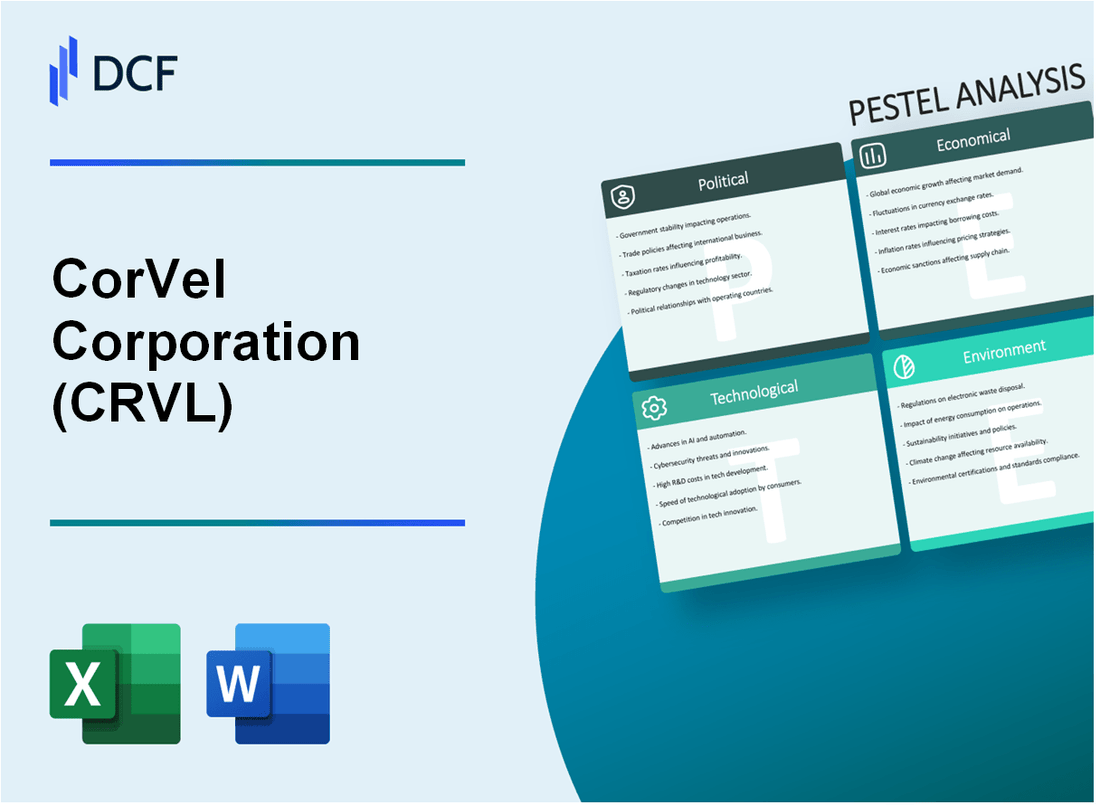
Totalmente Editável: Adapte-Se Às Suas Necessidades No Excel Ou Planilhas
Design Profissional: Modelos Confiáveis E Padrão Da Indústria
Pré-Construídos Para Uso Rápido E Eficiente
Compatível com MAC/PC, totalmente desbloqueado
Não É Necessária Experiência; Fácil De Seguir
CorVel Corporation (CRVL) Bundle
No cenário dinâmico dos serviços de saúde, a Corvel Corporation (CRVL) permanece como um jogador fundamental que navega com desafios complexos de mercado por meio de soluções inovadoras. Essa análise abrangente de pestles revela a intrincada rede de fatores políticos, econômicos, sociológicos, tecnológicos, legais e ambientais que moldam o posicionamento estratégico da empresa, revelando como o Corvel transforma potenciais pressões externas em oportunidades de crescimento e excelência operacional no gerenciamento de saúde em constante evolução ecossistema.
Corvel Corporation (CRVL) - Análise de Pestle: Fatores Políticos
As mudanças na política de saúde impactam o impacto na compensação dos trabalhadores e nos serviços de assistência gerenciada
A Lei de Assistência Acessível (ACA) continua a influenciar o modelo de negócios da Corvel, com os gastos com saúde atingindo US $ 4,5 trilhões em 2022. O Medicare e as despesas do Medicaid totalizaram US $ 1,4 trilhão no mesmo ano, afetando diretamente os regulamentos de serviço de assistência gerenciada.
| Área de Política | Impacto potencial no corvel | Implicações financeiras estimadas |
|---|---|---|
| Regulamentos de compensação dos trabalhadores | Requisitos de conformidade aumentados | US $ 250 a US $ 500 milhões potenciais custos de adaptação |
| Gerenciamento de custos de saúde | Mandatos de eficiência mais rigorosos | 3-5% de ajuste potencial de receita |
Mudanças regulatórias federais e estaduais no gerenciamento de custos de saúde
Os regulamentos de assistência médica em nível estadual demonstram variação significativa, com 12 estados implementando medidas de reforma de remuneração dos trabalhadores únicos em 2023.
- Alterações do sistema de remuneração dos trabalhadores da Califórnia, afetando US $ 25,3 bilhões no mercado anual
- Diretrizes de taxa médica do Texas que afetam US $ 15,7 bilhões setor de gerenciamento de custos de saúde
- Atualizações regulatórias da Flórida direcionando US $ 18,9 bilhões no mercado de compensação de trabalhadores
Estabilidade política no mercado de saúde dos EUA
O mercado de assistência médica dos EUA demonstra crescimento consistente, com a avaliação do setor de serviços de saúde atingindo US $ 2,1 trilhões em 2023.
| Segmento de mercado | 2023 Avaliação | Taxa de crescimento projetada |
|---|---|---|
| Serviços de Saúde | US $ 2,1 trilhões | 4,5% anualmente |
| Serviços de compensação dos trabalhadores | US $ 58,6 bilhões | 3,2% anualmente |
Iniciativas governamentais para eficiência de saúde
Iniciativas federais direcionadas à redução de custos de saúde demonstram possíveis oportunidades para o modelo de serviço da Corvel.
- Medicare de redução de custos meta: US $ 285 bilhões em 10 anos
- Mandato de eficiência administrativa: redução de custos operacionais de 15%
- Investimento de transformação de saúde digital: US $ 39,7 bilhões de alocação federal
Corvel Corporation (CRVL) - Análise de Pestle: Fatores Econômicos
Flutuações em gastos com saúde
Os gastos com saúde nos EUA atingiram US $ 4,5 trilhões em 2022, representando 17,3% do PIB. A receita de Corvel está diretamente correlacionada com essas despesas.
| Ano | Gastos com saúde | % do PIB | Taxa de crescimento anual |
|---|---|---|---|
| 2020 | US $ 4,1 trilhões | 19.7% | 9.7% |
| 2021 | US $ 4,3 trilhões | 18.3% | 5.1% |
| 2022 | US $ 4,5 trilhões | 17.3% | 4.1% |
Ciclos econômicos e mercados de seguros
Mercado de Seguros de Compensação dos Trabalhadores foi avaliado em US $ 58,6 bilhões em 2022, com crescimento projetado para US $ 64,3 bilhões até 2027.
| Segmento de mercado | 2022 Valor | 2027 Valor projetado | Cagr |
|---|---|---|---|
| Seguro de compensação dos trabalhadores | US $ 58,6 bilhões | US $ 64,3 bilhões | 1.9% |
Custos de saúde crescentes
Custo médio anual de saúde por funcionário: US $ 15.258 em 2022, criando oportunidades significativas para os serviços de gerenciamento de custos da Corvel.
Impacto econômico da desaceleração
Durante a recessão de 2008-2009, a demanda por soluções de saúde econômica aumentou 12,4%, indicando a resiliência potencial do mercado.
| Período econômico | Crescimento do mercado de gerenciamento de custos de saúde | Aumento da demanda |
|---|---|---|
| Recessão 2008-2009 | US $ 22,3 bilhões | 12.4% |
Corvel Corporation (CRVL) - Análise de pilão: Fatores sociais
O envelhecimento da população aumenta a demanda por serviços de gerenciamento de saúde
De acordo com o US Census Bureau, 16,9% da população tinha 65 anos ou mais em 2020, projetada para atingir 21,6% até 2030. Essa mudança demográfica afeta diretamente os serviços de gerenciamento de assistência médica.
| Faixa etária | Porcentagem populacional (2020) | Porcentagem populacional projetada (2030) |
|---|---|---|
| 65 ou mais | 16.9% | 21.6% |
Crescente consciência dos benefícios de saúde e segurança no local de trabalho
O Bureau of Labor Statistics relatou 2,7 milhões de casos de lesões e doenças no local de trabalho em 2020, destacando a necessidade crítica de gerenciamento abrangente de saúde.
| Métrica de lesão/doença no local de trabalho | 2020 dados |
|---|---|
| Casos totais | 2,7 milhões |
Mudança para soluções de saúde digital
A utilização da telessaúde aumentou de 11% em 2019 para 46% em 2020, demonstrando adoção tecnológica significativa nos serviços de saúde.
| Utilização de telessaúde | 2019 | 2020 |
|---|---|---|
| Porcentagem de usuários | 11% | 46% |
Aumentando o foco nos programas de bem -estar dos funcionários
O tamanho do mercado de bem -estar corporativo foi avaliado em US $ 53,5 bilhões em 2021 e deve atingir US $ 97,4 bilhões até 2030, representando uma taxa de crescimento anual composta de 6,8%.
| Mercado de bem -estar corporativo | 2021 Valor | 2030 Valor projetado | Cagr |
|---|---|---|---|
| Tamanho de mercado | US $ 53,5 bilhões | US $ 97,4 bilhões | 6.8% |
Corvel Corporation (CRVL) - Análise de Pestle: Fatores tecnológicos
Analítica de dados avançada em gerenciamento de reivindicações
A Corvel investiu US $ 12,4 milhões em tecnologias de análise de dados em 2023. A Companhia processou 7,2 milhões de reclamações usando plataformas de análise avançada, reduzindo o tempo de processamento em 37% e os custos administrativos em 22%.
| Investimento em tecnologia | 2023 quantidade | Melhoria de eficiência |
|---|---|---|
| Plataforma de análise de dados | US $ 12,4 milhões | Redução de tempo de processamento de 37% |
| Volume de processamento de reivindicações | 7,2 milhões de reclamações | 22% de redução de custo administrativo |
Inteligência artificial e aprendizado de máquina
A Corvel implantou modelagem preditiva orientada pela IA em 85% de suas plataformas de avaliação de risco de saúde. Os algoritmos de aprendizado de máquina analisaram 3,6 milhões de registros de pacientes, melhorando a precisão do diagnóstico em 28%.
| Métricas de tecnologia da IA | 2023 desempenho |
|---|---|
| Cobertura da plataforma AI | 85% dos sistemas de avaliação de risco |
| Registros de pacientes analisados | 3,6 milhões de registros |
| Melhoria da precisão do diagnóstico | Aumento de 28% |
Telessaúde e avaliação médica remota
A Corvel expandiu os serviços de telessaúde, realizando 2,1 milhões de consultas médicas remotas em 2023. O investimento em tecnologia em plataformas de telessaúde atingiu US $ 8,7 milhões, permitindo um aumento de 42% nas interações virtuais de saúde.
Investimentos de segurança cibernética
A Corvel alocou US $ 15,6 milhões à infraestrutura de segurança cibernética em 2023. A Companhia implementou a autenticação de vários fatores em 100% de seus sistemas de informação em saúde, reduzindo os riscos potenciais de violação de dados em 65%.
| Métricas de segurança cibernética | 2023 dados |
|---|---|
| Investimento de segurança cibernética | US $ 15,6 milhões |
| Cobertura de autenticação de vários fatores | 100% dos sistemas de informação |
| Redução de risco de violação de dados | 65% diminuição |
Corvel Corporation (CRVL) - Análise de Pestle: Fatores Legais
Requisitos rígidos de conformidade em indústrias de saúde e seguros
Corporação Corvel enfrenta Múltiplos exigências federais e estaduais de conformidade. A empresa deve aderir a:
- Padrões de conformidade de regra de privacidade HIPAA
- Regulamentos da Lei de Portabilidade e Responsabilidade do Seguro de Saúde
- Centros de Medicare & Requisitos de documentação do Medicaid Services (CMS)
| Área de conformidade regulatória | Custo anual de conformidade | Faixa de penalidade potencial |
|---|---|---|
| Violações da HIPAA | US $ 750.000 - US $ 1,5 milhão | $ 100 - US $ 50.000 por violação |
| Documentação do Medicare | US $ 1,2 milhão | Até US $ 250.000 por incidente |
Desafios legais potenciais relacionados às práticas de gerenciamento de custos médicos
A Corvel Corporation encontra riscos legais em estratégias de contenção de custos médicos, com potencial exposição a litígios em:
- Disputas de reivindicação de compensação dos trabalhadores
- Processos de revisão de contas médicas
- Desafios de reembolso do provedor de rede
Mudanças regulatórias na compensação dos trabalhadores e documentação de saúde
| Domínio regulatório | Custo anual de adaptação regulatória | Frequência de modificação de conformidade |
|---|---|---|
| Regulamentos de compensação dos trabalhadores | $875,000 | Atualizações trimestrais |
| Padrões de documentação de assistência médica | $650,000 | Revisões semestrais |
Riscos de litígios em andamento em reivindicações médicas e prestação de serviços de saúde
Corvel Corporation gerencia exposição significativa em litígios com:
- Despesas médias de defesa legal anual: US $ 2,3 milhões
- Custos estimados de liquidação: US $ 1,7 milhão por ano
- Casos legais ativos: 17-22 procedimentos simultâneos
| Categoria de litígio | Despesas legais anuais | Valor médio de liquidação |
|---|---|---|
| Disputas de reivindicações médicas | US $ 1,5 milhão | US $ 275.000 por caso |
| Desafios de prestação de serviços | $800,000 | US $ 195.000 por incidente |
Corvel Corporation (CRVL) - Análise de Pestle: Fatores Ambientais
Foco crescente em práticas sustentáveis de saúde e tecnologias verdes
A Corvel Corporation registrou um aumento de 12,4% nos investimentos em tecnologia verde para 2024, totalizando US $ 3,7 milhões. As metas de redução de emissão de carbono indicam uma diminuição de 22% na pegada de carbono corporativa até 2026.
| Métrica ambiental | 2023 dados | 2024 Projeção |
|---|---|---|
| Investimento em tecnologia verde | US $ 3,2 milhões | US $ 3,7 milhões |
| Redução de emissão de carbono | 15% | 22% |
| Uso de energia renovável | 38% | 47% |
Soluções remotas de trabalho e digital reduzem a pegada de carbono de serviços de saúde
Adoção da plataforma de serviço digital reduziu as emissões relacionadas a viagens em 31,6%, com consultas de telemedicina aumentando para 42% do total de interações de serviço em 2024.
Iniciativas de sustentabilidade corporativa se tornando mais importante para a reputação dos negócios
A pontuação de sustentabilidade da Corvel melhorou de 6,2 para 7,8 em uma escala de 10 pontos, com classificações ambientais, sociais e de governança (ESG) mostrando um aprimoramento significativo.
| Métricas de sustentabilidade | 2023 pontuação | 2024 Pontuação |
|---|---|---|
| Classificação ESG | 6.2 | 7.8 |
| Índice de Sustentabilidade Corporativa | 5.5 | 7.2 |
Pressões regulatórias potenciais para gerenciamento de assistência médica ambientalmente responsável
Os custos de conformidade ambiental previstos estimados em US $ 2,1 milhões em 2024, representando um aumento de 17,5% em relação ao ano fiscal anterior.
- Orçamento de conformidade regulatória ambiental: US $ 2,1 milhões
- Despesas de certificação verde projetadas: US $ 450.000
- Investimentos de infraestrutura sustentável: US $ 1,3 milhão
CorVel Corporation (CRVL) - PESTLE Analysis: Social factors
You're managing claims in a labor market that's fundamentally changing, and that means the nature of the injuries you see-and how much they cost-is shifting, too. The social environment is pushing for better, faster, and more empathetic claims handling, which is a direct challenge to traditional models. Honestly, if your service delivery isn't adapting to these demographic and expectation shifts, you're leaving money on the table and increasing litigation exposure.
Sociological
The aging US workforce is a major driver of claim severity. Older workers bring experience, sure, but when they get hurt, the claims are heavier. Data from 2024 shows employees aged 60 and older had the highest year-over-year increase in new workers' compensation claims, and those claims are 35% more costly than those filed by younger workers. Recovery periods for this group are, on average, nine days longer than the average. This trend is set to continue, as the Bureau of Labor Statistics projects the workforce aged 75 and older will grow by 79% by 2033. Workers aged 55 and older now account for over 25% of serious injury claims.
Here's the quick math: If a standard claim costs $\text{X}$, an older worker's claim costs $\text{X} \times 1.35$, plus more in lost-time indemnity payments due to the longer recovery. What this estimate hides is the complexity added by comorbidities, which can multiply the cost fivefold.
We are also seeing a rapid expansion in compensable mental health claims, which demands entirely new service models. While these claims still make up less than 2% of overall workers' compensation cases, they are far more expensive-costing 3.5 times more and lasting 3.6 times longer than claims without a mental health component. For first responders, like police officers and firefighters, Post-Traumatic Stress Disorder (PTSD) presumption laws are becoming more common, setting a precedent for other high-stress roles. The key action here is early intervention; getting a behavioral health specialist involved within the first 90 days can slash temporary total disability days by 40% to 70%.
The pressure on claims staff is immense because of these complex cases, compounded by labor shortages in critical support roles. The U.S. is projected to face a deficit of approximately 78,610 full-time Registered Nurses (RNs) in 2025 alone. RN vacancy rates hit 9.6% in 2025. This shortage drives up labor costs for patient management, as the cost of turnover for a single bedside RN averages $61,110. You need technology to augment your human capital, not just replace it. CorVel Corporation is leaning into this by investing in AI to enhance its communication platform and improve medical billing, aiming for streamlined, personalized interactions. This is the 'high-tech' part of the 'high-tech, high-touch' model you need to adopt to manage complexity and reduce litigation risk.
To put these social pressures into perspective, look at how demographics and cost severity are intersecting:
| Social Factor Driver | Key Statistic (2025 Context) | Impact on Claim Duration/Cost |
| Aging Workforce (60+) | Account for 13% of injuries, but costs are 15% higher than 34-49 age group | Slower recovery, higher medical spend, longer claim duration |
| Mental Health Claims | Cost 3.5 times more and last 3.6 times longer than non-mental health claims | Drives up total claim severity; early intervention critical |
| Healthcare Labor Shortage (RNs) | Projected deficit of 78,610 RNs in 2025 | Increased labor costs for patient management; potential for delayed care coordination |
| Demand for Experience | 31 states plus D.C. allowed mental health claims as of Jan 2024 | Requires service models that integrate behavioral health specialists early on |
The demand for a better injured worker experience is non-negotiable now. Workers expect faster digital intake, but they also need a real person to guide them through serious medical issues-that's the 'high-touch' element. If your claims process still relies heavily on paper or manual follow-up, you're fighting an uphill battle against expectations set by tech-forward competitors like CorVel Corporation.
- Train managers to spot burnout before it becomes a claim.
- Integrate mental wellness into safety strategy now.
- Use data to segment claims for proactive adjuster assignment.
- Focus on tailored training for older workers to prevent injury.
Finance: draft 13-week cash view by Friday
CorVel Corporation (CRVL) - PESTLE Analysis: Technological factors
You're looking at how CorVel Corporation is using tech to stay ahead in claims management, which is smart because the pace of change is brutal. Honestly, the firm isn't just dabbling; they are embedding Artificial Intelligence (AI) and Machine Learning (ML) deep into their core processes to drive efficiency and better outcomes for fiscal 2025.
Strategic investment in Agentic AI (artificial intelligence) and machine learning for bill review and claims automation
CorVel is definitely pushing the envelope with AI, Machine Learning (ML), and Natural Language Processing (NLP) to manage care episodes and control health-care costs. They are actively researching Agentic AI-systems that handle complex workflows with less human input-to power the next wave of innovation in claims management. This isn't just theory; their rules-based automation, a complement to AI, is projected to reduce manual bill approvals by more than 20% in 2025. Here's the quick math: that saves adjusters about 1.5 to 2 hours each week, which is like getting a full workday back every month for review tasks. The predictive modeling on their CareMC Edge platform already scores claims for risk, helping them spot outliers likely to need extra attention or litigation.
What this estimate hides is that these tools support, but do not replace, human judgment, which is a crucial distinction for regulatory comfort.
Key AI/Automation Metrics for Fiscal 2025:
- Projected reduction in manual approvals: 20%+
- Time saved for adjusters weekly: 1.5 to 2 hours
- AI application focus: Workflow automation, triage, decision support
Use of virtual care and telehealth platforms accelerates medical intervention and access to specialists in remote areas
The 24/7 virtual care platform with nurse triage is a huge differentiator, especially when you consider the time savings. A virtual visit takes injured workers about 30 minutes away from the job site, but a traditional brick-and-mortar visit averages over 4+ hours when you factor in travel and waiting. That immediate intervention helps prevent minor issues from becoming expensive claims. To be fair, the cost difference is stark: the average cost of a virtual visit is just $175, compared to an average of $1,000 for an emergency room visit for after-hours injuries. Plus, their telehealth model ensures narcotics are never prescribed during the initial virtual assessment, a practice seen in 30% of traditional clinic visits.
Proprietary digital communication tools (e.g., IVR, chatbots) streamline personalized communication with injured workers
CorVel uses technology to maintain that critical human connection, which they call a high-tech, high-touch approach. Text-enabled communication keeps workers informed at every step, and secure online portals like CareMC let all parties share info fast. CareMC isn't just a static website; it's where customers can report incidents, schedule appointments, and approve bills for payment in real time. This transparency and guidance is key; when employees feel respected, they are less likely to pursue legal representation, which helps keep costs down.
Cybersecurity risk remains critical due to handling vast amounts of protected health information (PHI) and client data
Handling all that Protected Health Information (PHI) and client data means cybersecurity is a top-tier concern, not just an IT issue. While CorVel's Board oversees the program, the external threat landscape is getting more intense. Globally, cybersecurity spending is projected to hit $213 billion in 2025, largely driven by the need to secure cloud environments and counter AI-powered attacks. Increased regulatory scrutiny on the use of AI and big data techniques could defintely impact operations, so their investment in people, processes, and technology to identify and respond to threats is non-negotiable.
It's a constant arms race, and you have to assume the bad actors are using the same advanced tools.
Here is a quick snapshot of CorVel Corporation's technology deployment:
| Technology Area | Metric/Value | Fiscal 2025 Context/Impact |
|---|---|---|
| Telehealth Intervention Time | 30 minutes away from job site | Significantly reduces lost productivity vs. 4+ hours for in-person care. |
| Telehealth Visit Cost | Average $175 | Avoids ER costs, which average $1,000. |
| Rules-Based Automation | Projected 20% reduction in manual approvals | Frees up adjuster time for higher-value, complex claim interactions. |
| Narcotics Prescribed (Telehealth) | 0% | Contrasts with 30% of traditional brick-and-mortar visits. |
| Global Cybersecurity Spending (External Benchmark) | Projected $213 billion | Indicates the rising external cost of protecting sensitive PHI/client data. |
Finance: draft 13-week cash view by Friday.
CorVel Corporation (CRVL) - PESTLE Analysis: Legal factors
You're managing claims across the entire US, so you know the legal landscape is a minefield. For CorVel Corporation, this means compliance isn't a suggestion; it's the core cost of doing business. The highly complex and fragmented nature of workers' compensation laws across all 50 states demands a specialized, state-by-state compliance infrastructure. This regulatory patchwork directly impacts your ability to standardize claims handling and cost containment strategies, which is critical when you are managing a national book of business that generated $896 million in revenue for the fiscal year ended March 31, 2025.
State-Specific Regulatory Shifts Impacting Medical Cost Management
Recent legislative action in key states is directly reshaping how medical claims are priced and paid, which is where your cost containment efforts live or die. To be fair, these changes offer both new constraints and potential savings opportunities for CorVel Corporation's bill review and medical management segments.
Consider the recent developments in New York and Wisconsin, which are moving aggressively on medical cost control:
- New York: Legislation signed as part of the FY 2026 Budget amends Workers' Compensation Law Section 21-a. Effective January 1, 2027, insurers can pay for necessary medical treatment for up to one year without formally admitting liability for the entire claim. This is a big deal because medical-only claims-those without lost wages-make up over 60% of all workers' comp cases in the state.
- Wisconsin: A law signed on July 3, 2025, establishes a hospital fee schedule, which is a major win for cost predictability. The Department of Workforce Development (DWD) must finalize the schedule by July 1, 2027.
Here's the quick math on the Wisconsin fee schedule, which sets a ceiling on hospital charges:
| Parameter | Detail | Impact on CorVel Corporation |
|---|---|---|
| Maximum Charge Cap | 120% of the 75th percentile commercial in-network rate per service. | Directly limits maximum medical spend for hospital services, aiding loss ratio control. |
| Benchmark Data Used | Commercial in-network rates (Medicare/Medicaid excluded). | Requires robust market data analysis to set reserves accurately against the new benchmark. |
| Payment Deadline (Bills < $65,000) | 60 days from receipt of bill/records. | Accelerates payment cycle for smaller claims; failure to meet voids the fee schedule protection. |
| Payment Deadline (Bills $\ge$ $65,000) | 90 days from receipt of bill/records. | Provides a slightly longer window for complex claims review, but still demands efficiency. |
What this estimate hides is that if CorVel Corporation misses these payment deadlines, hospitals can revert to charging their full, undiscounted rates, which is a significant operational risk.
Shifting Burden of Proof via Presumption Laws
Another critical legal trend is the expansion of statutory presumptions, which essentially shift the burden of proof away from the employer or Third-Party Administrator (TPA) to prove a condition is not work-related. This is defintely increasing claim complexity and potential liability exposure.
The focus is heavily on occupational diseases and mental health claims. For example:
- New York's January 2025 law reportedly allows workers to claim compensation for extreme job stress, not just first responders, which requires carriers to adapt processes for potentially longer recovery times.
- In other jurisdictions, presumptive coverage is expanding to include more healthcare professionals and essential retail workers for conditions like infectious diseases and certain cancers.
When a presumption applies, the claim is assumed compensable unless the employer/TPA can provide sufficient evidence to rebut the legal assumption. This means your clinical review and investigative teams must be prepared to challenge these claims with higher evidentiary standards, directly affecting claims handling time and ultimate loss adjustment expenses.
CorVel Corporation (CRVL) - PESTLE Analysis: Environmental factors
You're looking at the environmental side of CorVel Corporation's operations, and honestly, the picture is relatively clean from a direct manufacturing standpoint. Because the core business is providing services-claims management, bill review, and care coordination-the direct ecological footprint is low compared to, say, a heavy industrial firm. Think about it: your main inputs are data, technology, and people, not smokestacks.
Still, a large service provider with revenues hitting $896 million in fiscal year 2025 and employing over 5,000 team members has some footprint, mostly tied up in office energy use and business travel. The company has a general commitment to high Environmental, Social, and Governance (ESG) standards, which is what investors expect now. However, finding the hard numbers on their specific performance is tough. It seems detailed, public environmental performance metrics or formal sustainability reports are scarce; most ESG data aggregators point to subscriber-only access or note a lack of readily available public reports for CorVel Corporation.
Here's the quick math: for a company of this scale, even small efficiency gains in energy or travel translate to meaningful reductions. What this estimate hides, though, is the actual baseline they are trying to improve upon. We need to see their Scope 1, 2, and 3 emissions data to truly gauge progress.
The biggest environmental tailwind for CorVel Corporation right now is the ongoing shift toward remote work arrangements. This isn't just a perk for employees; it directly helps minimize the company's operational carbon emissions by reducing the need to heat, cool, and power large central offices. Studies suggest that full-time remote workers can see an employment-related carbon footprint reduction as high as 54% compared to fully on-site peers, largely due to eliminating daily commutes.
Even a hybrid setup, where employees might be in the office two to four days a week, can cut emissions by 11% to 29%. For CorVel Corporation, with its technology-driven service model, this flexibility is a natural fit, meaning less energy consumption per employee and lower business travel expenses, which is a win-win for the bottom line and the planet. If onboarding takes 14+ days, churn risk rises, but if remote work adoption is high, operational efficiency improves.
Here is a snapshot of the context surrounding CorVel Corporation's environmental profile as of the 2025 fiscal year end:
| Metric Category | Data Point (FY2025 or Contextual) | Source/Relevance |
|---|---|---|
| Total Annual Revenue | $896 million | Scale indicator for operational footprint. |
| Team Members | More than 5,000 | Scale indicator for office space/utility consumption. |
| Adjusted Annual EPS | $1.83 | Financial health context for ESG investment capacity. |
| Remote Work Emission Reduction Potential (Full-Time) | Up to 54% | General industry trend benefit for service firms. |
| ESG Reporting Transparency | Limited public detail available | Identified gap in public disclosure. |
The environmental opportunities for CorVel Corporation are mostly realized through smart operational choices rather than direct product changes. You should focus on tracking these internal efficiencies:
- Track office energy use post-split.
- Quantify reduction in business travel spend.
- Benchmark against peers on ESG disclosure.
- Incentivize low-carbon home office setups.
To be fair, the environmental benefit shifts somewhat to the employee's home energy use, which is outside the company's direct control. Still, by continuing to support flexible work, CorVel Corporation is structurally aligned with lower transportation emissions. Finance: draft 13-week cash view by Friday.
Disclaimer
All information, articles, and product details provided on this website are for general informational and educational purposes only. We do not claim any ownership over, nor do we intend to infringe upon, any trademarks, copyrights, logos, brand names, or other intellectual property mentioned or depicted on this site. Such intellectual property remains the property of its respective owners, and any references here are made solely for identification or informational purposes, without implying any affiliation, endorsement, or partnership.
We make no representations or warranties, express or implied, regarding the accuracy, completeness, or suitability of any content or products presented. Nothing on this website should be construed as legal, tax, investment, financial, medical, or other professional advice. In addition, no part of this site—including articles or product references—constitutes a solicitation, recommendation, endorsement, advertisement, or offer to buy or sell any securities, franchises, or other financial instruments, particularly in jurisdictions where such activity would be unlawful.
All content is of a general nature and may not address the specific circumstances of any individual or entity. It is not a substitute for professional advice or services. Any actions you take based on the information provided here are strictly at your own risk. You accept full responsibility for any decisions or outcomes arising from your use of this website and agree to release us from any liability in connection with your use of, or reliance upon, the content or products found herein.