

|
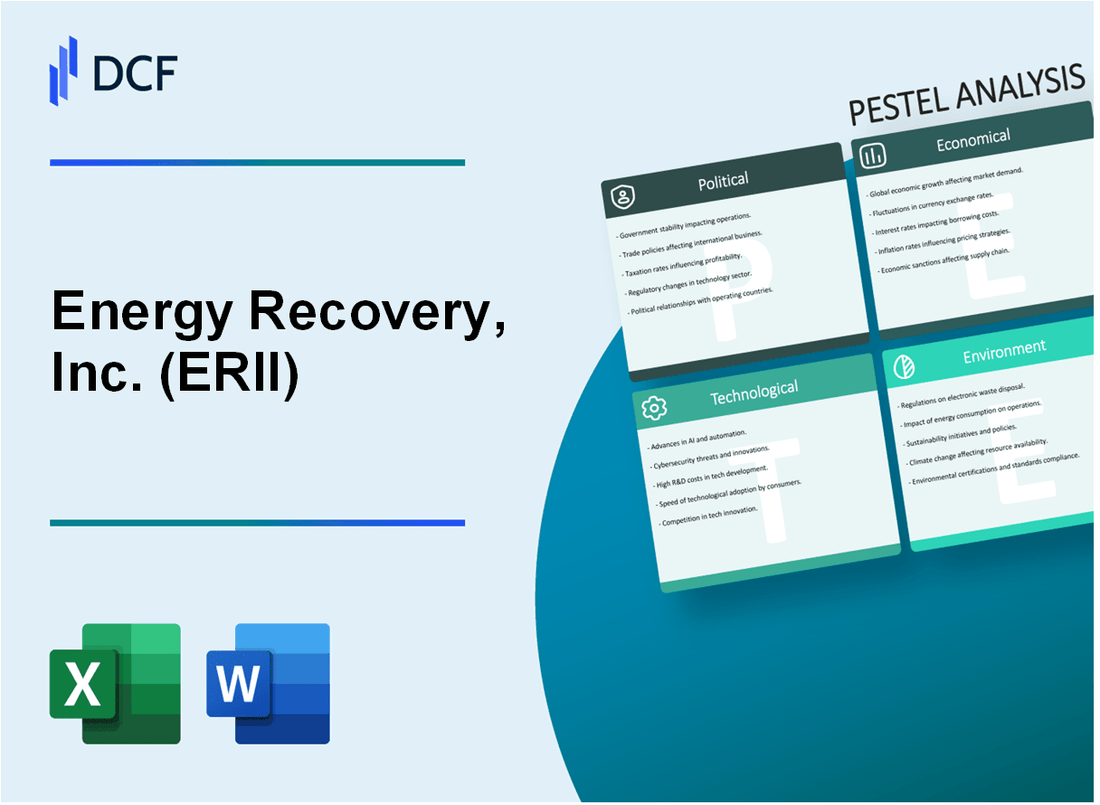
Energy Recovery, Inc. (ERII): PESTLE Analysis [Nov-2025 Updated] |
Fully Editable: Tailor To Your Needs In Excel Or Sheets
Professional Design: Trusted, Industry-Standard Templates
Investor-Approved Valuation Models
MAC/PC Compatible, Fully Unlocked
No Expertise Is Needed; Easy To Follow
Energy Recovery, Inc. (ERII) Bundle
You're looking for a clear, actionable breakdown of the macro-environment for Energy Recovery, Inc. (ERII), a company whose core technology is critical to global water and industrial energy efficiency. Honestly, the near-term risk is less about their core product-the PX® Pressure Exchanger® is defintely the gold standard-and more about geopolitical stability and the slow rollout of their new carbon capture technology. Here is the PESTLE analysis, grounded in late 2025 fiscal data and market trends, to help you map the risks and opportunities for ERII.
Political: Geopolitical Risks and Government Contracts
Political winds are a major swing factor for Energy Recovery, Inc. (ERII). US-China tariffs, for example, directly impact their gross margin due to the product mix and associated costs. Still, the upside is huge: government-backed mega-projects, especially in the Middle East, are driving major desalination contracts right now. That's where the big orders come from.
But you have to watch geopolitical instability in key regions like the Middle East and North Africa. These tensions can delay project timing, which messes up revenue recognition. Plus, global government incentives for water security and energy efficiency are a clear tailwind, boosting demand for ERII's core technology. The political landscape is a double-edged sword: massive contracts or total project stalls.
Economic: Strong Margins vs. Revenue Volatility
The economics for ERII are robust, though quarterly results can be a rollercoaster. Full-year 2025 revenue guidance is strong, sitting between $152 million and $164 million. Here's the quick math: they operate in a global desalination market valued at $19.03 billion in 2025 and growing at an 8.9% Compound Annual Growth Rate (CAGR). That's a massive and expanding addressable market.
What this estimate hides is the revenue recognition schedule. Revenue is back-end loaded in 2025, so you see quarterly volatility. Q3 2025 revenue was only $32.0 million, but the strong Q3 2025 gross margin of 64.2% reflects the high value of their proprietary technology. They sell a premium product, and the margins show it.
Sociological: Water Scarcity and ESG Mandates
Sociological trends are fundamentally driving ERII's business model. Escalating global water scarcity is the biggest factor, pushing both municipal and industrial players toward desalination adoption. Plus, consumer and industrial preference for energy-efficient, sustainable water technologies is rising fast. This isn't a nice-to-have anymore; it's a core mandate.
Urbanization in arid coastal regions increases the pressure on limited freshwater supplies, creating a constant demand floor. Also, Corporate Environmental, Social, and Governance (ESG) mandates favor energy-saving solutions like ERII's. Companies need to show they are minimizing their environmental footprint, and ERII helps them do that. Water scarcity is a growth engine.
Technological: The Gold Standard and the Carbon Capture Lag
The core technology is a huge competitive advantage. The PX® Pressure Exchanger® (PX) technology offers up to 98% hydraulic efficiency, which is practically unmatched. To be fair, they've also expanded the PX's certified design life to 30 years, significantly lowering total lifecycle costs for customers. That's a powerful sales pitch.
But, the commercialization of the CO2 PXG (carbon capture) business is slower than expected for 2025. This is the big opportunity that hasn't fully materialized yet. Still, competitor innovation in membrane and thermal desalination technologies means ERII can't sit still; continuous Research & Development (R&D) investment is crucial to maintain their lead. The PX is a proven winner, but the new tech needs to catch up.
Legal: IP Protection and Trade Compliance
The legal environment is about protecting the moat and managing trade friction. International and national water quality standards create a regulatory floor that new projects must meet, which ERII's technology easily supports. Crucially, Intellectual Property (IP) protection for the proprietary PX technology is a key competitive moat. They must defend this fiercely.
Also, compliance with export controls and trade sanctions affects sales in specific countries, so they have to be meticulous about where they ship. Plus, the direct impact from the scope and magnitude of tariffs on imported components hits the cost of goods sold. Legal compliance is non-negotiable for global operations.
Environmental: Efficiency and Brine Challenges
The environmental case for ERII is compelling. Their PX technology reduces energy consumption by up to 60% in Seawater Reverse Osmosis (SWRO) projects. For example, Saudi Arabia projects alone will prevent an estimated 706,485 tons of CO2 emissions annually. This is a massive environmental benefit that aligns perfectly with global climate goals.
The challenge, however, is brine disposal. Regulations around this are a persistent issue for the entire desalination industry, and ERII is not exempt from the resulting project complexity. Still, the company's technology is also critical for industrial wastewater reuse, minimizing water waste across multiple sectors. They are a net positive for the planet, but brine is the fly in the ointment.
So, the next step is clear. Strategy Team: Draft a scenario analysis by the end of the month detailing the impact of a 10% swing in US-China tariffs on the 2026 gross margin forecast and identify three alternative sourcing regions.
Energy Recovery, Inc. (ERII) - PESTLE Analysis: Political factors
US-China tariffs directly impact gross margin due to product mix and costs.
The political landscape of US-China trade relations creates a persistent, though currently mitigated, risk to Energy Recovery, Inc.'s (ERII) gross margin (GM). While the company's core desalination business enjoys a high GM, historically around 65%, the wastewater segment is more exposed to Chinese market dynamics and tariffs.
You have to watch the political rhetoric here, because a trade war escalation can quickly reverse financial gains. For example, in early 2025, the risk from tariffs was significant, including an estimated $5 million to $6 million in additional costs from components imported from China. The company also had about $9 million in FY25 wastewater projects at risk, representing 50% of the segment's guidance at the time. The good news is that a May 2025 agreement reduced the most punitive tariffs (which were as high as 150% and 250%) to a much more manageable 10% and 30%, essentially rendering the immediate tariff impact minimal. Still, a single political tweet could defintely change that.
Government-backed mega-projects in the Middle East drive major desalination contracts.
The political priority of water security in the Gulf Cooperation Council (GCC) nations, particularly Saudi Arabia, directly translates into massive, government-backed infrastructure spending that benefits Energy Recovery, Inc. These are not small private deals; they are national mega-projects. The Saudi government's push to secure fresh water for its growing population and industrial base is a primary revenue driver for the company's Water segment.
In the latter half of 2025 alone, the company announced substantial contract wins in the region, all expected to be fulfilled by the end of the year. This is a clear, concrete opportunity for near-term revenue.
| Region/Country | Contract Value (2025) | Fresh Water Capacity | Annual Energy Savings |
|---|---|---|---|
| Saudi Arabia | Nearly $33 million | Over 1.5 million cubic meters per day | Approx. 1,463 GWh/year |
| Gulf Region (Qatar, UAE, etc.) | Approx. $31 million | Over 1.6 million cubic meters per day | Approx. 1,724 GWh/year |
| Total (Late 2025) | $63.8 million | Over 3.1 million cubic meters per day | Over 3,187 GWh/year |
Geopolitical instability in key regions (Middle East/North Africa) can delay project timing.
While government-backed contracts are a tailwind, geopolitical instability is the constant headwind. The energy and infrastructure sectors broadly view political risk as the leading barrier to growth in 2025, leading to deferred investment decisions. This instability doesn't just affect oil markets; it impacts the long-term planning and execution of large-scale water projects, which are often multi-year endeavors.
For Energy Recovery, Inc., the risk is less about lost business in core GCC nations like Saudi Arabia and more about timing delays in less stable, but still critical, markets like Iraq and Iran. The company's Q2 2025 results reaffirmed guidance, showing resilience, but project timing remains a major variable. Honestly, deferred revenue is a cash flow killer.
- Political risk is the leading barrier to growth for the energy industry in 2025.
- Ongoing instability limits the success chance of major projects in Iran and Iraq.
- Project deferrals or smaller project choices are common responses to political uncertainty.
Global government incentives for water security and energy efficiency boost demand.
The global political consensus around climate change and resource scarcity is the long-term structural driver for Energy Recovery, Inc.'s technology. Governments worldwide are channeling public funds into projects that offer dual benefits: climate mitigation (reducing emissions) and adaptation (securing water).
Public funders are increasingly focused on water and wastewater, which, along with agriculture, accounted for 74% of all dual-benefit climate finance between 2018 and 2023. This policy-driven demand creates a massive market opportunity for the company's PX Pressure Exchanger (PX) technology, which reduces energy consumption in seawater reverse osmosis (SWRO) facilities by up to 60%.
Here's the quick math: the World Economic Forum (WEF) estimates a staggering $7 trillion global investment gap in water-related infrastructure. This gap signals that public and private investment, driven by government policy, will need to surge for decades. The water tech sector is already responding, raising $196 million in investment in just the first quarter of 2025. The political will to solve water scarcity and energy intensity is the company's biggest macro-opportunity.
Energy Recovery, Inc. (ERII) - PESTLE Analysis: Economic factors
Full-year 2025 Revenue Guidance
The economic outlook for Energy Recovery, Inc. is anchored by its strong, albeit project-lumpy, revenue guidance. The company has set its full-year 2025 revenue expectation between $152 million and $164 million. This range reflects a defintely solid performance, especially considering the global economic headwinds that can delay large infrastructure projects like desalination plants. This is a crucial metric for investors, as it provides a clear line of sight into the top-line growth driven by their core Pressure Exchanger (PX) technology.
Global Desalination Market Growth
Energy Recovery's long-term financial health is tightly coupled with the global desalination market, which is experiencing significant structural growth. The market is estimated to be valued at $19.03 billion in 2025, and it's not slowing down. We're seeing a robust Compound Annual Growth Rate (CAGR) of 8.9% projected from 2025 to 2032. This macro-trend, fueled by increasing water scarcity in regions like the Middle East and North America, provides a massive and enduring tailwind for the company's energy recovery devices. Water scarcity is a powerful economic driver.
Quarterly Volatility and Back-end Loaded Revenue
You need to be prepared for quarterly volatility in their earnings reports, as revenue recognition is heavily back-end loaded for 2025. This is normal for companies that rely on large, contracted infrastructure projects. For example, the Q3 2025 revenue came in at $32.0 million, which was a sequential drop from earlier in the year, but in line with management's communicated cadence. This pattern means that the bulk of the full-year guidance will be realized in the fourth quarter as contracted equipment shipments are completed. Here's the quick math on the quarterly breakdown:
| Metric | Q3 2025 Actual | Implied Q4 2025 (Based on Midpoint Guidance) |
|---|---|---|
| Revenue (Millions) | $32.0 | ~$45.0 - $57.0 (To hit $158M midpoint) |
| Gross Margin | 64.2% | Consistent with historical high-margin profile |
What this estimate hides is that any major project delay could push revenue into 2026, so watching the backlog is key.
Proprietary Technology and Gross Margin Strength
The company's technology moat translates directly into superior economic performance, particularly in its gross margin. Even with lower quarterly revenue, the Q3 2025 gross margin remained exceptionally strong at 64.2%. This high margin reflects the value of their proprietary Pressure Exchanger technology, which is a critical component for reducing the energy consumption of Reverse Osmosis (RO) desalination plants. It's a classic example of a high-value, niche component dominating its segment. The high margin gives them a substantial buffer against rising operating expenses and allows for continued investment in their emerging technologies segment, such as CO2 refrigeration and industrial fluid recovery.
The economic factors are simple:
- Tap into a growing $19.03 billion market.
- Maintain a high gross margin of 64.2%.
- Deliver on the $152 million to $164 million revenue guidance.
That high gross margin is the real indicator of economic defensibility.
Energy Recovery, Inc. (ERII) - PESTLE Analysis: Social factors
You and your peers, whether you're managing an investment portfolio or a corporate strategy unit, know that social trends are now inseparable from market performance. For Energy Recovery, Inc. (ERII), the key social factors boil down to a global, collective realization that water is a finite resource and that energy efficiency is the only way to scale its supply. This shift in social consciousness is a powerful tailwind, directly translating into demand for ERII's pressure exchanger technology.
Escalating global water scarcity drives municipal and industrial desalination adoption.
The stark reality is that by 2025, the Wildlife Federation estimates that two-thirds of the world's population may face water shortages, which is a massive social risk. This crisis is no longer a future problem; it is a present-day driver for infrastructure spending. Consequently, the global water desalination market, which was valued at an estimated $24.26 billion in 2025, is projected to grow at a Compound Annual Growth Rate (CAGR) of 11.6% through 2033.
The municipal sector-providing clean water to cities-is the largest application segment in the desalination market, which is where ERII's core business thrives. To maintain current urban domestic water needs in just a handful of water-scarce countries, the municipal desalination capacity will need to reach 14.8 million cubic meters per day by 2025. That's a huge, immediate need. The technology segment dominating this growth is membrane-based desalination, like Reverse Osmosis (RO), precisely because it offers lower energy consumption than older thermal methods.
Consumer and industrial preference for energy-efficient, sustainable water technologies is rising.
It's not just regulators pushing for efficiency; consumers and businesses are demanding it, too. This preference is creating a feedback loop where utility providers and industrial clients must prioritize energy-saving solutions. For example, a 2025 survey showed that nearly one-third of consumers rate sustainability as highly important (an average rating of 7.7 out of 10) when choosing home products. This sentiment extends to industrial and municipal decision-makers who face pressure from their stakeholders and customers.
The move toward efficiency is visible in consumer behavior right now:
- 81.2% of consumers are already using water-saving fixtures in their homes.
- 68.8% of consumers are using energy-efficient appliances.
This consumer-driven demand is mirrored in the industrial sector, pushing utilities to invest in smart water technologies and energy-efficient systems to meet their own sustainability goals and reduce long-term costs. Honestly, a company that can save you money and improve your public image is defintely a winner.
Urbanization in arid coastal regions increases pressure on limited freshwater supplies.
The social megatrend of rapid urbanization, especially in coastal and arid regions, is a direct catalyst for the need for desalination. As populations swell in coastal cities-think the Middle East, North Africa, and parts of the US like California and Florida-the existing freshwater sources, particularly shallow coastal aquifers, become overtaxed.
Here's the quick math: more people in one place means higher water demand, plus the urbanization itself-the concrete and infrastructure-causes increased runoff and pollution, further degrading the quality of the remaining natural water supply. The combined effect of rising sea levels and urbanization leads to saltwater intrusion, permanently damaging groundwater. This leaves seawater desalination as a primary, non-negotiable solution for water security in these high-growth urban hubs.
Corporate Environmental, Social, and Governance (ESG) mandates favor energy-saving solutions.
The rise of formal Environmental, Social, and Governance (ESG) reporting is a massive structural change that benefits ERII. In 2025, new reporting obligations, such as the European Union's Corporate Sustainability Reporting Directive (CSRD), are taking effect, forcing a broader group of large, multinational companies to report their ESG performance. This regulatory push means companies must now quantify their environmental impact, including water and energy use, which is a direct opportunity for ERII's products.
For ERII specifically, the focus on the 'E' in ESG is core to its business model. The company has set a goal to double emissions reductions from its products by 2025. A strong ESG proposition is no longer optional; McKinsey research shows that better ESG performance can lead to top-line growth and cost reductions by decreasing energy and water consumption. This makes an investment in ERII's energy recovery devices a clear, financially-sound ESG action for its customers.
To illustrate the direct link between social/ESG drivers and ERII's financial reality, consider the 2025 Q3 results, which, despite a revenue decline due to project timing, showed a strong gross margin of 64.2%. This high margin reflects the premium value placed on the core technology's efficiency and the high barrier to entry for competitors. The market is willing to pay for energy-saving, sustainable solutions.
| Social Factor Driver (2025) | Quantitative Impact / Market Data | Implication for Energy Recovery, Inc. (ERII) |
|---|---|---|
| Global Water Scarcity | Global desalination market valued at $24.26 billion in 2025. | Creates a massive, non-cyclical demand floor for desalination components. |
| Municipal Desalination Adoption | Municipal segment is the largest application market. Municipal capacity needs to reach 14.8 million m³/day by 2025 in key regions. | Validates the core market focus and provides a clear growth runway. |
| Consumer/Industrial Preference | 81.2% of consumers use water-saving fixtures; utilities prioritize energy-efficient solutions. | Reinforces the business case for high-efficiency products over lower-cost, less sustainable alternatives. |
| Corporate ESG Mandates | ERII's goal to double emissions reductions from products by 2025. EU CSRD reporting obligations start for many in 2025. | Drives B2B sales by making ERII's energy-saving technology a mandatory part of a customer's sustainability and financial reporting strategy. |
Energy Recovery, Inc. (ERII) - PESTLE Analysis: Technological factors
PX® Pressure Exchanger® (PX) technology offers up to 98% hydraulic efficiency.
The core of Energy Recovery, Inc.'s (ERII) technological moat remains the PX® Pressure Exchanger® (PX) device. Honestly, this technology is the gold standard in seawater reverse osmosis (SWRO) energy recovery, and its performance data from 2025 is defintely impressive. The PX Q400 model, for instance, achieves a peak hydraulic efficiency of up to 98%, which is a key differentiator in a market obsessed with cost-per-gallon.
This efficiency translates directly into massive energy savings for desalination plant operators. For example, a contract announced in May 2025 for projects in Spain is expected to save an estimated 280.5 GWh of energy annually, which is a concrete, substantial number. That's the power of ceramic-based, rotary-style energy recovery-it's simple, durable, and incredibly efficient.
The PX's certified design life was expanded to 30 years, lowering total lifecycle costs.
In February 2025, the company officially announced an expansion of the PX Pressure Exchanger's certified design life to 30 years, an increase from the previously published 25 years. This is a huge win for the Water segment, and it's a critical factor for financial models like Discounted Cash Flow (DCF) analyses used by investors and project developers.
Here's the quick math on why this matters: extending the life by five years without increasing the upfront cost dramatically lowers the total lifecycle cost of the desalination plant. It reinforces the product's value proposition against competitors, as the PX devices require no routine maintenance and have shown zero history of material fatigue in field performance. This durability is a technological advantage that directly impacts the long-term profitability and reliability for customers, which is what every utility executive wants.
| PX Technology Metric (2025) | Value/Status | Financial/Strategic Impact |
|---|---|---|
| Peak Hydraulic Efficiency (PX Q400) | Up to 98% | Maximizes energy savings (up to 60% reduction in SWRO energy consumption). |
| Certified Design Life (Expanded Feb 2025) | 30 years | Reduces Total Cost of Ownership (TCO) and improves project Return on Investment (ROI) for customers. |
| Desalination Contract Awards (Q3 2025) | Approx. $32.0 million (Q3 Revenue) | Core business strength; Q3 2025 revenue was $32.0 million, demonstrating continued market trust. |
Commercialization of the CO2 PXG (carbon capture) business is slower than expected for 2025.
The Emerging Technologies segment, primarily focused on the CO2 PXG (carbon capture) device for refrigeration, is facing a slower-than-anticipated commercialization curve. Management confirmed in November 2025 that while OEM engagement is strong, a commercial agreement with a large OEM is likely a year away, pushing real market adoption into 2027. This is a significant delay from earlier expectations. The technology itself is sound, showing peak Coefficient of Performance (COP) improvement of up to 30% and projected annual energy savings of up to 15% in CO2 refrigeration systems.
The market adoption is proving more measured, so the company is acting like a realist. The Q3 2025 Operating Expenses of $16.9 million reflected a decrease of 6.4% compared to Q3 2024, due in part to a decrease in Emerging Technologies segment development costs. This OpEx reduction, which totaled about $5 million year-to-date, is a prudent move to protect profitability while the market matures. You can't force a new technology on a slow-moving industry, so you manage your burn rate.
Competitor innovation in membrane and thermal desalination technologies requires continuous R&D investment.
While Energy Recovery's PX technology is dominant in energy recovery for SWRO, the broader desalination market is constantly evolving. Competitors like Acciona, Dow, Evoqua Water Technologies, Siemens AG, DuPont, Doosan Enerbility, Toray Industries Inc., and Xylem are driving advancements in membrane technology (like Reverse Osmosis membranes) and thermal distillation processes. These innovations are making desalination more economically viable by drastically reducing overall energy consumption and costs.
To maintain its market leadership, ERII must commit to continuous Research and Development (R&D), not just in new markets like CO2, but also in its core Water segment. The company has a strong foundation, having deployed over 35,000 PX devices across seven continents, but the competitive landscape demands vigilance. The key technological risks and opportunities are:
- Membrane Efficiency Gains: Competitors' improved membrane technology could reduce the overall energy required for SWRO, slightly diminishing the relative value of the PX's energy savings.
- New PX Applications: Developing new PX series, like the Q400, Low-pressure PX, and Ultra high-pressure PX Series, is crucial for market expansion into industrial wastewater and ultra-high-pressure applications.
- R&D Allocation: The decision to reduce OpEx in the Emerging Technologies segment (CO2) to protect profitability must be balanced against the need to invest in the next generation of PX technology for the core Water business.
The company must keep its foot on the gas for R&D in the core business to stay ahead of the curve, even as it manages a slower rollout in the CO2 market.
Energy Recovery, Inc. (ERII) - PESTLE Analysis: Legal factors
International and national water quality standards create a regulatory floor for new projects.
You need to understand that global water quality regulations aren't just a compliance checklist; they're the fundamental market driver for Energy Recovery, Inc. The stricter the standards, the more essential and valuable the company's energy-efficient technology becomes. The regulatory floor is high, which is good for ERII.
Specifically, the US Environmental Protection Agency (EPA) National Water Program Guidance for FY 2025-2026 focuses heavily on investing in water infrastructure, addressing PFAS (per- and polyfluoroalkyl substances), and mitigating the effects of climate change, all of which drive demand for advanced, energy-efficient desalination and water reuse solutions. Internationally, the World Health Organization (WHO) sets global drinking water quality guidelines, while standards like ISO 23446:2021 provide specific water quality guidelines for product water from reverse osmosis (RO) desalination.
The California Ocean Plan's Desalination Provisions are a concrete example of this regulatory pressure, requiring new or expanded seawater desalination plants to use the 'best available, site, design, technology, and mitigation measures feasible' to minimize environmental impact. This regulatory mandate pushes project developers directly toward the most efficient technologies, like ERII's Pressure Exchanger (PX) devices, to meet both energy and environmental requirements.
Intellectual property (IP) protection for the proprietary PX technology is a key competitive moat.
The core of Energy Recovery, Inc.'s competitive advantage is its proprietary Pressure Exchanger (PX) technology, and the legal protection around it is a critical moat. The company maintains a robust intellectual property (IP) portfolio, which includes both US and international issued patents, plus registered trademarks like PX and Pressure Exchanger.
In the 2025 fiscal year alone, the company has secured new patent grants, reinforcing its market position and extending the life of its technological lead. This constant innovation and IP defense is how they stay ahead of competitors trying to replicate their energy-saving efficiencies. Here's the quick math on IP defense:
| Patent Number | Description (Simplified) | Date of Patent (2025) |
|---|---|---|
| 12209778 | Refrigeration and heat pump systems with PXs | January 28, 2025 |
| 12392528 | Control of refrigeration and heat pump systems with PXs | August 19, 2025 |
| 12404877 | PXs with fouling and particle handling capabilities | September 2, 2025 |
| 12410821 | Reducing cavitation, noise, and vibration in a PX | September 9, 2025 |
The IP portfolio isn't just about desalination anymore; these 2025 patents show a clear legal strategy to protect the use of PX technology in new, high-growth areas like refrigeration and industrial fluid exchange. This is defintely a long-term value play.
Compliance with export controls and trade sanctions affects sales in specific countries.
Operating globally means navigating a complex web of US and international export controls and trade sanctions, which can abruptly limit access to key markets or customers. Energy Recovery, Inc. must comply with US regulations like the Export Administration Regulations (EAR) and the sanctions programs administered by the Office of Foreign Assets Control (OFAC).
The legal risk here is not theoretical; it directly impacts where the company can sell its high-value equipment. For instance, the tightening of US sanctions in 2025, particularly those targeting entities in Russia and Iran, creates significant compliance hurdles and restricts the ability to pursue projects in those regions. Even if a project is for civil water infrastructure, the end-user or financing source can trigger compliance issues.
This macro-legal pressure forces ERII to:
- Conduct rigorous due diligence on all international distributors and end-users.
- Avoid sales to countries or entities on US sanctions lists.
- Manage the risk of secondary sanctions for partners operating in restricted territories.
A single violation of these controls can result in massive fines and a loss of export privileges, so compliance is a non-negotiable cost of doing business.
Direct impact from the scope and magnitude of tariffs on imported components.
Tariffs, essentially taxes on imported goods, are a direct legal factor that hits the bottom line by increasing the cost of goods sold (COGS). Energy Recovery, Inc. sources components globally, and the ongoing US-China tariffs, among others, create a measurable financial drag.
We saw this impact clearly in the Q3 2025 financial results: the company's gross margin declined to 64.2%, a decrease of 90 basis points compared to Q3 2024. Management explicitly attributed this decline, in part, to costs related to product mix and tariffs. This means tariffs are directly eroding profitability, forcing the company to either absorb the cost or pass it on to customers, which risks making their product less competitive.
What this estimate hides is the operational cost of managing a tariff-affected supply chain, including legal fees for classification, logistics complexity, and the need to constantly re-source components. The risk is that if tariffs increase further, or if new trade wars emerge, the gross margin could compress even more, requiring a strategic shift in manufacturing or sourcing locations.
Energy Recovery, Inc. (ERII) - PESTLE Analysis: Environmental factors
PX technology reduces energy consumption by up to 60% in Seawater Reverse Osmosis (SWRO)
The core of Energy Recovery, Inc.'s environmental advantage is the Pressure Exchanger (PX) technology, which drastically cuts the energy footprint of Seawater Reverse Osmosis (SWRO) desalination. Energy consumption is the single largest operating cost in SWRO, often making up to 60% of the total, so reducing it is a major win for both the bottom line and the planet. The PX device recycles nearly all the hydraulic energy from the high-pressure brine stream, which would otherwise be wasted. This process allows the PX to reduce the energy required for desalination by up to 60% in SWRO facilities. The device itself boasts an efficiency of up to 98%, which is defintely a high-water mark for the industry. This efficiency directly translates into lower greenhouse gas emissions for customers globally.
Saudi Arabia projects alone will prevent an estimated 706,485 tons of CO2 emissions annually
The environmental impact of Energy Recovery's technology is most clearly seen in large-scale projects in energy-intensive regions. For example, the significant contracts announced in Saudi Arabia in November 2025, valued at nearly $33 million, highlight this massive scale. Once operational, the combined desalination plants utilizing the PX technology are expected to save approximately 1,463 GWh (gigawatt-hours) of electricity per year. Here's the quick math: based on the carbon intensity of the regional grid, these Saudi Arabia projects alone will prevent an estimated 706,485 tons of CO2 emissions annually. That's a huge, concrete step toward decarbonizing a critical infrastructure sector.
This environmental contribution is a key selling point for nations like Saudi Arabia, which is working toward its Vision 2030 goals for environmental sustainability.
| Metric (Saudi Arabia SWRO Projects) | Value (Annual Estimate) | Significance |
|---|---|---|
| CO2 Emissions Prevented | 706,485 tons | Directly supports national decarbonization goals. |
| Electricity Saved (Energy Efficiency) | 1,463 GWh | Reduces operating costs and grid strain. |
| Fresh Water Supplied | Over 1.5 million cubic meters per day | Addresses water scarcity sustainably. |
Brine disposal regulations are a persistent challenge for the entire desalination industry
While Energy Recovery's technology solves the energy problem, the challenge of brine disposal-the highly concentrated saline byproduct of desalination-remains a persistent, industry-wide issue. Globally, over 37 billion gallons of brine waste are produced every day. Improper disposal, such as dumping concentrated brine into the ocean or storing it in evaporation ponds, can harm marine ecosystems by increasing salinity and contaminate groundwater.
Regulators are pushing for stricter limits and better management practices, which creates both a risk and an opportunity. The risk is that new regulations could slow down desalination projects, which are a major source of revenue. The opportunity is that this pressure drives demand for advanced solutions, including those that can further concentrate the brine or recover valuable minerals, known as brine mining. The industry is actively looking for ways to:
- Meet stringent discharge regulatory requirements.
- Minimize or eliminate liquid brine waste entirely.
- Extract valuable resources like lithium and magnesium from the concentrate.
The company's technology is critical for industrial wastewater reuse and minimizing water waste
Beyond seawater desalination, Energy Recovery's technology is becoming critical in the industrial wastewater and water reuse sectors, which are expanding rapidly due to water scarcity and rising discharge costs. Their low-pressure PX solutions are specifically designed for brackish water reverse osmosis and water reuse in both municipal and industrial applications. By applying the PX technology to industrial wastewater treatment, facilities can reduce the specific energy footprint of producing clean, reusable water by 30-60%. This makes the economics of water reuse much more compelling for plant managers.
The ability to efficiently treat and reuse industrial wastewater minimizes the volume of contaminated water discharged into the environment, helping companies avoid harmful discharge and secure new, reliable water sources. The over 35,000 PX devices deployed are already operating in some of the harshest environments, including industrial wastewater, proving their long-term durability and reliability.
Disclaimer
All information, articles, and product details provided on this website are for general informational and educational purposes only. We do not claim any ownership over, nor do we intend to infringe upon, any trademarks, copyrights, logos, brand names, or other intellectual property mentioned or depicted on this site. Such intellectual property remains the property of its respective owners, and any references here are made solely for identification or informational purposes, without implying any affiliation, endorsement, or partnership.
We make no representations or warranties, express or implied, regarding the accuracy, completeness, or suitability of any content or products presented. Nothing on this website should be construed as legal, tax, investment, financial, medical, or other professional advice. In addition, no part of this site—including articles or product references—constitutes a solicitation, recommendation, endorsement, advertisement, or offer to buy or sell any securities, franchises, or other financial instruments, particularly in jurisdictions where such activity would be unlawful.
All content is of a general nature and may not address the specific circumstances of any individual or entity. It is not a substitute for professional advice or services. Any actions you take based on the information provided here are strictly at your own risk. You accept full responsibility for any decisions or outcomes arising from your use of this website and agree to release us from any liability in connection with your use of, or reliance upon, the content or products found herein.