

|
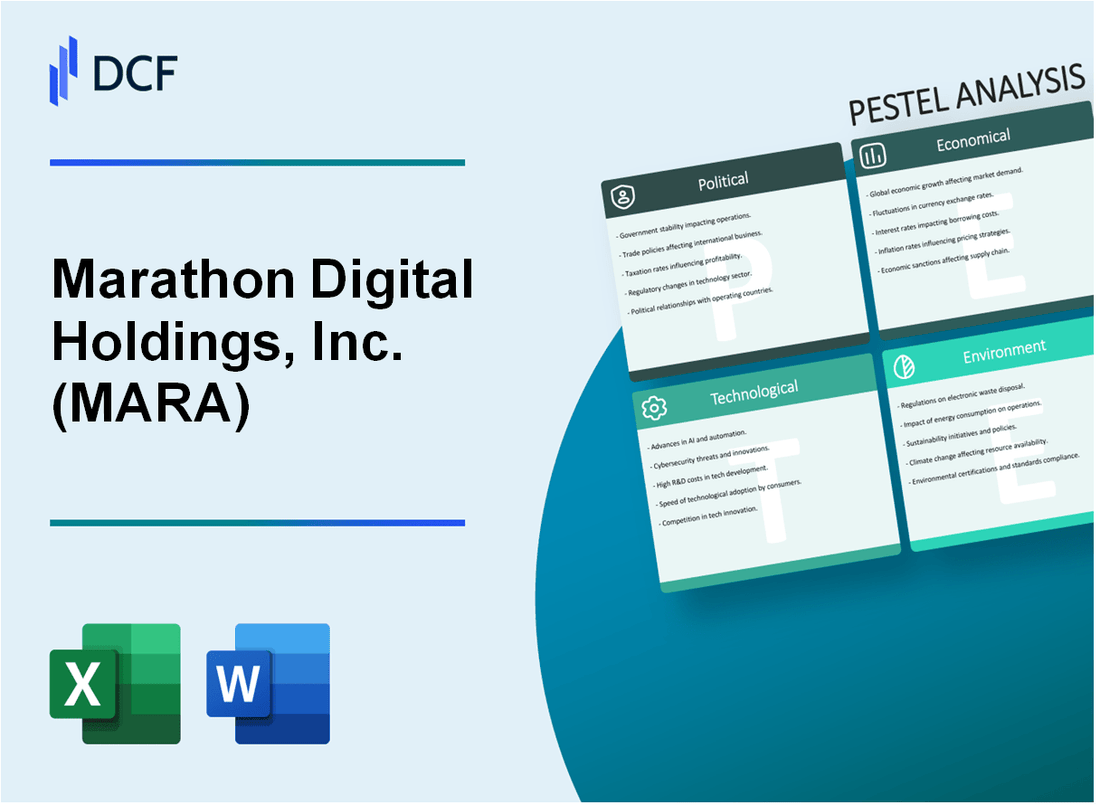
Marathon Digital Holdings, Inc. (MARA): PESTLE Analysis [Nov-2025 Updated] |
Fully Editable: Tailor To Your Needs In Excel Or Sheets
Professional Design: Trusted, Industry-Standard Templates
Investor-Approved Valuation Models
MAC/PC Compatible, Fully Unlocked
No Expertise Is Needed; Easy To Follow
Marathon Digital Holdings, Inc. (MARA) Bundle
You're looking for the real story behind Marathon Digital Holdings, Inc. (MARA), and honestly, the simple Bitcoin miner narrative is dead. The company is undergoing a defintely complex, high-stakes pivot, transforming into a diversified technology player focused on High-Performance Computing (HPC) and Artificial Intelligence (AI). This shift means the external risks-from the pro-crypto US political climate to the pressure of maintaining a massive 60.4 EH/s hash rate-are changing fast. We need to map these forces because MARA's Q3 2025 revenue surge to $252.4 million proves they are executing, but the 1.96x premium to net asset value shows investors are betting on the future, not just the present.
Political: Navigating Federal Support and Local Friction
You need to understand that Marathon Digital Holdings, Inc. operates in a political landscape that is two-sided. On one hand, the US federal policy under the Trump administration is generally pro-crypto and deregulatory, which is a massive tailwind for the core mining business. But that federal clarity is often undermined by state and local government pushback, driven by concerns over power grid strain and noise complaints in US operating areas. This is a classic case of federal support versus local friction.
Also, the company's strategic pivot into High-Performance Computing (HPC) and AI is smart political hedging. Government interest in these areas aligns perfectly with MARA's new focus, potentially opening doors for partnerships or favorable treatment. Still, operating across four continents-including the Middle East and South America-introduces geopolitical risk that you simply can't ignore. Federal policy is a boon, but local politics is the friction.
Economic: Scale, Volatility, and the Cost of Efficiency
The economics of Marathon Digital Holdings, Inc. are dominated by two numbers: scale and volatility. The company's operational scale is driving impressive results, with revenue surging to $252.4 million in Q3 2025. That's a clear sign that higher Bitcoin prices and their massive hash rate are paying off. Still, the core risk is the volatility of their 53,250 BTC treasury holdings as of November 2025; a sharp price drop instantly erodes billions from the balance sheet.
Here's the quick math on efficiency: despite the post-halving pressure, the energy cost per Bitcoin mined remained competitive at approximately $39.2 thousand in Q3 2025. What this estimate hides is the relentless need for aggressive efficiency gains and diversification into non-mining revenue streams, like AI/HPC, to keep that cost competitive. Bitcoin price is the tide, but efficiency is the boat.
Sociological: ESG Pressure and the Tech Talent Shift
Sociological factors boil down to public perception and talent acquisition. There is growing public and institutional pressure for better Environmental, Social, and Governance (ESG) compliance, especially given the high energy consumption of the sector. This is a real cost, not just a headline.
Community backlash over noise pollution and local power grid consumption in US operating areas is forcing operational changes. To attract the right talent for the AI pivot, Marathon Digital Holdings, Inc. is shifting toward a technology company board structure. Investors are watching this closely; the stock trading at a premium to its net asset value (mNAV) of 1.96x shows that sentiment is volatile, but the market is willing to pay for the promise of a tech-forward future. The market is betting on the tech pivot, not just the mining.
Technological: Hash Rate Dominance and the AI Pivot
Marathon Digital Holdings, Inc. has cemented its market leadership technologically. Their energized hash rate reached a massive 60.4 EH/s in September 2025. Plus, fleet efficiency improved to 18.3 J/TH (Joules per Terahash) in Q2 2025, representing a strong 26% year-over-year enhancement-that's how they beat the halving.
The major technological move is the strategic pivot to AI inference and HPC infrastructure, with initial AI racks deployed in Q3 2025. The real advantage here is their modular data center design, which allows flexible allocation of their 1.8 GW energy capacity between mining and AI workloads. That flexibility is the defintely most valuable technology asset they own right now. Efficiency gains are table stakes; modular capacity is the game-changer.
Legal: Federal Clarity vs. State Tax Risk
You can be thankful for the federal clarity from the SEC that proof-of-work (PoW) crypto mining is not subject to federal securities laws. That removes a major regulatory cloud. Still, the legal risks have simply moved to the state level, so you need to monitor increased state-level legislative risk, such as New York's proposed Bill S8518, which aims to impose additional taxes on miners.
Also, compliance with Anti-Money Laundering (AML) and Counter-Financing of Terrorism (CFT) rules is mandatory for all US operations, which adds a constant operational cost. The near-term legal action to watch is the pending regulatory approval for the $168 million Exaion acquisition, which is expected to close in late 2025 or early 2026. This deal is crucial for the AI pivot, so any delay is a problem. State tax bills are the biggest legal risk right now.
Environmental: Renewable Commitment and E-Waste Challenge
Environmental factors are where Marathon Digital Holdings, Inc. faces the most public scrutiny. The commitment to power operations with 100% renewable energy by 2025 is a necessary, proactive step to mitigate carbon footprint concerns and manage ESG risk. This is a crucial defense against environmental activists and regulators who target the high energy consumption of Bitcoin mining.
The vertical integration strategy, like the MPLX partnership, is designed to secure low-cost natural gas power and reduce energy cost volatility, which is a financial and environmental win. Still, two issues remain: the sheer energy consumption of the sector and the long-term challenge of managing e-waste from rapidly obsolete ASIC mining hardware. Renewables are the shield, but e-waste is the hidden sword.
Next Action: Finance/Strategy: Model the impact of a 10% state-level tax increase on the Q3 2025 energy cost per Bitcoin by end of next week.
Marathon Digital Holdings, Inc. (MARA) - PESTLE Analysis: Political factors
US federal policy under the Trump administration is generally pro-crypto and deregulatory.
The political environment for Bitcoin miners like Marathon Digital Holdings has seen a definitive shift toward deregulation and industry support under the Trump administration in 2025. This change began with an Executive Order signed on January 23, 2025, which explicitly set forth a policy to support the responsible growth and use of digital assets.
The administration has moved away from the prior 'regulation by enforcement' approach, instead prioritizing clear, technology-neutral rules. A key action was the establishment of a US Strategic Bitcoin Reserve, composed of previously seized Bitcoin, and a directive to halt all sales of BTC, signaling a direct government interest in the asset class. This federal stance provides a tailwind for MARA, offering greater regulatory certainty for its core Bitcoin mining business.
Key political actions in the first half of 2025 include:
- Executive Order to support digital asset growth.
- Prohibition of a US Central Bank Digital Currency (CBDC).
- Formation of the President's Working Group on Digital Asset Markets.
- SEC pausing high-profile enforcement cases against crypto companies.
Increased geopolitical risk from operating across four continents, including the Middle East and South America.
Marathon Digital Holdings' strategy to diversify its operations across four continents and 16 data centers-including sites in North America, Europe, the Middle East, and Latin America-is a double-edged sword. While it diversifies energy and local regulatory risks, it significantly raises exposure to unpredictable geopolitical instability. The company's 2025 10-K filing notes this diversification is a core strategy to mitigate risk.
For example, the Middle East saw a sharp escalation in June 2025, with tensions between Israel and Iran leading to American airstrikes and Iranian missile responses, which immediately caused WTI Crude Oil prices to surge over 10%. Such regional conflict creates significant headline risk and potential disruptions to energy supply chains, directly impacting MARA's operational costs and stability in that region. Similarly, Latin America presents risks from persistent political instability and corruption challenges in countries like Colombia and Guatemala.
Rising state and local government pushback on mining due to power grid strain and noise complaints.
Despite a favorable federal environment, MARA faces intense political headwinds at the state and local levels, particularly in key US mining hubs like Texas. Local governments and residents are increasingly pushing back on mining operations due to their massive energy consumption and noise pollution.
The most concrete example is the MARA facility in Granbury, Texas, which has been cited more than 30 times for violating local noise limits, with measurements exceeding 85 decibels at the property line. This is not a small issue; it leads to direct regulatory fines and community opposition that can halt or delay operations. State lawmakers in Texas have also voiced concerns that the energy-intensive operations risk 'crashing' the electrical grid, especially during peak demand periods.
Here is the quick math on the local political cost:
| Risk Factor | Location Example | 2025 Impact/Metric |
|---|---|---|
| Noise Pollution | Granbury, Texas (MARA site) | Over 30 citations for noise limit violations. |
| Power Grid Strain | Texas (ERCOT Grid) | State lawmaker concerns over grid stability; MARA's total nameplate capacity is ~1.7 gigawatts. |
| Energy Cost | US Operations | Q2 2025 purchased energy cost per Bitcoin was $33,735, making local energy policy crucial. |
Government interest in High-Performance Computing (HPC) and AI aligns with MARA's new strategic focus.
The US government's strong push for domestic High-Performance Computing (HPC) and Artificial Intelligence (AI) infrastructure aligns perfectly with MARA's strategic pivot away from pure Bitcoin mining. The company is actively transforming into a digital energy and computing platform. This alignment could unlock significant opportunities for public sector contracts and government-backed financing.
The most tangible evidence is MARA's major investment in the AI/HPC sector in 2025: the pending acquisition of a 64% majority stake in Exaion, a French technology and HPC infrastructure company, for approximately $168 million. This deal, expected to close in late 2025, gives MARA immediate enterprise-grade AI and cloud capabilities. The company is also leveraging its existing 1.7 GW energy capacity and modular data centers to flexibly support AI inference workloads, which are increasingly critical for sovereign AI initiatives. The government views US Bitcoin miners as having a role in national security, especially concerning concerns about foreign ownership in the data center sector. This is a defintely a strategic advantage.
Marathon Digital Holdings, Inc. (MARA) - PESTLE Analysis: Economic factors
Revenue surged to $252.4 million in Q3 2025, driven by higher Bitcoin prices and operational scale.
You can see a clear picture of Marathon Digital Holdings' successful scaling in their Q3 2025 results. Revenue for the quarter surged to $252.4 million, marking a 92% year-over-year increase from Q3 2024. This impressive jump wasn't just about mining more Bitcoin; it was also heavily influenced by the appreciation of the digital assets they held. The company reported a net income of $123.1 million, a significant turnaround from a $124.8 million net loss in the prior-year quarter. Honestly, this swing to profitability shows the operational efficiency improvements are working, but you can't ignore the tailwind from the Bitcoin market.
Here's the quick math on the financial health: the net income included a substantial $343.1 million gain on the fair value of digital assets, which is a reminder that the Bitcoin price movement is a massive, defintely impactful factor on the bottom line. This is a digital asset company, so the value of the asset is central to its economic performance.
| Q3 2025 Key Financial Metric | Amount / Value | Context |
|---|---|---|
| Total Revenue | $252.4 million | 92% increase year-over-year |
| Net Income | $123.1 million | Turnaround from a $124.8 million net loss in Q3 2024 |
| Gain on Digital Assets (Fair Value) | $343.1 million | Major contributor to net income |
| Purchased Energy Cost per BTC | $39,235 | Remains competitive despite network difficulty |
Bitcoin price volatility remains the single largest risk to the 53,250 BTC treasury holdings (as of November 2025).
The core economic risk for Marathon Digital Holdings is right there on the balance sheet: the massive Bitcoin treasury. As of November 15, 2025, the company held 53,250 BTC, making it one of the largest corporate Bitcoin holders globally. That's a huge asset, but it also means the company's valuation is highly sensitive to market swings. When Bitcoin's price moves, MARA's stock feels it immediately.
The company's reliance on Bitcoin appreciation is a double-edged sword. While the price surge created a significant gain in Q3, a sharp downturn could quickly wipe out operating profits and turn net income negative, as seen in previous periods. This volatility necessitates a robust treasury management strategy, which includes using a portion of their holdings for loans and as collateral.
Energy cost per Bitcoin remains competitive at approximately $39.2 thousand in Q3 2025.
Operational efficiency is non-negotiable in the mining sector, and Marathon Digital Holdings is focused on controlling its energy costs. For Q3 2025, their purchased energy cost per Bitcoin was reported at $39,235. This is a competitive figure, especially when you consider the overall increase in global network difficulty. They've been on a mission to reduce unitary costs by shifting from an asset-light model to a vertically integrated one.
This strategic pivot is paying off in efficiency gains. They reduced their cost per petahash per day by 15% year-over-year between Q3 2024 and Q3 2025. The goal is to reduce the contribution of third-party sites to 30% by the end of 2025, which should further stabilize and lower their overall energy expenditure.
Post-halving pressure necessitates aggressive efficiency gains and diversification into non-mining revenue streams.
The Bitcoin halving event, which cuts the block reward in half, puts immense pressure on all miners. To survive and thrive in a post-halving world, you have to get leaner and smarter. Marathon Digital Holdings is tackling this through two clear actions:
- Vertical Integration: Moving to own and operate more of their sites, which helps secure lower, more predictable energy prices.
- Diversification: Expanding into high-performance computing (HPC) and Artificial Intelligence (AI) infrastructure.
This diversification is a critical economic hedge against mining revenue compression. The company has already deployed its first ten AI inference racks at its Granbury, Texas site in Q3 2025. Plus, the planned acquisition of a 64% stake in Exaion, a secure, low-carbon cloud data center operator, for approximately $168.0 million, is a concrete step toward generating high-margin, contracted cash flow outside of pure Bitcoin mining. This move is all about leveraging their massive energy and data center infrastructure to tap into the booming AI market.
Marathon Digital Holdings, Inc. (MARA) - PESTLE Analysis: Social factors
Growing public and institutional pressure for better Environmental, Social, and Governance (ESG) compliance.
The social license to operate for Bitcoin miners like Marathon Digital Holdings is defintely under pressure, driven by institutional investor mandates and broader public scrutiny of energy-intensive industries. You need to understand that for major asset managers, ESG (Environmental, Social, and Governance) is not a fad; it's a risk management tool. A Morgan Stanley survey from mid-2025 showed that an overwhelming 88% of institutional investors globally view sustainability as a critical value creation opportunity, not just a compliance checkbox.
For Marathon Digital Holdings, this pressure is most acute on the Governance side, specifically concerning the concentration of its balance sheet. The company's massive Bitcoin holdings-which reached 52,850 BTC by the end of Q3 2025-place it under review by major index providers like MSCI. The risk is that if over 50% of the company's assets are deemed to be in a non-operating asset (Bitcoin), it could be reclassified as an investment fund, leading to exclusion from mainstream indices. This is a huge governance signal, forcing a strategic pivot to diversify revenue away from pure mining.
The strategic move into High-Performance Computing (HPC) and Artificial Intelligence (AI) infrastructure, including the planned acquisition of a 64% majority stake in French HPC firm Exaion in August 2025, is a direct response to this social and governance pressure. It's a clear action to future-proof the business and demonstrate a commitment to a broader, more sustainable digital infrastructure role.
Community backlash over noise pollution and local power grid consumption in US operating areas.
The most immediate and concrete social risk for Marathon Digital Holdings is the intense community backlash in its US operating areas, particularly concerning noise pollution. This isn't just local chatter; it's escalated to litigation. Residents of Granbury, Texas, filed a lawsuit in Hood County in late 2024, alleging the 24/7 noise from the company's Bitcoin mining facility constitutes a private nuisance.
The complaints are severe, citing direct health impacts on dozens of individuals, including permanent hearing loss, severe migraines, tinnitus, and debilitating vertigo, all stemming from the incessant, low-frequency hum of the cooling fans. The facility in question has a significant capacity of 300-megawatts. While the company stated its noise levels are within the normal range, they've had to take action, announcing in late 2024 that they were upgrading 30% of the miners in Granbury to quieter liquid immersion cooling, with a goal of 50% conversion by the end of 2024. That's a costly, but necessary, mitigation step.
The power grid consumption issue is also a social flashpoint. The company's new joint venture with MPLX LP to develop integrated power and datacenter facilities in West Texas, planning for an initial 400MW of gas-fired power and datacenter capacity (scalable up to 1.5GW), highlights the scale of its energy demand, which inevitably draws scrutiny from local power grid operators and consumers. Energy use is a social issue in Texas, where grid reliability is a constant concern.
Corporate shift toward a technology company board structure to attract AI and HPC talent.
The strategic pivot to AI and HPC is fundamentally a talent and governance shift. You can't run a complex AI infrastructure business with a board and executive team solely focused on Bitcoin mining. The August 2025 announcement of the Exaion acquisition is the clearest signal of this intent. The company is moving from a pure-play, capital-intensive Bitcoin miner to a diversified digital infrastructure provider.
This shift requires a new mix of human capital: deep domain expertise in AI/ML operations, high-performance computing, and advanced data center management. Expect to see new board appointments and executive hires in late 2025 and 2026 with backgrounds from traditional tech and cloud services, not just energy or finance. The goal is to evolve the corporate identity to attract this high-value talent, which is currently the most competitive resource in the global economy.
Investor sentiment is volatile, with the stock trading at a premium to its net asset value (mNAV) of 1.96x.
Investor sentiment remains highly volatile, which is typical for a high-beta proxy to Bitcoin. The market capitalization premium to Net Asset Value (mNAV) is a critical metric here, showing what the market is willing to pay for the mining operation and its future growth potential beyond the raw value of its Bitcoin holdings.
As of late 2025, Marathon Digital Holdings' stock is trading at a significant premium to its mNAV, specifically at 1.96x. This means for every dollar of Bitcoin and net cash on the balance sheet, the market is valuing the company's stock at $1.96. This premium is a double-edged sword: it allows the company to raise capital cheaply, but it also makes the stock extremely sensitive to any decline in Bitcoin price or operational misstep.
Here's the quick math for the Q3 2025 financial base, illustrating the scale of the company's exposure and the volatility of its valuation:
| Metric | Q3 2025 Value | Source/Context |
|---|---|---|
| Bitcoin Holdings (as of Sep 30, 2025) | 52,850 BTC | Represents a 98% YoY increase. |
| Liquid Assets (as of Sep 30, 2025) | Over $7 billion | Includes digital assets and cash. |
| Q3 2025 Revenue | $252.4 million | Up 92% year-over-year. |
| Stock Premium to mNAV | 1.96x | Required metric, indicating high growth expectation. |
This premium is a clear sign of bullish sentiment on the company's ability to execute its diversification strategy and its operational efficiency, which saw a 15% year-over-year improvement in the daily cost per petahash in Q3 2025. However, the stock price volatility-seen in the post-earnings decline despite a net income of $123.1 million in Q3 2025-shows that investor confidence is fragile and sentiment can turn on a dime. The market is pricing in significant future success, but the risk of mNAV compression (a drop toward 1.0x) is ever-present, especially if the AI pivot falters.
Marathon Digital Holdings, Inc. (MARA) - PESTLE Analysis: Technological factors
Energized hash rate reached a massive 60.4 EH/s in September 2025, cementing market leadership.
The technological scale Marathon Digital Holdings has achieved in 2025 is defintely a core competitive advantage. By the end of September 2025, the company's energized hash rate-the total computing power actively mining Bitcoin-climbed to a massive 60.4 EH/s (Exahashes per second). This figure represents a significant operational expansion, solidifying Marathon's position as a market leader among publicly traded Bitcoin miners. For context, this was a 1% month-over-month increase from August 2025's 59.4 EH/s, showing consistent, incremental growth even as the global network hashrate grew 9% month-over-month to an average of 1,031 EH/s.
This sheer scale is crucial because it directly translates to a greater share of block rewards. In September 2025, Marathon won 218 blocks, a 5% increase over August, and accounted for a 5.2% share of all miner rewards. Here's the quick math on their Q2 2025 capacity growth:
- Q2 2025 Energized Hash Rate: 57.4 EH/s
- Year-over-Year Q2 Growth: 82%
- Total BTC Produced in Q2 2025: 2,358 BTC
Strategic pivot to AI inference and HPC infrastructure, deploying initial AI racks in Q3 2025.
The biggest technological shift this year isn't just about mining; it's the strategic pivot toward High-Performance Computing (HPC) and Artificial Intelligence (AI) inference. Honestly, this move changes the entire business model. Marathon is transforming its energy infrastructure into a dual-purpose digital energy platform. The company is actively pursuing a recurring revenue model in AI to counter the cyclical nature of Bitcoin mining.
This strategy is already in motion. Subsequent to the end of the September quarter, Marathon arranged and deployed its initial 10 AI racks at its Granbury, Texas, site, making it the company's first hybrid operational location. Plus, to fast-track its entry into the enterprise AI and cloud space, Marathon entered an agreement to acquire a 64% stake in Exaion, a French HPC and AI infrastructure company, from the EDF Group for approximately $168 million. This acquisition gives them immediate access to Tier-4, GDPR-compliant data centers and European enterprise clients.
Fleet efficiency improved to 18.3 J/TH (Joules per Terahash) in Q2 2025, a 26% year-over-year enhancement.
In the post-halving environment, efficiency is everything. Marathon's focus on operational efficiency is paying clear dividends. In Q2 2025, the company achieved a fleet efficiency of 18.3 J/TH (Joules per Terahash), which is a 26% year-over-year enhancement from the 24.8 J/TH reported in Q2 2024. This improvement is largely driven by the deployment of newer, more efficient hardware like the S21 Pro miners and the shift to owned and operated sites, which now account for approximately 70% of the total hash rate.
This technical precision directly impacts the bottom line. For example, the purchased energy cost per Bitcoin in Q2 2025 was reduced to $33,735 per coin, which is a figure Marathon believes is among the lowest in the sector. The daily cost per petahash also decreased by 24% year-over-year.
| Operational Efficiency Metric | Q2 2025 Value | Year-over-Year Change | Significance |
|---|---|---|---|
| Fleet Efficiency (J/TH) | 18.3 J/TH | 26% Enhancement | Lower energy consumption per unit of compute power. |
| Purchased Energy Cost per Bitcoin | $33,735 | N/A (Among the lowest in sector) | Direct cost reduction and margin protection. |
| Daily Cost per Petahash | ~$28.7 USD/PH | 24% Decline | Improved cost structure for mining operations. |
Modular data center design allows flexible allocation of 1.8 GW energy capacity between mining and AI workloads.
Marathon's infrastructure is built for flexibility, which is a huge advantage. The modular data center design is the key enabler for the AI pivot. As of the September 2025 quarter, the company had installed a total of 1.8 GW of energy capacity across 18 data centers. This massive energy footprint is not static; the modular nature allows the company to dynamically shift power allocation.
This means that when AI inference demand spikes-which often has a higher margin-Marathon can scale down power consumption for Bitcoin mining, and then ramp it back up when AI demand tapers off. This ability to control large power loads and monetize excess energy is a strategic moat. The company's global growth pipeline further emphasizes this focus, with plans for a 3+ gigawatt power infrastructure pipeline. The entire setup is designed to maximize dollar profit per megawatt-hour, whether it's powering Bitcoin mining or a demanding AI workload.
Marathon Digital Holdings, Inc. (MARA) - PESTLE Analysis: Legal factors
Federal Clarity from the SEC on Proof-of-Work (PoW) Crypto Mining
You're operating in a space that has historically been murky from a regulatory standpoint, but the good news is that a major piece of federal uncertainty has been cleared up in 2025. The U.S. Securities and Exchange Commission (SEC) Staff, specifically the Division of Corporation Finance, issued a non-binding statement on March 20, 2025, which is a huge de-risking event for Proof-of-Work (PoW) miners like Marathon Digital Holdings, Inc.
This statement clarifies that PoW mining activities-including both solo mining and participating in mining pools-do not generally constitute the offer and sale of securities under the Securities Act of 1933 or the Securities Exchange Act of 1934. Essentially, the SEC found that miners rely on their own efforts (computational power and electricity) for profit, not the managerial efforts of others, which is the core of the Howey Test for an investment contract. This means MARA does not need to register its core mining transactions with the SEC. That's one less existential threat to worry about.
Increased State-Level Legislative Risk: New York's Proposed Bill S8518
While the federal picture is clearer, state-level legislative risk is definitely rising, and it's focused on energy consumption. New York State, for example, introduced Senate Bill S8518 in October 2025, which proposes a tiered excise tax on electricity used by PoW crypto miners. This bill aims to fund energy affordability programs for low-income residents, arguing that high-volume mining drives up local utility costs.
For a large-scale operator, this tax structure is a real cost-of-doing-business threat. The tax rates are aggressive and scaled by annual consumption, which penalizes the industrial-scale operations that MARA represents. The only way to avoid it is to run entirely on renewable energy sources, which is a big capital expenditure hurdle. Honestly, this kind of legislation can make grid-based mining financially unsustainable in a state like New York.
Here's the quick math on the proposed New York excise tax rates for PoW miners, effective for the 2025 fiscal year if passed:
| Annual Electricity Consumption (kWh) | Proposed Excise Tax Rate (per kWh) |
|---|---|
| Less than or equal to 2.25 million kWh | 0 cents |
| Over 2.25 million to 5 million kWh | 2 cents |
| Over 5 million to 10 million kWh | 3 cents |
| Over 10 million to 20 million kWh | 4 cents |
| Over 20 million kWh | 5 cents |
Mandatory Compliance with AML and CFT Rules
Every US-based crypto business, including a digital asset company like Marathon Digital Holdings, must comply with the Bank Secrecy Act (BSA) and its requirements for Anti-Money Laundering (AML) and Counter-Financing of Terrorism (CFT). Even though MARA is a miner, not a typical exchange, its operations involving the transfer and custody of digital assets mean it falls under the purview of the Financial Crimes Enforcement Network (FinCEN), often as a Money Services Business (MSB).
Compliance is non-negotiable. You need a comprehensive program, or the fines can be steep-crypto companies paid over $5.80 billion in fines during 2023 for compliance program shortcomings. This means MARA must maintain a strict, auditable AML/CFT framework, which includes:
- Appointing a dedicated Compliance Officer.
- Developing a risk-based AML program with written policies.
- Filing Suspicious Activity Reports (SARs) for illicit activities exceeding the $5,000 threshold.
- Conducting independent audits of the AML program annually.
Pending Regulatory Approval for the $168 Million Exaion Acquisition
Marathon Digital Holdings' strategic pivot into High-Performance Computing (HPC) and Artificial Intelligence (AI) infrastructure hinges on the successful acquisition of a 64% majority stake in Exaion, a subsidiary of the French state-owned energy giant Électricité de France (EDF). The deal is valued at approximately $168 million in cash.
The legal risk here is purely transactional. The deal, which was signed in August 2025, is expected to close in the fourth quarter of 2025 or early 2026, but it is contingent upon receiving all necessary regulatory approvals. Because Exaion is a French entity and the deal involves a major state-owned company, the key approvals are needed from regulatory bodies in both France and Canada. The acquisition also reportedly includes a standard non-compete clause that limits EDF's ability to engage in Exaion's current HPC activities for a period, which is a legal detail that secures MARA's new market position.
Marathon Digital Holdings, Inc. (MARA) - PESTLE Analysis: Environmental factors
Commitment to Power Operations with 100% Renewable Energy
You're watching the energy mix closely because, honestly, the environmental baggage of Bitcoin mining is a huge regulatory and public relations risk. Marathon Digital Holdings (MARA) has made a public commitment to power its operations with 100% renewable energy, but as of mid-2025, they're still working toward that goal. Here's the quick math: approximately 68% of the power for their U.S. operations is currently sourced from renewables.
This isn't just a marketing play; it's a strategic move to de-risk the business. They've backed this up with hard assets, like the acquisition of a wind farm in North Texas with 114 megawatts (MW) of nameplate capacity and a total of 240 MW of interconnection capacity. This vertical integration into power generation is defintely the right action to take.
Vertical Integration Strategy to Secure Low-Cost Power
The core of Marathon Digital Holdings' strategy to manage energy cost volatility is vertical integration (owning and operating the power source and data center). The partnership with MPLX LP is a clear example, aiming to secure low-cost natural gas power in West Texas. This is about control and cost-efficiency, not just green energy.
This collaboration is designed to deliver reliable, scalable power, starting with an initial capacity of 400 MW and the potential to scale up to 1.5 GW across three planned sites. This control allows Marathon Digital Holdings to maintain an exceptionally low fleet-wide energy cost of just $0.04/kWh for their owned power sites in Q3 2025. To be fair, this is a massive advantage when the purchased energy cost per Bitcoin for the same quarter was $39,235, up from $32,433 year-over-year due to network difficulty.
| Energy Cost Metric | Q3 2025 Value | Strategic Implication |
|---|---|---|
| Owned Power Cost (per kWh) | $0.04 | Mitigates energy cost volatility and provides a competitive edge. |
| Purchased Energy Cost (per Bitcoin) | $39,235 | Highlights exposure to market price fluctuations and network difficulty. |
| MPLX Partnership Initial Capacity | 400 MW | Quantifies the near-term scale of the vertical integration strategy. |
High Energy Consumption and Activist/Regulatory Scrutiny
The high energy consumption of Bitcoin mining remains the biggest environmental target. While the global average cost to mine one bitcoin in mid-2025 stood at approximately $101,000 per coin, Marathon Digital Holdings' Q2 2025 energy cost per Bitcoin was a much lower $33,735. Still, the sheer volume of energy consumed by the industry draws fire from environmental activists and increasingly, from regulators.
Marathon Digital Holdings is using its flexible load to help grid operators balance supply, but they are also tackling the issue head-on with methane mitigation projects. This is a smart way to flip the narrative. For example, a 25-megawatt Bitcoin mining initiative at oil and gas wellheads across Texas and North Dakota is capturing excess gas that would otherwise be flared. This process achieves up to 99% methane mitigation efficiency, which is a significant environmental win.
Managing E-Waste from Obsolete ASIC Mining Hardware
The rapid obsolescence of Application-Specific Integrated Circuit (ASIC) mining hardware creates a long-term e-waste challenge. With a fleet of over 400,000 bitcoin mining rigs as of early 2025, the scale of this problem is substantial. You have to plan for the eventual retirement of all that specialized equipment.
Marathon Digital Holdings' solution is the 'Advanced ASIC Retirement Program.' Instead of immediately scrapping older machines, they are repurposed and reused at sites with near-zero marginal energy costs, like the newly acquired wind farm in Texas. This extends the hardware's profitable lifecycle and helps reduce the actual e-waste footprint.
- Repurpose older ASICs at low-cost energy sites.
- Extend hardware lifecycle beyond normal depreciation.
- Mitigate e-waste from 400,000+ mining rigs.
Next step: Operations should document the projected e-waste reduction (in metric tons) for the Advanced ASIC Retirement Program by the end of Q4 2025.
Disclaimer
All information, articles, and product details provided on this website are for general informational and educational purposes only. We do not claim any ownership over, nor do we intend to infringe upon, any trademarks, copyrights, logos, brand names, or other intellectual property mentioned or depicted on this site. Such intellectual property remains the property of its respective owners, and any references here are made solely for identification or informational purposes, without implying any affiliation, endorsement, or partnership.
We make no representations or warranties, express or implied, regarding the accuracy, completeness, or suitability of any content or products presented. Nothing on this website should be construed as legal, tax, investment, financial, medical, or other professional advice. In addition, no part of this site—including articles or product references—constitutes a solicitation, recommendation, endorsement, advertisement, or offer to buy or sell any securities, franchises, or other financial instruments, particularly in jurisdictions where such activity would be unlawful.
All content is of a general nature and may not address the specific circumstances of any individual or entity. It is not a substitute for professional advice or services. Any actions you take based on the information provided here are strictly at your own risk. You accept full responsibility for any decisions or outcomes arising from your use of this website and agree to release us from any liability in connection with your use of, or reliance upon, the content or products found herein.