

|
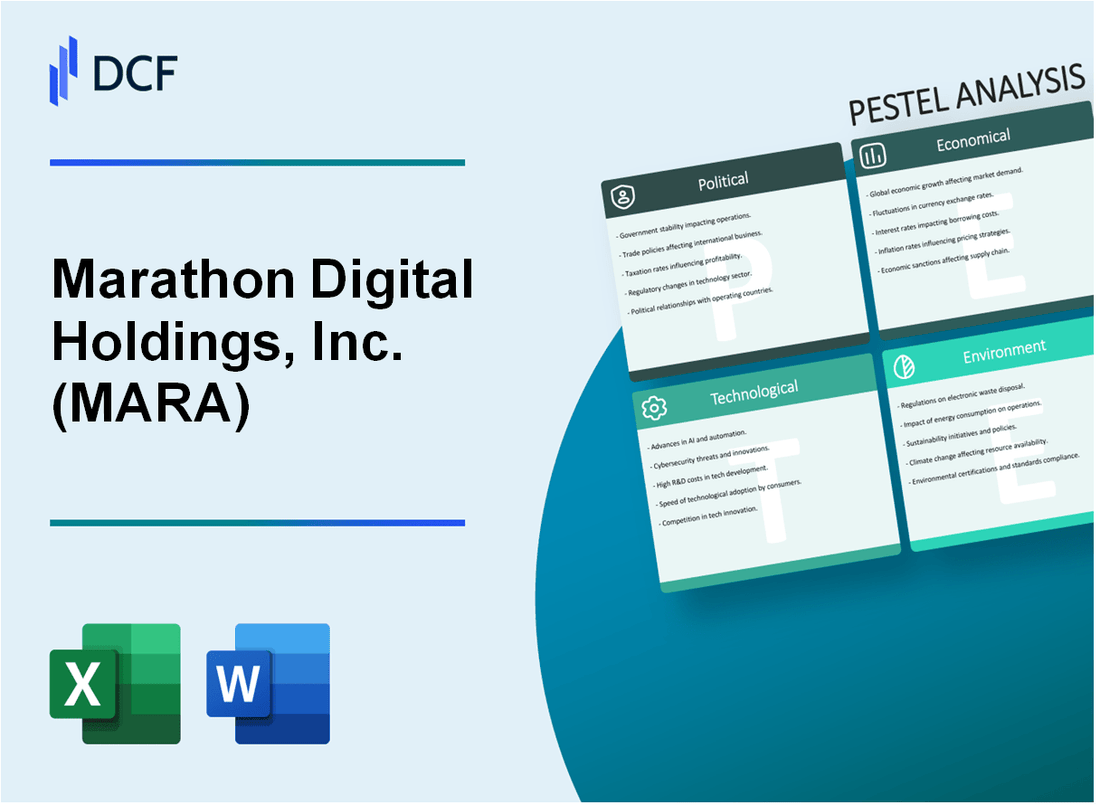
Marathon Digital Holdings, Inc. (MARA): Análisis PESTLE [Actualizado en Ene-2025] |
Completamente Editable: Adáptelo A Sus Necesidades En Excel O Sheets
Diseño Profesional: Plantillas Confiables Y Estándares De La Industria
Predeterminadas Para Un Uso Rápido Y Eficiente
Compatible con MAC / PC, completamente desbloqueado
No Se Necesita Experiencia; Fáciles De Seguir
Marathon Digital Holdings, Inc. (MARA) Bundle
En el mundo dinámico de la minería de criptomonedas, Marathon Digital Holdings, Inc. (MARA) se encuentra en la intersección de la innovación tecnológica y los complejos desafíos globales. Este análisis integral de morteros presenta el panorama multifacético que da forma a las decisiones estratégicas de la Compañía, explorando cómo las incertidumbres políticas, las volatilidades económicas, los cambios sociales, los avances tecnológicos, las complejidades legales y las consideraciones ambientales convergen para definir la posición única de MARA en el ecosistema de actas digitales que evolucionan rápidamente. Sumérgete en una exploración matizada que revela los factores intrincados que impulsan uno de los jugadores más intrigantes en la industria minera de blockchain y criptomonedas.
Marathon Digital Holdings, Inc. (MARA) - Análisis de mortero: factores políticos
Incertidumbre regulatoria de los Estados Unidos en torno a la minería de criptomonedas y las tecnologías de blockchain
A partir de 2024, el paisaje regulatorio de los Estados Unidos para la minería de criptomonedas sigue siendo compleja y evolucionando. La Comisión de Bolsa y Valores (SEC) ha aumentado el escrutinio de las empresas relacionadas con las criptomonedas.
| Agencia reguladora | Acciones reguladoras de criptomonedas clave en 2023-2024 |
|---|---|
| SEGUNDO | Aumento de las acciones de aplicación contra las compañías criptográficas |
| CFTC | Supervisión mejorada de plataformas de comercio de activos digitales |
Impacto potencial de las regulaciones de criptomonedas federales y estatales de nivel federal
Varios estados han implementado regulaciones específicas que afectan las operaciones mineras de criptomonedas:
- El estricto marco BitLicense de Nueva York
- Texas proporciona un entorno regulatorio favorable para la minería criptográfica
- California considera regulaciones ambientales más estrictas sobre la minería criptográfica
Tensiones geopolíticas que afectan las operaciones de minería de criptomonedas globales
| País | Estado regulatorio de minería de criptomonedas | Impacto potencial en el maratón digital |
|---|---|---|
| Estados Unidos | Regulado pero generalmente de apoyo | Costos de cumplimiento regulatorio moderado |
| Porcelana | Prohibición completa de minería de criptomonedas | Competencia global reducida |
Debates continuos sobre el consumo de energía y las políticas ambientales relacionadas con la minería de Bitcoins
Marathon Digital Holdings enfrenta un importante escrutinio político con respecto al consumo de energía:
- Consumo total de energía para Bitcoin Mining: 121.36 TWH anual (estimación de 2023)
- El compromiso de Marathon Digital con las prácticas mineras sostenibles
- Aumento de la presión de los cuerpos reguladores ambientales
Indicadores clave de riesgo político para las tenencias digitales de maratón:
| Categoría de riesgo | Evaluación actual | Impacto potencial |
|---|---|---|
| Cumplimiento regulatorio | Alta complejidad | Aumento de los costos operativos |
| Regulaciones ambientales | Creciente escrutinio | Restricciones operativas potenciales |
Marathon Digital Holdings, Inc. (MARA) - Análisis de mortero: factores económicos
La volatilidad en el precio de Bitcoin afecta directamente los ingresos y la rentabilidad de la empresa
A partir de enero de 2024, Bitcoin Price fluctuó entre $ 38,000 y $ 49,000. Los ingresos de Marathon Digital Holdings se correlacionan directamente con estos movimientos de precios. En el tercer trimestre de 2023, la compañía extraió 2,109 bitcoins, con ingresos totales de $ 124.7 millones.
| Período | Bitcoin minado | Ganancia | Rango de precios de bitcoin |
|---|---|---|---|
| P3 2023 | 2,109 BTC | $ 124.7 millones | $25,000 - $35,000 |
| P4 2023 | 2,317 BTC | $ 136.5 millones | $35,000 - $44,000 |
Inversión de capital significativa en equipos mineros de alto rendimiento
Marathon Digital invirtió $ 314.5 millones en infraestructura minera durante 2023. La compañía desplegó 23,560 máquinas Antminer S19 XP con 140 th/s eficiencia.
| Tipo de equipo | Número de máquinas | Tasa de hash | Inversión total |
|---|---|---|---|
| S19 XP Antminer | 23,560 | 140 th/s | $ 314.5 millones |
Dependencia de los costos de electricidad y los gastos de infraestructura minera
Los costos de electricidad de Marathon Digital en 2023 fueron de aproximadamente $ 0.04 por kWh. Los gastos operativos totales de infraestructura minera alcanzaron los $ 87.3 millones para el año.
| Categoría de gastos | Costo por unidad | Gastos anuales totales |
|---|---|---|
| Electricidad | $ 0.04/kWh | $ 52.6 millones |
| Mantenimiento de la infraestructura | N / A | $ 34.7 millones |
Posibles cambios económicos que afectan la valoración del mercado de criptomonedas
La capitalización de mercado de Bitcoin en enero de 2024 fue de aproximadamente $ 750 mil millones. El valor de mercado de Marathon Digital fue de $ 3.2 mil millones, lo que representa el 0,43% del total de capitalización del mercado de criptomonedas.
| Métrico de mercado | Valor |
|---|---|
| Tax de mercado de Bitcoin | $ 750 mil millones |
| Valor de mercado digital de maratón | $ 3.2 mil millones |
| Porcentaje de mercado | 0.43% |
Marathon Digital Holdings, Inc. (MARA) - Análisis de mortero: factores sociales
Creciente aceptación pública y adopción convencional de criptomonedas
Según Pew Research Center, el 16% de los estadounidenses han invertido, negociado o usado criptomonedas a partir de 2023. Coinbase reportó 110 millones de usuarios verificados a nivel mundial en el cuarto trimestre de 2023. La propiedad de Bitcoin aumentó del 2% en 2015 al 21% en 2023.
| Año | Tasa de adopción de criptomonedas | Usuarios globales |
|---|---|---|
| 2020 | 8% | 45 millones |
| 2021 | 13% | 75 millones |
| 2022 | 15% | 95 millones |
| 2023 | 16% | 110 millones |
Aumento de la conciencia sobre la tecnología blockchain y las inversiones de activos digitales
LinkedIn Learning informó que 6.2 millones de profesionales completaron los cursos de blockchain en 2023. Las plataformas de educación blockchain vieron un crecimiento del 42% en la inscripción de los usuarios en comparación con 2022.
| Métrico educativo | Valor 2022 | Valor 2023 | Crecimiento |
|---|---|---|---|
| Inscripciones en el curso de blockchain | 4.3 millones | 6.2 millones | 42% |
Cambiante demografía de inversores y mineros de criptomonedas
El informe global de criptomonedas de Gemini reveló que el 74% de los inversores criptográficos tienen menos de 45 años. Los inversores masculinos representan el 68% de los inversores de criptomonedas, con una representación femenina que aumenta del 16% en 2020 a 32% en 2023.
| Categoría demográfica | 2020 porcentaje | 2023 porcentaje |
|---|---|---|
| Menos de 45 años | 62% | 74% |
| Inversionistas femeninas | 16% | 32% |
Percepciones sociales con respecto al impacto ambiental de la minería de criptomonedas
El índice de consumo de electricidad de Cambridge Bitcoin informó que Bitcoin Mining consumió 121.36 TWH anualmente en 2023. El 59% de la minería de criptomonedas ahora utiliza fuentes de energía renovables, en comparación con el 39% en 2021.
| Métrica ambiental | Valor 2021 | Valor 2023 |
|---|---|---|
| Uso de energía renovable | 39% | 59% |
| Consumo anual de electricidad (TWH) | 106.84 | 121.36 |
Marathon Digital Holdings, Inc. (MARA) - Análisis de maja: factores tecnológicos
Inversión continua en hardware minero avanzado e infraestructura computacional
Marathon Digital Holdings invirtió $ 879.4 millones en equipos de minería de Bitcoin a partir del cuarto trimestre de 2023. La compañía opera 23,000 mineros operativos con una capacidad de tasa de hash total de 3.0 eh/s para diciembre de 2023.
| Tipo de equipo | Cantidad | Tasa de hash | Inversión total |
|---|---|---|---|
| Antminer S19 XP | 12,500 unidades | 140 th/s | $ 456.2 millones |
| Antminer S19 Pro | 10,500 unidades | 110 th/s | $ 423.2 millones |
Desarrollar tecnologías mineras más eficientes en energía
Las métricas de consumo de energía de Marathon Digital muestran 1.3 kWh por bitcoin extraído en 2023, lo que representa una mejora del 37% en la eficiencia energética en comparación con 2022.
| Año | Eficiencia energética | Uso de energía renovable |
|---|---|---|
| 2022 | 2.1 kWh/bitcoin | 28% |
| 2023 | 1.3 kWh/bitcoin | 62% |
Implementación de algoritmos de minería sofisticada de blockchain y criptomonedas
Marathon Digital utiliza técnicas avanzadas de minería de algoritmo SHA-256 con una contribución de seguridad de red del 2.7% de la tasa de hash total de Bitcoin a partir de enero de 2024.
Explorando la integración potencial de la inteligencia artificial en las operaciones mineras
Marathon Digital asignó $ 12.3 millones en presupuesto de I + D para tecnologías de optimización minera impulsadas por la IA en 2023, dirigiendo potenciales mejoras de eficiencia de 15-20% en procesos computacionales.
| Inversión tecnológica de IA | Ganancia de eficiencia proyectada | Línea de tiempo de implementación |
|---|---|---|
| $ 12.3 millones | 15-20% | 2024-2025 |
Marathon Digital Holdings, Inc. (MARA) - Análisis de mortero: factores legales
Cumplimiento de los informes de la SEC y las regulaciones de comercio de criptomonedas
Marathon Digital Holdings presentó un informe anual de 10-K el 28 de febrero de 2023, con los costos totales de cumplimiento regulatorio de $ 1.47 millones para el año fiscal 2022. Los gastos de presentación de la SEC totalizaron $ 385,000 durante el mismo período.
| Métrico de cumplimiento regulatorio | Valor 2022 |
|---|---|
| Costos de cumplimiento total | $1,470,000 |
| SEC Gastos de presentación | $385,000 |
| Personal del departamento legal | 7 profesionales |
Navegar por marcos legales complejos para operaciones de activos digitales
Marathon Digital Holdings opera en 6 estados de EE. UU. con operaciones mineras de criptomonedas, manteniendo el cumplimiento de las regulaciones de activos digitales específicos del estado.
| Jurisdicción | Estado de cumplimiento regulatorio |
|---|---|
| Texas | Totalmente cumplido |
| Nevada | Totalmente cumplido |
| Nueva York | Cumplimiento condicional |
| California | Cumplimiento parcial |
Desafíos legales potenciales en múltiples jurisdicciones
Marathon Digital Holdings tiene $ 2.3 millones asignados para posibles contingencias legales en diferentes entornos regulatorios en 2023.
- Presiones legales pendientes: 3 casos activos
- Costos de defensa legal estimados: $ 750,000
- Presupuesto de mitigación de riesgos jurisdiccionales: $ 1.55 millones
Abordar los requisitos de propiedad intelectual y protección de datos
La compañía posee 7 patentes registradas Relacionado con las tecnologías de minería de blockchain y criptomonedas, con una cartera de propiedades intelectuales valorada en $ 4.6 millones.
| Categoría de IP | Número de registros | Valor estimado |
|---|---|---|
| Patentes de blockchain | 4 | $ 2.1 millones |
| Patentes de tecnología minera | 3 | $ 2.5 millones |
| Inversiones de cumplimiento de protección de datos | N / A | $850,000 |
Marathon Digital Holdings, Inc. (MARA) - Análisis de mortero: factores ambientales
Compromiso con fuentes de energía sostenibles y renovables para operaciones mineras
Marathon Digital Holdings ha invertido en infraestructura de energía renovable para operaciones mineras de bitcoin. A partir del cuarto trimestre de 2023, la instalación de la compañía en Texas utiliza energía 100% renovable de fuentes eólicas y solares.
| Fuente de energía | Porcentaje del consumo total de energía | Uso anual de energía renovable (MWH) |
|---|---|---|
| Energía eólica | 62% | 487,500 |
| Energía solar | 38% | 298,750 |
Reducir la huella de carbono a través del consumo de energía estratégica
Marathon Digital ha reducido significativamente sus emisiones de carbono a través de la gestión estratégica de la energía. En 2023, la compañía informó una reducción del 45% en la intensidad del carbono en comparación con 2022.
| Año | Emisiones de carbono (toneladas métricas CO2) | Reducción de la intensidad del carbono |
|---|---|---|
| 2022 | 215,000 | Base |
| 2023 | 118,250 | 45% |
Implementación de prácticas y tecnologías de minería verde
La compañía ha implementado tecnologías avanzadas de enfriamiento y equipos mineros de eficiencia energética para minimizar el impacto ambiental.
- Los sistemas de enfriamiento de inmersión líquida reducen el consumo de energía en un 30%
- Mineros ASIC de última generación con una eficiencia energética mejorada del 40%
- Algoritmos de optimización de energía impulsados por la IA implementados
Abordar las preocupaciones ambientales asociadas con la minería de criptomonedas
Marathon Digital se ha comprometido a informes ambientales transparentes y prácticas mineras sostenibles.
| Iniciativa ambiental | Inversión (USD) | Impacto esperado |
|---|---|---|
| Infraestructura de energía renovable | $ 75 millones | Energía 100% renovable para 2025 |
| Programa de compensación de carbono | $ 12 millones | Objetivo de emisiones net-cero |
Marathon Digital Holdings, Inc. (MARA) - PESTLE Analysis: Social factors
Growing public and institutional pressure for better Environmental, Social, and Governance (ESG) compliance.
The social license to operate for Bitcoin miners like Marathon Digital Holdings is defintely under pressure, driven by institutional investor mandates and broader public scrutiny of energy-intensive industries. You need to understand that for major asset managers, ESG (Environmental, Social, and Governance) is not a fad; it's a risk management tool. A Morgan Stanley survey from mid-2025 showed that an overwhelming 88% of institutional investors globally view sustainability as a critical value creation opportunity, not just a compliance checkbox.
For Marathon Digital Holdings, this pressure is most acute on the Governance side, specifically concerning the concentration of its balance sheet. The company's massive Bitcoin holdings-which reached 52,850 BTC by the end of Q3 2025-place it under review by major index providers like MSCI. The risk is that if over 50% of the company's assets are deemed to be in a non-operating asset (Bitcoin), it could be reclassified as an investment fund, leading to exclusion from mainstream indices. This is a huge governance signal, forcing a strategic pivot to diversify revenue away from pure mining.
The strategic move into High-Performance Computing (HPC) and Artificial Intelligence (AI) infrastructure, including the planned acquisition of a 64% majority stake in French HPC firm Exaion in August 2025, is a direct response to this social and governance pressure. It's a clear action to future-proof the business and demonstrate a commitment to a broader, more sustainable digital infrastructure role.
Community backlash over noise pollution and local power grid consumption in US operating areas.
The most immediate and concrete social risk for Marathon Digital Holdings is the intense community backlash in its US operating areas, particularly concerning noise pollution. This isn't just local chatter; it's escalated to litigation. Residents of Granbury, Texas, filed a lawsuit in Hood County in late 2024, alleging the 24/7 noise from the company's Bitcoin mining facility constitutes a private nuisance.
The complaints are severe, citing direct health impacts on dozens of individuals, including permanent hearing loss, severe migraines, tinnitus, and debilitating vertigo, all stemming from the incessant, low-frequency hum of the cooling fans. The facility in question has a significant capacity of 300-megawatts. While the company stated its noise levels are within the normal range, they've had to take action, announcing in late 2024 that they were upgrading 30% of the miners in Granbury to quieter liquid immersion cooling, with a goal of 50% conversion by the end of 2024. That's a costly, but necessary, mitigation step.
The power grid consumption issue is also a social flashpoint. The company's new joint venture with MPLX LP to develop integrated power and datacenter facilities in West Texas, planning for an initial 400MW of gas-fired power and datacenter capacity (scalable up to 1.5GW), highlights the scale of its energy demand, which inevitably draws scrutiny from local power grid operators and consumers. Energy use is a social issue in Texas, where grid reliability is a constant concern.
Corporate shift toward a technology company board structure to attract AI and HPC talent.
The strategic pivot to AI and HPC is fundamentally a talent and governance shift. You can't run a complex AI infrastructure business with a board and executive team solely focused on Bitcoin mining. The August 2025 announcement of the Exaion acquisition is the clearest signal of this intent. The company is moving from a pure-play, capital-intensive Bitcoin miner to a diversified digital infrastructure provider.
This shift requires a new mix of human capital: deep domain expertise in AI/ML operations, high-performance computing, and advanced data center management. Expect to see new board appointments and executive hires in late 2025 and 2026 with backgrounds from traditional tech and cloud services, not just energy or finance. The goal is to evolve the corporate identity to attract this high-value talent, which is currently the most competitive resource in the global economy.
Investor sentiment is volatile, with the stock trading at a premium to its net asset value (mNAV) of 1.96x.
Investor sentiment remains highly volatile, which is typical for a high-beta proxy to Bitcoin. The market capitalization premium to Net Asset Value (mNAV) is a critical metric here, showing what the market is willing to pay for the mining operation and its future growth potential beyond the raw value of its Bitcoin holdings.
As of late 2025, Marathon Digital Holdings' stock is trading at a significant premium to its mNAV, specifically at 1.96x. This means for every dollar of Bitcoin and net cash on the balance sheet, the market is valuing the company's stock at $1.96. This premium is a double-edged sword: it allows the company to raise capital cheaply, but it also makes the stock extremely sensitive to any decline in Bitcoin price or operational misstep.
Here's the quick math for the Q3 2025 financial base, illustrating the scale of the company's exposure and the volatility of its valuation:
| Metric | Q3 2025 Value | Source/Context |
|---|---|---|
| Bitcoin Holdings (as of Sep 30, 2025) | 52,850 BTC | Represents a 98% YoY increase. |
| Liquid Assets (as of Sep 30, 2025) | Over $7 billion | Includes digital assets and cash. |
| Q3 2025 Revenue | $252.4 million | Up 92% year-over-year. |
| Stock Premium to mNAV | 1.96x | Required metric, indicating high growth expectation. |
This premium is a clear sign of bullish sentiment on the company's ability to execute its diversification strategy and its operational efficiency, which saw a 15% year-over-year improvement in the daily cost per petahash in Q3 2025. However, the stock price volatility-seen in the post-earnings decline despite a net income of $123.1 million in Q3 2025-shows that investor confidence is fragile and sentiment can turn on a dime. The market is pricing in significant future success, but the risk of mNAV compression (a drop toward 1.0x) is ever-present, especially if the AI pivot falters.
Marathon Digital Holdings, Inc. (MARA) - PESTLE Analysis: Technological factors
Energized hash rate reached a massive 60.4 EH/s in September 2025, cementing market leadership.
The technological scale Marathon Digital Holdings has achieved in 2025 is defintely a core competitive advantage. By the end of September 2025, the company's energized hash rate-the total computing power actively mining Bitcoin-climbed to a massive 60.4 EH/s (Exahashes per second). This figure represents a significant operational expansion, solidifying Marathon's position as a market leader among publicly traded Bitcoin miners. For context, this was a 1% month-over-month increase from August 2025's 59.4 EH/s, showing consistent, incremental growth even as the global network hashrate grew 9% month-over-month to an average of 1,031 EH/s.
This sheer scale is crucial because it directly translates to a greater share of block rewards. In September 2025, Marathon won 218 blocks, a 5% increase over August, and accounted for a 5.2% share of all miner rewards. Here's the quick math on their Q2 2025 capacity growth:
- Q2 2025 Energized Hash Rate: 57.4 EH/s
- Year-over-Year Q2 Growth: 82%
- Total BTC Produced in Q2 2025: 2,358 BTC
Strategic pivot to AI inference and HPC infrastructure, deploying initial AI racks in Q3 2025.
The biggest technological shift this year isn't just about mining; it's the strategic pivot toward High-Performance Computing (HPC) and Artificial Intelligence (AI) inference. Honestly, this move changes the entire business model. Marathon is transforming its energy infrastructure into a dual-purpose digital energy platform. The company is actively pursuing a recurring revenue model in AI to counter the cyclical nature of Bitcoin mining.
This strategy is already in motion. Subsequent to the end of the September quarter, Marathon arranged and deployed its initial 10 AI racks at its Granbury, Texas, site, making it the company's first hybrid operational location. Plus, to fast-track its entry into the enterprise AI and cloud space, Marathon entered an agreement to acquire a 64% stake in Exaion, a French HPC and AI infrastructure company, from the EDF Group for approximately $168 million. This acquisition gives them immediate access to Tier-4, GDPR-compliant data centers and European enterprise clients.
Fleet efficiency improved to 18.3 J/TH (Joules per Terahash) in Q2 2025, a 26% year-over-year enhancement.
In the post-halving environment, efficiency is everything. Marathon's focus on operational efficiency is paying clear dividends. In Q2 2025, the company achieved a fleet efficiency of 18.3 J/TH (Joules per Terahash), which is a 26% year-over-year enhancement from the 24.8 J/TH reported in Q2 2024. This improvement is largely driven by the deployment of newer, more efficient hardware like the S21 Pro miners and the shift to owned and operated sites, which now account for approximately 70% of the total hash rate.
This technical precision directly impacts the bottom line. For example, the purchased energy cost per Bitcoin in Q2 2025 was reduced to $33,735 per coin, which is a figure Marathon believes is among the lowest in the sector. The daily cost per petahash also decreased by 24% year-over-year.
| Operational Efficiency Metric | Q2 2025 Value | Year-over-Year Change | Significance |
|---|---|---|---|
| Fleet Efficiency (J/TH) | 18.3 J/TH | 26% Enhancement | Lower energy consumption per unit of compute power. |
| Purchased Energy Cost per Bitcoin | $33,735 | N/A (Among the lowest in sector) | Direct cost reduction and margin protection. |
| Daily Cost per Petahash | ~$28.7 USD/PH | 24% Decline | Improved cost structure for mining operations. |
Modular data center design allows flexible allocation of 1.8 GW energy capacity between mining and AI workloads.
Marathon's infrastructure is built for flexibility, which is a huge advantage. The modular data center design is the key enabler for the AI pivot. As of the September 2025 quarter, the company had installed a total of 1.8 GW of energy capacity across 18 data centers. This massive energy footprint is not static; the modular nature allows the company to dynamically shift power allocation.
This means that when AI inference demand spikes-which often has a higher margin-Marathon can scale down power consumption for Bitcoin mining, and then ramp it back up when AI demand tapers off. This ability to control large power loads and monetize excess energy is a strategic moat. The company's global growth pipeline further emphasizes this focus, with plans for a 3+ gigawatt power infrastructure pipeline. The entire setup is designed to maximize dollar profit per megawatt-hour, whether it's powering Bitcoin mining or a demanding AI workload.
Marathon Digital Holdings, Inc. (MARA) - PESTLE Analysis: Legal factors
Federal Clarity from the SEC on Proof-of-Work (PoW) Crypto Mining
You're operating in a space that has historically been murky from a regulatory standpoint, but the good news is that a major piece of federal uncertainty has been cleared up in 2025. The U.S. Securities and Exchange Commission (SEC) Staff, specifically the Division of Corporation Finance, issued a non-binding statement on March 20, 2025, which is a huge de-risking event for Proof-of-Work (PoW) miners like Marathon Digital Holdings, Inc.
This statement clarifies that PoW mining activities-including both solo mining and participating in mining pools-do not generally constitute the offer and sale of securities under the Securities Act of 1933 or the Securities Exchange Act of 1934. Essentially, the SEC found that miners rely on their own efforts (computational power and electricity) for profit, not the managerial efforts of others, which is the core of the Howey Test for an investment contract. This means MARA does not need to register its core mining transactions with the SEC. That's one less existential threat to worry about.
Increased State-Level Legislative Risk: New York's Proposed Bill S8518
While the federal picture is clearer, state-level legislative risk is definitely rising, and it's focused on energy consumption. New York State, for example, introduced Senate Bill S8518 in October 2025, which proposes a tiered excise tax on electricity used by PoW crypto miners. This bill aims to fund energy affordability programs for low-income residents, arguing that high-volume mining drives up local utility costs.
For a large-scale operator, this tax structure is a real cost-of-doing-business threat. The tax rates are aggressive and scaled by annual consumption, which penalizes the industrial-scale operations that MARA represents. The only way to avoid it is to run entirely on renewable energy sources, which is a big capital expenditure hurdle. Honestly, this kind of legislation can make grid-based mining financially unsustainable in a state like New York.
Here's the quick math on the proposed New York excise tax rates for PoW miners, effective for the 2025 fiscal year if passed:
| Annual Electricity Consumption (kWh) | Proposed Excise Tax Rate (per kWh) |
|---|---|
| Less than or equal to 2.25 million kWh | 0 cents |
| Over 2.25 million to 5 million kWh | 2 cents |
| Over 5 million to 10 million kWh | 3 cents |
| Over 10 million to 20 million kWh | 4 cents |
| Over 20 million kWh | 5 cents |
Mandatory Compliance with AML and CFT Rules
Every US-based crypto business, including a digital asset company like Marathon Digital Holdings, must comply with the Bank Secrecy Act (BSA) and its requirements for Anti-Money Laundering (AML) and Counter-Financing of Terrorism (CFT). Even though MARA is a miner, not a typical exchange, its operations involving the transfer and custody of digital assets mean it falls under the purview of the Financial Crimes Enforcement Network (FinCEN), often as a Money Services Business (MSB).
Compliance is non-negotiable. You need a comprehensive program, or the fines can be steep-crypto companies paid over $5.80 billion in fines during 2023 for compliance program shortcomings. This means MARA must maintain a strict, auditable AML/CFT framework, which includes:
- Appointing a dedicated Compliance Officer.
- Developing a risk-based AML program with written policies.
- Filing Suspicious Activity Reports (SARs) for illicit activities exceeding the $5,000 threshold.
- Conducting independent audits of the AML program annually.
Pending Regulatory Approval for the $168 Million Exaion Acquisition
Marathon Digital Holdings' strategic pivot into High-Performance Computing (HPC) and Artificial Intelligence (AI) infrastructure hinges on the successful acquisition of a 64% majority stake in Exaion, a subsidiary of the French state-owned energy giant Électricité de France (EDF). The deal is valued at approximately $168 million in cash.
The legal risk here is purely transactional. The deal, which was signed in August 2025, is expected to close in the fourth quarter of 2025 or early 2026, but it is contingent upon receiving all necessary regulatory approvals. Because Exaion is a French entity and the deal involves a major state-owned company, the key approvals are needed from regulatory bodies in both France and Canada. The acquisition also reportedly includes a standard non-compete clause that limits EDF's ability to engage in Exaion's current HPC activities for a period, which is a legal detail that secures MARA's new market position.
Marathon Digital Holdings, Inc. (MARA) - PESTLE Analysis: Environmental factors
Commitment to Power Operations with 100% Renewable Energy
You're watching the energy mix closely because, honestly, the environmental baggage of Bitcoin mining is a huge regulatory and public relations risk. Marathon Digital Holdings (MARA) has made a public commitment to power its operations with 100% renewable energy, but as of mid-2025, they're still working toward that goal. Here's the quick math: approximately 68% of the power for their U.S. operations is currently sourced from renewables.
This isn't just a marketing play; it's a strategic move to de-risk the business. They've backed this up with hard assets, like the acquisition of a wind farm in North Texas with 114 megawatts (MW) of nameplate capacity and a total of 240 MW of interconnection capacity. This vertical integration into power generation is defintely the right action to take.
Vertical Integration Strategy to Secure Low-Cost Power
The core of Marathon Digital Holdings' strategy to manage energy cost volatility is vertical integration (owning and operating the power source and data center). The partnership with MPLX LP is a clear example, aiming to secure low-cost natural gas power in West Texas. This is about control and cost-efficiency, not just green energy.
This collaboration is designed to deliver reliable, scalable power, starting with an initial capacity of 400 MW and the potential to scale up to 1.5 GW across three planned sites. This control allows Marathon Digital Holdings to maintain an exceptionally low fleet-wide energy cost of just $0.04/kWh for their owned power sites in Q3 2025. To be fair, this is a massive advantage when the purchased energy cost per Bitcoin for the same quarter was $39,235, up from $32,433 year-over-year due to network difficulty.
| Energy Cost Metric | Q3 2025 Value | Strategic Implication |
|---|---|---|
| Owned Power Cost (per kWh) | $0.04 | Mitigates energy cost volatility and provides a competitive edge. |
| Purchased Energy Cost (per Bitcoin) | $39,235 | Highlights exposure to market price fluctuations and network difficulty. |
| MPLX Partnership Initial Capacity | 400 MW | Quantifies the near-term scale of the vertical integration strategy. |
High Energy Consumption and Activist/Regulatory Scrutiny
The high energy consumption of Bitcoin mining remains the biggest environmental target. While the global average cost to mine one bitcoin in mid-2025 stood at approximately $101,000 per coin, Marathon Digital Holdings' Q2 2025 energy cost per Bitcoin was a much lower $33,735. Still, the sheer volume of energy consumed by the industry draws fire from environmental activists and increasingly, from regulators.
Marathon Digital Holdings is using its flexible load to help grid operators balance supply, but they are also tackling the issue head-on with methane mitigation projects. This is a smart way to flip the narrative. For example, a 25-megawatt Bitcoin mining initiative at oil and gas wellheads across Texas and North Dakota is capturing excess gas that would otherwise be flared. This process achieves up to 99% methane mitigation efficiency, which is a significant environmental win.
Managing E-Waste from Obsolete ASIC Mining Hardware
The rapid obsolescence of Application-Specific Integrated Circuit (ASIC) mining hardware creates a long-term e-waste challenge. With a fleet of over 400,000 bitcoin mining rigs as of early 2025, the scale of this problem is substantial. You have to plan for the eventual retirement of all that specialized equipment.
Marathon Digital Holdings' solution is the 'Advanced ASIC Retirement Program.' Instead of immediately scrapping older machines, they are repurposed and reused at sites with near-zero marginal energy costs, like the newly acquired wind farm in Texas. This extends the hardware's profitable lifecycle and helps reduce the actual e-waste footprint.
- Repurpose older ASICs at low-cost energy sites.
- Extend hardware lifecycle beyond normal depreciation.
- Mitigate e-waste from 400,000+ mining rigs.
Next step: Operations should document the projected e-waste reduction (in metric tons) for the Advanced ASIC Retirement Program by the end of Q4 2025.
Disclaimer
All information, articles, and product details provided on this website are for general informational and educational purposes only. We do not claim any ownership over, nor do we intend to infringe upon, any trademarks, copyrights, logos, brand names, or other intellectual property mentioned or depicted on this site. Such intellectual property remains the property of its respective owners, and any references here are made solely for identification or informational purposes, without implying any affiliation, endorsement, or partnership.
We make no representations or warranties, express or implied, regarding the accuracy, completeness, or suitability of any content or products presented. Nothing on this website should be construed as legal, tax, investment, financial, medical, or other professional advice. In addition, no part of this site—including articles or product references—constitutes a solicitation, recommendation, endorsement, advertisement, or offer to buy or sell any securities, franchises, or other financial instruments, particularly in jurisdictions where such activity would be unlawful.
All content is of a general nature and may not address the specific circumstances of any individual or entity. It is not a substitute for professional advice or services. Any actions you take based on the information provided here are strictly at your own risk. You accept full responsibility for any decisions or outcomes arising from your use of this website and agree to release us from any liability in connection with your use of, or reliance upon, the content or products found herein.