

|
Onto Innovation Inc. (ONTO): PESTLE Analysis [Nov-2025 Updated] |
Fully Editable: Tailor To Your Needs In Excel Or Sheets
Professional Design: Trusted, Industry-Standard Templates
Investor-Approved Valuation Models
MAC/PC Compatible, Fully Unlocked
No Expertise Is Needed; Easy To Follow
Onto Innovation Inc. (ONTO) Bundle
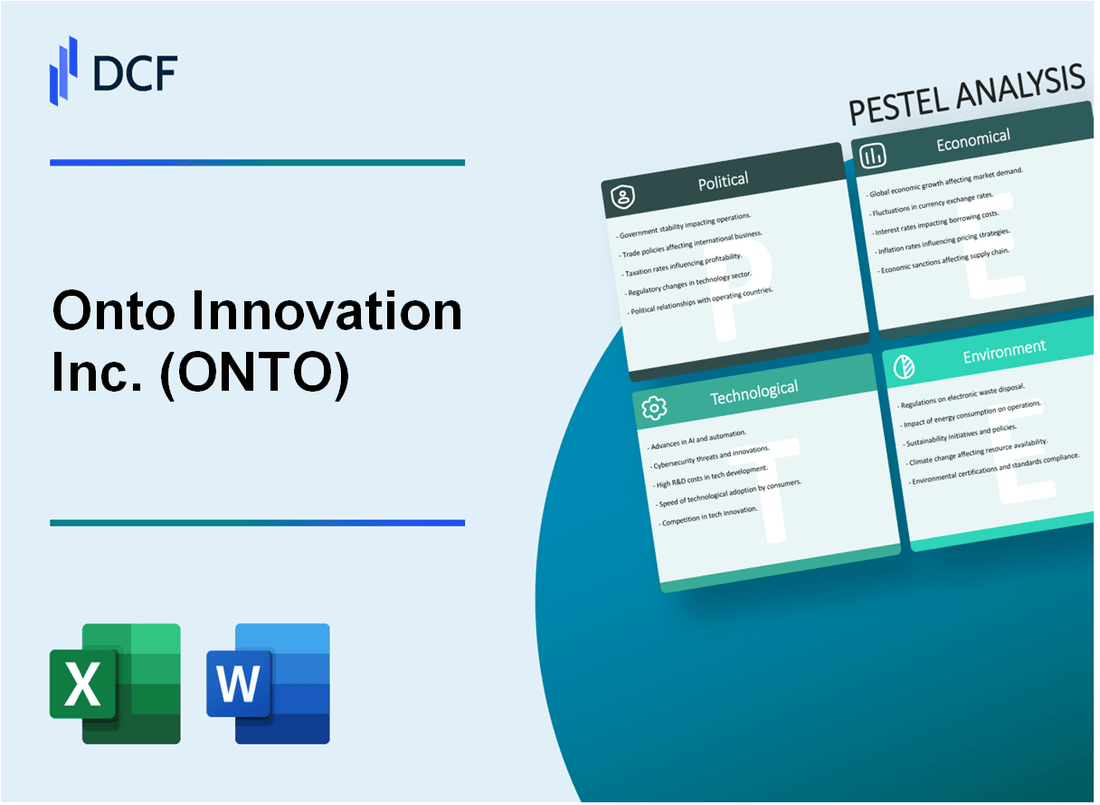
You're tracking Onto Innovation (ONTO) and need to know the real external forces shaping its 2025 outlook. Honestly, the game is a high-stakes tightrope walk: ONTO must navigate severe US export controls that restrict sales to key Chinese foundries, but simultaneously, they stand to capture a huge piece of the government-subsidized CapEx wave-a global semiconductor equipment market projected to hit nearly $180 billion this year. We've mapped out the Political, Economic, Sociological, Technological, Legal, and Environmental factors so you can see precisely where the defintely actionable risks and opportunities are.
Onto Innovation Inc. (ONTO) - PESTLE Analysis: Political factors
You're operating a high-precision semiconductor equipment company, so you sit right at the intersection of national security and global trade. The political landscape isn't just a backdrop; it's a primary driver of your capital expenditure cycle and geographic sales mix, and right now, it's a story of two opposing forces: aggressive restriction in China and massive subsidy-fueled growth in the West.
US export controls severely restrict sales to major Chinese foundries.
The most immediate political risk is the tightening US export control regime, which specifically targets advanced semiconductor manufacturing equipment (SME). This policy is designed to slow China's ability to produce advanced chips, and it directly impacts Onto Innovation's ability to sell its leading-edge metrology and inspection tools to major Chinese foundries like Semiconductor Manufacturing International Co. (SMIC).
The impact is clear: while Onto Innovation is on track to deliver a record year in advanced node revenue outside of China for 2025, the China market for advanced technology remains heavily restricted. For context, US SME exports to China have been declining, dropping from $5.1 billion in 2022 to an estimated $4.2 billion in 2024, a trend that continues to pressure US equipment makers. This forces you to pivot your advanced node sales strategy entirely toward non-Chinese customers, which is a smart move, but it cuts off a massive potential growth market.
CHIPS Act and similar global subsidies (e.g., EU Chips Act) drive domestic fab construction.
The flip side of the China restriction is a massive, government-backed capital expenditure cycle in the US and Europe. This is a huge opportunity for a US-based equipment provider like Onto Innovation. The US CHIPS and Science Act is the primary catalyst, earmarking $52.7 billion in total funding, including $39 billion in subsidies for domestic chip manufacturing and a 25% Advanced Manufacturing Investment Tax Credit for equipment costs.
This money is already flowing, attracting over $540 billion in announced private investments across 28 US states. Here's the quick math on the biggest awards that will drive equipment demand:
- TSMC Arizona Corporation received up to $6.6 billion in direct funding.
- GlobalFoundries received a $1.5 billion award.
Similarly, the European Union's Chips Act aims to mobilize over €43 billion in public and private investments by 2030, with €11 billion already allotted to the 'Chips for Europe Initiative' to strengthen R&D and deploy advanced semiconductor tools. This global reshoring effort creates a multi-year tailwind for your metrology and inspection products, especially your Dragonfly and Iris platforms, as new fabs in Arizona, New York, and Germany start to equip their cleanrooms.
Geopolitical tension creates supply chain instability and reshoring mandates.
Geopolitical tension does more than just restrict sales; it mandates a fundamental shift in your operational footprint, a process called 'reshoring' or 'friend-shoring.' You can't rely on a single, centralized supply chain anymore. This instability shows up as a direct cost and operational complexity.
Onto Innovation is actively managing this risk by diversifying its manufacturing. The company is aggressively ramping up its extended factories in Asia. By the end of the first quarter of 2026, the company expects to ship over 60% of its tools from international locations, a significant jump from shipping over 30% of tools from these same factories in Q3 2025. This move is defintely a direct response to supply chain fragmentation and is expected to expand gross margins in 2026 by mitigating tariff and logistics costs.
Increased regulatory scrutiny on technology transfer and foreign investment.
Any major transaction in the semiconductor space is now subject to intense scrutiny from the Committee on Foreign Investment in the United States (CFIUS) and similar bodies globally, especially when it involves technology transfer. The US government's Executive Order 14105, which restricts US investment in advanced chips and AI in China, sets a clear precedent for caution.
You saw this play out with your own M&A activity in 2025. Onto Innovation completed the acquisition of key product lines from Semilab International Zrt. in November 2025, but the transaction was amended, ultimately valued at approximately $495 million, down from the originally announced $545 million. This kind of amendment and the time it takes to close demonstrates the heightened regulatory complexity in cross-border deals. The acquisition, which adds over $130 million in expected annual revenue, strengthens your materials characterization portfolio in high-growth areas like AI-enabling advanced packaging.
| Political Factor | Impact on ONTO's 2025 Business | Quantifiable Data / Action |
|---|---|---|
| US Export Controls on China | Restricts access to the advanced node market in China. | ONTO is on track for a record year in advanced node revenue outside of China. US SME exports to China declined to an estimated $4.2 billion in 2024. |
| US CHIPS Act & Subsidies | Drives massive, subsidized domestic CAPEX for new fabs. | US CHIPS Act includes $39 billion in manufacturing subsidies and a 25% tax credit for equipment. Major awards include $6.6 billion to TSMC Arizona. |
| Supply Chain Fragmentation | Mandates operational restructuring to mitigate geopolitical risk. | ONTO expects to ship over 60% of tools from international factories by Q1 2026, up from 30% in Q3 2025. |
| Regulatory Scrutiny on M&A | Increases complexity and time for cross-border technology acquisitions. | Acquisition of Semilab product lines closed in November 2025 for approximately $495 million, following an amendment to the original terms. |
Next Step: Strategy: Prioritize sales and support resources to US and EU CHIPS Act-funded projects over the next 18 months.
Onto Innovation Inc. (ONTO) - PESTLE Analysis: Economic factors
Global semiconductor CapEx cycle remains strong, projected to hit near $180 billion in 2025 for equipment and facilities.
The economic outlook for the semiconductor equipment industry, where Onto Innovation operates, is robust for 2025, driven by massive capital expenditure (CapEx) from global chipmakers. The World Semiconductor Trade Statistics (WSTS) projects total semiconductor company CapEx to be around $185 billion in 2025, reflecting a continued push to expand manufacturing capacity, especially for advanced nodes and AI-related chips. This huge spending is a direct opportunity for Onto Innovation's metrology and inspection tools.
Another forecast from Semiconductor Intelligence (SC-IQ) puts the total semiconductor CapEx at a slightly more conservative $160 billion for 2025, still indicating a significant market. For the equipment segment specifically, SEMI forecasts that global sales of total semiconductor manufacturing equipment by original equipment manufacturers (OEMs) will reach a record $125.5 billion in 2025. This momentum is largely fueled by demand for high-performance computing (HPC) and memory, particularly High Bandwidth Memory (HBM) for AI deployment.
Here's the quick math: The Wafer Fab Equipment (WFE) segment, which includes Onto Innovation's core market, is projected to increase 6.2% to $110.8 billion in 2025. That's a big, defintely growing pie.
Inflation and high interest rates increase the cost of capital for fab expansion projects.
While demand is strong, the cost of building and equipping new fabrication plants (fabs) is soaring due to persistent inflation and elevated interest rates. These macro-economic factors increase the cost of capital for Onto Innovation's customers, forcing them to scrutinize their CapEx budgets and potentially delay less critical tool purchases.
The high costs of construction materials, labor, and specialized equipment contribute to ongoing inflationary pressures in the supply chain. For US-based fab projects, public funding like the US CHIPS Act helps mitigate the initial sticker shock, providing approximately $32 billion in grants and $6 billion in loans. However, these incentives often don't offset the long-term operational costs, which are continually pressured by rising prices for labor, technology, and raw materials. This pressure means a longer payback period for new fabs, making customers more sensitive to equipment pricing.
Currency fluctuations impact revenue translation, as a significant portion of sales are international.
Onto Innovation's business is highly global, meaning currency fluctuations pose a tangible economic risk to its reported US Dollar revenue and profitability. The majority of the company's sales are generated outside of the United States, primarily in Asian markets.
Based on the latest available full-year data (FY 2024), the geographical revenue concentration clearly shows this exposure. Taiwan and South Korea alone accounted for over 60% of sales. A strengthening US Dollar (USD) against the New Taiwan Dollar (TWD) or the South Korean Won (KRW) would negatively impact revenue when translated back into USD, even if local sales volumes remain flat.
This is a major currency translation risk. You need to watch the USD/TWD and USD/KRW rates closely.
| Region | FY 2024 Revenue (Millions USD) | % of Total Revenue ($987.32M) |
|---|---|---|
| Taiwan | $307.54M | 31.15% |
| South Korea | $285.7M | 28.94% |
| China | $116.39M | 11.79% |
| United States | $104.11M | 10.54% |
| Southeast Asia, Japan, Europe (Combined) | $173.5M | 17.58% |
Note: Total revenue for FY 2024 was $987.32 million.
Customer concentration risk with major foundry and memory players.
The high geographic concentration directly translates into a significant customer concentration risk. Onto Innovation depends on a few major foundry and memory players for a large portion of its revenue, as these companies are the primary drivers of CapEx in Taiwan and South Korea.
Major advanced packaging customers, including TSMC and Samsung, are explicitly named as key drivers of demand for Onto Innovation's advanced metrology and inspection systems. This is a double-edged sword:
- Gain: You get a disproportionate benefit from their massive CapEx cycles, like TSMC's continued investment in new fabs.
- Risk: Any sudden cut or delay in CapEx from one of these top-tier customers, or a shift in their technology roadmap that bypasses Onto Innovation's tools, would instantly and severely impact revenue.
The company acknowledged a dependence on certain significant customers in its 2024 Form 10-K, and with Taiwan and South Korea accounting for over 60% of sales, the financial health and spending plans of a handful of companies in those regions are the single largest near-term economic risk factor.
Onto Innovation Inc. (ONTO) - PESTLE Analysis: Social factors
Severe global shortage of highly-skilled STEM talent (engineers, physicists) for R&D and field service.
You are operating in a market where the talent pool is critically shallow, and this is a major headwind for Onto Innovation. The entire semiconductor industry is facing an unprecedented talent crisis, with projections indicating a need for over one million additional skilled workers globally by 2030. This isn't just about factory workers; it's about the highly specialized engineers and physicists who design and service advanced metrology and inspection tools like yours.
The immediate impact is fierce competition. Across the tech sector, a staggering 92% of executives report significant difficulties in hiring skilled workers. For Onto Innovation, where core technical roles like engineering account for a substantial portion of the workforce-estimated at around 47% in some datasets-this shortage directly increases labor costs and slows down product roadmaps. Plus, retaining the talent you have is hard: employee turnover in the semiconductor sector was expected to hit 53% in early 2024. That's a huge drain on institutional knowledge.
Here's the quick math on the retention risk:
- Industry Turnover (Expected Early 2024): 53%
- Global Talent Shortage by 2030: Over 1,000,000 workers
- Action: Aggressively fund internal upskilling programs for existing staff.
Growing investor and public pressure for Environmental, Social, and Governance (ESG) transparency.
Investor scrutiny on Environmental, Social, and Governance (ESG) factors is no longer a fringe issue; it's a core component of capital allocation. Onto Innovation is under increasing pressure to demonstrate measurable progress beyond just environmental targets. While the company is dedicated to sustainability and received a B grade on climate change and water security in 2024, the 'S' for Social requires continuous, transparent reporting on workforce metrics.
You need to clearly map your social impact. The good news is Onto Innovation has a governance structure that supports this, including a board that achieved 37.5% female representation in 2022. This level of board diversity is a strong signal to the market, but investors are now demanding similar transparency for the wider employee base and technical roles, which is where the industry typically struggles.
Increased focus on workforce diversity and inclusion as a competitive advantage.
Diversity and inclusion (D&I) is a competitive advantage, not a compliance checkbox. Companies with diverse leadership are 33% more likely to outperform their less diverse counterparts. For Onto Innovation, attracting talent from a wider pool is a necessity to combat the STEM shortage.
The challenge is starkly visible in the technical pipeline. Women represent only about 27.6% of the total tech workforce in 2025, and this drops to less than 25% in core technical roles like engineering. Onto Innovation's internal efforts, like the global RISE teams that promote community engagement, are important for culture, but the real test is moving the needle on representation in the highly-skilled engineering and R&D functions.
Here is a snapshot of the diversity challenge in the tech sector as of 2025:
| Metric | Industry Benchmark (2025) | Onto Innovation Context |
|---|---|---|
| Women in Tech Workforce | ~27.6% | Critical area for recruitment given the high percentage of technical roles. |
| Women in Core Technical Roles | < 25% | Directly impacts R&D and field service talent pipeline. |
| Female Board Representation | < 20% (Major Tech Firms) | Onto Innovation is ahead at 37.5% (as of 2022). |
Remote work models complicate sensitive intellectual property (IP) protection and collaboration.
Onto Innovation's business is built on proprietary metrology and inspection technology, meaning its intellectual property (IP) is its lifeblood. The shift to remote and hybrid work models-especially for a global workforce estimated at approximately 1.1K employees as of September 2025-significantly complicates the protection of trade secrets and sensitive R&D data. In fact, IP protection is explicitly listed as a key risk factor in the company's Q1 2025 financial results.
You have to assume the risk has risen. When engineers are working on complex, nanometer-scale technology from dispersed locations, the potential for data breaches or unauthorized access to schematics and algorithms increases. The industry standard response in 2025 is to implement robust cybersecurity measures, mandatory Non-Disclosure Agreements (NDAs), and internal policies that restrict access to the most sensitive information. The US Patent and Trademark Office (USPTO) is also actively developing its 2025 AI strategy to maintain an 'effective and predictable IP ecosystem,' but the primary defense is internal security protocols.
This is a trade-off: remote work helps you attract scarce talent, but defintely increases your IP risk profile.
Onto Innovation Inc. (ONTO) - PESTLE Analysis: Technological factors
Rapid shift to Gate-All-Around (GAA) and 3D NAND requires new, complex metrology and inspection tools.
The core technological shift in the semiconductor industry is directly fueling demand for Onto Innovation Inc.'s (ONTO) most advanced metrology (precise measurement) and inspection tools. You're seeing a hard pivot from traditional FinFET transistors to Gate-All-Around (GAA) architectures, which are expected to enter high-volume production at leading fabs like TSMC and Intel in 2025. This structural change, where the gate surrounds the channel on all sides, introduces critical manufacturing challenges, particularly in controlling the dimensions of buried, atomic-scale features.
Similarly, 3D NAND memory is scaling vertically, pushing well beyond 200 layers. This necessitates precise control over high aspect ratio (HAR) etching, where a deviation of even 0.5 nanometers can compromise the device. Traditional metrology solutions like optical critical dimension (OCD) and top-down scanning electron microscopy (CD-SEM) are struggling to see these complex, three-dimensional structures. This is a huge opportunity for ONTO, whose CEO noted an expected near doubling of revenue in 2025 in advanced nodes markets. The complexity is the opportunity.
Advanced packaging (e.g., chiplets) drives demand for ONTO's front-end and back-end inspection solutions.
The industry's move toward heterogeneous integration-connecting multiple discrete chiplets into a single package-is turning the back-end of the fabrication process into a critical growth engine. This advanced packaging trend, including 2.5D and 3D stacking, requires a new level of inspection to ensure perfect alignment and bond quality across multiple layers.
ONTO is directly addressing this with its portfolio. For instance, the company is seeing expanded positions for its Dragonfly® 3Di interconnect metrology, which is crucial for applications like co-packaged optics and advanced 2.5D logic. In the first quarter of 2025 alone, ONTO shipped multiple 3D bump metrology systems, with additional shipments planned for the second quarter to an expanding list of customers. This shift means inspection is no longer just a front-end (wafer-level) issue; it's now a mission-critical step in assembly, too.
Artificial Intelligence (AI) and machine learning are integrating into inspection tools for faster defect detection.
Artificial Intelligence (AI) and machine learning (ML) are moving from buzzwords to core components of process control. The sheer volume and complexity of data generated by advanced inspection tools-especially in sub-5nm nodes-demand automated analysis. Integrating AI-enhanced analytics is becoming the competitive differentiator.
This integration is all about speed and yield. For example, AI classification algorithms can already reduce the recipe setup time for inspection tools by an estimated 20%, which directly improves fab throughput and lowers costs. ONTO must continue to embed these capabilities into its platforms to enable real-time defect classification and predictive failure analysis. It's the only way to keep up with the data firehose coming from the world's most advanced fabs.
Competition intensifies from larger players like KLA Corporation and niche specialists.
While the market is growing-the global semiconductor metrology and inspection equipment market is valued at approximately $14.92 billion in 2025-competition remains intense, and frankly, dominated by a giant. KLA Corporation is the undisputed market leader, holding nearly 63% of the overall metrology and inspection market share in 2024.
To put this in perspective, ONTO's entire 2025 revenue is forecast to be around $1.002 billion. KLA Corporation's total 2025 revenue is forecast at approximately $12.524 billion. That's a massive scale difference. Even in the high-growth advanced packaging segment, KLA expects its related revenue to exceed $925 million in 2025, which is nearly the size of ONTO's total forecast revenue. ONTO is a significant contributor, but it must constantly innovate to compete with KLA's scale and R&D budget, plus fend off smaller, niche specialists who target specific metrology gaps.
Here's the quick math on the competitive landscape:
| Metric | Onto Innovation Inc. (ONTO) | KLA Corporation (KLAC) |
|---|---|---|
| 2025 Revenue Forecast | ~$1.002 billion | ~$12.524 billion |
| Advanced Packaging Revenue (2025E) | Expected near doubling of advanced nodes revenue | Expected to exceed $925 million (70% YoY increase) |
| Overall Market Share (2024) | Notable, though smaller, contributor | Nearly 63% of the overall market |
The next step is to defintely focus R&D investment on the next-generation e-beam inspection and hybrid metrology solutions to address the buried feature challenges of GAA. Finance: Allocate 35% of Q4 2025 R&D budget to AI-driven defect classification software development.
Onto Innovation Inc. (ONTO) - PESTLE Analysis: Legal factors
Strict compliance required for US government export administration regulations (EAR)
The geopolitical landscape has made U.S. government export administration regulations (EAR) a primary legal and operational concern for Onto Innovation Inc. The company's global footprint, especially its exposure to the Chinese semiconductor market, means compliance with these rules is non-negotiable and costly.
You're not just selling metrology tools; you're navigating a complex web of technology transfer restrictions aimed at advanced computing and supercomputer industries. The U.S. Department of Commerce's expanded controls on semiconductor equipment exports to China have forced a significant diversion of resources toward compliance. This isn't just paperwork; it directly impacts the bottom line. For instance, in the second quarter of the 2025 fiscal year alone, the company incurred an expense of approximately $1.1 million due to tariffs, a clear cost of these trade restrictions.
This regulatory environment forces a constant review of the company's supply chain and customer base to avoid civil or criminal penalties.
Patent litigation and IP protection are constant, high-cost concerns in the semiconductor space
In the semiconductor equipment sector, intellectual property (IP) is the core asset, so patent litigation is a perpetual, high-stakes battle. Onto Innovation Inc. manages a substantial portfolio to protect its metrology, inspection, and lithography technologies.
As of late 2024, the company was leveraging a portfolio of 408 U.S. and foreign patents, plus another 240 pending patent applications. That's a huge asset, but it also paints a target on your back for competitors and patent assertion entities (PAEs). Litigation costs are so frequent and material that the company excludes them from its Non-GAAP operating income figures to show core business performance.
Here's the quick math on the scale of non-routine, excluded costs-which include litigation expenses-for the first nine months of 2025.
| Metric (Nine Months Ended Sept. 27, 2025) | GAAP Operating Income (millions) | Non-GAAP Operating Income (millions) | Total Excluded Amount (millions) |
|---|---|---|---|
| Amount | $119.1 | $188.2 | $69.1 |
| As a % of Revenue ($738.4 million) | 16.1% | 25.5% | 9.4% |
What this estimate hides is the specific litigation slice of that $69.1 million, but it shows the sheer magnitude of non-routine expenses-like amortization, M&A costs, and legal disputes-that Onto Innovation Inc. must manage. Protecting those 408 patents is not cheap.
New data privacy laws (e.g., GDPR, CCPA) affect global customer and employee data handling
Operating globally means Onto Innovation Inc. must adhere to a patchwork of increasingly strict data privacy regulations, not just U.S. laws. The European Union's General Data Protection Regulation (GDPR) and California's Consumer Privacy Act (CCPA), along with the California Privacy Rights Act (CPRA), set a high bar for handling customer and employee data worldwide.
Compliance is a continuous, resource-intensive activity that demands constant updates to IT infrastructure and internal policies.
- Mandatory data mapping and processing agreements for GDPR.
- Managing consumer opt-out requests under CCPA/CPRA.
- Risk of fines up to 4% of global annual revenue for severe GDPR violations.
Honestly, the biggest risk here isn't a fine, but the reputational damage and the potential for a material adverse effect on the business if a breach occurs. It's a defintely a high-priority, low-visibility cost center.
Increased focus on anti-bribery and corruption laws (FCPA) due to global operations
With a significant portion of its revenue coming from international sales, the risk of violating the U.S. Foreign Corrupt Practices Act (FCPA) is a constant factor. The FCPA prohibits offering anything of value to foreign government officials to obtain or retain business.
The Department of Justice (DOJ) and the Securities and Exchange Commission (SEC) continue to pursue aggressive enforcement, and the penalties are staggering. For context, FCPA-related resolution payments imposed on companies by the DOJ and SEC totaled approximately $1.58 billion in 2024. This trend underscores why Onto Innovation Inc. must maintain a robust, well-funded global anti-corruption compliance program.
The core action here is ensuring that third-party agents, distributors, and joint venture partners-especially in high-risk jurisdictions-are rigorously vetted and monitored. The cost of a thorough compliance audit is pennies compared to a multi-million-dollar FCPA settlement.
Onto Innovation Inc. (ONTO) - PESTLE Analysis: Environmental factors
You need to view environmental factors not just as a compliance cost, but as a critical driver for your customers' CapEx decisions, especially given the push for energy-efficient chips and chemical restrictions. The semiconductor industry's environmental footprint is under intense scrutiny, and Onto Innovation Inc.'s (ONTO) value proposition-tools that reduce waste and improve yield-is inherently tied to this trend.
Here's the quick math: If ONTO captures just 1% more of the 2025 CapEx market, which is projected at $116.00 billion, that's an additional $1.16 billion in potential revenue. That's why the focus on advanced packaging and GAA metrology is defintely the right play.
Next Step: Sales and Strategy teams should draft a 'Geopolitical Risk-Adjusted' sales forecast by the end of the week, specifically modeling a 20% reduction in China-related revenue against a 30% increase in US/EU/Japan CapEx revenue for Q1 2026.
Growing customer and regulatory demand for lower-power consumption equipment.
The shift to advanced nodes and AI applications is driving unprecedented demand for energy efficiency, making the power consumption of semiconductor manufacturing equipment a key purchasing criterion. ONTO's metrology and inspection tools are positioned to help customers improve yield, which inherently reduces the energy wasted on scrapped wafers. This is a crucial sales point, and the company has already made internal progress, increasing its renewable energy usage to 41% of total electrical consumption.
Customers like Taiwan Semiconductor Manufacturing Company (TSMC) and Samsung are setting aggressive net-zero targets, meaning they require equipment suppliers to demonstrate lower operational power draw and a smaller carbon footprint. The market opportunity lies in quantifying the energy savings (in kilowatt-hours) that ONTO's tools, such as the Iris™ G2 system for film metrology or the JetStep® lithography system, provide over legacy equipment. This is a direct financial benefit for the customer, so it's a clear competitive advantage.
Pressure to reduce the use of per- and polyfluoroalkyl substances (PFAS) in manufacturing processes.
The global push to restrict per- and polyfluoroalkyl substances (PFAS), or forever chemicals, is a major transition risk for the entire semiconductor supply chain, including equipment manufacturers. The European Union's REACH regulation is actively evaluating a broad PFAS restriction proposal that specifically targets the electronics and semiconductors sector.
The latest update to the proposal, published in August 2025, includes potential transition periods ranging from five to 12 years for complex applications like semiconductor manufacturing, acknowledging the difficulty of substitution. ONTO must proactively identify and qualify non-PFAS alternatives for components in its systems-like seals, filters, and coatings-that are used in its global manufacturing sites and sold to EU customers. Failure to do so will lead to significant supply chain disruption and market access issues in Europe, which is a major CapEx region.
Need for transparent reporting on Scope 1, 2, and 3 greenhouse gas (GHG) emissions.
While the U.S. Securities and Exchange Commission (SEC) final rule on climate disclosure, effective for large accelerated filers starting in 2025, primarily mandates disclosure of material Scope 1 (direct) and Scope 2 (purchased energy) GHG emissions, the pressure for Scope 3 (value chain) transparency is still high. The SEC rule was under legal challenge and its defense was reversed in March 2025, but global market forces are pushing disclosure anyway.
ONTO has already committed to the Science Based Targets initiative (SBTi) and reports through CDP, showing a proactive stance. The real challenge for ONTO, as a capital equipment provider, is Scope 3, which includes the emissions from the use of its products by customers. This is where the company's focus on resource-efficient products becomes a reporting asset. Internally, the company has already reduced its carbon footprint per person by 51%.
Key Reporting Requirements for 2025:
- Mandatory disclosure of material Scope 1 and Scope 2 emissions for large accelerated filers in 2025 SEC filings.
- Scope 3 disclosure is required if material or if ONTO has set a Scope 3 reduction goal.
- California's rule, while phased in later, will require Scope 3 reporting for large companies operating there, setting a precedent.
Waste management and hazardous material disposal compliance in global manufacturing sites.
As a global manufacturer of complex equipment, ONTO faces stringent and varied waste management and hazardous material disposal regulations across its worldwide sites, including its headquarters in Wilmington, Massachusetts. The company explicitly commits to minimizing waste to landfills and eliminating or reducing hazardous materials.
The complexity is high due to the nature of semiconductor manufacturing chemicals and the need for global compliance. The Environmental Protection Agency (EPA) and local state regulations govern the disposal of materials used in the assembly and testing of metrology and inspection tools. Efficient waste streams, particularly for electronic waste (e-waste) from end-of-life equipment and chemical byproducts from tool calibration, are essential to mitigate compliance risk and avoid significant fines. The focus must be on a circular economy approach for high-value components.
The following table outlines the key environmental compliance risks and ONTO's corresponding strategic actions as of 2025:
| Environmental Factor | 2025 Regulatory/Market Driver | ONTO Strategic Action/Status | Risk/Opportunity Impact |
|---|---|---|---|
| Lower-Power Equipment | Customer Net-Zero Targets; AI/Advanced Node Power Demand | Products designed to improve yield, reducing energy wasted on scrap. Renewable energy usage at 41% of total electrical consumption. | Opportunity: Strong competitive differentiator in CapEx decisions. |
| PFAS Restriction | EU REACH Proposal (August 2025 update) targeting semiconductors. | Proactive identification and qualification of non-PFAS components in tools. | Risk: Supply chain disruption and European market access if non-compliant components are used. |
| GHG Emissions Reporting | SEC Climate Rule (Scope 1 & 2 mandatory, if material); SBTi commitment. | Committed to SBTi; already reduced carbon footprint per person by 51%. | Risk: Scope 3 data collection complexity. Opportunity: Use product efficiency to lower customer's Scope 3 (Product Use) emissions. |
| Hazardous Waste | EPA/Global E-Waste (WEEE) and chemical disposal regulations. | Commitment to minimizing waste to landfills and reducing hazardous materials. | Risk: High compliance cost and potential fines from global operational sites. Opportunity: Enhanced reputation via certified e-waste recycling programs. |
Disclaimer
All information, articles, and product details provided on this website are for general informational and educational purposes only. We do not claim any ownership over, nor do we intend to infringe upon, any trademarks, copyrights, logos, brand names, or other intellectual property mentioned or depicted on this site. Such intellectual property remains the property of its respective owners, and any references here are made solely for identification or informational purposes, without implying any affiliation, endorsement, or partnership.
We make no representations or warranties, express or implied, regarding the accuracy, completeness, or suitability of any content or products presented. Nothing on this website should be construed as legal, tax, investment, financial, medical, or other professional advice. In addition, no part of this site—including articles or product references—constitutes a solicitation, recommendation, endorsement, advertisement, or offer to buy or sell any securities, franchises, or other financial instruments, particularly in jurisdictions where such activity would be unlawful.
All content is of a general nature and may not address the specific circumstances of any individual or entity. It is not a substitute for professional advice or services. Any actions you take based on the information provided here are strictly at your own risk. You accept full responsibility for any decisions or outcomes arising from your use of this website and agree to release us from any liability in connection with your use of, or reliance upon, the content or products found herein.