
|
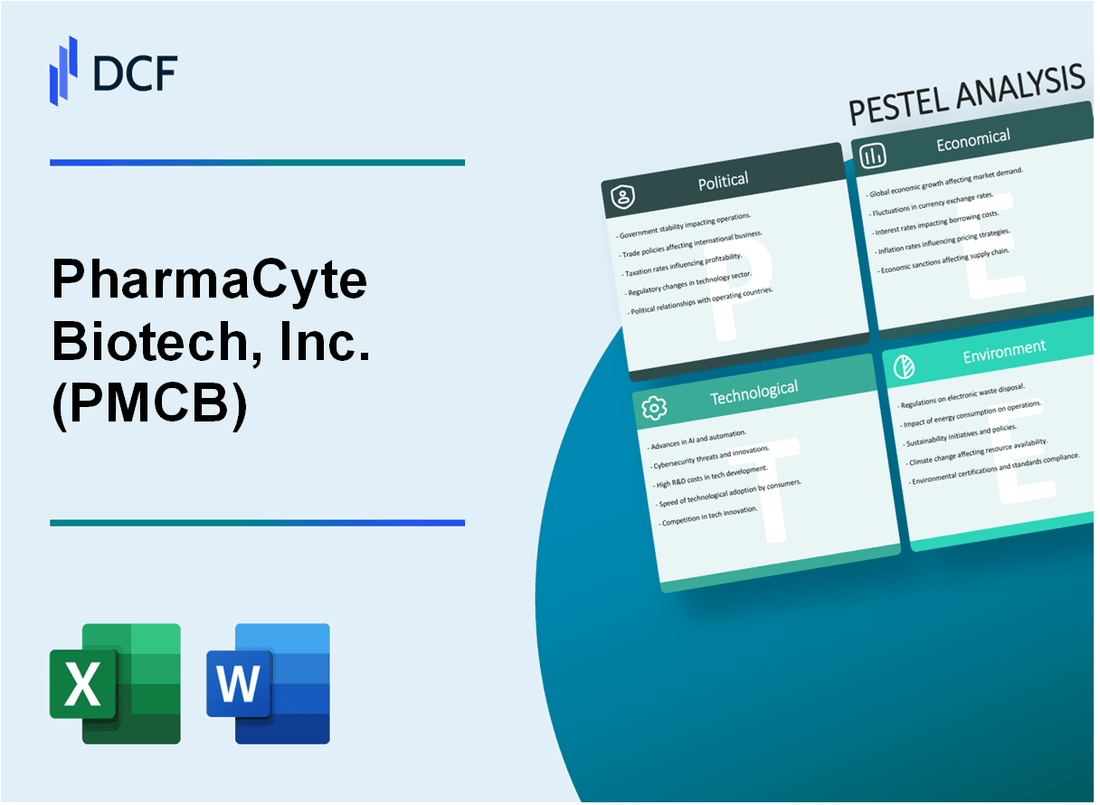
PharmaCyte Biotech, Inc. (PMCB): PESTLE Analysis [Nov-2025 Updated] |
Fully Editable: Tailor To Your Needs In Excel Or Sheets
Professional Design: Trusted, Industry-Standard Templates
Investor-Approved Valuation Models
MAC/PC Compatible, Fully Unlocked
No Expertise Is Needed; Easy To Follow
PharmaCyte Biotech, Inc. (PMCB) Bundle
You asked for a PESTLE analysis on PharmaCyte Biotech, Inc. (PMCB) grounded in late 2025 data, and I've got the breakdown for you. As a seasoned analyst, I see a company with a strong cash position but a critical regulatory bottleneck, operating in a hyper-competitive, politically-charged sector. The core takeaway is this: PMCB has bought itself financial runway, but its primary clinical asset remains stalled, forcing a strategic pivot toward non-core assets that investors must scrutinize.
Political Factors: Regulatory Hurdles and Pricing Pressure
The political landscape for PharmaCyte Biotech, Inc. is dominated by two big factors. First is the general US drug pricing uncertainty, thanks to potential Most Favored Nation (MFN) policies and the ongoing Inflation Reduction Act (IRA) negotiations. This creates a cloudy future for eventual revenue.
But the single biggest hurdle is the FDA clinical hold on their Investigational New Drug (IND) application for the pancreatic cancer therapy. That's a direct, immediate regulatory barrier. Also, the current administration is pushing for a more domestic biopharma supply chain, which could be an opportunity, but it doesn't solve the core clinical hold problem.
Economic Factors: Cash Runway vs. Pre-Revenue Status
Honestly, the company's financial health is a mixed bag. The good news: they have a strong cash position, boosted by the November 2025 Femasys stake sale. That move pushed their cash and marketable securities to approximately $45 million.
Here's the quick math: with operating expenses for the nine months ended January 31, 2025, at $3,335,998, they've bought themselves significant runway. Still, they are a pre-revenue, development-stage firm with a Q3 2025 net loss of $3.045 million.
Biotech M&A is surging in late 2025, but the funding bar is higher, favoring companies with clear revenue paths, not just potential. They did close a successful $7.0 million private placement in August 2025, led by existing investors. That's defintely a vote of confidence.
Sociological Factors: Advocacy and Perception Risk
The sociological pressure is intense, and it's mostly a tailwind for the core mission. Pancreatic cancer has a five-year survival rate below 10%, driving strong patient advocacy like PanCAN. This creates a huge demand for innovative therapies and helps with public awareness.
Patients are also increasingly demanding precision medicine-targeted therapies that skip the systemic toxicity of old chemotherapy. But there's a definite perception risk. The company's diversification into non-core assets, like a license for a 'Light Speed Computing Platform for Use in Cryptocurrency Applications,' can make investors and the public question their focus. You have to keep the main thing the main thing.
Technological Factors: Niche Platform in a Fast Race
Technology is a race, and PharmaCyte Biotech, Inc.'s core Cell-in-a-Box live-cell encapsulation technology is a niche targeted drug delivery platform. Encapsulation is the process of coating live cells with a semi-permeable membrane so they can be implanted and protected while still delivering a drug.
The live cell encapsulation market is valued at $236.8 million in 2025, so there is a clear, though small, market. However, competition is fierce. They are up against rapidly advancing modalities like KRAS-targeted inhibitors, personalized mRNA vaccines, and other cytokine-producing cell implants for solid tumors.
Plus, the industry-wide integration of Artificial Intelligence (AI) and machine learning to optimize R&D is raising the efficiency bar for everyone.
Legal Factors: The Clinical Hold and Compliance
The legal environment is all about compliance and Intellectual Property (IP) protection. The critical FDA clinical hold is a major legal and operational hurdle; it necessitates additional, time-consuming preclinical studies and manufacturing data submissions to satisfy regulatory requirements.
Also, they must comply with the U.S. Environmental Protection Agency's (EPA) Hazardous Waste Generator Improvements Rule (HWGIR). Specifically, they needed to complete the Small Quantity Generator (SQG) Re-Notification by September 1, 2025.
Finally, protecting their proprietary Cell-in-a-Box platform is crucial in a field where patents are constantly challenged.
Environmental Factors: ESG and Waste Management
Environmental, Social, and Governance (ESG) compliance is no longer just for the mega-caps; even small-cap biotechs feel the pressure. Operationally, this means carefully managing and tracking hazardous laboratory and clinical trial waste streams according to evolving state and federal regulations.
The manufacturing process for cell-based therapies, like theirs, requires specialized waste disposal and careful energy consumption management. A positive industry trend is the move toward Decentralized Clinical Trials (DCTs), which helps reduce the environmental footprint by cutting down on patient travel and site resource use.
Legal/Regulatory: Draft a clear, public-facing timeline for the FDA clinical hold response submission by the end of the quarter.
PharmaCyte Biotech, Inc. (PMCB) - PESTLE Analysis: Political factors
You're operating a clinical-stage biotech company like PharmaCyte Biotech, Inc. (PMCB) in 2025, so your biggest risks aren't just scientific-they are political and regulatory. The political environment is creating a perfect storm of pricing pressure on future revenue and a persistent, high-stakes regulatory hurdle that must be cleared first. We need to map these factors to understand the company's near-term viability.
US drug pricing uncertainty from potential Most Favored Nation (MFN) policies and the Inflation Reduction Act (IRA) negotiations.
The biggest financial headwind for any future drug is the shifting landscape of US drug pricing, specifically the one-two punch of the Inflation Reduction Act (IRA) and the renewed push for a Most Favored Nation (MFN) policy. The IRA, enacted in 2022, gives Medicare the power to negotiate prices for high-cost drugs, with the first set of negotiated prices taking effect in January 2026. This negotiation authority is a permanent check on future revenue.
Adding to this is the MFN policy, which the current administration revived with a May 2025 Executive Order. This policy aims to align US drug prices with the lowest prices paid in other comparable developed nations. While PharmaCyte Biotech's pancreatic cancer therapy is still in the pre-commercial stage, any successful drug launch will face a market where the government is aggressively driving prices down. This uncertainty defintely chills the long-term revenue projections needed to attract later-stage investment.
Here's the quick math: A drug's net price could be anchored to a foreign price benchmark, potentially capping its US revenue.
| Policy Mechanism (2025 Status) | Targeted Impact | Relevance to PharmaCyte Biotech (PMCB) |
|---|---|---|
| Inflation Reduction Act (IRA) Negotiations | Medicare price negotiation for high-cost drugs (first prices effective Jan 2026). | Caps the ultimate revenue potential of any approved drug, reducing the net present value (NPV) of the Cell-in-a-Box® technology. |
| Most Favored Nation (MFN) Policy (May 2025 EO) | Aligns US drug prices with the lowest prices in developed nations. | Creates a lower pricing ceiling for future commercialized products, impacting global pricing strategy from day one. |
The FDA clinical hold on the Investigational New Drug (IND) application for the pancreatic cancer therapy is the single largest regulatory barrier.
The most critical political factor for PharmaCyte Biotech is the regulatory status of its core product: the Investigational New Drug (IND) application for the pancreatic cancer therapy, which remains on clinical hold by the U.S. Food and Drug Administration (FDA). The IND was placed on hold in late 2020, citing the need for several additional preclinical studies, manufacturing information, and product release specifications.
This clinical hold is the single largest barrier to any progress, effectively stopping the planned Phase 2b clinical trial for locally advanced, inoperable pancreatic cancer (LAPC). Until the company satisfactorily addresses the FDA's comprehensive list of requests-which involves lengthy studies like cell bank stability-all clinical and commercial development for the therapy is stalled.
A clinical hold is a zero-progress state. It's the ultimate regulatory risk.
Increased government and patient advocacy pressure to prioritize federal funding for pancreatic cancer research.
While the regulatory hold is a negative, the political pressure around pancreatic cancer is a significant tailwind. Pancreatic cancer remains one of the deadliest cancers, with a five-year survival rate of just 13%. This high mortality rate fuels intense patient advocacy pressure, which translates into specific federal funding priorities.
However, the funding landscape is volatile. For Fiscal Year (FY) 2025, the dedicated Pancreatic Cancer Research Program (PCARP) under the Department of Defense's Congressionally Directed Medical Research Program (CDMRP) was alarmingly zeroed out despite a general 57% cut to the CDMRP, raising strong concern from Congressmen. In contrast, the National Institutes of Health (NIH) funding for pancreatic cancer research was estimated at $286 million in 2024, up from $230 million in 2020. This push-and-pull creates both an urgent need for new therapies like PharmaCyte Biotech's and a high-risk funding environment for non-NIH-backed research.
- 2025 Pancreatic Cancer Diagnoses: Over 67,000 Americans expected to be diagnosed.
- FY25 Dedicated Research Funding: Pancreatic Cancer Research Program (PCARP) funding was eliminated (zeroed out).
- Advocacy Goal (FY26): Coalition is pushing for $47.2 billion for the NIH and $7.374 billion for the National Cancer Institute (NCI).
The current administration's focus on encouraging domestic production in the biopharma supply chain.
The current administration is aggressively pushing policies to reduce US reliance on foreign sources for Active Pharmaceutical Ingredients (APIs) and finished drug products. This focus, formalized by Executive Orders in May and August 2025, creates both a risk and an opportunity for a US-based biotech company like PharmaCyte Biotech.
The policy goal is to 'onshore' manufacturing. To achieve this, the administration is using tariffs, announcing the imposition of up to 100% tariffs on branded and patented medicines imported from companies without US manufacturing plants, effective October 1, 2025. This is a huge cost incentive to manufacture domestically. The Strategic Active Pharmaceutical Ingredients Reserve (SAPIR) was also revived in August 2025 to build domestic stockpiles of APIs, only about 10% of which are currently made in the US.
For PharmaCyte Biotech, whose Cell-in-a-Box® technology involves a complex manufacturing process with a partner (Austrianova), this political push means a clear strategic action: prioritize domestic manufacturing capacity or risk substantial import tariffs on key components or the final product.
PharmaCyte Biotech, Inc. (PMCB) - PESTLE Analysis: Economic factors
The economic landscape for PharmaCyte Biotech, Inc. (PMCB) in late 2025 is defined by a significantly strengthened balance sheet, prudent capital management, and the high-stakes, risk-averse environment of the broader biotechnology (biotech) funding market. You are looking at a company that has successfully insulated its operations from near-term capital market volatility, but which still faces the fundamental challenge of being a pre-revenue, development-stage firm.
Here's the quick math: The company's financial position saw a major boost following the strategic monetization of its stake in Femasys Inc. (FEMY) in November 2025. This transaction increased the total cash and marketable securities to approximately $45 million, up from $13.3 million as of July 31, 2025. That's a defintely solid liquidity runway for a company focused on cellular therapies.
Strong Cash Position and Strategic Financing
The company has executed a disciplined capital allocation strategy throughout 2025. The Femasys stake sale resulted in a total financial position of roughly $20 million in cash and approximately $25 million in marketable securities. This strong cash position is critical for funding the ongoing efforts to address the Food and Drug Administration (FDA) clinical hold on its Investigational New Drug (IND) application for its pancreatic cancer treatment. Also, a successful $7.0 million private placement financing closed in August 2025, led by existing investors, further bolstering the balance sheet.
This August financing involved the sale of 7,000 shares of Series C convertible preferred stock, convertible into 7,000,000 shares of common stock at a conversion price of $1.00 per share, plus warrants to purchase up to 7,000,000 shares of common stock. This type of financing, led by existing backers, shows a strong internal vote of confidence, but it also means an increase in potential dilution for common shareholders.
| Financial Metric (As of 2025) | Amount/Value | Context |
|---|---|---|
| Cash and Marketable Securities (Post-Nov 2025) | Approx. $45 million | Strengthened liquidity following Femasys stake sale. |
| Net Loss (Q3 2025, Jan 31) | Approx. $3.05 million | Reflects status as a pre-revenue, development-stage company. |
| Operating Expenses (Nine Months Ended Jan 31, 2025) | $3,335,998 | Operating burn rate; decreased due to cost reductions. |
| August 2025 Private Placement Financing | $7.0 million | Capital raise led by existing investors. |
Operational Burn Rate and Pre-Revenue Status
PharmaCyte Biotech remains a pre-revenue, development-stage company, meaning its economic health is entirely dependent on its cash reserves and investment performance, not product sales. For the quarter ended January 31, 2025 (Q3 2025), the company reported a net loss of approximately $3.05 million.
The good news is that management has been controlling the operational burn. Operating expenses for the nine months ended January 31, 2025, were $3,335,998. This figure reflects a reduction in both Research and Development (R&D) and General and Administrative (G&A) costs compared to the prior year. This focus on cost management is crucial, as it extends the company's cash runway, giving the team more time to generate the clinical data needed to lift the FDA hold.
Biotech Market Funding and M&A Trends
The external economic climate for biotech is a mixed bag. While Merger & Acquisition (M&A) activity is surging in late 2025, the funding bar for smaller companies is significantly higher.
- Large pharmaceutical companies are actively pursuing acquisitions, often in the $1 billion to $10 billion range, to offset revenue pressures from patent expirations.
- The focus is on derisking external innovation portfolios, meaning acquirers favor later-stage assets with strong clinical data and clear revenue paths.
- Venture funding for early-stage companies is declining, and investors are being more risk-averse.
For PharmaCyte Biotech, this trend presents a clear opportunity and a risk. The opportunity is that a successful resolution of the clinical hold and positive clinical data could make the company an attractive acquisition target in the current M&A environment, especially given the interest in oncology and cell therapy. The risk is that without that clinical data, the higher funding bar means raising additional capital, if needed, will be more challenging and potentially more dilutive.
Finance: draft 13-week cash view by Friday, incorporating the $45 million post-Femasys cash position to model runway extension scenarios based on the $3.34 million nine-month operating expense rate.
PharmaCyte Biotech, Inc. (PMCB) - PESTLE Analysis: Social factors
You're operating in a space where public sentiment and patient advocacy don't just influence policy-they drive market demand and investor perception. For PharmaCyte Biotech, Inc., the social factors are a double-edged sword: immense, empathetic pressure to solve an intractable problem, but also intense scrutiny on corporate focus and the eventual cost of innovation.
Honestly, the biggest social factor is the stark reality of pancreatic cancer itself. That urgency is what creates both your opportunity and your risk.
High public awareness and strong patient advocacy (like PanCAN) for pancreatic cancer, which has a five-year survival rate below 10%
The grim statistics for pancreatic cancer create a powerful social mandate for any company developing new treatments. As of the American Cancer Society's 2025 data, the overall five-year relative survival rate for pancreatic cancer remains stubbornly low at just 13%. For the most common and aggressive form, pancreatic adenocarcinoma, that rate is even lower, sitting at a shocking 8%. This minimal progress means patient advocacy groups are highly motivated and influential.
Groups like the Pancreatic Cancer Action Network (PanCAN) are vocal, well-funded, and continuously lobby for more research and faster access to effective therapies. This creates a favorable public relations environment for PharmaCyte Biotech's core mission, but it also means the public and patient community are defintely watching your progress closely. The pressure to deliver a breakthrough is immense.
| Pancreatic Cancer Survival Statistics (2025) | 5-Year Relative Survival Rate | Key Social Impact |
|---|---|---|
| All Pancreatic Cancer Stages Combined (US) | 13% | Creates a strong public and political mandate for new treatments. |
| Pancreatic Adenocarcinoma (Most Common Form) | 8% | Fuels intense patient advocacy and a sense of urgency for innovation. |
| Estimated New US Cases in 2025 | 67,440 | High incidence rate ensures continuous media and public attention. |
Growing patient demand for precision medicine and targeted therapies that minimize the systemic toxicity of traditional chemotherapy
Patients are savvier than ever, and the social conversation in oncology has shifted dramatically toward quality of life. They are actively seeking precision medicine (or personalized medicine), which tailors treatment to their specific tumor biology, minimizing the devastating side effects of traditional systemic chemotherapy. PharmaCyte Biotech's Cell-in-a-Box technology, which is a form of targeted chemotherapy, aligns perfectly with this trend, as it is designed to activate a chemotherapy drug directly at the tumor site, resulting in 'little to no treatment related side effects.'
This is a massive market opportunity. The Global Oncology Precision Medicine Market is estimated to be valued at approximately $153.81 billion in 2025, and it's projected to grow at a Compound Annual Growth Rate (CAGR) of 9.00% through 2032. Your product's value proposition-targeted delivery-is exactly what this growing market segment demands.
Investor and public perception risk due to the company's diversification into non-core assets, such as a license for a 'Light Speed Computing Platform for Use in Cryptocurrency Applications'
Here's where the narrative gets messy, and perception risk spikes. While the company is sitting on a solid cash position, with total assets over $55 million as of April 30, 2025, and approximately $20 million in cash and $25 million in marketable securities as of November 2025, the decision to diversify into non-core assets like a 'Light Speed Computing Platform for Use in Cryptocurrency Applications' is a significant social and investor relations challenge.
The market seems to be discounting the core biotech asset, as evidenced by the low current Market Cap of only $6.38 million as of October 30, 2025. When a company focused on a deadly disease like pancreatic cancer is simultaneously investing in cryptocurrency-related technology, it raises serious questions for the public and for biotech-focused institutional investors about management's focus and capital allocation strategy. It looks like a distraction.
- Core mission: Cancer therapy.
- Diversification: Light Speed Computing for Cryptocurrency.
- Investor sentiment: Technical Sentiment Signal is a 'Sell.'
Increased focus on health equity and access to innovative medicines, which can lead to pricing pressure down the line
The US pharmaceutical landscape is undergoing a massive social and political shift toward affordability and health equity in 2025, and this will absolutely impact future pricing. The government and consumers are pushing back hard on high drug costs. US drug pricing reforms are in full swing, driven by the Inflation Reduction Act (IRA) and executive actions aimed at lowering costs.
Specifically, a May 2025 executive order aimed to cut prescription drug prices by up to 90% by aligning US prices with those in other developed nations via a Most-Favored Nation (MFN) model. This means that even a breakthrough therapy like Cell-in-a-Box will face intense scrutiny and negotiation pressure from government payers like Medicare. Your long-term commercial strategy must be built around demonstrating clear, evidence-based value to justify a premium price, not just clinical efficacy.
Here's the quick math: US prescription drug spending was over $463 billion in 2024, and the political will to reduce that is now a concrete regulatory force. You need a value-based pricing model from day one.
Next Step: Strategy: Develop a public-facing value-based pricing model that explicitly addresses health equity concerns and demonstrates long-term cost savings over traditional, high-toxicity treatments. Owner: Finance and Investor Relations.
PharmaCyte Biotech, Inc. (PMCB) - PESTLE Analysis: Technological factors
Core Cell-in-a-Box live-cell encapsulation technology is a niche targeted drug delivery platform.
PharmaCyte Biotech, Inc.'s core technology, Cell-in-a-Box, is a proprietary, cellulose-based live cell encapsulation system. This platform is a niche targeted drug delivery mechanism, essentially a bio-artificial liver implanted near a tumor to activate a chemotherapy prodrug like ifosfamide directly at the cancer site. This targeted approach is designed to deliver highly concentrated cancer-killing drugs while minimizing the systemic toxicity and severe side effects that limit standard chemotherapy. It's a unique strategy, but its success hinges on navigating the complex regulatory landscape for combined cell-device products, which is a major technical and operational hurdle.
The market for this specific technology, live cell encapsulation, while clear, is relatively small in the broader oncology space. The global live cell encapsulation market is valued at USD 236.8 million in 2025. This segment is projected to grow at a Compound Annual Growth Rate (CAGR) of 3.97% through 2035, showing steady, but not explosive, growth. Oncological disorders are the leading application segment, accounting for a dominant 65% of the live cell encapsulation market in 2025. This confirms a defined market, but one that is easily overshadowed by the massive scale of competing therapeutic modalities.
Intense competition from rapidly advancing modalities like KRAS-targeted inhibitors, personalized mRNA vaccines, and other cytokine-producing cell implants for solid tumors.
The biggest technological risk you face is the accelerating pace of competing, more broadly applicable oncology platforms. While Cell-in-a-Box focuses on local activation, competitors are achieving systemic, targeted effects with far greater capital and speed.
Here's the quick math on the competitive landscape:
| Competing Modality | 2025 Market Value / Pipeline Scale | Key Competitive Edge |
| KRAS-Targeted Inhibitors | ~$526 million in 7 Major Markets (7MM) | Small molecule, oral administration, targets common mutations (e.g., KRAS G12C). |
| Personalized mRNA Vaccines | Projected $272.1 million in 2025 (PCV Market) | Highly customizable, rapid design, and strong clinical signals (e.g., 44% reduction in recurrence risk in melanoma). |
| Broader Cell & Gene Therapy | 4,099 therapies in development pipeline. | Systemic, curative potential, and massive Big Pharma investment. |
The KRAS inhibitor market alone, targeting a common oncogene in pancreatic, lung, and colorectal cancers, is a significant threat, with marketed drugs like Amgen's LUMAKRAS and Mirati Therapeutics' KRAZATI. Also, personalized mRNA vaccines are transforming oncology, with over 60 candidates in the pipeline and over 120 clinical trials underway in 2025. These platforms are inherently more scalable and less logistically complex than an implanted cell-device system.
Industry-wide integration of Artificial Intelligence (AI) and machine learning to accelerate drug discovery and optimize clinical trial design, raising the R&D efficiency bar for all players.
The integration of Artificial Intelligence (AI) and machine learning (ML) is fundamentally changing the speed and cost of drug development, creating an efficiency gap that smaller, non-AI-native companies must close fast. The global AI-based clinical trials market reached USD 9.17 billion in 2025. This isn't a futuristic concept; it's the current operating standard.
AI is accelerating development timelines dramatically:
- Reduce patient screening time by up to 42.6 percent.
- Improve Phase I trial success rates to 80-90% for AI-designed drugs.
- Cut drug development time from 5-6 years to potentially as little as one year.
This means competitors are moving faster and failing less often. If your R&D process doesn't integrate computational biology and AI-driven predictive analytics, you're defintely operating at a significant, and growing, time and cost disadvantage compared to the industry leaders.
PharmaCyte Biotech, Inc. (PMCB) - PESTLE Analysis: Legal factors
The critical FDA clinical hold necessitates additional, time-consuming preclinical studies and manufacturing data submissions to satisfy regulatory requirements.
The single largest legal and regulatory hurdle for PharmaCyte Biotech, Inc. remains the U.S. Food and Drug Administration (FDA) clinical hold placed on its Investigational New Drug application (IND) for the pancreatic cancer therapy. This hold, initiated in 2020, requires a comprehensive response, demanding extensive and costly additional preclinical studies and manufacturing data to demonstrate the safety and comparability of the refined product, CypCaps™.
The financial burden of this compliance is significant, consuming a large portion of the company's liquidity. As of July 30, 2025, the company reported Cash and cash equivalents of $13,178,305, which was later supplemented by a $7 million financing round in August 2025. This capital is the runway for completing the FDA's list of requirements. For context, the Q3 2025 operating loss was $0.960 million, showing the burn rate even without a full-scale clinical trial. The hold means no clinical progress, and that's a legal risk that translates directly to a valuation risk.
The company has been working on a lengthy list of specific studies required to lift the hold. These include:
- Completing product stability studies on CypCaps™ out to the 24-month time point of frozen storage at -80C.
- Conducting a stability study on the cells from the Master Cell Bank (MCB), which has reached the 3-year stability timepoint.
- Performing a battery of biocompatibility studies, including Subchronic and Chronic Toxicity, Skin Sensitization, and Ames tests.
- Providing additional manufacturing information and qualification studies for the drug substance filling step to ensure sterility and stability.
Here's the quick math on the runway: the ongoing operating loss of roughly $1 million per quarter, plus the cost of these specialized studies conducted by Contract Research Organizations (CROs), means the company is spending its capital to meet a regulatory mandate before it can generate any revenue. The FDA has 30 days to review the complete response once submitted, but the submission date itself remains fluid in late 2025.
Compliance with the U.S. Environmental Protection Agency's (EPA) Hazardous Waste Generator Improvements Rule (HWGIR) and the required Small Quantity Generator (SQG) Re-Notification by September 1, 2025.
As a biotechnology firm handling laboratory and pharmaceutical waste, PharmaCyte Biotech, Inc. is subject to strict environmental regulations, primarily under the Resource Conservation and Recovery Act (RCRA). The immediate legal action item in 2025 is the compliance with the EPA's HWGIR.
A key provision of this rule for smaller-scale facilities is the Small Quantity Generator (SQG) Re-Notification, which has a critical deadline of September 1, 2025. Failure to comply with this re-notification requirement can result in fines and elevated regulatory scrutiny, which no development-stage biotech can afford. This is a non-negotiable administrative compliance task.
The HWGIR, which has been adopted by 40 states and Puerto Rico as of December 2024, also mandates:
- Enhanced labeling and storage protocols for hazardous waste.
- Improved risk communication and emergency management standards.
- A clear, one-time re-notification process to confirm generator status.
This regulation is less about the core drug development and more about operational hygiene, but it's defintely a legal tripwire if ignored. The complexity increases because the company must also adhere to the Management Standards for Hazardous Waste Pharmaceuticals, which prohibits the sewering of any hazardous waste pharmaceuticals.
The company must adhere to stringent intellectual property (IP) protection laws for its proprietary Cell-in-a-Box platform in a field where patents are constantly challenged.
The core value of PharmaCyte Biotech, Inc. is its proprietary live-cell encapsulation technology, the Cell-in-a-Box platform. Protecting this intellectual property (IP) is a continuous and high-stakes legal battleground in the biotech sector. The entire business model hinges on the defensibility of its patents, especially for its applications in cancer and diabetes.
The legal environment for biotech IP in the U.S. is challenging. Venture capital investment in patent-intensive industries like pharmaceuticals fell from over 50% to 28% of total U.S. VC funding between 2004 and 2017, largely due to court decisions and legislation that weakened patent reliability. This trend underscores the persistent risk of patent challenges (e.g., through Inter Partes Review or IPR proceedings) that can be costly and time-consuming, even if ultimately successful.
The company must maintain a robust legal strategy to ensure the Cell-in-a-Box IP is protected globally. This involves ongoing legal expenses for patent maintenance, prosecution of new applications, and readiness for litigation. The financial health of the company, with its cash position, is the war chest for defending this core asset.
The table below summarizes the critical legal risks and their associated actions in the 2025 fiscal year:
| Legal Factor | Regulatory Body / Law | 2025 Actionable Requirement / Risk | Impact on Operations |
|---|---|---|---|
| Clinical Hold on IND | U.S. Food and Drug Administration (FDA) | Complete and submit a comprehensive response package (preclinical, manufacturing, and stability data) to lift the hold. | Blocks all clinical trials; necessitates significant expenditure of capital (Cash: ~$13.2M as of 7/30/25) on non-revenue-generating studies. |
| Hazardous Waste Compliance | U.S. Environmental Protection Agency (EPA) HWGIR | Small Quantity Generator (SQG) Re-Notification deadline of September 1, 2025. | Mandatory administrative compliance; failure risks fines and operational disruption; requires updated waste management protocols (e.g., no sewering of hazardous pharmaceuticals). |
| Intellectual Property (IP) Protection | U.S. Patent and Trademark Office (USPTO) / Federal Courts | Continuous defense of Cell-in-a-Box patents against potential infringement or validity challenges. | High, recurring legal costs; success is critical to maintaining the company's competitive moat and long-term valuation. |
PharmaCyte Biotech, Inc. (PMCB) - PESTLE Analysis: Environmental factors
Increasing investor and regulatory pressure for Environmental, Social, and Governance (ESG) compliance, even for small-cap biotechs.
You might think a small-cap, pre-commercial biotech like PharmaCyte Biotech, Inc., with a market capitalization of around \$5.35 million as of September 2025, can fly under the radar on ESG, but that's defintely changing. Investor scrutiny is tightening across the board, even for companies without near-term revenue.
The general biotech funding environment is cautious in 2025, and investors are placing greater emphasis on capital discipline and management credibility. This means environmental risk management is no longer just a compliance cost; it's a proxy for good governance and operational efficiency. If you're looking for a capital raise, like the \$7 million financing PMCB closed in August 2025, demonstrating a clear path to managing environmental liabilities is becoming a non-negotiable part of the pitch.
Here's the quick math: Poor environmental compliance can lead to fines, which for a company with approximately \$15.5 million in cash as of April 30, 2025, would be a major financial hit. Investors see a clean environmental record as risk mitigation.
Need to manage and track hazardous laboratory and clinical trial waste streams in accordance with evolving state and federal regulations.
Managing the specialized waste from cell-based therapy research and clinical trials is a significant environmental and logistical challenge. The complexity of PMCB's proprietary Cell-in-a-Box technology, which involves genetically engineered live cells, means its waste streams are subject to stringent US Environmental Protection Agency (EPA) and state regulations.
A major regulatory shift in 2025 is the full implementation of the EPA's 40 CFR Part 266 Subpart P, which specifically governs hazardous waste pharmaceuticals. This rule includes a nationwide ban on the sewering (flushing down the drain) of any hazardous waste pharmaceuticals, which impacts laboratory and clinical trial sites. Also, the Resource Conservation and Recovery Act (RCRA) e-manifest changes taking effect in late 2025 require both small and large hazardous waste generators to register for electronic manifests, increasing the administrative burden and transparency on waste tracking.
For a company in the clinical stage, the waste volume is highly variable, but the type of waste-biohazardous, chemical, and pharmaceutical-requires specialized, and expensive, disposal protocols. The cost of manufacturing cell therapies can already exceed \$100,000 per patient, and waste disposal is a key, non-recoverable part of that expense.
Industry trend toward Decentralized Clinical Trials (DCTs) to reduce the environmental footprint (e.g., patient travel, site resource use).
The shift to Decentralized Clinical Trials (DCTs) is a clear opportunity for PMCB to improve its environmental profile and cut costs, particularly as it addresses the clinical hold on its Investigational New Drug (IND) application. DCTs use digital tools, wearable sensors, and telemedicine to minimize patient travel, which is a major source of carbon emissions in traditional trials.
This isn't a minor benefit; it's a substantial reduction in the environmental footprint. For example, a fully digitalized clinical trial can cut $\text{CO}_2$ emissions by 90.1%, saving approximately 4,399 kg of $\text{CO}_2$ compared to a traditional trial. This reduction comes primarily from cutting patient travel, which, in some cancer trials, accounts for 59% of total emissions. The industry is moving fast: by 2025, an estimated 70% of all clinical trials will use wearable sensors.
The table below shows the environmental impact difference, which should drive PMCB's clinical strategy. DCTs are simply more efficient and less polluting.
| Environmental Impact Factor | Traditional Clinical Trial (Example) | Decentralized Clinical Trial (DCT) |
|---|---|---|
| CO2 Emissions Reduction (Fully Digital) | 0% | Up to 90.1% reduction |
| Paper Waste (Medium Trial, 2,000 patients) | Approx. 164,800 sheets (799 kg CO2) | Significantly lower, near zero with e-documentation |
| Primary Source of Emissions | Participant travel (up to 59% of total) | Logistics (e.g., shipping mobile lab kits) |
The manufacturing process for cell-based therapies requires careful management of energy consumption and specialized waste disposal protocols.
PharmaCyte Biotech, Inc.'s eventual commercial manufacturing of the Cell-in-a-Box product will face intense pressure to manage the environmental impact of single-use technologies (SUTs) and energy-intensive cleanroom operations. Cell-based therapy manufacturing relies heavily on SUTs for sterility, but this generates substantial plastic waste.
A typical batch in a single-use bioreactor system can generate around 880 kg of solid waste per batch, which is difficult to recycle due to Good Manufacturing Practice (GMP) contamination rules. This waste must be incinerated or specially treated, adding significant cost and carbon footprint.
The industry is responding with innovation, and PMCB should follow suit:
- Adopt closed manufacturing systems to reduce the need for high-grade, energy-intensive cleanrooms.
- Prioritize new single-use systems that offer a material-to-surface ratio that is ten times more efficient, reducing the plastic volume per experiment.
- Explore plant-based or biodegradable single-use plastics to align with the growing market, which is projected to grow from \$5.65 billion in 2025 to \$15.14 billion by 2032.
The path to commercial viability must include a 'green lab' strategy that addresses this waste and energy challenge upfront. Finance: draft a preliminary waste management cost model for a Phase 3 trial to quantify this risk by the end of the quarter.
Disclaimer
All information, articles, and product details provided on this website are for general informational and educational purposes only. We do not claim any ownership over, nor do we intend to infringe upon, any trademarks, copyrights, logos, brand names, or other intellectual property mentioned or depicted on this site. Such intellectual property remains the property of its respective owners, and any references here are made solely for identification or informational purposes, without implying any affiliation, endorsement, or partnership.
We make no representations or warranties, express or implied, regarding the accuracy, completeness, or suitability of any content or products presented. Nothing on this website should be construed as legal, tax, investment, financial, medical, or other professional advice. In addition, no part of this site—including articles or product references—constitutes a solicitation, recommendation, endorsement, advertisement, or offer to buy or sell any securities, franchises, or other financial instruments, particularly in jurisdictions where such activity would be unlawful.
All content is of a general nature and may not address the specific circumstances of any individual or entity. It is not a substitute for professional advice or services. Any actions you take based on the information provided here are strictly at your own risk. You accept full responsibility for any decisions or outcomes arising from your use of this website and agree to release us from any liability in connection with your use of, or reliance upon, the content or products found herein.